


 Скачать презентацию Methods and organization of legal studies 5 Methods
methods lect5 v09 2014 send.ppt
- Количество слайдов: 39
 Methods and organization of legal studies 5. Methods of legal research. Scientific method. Marusenko R. , Ph. D maru@fm. com. ua
 Scientific method “The scientific method is the process by which scientists, collectively and over time, endeavor to construct an accurate (that is, reliable, consistent and non-arbitrary) representation of the world. ” http: //teacher. pas. rochester. edu/phy_labs/appendixe. html
 Theory vs. practice “Theory is when you know everything but nothing works. Practice is when everything works but no one knows why. In our lab, theory and practice are combined: nothing works and no one knows why. ”
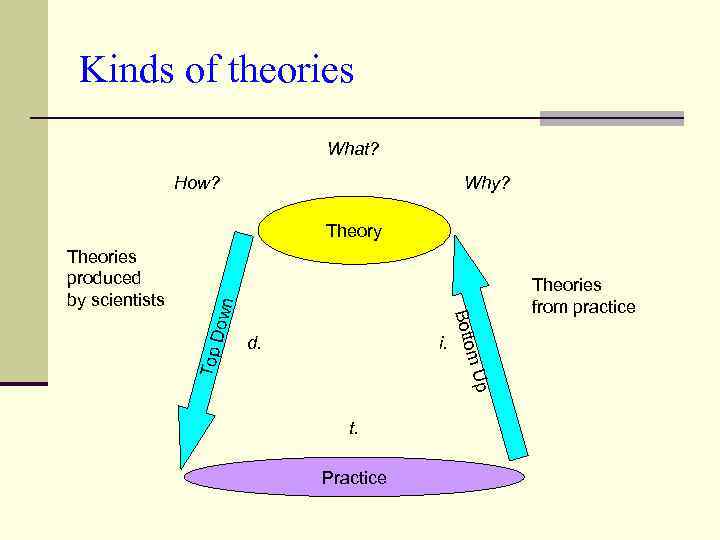 Kinds of theories What? How? Why? Dow i. m. U d. B ot t o Top Theories produced by scientists n Theory p t. Practice Theories from practice
 Reasoning ways (laws of logic) Induction (from specific observation to generalisation, bottom-up approach, complete and incomplete) Deduction (from general rule to more specific case or top-down approach) Traduction (same level of prerequisite and conclusion, i. e. specific-specific, analogy)
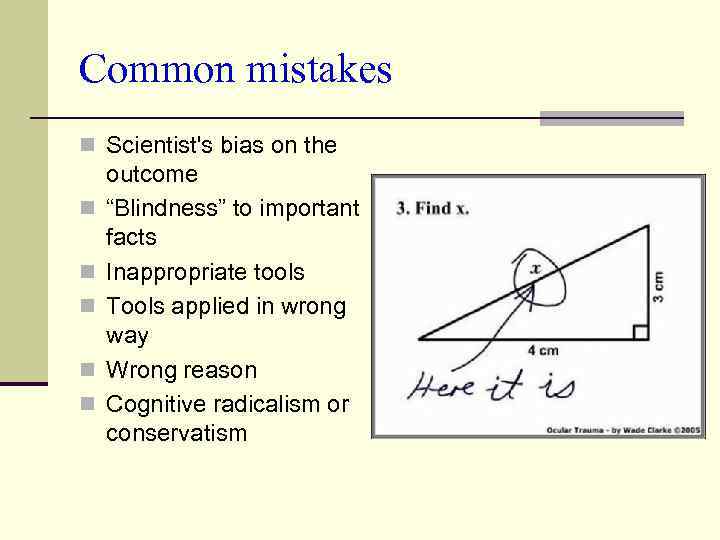 Common mistakes n Scientist's bias on the n n n outcome “Blindness” to important facts Inappropriate tools Tools applied in wrong way Wrong reason Cognitive radicalism or conservatism
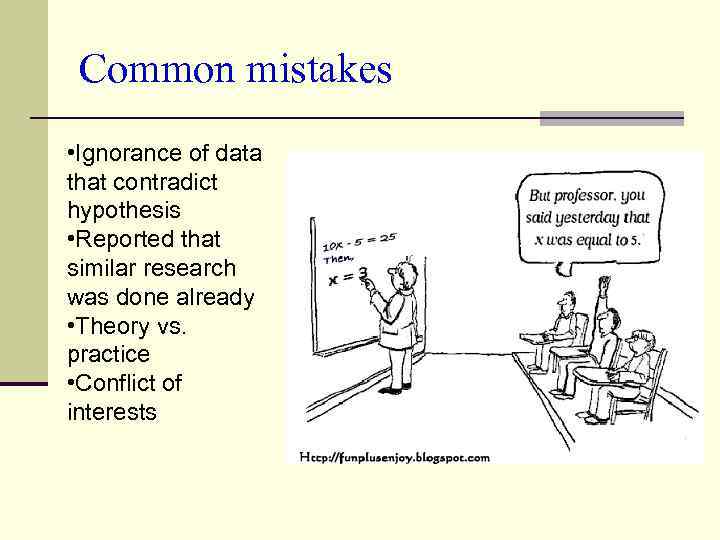 Common mistakes • Ignorance of data that contradict hypothesis • Reported that similar research was done already • Theory vs. practice • Conflict of interests
 Theory vs. practice “Darrow has concluded, after a life full of experience with criminals, "if doctors and scientists had been no wiser than lawyers, judges, legislatures and the public, the world would still be punishing imbeciles, the insane, the inferior and the sick; and treating human ailments with incantations, witchcraft, force and magic. We should still be driving devils out of the sick and into the swine. " Fowler V. Harper, 1927
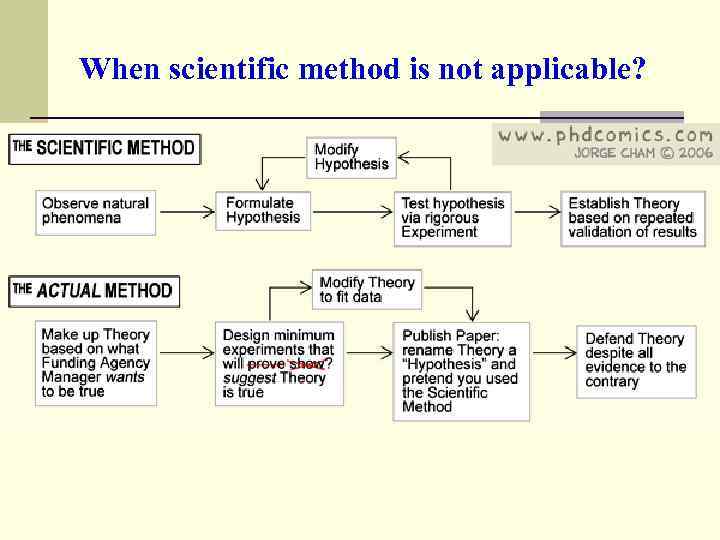 When scientific method is not applicable?
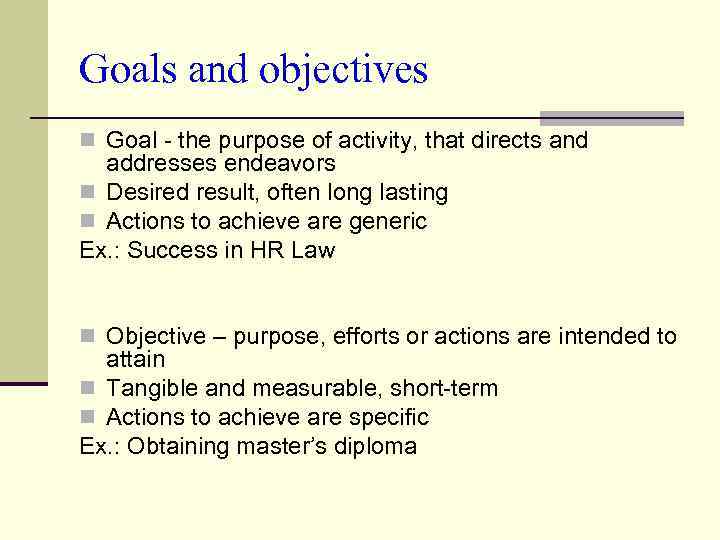 Goals and objectives n Goal - the purpose of activity, that directs and addresses endeavors n Desired result, often long lasting n Actions to achieve are generic Ex. : Success in HR Law n Objective – purpose, efforts or actions are intended to attain n Tangible and measurable, short-term n Actions to achieve are specific Ex. : Obtaining master’s diploma
 3 types of goals n Goals – tasks n Goals – demands n Goals – dreams
 5 more types of goals n To do n To have n To know n To treat n To be
 Models of analysis General purpose model n S. M. A. R. T. Specific models n S. W. O. T. n S. N. W. n V. R. I. O.
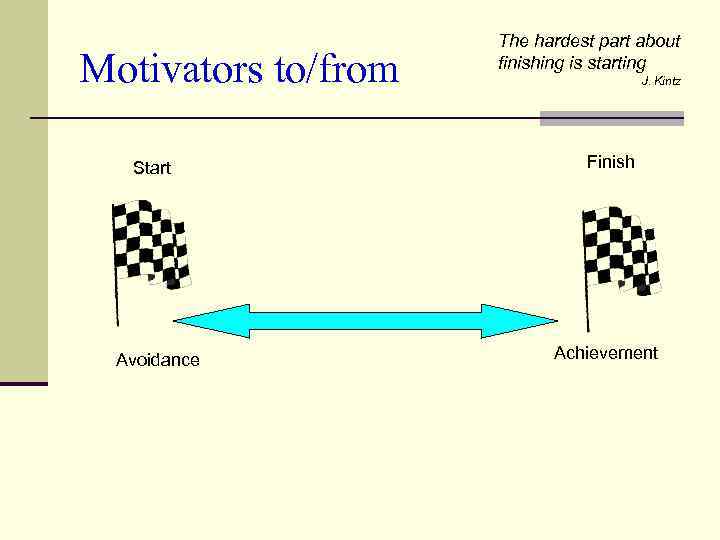 Motivators to/from Start Avoidance The hardest part about finishing is starting J. Kintz Finish Achievement
 Motivation 1. Decision Internal / external 2. Persistence Biological, emotional, social, cognitive factors 3. Intensity Concentration, efforts
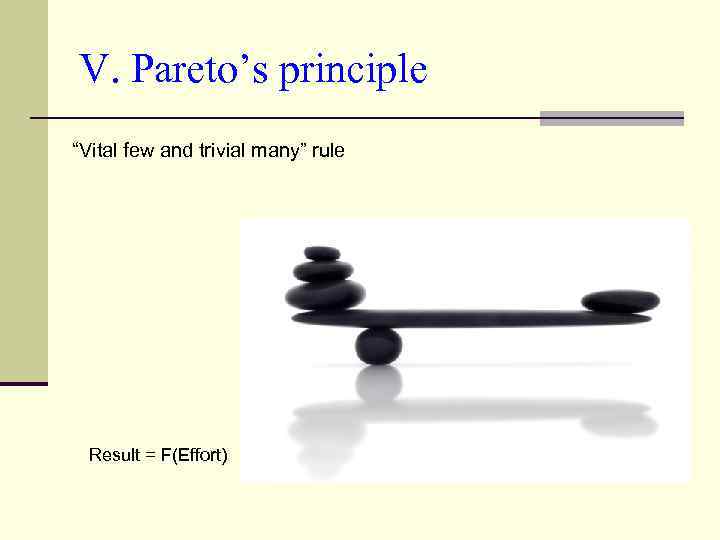 V. Pareto’s principle “Vital few and trivial many” rule Result = F(Effort)
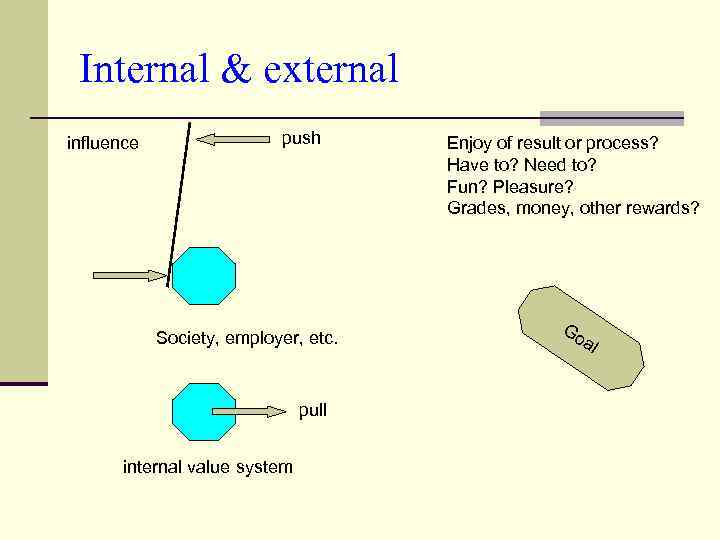 Internal & external influence push Society, employer, etc. pull internal value system Enjoy of result or process? Have to? Need to? Fun? Pleasure? Grades, money, other rewards? Go al
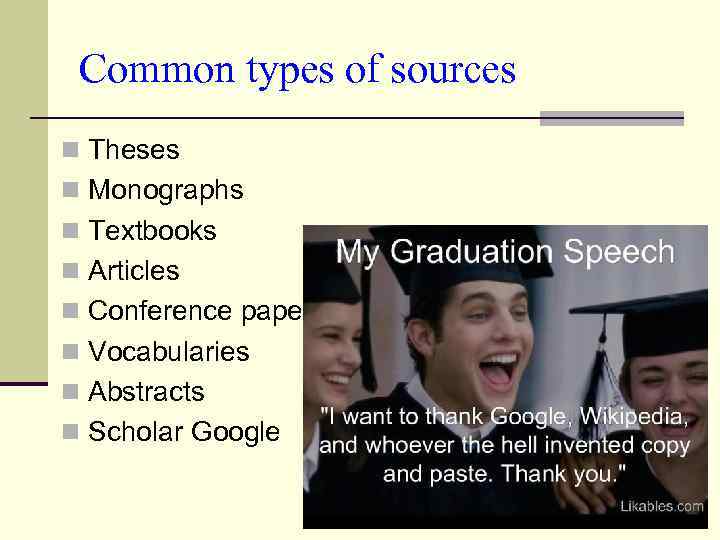 Common types of sources n Theses n Monographs n Textbooks n Articles n Conference papers n Vocabularies n Abstracts n Scholar Google
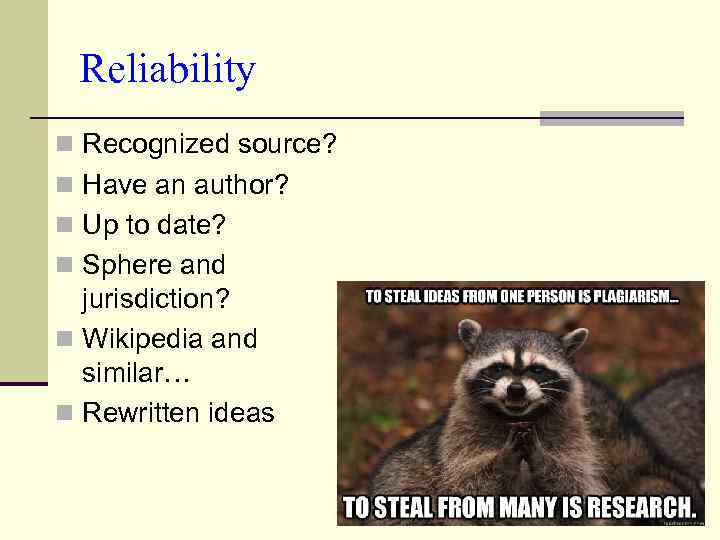 Reliability n Recognized source? n Have an author? n Up to date? n Sphere and jurisdiction? n Wikipedia and similar… n Rewritten ideas
 Techs n Follow the references n Supervisor’s help n Identify most relevant n Map sources n Keywords n ‘Main’ authors
 Nonverbal communication n Gestures n Body position n Expressions n Eye contact n Hands position n Dress n Time
 Active listening n To listen and to hear n Understanding n Intrest in. . . n Absence of estimation clarification n Pauses n Generalization n To listen vs. to speak n Information vs. emotions
 Is the time manageable? Time management is the process of planning activity that includes control of amount of time available for such activity. Goal – to increase effectiveness, efficiency or productivity. Time management system is a designed combination of processes, tools, techniques, and methods.
 We need to… n Set priorities n Carry activities around priorities set n Eliminate or exclude activities beyond the priorities n Organize time n Distribute resources n Organize people (teamwork) n Plan regularly
 Time to be organized Techniques of: n V. Pareto n D. Eisenhower n A. B. C. method n ‘Eat a frog’ n POSEC method n Grant’s diagram n S. Covey n GTD (D. Allen’s) n etc… “And in the end, it’s not the years in your life that count. It’s the life in your years. ” Abraham Lincoln
 C. Parkinson’s law “ 1001 tickets and 1 night” Student’s story The more time you have to complete the work, the more time you will use. Work expands to fill all time available for it. Productivity=1/Time
 24 hours You will have better sleep when you set alarm not for 6: 30, but for example… at the staircase… Techniques. What matters: n 30 min to plan n To deal with time-fillers n To run against the clock n Be organized n Behavior, not time n TM tools n Prioritization n Time in-between n Cut off n Rest
 24 hours Techniques. What matters: n Delegation n Time limits for tasks n Time pockets n Do-do lists vs. deadlines n Moment to decide n Target to be early n Reminders n Synergy of tasks n Unimportant details? n Focus on Big Rocks n Be accountable “A goal is a dream with a deadline. ” Napolean Hill
 Time to manage/waste n Motivation to/from n Orientation on process/result n Internal/external reference n 3 p’s By failing to plan, you are planning to fail.
 Law of Diminishing Returns Output = f (input) Increasing curve Point of satiety (!) Decreasing curve
 Group dynamics n Interaction n Within group n Verbal or not n Mutual ‘goal’
 Stages n Forming n Storming n Norming n Performing n Adjoining B. Tuckman
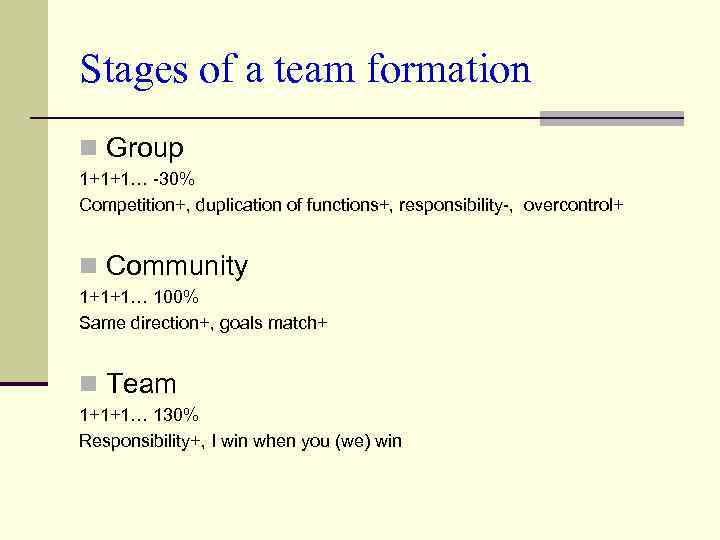 Stages of a team formation n Group 1+1+1… -30% Competition+, duplication of functions+, responsibility-, overcontrol+ n Community 1+1+1… 100% Same direction+, goals match+ n Team 1+1+1… 130% Responsibility+, I win when you (we) win
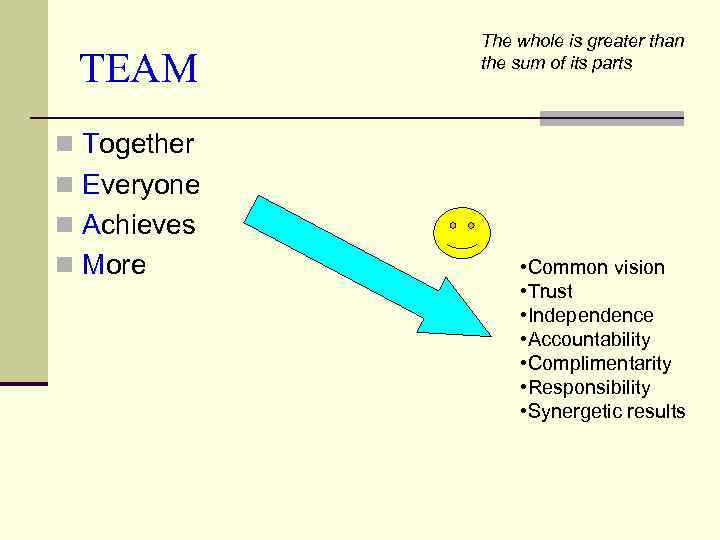 TEAM The whole is greater than the sum of its parts n Together n Everyone n Achieves n More • Common vision • Trust • Independence • Accountability • Complimentarity • Responsibility • Synergetic results
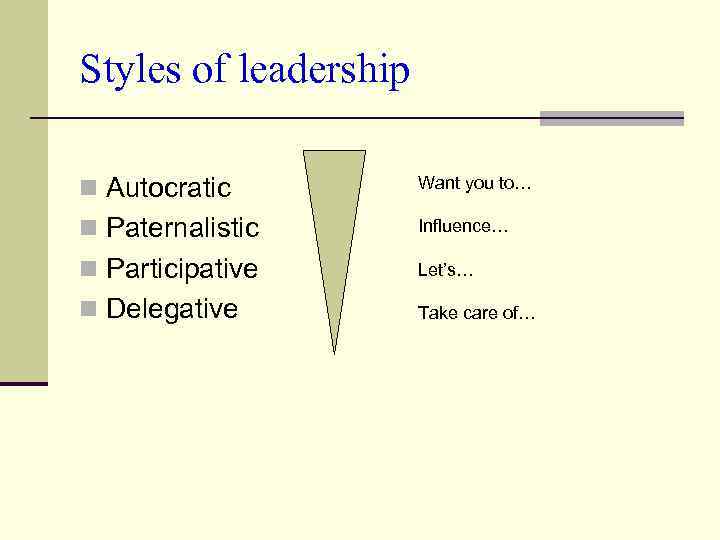 Styles of leadership n Autocratic Want you to… n Paternalistic Influence… n Participative Let’s… n Delegative Take care of…
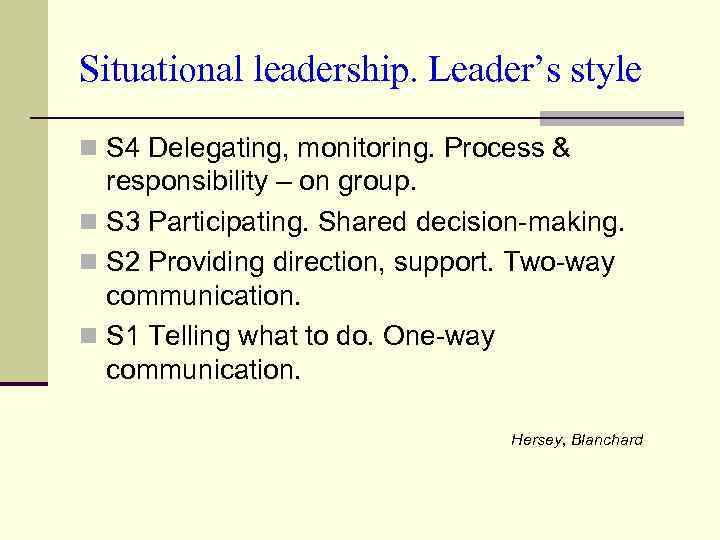 Situational leadership. Leader’s style n S 4 Delegating, monitoring. Process & responsibility – on group. n S 3 Participating. Shared decision-making. n S 2 Providing direction, support. Two-way communication. n S 1 Telling what to do. One-way communication. Hersey, Blanchard
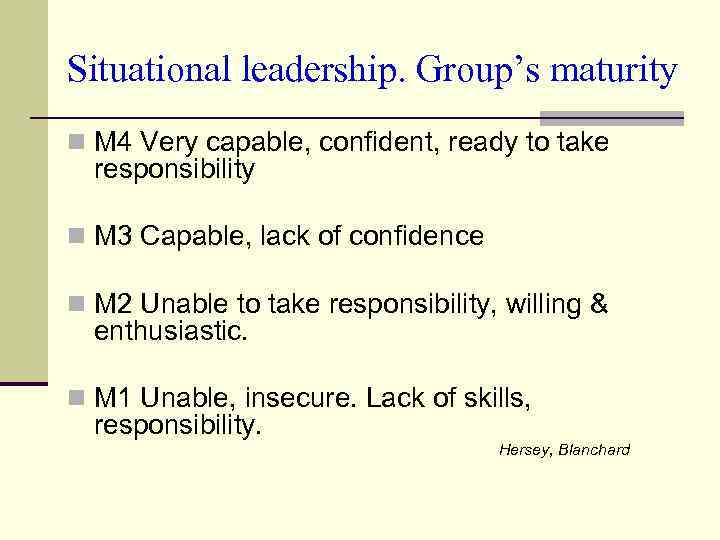 Situational leadership. Group’s maturity n M 4 Very capable, confident, ready to take responsibility n M 3 Capable, lack of confidence n M 2 Unable to take responsibility, willing & enthusiastic. n M 1 Unable, insecure. Lack of skills, responsibility. Hersey, Blanchard
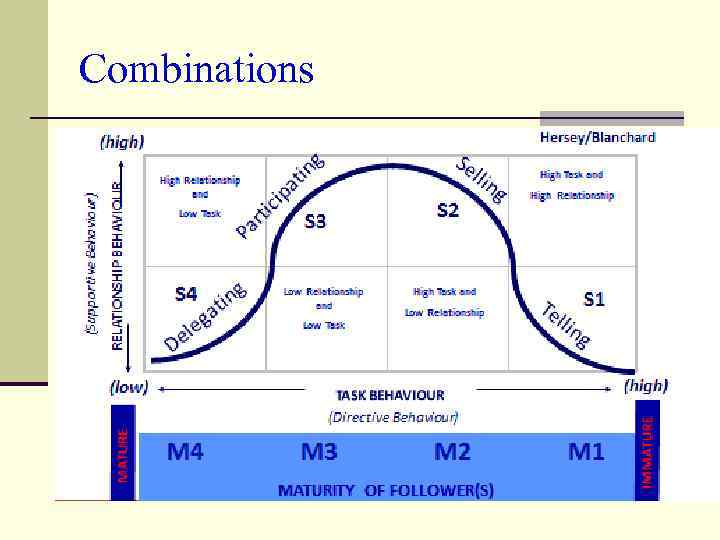 Combinations
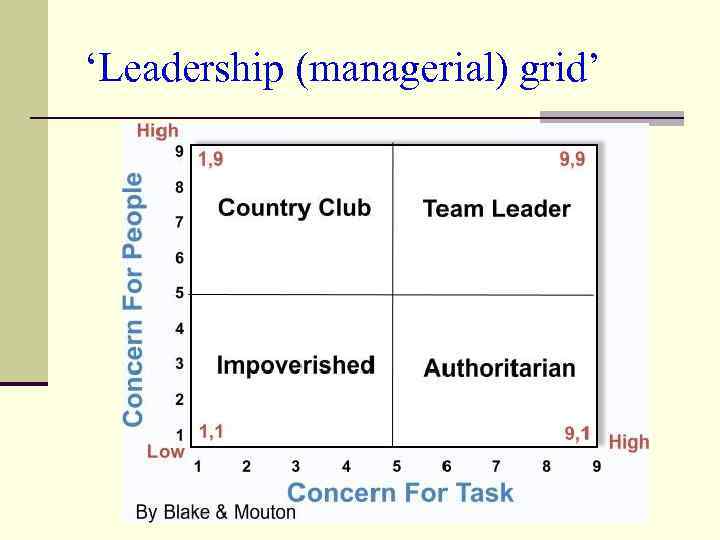 ‘Leadership (managerial) grid’