


 Скачать презентацию Methodology of RIA for European integration purposes and
5e01e2599788dd4c10109bf5d56f7267.ppt
- Количество слайдов: 130
 Methodology of RIA for European integration purposes and practical examples Training seminar for Bi. H institutions (state and entity level) organized by the Directorate of European Integration of Bi. H and EU support to DEI TA project 4 February 2011 (Friday, 9. 00 -15. 30) Parliamentary Assembly Building of Bi. H, Sarajevo Dr. Péter Futó Short term Expert, EU support to DEI TA project with intervention from Darius Žeruolis Key expert, EU support to DEI TA project
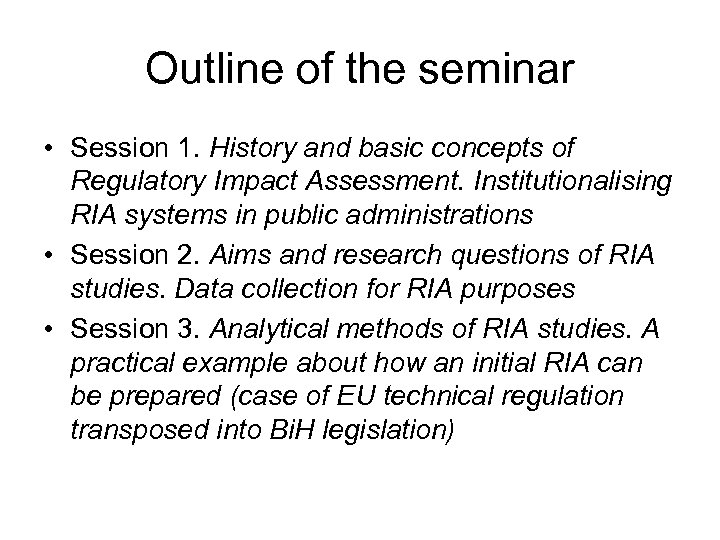 Outline of the seminar • Session 1. History and basic concepts of Regulatory Impact Assessment. Institutionalising RIA systems in public administrations • Session 2. Aims and research questions of RIA studies. Data collection for RIA purposes • Session 3. Analytical methods of RIA studies. A practical example about how an initial RIA can be prepared (case of EU technical regulation transposed into Bi. H legislation)
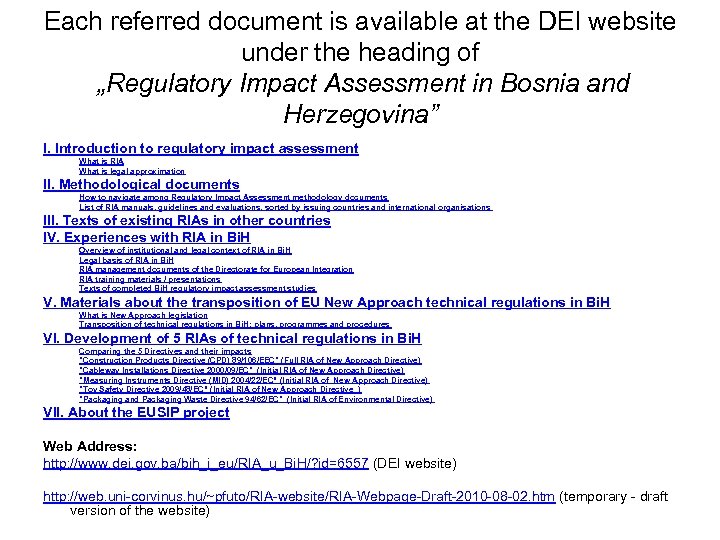 Each referred document is available at the DEI website under the heading of „Regulatory Impact Assessment in Bosnia and Herzegovina” I. Introduction to regulatory impact assessment What is RIA What is legal approximation II. Methodological documents How to navigate among Regulatory Impact Assessment methodology documents List of RIA manuals, guidelines and evaluations, sorted by issuing countries and international organisations III. Texts of existing RIAs in other countries IV. Experiences with RIA in Bi. H Overview of institutional and legal context of RIA in Bi. H Legal basis of RIA in Bi. H RIA management documents of the Directorate for European Integration RIA training materials / presentations Texts of completed Bi. H regulatory impact assessment studies V. Materials about the transposition of EU New Approach technical regulations in Bi. H What is New Approach legislation Transposition of technical regulations in Bi. H: plans, programmes and procedures VI. Development of 5 RIAs of technical regulations in Bi. H Comparing the 5 Directives and their impacts "Construction Products Directive (CPD) 89/106/EEC" (Full RIA of New Approach Directive) "Cableway Installations Directive 2000/09/EC" (Initial RIA of New Approach Directive) "Measuring Instruments Directive (MID) 2004/22/EC” (Initial RIA of New Approach Directive) "Toy Safety Directive 2009/48/EC” (Initial RIA of New Approach Directive ) "Packaging and Packaging Waste Directive 94/62/EC" (Initial RIA of Environmental Directive) VII. About the EUSIP project Web Address: http: //www. dei. gov. ba/bih_i_eu/RIA_u_Bi. H/? id=6557 (DEI website) http: //web. uni-corvinus. hu/~pfuto/RIA-website/RIA-Webpage-Draft-2010 -08 -02. htm (temporary - draft version of the website)
 Session 1. History and basic concepts of Regulatory Impact Assessment Definition of RIA in the framework of regulatory management Preparation of an individual RIA: the question of template Main concepts of RIA Policy area specific types of impacts Comparing impacts under various regulatory options or scenarios From initial to full RIA
 Definition What is Regulatory Impact Assessment (RIA)? RIA is a fact based analysis which is used as a systematic decision tool in public administrations in order to examine and measure the likely – benefits, – costs, – risks, – competition effects, – distributional effects of new or existing regulation.
 RIA in the framework of regulatory management Uses of RIA • supports the process of policy making by empirical data • considers potential economic impacts of regulatory proposals • assists governments to make their policies more efficient • improves regulatory quality Application areas of RIA: • Supporting ongoing regulatory policy • Facilitating deregulation campaigns, (“Regulatory Guillotine”) • Supporting legal harmonisation with the European Union.
 What is regulatory quality Aims of Better Regulation Policy • Transparent rule-making process, consultation and communication with the public • Both compliance and enforcement should be feasible • Benefits of regulations should justify costs • Regulations should improve business environment, should enhance “ease of doing business” (measured by World Bank) • Decrease of administrative burdens • Support SMEs
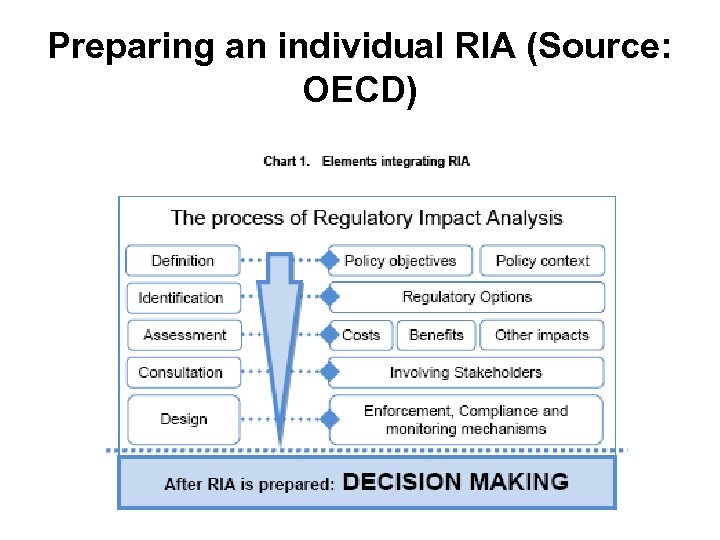 Preparing an individual RIA (Source: OECD)
 RIA Checklist Source: Page i of UK Guide to RIA: Better Policy Making: A Guide to Regulatory Impact Assessment. UK Government, London 2003.
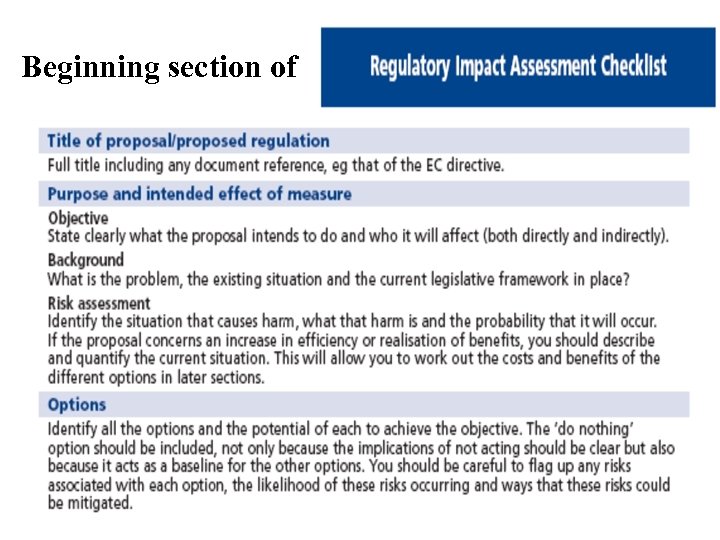 Beginning section of
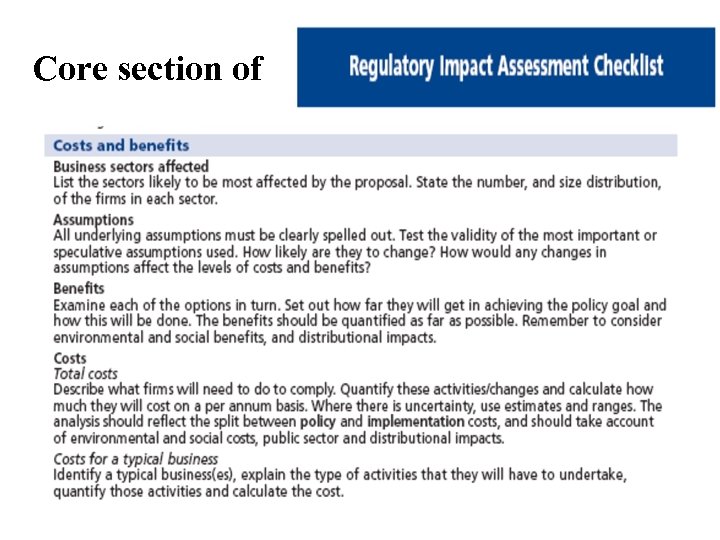 Core section of
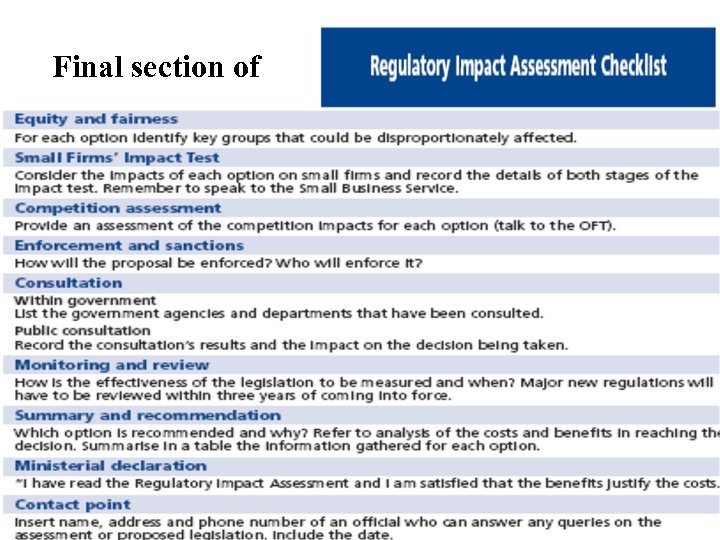 Final section of
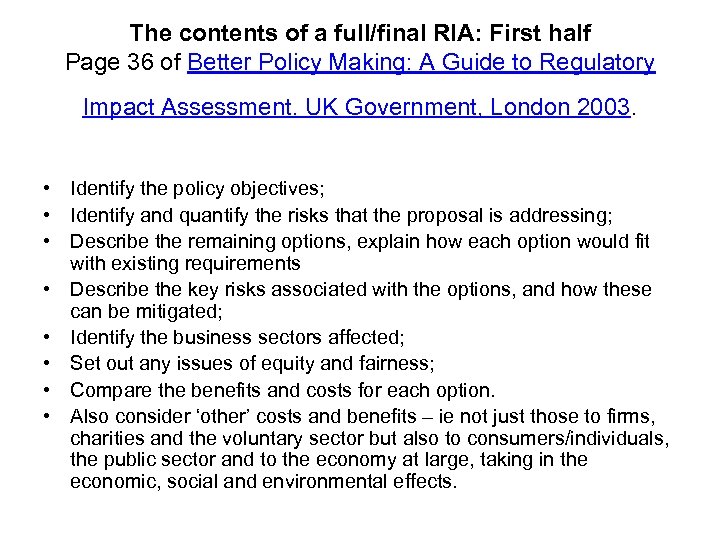 The contents of a full/final RIA: First half Page 36 of Better Policy Making: A Guide to Regulatory Impact Assessment. UK Government, London 2003. • Identify the policy objectives; • Identify and quantify the risks that the proposal is addressing; • Describe the remaining options, explain how each option would fit with existing requirements • Describe the key risks associated with the options, and how these can be mitigated; • Identify the business sectors affected; • Set out any issues of equity and fairness; • Compare the benefits and costs for each option. • Also consider ‘other’ costs and benefits – ie not just those to firms, charities and the voluntary sector but also to consumers/individuals, the public sector and to the economy at large, taking in the economic, social and environmental effects.
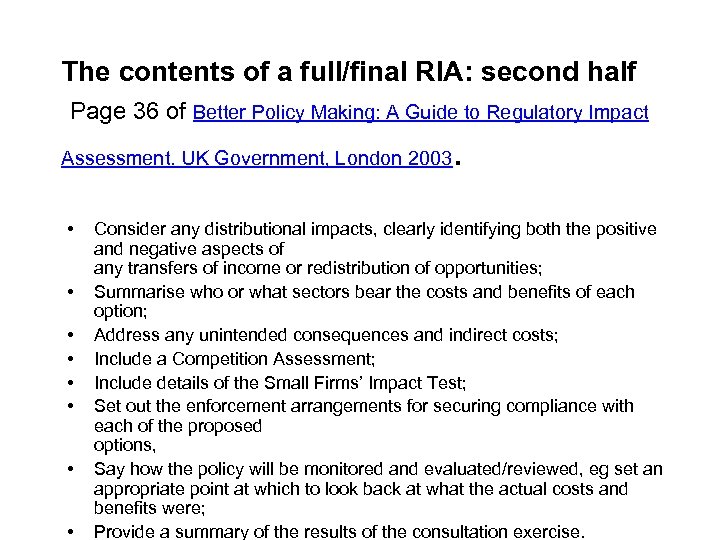 The contents of a full/final RIA: second half Page 36 of Better Policy Making: A Guide to Regulatory Impact Assessment. UK Government, London 2003 • • . Consider any distributional impacts, clearly identifying both the positive and negative aspects of any transfers of income or redistribution of opportunities; Summarise who or what sectors bear the costs and benefits of each option; Address any unintended consequences and indirect costs; Include a Competition Assessment; Include details of the Small Firms’ Impact Test; Set out the enforcement arrangements for securing compliance with each of the proposed options, Say how the policy will be monitored and evaluated/reviewed, eg set an appropriate point at which to look back at what the actual costs and benefits were; Provide a summary of the results of the consultation exercise.
 In case of technical regulations, the procedure of preparing the RIA report looks like this:
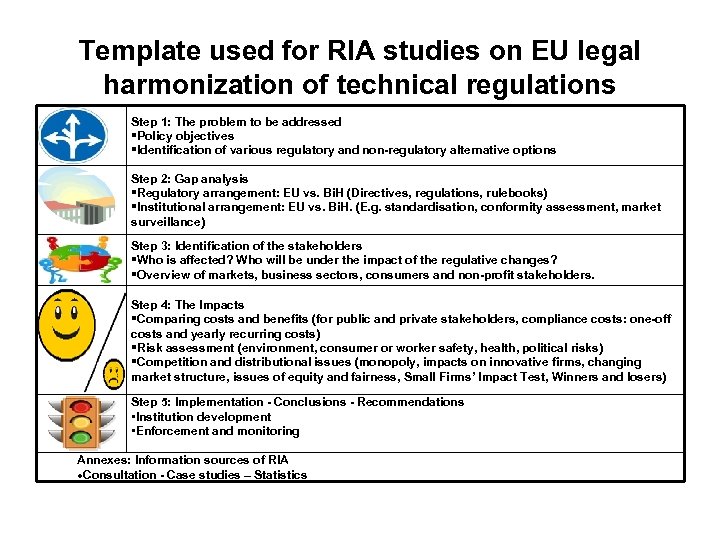 Template used for RIA studies on EU legal harmonization of technical regulations Step 1: The problem to be addressed Policy objectives Identification of various regulatory and non-regulatory alternative options Step 2: Gap analysis Regulatory arrangement: EU vs. Bi. H (Directives, regulations, rulebooks) Institutional arrangement: EU vs. Bi. H. (E. g. standardisation, conformity assessment, market surveillance) Step 3: Identification of the stakeholders Who is affected? Who will be under the impact of the regulative changes? Overview of markets, business sectors, consumers and non-profit stakeholders. Step 4: The Impacts Comparing costs and benefits (for public and private stakeholders, compliance costs: one-off costs and yearly recurring costs) Risk assessment (environment, consumer or worker safety, health, political risks) Competition and distributional issues (monopoly, impacts on innovative firms, changing market structure, issues of equity and fairness, Small Firms’ Impact Test, Winners and losers) Step 5: Implementation - Conclusions - Recommendations • Institution development • Enforcement and monitoring Annexes: Information sources of RIA Consultation - Case studies – Statistics
 Main concepts of RIA • Policy objectives and alternatives • Regulatory scenarios / options, cause and effect paradigm, counterfactual scenario • Regulatory and non-regulatory responses to existing challenges /problems • Regulatory and institutional gaps, gap analysis • Stakeholders, stakeholder consultation, winners and losers • Compliance and enforcement • Monitoring and evaluation • A basic typology of regulatory impacts: – – – costs, benefits risks, competition issues distributional issues
 Policy-area-specific types of impacts Assessing economic, social and environmental impacts. • Impacts on international trade and cross-border investments. • Impacts on firms in terms of investment, operating costs, products and services. • Impacts on technological development and innovation. • Impacts on the number and the quality of jobs. • Impacts on SME's. • Impacts on public authorities. • Macroeconomic impacts. • Impacts on consumers.
 Comparing impacts under various regulatory options or “scenarios” How does RIA identify the impacts of regulations? By comparing the implications of various options, the so-called “scenarios”. • Baseline option: the scenario of “doing nothing” i. e. abstaining from the regulation • Other possible options: 1. introducing the regulation (a) partially or (b) fully 2. introducing the regulation (a) immediately or (b) later 3. Substituting the regulation by non-regulatory tools, e. g. (a) through self-regulation of companies through chambers of commerce or (b) through subsidies RIA identifies impacts of the regulation by comparing the impacts of all regulatory options with the impacts of the baseline scenario (“Doing nothing”).
 From initial to full RIA Decision makers need quick information at the early stage of the policy process. In various governments and international organizations a need for early version of RIA has emerged. Methodologies have been elaborated for initial and preliminary RIA • in the UK Government • in the EU Commission. Features of simplified RIA (if compared to Final / Full / Deep RIA) • Reaches lower levels of Government • RIA report is shorter than full RIA • Relies only on readily available information, contains less statistical and less exact information, • Impacts are not as deeply elaborated as in full RIA • Justification of findings may be less convincing than in full RIA • Contains more RIA management information (timing, dissemination, co-operation needs, consultation efforts, further information to be collected, etc. ) But timely: simplified RIA arrives in good time to all concerned parties.
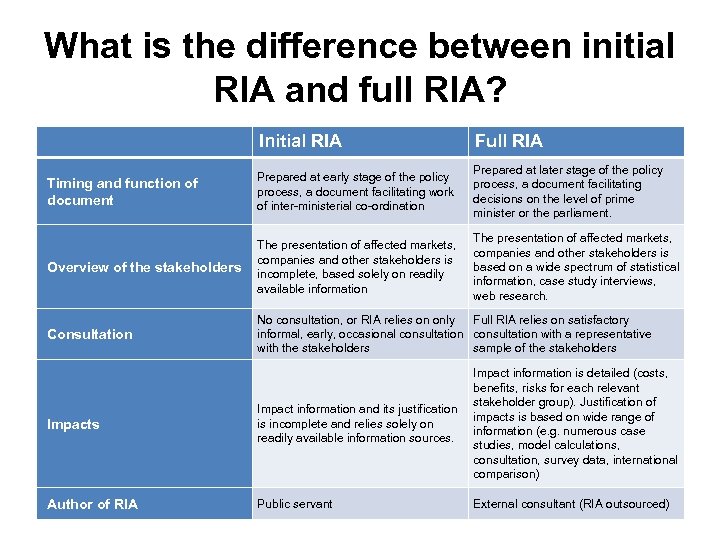 What is the difference between initial RIA and full RIA? Initial RIA Full RIA Timing and function of document Prepared at early stage of the policy process, a document facilitating work of inter-ministerial co-ordination Prepared at later stage of the policy process, a document facilitating decisions on the level of prime minister or the parliament. Overview of the stakeholders The presentation of affected markets, companies and other stakeholders is incomplete, based solely on readily available information The presentation of affected markets, companies and other stakeholders is based on a wide spectrum of statistical information, case study interviews, web research. Consultation No consultation, or RIA relies on only Full RIA relies on satisfactory informal, early, occasional consultation with a representative with the stakeholders sample of the stakeholders Impact information and its justification is incomplete and relies solely on readily available information sources. Impact information is detailed (costs, benefits, risks for each relevant stakeholder group). Justification of impacts is based on wide range of information (e. g. numerous case studies, model calculations, consultation, survey data, international comparison) Author of RIA Public servant External consultant (RIA outsourced)
 Session 1. Institutionalising RIA systems in public administrations
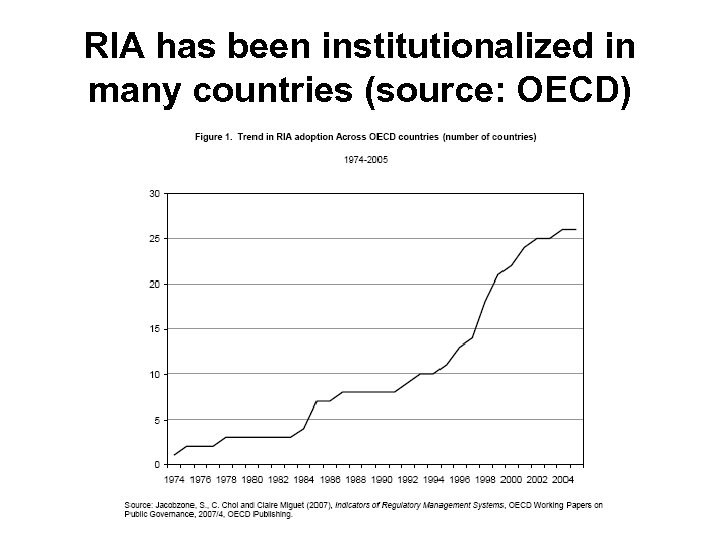 RIA has been institutionalized in many countries (source: OECD)
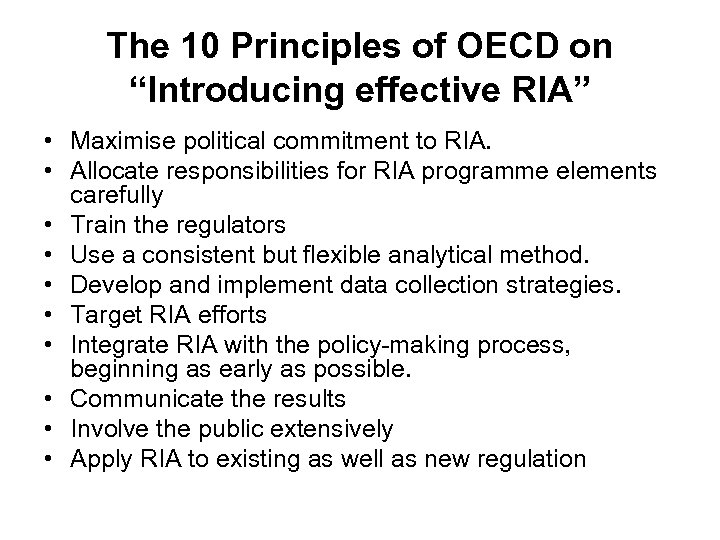 The 10 Principles of OECD on “Introducing effective RIA” • Maximise political commitment to RIA. • Allocate responsibilities for RIA programme elements carefully • Train the regulators • Use a consistent but flexible analytical method. • Develop and implement data collection strategies. • Target RIA efforts • Integrate RIA with the policy-making process, beginning as early as possible. • Communicate the results • Involve the public extensively • Apply RIA to existing as well as new regulation
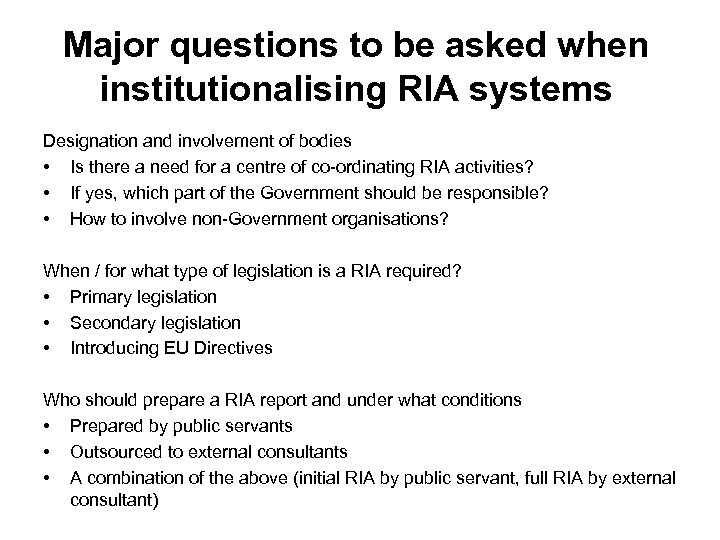 Major questions to be asked when institutionalising RIA systems Designation and involvement of bodies • Is there a need for a centre of co-ordinating RIA activities? • If yes, which part of the Government should be responsible? • How to involve non-Government organisations? When / for what type of legislation is a RIA required? • Primary legislation • Secondary legislation • Introducing EU Directives Who should prepare a RIA report and under what conditions • Prepared by public servants • Outsourced to external consultants • A combination of the above (initial RIA by public servant, full RIA by external consultant)
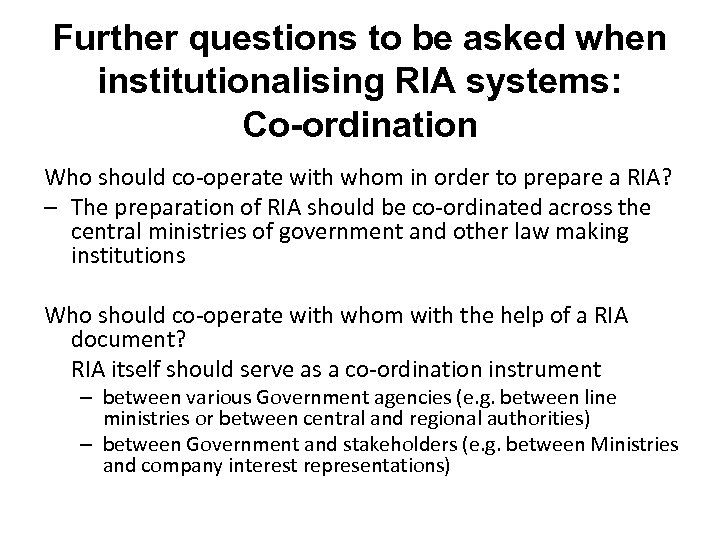 Further questions to be asked when institutionalising RIA systems: Co-ordination Who should co-operate with whom in order to prepare a RIA? – The preparation of RIA should be co-ordinated across the central ministries of government and other law making institutions Who should co-operate with whom with the help of a RIA document? RIA itself should serve as a co-ordination instrument – between various Government agencies (e. g. between line ministries or between central and regional authorities) – between Government and stakeholders (e. g. between Ministries and company interest representations)
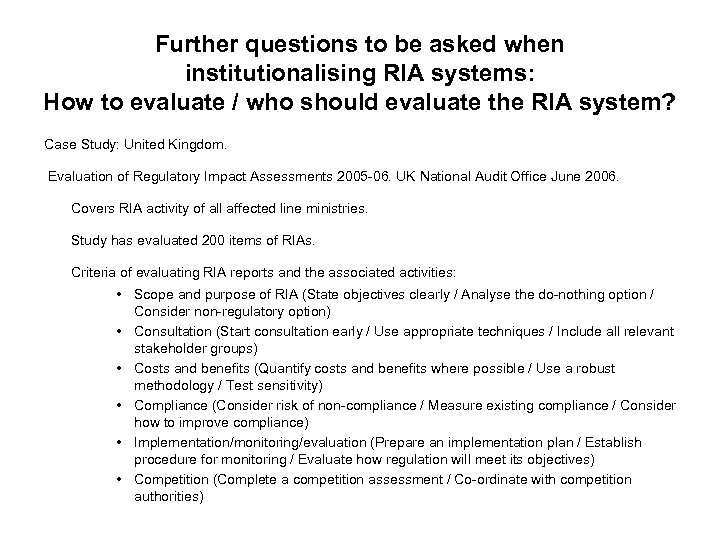 Further questions to be asked when institutionalising RIA systems: How to evaluate / who should evaluate the RIA system? Case Study: United Kingdom. Evaluation of Regulatory Impact Assessments 2005 -06. UK National Audit Office June 2006. Covers RIA activity of all affected line ministries. Study has evaluated 200 items of RIAs. Criteria of evaluating RIA reports and the associated activities: • Scope and purpose of RIA (State objectives clearly / Analyse the do-nothing option / Consider non-regulatory option) • Consultation (Start consultation early / Use appropriate techniques / Include all relevant stakeholder groups) • Costs and benefits (Quantify costs and benefits where possible / Use a robust methodology / Test sensitivity) • Compliance (Consider risk of non-compliance / Measure existing compliance / Consider how to improve compliance) • Implementation/monitoring/evaluation (Prepare an implementation plan / Establish procedure for monitoring / Evaluate how regulation will meet its objectives) • Competition (Complete a competition assessment / Co-ordinate with competition authorities)
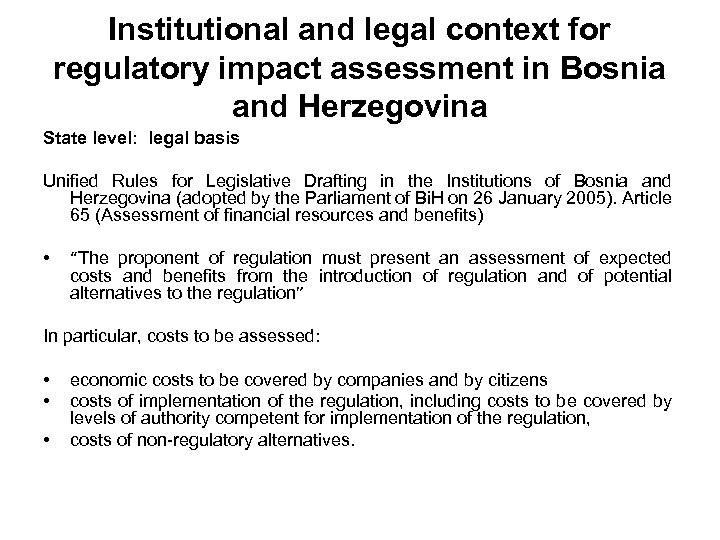 Institutional and legal context for regulatory impact assessment in Bosnia and Herzegovina State level: legal basis Unified Rules for Legislative Drafting in the Institutions of Bosnia and Herzegovina (adopted by the Parliament of Bi. H on 26 January 2005). Article 65 (Assessment of financial resources and benefits) • “The proponent of regulation must present an assessment of expected costs and benefits from the introduction of regulation and of potential alternatives to the regulation” In particular, costs to be assessed: • • • economic costs to be covered by companies and by citizens costs of implementation of the regulation, including costs to be covered by levels of authority competent for implementation of the regulation, costs of non-regulatory alternatives.
 Bi. H state level RIA efforts - 1 RIA activity still project-like and non institutionalized. Ministry of Justice of Bi. H oversees how the Unified Rules for Legislative Drafting are implemented. Ministry of Foreign Trade and Economic Relations (Mo. FTER) • produced three pilot full RIA studies, five more are under discussion • the Department for Trade Relations and European Integration has plans to institutionalise responsibility for better regulation policy and measurement of administrative burden
 Bi. H state level RIA efforts – 2 Directorate for European Integration • Book of Rules of the Directorate for European Integration, Article 6. (1 November 2010): • „Division for Strategy and Integration Policies of DEI is responsible for co-operation with the Division for Harmonisation of the Bi. H Legal System with the Acquis Communautaire [of DEI] in conducting the regulatory impact assessments in the fields that are to be or are already harmonised. ” • DEI has a function for co-ordination. Initiatives made: – training on RIA in 2005 for line institutions, – four pilot full RIA studies in 2007, – conference on RIA in Bi. H Parliamentary Assembly in November 2007
 Bosnia Herzegovina: specific RIA studies prepared on state level RIA studies commissioned by DEI in 2007 • RIA on Free Economic Zones • RIA on Bologna Declaration • RIA on ATEX Directive • RIA on Regional Classification
 Bosnia Herzegovina: specific RIA studies prepared on state level RIA studies commissioned by Mo. FTER between 2008 and 2010 • RIA on Implementation of Machinery Directive in Bi. H. • RIA on implementation of Low Voltage Directive in Bi. H • RIA on Foreign Direct Investment Policy laws (Bi. H Official Bulletin 17/98 and 13/03) • RIAs prepared by EUSIP Project – "Construction Products Directive (CPD) 89/106/EEC" (Full RIA of New Approach Directive) – "Cableway Installations Directive 2000/09/EC" (Initial RIA of New Approach Directive) – "Measuring Instruments Directive (MID) 2004/22/EC” (Initial RIA of New Approach Directive) – "Toy Safety Directive 2009/48/EC” (Initial RIA of New Approach Directive ) – "Packaging and Packaging Waste Directive 94/62/EC" (Initial RIA of Environmental Directive
 Entity level: Republic of Srpska (RS) 2007: Department of Regulatory Impact Analysis within the Ministry of Economic Relations and Regional Co-operation was established. Since 2009: all proponents of legislation by the Government of Republic of Srpska are required to obtain opinion of this Department as regards the impact of new regulatory measures, permits and approvals affecting business. 2010: drafting a Strategy of Regulatory Reform in Republic of Srpska for 2011 -2015. It envisages further institutionalization of RIA, and to ask all proponents to prepare initial/basic RIAs for all draft legislation and extended/full RIAs for systemic legislation with potentially significant economic, social and environment impact.
 Results of RIA activity in the Republika Srpska 2006: “Regulatory Guillotine” project. Result: single business register of formalities and inspection related measures was created by the Ministry of Economic Relations and Regional Co-operation of Republic of Srpska. (www. regodobrenja. net). RIA studies commissioned by the Department of RIA of the Ministry for Economic Relation and Regional Cooperation of Republic of Srpska • 2007: RIA on Draft Law of Spas, • 2007: RIA on Draft Law on Tourist Fees. • 2009 -2010: ongoing RIA research on the draft Law on Labour.
 Entity level: Federation of Bosnia and Herzegovina (FBi. H) Consultations on launching RIA activity between the Government of FBIH and International Financial Corporation /World Bank Discussions about creating a unit for RIA /regulatory policy within the Office of Prime Minister of FBi. H.
 Municipal level IFC/WB is working with 8 municipalities in both entities on regulatory policy, implementability of local mesures Scope: • Assessment of concrete instances of proposed legislation • Implementation aspects of adopted legislation (for example, construction permits, licences for businesses, taxes)
 External stakeholders of RIA in Bi. H Much of the RIA effort and production in Bi. H so far has been either driven by external stakeholders or produced with their financial assistance. Projects and project organisations of international organisations: • EU support to DEI, • EUSIP, • EU Technical Assistance project on trade policy • UNDP project for Strategic Planning and Policy Development (SPPD) • International Financial Corporation (IFC)/World Bank
 Questions and answers
 Session 2: Aims and research questions of RIA studies
 RIA genre to be selected according to aim of RIA research. RIA aim is defined: By the policy area which has issued the regulation • The regulation of product markets, free movement of goods, conformity of products, technical regulations • Health and Safety • Trade policy • Business development policy • Environment protection policy • Labour / Social policy • Etc. By stakeholder scope • Focus on effects on companies / small businesses / business environment • Focus on implementing agencies / fiscal effects • Focus on consumers / social groups • Focus on effects on environment (future generations) • Focus on one single company (Company Level RIA) • Focus on all of the above stakeholders / implications
 RIA aim is further defined: By geographical scope • Single country RIA • Comparative RIA • EU-wide RIA By speed of preparation and depth of analysis • Initial RIA • Partial RIA • Full RIA By whether RIA report is prepared before or after regulation is in force • Ex ante RIA • Ex post RIA
 Contrasting RIA with other genres of research / consultancy Difference is in scope of measures of which the impact is assessed • Impact Assessment: analyses the impacts of all kind of “measures”: regulations, policies, decisions, programmes, etc. • Regulatory Impact Assessment: analyses only the impacts of regulations. Difference is in method of analysis • Impact Assessment: works with scenarios. “What would happen if? ”, “What would have happened if not? ” • Evaluation: works with criteria. To what extent is it relevant, efficient, effective, far reaching, sustainable?
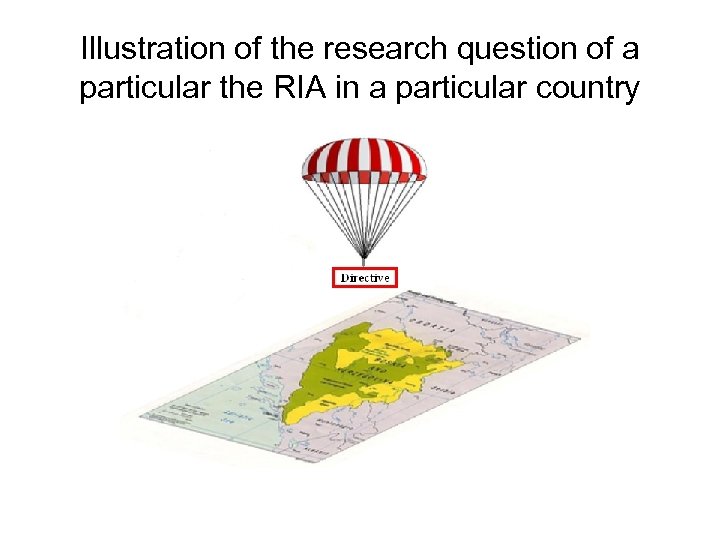 Illustration of the research question of a particular the RIA in a particular country
 But let us focus on RIAs of technical regulations Case study: 5 RIAs on EU technical regulations made by EUSIP Project in 2010
 RIA preparation always begins with legal and institutional analysis Examples of research questions: • Which group of regulations does the directive belong to? (New Approach, Old Approach, Quasi-New Approach, etc. ) • What is the range of applicable technical specifications? (Standards, European technical Approvals, etc. ) • What is the status of applicable technical specifications? (Mandatory / voluntary) • Scope: What is the range of products / phenomena covered by the Directive? • What are the essential requirements? • Which institutions are active in the enforcement?
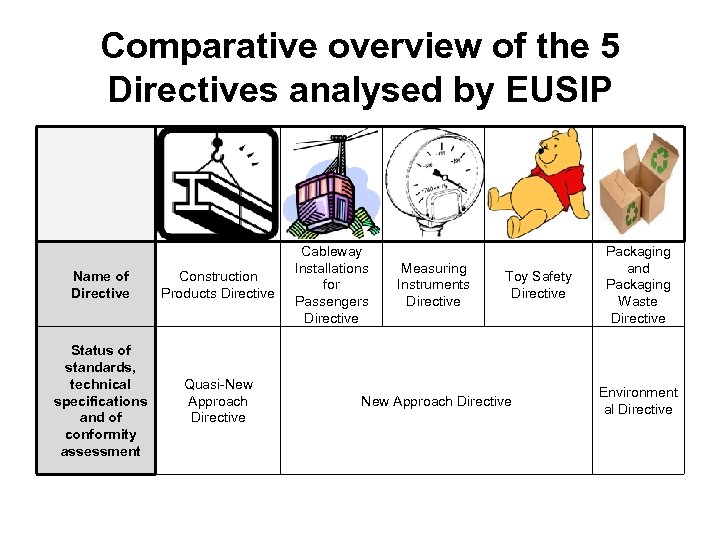 Comparative overview of the 5 Directives analysed by EUSIP Name of Directive Construction Products Directive Status of standards, technical specifications and of conformity assessment Quasi-New Approach Directive Cableway Installations for Passengers Directive Measuring Instruments Directive Toy Safety Directive New Approach Directive Packaging and Packaging Waste Directive Environment al Directive
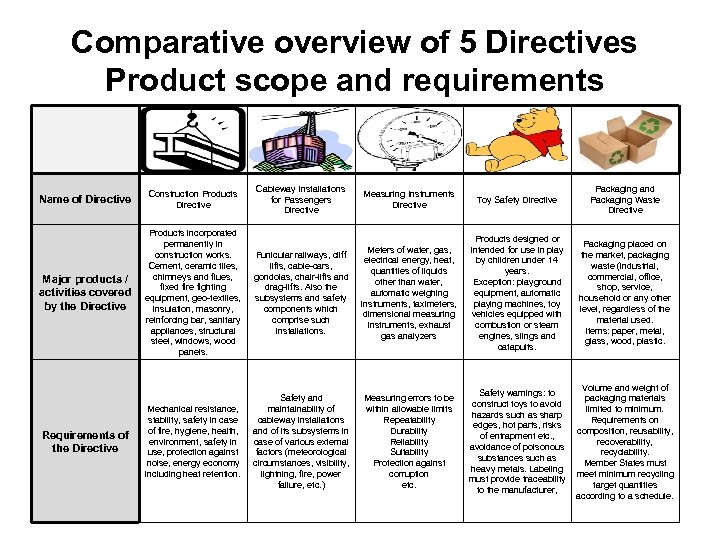 Comparative overview of 5 Directives Product scope and requirements Cableway Installations for Passengers Directive Measuring Instruments Directive Toy Safety Directive Packaging and Packaging Waste Directive Products incorporated permanently in construction works. Cement, ceramic tiles, chimneys and flues, fixed fire fighting equipment, geo-textiles, insulation, masonry, reinforcing bar, sanitary appliances, structural steel, windows, wood panels. Funicular railways, cliff lifts, cable-cars, gondolas, chair-lifts and drag-lifts. Also the subsystems and safety components which comprise such installations. Meters of water, gas, electrical energy, heat, quantities of liquids other than water, automatic weighing instruments, taximeters, dimensional measuring instruments, exhaust gas analyzers Products designed or intended for use in play by children under 14 years. Exception: playground equipment, automatic playing machines, toy vehicles equipped with combustion or steam engines, slings and catapults. Packaging placed on the market, packaging waste (industrial, commercial, office, shop, service, household or any other level, regardless of the material used. Items: paper, metal, glass, wood, plastic. Mechanical resistance, stability, safety in case of fire, hygiene, health, environment, safety in use, protection against noise, energy economy including heat retention. Safety and maintainability of cableway installations and of its subsystems in case of various external factors (meteorological circumstances, visibility, lightning, fire, power failure, etc. ) Measuring errors to be within allowable limits Repeatability Durability Reliability Suitability Protection against corruption etc. Volume and weight of Safety warnings: to packaging materials construct toys to avoid limited to minimum. hazards such as sharp Requirements on edges, hot parts, risks composition, reusability, of entrapment etc. , recoverability, avoidance of poisonous recyclability. substances such as Member States must heavy metals. Labeling meet minimum recycling must provide traceability target quantities to the manufacturer, according to a schedule. Name of Directive Construction Products Directive Major products / activities covered by the Directive Requirements of the Directive
 Status and scope of technical specifications
 Conformity assessment and market surveillance
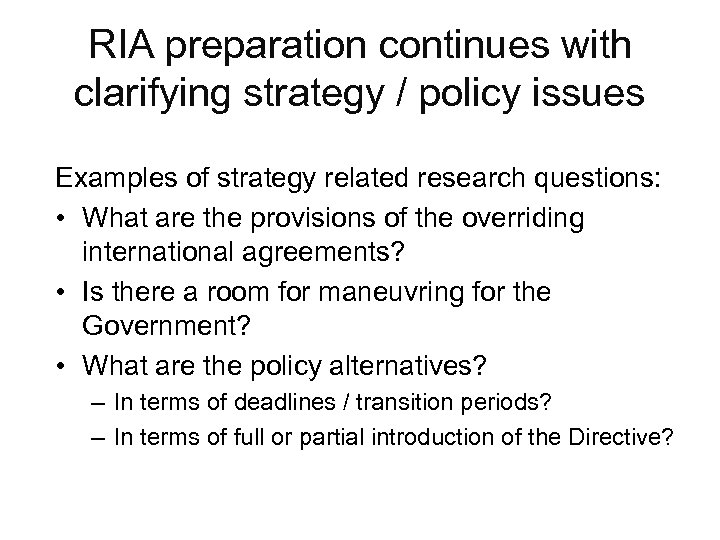 RIA preparation continues with clarifying strategy / policy issues Examples of strategy related research questions: • What are the provisions of the overriding international agreements? • Is there a room for maneuvring for the Government? • What are the policy alternatives? – In terms of deadlines / transition periods? – In terms of full or partial introduction of the Directive?
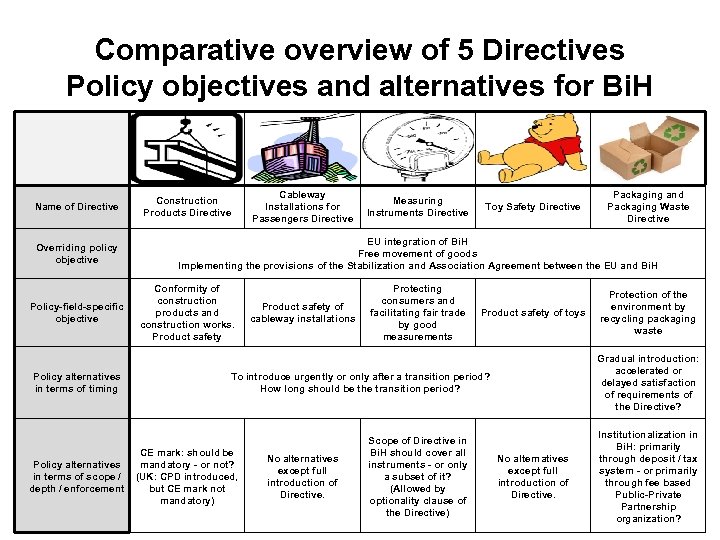 Comparative overview of 5 Directives Policy objectives and alternatives for Bi. H Name of Directive Overriding policy objective Policy-field-specific objective Policy alternatives in terms of timing Policy alternatives in terms of scope / depth / enforcement Construction Products Directive Cableway Installations for Passengers Directive Measuring Instruments Directive Toy Safety Directive Packaging and Packaging Waste Directive EU integration of Bi. H Free movement of goods Implementing the provisions of the Stabilization and Association Agreement between the EU and Bi. H Conformity of construction products and construction works. Product safety of cableway installations Protecting consumers and facilitating fair trade by good measurements Product safety of toys Gradual introduction: accelerated or delayed satisfaction of requirements of the Directive? To introduce urgently or only after a transition period? How long should be the transition period? CE mark: should be mandatory - or not? (UK: CPD introduced, but CE mark not mandatory) No alternatives except full introduction of Directive. Scope of Directive in Bi. H should cover all instruments - or only a subset of it? (Allowed by optionality clause of the Directive) Protection of the environment by recycling packaging waste No alternatives except full introduction of Directive. Institutionalization in Bi. H: primarily through deposit / tax system - or primarily through fee based Public-Private Partnership organization?
 Next step of RIA preparation: the relevance of the Directive must be clarified Examples of relevance related research questions: • Why and to what extent is the Directive important for Bi. H? • Volume of production, export, import consumption and investment of products within the scope of the Directive in Bi. H. • Number and employment of companies dealing with products within the scope of the Directive in Bi. H. • Structure of sectors affected by the introduction of the Directive in Bi. H.
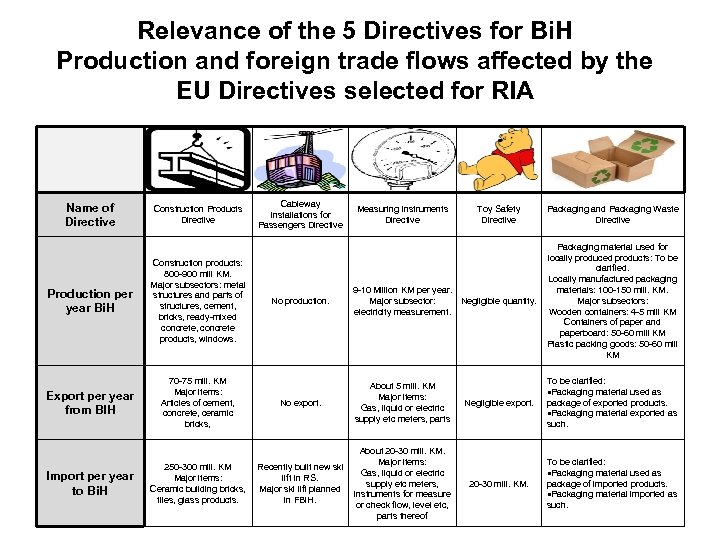 Relevance of the 5 Directives for Bi. H Production and foreign trade flows affected by the EU Directives selected for RIA Name of Directive Construction Products Directive Production per year Bi. H Construction products: 800 -900 mill KM. Major subsectors: metal structures and parts of structures, cement, bricks, ready-mixed concrete, concrete products, windows. Export per year from BIH 70 -75 mill. KM Major items: Articles of cement, concrete, ceramic bricks, Import per year to Bi. H Cableway Installations for Passengers Directive No production. No export. Measuring Instruments Directive Toy Safety Directive Packaging and Packaging Waste Directive 9 -10 Million KM per year. Major subsector: Negligible quantity. electricity measurement. Packaging material used for locally produced products: To be clarified. Locally manufactured packaging materials: 100 -150 mill. KM. Major subsectors: Wooden containers: 4 -5 mill KM Containers of paper and paperboard: 50 -60 mill KM Plastic packing goods: 50 -60 mill KM About 5 mill. KM Major items: Gas, liquid or electric supply etc meters, parts Negligible export. To be clarified: Packaging material used as package of exported products. Packaging material exported as such. 20 -30 mill. KM. To be clarified: Packaging material used as package of imported products. Packaging material imported as such. About 20 -30 mill. KM. Major items: 250 -300 mill. KM Recently built new ski Gas, liquid or electric Major items: lift in RS. supply etc meters, Ceramic building bricks, Major ski lift planned instruments for measure tiles, glass products. in FBi. H. or check flow, level etc, parts thereof
 Up to now we have not asked anything about the impacts. This will be done in this step Examples of impact related research questions: • Which stakeholders are affected by the regulation? • What are the impacts for these stakeholders in terms of costs, benefits, loss/gain in competitiveness and risks? • Who are the winners and who are the losers of introducing the regulation – and why?
 Case study: Construction Products Directive (CPD) RIA for Bi. H


 Questions and answers
 Session 2: Data collection for RIA purposes
 Documents as data sources of RIA studies • Laws, regulations (Bi. H and EU) • Description of activity of Bi. H and EU and other international institutions. (E. g. standardisation offices, Notified Bodies, etc. ) • Official Statistics (production, trade, consumption, accidents, etc. ) • RIAs made on the same directive for other countries (for EU MSs and for the whole EU) • Relevant project and programme documents. • Description of activity of companies, sectoral organisations, chambers and associations.
 How to obtain relevant documents • Finding analogous RIAs on the same New Approach directive: apply the method of recursive web search. • EU websites relevant for the New Approach • Websites of Bi. H and international organisations for the particular policy area (e. g. metrology). • Methodological documents from OECD, EU and UK. • Website of the Agency for Statistics of Bi. H • Finding affected companies by web search. • Obtaining sectoral documents from the Chamber of Commerce (state and entity level) • Asking all interviewed persons for relevant documents
 Official statistics How to obtain data of official statistics (production, trade, consumption, accidents, etc. ). • Relevance to research question • Level of aggregation • Timeliness
 Fieldwork as data source of RIA studies • Interviews made with institutional stakeholders on the enforcement aspects of the regulation (e. g. with Government agencies responsible for regulation and market surveillance, moreover with various bodies responsible for standardisation, accreditation and conformity assessment) • Interviews made with institutional stakeholders on the compliance aspects of the regulation (e. g. with companies producing, exporting and importing the particular products that are covered by New Approach technical regulations) • Questionnaire based surveys collecting responses from affected companies on their adaptation to change of regulatory environment • Consultations (Round Tables) made with companies and other stakeholders affected by the planned regulation.
 Interwiews on the compliance side and on the enforcement side How to make interviews with institutions and companies and how to use them • Plan the access to interview partners • Prepare previously interview outline • Generalize findings (i. e. impacts) generalization based on a limited set of stakeholder interviews • Inference should be built on compliance behavior of typical businesses. • Weighting: take into consideration the statistically dominant groups of businesses
 Questionnaire based business surveys Collect responses from many (several hundreds) companies • Sampling issues (sample size and sampling strategy) • Access to respondents (on-line, telephone, personal) • Questionnaire design
 Good practices for using questionnaires -1 • Structure • Introduce the questionnaire • Explain what feedback respondents can expect • Proceed from general to detailed questions • Allow respondents to comment on the consultation
 Good practices for using questionnaires - 2 • Formulation of the questions – Keep questions as short and simple as possible – Insert control questions by reformulating a problematic question, placed in a different part of the questionnaire. – Ask only one question at a time. – Avoid questions suggesting the ‘right’ answer. – Use closed-ended questions (e. g. scales) for quantifying opinions and attitudes • Use open-ended questions for detailed explanation of opinions and attitudes (“why” and “how”)
 Example: Bi. H company survey on expected impacts of introducing CPD

 CPD Survey instruments • Letter to construction/construction material companies in English • Letter to construction/construction material companies in local language • Online Questionnaire for construction/construction material companies in English • Online Questionnaire for construction/construction material companies in local language
 Selected results of the CPD survey -1
 Selected results of the CPD survey - 2
 Selected results of the CPD survey - 3
 Consultation with stakeholders • • • Why to consult (Open method of co-ordination) Whom to consult (Companies and/or professional associations, and… ) At which phase of RIA process What medium to choose (Internet, Round Tables/workshops, etc. ) Major issues to be raised at consultations
 Consultation as a source of information How to integrate consultation results into RIA argumentation • Information assymmetry between professional associations and authorities • Credibility of stakeholders / lobbysts
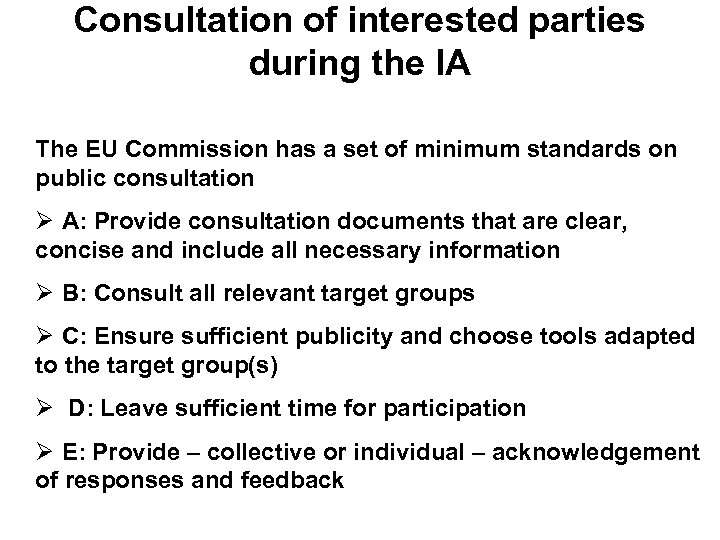 Consultation of interested parties during the IA The EU Commission has a set of minimum standards on public consultation Ø A: Provide consultation documents that are clear, concise and include all necessary information Ø B: Consult all relevant target groups Ø C: Ensure sufficient publicity and choose tools adapted to the target group(s) Ø D: Leave sufficient time for participation Ø E: Provide – collective or individual – acknowledgement of responses and feedback
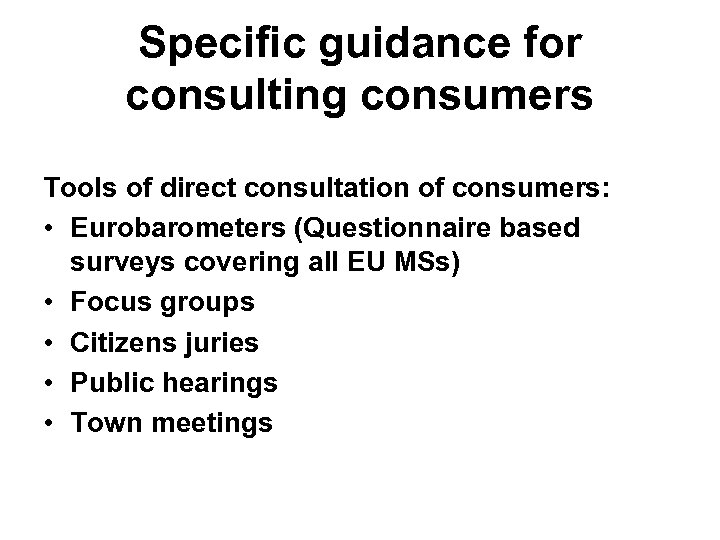 Specific guidance for consulting consumers Tools of direct consultation of consumers: • Eurobarometers (Questionnaire based surveys covering all EU MSs) • Focus groups • Citizens juries • Public hearings • Town meetings
![Questions and answers [Lunch break]](https://present5.com/presentation/5e01e2599788dd4c10109bf5d56f7267/image-78.jpg "Questions and answers [Lunch break]") Questions and answers [Lunch break]
Questions and answers [Lunch break]
 Session 3: Analytical methods of RIA studies
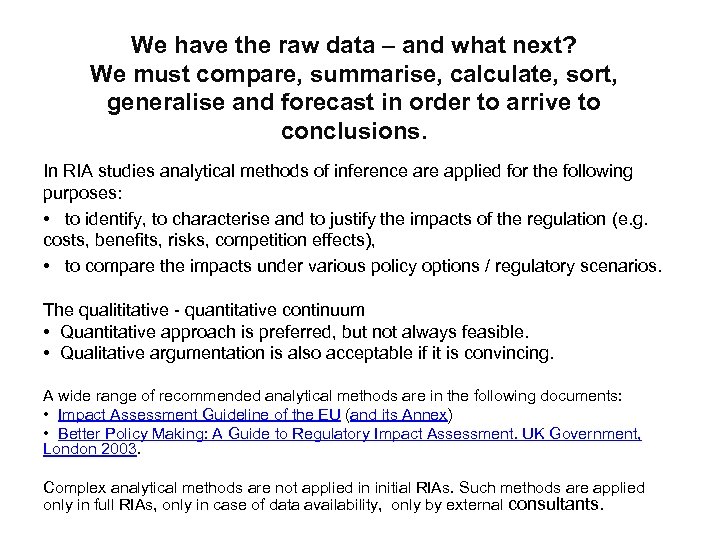 We have the raw data – and what next? We must compare, summarise, calculate, sort, generalise and forecast in order to arrive to conclusions. In RIA studies analytical methods of inference are applied for the following purposes: • to identify, to characterise and to justify the impacts of the regulation (e. g. costs, benefits, risks, competition effects), • to compare the impacts under various policy options / regulatory scenarios. The qualititative - quantitative continuum • Quantitative approach is preferred, but not always feasible. • Qualitative argumentation is also acceptable if it is convincing. A wide range of recommended analytical methods are in the following documents: • Impact Assessment Guideline of the EU (and its Annex) • Better Policy Making: A Guide to Regulatory Impact Assessment. UK Government, London 2003. Complex analytical methods are not applied in initial RIAs. Such methods are applied only in full RIAs, only in case of data availability, only by external consultants.
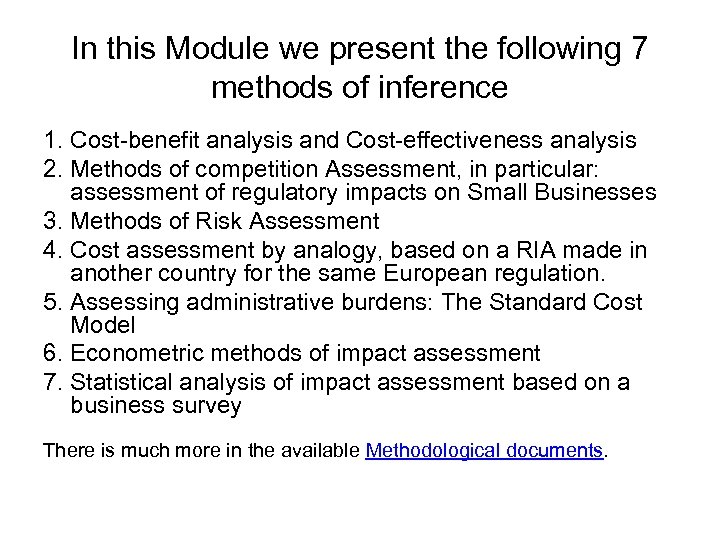 In this Module we present the following 7 methods of inference 1. Cost-benefit analysis and Cost-effectiveness analysis 2. Methods of competition Assessment, in particular: assessment of regulatory impacts on Small Businesses 3. Methods of Risk Assessment 4. Cost assessment by analogy, based on a RIA made in another country for the same European regulation. 5. Assessing administrative burdens: The Standard Cost Model 6. Econometric methods of impact assessment 7. Statistical analysis of impact assessment based on a business survey There is much more in the available Methodological documents.
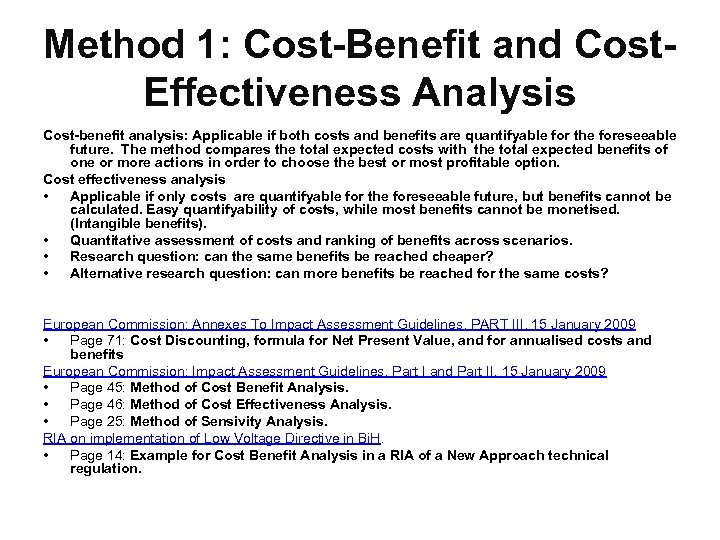 Method 1: Cost-Benefit and Cost. Effectiveness Analysis Cost-benefit analysis: Applicable if both costs and benefits are quantifyable for the foreseeable future. The method compares the total expected costs with the total expected benefits of one or more actions in order to choose the best or most profitable option. Cost effectiveness analysis • Applicable if only costs are quantifyable for the foreseeable future, but benefits cannot be calculated. Easy quantifyability of costs, while most benefits cannot be monetised. (Intangible benefits). • Quantitative assessment of costs and ranking of benefits across scenarios. • Research question: can the same benefits be reached cheaper? • Alternative research question: can more benefits be reached for the same costs? European Commission: Annexes To Impact Assessment Guidelines, PART III, 15 January 2009 • Page 71: Cost Discounting, formula for Net Present Value, and for annualised costs and benefits European Commission: Impact Assessment Guidelines, Part I and Part II. 15 January 2009 • Page 45: Method of Cost Benefit Analysis. • Page 46: Method of Cost Effectiveness Analysis. • Page 25: Method of Sensivity Analysis. RIA on implementation of Low Voltage Directive in Bi. H. • Page 14: Example for Cost Benefit Analysis in a RIA of a New Approach technical regulation.
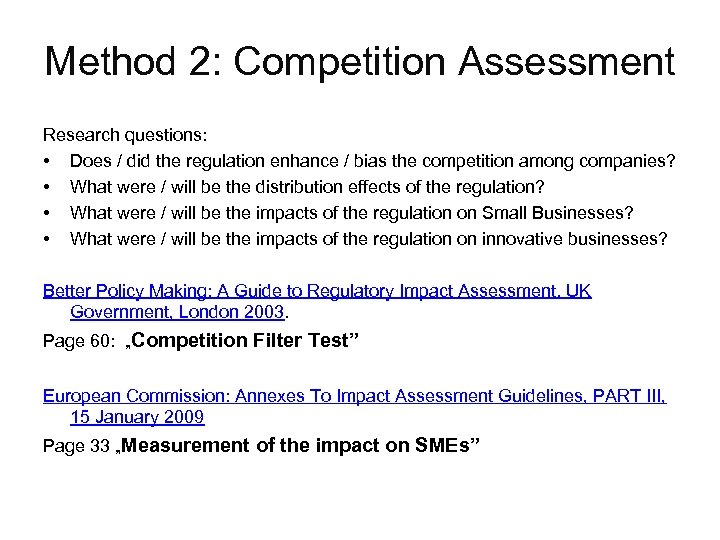 Method 2: Competition Assessment Research questions: • Does / did the regulation enhance / bias the competition among companies? • What were / will be the distribution effects of the regulation? • What were / will be the impacts of the regulation on Small Businesses? • What were / will be the impacts of the regulation on innovative businesses? Better Policy Making: A Guide to Regulatory Impact Assessment. UK Government, London 2003. Page 60: „Competition Filter Test” European Commission: Annexes To Impact Assessment Guidelines, PART III, 15 January 2009 Page 33 „Measurement of the impact on SMEs”
 Method 3: Risk Assessment European Commission: Impact Assessment Guidelines, Part I and Part II. 15 January 2009 Page 25: Method of Risk Assessment Regulatory impact analysis of the introduction of the EC Low Voltage directive into Ukrainian legislation Page 39: Example for Risk Assessment in a New Approach RIA
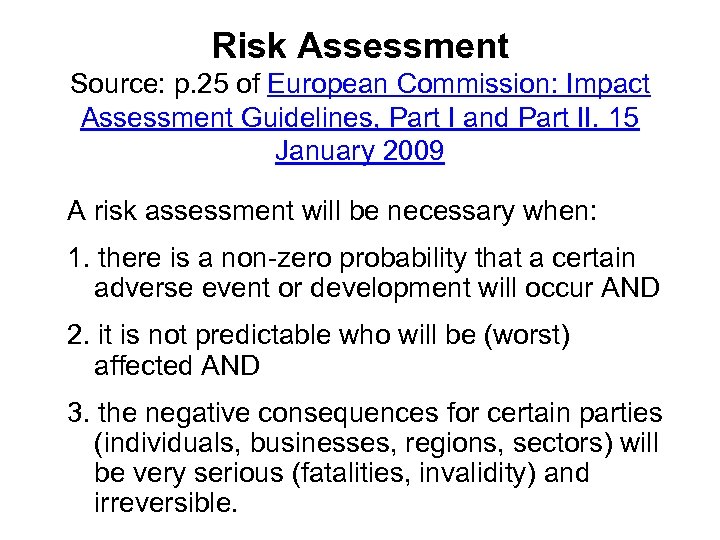 Risk Assessment Source: p. 25 of European Commission: Impact Assessment Guidelines, Part I and Part II. 15 January 2009 A risk assessment will be necessary when: 1. there is a non-zero probability that a certain adverse event or development will occur AND 2. it is not predictable who will be (worst) affected AND 3. the negative consequences for certain parties (individuals, businesses, regions, sectors) will be very serious (fatalities, invalidity) and irreversible.
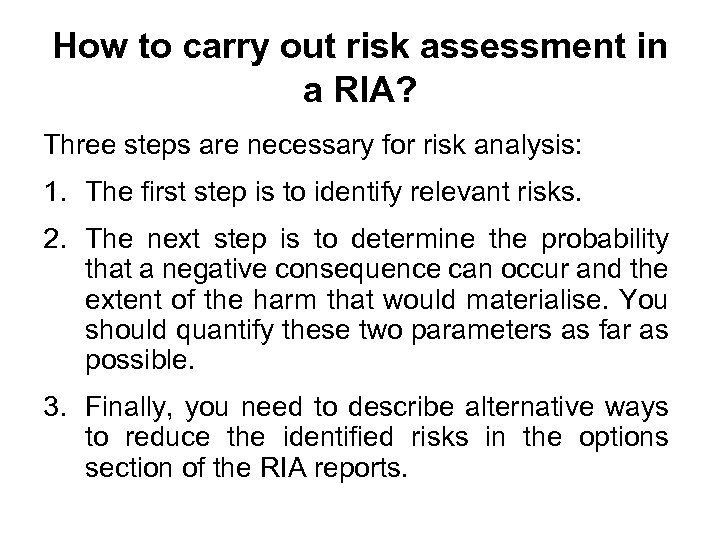 How to carry out risk assessment in a RIA? Three steps are necessary for risk analysis: 1. The first step is to identify relevant risks. 2. The next step is to determine the probability that a negative consequence can occur and the extent of the harm that would materialise. You should quantify these two parameters as far as possible. 3. Finally, you need to describe alternative ways to reduce the identified risks in the options section of the RIA reports.
 An example for verbal risk assessment Source: Page 3 of UK RIA of Packaging Waste Directive. Can be downloaded from BIH RIA Website: A wide selection of RIAs and Initial RIAs made in the United Kingdom in various regulatory areas
 An example for assessing the magnitude of risks with the help of examples of accidents Pages 9 – 10 of Bi. H RIA of Cableway Directive http: //web. uni-corvinus. hu/~pfuto/RIAwebsite/CID-Initial-RIA-2010 -12 -06. doc
 An example for assessing the magnitude of risks with the help of accident statistics Page 39 of Regulatory impact analysis of the introduction of the EC Low Voltage directive into Ukrainian legislation
 Method 4: Cost assessment by analogy Case study: RIA of Construction Products Directive in Bi. H Contains two examples of cost assessment by applying the method of analogy, based on a RIA made in an other country for the same European regulation.





 Method 5: Assessing administrative costs The Standard Cost Model Case study: UK Administrative Burden Calculator. Available under https: //www. abcalculator. bis. gov. uk/newuser. php Username: pfuto Free text search for Measuring Instruments
 Definition of administrative costs Administrative costs are defined as the costs incurred by enterprises, the voluntary sector, public authorities and citizens in meeting legal obligations to provide information on their action or production, either to public authorities or to private parties. • • • Information is to be construed in a broad sense, i. e. including costs of labeling, reporting, monitoring registration asking for permits/licenses
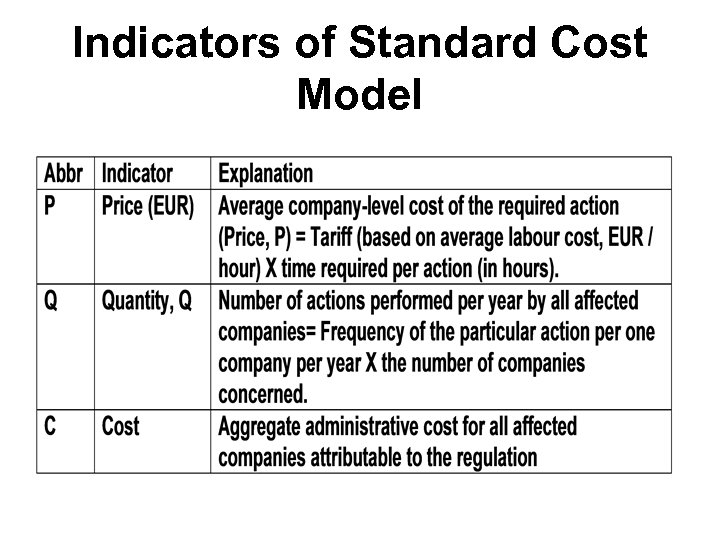 Indicators of Standard Cost Model
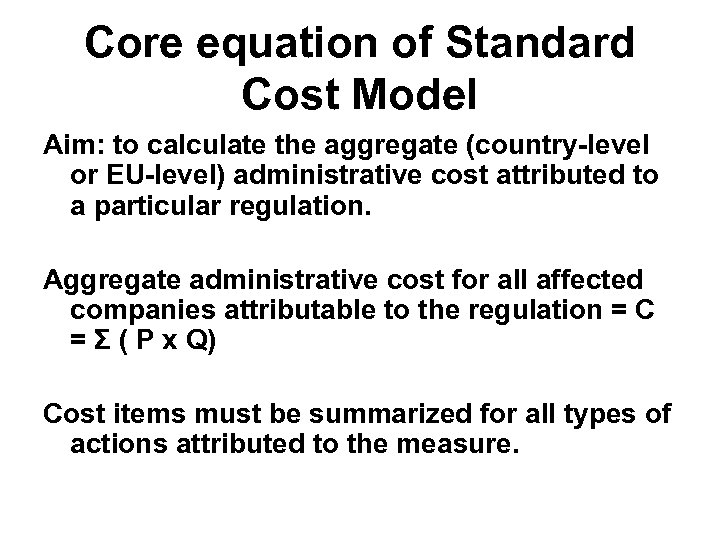 Core equation of Standard Cost Model Aim: to calculate the aggregate (country-level or EU-level) administrative cost attributed to a particular regulation. Aggregate administrative cost for all affected companies attributable to the regulation = C = Σ ( P x Q) Cost items must be summarized for all types of actions attributed to the measure.
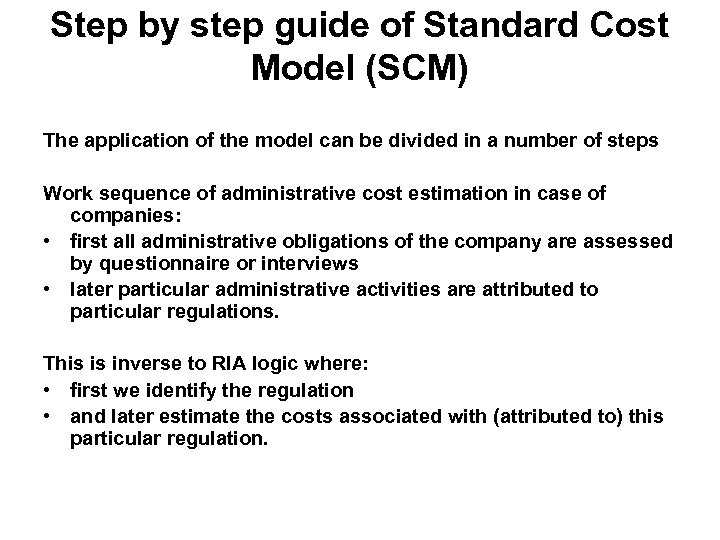 Step by step guide of Standard Cost Model (SCM) The application of the model can be divided in a number of steps Work sequence of administrative cost estimation in case of companies: • first all administrative obligations of the company are assessed by questionnaire or interviews • later particular administrative activities are attributed to particular regulations. This is inverse to RIA logic where: • first we identify the regulation • and later estimate the costs associated with (attributed to) this particular regulation.
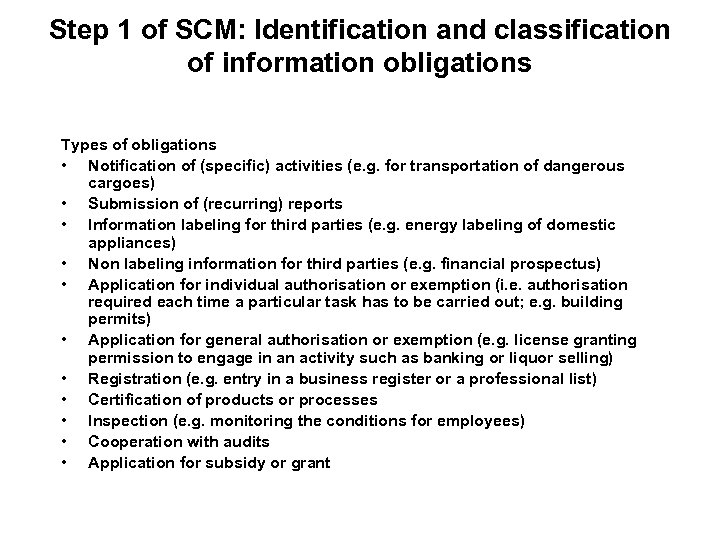 Step 1 of SCM: Identification and classification of information obligations Types of obligations • Notification of (specific) activities (e. g. for transportation of dangerous cargoes) • Submission of (recurring) reports • Information labeling for third parties (e. g. energy labeling of domestic appliances) • Non labeling information for third parties (e. g. financial prospectus) • Application for individual authorisation or exemption (i. e. authorisation required each time a particular task has to be carried out; e. g. building permits) • Application for general authorisation or exemption (e. g. license granting permission to engage in an activity such as banking or liquor selling) • Registration (e. g. entry in a business register or a professional list) • Certification of products or processes • Inspection (e. g. monitoring the conditions for employees) • Cooperation with audits • Application for subsidy or grant
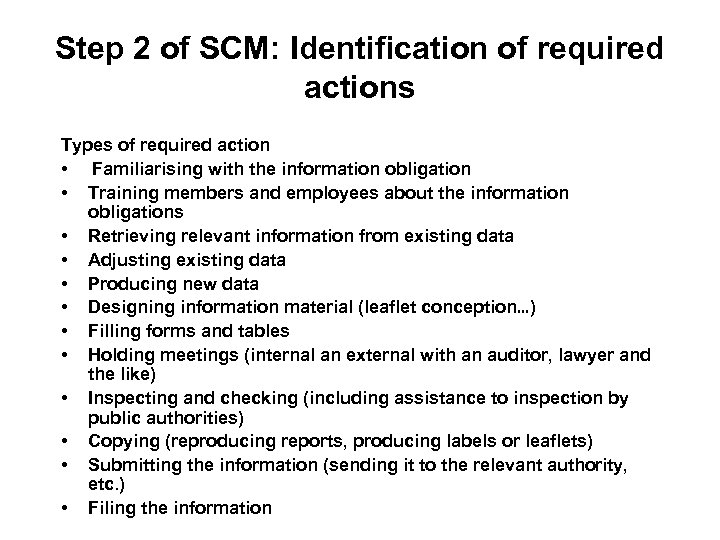 Step 2 of SCM: Identification of required actions Types of required action • Familiarising with the information obligation • Training members and employees about the information obligations • Retrieving relevant information from existing data • Adjusting existing data • Producing new data • Designing information material (leaflet conception…) • Filling forms and tables • Holding meetings (internal an external with an auditor, lawyer and the like) • Inspecting and checking (including assistance to inspection by public authorities) • Copying (reproducing reports, producing labels or leaflets) • Submitting the information (sending it to the relevant authority, etc. ) • Filing the information
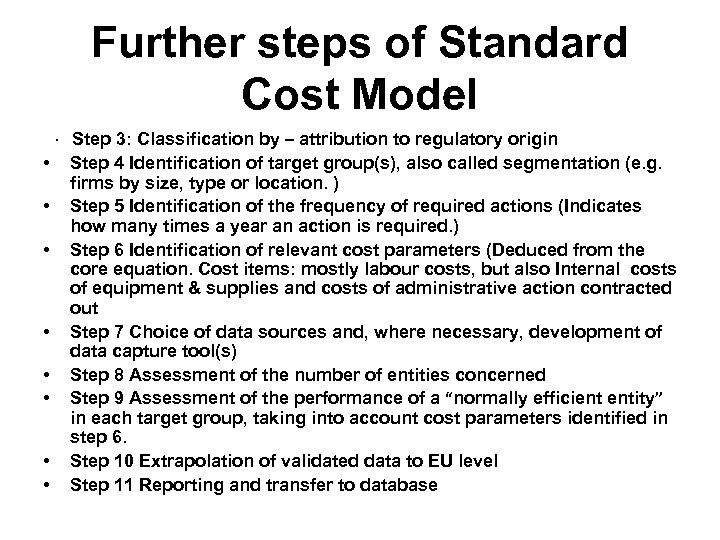 Further steps of Standard Cost Model · Step 3: Classification by – attribution to regulatory origin • Step 4 Identification of target group(s), also called segmentation (e. g. firms by size, type or location. ) • Step 5 Identification of the frequency of required actions (Indicates how many times a year an action is required. ) • Step 6 Identification of relevant cost parameters (Deduced from the core equation. Cost items: mostly labour costs, but also Internal costs of equipment & supplies and costs of administrative action contracted out • Step 7 Choice of data sources and, where necessary, development of data capture tool(s) • Step 8 Assessment of the number of entities concerned • Step 9 Assessment of the performance of a “normally efficient entity” in each target group, taking into account cost parameters identified in step 6. • Step 10 Extrapolation of validated data to EU level • Step 11 Reporting and transfer to database
 An example for SCM Footnote on Page 11 and table on Page 20 of the following document: RIA on Foreign Direct Investment Policy laws (Bi. H Official Bulletin 17/98 and 13/03). In local language: Ocjena preliminarnih efekata koji se odnose na moguće promjene u zakonu o direktnim stranim investicijama Bosne i Hercegovine. Juli 2008
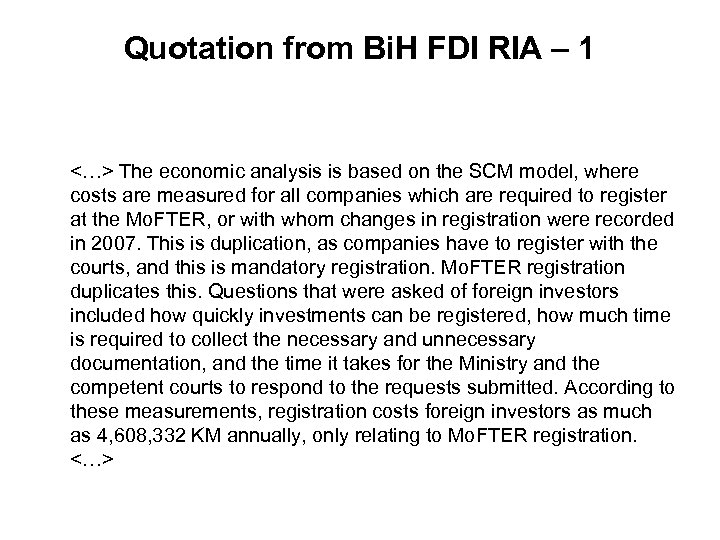 Quotation from Bi. H FDI RIA – 1 <…> The economic analysis is based on the SCM model, where costs are measured for all companies which are required to register at the Mo. FTER, or with whom changes in registration were recorded in 2007. This is duplication, as companies have to register with the courts, and this is mandatory registration. Mo. FTER registration duplicates this. Questions that were asked of foreign investors included how quickly investments can be registered, how much time is required to collect the necessary and unnecessary documentation, and the time it takes for the Ministry and the competent courts to respond to the requests submitted. According to these measurements, registration costs foreign investors as much as 4, 608, 332 KM annually, only relating to Mo. FTER registration. <…>
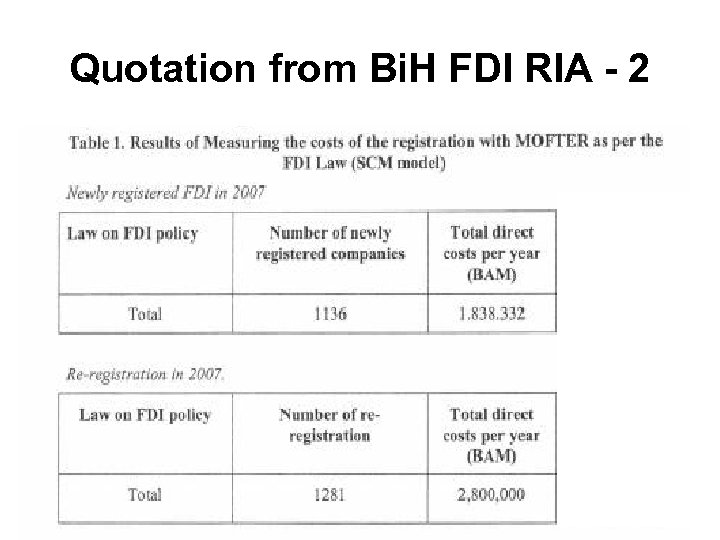 Quotation from Bi. H FDI RIA - 2
 Method 6: Econometric methods of impact assessment Econometric model building is feasible only if a relatively voluminous body of sectoral / country-level time series data is available. Applicable only in case of full RIAs, and only in case of RIAs outsourced to external consultants. When to apply: Models used predominantly for revealing trade and development effects of regulations, in case of removal of non-tariff barriers to trade and tariff-related barriers to trade. Examples of econometric models used in the above cases: • Gravity models: impacts revealed by coefficients of a regression equation. • Computable general equilibrium models: impacts revealed by successive application of the model, i. e. by testing / simulating. Sensitivity analysis necessary for validating the model.
 Method 7: Statistical analysis of impact assessment If a questionnaire based company survey is feasible. Applicable only in case of full RIAs, and only in case of RIAs outsourced to external consultants. Some issues to be addressed: • Sample size and weighting (representativeness). • Impacts revealed by interrelations of dependentindependent variables. Calculation methods: • • Cross-tabulation Comparison of means Correlation Regression
 Questions and answers
 Session 3: A practical example about how an initial RIA can be prepared (case of EU technical regulation transposed into Bi. H legislation)
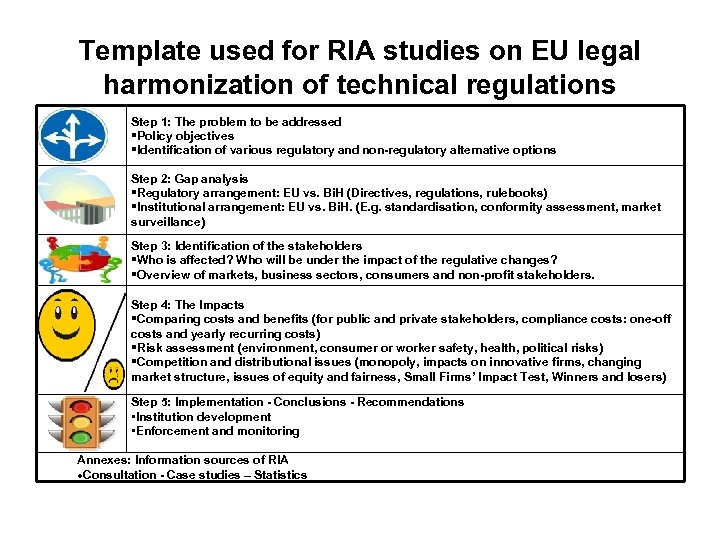 Template used for RIA studies on EU legal harmonization of technical regulations Step 1: The problem to be addressed Policy objectives Identification of various regulatory and non-regulatory alternative options Step 2: Gap analysis Regulatory arrangement: EU vs. Bi. H (Directives, regulations, rulebooks) Institutional arrangement: EU vs. Bi. H. (E. g. standardisation, conformity assessment, market surveillance) Step 3: Identification of the stakeholders Who is affected? Who will be under the impact of the regulative changes? Overview of markets, business sectors, consumers and non-profit stakeholders. Step 4: The Impacts Comparing costs and benefits (for public and private stakeholders, compliance costs: one-off costs and yearly recurring costs) Risk assessment (environment, consumer or worker safety, health, political risks) Competition and distributional issues (monopoly, impacts on innovative firms, changing market structure, issues of equity and fairness, Small Firms’ Impact Test, Winners and losers) Step 5: Implementation - Conclusions - Recommendations • Institution development • Enforcement and monitoring Annexes: Information sources of RIA Consultation - Case studies – Statistics
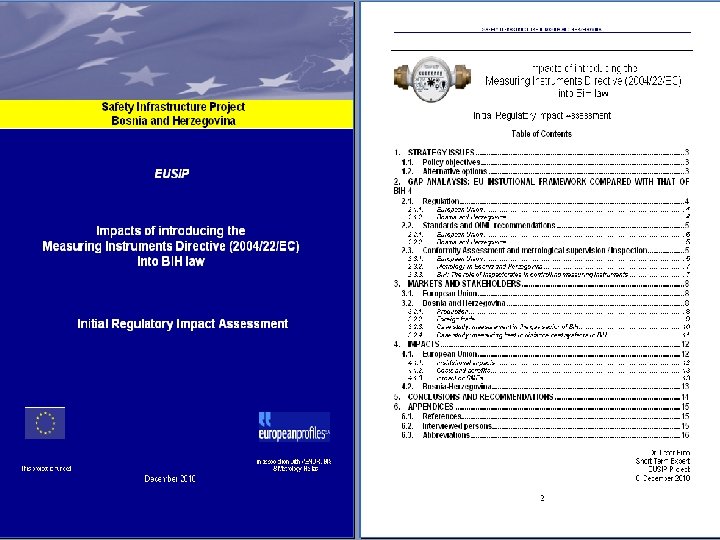
 Step-by-step procedure of preparing an Initial RIA Let us see, how to perform each step of the previous RIA template. Case study: Initial RIA of introducing the EU Measuring Instruments Directive in Bi. H.

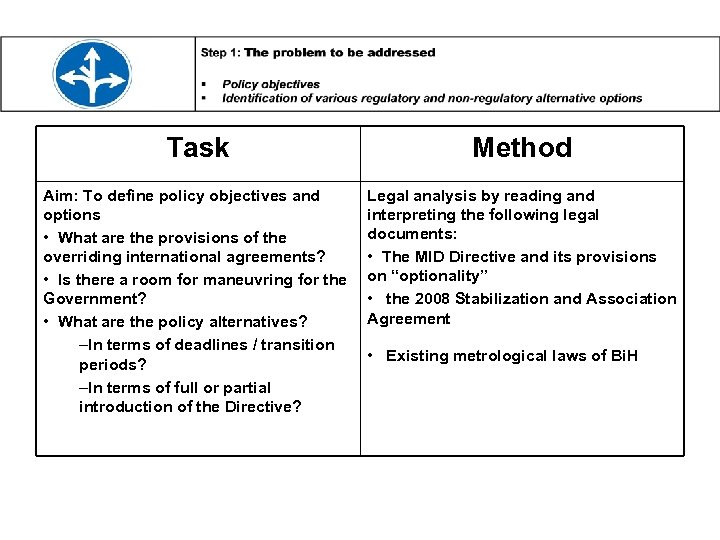 Task Method Aim: To define policy objectives and options • What are the provisions of the overriding international agreements? • Is there a room for maneuvring for the Government? • What are the policy alternatives? –In terms of deadlines / transition periods? –In terms of full or partial introduction of the Directive? Legal analysis by reading and interpreting the following legal documents: • The MID Directive and its provisions on “optionality” • the 2008 Stabilization and Association Agreement • Existing metrological laws of Bi. H
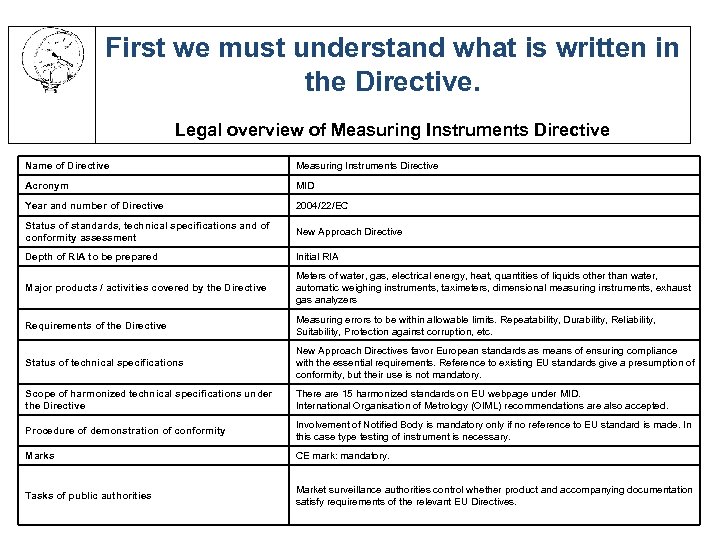 First we must understand what is written in the Directive. Legal overview of Measuring Instruments Directive Name of Directive Measuring Instruments Directive Acronym MID Year and number of Directive 2004/22/EC Status of standards, technical specifications and of conformity assessment New Approach Directive Depth of RIA to be prepared Initial RIA Major products / activities covered by the Directive Meters of water, gas, electrical energy, heat, quantities of liquids other than water, automatic weighing instruments, taximeters, dimensional measuring instruments, exhaust gas analyzers Requirements of the Directive Measuring errors to be within allowable limits. Repeatability, Durability, Reliability, Suitability, Protection against corruption, etc. Status of technical specifications New Approach Directives favor European standards as means of ensuring compliance with the essential requirements. Reference to existing EU standards give a presumption of conformity, but their use is not mandatory. Scope of harmonized technical specifications under the Directive There are 15 harmonized standards on EU webpage under MID. International Organisation of Metrology (OIML) recommendations are also accepted. Procedure of demonstration of conformity Involvement of Notified Body is mandatory only if no reference to EU standard is made. In this case type testing of instrument is necessary. Marks CE mark: mandatory. Tasks of public authorities Market surveillance authorities control whether product and accompanying documentation satisfy requirements of the relevant EU Directives.
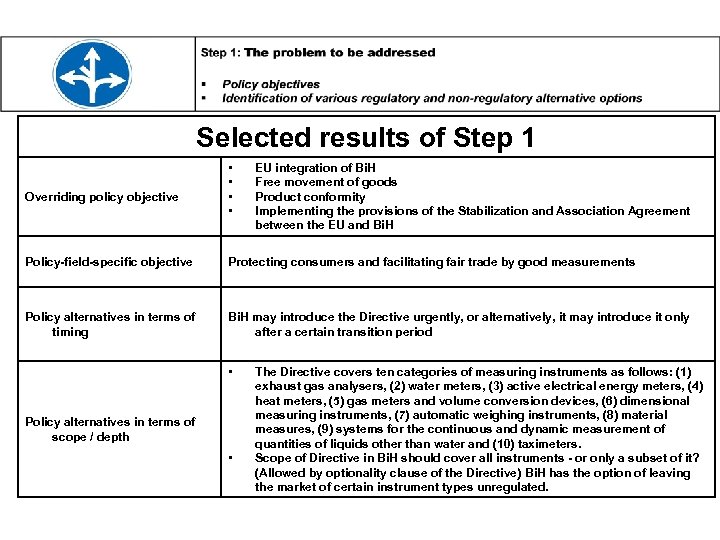 Selected results of Step 1 Overriding policy objective • • EU integration of Bi. H Free movement of goods Product conformity Implementing the provisions of the Stabilization and Association Agreement between the EU and Bi. H Policy-field-specific objective Protecting consumers and facilitating fair trade by good measurements Policy alternatives in terms of timing Bi. H may introduce the Directive urgently, or alternatively, it may introduce it only after a certain transition period • Policy alternatives in terms of scope / depth • The Directive covers ten categories of measuring instruments as follows: (1) exhaust gas analysers, (2) water meters, (3) active electrical energy meters, (4) heat meters, (5) gas meters and volume conversion devices, (6) dimensional measuring instruments, (7) automatic weighing instruments, (8) material measures, (9) systems for the continuous and dynamic measurement of quantities of liquids other than water and (10) taximeters. Scope of Directive in Bi. H should cover all instruments - or only a subset of it? (Allowed by optionality clause of the Directive) Bi. H has the option of leaving the market of certain instrument types unregulated.
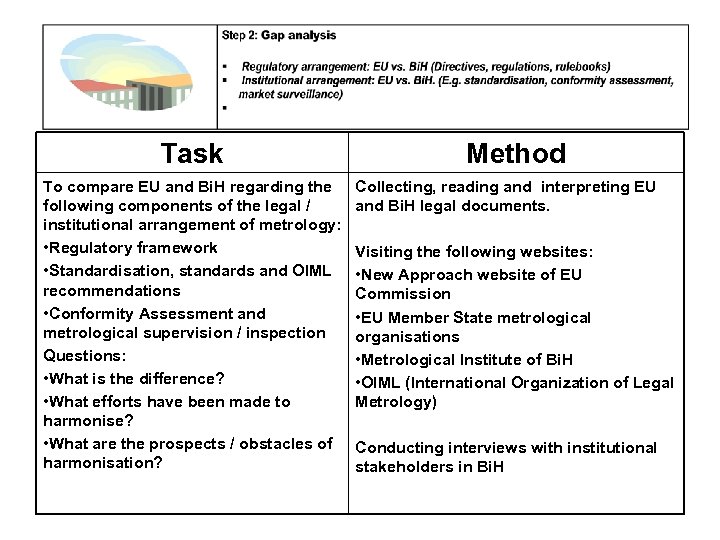 Task To compare EU and Bi. H regarding the following components of the legal / institutional arrangement of metrology: • Regulatory framework • Standardisation, standards and OIML recommendations • Conformity Assessment and metrological supervision / inspection Questions: • What is the difference? • What efforts have been made to harmonise? • What are the prospects / obstacles of harmonisation? Method Collecting, reading and interpreting EU and Bi. H legal documents. Visiting the following websites: • New Approach website of EU Commission • EU Member State metrological organisations • Metrological Institute of Bi. H • OIML (International Organization of Legal Metrology) Conducting interviews with institutional stakeholders in Bi. H
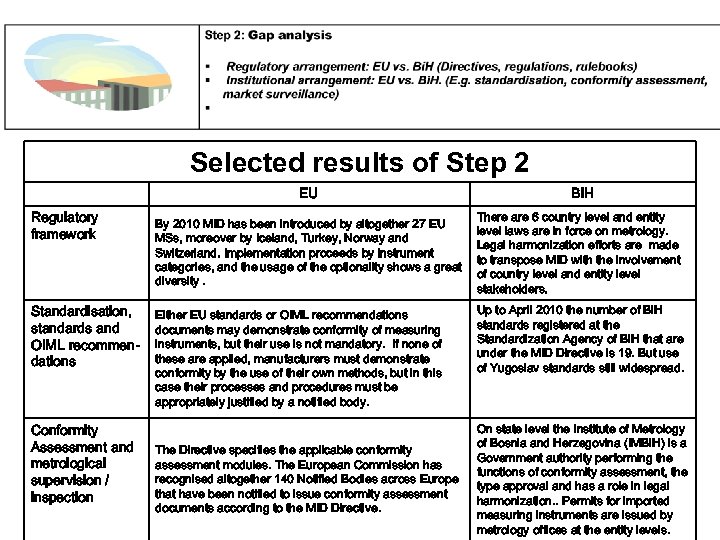 Selected results of Step 2 EU Regulatory framework Standardisation, standards and OIML recommendations Conformity Assessment and metrological supervision / inspection By 2010 MID has been introduced by altogether 27 EU MSs, moreover by Iceland, Turkey, Norway and Switzerland. Implementation proceeds by instrument categories, and the usage of the optionality shows a great diversity. Either EU standards or OIML recommendations documents may demonstrate conformity of measuring instruments, but their use is not mandatory. If none of these are applied, manufacturers must demonstrate conformity by the use of their own methods, but in this case their processes and procedures must be appropriately justified by a notified body. The Directive specifies the applicable conformity assessment modules. The European Commission has recognised altogether 140 Notified Bodies across Europe that have been notified to issue conformity assessment documents according to the MID Directive. Bi. H There are 6 country level and entity level laws are in force on metrology. Legal harmonization efforts are made to transpose MID with the involvement of country level and entity level stakeholders. Up to April 2010 the number of Bi. H standards registered at the Standardization Agency of Bi. H that are under the MID Directive is 19. But use of Yugoslav standards still widespread. On state level the Institute of Metrology of Bosnia and Herzegovina (IMBi. H) is a Government authority performing the functions of conformity assessment, the type approval and has a role in legal harmonization. . Permits for imported measuring instruments are issued by metrology offices at the entity levels.
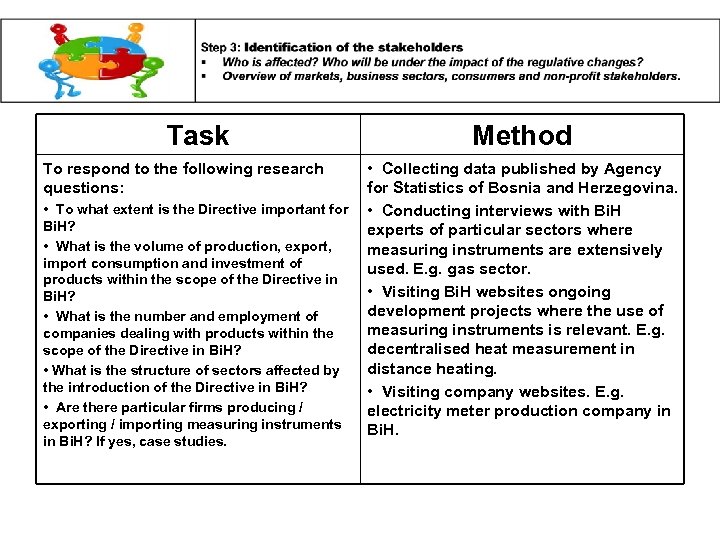 Task Method • Collecting data published by Agency for Statistics of Bosnia and Herzegovina. • To what extent is the Directive important for • Conducting interviews with Bi. H? experts of particular sectors where • What is the volume of production, export, measuring instruments are extensively import consumption and investment of used. E. g. gas sector. products within the scope of the Directive in • Visiting Bi. H websites ongoing Bi. H? development projects where the use of • What is the number and employment of measuring instruments is relevant. E. g. companies dealing with products within the decentralised heat measurement in scope of the Directive in Bi. H? distance heating. • What is the structure of sectors affected by the introduction of the Directive in Bi. H? • Visiting company websites. E. g. • Are there particular firms producing / electricity meter production company in exporting / importing measuring instruments Bi. H. To respond to the following research questions: in Bi. H? If yes, case studies.
 Selected results of Step 3



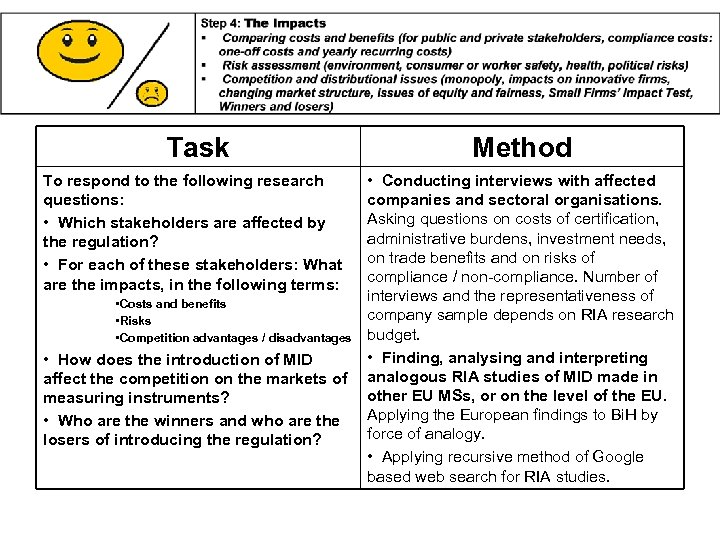 Task Method • Conducting interviews with affected companies and sectoral organisations. Asking questions on costs of certification, administrative burdens, investment needs, on trade benefits and on risks of compliance / non-compliance. Number of interviews and the representativeness of • Costs and benefits company sample depends on RIA research • Risks • Competition advantages / disadvantages budget. • Finding, analysing and interpreting • How does the introduction of MID affect the competition on the markets of analogous RIA studies of MID made in other EU MSs, or on the level of the EU. measuring instruments? • Who are the winners and who are the Applying the European findings to Bi. H by force of analogy. losers of introducing the regulation? • Applying recursive method of Google based web search for RIA studies. To respond to the following research questions: • Which stakeholders are affected by the regulation? • For each of these stakeholders: What are the impacts, in the following terms:
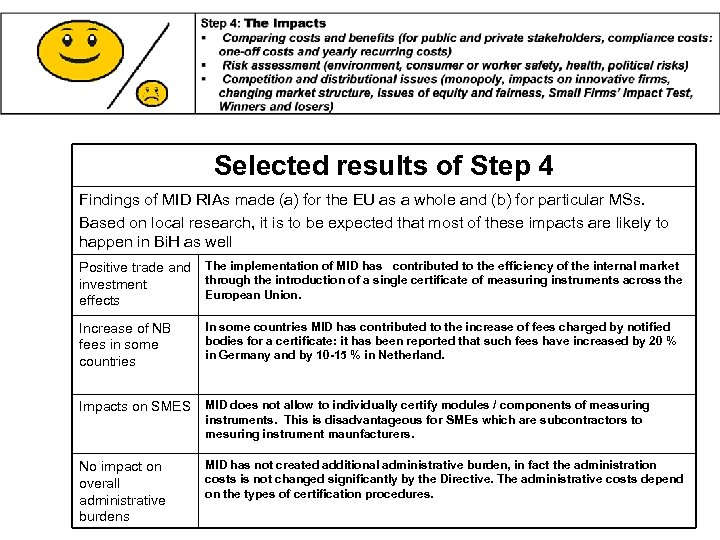 Selected results of Step 4 Findings of MID RIAs made (a) for the EU as a whole and (b) for particular MSs. Based on local research, it is to be expected that most of these impacts are likely to happen in Bi. H as well Positive trade and The implementation of MID has contributed to the efficiency of the internal market through the introduction of a single certificate of measuring instruments across the investment European Union. effects Increase of NB fees in some countries In some countries MID has contributed to the increase of fees charged by notified bodies for a certificate: it has been reported that such fees have increased by 20 % in Germany and by 10 -15 % in Netherland. Impacts on SMES MID does not allow to individually certify modules / components of measuring instruments. This is disadvantageous for SMEs which are subcontractors to mesuring instrument maunfacturers. No impact on overall administrative burdens MID has not created additional administrative burden, in fact the administration costs is not changed significantly by the Directive. The administrative costs depend on the types of certification procedures.
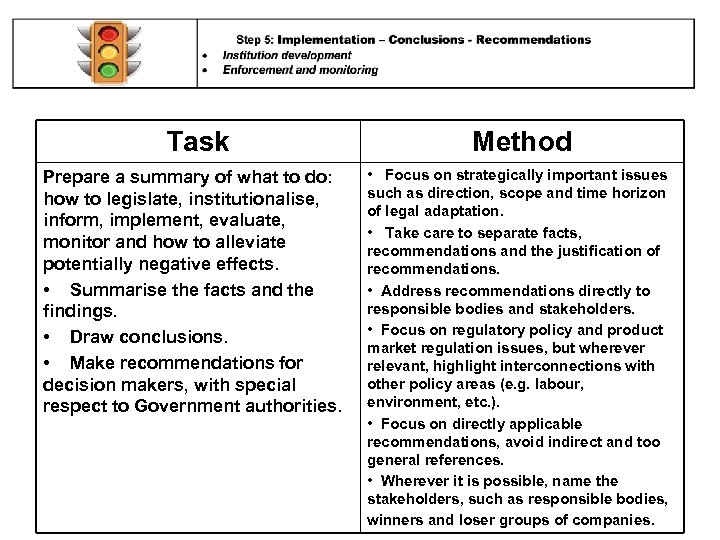 Task Prepare a summary of what to do: how to legislate, institutionalise, inform, implement, evaluate, monitor and how to alleviate potentially negative effects. • Summarise the facts and the findings. • Draw conclusions. • Make recommendations for decision makers, with special respect to Government authorities. Method • Focus on strategically important issues such as direction, scope and time horizon of legal adaptation. • Take care to separate facts, recommendations and the justification of recommendations. • Address recommendations directly to responsible bodies and stakeholders. • Focus on regulatory policy and product market regulation issues, but wherever relevant, highlight interconnections with other policy areas (e. g. labour, environment, etc. ). • Focus on directly applicable recommendations, avoid indirect and too general references. • Wherever it is possible, name the stakeholders, such as responsible bodies, winners and loser groups of companies.
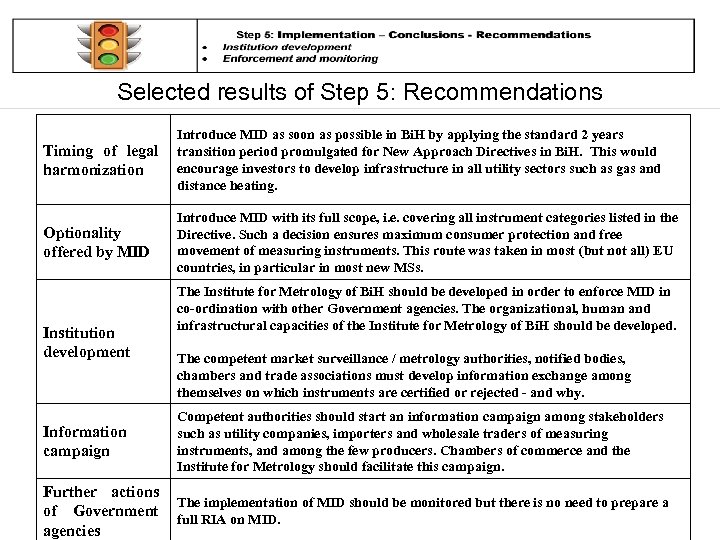 Selected results of Step 5: Recommendations Timing of legal harmonization Introduce MID as soon as possible in Bi. H by applying the standard 2 years transition period promulgated for New Approach Directives in Bi. H. This would encourage investors to develop infrastructure in all utility sectors such as gas and distance heating. Optionality offered by MID Introduce MID with its full scope, i. e. covering all instrument categories listed in the Directive. Such a decision ensures maximum consumer protection and free movement of measuring instruments. This route was taken in most (but not all) EU countries, in particular in most new MSs. Institution development The Institute for Metrology of Bi. H should be developed in order to enforce MID in co-ordination with other Government agencies. The organizational, human and infrastructural capacities of the Institute for Metrology of Bi. H should be developed. The competent market surveillance / metrology authorities, notified bodies, chambers and trade associations must develop information exchange among themselves on which instruments are certified or rejected - and why. Information campaign Competent authorities should start an information campaign among stakeholders such as utility companies, importers and wholesale traders of measuring instruments, and among the few producers. Chambers of commerce and the Institute for Metrology should facilitate this campaign. Further actions of Government agencies The implementation of MID should be monitored but there is no need to prepare a full RIA on MID.
 Questions and answers
 Thank you! Please don’t forget to evaluate the seminar (evaluation sheets are in the package of materials provided for you)