


 Скачать презентацию METHODOLOGY FOR SETTING UP A SUCCESSFUL PROPOSAL AND
3aad56b1969bc3a16af116e180b54c8b.ppt
- Количество слайдов: 75
 METHODOLOGY FOR SETTING UP A SUCCESSFUL PROPOSAL AND UNDERSTANDING THE MOST COMMON MISTAKES THROUGH AN ANALYSIS OF THE COMMISSION’S EVALUATION PROCESS MASSIMO BUSUOLI HEAD OF ENEA LIAISON OFFICE IN BRUXELLES
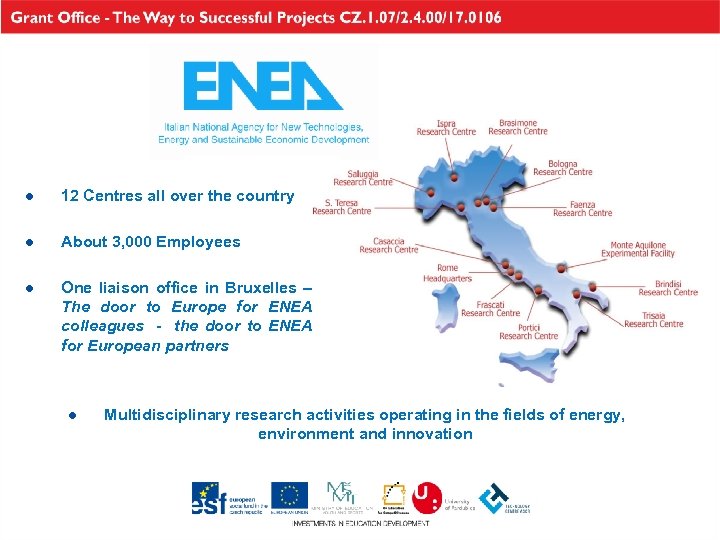 l 12 Centres all over the country l About 3, 000 Employees l One liaison office in Bruxelles – The door to Europe for ENEA colleagues - the door to ENEA for European partners l Multidisciplinary research activities operating in the fields of energy, environment and innovation
 ENEA research activities are focused on the following sectors: • • ENERGY EFFICIENCY : Support to Public Administration, Information and Training; Advanced Technologies for Energy and Industry RENEWABLE ENERGY SOURCES: Concentrated Solar Thermal Energy; Photovoltaics; Biomass and Biofuels; Solar Thermal Energy at low and medium temperatures; Hydrogen, Fuel Cells and Energy Storage Systems NUCLEAR ENERGY: Nuclear Fusion; Nuclear Fission CLIMATE AND THE ENVIRONMENT: Environmental Characterization, Prevention and Recovery; Environmental Technologies; Energy and Environmental Modeling; Marine environment and Sustainable Development; Antarctic Expeditions and Research in Polar Areas SAFETY AND HUMAN HEALTH: Seismic Protection; Radiation Biology and Human Health; Radiation Protection; Metrology of Ionizing Radiation NEW TECHNOLOGIES: Materials Technologies; Radiation Applications; Sustainable Development and Innovation of the Agro-Industrial System; ICT ELECTRIC SYSTEM RESEARCH: Studies and research, under a Programme Agreement with the Italian Ministry of Economic Development, aimed at innovating the National Electric System to make it cheaper, safer and more environmentally-friendly.
 PROJECT PERFORMANCE IN FP 7 • • 152 Projects granted About 45 Million Euros of funding Success Rate of about 30% 26 th place in the Ranking related to R&D Organisations* *source: European Commission sixth monitoring report 2012
 Index • • • Requirements Establishment of consortium How to find information and documents Funding tools selection Contents: the first meeting The evaluation process and the most common mistakes
 Introduction Goo d ws! ne In Brussels there is a lot of money and you can: work in an international context • cooperate to create a critical mass, sharing risks • work with the major experts in a single, specific sector • open up or explore new markets using the latest technologies • enhance your credit and reputation •
 Introduction Hardcopy production is heavy Leading a big project is complex Writing an excellent proposal is economically expensive Many months are needed to know if the project will be financed bad-performing partners might ruin your proposal It is not always simple to collaborate with certain partners / countries Bad n ews ! … nd gh! o sec enou g ivin t be arr no d oul c
 Introduction Basic rule N. 1 To have more possibilities to be successful (in every funding framework) is mandatory to fully understand the objectives (also social / economic / political) and the rationale of the institution that finance them AND ACCEPT THEM! Basic rule N. 2 The participation in a specific topic has to fit in the strategy of your organization (and it has to be supported!)
 Introduction “Good ideas are always financed” NO!
 Index • • Requirements Establishment of consortium How to find information and documents Funding tools selection Contents: the first meeting Lobbying: some advice The evaluation process and the most common mistakes
 Requirements • Right idea • Right call • Right consortium
 I have a good project idea…… • Understand where you want to arrive, from a good idea, with clear and feasible objectives • According to the objective, it’s necessary to determine the typology of project among the available EU instruments (Large R&D project, Small R&D project, Industry oriented project, SA, CA, etc. ) • Verify the degree of innovation of the project, comparing it to past projects (Cordis database) or existing results/products
 Finding the funding framework: the call • Search the possible call on EC participants’ portal http: //ec. europa. eu/research/participants/portal/page/funding Where you will find the templates and instructions for proposal writing
 This is the call for me!!! GREAT! But, before starting to prepare the proposal, complete the consortium, making meetings etc……. • Foresee a cognitive and preventive discussion with the Project Officer (PO) responsible for your target topic. – – • To check if your idea fits with the call objectives (saving months of work in case not) To clarify any doubt related to the call No contacts in Brussels? Consider to exploit your liaison office
 Index • • Requirements Establishment of consortium How to find information and documents Funding tools selection Contents: the first meeting Lobbying: some advice The evaluation process and the most common mistakes
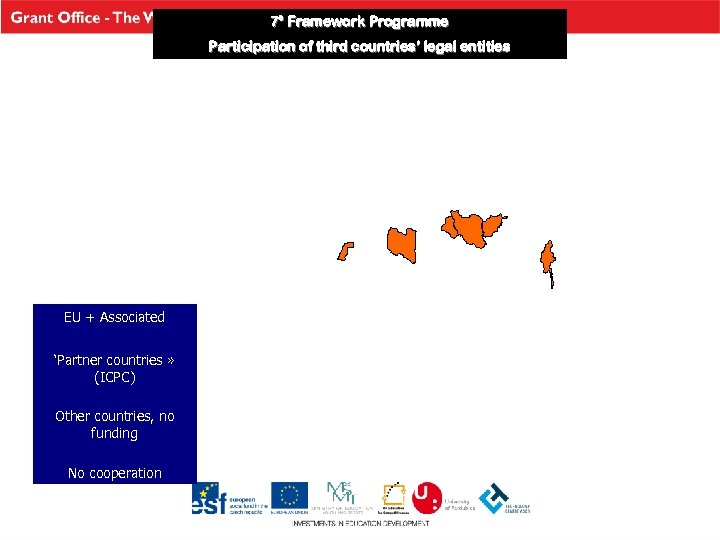
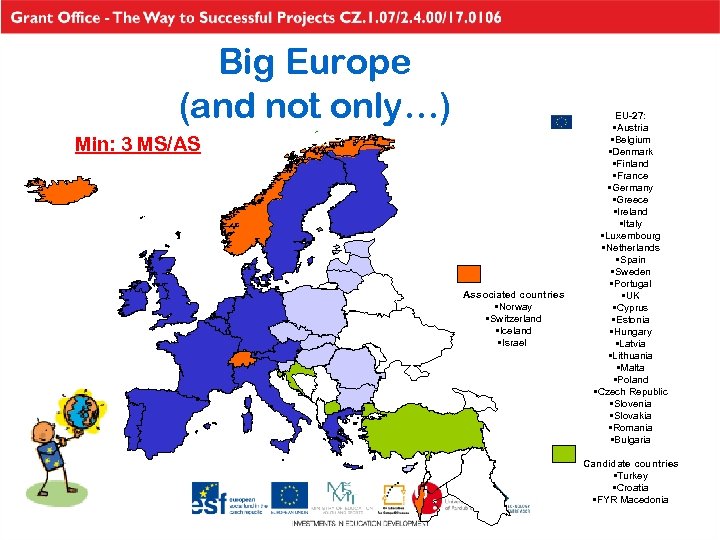 Big Europe (and not only…) Min: 3 MS/AS Associated countries • Norway • Switzerland • Iceland • Israel EU-27: • Austria • Belgium • Denmark • Finland • France • Germany • Greece • Ireland • Italy • Luxembourg • Netherlands • Spain • Sweden • Portugal • UK • Cyprus • Estonia • Hungary • Latvia • Lithuania • Malta • Poland • Czech Republic • Slovenia • Slovakia • Romania • Bulgaria Candidate countries • Turkey • Croatia • FYR Macedonia
 7° Framework Programme Participation of third countries’ legal entities EU + Associated ‘Partner countries » (ICPC) Other countries, no funding No cooperation
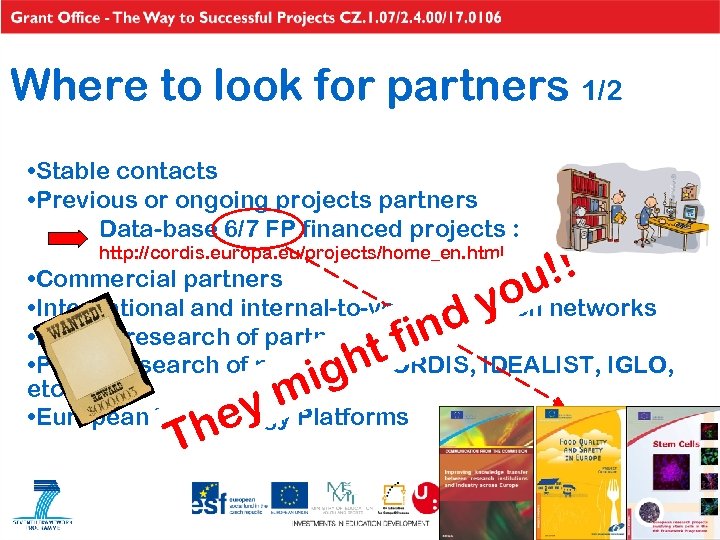 Where to look for partners 1/2 • Stable contacts • Previous or ongoing projects partners Data-base 6/7 FP financed projects : !! ou http: //cordis. europa. eu/projects/home_en. html • Commercial partners • International and internal-to-your institution networks • Private research of partners • Public research of partners / CORDIS, IDEALIST, IGLO, etc. • European Technology Platforms y d he T ig m y fin ht
 Where to look for partners 2/2 And also • Scientific publications • Patent and licences database • Conferences and scientific workshops • Information days (Info Day) and other EC events • National Contact Points & Enterprise Europe Network (former Innovation Relay Centres) http: //ec. europa. eu/research/participants/portal/page/nationalcontactpoint P LF U E URS O EP Y KE E DAT TO
 Possible options 1/3 Stable contacts Main method based on ‘word of mouth’ and on previous collaborations and exchanges • MAIN ADVANTAGES: quick access, confidence and common working language based on previous or ongoing experiences • DISADVANTAGES: the lack of openness to new interlocutors reduces the own database to poor and inappropriate contacts
 Possible options 2/3 Private search for partners A profile for every kind of partner is established and confidentially sent to select personal and professional contacts • MAIN ADVANTAGES: high-quality partners • DISADVANTAGES: slow procedure, limited impact on the number of partners
 Possible options 3/3 Public search for partners To be used when the confidentiality of the project is not crucial or when the project description is unclear to the possible competitors (to avoid stealing of ideas) • MAIN ADVANTAGES: very quick, higher output • DISADVANTAGES: many inappropriate or off topic candidates, informations not directly comparable Website examples: https: //cordis. europa. eu/partners/ http: //partnersearch. apre. it/ http: //www. iglortd. org/services/partner. html http: //www. fitforhealth. eu/participate. aspx
 Recommendations • Be active • Persist • Be initially flexible on your idea: external contributions can enrich it • Plan activities and priorities • Keep close relationships with the potential partners • Frankness and confidence are a must Consider European projects as an opportunity for business: “Is it suitable to invest on your planning idea? ”
 What to write (for the partnership search) • General informations • Name of proposal (acronym – title) • Object • Information about the proposer body / Institution / Enterprise • Description of the idea • Profile of the sought partner • Contact (to receive the answer) Who in the Consortium? • It depends on the objectives of the project • Partners have to perfectly cover the RST activities contained in the proposal • It is linked also to the impact that the proposal has to have • Balanced and diversified consortium • European dimension • Active partners, with a clear role No ‘sleeping’, ‘token’ or ‘alibi’ partners • Some target partners can be requested: SMEs, Third countries, ICPC
 Selection criteria to identify partners • Strategic interest on results and motivation • Pertinent to the proposal capabilities or specific RST activities • Complementarity, interdisciplinarity, excellence, committment • Previous experiences on european RST projects • Many sectors: industry-academy-final users… • Access to local markets, contacts and other cathegories (stakeholders) • Proficiency in English • Availability / Capacity to invest resources / infrastructures • Critical mass (related to the project structure and dimension)
 The consortium: basics • International, as required by the call • Balanced, according to the objectives • «end user» ? fundamental! (often also in R&D oriented projects)
 Index • • Requirements Establishment of consortium How to find information and documents Funding tools selection Contents: the first meeting Lobbying: some advice The evaluation process and the most common mistakes
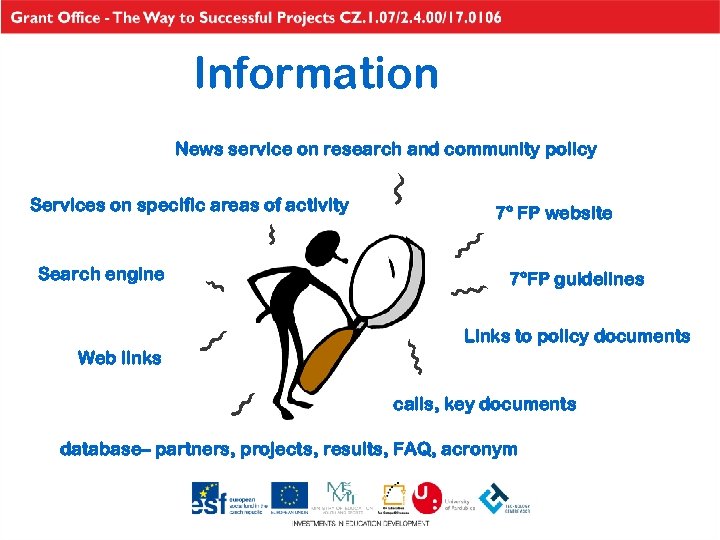 Information News service on research and community policy Services on specific areas of activity Search engine 7° FP website 7°FP guidelines Links to policy documents Web links calls, key documents database– partners, projects, results, FAQ, acronym
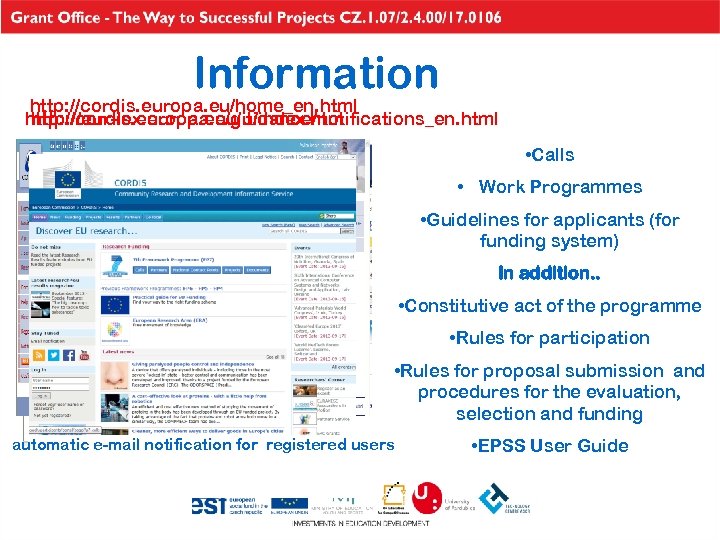 Information http: //cordis. europa. eu/home_en. html http: //cordis. europa. eu/guidance/notifications_en. html http: //eur-lex. europa. eu/it/index. htm • Calls • Work Programmes • Guidelines for applicants (for funding system) In addition. . • Constitutive act of the programme • Rules for participation • Rules for proposal submission and procedures for the evaluation, selection and funding automatic e-mail notification for registered users announced in the Official Journal of the European Union • EPSS User Guide
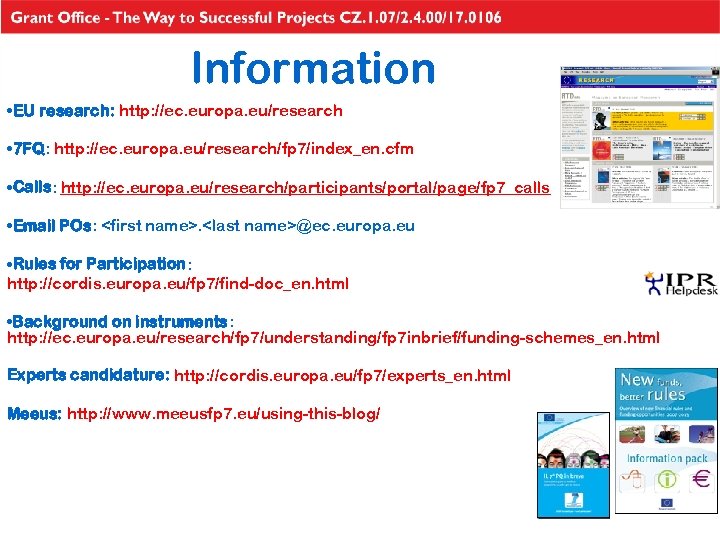 Information • EU research: http: //ec. europa. eu/research • 7 FQ: http: //ec. europa. eu/research/fp 7/index_en. cfm • Calls: http: //ec. europa. eu/research/participants/portal/page/fp 7_calls • Email POs:
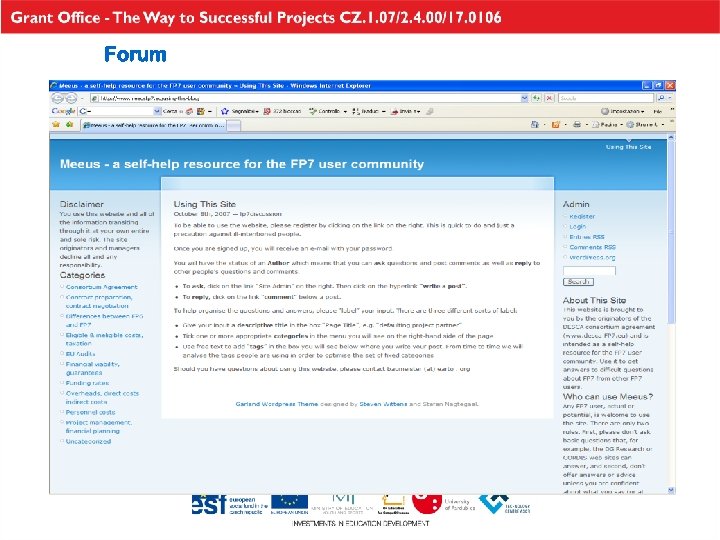 Forum
Forum
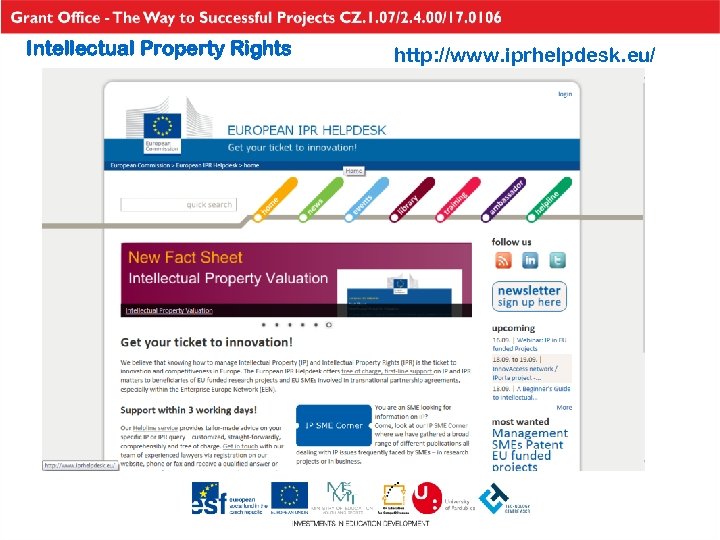 Intellectual Property Rights http: //www. iprhelpdesk. eu/
 Index • • Requirements Establishment of consortium How to find information and documents Funding tools selection Contents: the first meeting Lobbying: some advice The evaluation process and the most common mistakes
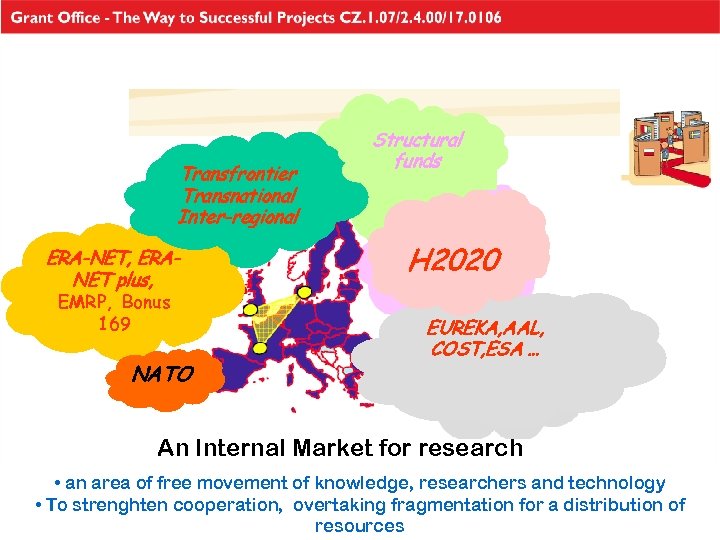 Territorial Transfrontier cooperation Transnational programmes Inter-regional Coordination of ERA-NET, ERANET plus, National EMRP, Bonus Research 169 Programmes NATO Structural National funds programmes Cooperation Ideas, People, H 2020 Capacities Programmi EUREKA, AAL, Intergovernmental COST, ESA … inter. Programmes governamentali (Eureka, COST) An Internal Market for research • an area of free movement of knowledge, researchers and technology • To strenghten cooperation, overtaking fragmentation for a distribution of 2008 Training sulla progettualità - ENEA CR Trisaia 28 -29 maggio resources
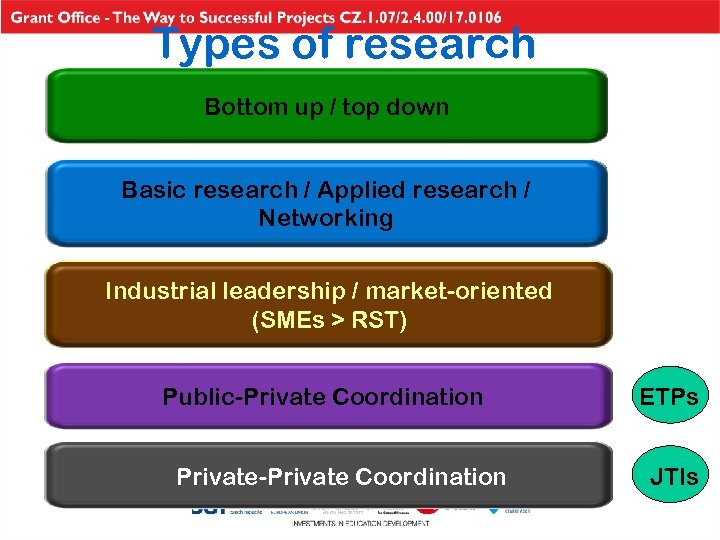 Types of research Bottom up / top down Basic research / Applied research / Networking Industrial leadership / market-oriented (SMEs > RST) Public-Private Coordination Private-Private Coordination ETPs JTIs
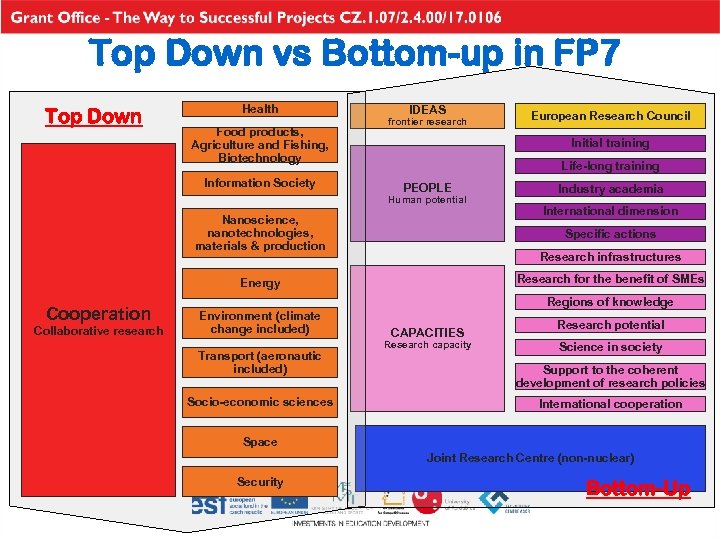 Top Down vs Bottom-up in FP 7 Top Down Health Food products, Agriculture and Fishing, Biotechnology Information Society IDEAS frontier research Initial training Life-long training PEOPLE Human potential Nanoscience, nanotechnologies, materials & production Collaborative research Industry academia International dimension Specific actions Research infrastructures Research for the benefit of SMEs Energy Cooperation European Research Council Regions of knowledge Environment (climate change included) Transport (aeronautic included) Socio-economic sciences CAPACITIES Research capacity Research potential Science in society Support to the coherent development of research policies International cooperation Space Joint Research Centre (non-nuclear) Security Bottom-Up
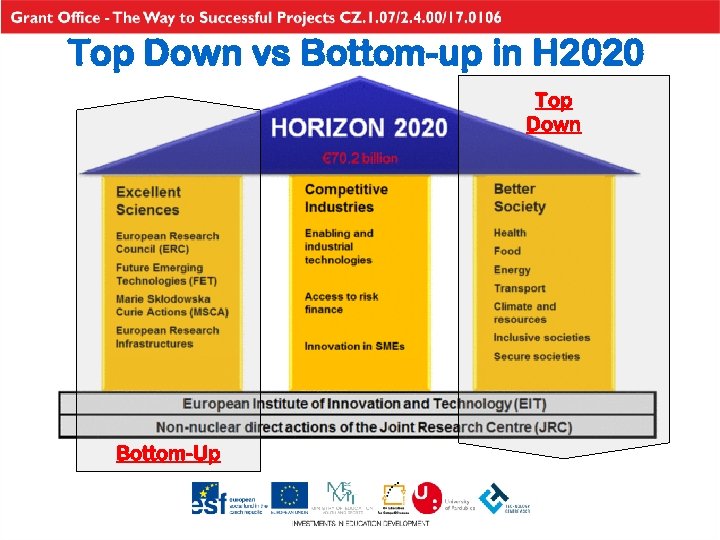 Top Down vs Bottom-up in H 2020 Top Down Bottom-Up
 Index • • Requirements Establishment of consortium How to find information and documents Funding tools selection Contents: the first meeting Lobbying: some advice The evaluation process and the most common mistakes
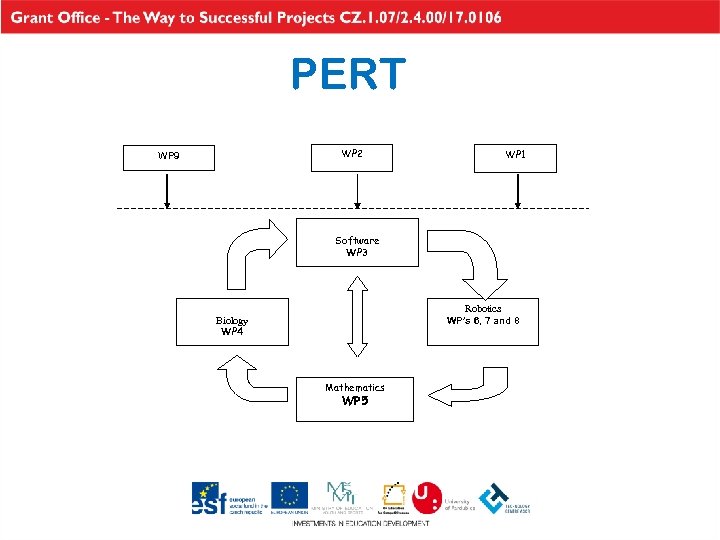
 Contents: the first meeting Of crucial importance at least one Meeting with the partners (at least the core ones) in which to fix: • Shared vision on the project • Objectives • Definition of WPs, Milestones and Deliverables • GANTT & PERT
 The proposal • The project idea must be an answer to the Call requests • Essential: – A good plan of dissemination – A good analysis of the impact and output on european level
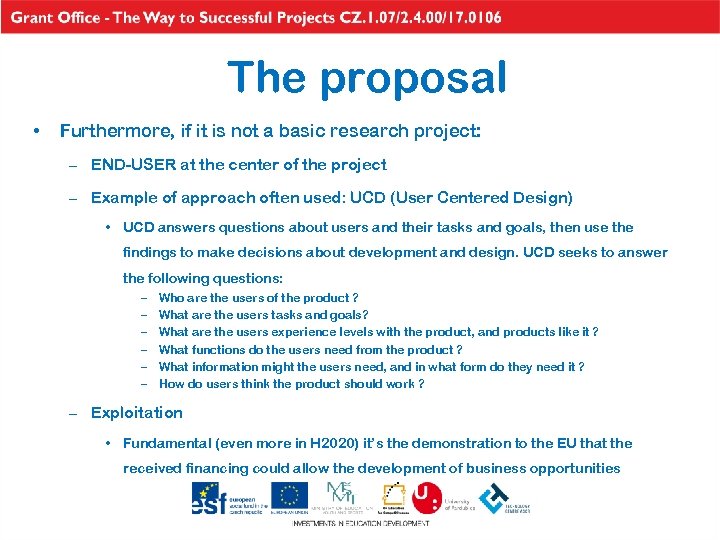 The proposal • Furthermore, if it is not a basic research project: – END-USER at the center of the project – Example of approach often used: UCD (User Centered Design) • UCD answers questions about users and their tasks and goals, then use the findings to make decisions about development and design. UCD seeks to answer the following questions: – – – Who are the users of the product ? What are the users tasks and goals? What are the users experience levels with the product, and products like it ? What functions do the users need from the product ? What information might the users need, and in what form do they need it ? How do users think the product should work ? – Exploitation • Fundamental (even more in H 2020) it’s the demonstration to the EU that the received financing could allow the development of business opportunities
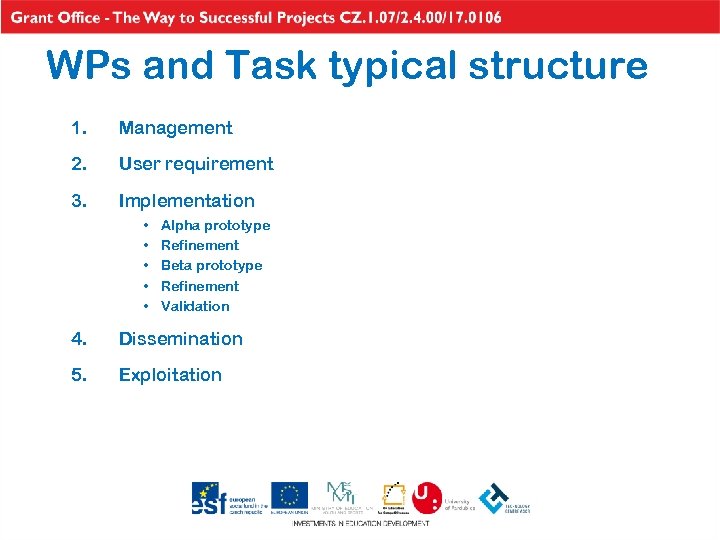 WPs and Task typical structure 1. Management 2. User requirement 3. Implementation • • • Alpha prototype Refinement Beta prototype Refinement Validation 4. Dissemination 5. Exploitation
 Suggestions • Avoid to be long-winded • Be synthetic and exhaustive • Don't take anything for granted (also the acronyms) • Underline the benefits: meaningful evaluations on European value • Keyword: End user
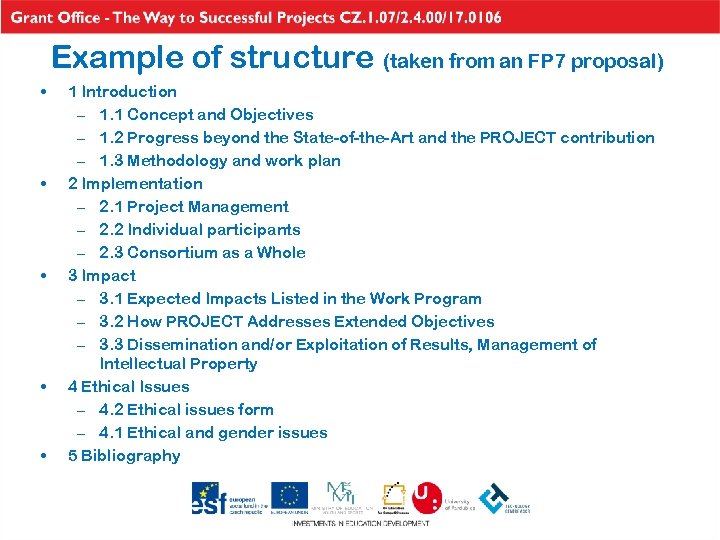 Example of structure (taken from an FP 7 proposal) • • • 1 Introduction – 1. 1 Concept and Objectives – 1. 2 Progress beyond the State-of-the-Art and the PROJECT contribution – 1. 3 Methodology and work plan 2 Implementation – 2. 1 Project Management – 2. 2 Individual participants – 2. 3 Consortium as a Whole 3 Impact – 3. 1 Expected Impacts Listed in the Work Program – 3. 2 How PROJECT Addresses Extended Objectives – 3. 3 Dissemination and/or Exploitation of Results, Management of Intellectual Property 4 Ethical Issues – 4. 2 Ethical issues form – 4. 1 Ethical and gender issues 5 Bibliography
 GANTT
GANTT
 PERT WP 2 WP 9 WP 1 Software WP 3 Robotics WP’s 6, 7 and 8 Biology WP 4 Mathematics WP 5
 Contents: the first meeting • Arrive to a shared clear vision of the proposal and build a ‘core group’ group able to lead the proposal writing • Establish a regular and direct interaction with the EC Project Officer, Officer responsible for the topic of reference • Communication: videoconference, periodic meetings, one or two Communication checks with the Project Officer • Clear and shared committment, accountability and role of the partners (stable contacts among partners)
 Problems 1/3 • Lack of a long-term vision (the vision is only “we want this project” or “we want European Union money”) • The planning idea has not any potential impact on RST and on relevant community policies (it is interesting only for the proposer) • Universities would like to make only basic research and consider the industrial partners as a nuisance • The industrial partners would like to easily monetize to develop their products (with few research contents) • The partners of the projects are friends instead of partners (. . . if you do not select him/her, he/she is offended, if you select both the project makes worse…)
 Problems 2/3 • Imbalances among partners (in terms of resources and activities) • Coordination in the preparatory phase is too ‘anarchical’ (everybody boost anarchical for the own idea, the coordinator has not authority or a sufficient knowledge of the issues) • contributions / suggestions from other partners are ignored, not assuring consequently the consistency of the project • A clear and common language is not used • «small things» are forgot: presence of SMEs (big enterprises could not have forgot a great interest on certain subjects), IPR, dissemination, EU contribution, equal opportunities. . . • evaluation criteria are not taken into account in the preparation
 Problems 3/3 timing: waiting for the last moment to complete the Consortium timing and for the project drafting (the preparation of the project becomes a neurotic copy/paste of many other texts) Dear partners, after busy weeks working on the XXX proposal and with some of you in parallel on the YYY proposal I have to admit that I have underestimated the work and organizational efforts. At the end we missed the deadline only by some hours after working also the last night very hard without stop. I take the responsibility for the bad situation. Many thanks to you all for your engagement especially. . . We have become a good team and I hope this will enable us to use the proposal for the next call. . .
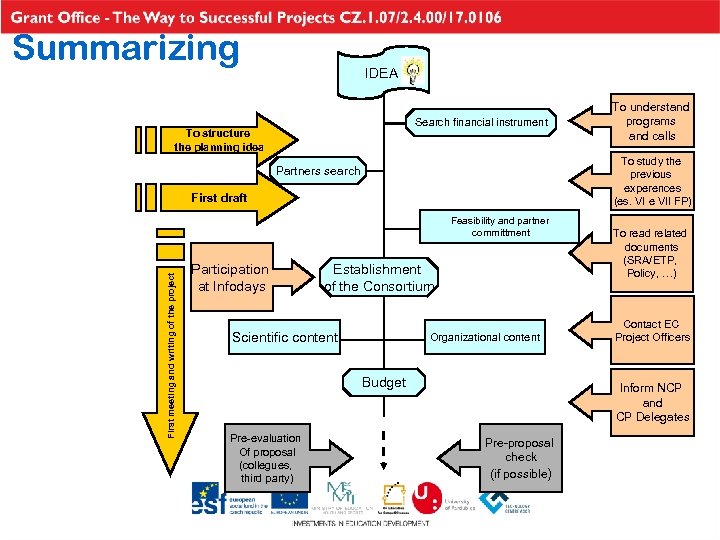 Summarizing IDEA Search financial instrument To structure the planning idea To study the previous experences (es. VI e VII FP) Partners search First draft First meeting and writing of the project Feasibility and partner committment Participation at Infodays Establishment of the Consortium Scientific content Organizational content Budget Pre-evaluation Of proposal (collegues, third party) To understand programs and calls To read related documents (SRA/ETP, Policy, …) Contact EC Project Officers Inform NCP and CP Delegates Pre-proposal check (if possible)
 Index • • • Requirements Establishment of consortium How to find information and documents Funding tools selection Contents: the first meeting The evaluation process and the most common mistakes
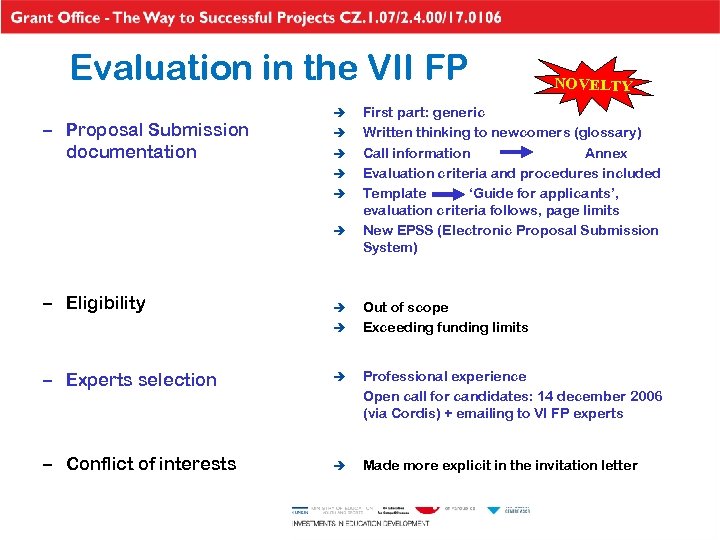 Evaluation in the VII FP – Proposal Submission documentation è è è – Eligibility è è NOVELTY First part: generic Written thinking to newcomers (glossary) Call information Annex Evaluation criteria and procedures included Template ‘Guide for applicants’, evaluation criteria follows, page limits New EPSS (Electronic Proposal Submission System) Out of scope Exceeding funding limits – Experts selection è Professional experience Open call for candidates: 14 december 2006 (via Cordis) + emailing to VI FP experts – Conflict of interests è Made more explicit in the invitation letter
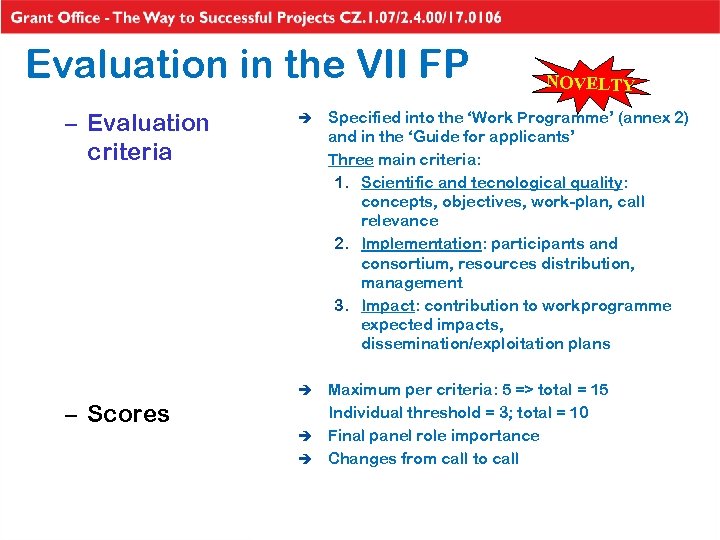 Evaluation in the VII FP – Evaluation criteria è Specified into the ‘Work Programme’ (annex 2) and in the ‘Guide for applicants’ Three main criteria: 1. Scientific and tecnological quality: concepts, objectives, work-plan, call relevance 2. Implementation: participants and consortium, resources distribution, management 3. Impact: contribution to workprogramme expected impacts, dissemination/exploitation plans Maximum per criteria: 5 => total = 15 Individual threshold = 3; total = 10 è Final panel role importance è Changes from call to call è – Scores NOVELTY
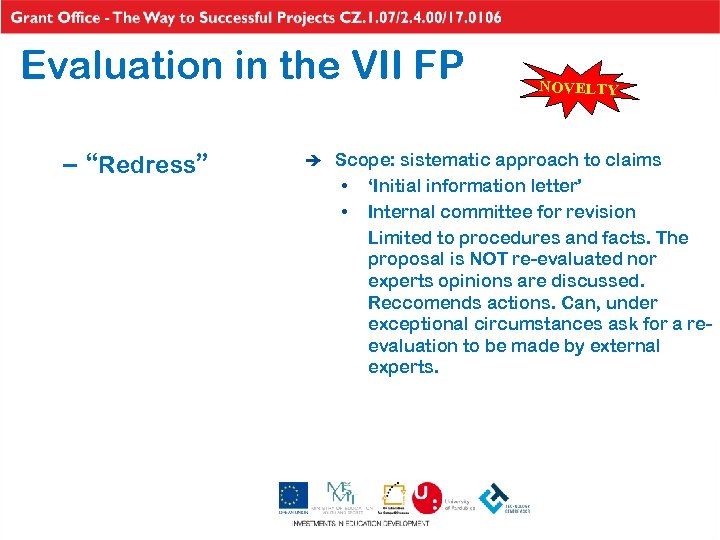 Evaluation in the VII FP – “Redress” NOVELTY è Scope: sistematic approach to claims • • ‘Initial information letter’ Internal committee for revision Limited to procedures and facts. The proposal is NOT re-evaluated nor experts opinions are discussed. Reccomends actions. Can, under exceptional circumstances ask for a reevaluation to be made by external experts.
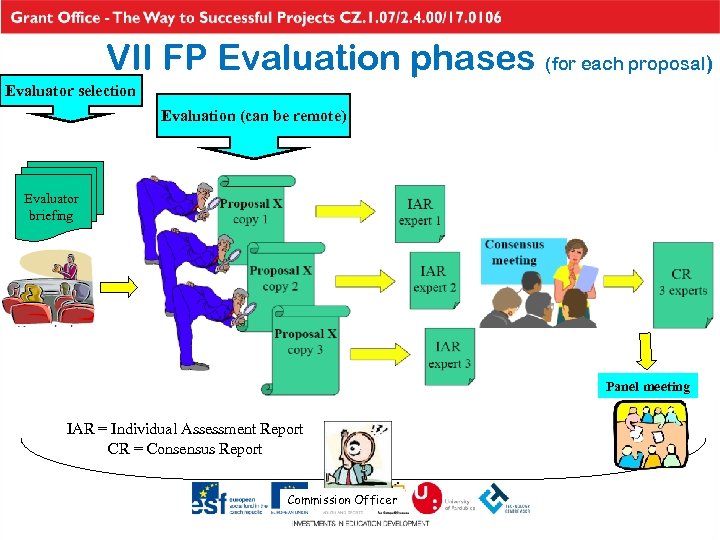 VII FP Evaluation phases (for each proposal) Evaluator selection Evaluation (can be remote) Evaluator briefing Panel meeting IAR = Individual Assessment Report CR = Consensus Report Commission Officer
 Evaluators Selection Evaluators selection • Indipendent experts chosen from the database (call for single candidatures and/or promoted by organisations) • The experts are selected as individuals (they do not represent any organisation, country or other entity) • Competenes evaluated from CVs and from possible previous participations in evaluation processes • Indipendence criteria (confidentiality declaration and absence of conflict of interest) • There is a code of conduct to be respected • There is a balance among ountries, kind and dimension of organisations (big industries/SMEs, industry/research/university) • Gender balance • Renewal (about 30% of new experts per call)
 Evaluation groups • Eligible proposals clustered by priority following the Workprogramme. • Evaluators groups assigned to each priority topic • Number of evaluators per group based on the expected amount of work (number of proposals per group and expert efficiency)
 Evaluators’ briefing • Done at the beginning by a Commission Officer in charge of the call • Evaluator briefing Explanation about Commission’s expectations from the evaluators (objectives, procedures, criteria, timing) • Answers to specific evaluators’ questions • Provision of general information about the call like: proposals received, total requested funding, available budget (oversubscription ratio) • Some more reccomendations can be made by the moderator to his own group of evaluators (tipically try to be balanced, read more than one proposal before starting to give scores, use all available scores from 1 to 5 and also half points)
 Individual evaluations • Evaluators number: from a minimum of 3 (small/medium CP, SA, CA) to a maximum of 7 for large projects • Evaluators must declare any potential conflict of interests before starting • Individual scores and comments based only on the proposal and evaluation criteria • Discussion among evaluators not allowed during this phase • No contacts with proposal participants, no phone, no computer, all documents to be given back to the secretariat before leaving the evaluation building at the end of each evaluation day • All the process is controlled by an indipendent observer
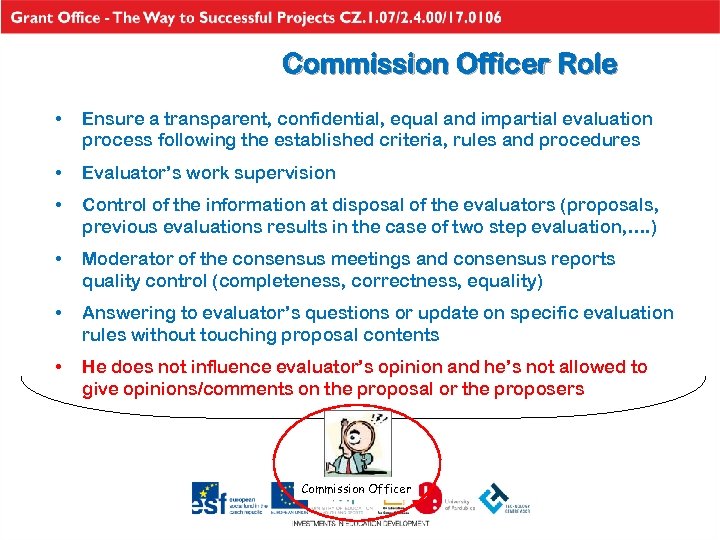 Commission Officer Role • Ensure a transparent, confidential, equal and impartial evaluation process following the established criteria, rules and procedures • Evaluator’s work supervision • Control of the information at disposal of the evaluators (proposals, previous evaluations results in the case of two step evaluation, …. ) • Moderator of the consensus meetings and consensus reports quality control (completeness, correctness, equality) • Answering to evaluator’s questions or update on specific evaluation rules without touching proposal contents • He does not influence evaluator’s opinion and he’s not allowed to give opinions/comments on the proposal or the proposers Commission Officer
 Consensus meetings • Moderated by a Commission Officer • Done on the basis of the individual evaluations of all involved experts • Discussion among evaluators with the aim to reach an agreed judgement on the proposal. Comments and scores must be accepted unanimously • If an agreement is not reached other evaluators (max 3) can be involved • A consensus report is written by a ‘rapporteur’ (can be one of the evaluators) • The moderator ensures that the discussion is coherent, complete and balanced, that every evaluator can give his opinion and that the conclusions are correctly reported into the consensus report.
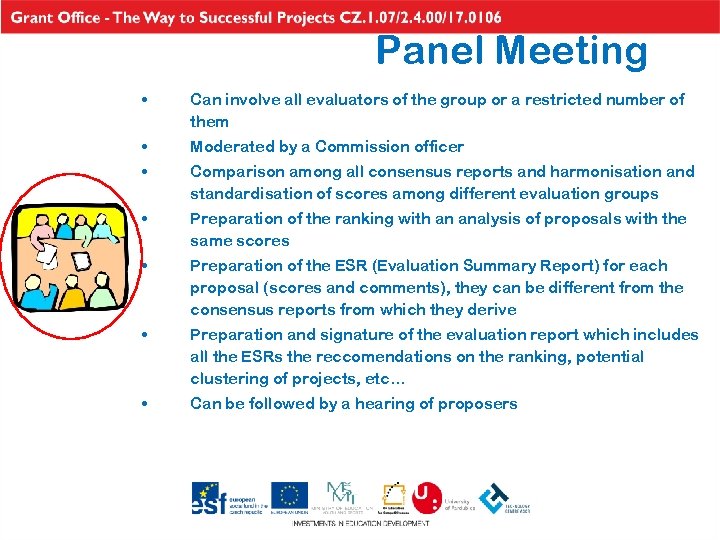 Panel Meeting • Can involve all evaluators of the group or a restricted number of them • Moderated by a Commission officer • Comparison among all consensus reports and harmonisation and standardisation of scores among different evaluation groups • Preparation of the ranking with an analysis of proposals with the same scores • Preparation of the ESR (Evaluation Summary Report) for each proposal (scores and comments), they can be different from the consensus reports from which they derive • Preparation and signature of the evaluation report which includes all the ESRs the reccomendations on the ranking, potential clustering of projects, etc… • Can be followed by a hearing of proposers
 Finalization • ESRs sent to coordinators – Informative letter – “Redress” procedure • Compilation by the commission of the final list which includes the projects to be negotiated, the reserve list and the budget limits • Information sent to the Programme Committee • Commission decision of rejected proposals and notification to related coordinators • Formal consultation of Programme Committee (when requested) • Notification of co-funded acceptance to coordinators and negotiation start • Definition of funded proposals • Analisis of evaluators’ performance and of the indipendent observer’ report
 Now that we know how it works…… Let’s see some common errors and suggestions on how to improve your proposal’ contents
 Suggestions Before preparation • Innovative idea • Verify you’re not “re-inventing the wheel” • Discuss the idea with reference project officers to verify if it is in line with the call expectations • Be sure that your is an “excellent” consortium • Read carefully the ‘Guide for proposers’ • …but also the ‘Evaluation criteria section’
 Suggestions Proposal writing l Consider that the evaluator has a limited time to read your proposal and that the experts’ group is composed by people with different backgrounds: è Try to create a good project objectives chapter putting on evidence what the project aims to achieve with clear and measurable statements (avoid generic sentences) è Try to find the right balancing among technicalities and simple language è Try not to create long documents è Do not write complicate acronyms or complex technical sentences without explaining them once in the document
 Suggestions Criteria 1: Scientific and Technical Quality • In the past a specific section was devoted to the Relevance to the call objectives. Now this is no more clearly stated but it can be useful to specify the congruence of the project by referring to specific parts of the call text and their link with the project objectives • Demonstrate the innovative value of the project • Compare (if better and innovative) your project with existing projects/applications • Comparison of your work with similar made in extra European countries can represent an added value (USA, Japan)
 Suggestions Implementation • Do not underestimate the importance to be given to the management scheme (use also images): – Give an accurate description of the duties, roles and relationships of the various project boards (Project management board, advisory board…) – Give an accurate description of the responsabilities of the principal project components (Project manager, WP leader…)
 Suggestions Implementation Things people always tend to forget: • Short Cvs of key personnel for each partner • A clear conflict resolution procedure • A description about IPR management • A quality control procedure • A project risk analysis with contingency plans – for example in a table format like: Risk impact Description Contingency plan
 Suggestions Implementation • • • Define clearly partner roles with reference to the workplan Define a reasonable resources allocation avoiding to over estimate expenses looking for “easy gains” Give a detailed description of the budget composition for each partner (really appreciated by evaluators also if not specifically requested by guidelines)
 Suggestions Impact • Impact definition must be convincing especially at European Level – Avoid generic sentences (the proposed research will contribute to reduce European pollution) – Better to estimate the potential impact through the provision of quantitative/qualitative data both at single partner level (e. g. “thanks to the proposed approach the partner xxx estimates a decrease of 20% in its time to market…. the proposed technology will contribute to reduce the production costs of 15%. . ) both at European sectorial level. – Dissemination plan – avoid generic descriptions (better to provide quantitative and verifiable objectives like: identification of the target audience, dissemination instruments to be used, number and kind of foreseen events and pubblications possibly providing also events and publications titles) – Explotation plan (a per partner level description is advisable together with a project level one)
 A last advice…. If you are coordinating a proposal preparation, try to exploit at maximum the whole team by sharing work loads, otherwise…. .
 massimo. busuoli@enea. it Thanks for the attention