 Скачать презентацию Methodology and practical experience in elaboration of aggregated
3af811dfc6061ce388930684f4e881d7.ppt
- Количество слайдов: 17



Methodology and practical experience in elaboration of aggregated ratings and indexes, measuring public management quality and efficiency Vladimir Eliseenko head of NPM technologies department HSE Institute for Public administration and public management executive secretary HSE coordination group for strategic development in PA research and teaching Higher School of Economics , Moscow, 2011 www. hse. ru
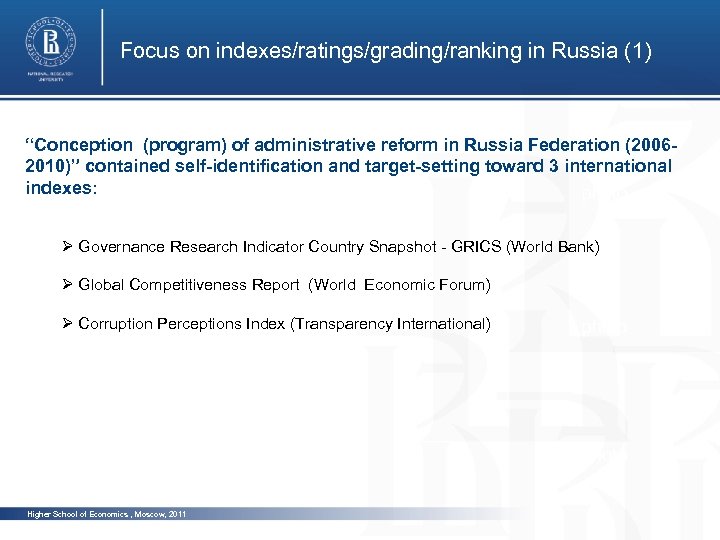
Focus on indexes/ratings/grading/ranking in Russia (1) “Conception (program) of administrative reform in Russia Federation (20062010)” contained self-identification and target-setting toward 3 international indexes: photo Ø Governance Research Indicator Country Snapshot - GRICS (World Bank) Ø Global Competitiveness Report (World Economic Forum) Ø Corruption Perceptions Index (Transparency International) photo Higher School of Economics , Moscow, 2011
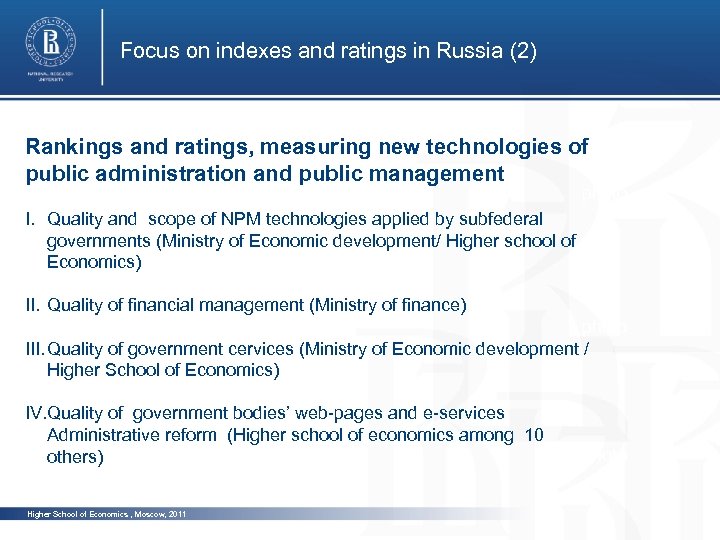
Focus on indexes and ratings in Russia (2) Rankings and ratings, measuring new technologies of public administration and public management photo I. Quality and scope of NPM technologies applied by subfederal governments (Ministry of Economic development/ Higher school of Economics) II. Quality of financial management (Ministry of finance) photo III. Quality of government cervices (Ministry of Economic development / Higher School of Economics) IV. Quality of government bodies’ web-pages and e-services Administrative reform (Higher school of economics among 10 others) Higher School of Economics , Moscow, 2011 photo
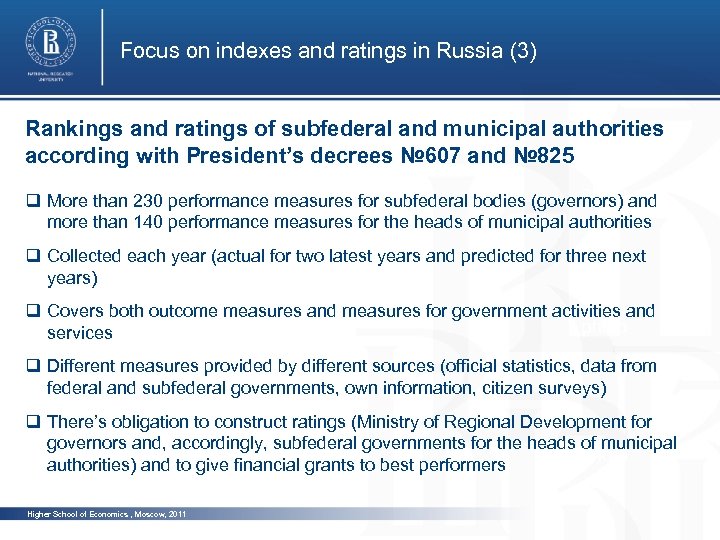
Focus on indexes and ratings in Russia (3) Rankings and ratings of subfederal and municipal authorities according with President’s decrees № 607 and № 825 photo q More than 230 performance measures for subfederal bodies (governors) and more than 140 performance measures for the heads of municipal authorities q Collected each year (actual for two latest years and predicted for three next years) q Covers both outcome measures and measures for government activities and photo services q Different measures provided by different sources (official statistics, data from federal and subfederal governments, own information, citizen surveys) q There’s obligation to construct ratings (Ministry of Regional Development for governors and, accordingly, subfederal governments for the heads of municipal photo authorities) and to give financial grants to best performers Higher School of Economics , Moscow, 2011
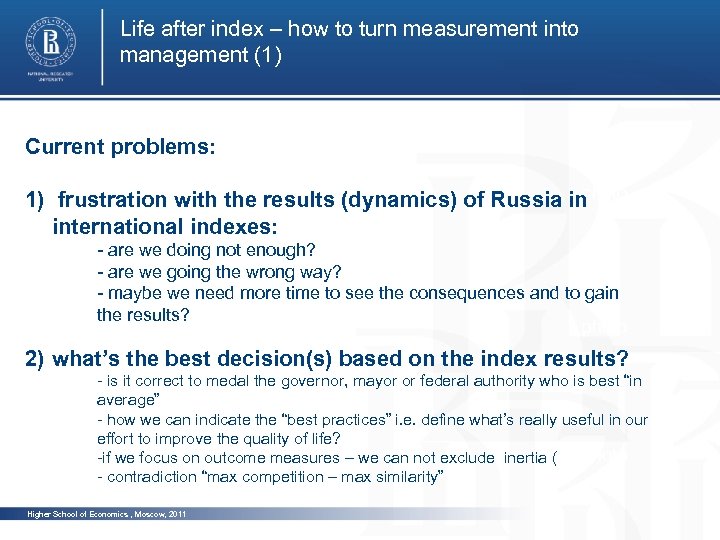
Life after index – how to turn measurement into management (1) Current problems: photo 1) frustration with the results (dynamics) of Russia in international indexes: - are we doing not enough? - are we going the wrong way? - maybe we need more time to see the consequences and to gain the results? photo 2) what’s the best decision(s) based on the index results? - is it correct to medal the governor, mayor or federal authority who is best “in average” - how we can indicate the “best practices” i. e. define what’s really useful in our effort to improve the quality of life? photo -if we focus on outcome measures – we can not exclude inertia ( - contradiction “max competition – max similarity” Higher School of Economics , Moscow, 2011
Life after index – how to turn measurement into management (2) photo Higher School of Economics , Moscow, 2011
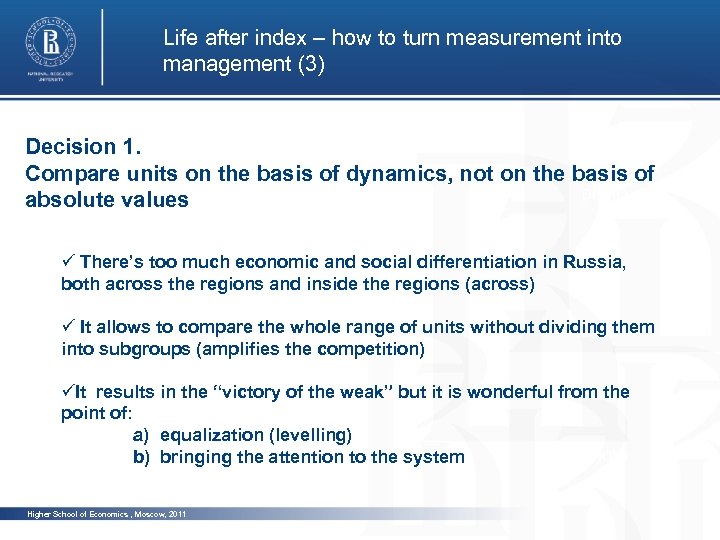
Life after index – how to turn measurement into management (3) Decision 1. Compare units on the basis of dynamics, not on the basis of photo absolute values ü There’s too much economic and social differentiation in Russia, both across the regions and inside the regions (across) ü It allows to compare the whole range of units without dividing them photo into subgroups (amplifies the competition) üIt results in the “victory of the weak” but it is wonderful from the point of: a) equalization (levelling) photo b) bringing the attention to the system Higher School of Economics , Moscow, 2011
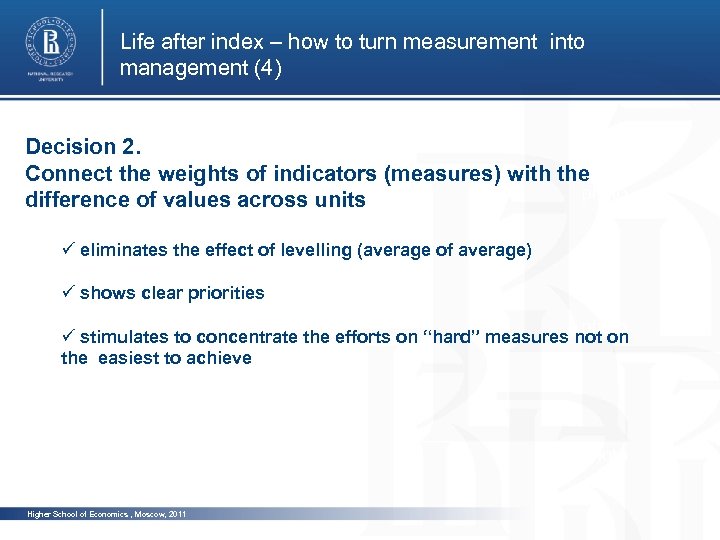
Life after index – how to turn measurement into management (4) Decision 2. Connect the weights of indicators (measures) with the photo difference of values across units ü eliminates the effect of levelling (average of average) ü shows clear priorities photo ü stimulates to concentrate the efforts on “hard” measures not on the easiest to achieve photo Higher School of Economics , Moscow, 2011
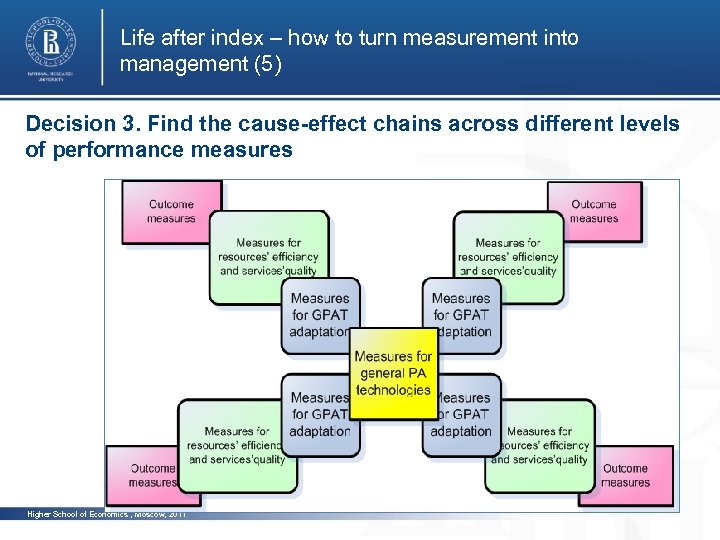
Life after index – how to turn measurement into management (5) Decision 3. Find the cause-effect chains across different levels of performance measures photo Higher School of Economics , Moscow, 2011
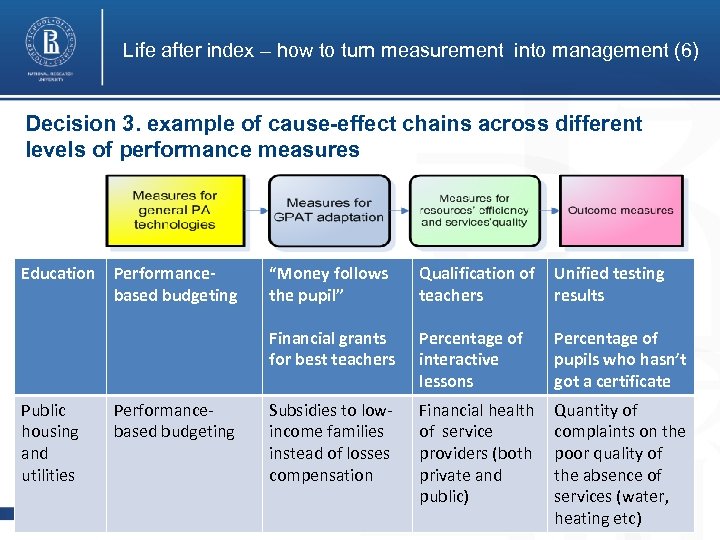
Life after index – how to turn measurement into management (6) Decision 3. example of cause-effect chains across different levels of performance measures photo Education Performancebased budgeting Higher School of Economics , Moscow, 2011 Qualification of teachers Unified testing results Financial grants for best teachers Public housing and utilities “Money follows the pupil” Percentage of interactive lessons photo Percentage of pupils who hasn’t got a certificate Subsidies to lowincome families instead of losses compensation Financial health of service providers (both private and public) Quantity of complaints on the poor quality of photo the absence of services (water, heating etc)
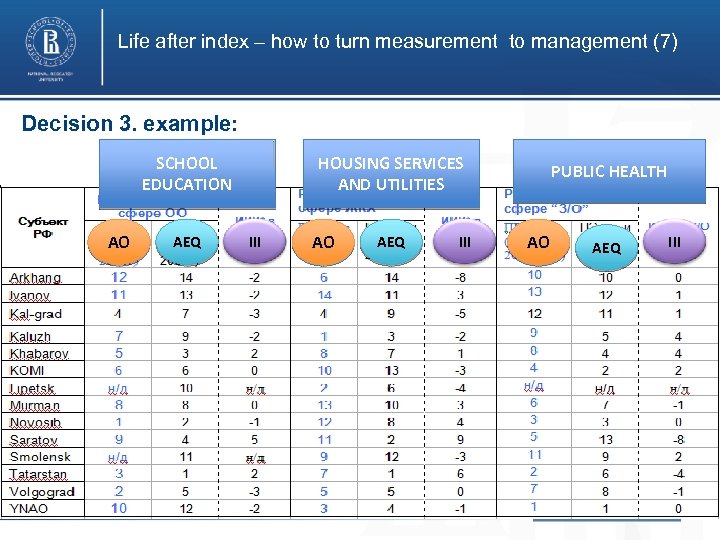
Life after index – how to turn measurement to management (7) Decision 3. example: SCHOOL EDUCATION AO AEQ HOUSING SERVICES AND UTILITIES III AO AEQ III PUBLIC HEALTH photo AO AEQ photo Higher School of Economics , Moscow, 2011 III
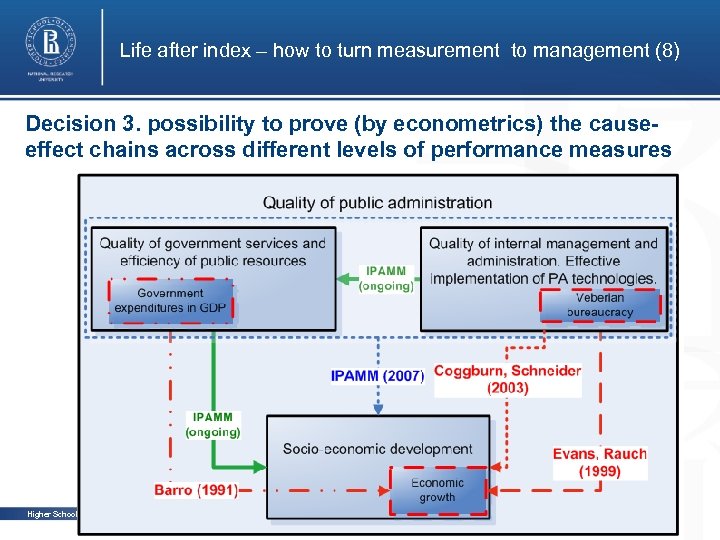
Life after index – how to turn measurement to management (8) Decision 3. possibility to prove (by econometrics) the causeeffect chains across different levels of performance measures photo Higher School of Economics , Moscow, 2011
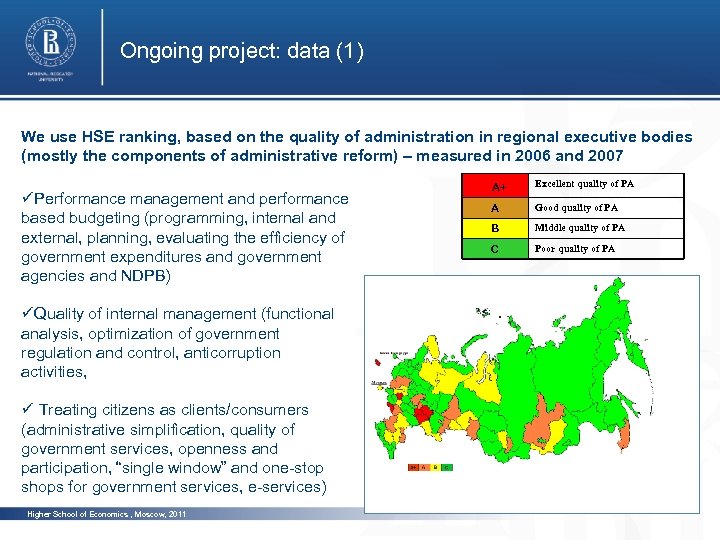
Ongoing project: data (1) We use HSE ranking, based on the quality of administration in regional executive bodies (mostly the components of administrative reform) – measured in 2006 and 2007 üPerformance management and performance based budgeting (programming, internal and external, planning, evaluating the efficiency of government expenditures and government agencies and NDPB) üQuality of internal management (functional analysis, optimization of government regulation and control, anticorruption activities, ü Treating citizens as clients/consumers (administrative simplification, quality of government services, openness and participation, “single window” and one-stop shops for government services, e-services) Higher School of Economics , Moscow, 2011 А+ Excellent quality of PA photo А Good quality of PA В Middle quality of PA С Poor quality of PA photo
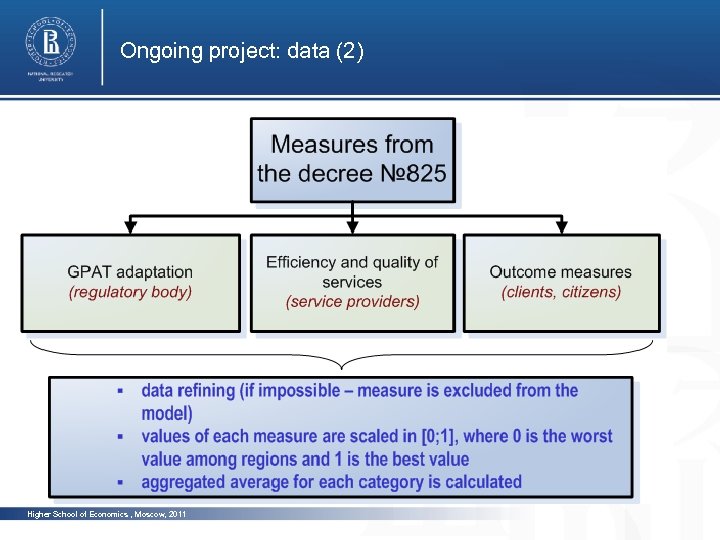
Ongoing project: data (2) photo Higher School of Economics , Moscow, 2011
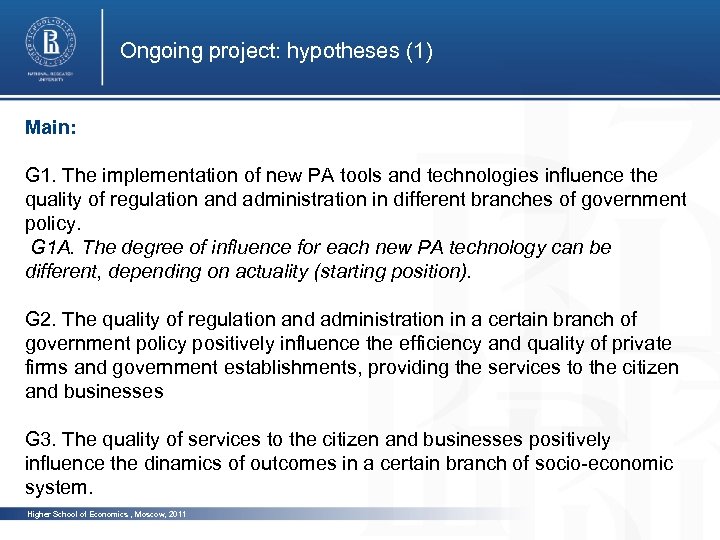
Ongoing project: hypotheses (1) Main: G 1. The implementation of new PA tools and technologies influence the photo quality of regulation and administration in different branches of government policy. G 1 A. The degree of influence for each new PA technology can be different, depending on actuality (starting position). G 2. The quality of regulation and administration in a certain branch of photo government policy positively influence the efficiency and quality of private firms and government establishments, providing the services to the citizen and businesses G 3. The quality of services to the citizen and businesses positively photo influence the dinamics of outcomes in a certain branch of socio-economic system. Higher School of Economics , Moscow, 2011
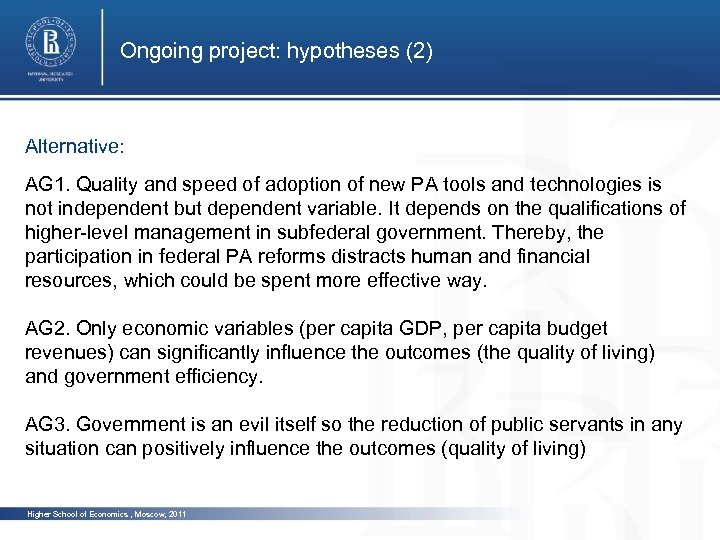
Ongoing project: hypotheses (2) Alternative: AG 1. Quality and speed of adoption of new PA tools and technologies is photo not independent but dependent variable. It depends on the qualifications of higher-level management in subfederal government. Thereby, the participation in federal PA reforms distracts human and financial resources, which could be spent more effective way. AG 2. Only economic variables (per capita GDP, per capita budget revenues) can significantly influence the outcomes (the quality of living) and government efficiency. AG 3. Government is an evil itself so the reduction of public servants in any situation can positively influence the outcomes (quality of living)photo Higher School of Economics , Moscow, 2011

Vladimir Eliseenko e-mail: veliseenko@hse. ru room k-204 20, Myasnitskaya str. , Moscow, Russia, Phone. : +7 -916 -596 -6620
Скачать презентацию Methodology and practical experience in elaboration of aggregated
3af811dfc6061ce388930684f4e881d7.ppt