 Скачать презентацию Methodological handbook for teachers Comenius 2008 -2010
2f493b35a2dc1aac8fa172c8e752ef7b.ppt
- Количество слайдов: 29



Methodological handbook for teachers – Comenius 2008 -2010
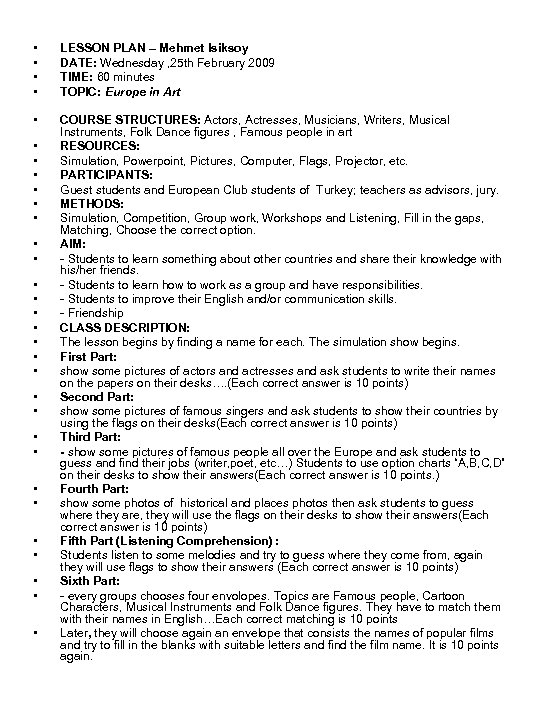
• • LESSON PLAN – Mehmet Isiksoy DATE: Wednesday , 25 th February 2009 TIME: 60 minutes TOPIC: Europe in Art • COURSE STRUCTURES: Actors, Actresses, Musicians, Writers, Musical Instruments, Folk Dance figures , Famous people in art RESOURCES: Simulation, Powerpoint, Pictures, Computer, Flags, Projector, etc. PARTICIPANTS: Guest students and European Club students of Turkey; teachers as advisors, jury. METHODS: Simulation, Competition, Group work, Workshops and Listening, Fill in the gaps, Matching, Choose the correct option. AIM: - Students to learn something about other countries and share their knowledge with his/her friends. - Students to learn how to work as a group and have responsibilities. - Students to improve their English and/or communication skills. - Friendship CLASS DESCRIPTION: The lesson begins by finding a name for each. The simulation show begins. First Part: show some pictures of actors and actresses and ask students to write their names on the papers on their desks…. (Each correct answer is 10 points) Second Part: show some pictures of famous singers and ask students to show their countries by using the flags on their desks(Each correct answer is 10 points) Third Part: - show some pictures of famous people all over the Europe and ask students to guess and find their jobs (writer, poet, etc…) Students to use option charts “A, B, C, D” on their desks to show their answers(Each correct answer is 10 points. ) Fourth Part: show some photos of historical and places photos then ask students to guess where they are, they will use the flags on their desks to show their answers(Each correct answer is 10 points) Fifth Part (Listening Comprehension) : Students listen to some melodies and try to guess where they come from, again they will use flags to show their answers (Each correct answer is 10 points) Sixth Part: - every groups chooses four envolopes. Topics are Famous people, Cartoon Characters, Musical Instruments and Folk Dance figures. They have to match them with their names in English…Each correct matching is 10 points Later, they will choose again an envelope that consists the names of popular films and try to fill in the blanks with suitable letters and find the film name. It is 10 points again. • • • • • • •
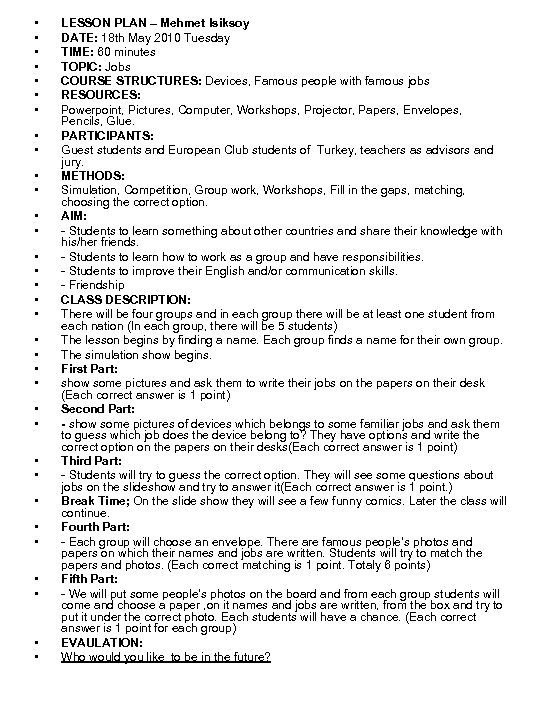
• • • • • • • • • LESSON PLAN – Mehmet Isiksoy DATE: 18 th May 2010 Tuesday TIME: 60 minutes TOPIC: Jobs COURSE STRUCTURES: Devices, Famous people with famous jobs RESOURCES: Powerpoint, Pictures, Computer, Workshops, Projector, Papers, Envelopes, Pencils, Glue. PARTICIPANTS: Guest students and European Club students of Turkey, teachers as advisors and jury. METHODS: Simulation, Competition, Group work, Workshops, Fill in the gaps, matching, choosing the correct option. AIM: - Students to learn something about other countries and share their knowledge with his/her friends. - Students to learn how to work as a group and have responsibilities. - Students to improve their English and/or communication skills. - Friendship CLASS DESCRIPTION: There will be four groups and in each group there will be at least one student from each nation (In each group, there will be 5 students) The lesson begins by finding a name. Each group finds a name for their own group. The simulation show begins. First Part: show some pictures and ask them to write their jobs on the papers on their desk (Each correct answer is 1 point) Second Part: - show some pictures of devices which belongs to some familiar jobs and ask them to guess which job does the device belong to? They have options and write the correct option on the papers on their desks(Each correct answer is 1 point) Third Part: - Students will try to guess the correct option. They will see some questions about jobs on the slideshow and try to answer it(Each correct answer is 1 point. ) Break Time; On the slide show they will see a few funny comics. Later the class will continue. Fourth Part: - Each group will choose an envelope. There are famous people’s photos and papers on which their names and jobs are written. Students will try to match the papers and photos. (Each correct matching is 1 point. Totaly 6 points) Fifth Part: - We will put some people’s photos on the board and from each group students will come and choose a paper , on it names and jobs are written, from the box and try to put it under the correct photo. Each students will have a chance. (Each correct answer is 1 point for each group) EVAULATION: Who would you like to be in the future?
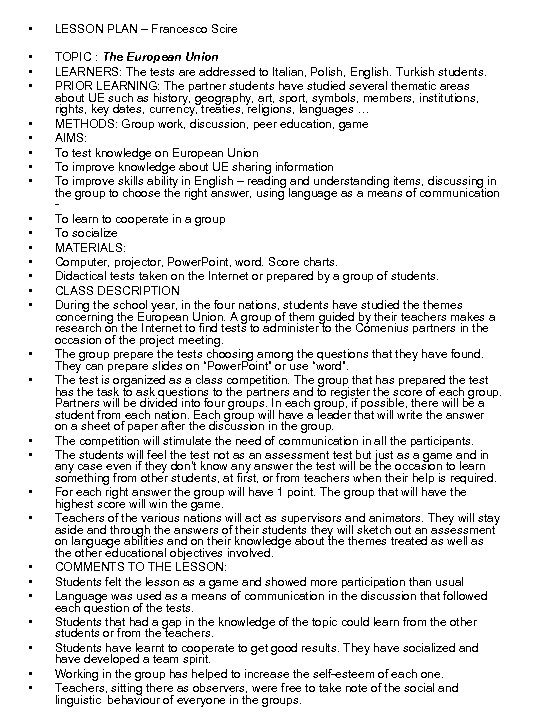
• LESSON PLAN – Francesco Scire • • • TOPIC : The European Union LEARNERS: The tests are addressed to Italian, Polish, English. Turkish students. PRIOR LEARNING: The partner students have studied several thematic areas about UE such as history, geography, art, sport, symbols, members, institutions, rights, key dates, currency, treaties, religions, languages … METHODS: Group work, discussion, peer education, game AIMS: To test knowledge on European Union To improve knowledge about UE sharing information To improve skills ability in English – reading and understanding items, discussing in the group to choose the right answer, using language as a means of communication To learn to cooperate in a group To socialize MATERIALS: Computer, projector, Power. Point, word. Score charts. Didactical tests taken on the Internet or prepared by a group of students. CLASS DESCRIPTION During the school year, in the four nations, students have studied themes concerning the European Union. A group of them guided by their teachers makes a research on the Internet to find tests to administer to the Comenius partners in the occasion of the project meeting. The group prepare the tests choosing among the questions that they have found. They can prepare slides on “Power. Point” or use “word”. The test is organized as a class competition. The group that has prepared the test has the task to ask questions to the partners and to register the score of each group. Partners will be divided into four groups. In each group, if possible, there will be a student from each nation. Each group will have a leader that will write the answer on a sheet of paper after the discussion in the group. The competition will stimulate the need of communication in all the participants. The students will feel the test not as an assessment test but just as a game and in any case even if they don’t know any answer the test will be the occasion to learn something from other students, at first, or from teachers when their help is required. For each right answer the group will have 1 point. The group that will have the highest score will win the game. Teachers of the various nations will act as supervisors and animators. They will stay aside and through the answers of their students they will sketch out an assessment on language abilities and on their knowledge about themes treated as well as the other educational objectives involved. COMMENTS TO THE LESSON: Students felt the lesson as a game and showed more participation than usual Language was used as a means of communication in the discussion that followed each question of the tests. Students that had a gap in the knowledge of the topic could learn from the other students or from the teachers. Students have learnt to cooperate to get good results. They have socialized and have developed a team spirit. Working in the group has helped to increase the self-esteem of each one. Teachers, sitting there as observers, were free to take note of the social and linguistic behaviour of everyone in the groups. • • • • • • •
• mgr Katarzyna Drabik • • • LESSON PLAN European diversity. Customs and traditions. LEVEL: Pre-intermediate TOPIC: European diversity. Customs and traditions. LANGUAGE: Vocabulary connected with geography, history, European facts, TV programmes TIME: 1, 5 h LEARNERS: Students from Poland, Turkey, England Italy as part of Comenius Project AIMS: Students: know something about partner countries, share their knowledge with other people, divide roles and responsibilities, select and present the information they have gathered, develop speaking skills, use English during the classes ( treat foreign language as a tool of communication), cooperate in groups, MATERIALS: Materials prepared by students: score charts, topic charts, photos, pictures etc Classroom staff: Computer, projector, CDplayer TEACHING METHODS: explaining demonstrating brainstorming collaborating problem solving LESSON STAGES: Warming-up questions: Which TV Quizzes do you like watching in your country? What are the most important features of a good TV Quiz? A multimedia display: Short parts of popular TV shows from different countries – video presentations Group work (stage 1): Students divide roles to organize the TV Quiz – 3 groups of 6 students. The participants of the quiz choose the topic and answer questions about traditional music, dances, fashion, art, famous people, plants, animals and cuisine. The quiz is organized as a class competition. A multimedia display: All the questions and tasks are accompanied by the visual and audio materials. Discussion: Students consult some difficult issues with teachers’ support teams – they discuss all the difficult parts of Quiz. A multimedia display: Presentation of tasks for all participants, counting the scores Evaluation European facts - what do we remember? – the game • • • • • • • • •
• • BYTOM, 28. 01. 2010 MGR AGNIESZKA GROMBIK • • LESSON PLAN Small Economics LEVEL: Pre-intermediate TOPIC: Little economics LANGUAGE: Vocabulary connected with money TIME: 1, 5 h LEARNERS: Students from Poland, Turkey, England Italy as part of Comenius Project AIMS: -Developing Speaking Skills (talking about wise money management and saving) - Cooperating in groups - Creative problem solving - Expressing opinions, suggestions and feelings - Responding to other people’s opinion and using the register or language variety that is appropriate to the situation and the relationship to the conversation partner - using vocabulary connected with money issues appropriately MATERIALS: -Worksheet 1: monthly expenses -Worksheet 2: “You and Money” quiz - Multimedia displays: 1. “Money makes the world go round”- Students learn the currency of Italy, England, Turkey and Poland 2. Shopping tips that add up to big savings 3. Few steps to become money maker TEACHING METHODS: -demonstrating -explaining -collaborating - brainstorming -problem solving LESSON STAGES: Warming-up questions: How many Euros do you think European teenagers collectively spend every year? How much money do you think European teenagers earn? A multimedia display: Students learn Italian, English, Turkish and Polish currency. • • • • • • •
• • • • • Group work (worksheet 1): Students do speaking in groups of 6. They try to figure out what they spend most of their pocket money on and compare their monthly expenses. While collaborating, students are supposed to find out the biggest money spender and most thrifty person in their group. When ready, learners present and comment their results to the rest of the class. A multimedia display: Shopping Tips- Students learn few useful tips that add up to bigger savings and will help them to manage their money in a better and more effective way. Discussion: Students share their best saving ideas and shopping tips that will turn out to be very useful to create good, lucrative shopping and saving habits. You and Money Quiz: Students do the quiz to learn how money savvy they really are. (Retrieved from: http: //www. pearsonlongman. com/adult/pdf/you_and_money_t. pdf) A multimedia display: Students learn how to become money makers, multiply their savings and invest money well. A multimedia display: Students are provided with the halves of sentences and they try to complete them according to their own ideas and feelings. If I had a lot of Money, I …. Money is what I …. Independent practice -Learners write their financial resolutions on paper coins. When ready, they stick it on a big “piggy bank” poster. Evaluation -For being active and committed to the classroom work learners are praised with chocolate coins. From 25 to 29 January 2010 Polish school in Bytom was playing a host to quests from Turkey, England Italy. Both fun and education became an integral part of children’s stay in Poland. The learners took part in a “small economics” lesson which was designed to help teens learn the importance of good money management before they are out on their own where a mistake could lead them into money troubles or even bankruptcy. They were provided with some simple yet useful financial tips which will help them to become money wise and add to their future household running. Working in groups and shared tasks motivated learners to use English language as a main tool in conversation. They could see that vocabulary and grammar rules are not learnt for their own sake only, but they also give students a chance for better understanding of life, traditions and customs from other countries. It opens the door to real life communication without any barriers or fears. Although money management is perceived as a rather difficult subject for young learners, all participants demonstrated a lot of interest. Friendly atmosphere and proper attitude made learners eager to cooperate and take active part in constructive discussion. At the end of the class, learners were asked to write their New Year financial resolutions on paper coins and stick them to a collective paper piggy bank. For an active participation and engagement learners were prized with chocolate coins
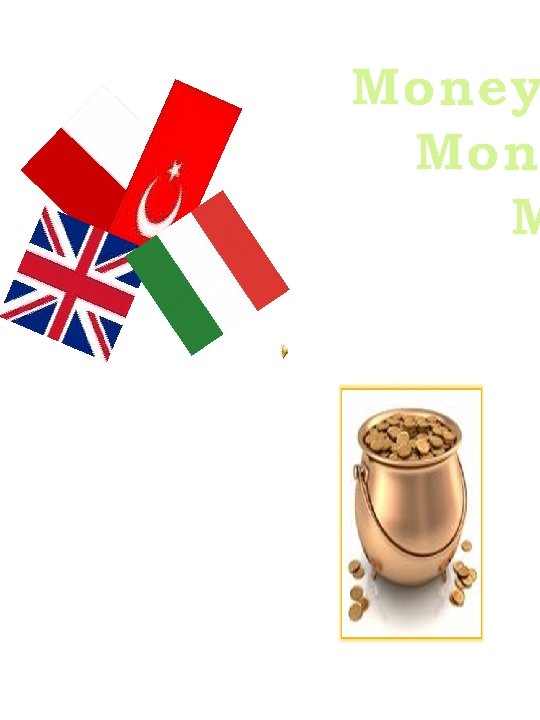
Money Mon M

MONEY MAKES THE WORLD GO ROUND
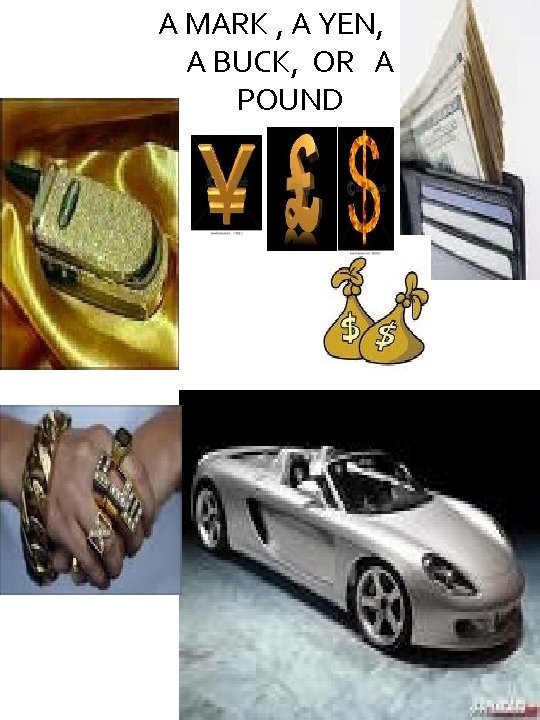
A MARK , A YEN, A BUCK, OR A POUND
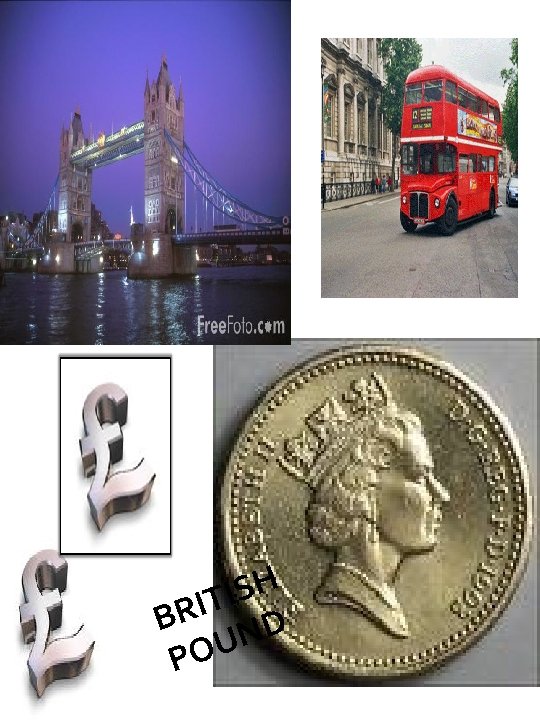
< ISH RIT D B UN PO
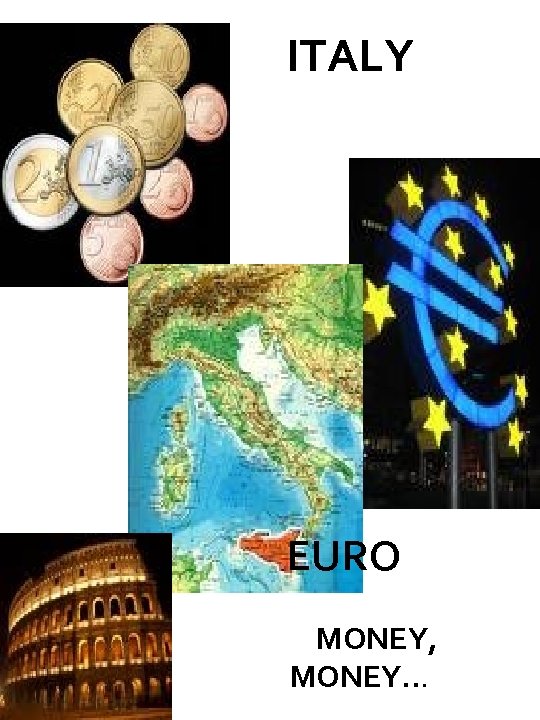
ITALY EURO MONEY, MONEY. . .
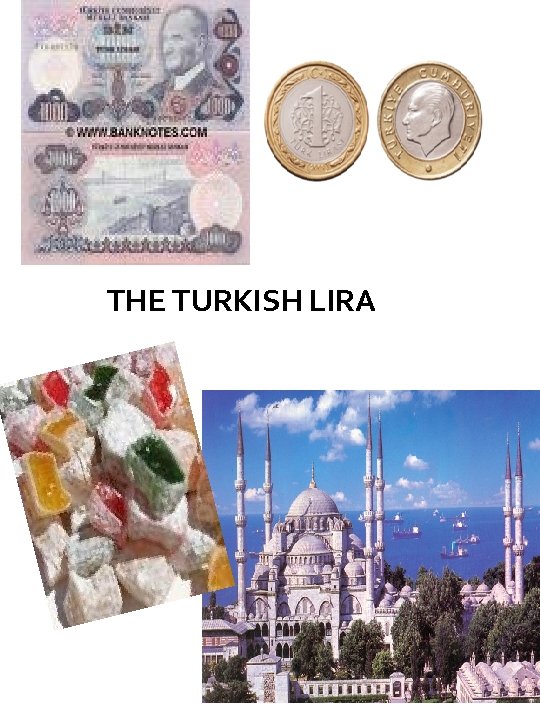
THE TURKISH LIRA
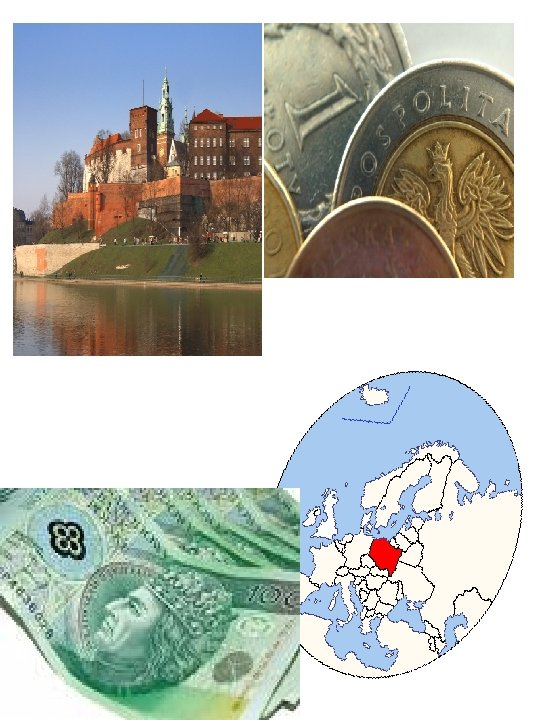
POLISH ZŁOTY
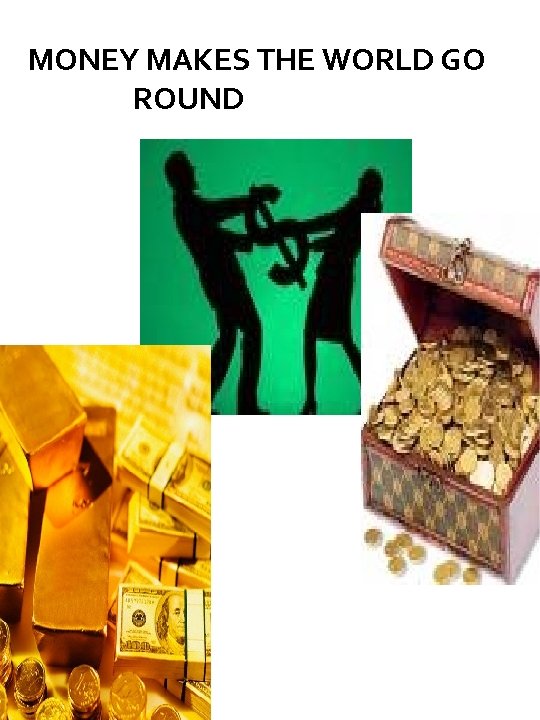
MONEY MAKES THE WORLD GO ROUND
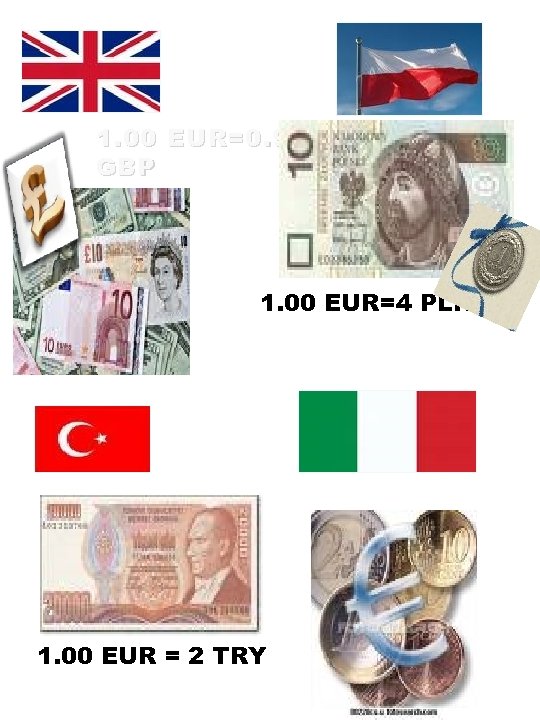
1. 00 EUR=0. 9 GBP R 1. 00 EUR=4 PLN 1. 00 EUR = 2 TRY
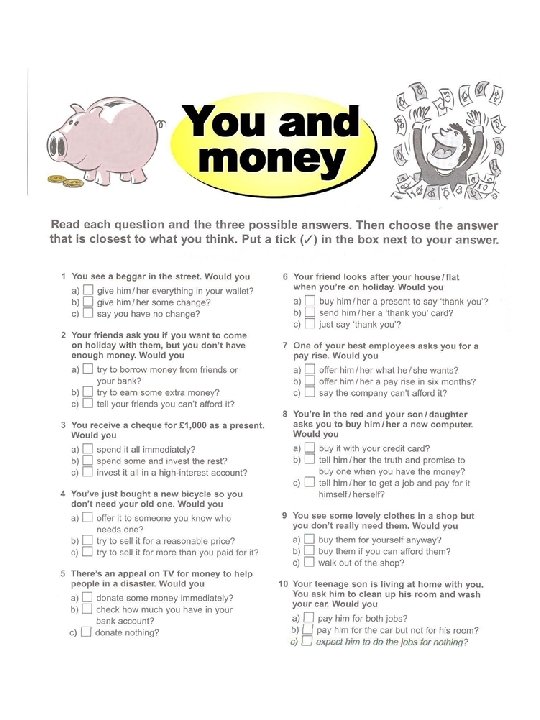
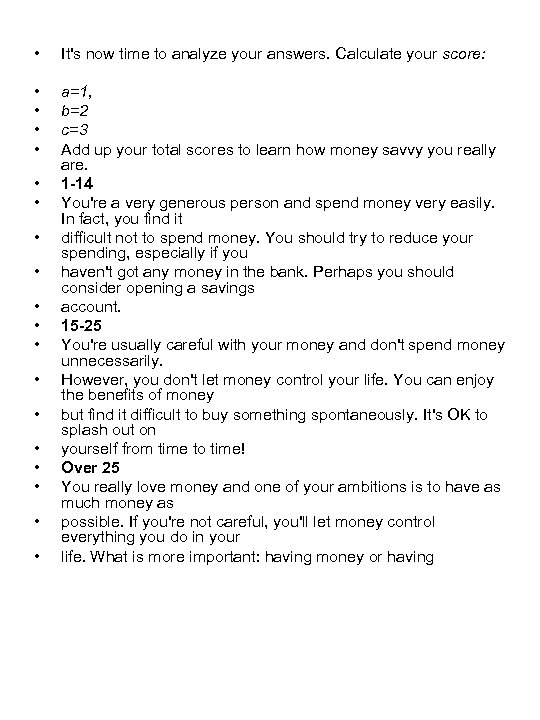
• It's now time to analyze your answers. Calculate your score: • • a=1, b=2 c=3 Add up your total scores to learn how money savvy you really are. 1 -14 You're a very generous person and spend money very easily. In fact, you find it difficult not to spend money. You should try to reduce your spending, especially if you haven't got any money in the bank. Perhaps you should consider opening a savings account. 15 -25 You're usually careful with your money and don't spend money unnecessarily. However, you don't let money control your life. You can enjoy the benefits of money but find it difficult to buy something spontaneously. It's OK to splash out on yourself from time to time! Over 25 You really love money and one of your ambitions is to have as much money as possible. If you're not careful, you'll let money control everything you do in your life. What is more important: having money or having • • • •
TIPS THAT ADD UP TO BIG SAVINGS
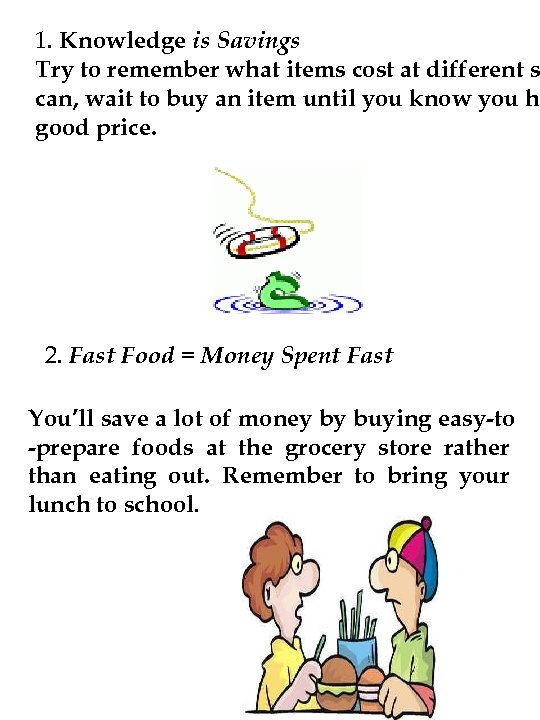
1. Knowledge is Savings Try to remember what items cost at different s can, wait to buy an item until you know you ha good price. 2. Fast Food = Money Spent Fast You’ll save a lot of money by buying easy-to -prepare foods at the grocery store rather than eating out. Remember to bring your lunch to school.
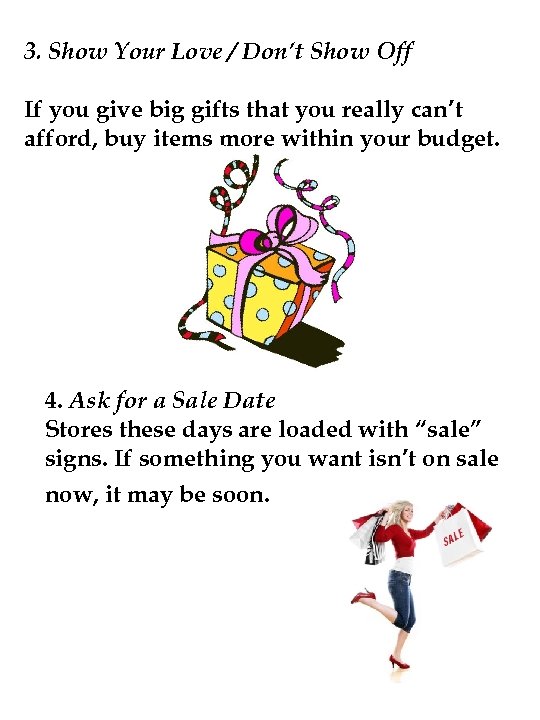
3. Show Your Love / Don’t Show Off If you give big gifts that you really can’t afford, buy items more within your budget. 4. Ask for a Sale Date Stores these days are loaded with “sale” signs. If something you want isn’t on sale now, it may be soon.
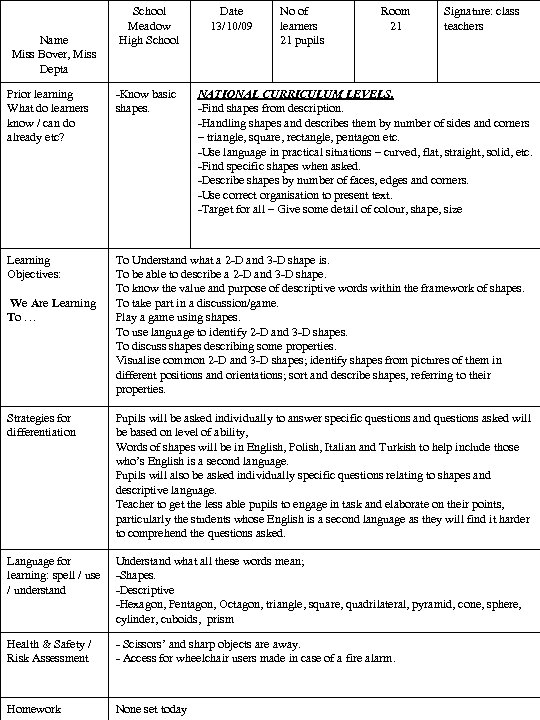
Name Miss Bover, Miss Depta School Meadow High School Date 13/10/09 No of learners 21 pupils Room 21 Signature: class teachers Prior learning What do learners know / can do already etc? -Know basic shapes. Learning Objectives: To Understand what a 2 -D and 3 -D shape is. To be able to describe a 2 -D and 3 -D shape. To know the value and purpose of descriptive words within the framework of shapes. To take part in a discussion/game. Play a game using shapes. To use language to identify 2 -D and 3 -D shapes. To discuss shapes describing some properties. Visualise common 2 -D and 3 -D shapes; identify shapes from pictures of them in different positions and orientations; sort and describe shapes, referring to their properties. We Are Learning To … NATIONAL CURRICULUM LEVELS. -Find shapes from description. -Handling shapes and describes them by number of sides and corners – triangle, square, rectangle, pentagon etc. -Use language in practical situations – curved, flat, straight, solid, etc. -Find specific shapes when asked. -Describe shapes by number of faces, edges and corners. -Use correct organisation to present text. -Target for all – Give some detail of colour, shape, size Strategies for differentiation Pupils will be asked individually to answer specific questions and questions asked will be based on level of ability, Words of shapes will be in English, Polish, Italian and Turkish to help include those who’s English is a second language. Pupils will also be asked individually specific questions relating to shapes and descriptive language. Teacher to get the less able pupils to engage in task and elaborate on their points, particularly the students whose English is a second language as they will find it harder to comprehend the questions asked. Language for learning: spell / use / understand Understand what all these words mean; -Shapes. -Descriptive -Hexagon, Pentagon, Octagon, triangle, square, quadrilateral, pyramid, cone, sphere, cylinder, cuboids, prism Health & Safety / Risk Assessment - Scissors’ and sharp objects are away. - Access for wheelchair users made in case of a fire alarm. Homework None set today
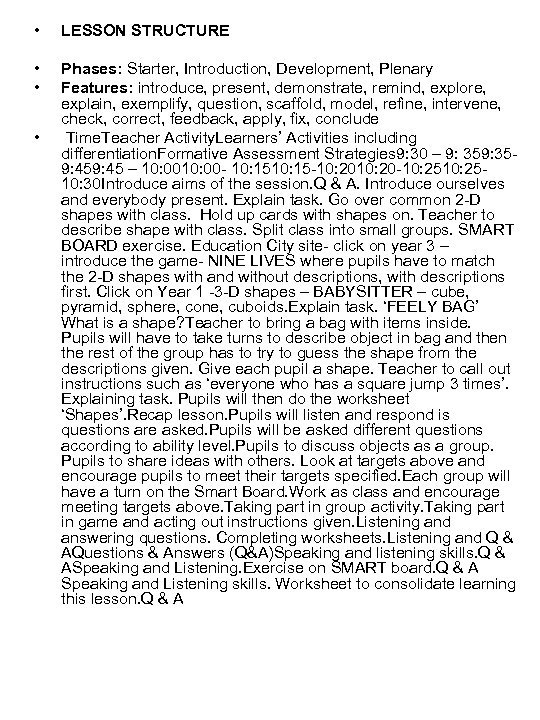
• LESSON STRUCTURE • • Phases: Starter, Introduction, Development, Plenary Features: introduce, present, demonstrate, remind, explore, explain, exemplify, question, scaffold, model, refine, intervene, check, correct, feedback, apply, fix, conclude Time. Teacher Activity. Learners’ Activities including differentiation. Formative Assessment Strategies 9: 30 – 9: 359: 45 – 10: 00 - 10: 15 -10: 20 -10: 2510: 30 Introduce aims of the session. Q & A. Introduce ourselves and everybody present. Explain task. Go over common 2 -D shapes with class. Hold up cards with shapes on. Teacher to describe shape with class. Split class into small groups. SMART BOARD exercise. Education City site- click on year 3 – introduce the game- NINE LIVES where pupils have to match the 2 -D shapes with and without descriptions, with descriptions first. Click on Year 1 -3 -D shapes – BABYSITTER – cube, pyramid, sphere, cone, cuboids. Explain task. ‘FEELY BAG’ What is a shape? Teacher to bring a bag with items inside. Pupils will have to take turns to describe object in bag and then the rest of the group has to try to guess the shape from the descriptions given. Give each pupil a shape. Teacher to call out instructions such as ‘everyone who has a square jump 3 times’. Explaining task. Pupils will then do the worksheet ‘Shapes’. Recap lesson. Pupils will listen and respond is questions are asked. Pupils will be asked different questions according to ability level. Pupils to discuss objects as a group. Pupils to share ideas with others. Look at targets above and encourage pupils to meet their targets specified. Each group will have a turn on the Smart Board. Work as class and encourage meeting targets above. Taking part in group activity. Taking part in game and acting out instructions given. Listening and answering questions. Completing worksheets. Listening and Q & AQuestions & Answers (Q&A)Speaking and listening skills. Q & ASpeaking and Listening. Exercise on SMART board. Q & A Speaking and Listening skills. Worksheet to consolidate learning this lesson. Q & A •
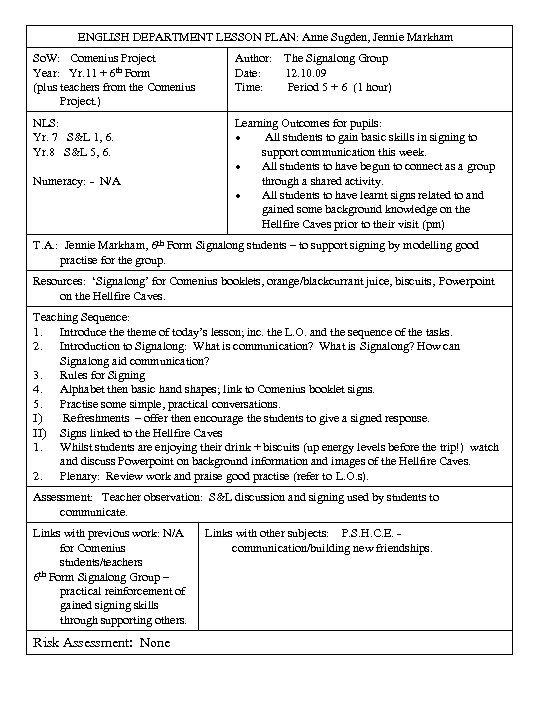
ENGLISH DEPARTMENT LESSON PLAN: Anne Sugden, Jennie Markham So. W: Comenius Project Year: Yr. 11 + 6 th Form (plus teachers from the Comenius Project. ) Author: Date: Time: NLS: Yr. 7 S&L 1, 6. Yr. 8 S&L 5, 6. Learning Outcomes for pupils: All students to gain basic skills in signing to support communication this week. All students to have begun to connect as a group through a shared activity. All students to have learnt signs related to and gained some background knowledge on the Hellfire Caves prior to their visit (pm) Numeracy: - N/A The Signalong Group 12. 10. 09 Period 5 + 6 (1 hour) T. A. : Jennie Markham, 6 th Form Signalong students – to support signing by modelling good practise for the group. Resources: ‘Signalong’ for Comenius booklets, orange/blackcurrant juice, biscuits, Powerpoint on the Hellfire Caves. Teaching Sequence: 1. Introduce theme of today’s lesson; inc. the L. O. and the sequence of the tasks. 2. Introduction to Signalong: What is communication? What is Signalong? How can Signalong aid communication? 3. Rules for Signing 4. Alphabet then basic hand shapes; link to Comenius booklet signs. 5. Practise some simple, practical conversations. I) Refreshments – offer then encourage the students to give a signed response. II) Signs linked to the Hellfire Caves 1. Whilst students are enjoying their drink + biscuits (up energy levels before the trip!) watch and discuss Powerpoint on background information and images of the Hellfire Caves. 2. Plenary: Review work and praise good practise (refer to L. O. s). Assessment: Teacher observation: S&L discussion and signing used by students to communicate. Links with previous work: N/A for Comenius students/teachers th Form Signalong Group – 6 practical reinforcement of gained signing skills through supporting others. Risk Assessment: None Links with other subjects: P. S. H. C. E. communication/building new friendships.
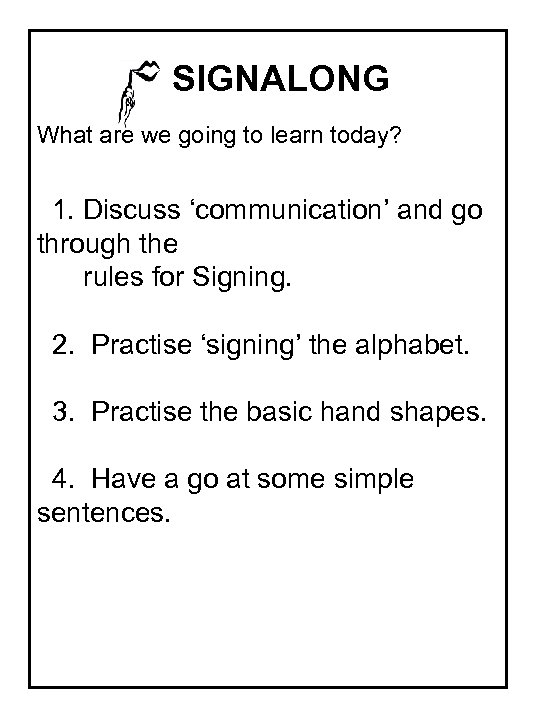
SIGNALONG What are we going to learn today? 1. Discuss ‘communication’ and go through the rules for Signing. 2. Practise ‘signing’ the alphabet. 3. Practise the basic hand shapes. 4. Have a go at some simple sentences.
SIGNALONG What is Signalong? What do we mean by communication? How can Signalong help communication? • encourage the use of body language and tone of voice • create a common language to support when words fail!
SIGNALONG Key Points to remember when signing q Always use the same working and supporting hand. q Make sure that you gain child’s eye contact or attention. q Always sign when you speak. q Use real objects to help the communication if they are available. q Only sign key words. q Be patient do not guess or anticipate the words. q Make sure you sign in the signing window. q Use appropriate facial expressions, gestures and body language when communicating and signing. q Try not to guess signs; look in the book
What are the key words we need to sign for this ‘communication’? Person 1: Would you like to drink? Person 2: Yes, please. Person 1: Would you like orange, blackcurrant, tea or coffee? Person 2: I would like please. What are the key words we need to sign for this ‘communication’? Person 1: We are going on a visit. Person 2: Where are we going? Person 1: We are going to the Hell Fire Caves Person 2: Help! I’m scared!
“The project has been realized by the financial support of the European Union as part of the Socrates-Comenius programme. The contest of the project and its materials do not represent the European Union’s or the National Agency views in any of the cases. Neither European Union nor the National Agency is responsible for the contest of the published materials. ”
Скачать презентацию Methodological handbook for teachers Comenius 2008 -2010
2f493b35a2dc1aac8fa172c8e752ef7b.ppt