


 Скачать презентацию METHADONE VS NON-METHADONE PATIENTS IN A THERAPEUTIC COMMUNITY
1f10f3d4c8babb5ae5c58eb2b58f5f4a.ppt
- Количество слайдов: 1
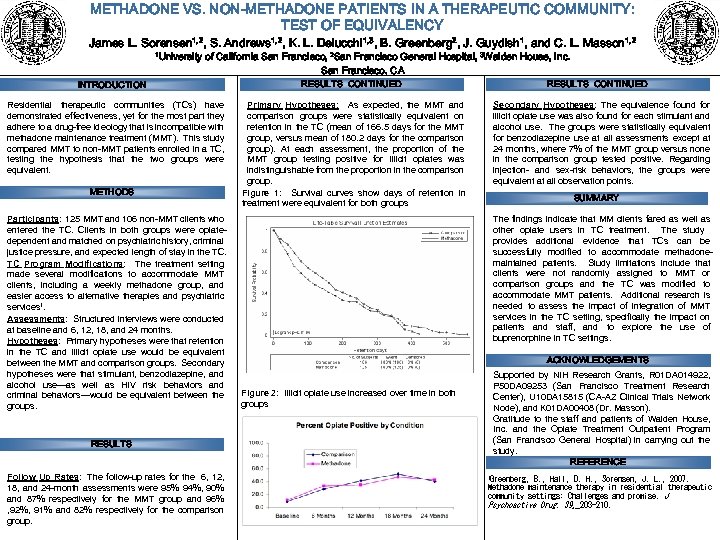 METHADONE VS. NON-METHADONE PATIENTS IN A THERAPEUTIC COMMUNITY: TEST OF EQUIVALENCY James L. Sorensen 1, 2, S. Andrews 1, 2, K. L. Delucchi 1, 3, B. Greenberg 2, J. Guydish 1, and C. L. Masson 1, 2 1 University of California San Francisco, 2 San Francisco General Hospital, 3 Walden House, Inc. San Francisco, CA INTRODUCTION Residential therapeutic communities (TCs) have demonstrated effectiveness, yet for the most part they adhere to a drug-free ideology that is incompatible with methadone maintenance treatment (MMT). This study compared MMT to non-MMT patients enrolled in a TC, testing the hypothesis that the two groups were equivalent. METHODS Participants: 125 MMT and 106 non-MMT clients who entered the TC. Clients in both groups were opiatedependent and matched on psychiatric history, criminal justice pressure, and expected length of stay in the TC. TC Program Modifications: The treatment setting made several modifications to accommodate MMT clients, including a weekly methadone group, and easier access to alternative therapies and psychiatric services 1. Assessments: Structured interviews were conducted at baseline and 6, 12, 18, and 24 months. Hypotheses: Primary hypotheses were that retention in the TC and illicit opiate use would be equivalent between the MMT and comparison groups. Secondary hypotheses were that stimulant, benzodiazepine, and alcohol use—as well as HIV risk behaviors and criminal behaviors---would be equivalent between the groups. RESULTS Follow Up Rates: The follow-up rates for the 6, 12, 18, and 24 -month assessments were 95% 94%, 90% and 87% respectively for the MMT group and 96% , 92%, 91% and 82% respectively for the comparison group. RESULTS CONTINUED Primary Hypotheses: As expected, the MMT and comparison groups were statistically equivalent on retention in the TC (mean of 166. 5 days for the MMT group, versus mean of 180. 2 days for the comparison group). At each assessment, the proportion of the MMT group testing positive for illicit opiates was indistinguishable from the proportion in the comparison group. Figure 1: Survival curves show days of retention in treatment were equivalent for both groups RESULTS CONTINUED Secondary Hypotheses: The equivalence found for illicit opiate use was also found for each stimulant and alcohol use. The groups were statistically equivalent for benzodiazepine use at all assessments except at 24 months, where 7% of the MMT group versus none in the comparison group tested positive. Regarding injection- and sex-risk behaviors, the groups were equivalent at all observation points. SUMMARY The findings indicate that MM clients fared as well as other opiate users in TC treatment. The study provides additional evidence that TCs can be successfully modified to accommodate methadonemaintained patients. Study limitations include that clients were not randomly assigned to MMT or comparison groups and the TC was modified to accommodate MMT patients. Additional research is needed to assess the impact of integration of MMT services in the TC setting, specifically the impact on patients and staff, and to explore the use of buprenorphine in TC settings. ACKNOWLEDGEMENTS Figure 2: Illicit opiate use increased over time in both groups Supported by NIH Research Grants, R 01 DA 014922, P 50 DA 09253 (San Francisco Treatment Research Center), U 10 DA 15815 (CA-AZ Clinical Trials Network Node), and K 01 DA 00408 (Dr. Masson). Gratitude to the staff and patients of Walden House, Inc. and the Opiate Treatment Outpatient Program (San Francisco General Hospital) in carrying out the study. REFERENCE 1 Greenberg, B. , Hall, D. H. , Sorensen, J. L. , 2007. Methadone maintenance therapy in residential therapeutic community settings: Challenges and promise. J Psychoactive Drug. 39, 203 -210.