


 Скачать презентацию Meteor Scan Overview and other Transient Detection Algorithms
e8217106672aee528921fb9306c79161.ppt
- Количество слайдов: 22
 Meteor. Scan Overview and other Transient Detection Algorithms Pete Gural peter. s. gural@saic. com Meteor Orbit Determination Workshop #3 April 17, 2010 1
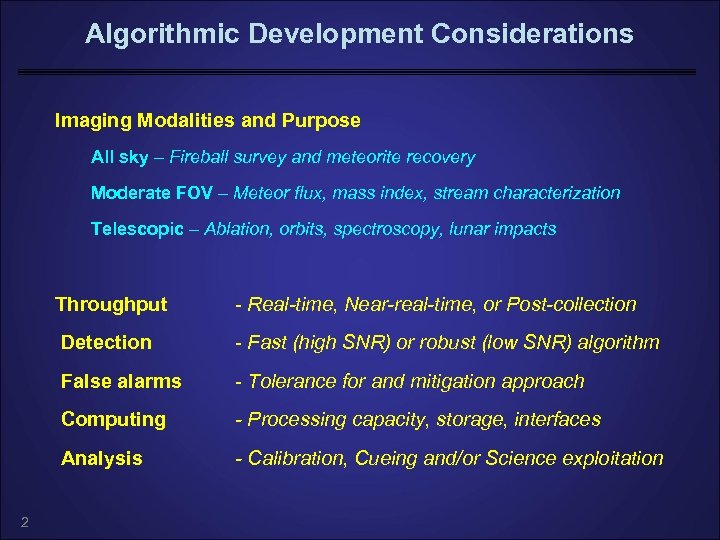 Algorithmic Development Considerations Imaging Modalities and Purpose All sky – Fireball survey and meteorite recovery Moderate FOV – Meteor flux, mass index, stream characterization Telescopic – Ablation, orbits, spectroscopy, lunar impacts Throughput Detection - Fast (high SNR) or robust (low SNR) algorithm False alarms - Tolerance for and mitigation approach Computing - Processing capacity, storage, interfaces Analysis 2 - Real-time, Near-real-time, or Post-collection - Calibration, Cueing and/or Science exploitation
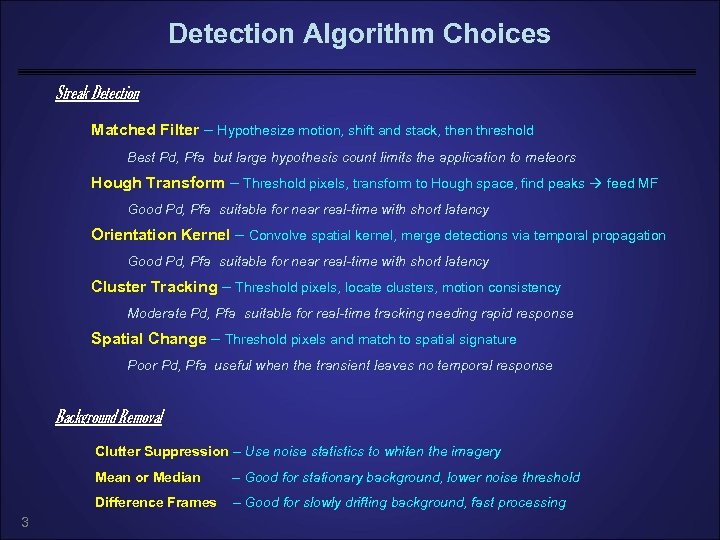 Detection Algorithm Choices Streak Detection Matched Filter – Hypothesize motion, shift and stack, then threshold Best Pd, Pfa but large hypothesis count limits the application to meteors Hough Transform – Threshold pixels, transform to Hough space, find peaks feed MF Good Pd, Pfa suitable for near real-time with short latency Orientation Kernel – Convolve spatial kernel, merge detections via temporal propagation Good Pd, Pfa suitable for near real-time with short latency Cluster Tracking – Threshold pixels, locate clusters, motion consistency Moderate Pd, Pfa suitable for real-time tracking needing rapid response Spatial Change – Threshold pixels and match to spatial signature Poor Pd, Pfa useful when the transient leaves no temporal response Background Removal Clutter Suppression – Use noise statistics to whiten the imagery Mean or Median Difference Frames 3 – Good for stationary background, lower noise threshold – Good for slowly drifting background, fast processing
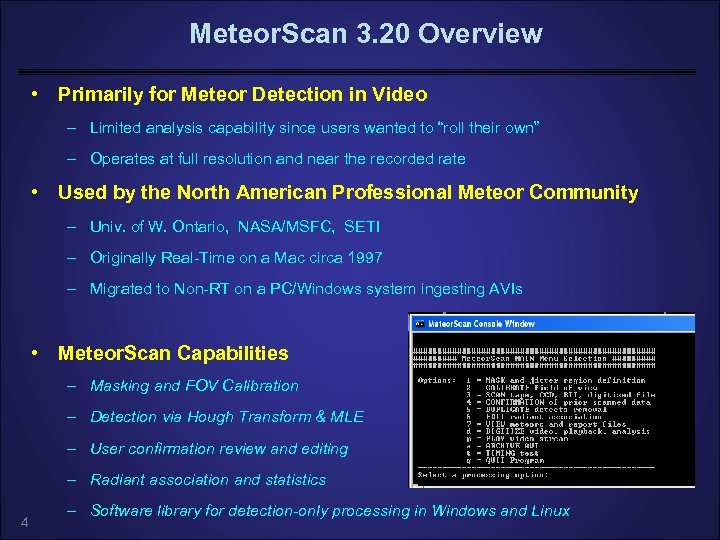 Meteor. Scan 3. 20 Overview • Primarily for Meteor Detection in Video – Limited analysis capability since users wanted to “roll their own” – Operates at full resolution and near the recorded rate • Used by the North American Professional Meteor Community – Univ. of W. Ontario, NASA/MSFC, SETI – Originally Real-Time on a Mac circa 1997 – Migrated to Non-RT on a PC/Windows system ingesting AVIs • Meteor. Scan Capabilities – Masking and FOV Calibration – Detection via Hough Transform & MLE – User confirmation review and editing – Radiant association and statistics 4 – Software library for detection-only processing in Windows and Linux
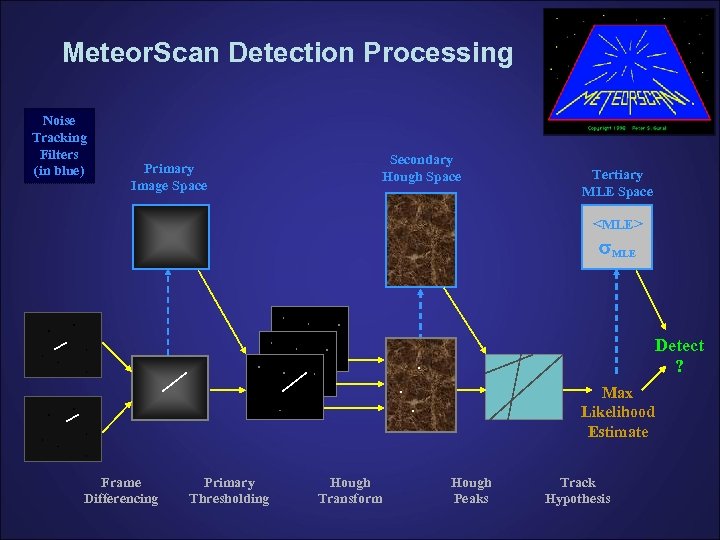 Meteor. Scan Detection Processing Noise Tracking Filters (in blue) Primary Image Space Secondary Hough Space Tertiary MLE Space
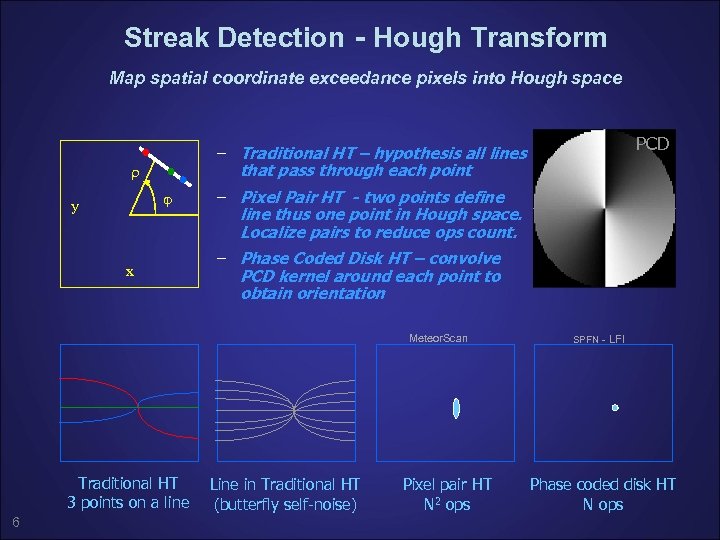 Streak Detection - Hough Transform Map spatial coordinate exceedance pixels into Hough space y x – Pixel Pair HT - two points define line thus one point in Hough space. Localize pairs to reduce ops count. – Phase Coded Disk HT – convolve PCD kernel around each point to obtain orientation Meteor. Scan Traditional HT 3 points on a line 6 PCD – Traditional HT – hypothesis all lines that pass through each point Line in Traditional HT (butterfly self-noise) Pixel pair HT N 2 ops SPFN - LFI Phase coded disk HT N ops
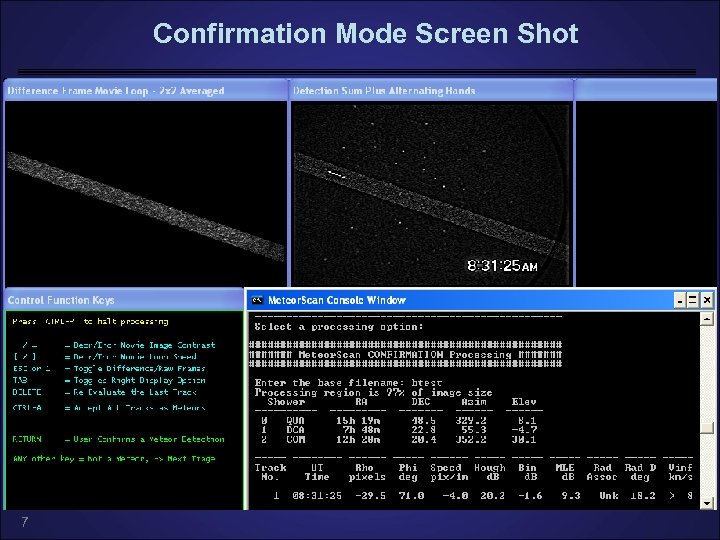 Confirmation Mode Screen Shot 7
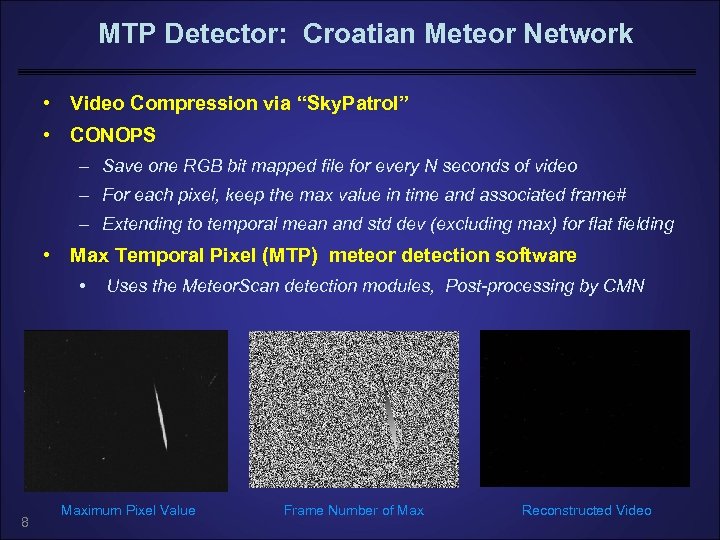 MTP Detector: Croatian Meteor Network • Video Compression via “Sky. Patrol” • CONOPS – Save one RGB bit mapped file for every N seconds of video – For each pixel, keep the max value in time and associated frame# – Extending to temporal mean and std dev (excluding max) for flat fielding • Max Temporal Pixel (MTP) meteor detection software • 8 Uses the Meteor. Scan detection modules, Post-processing by CMN Maximum Pixel Value Frame Number of Max Reconstructed Video
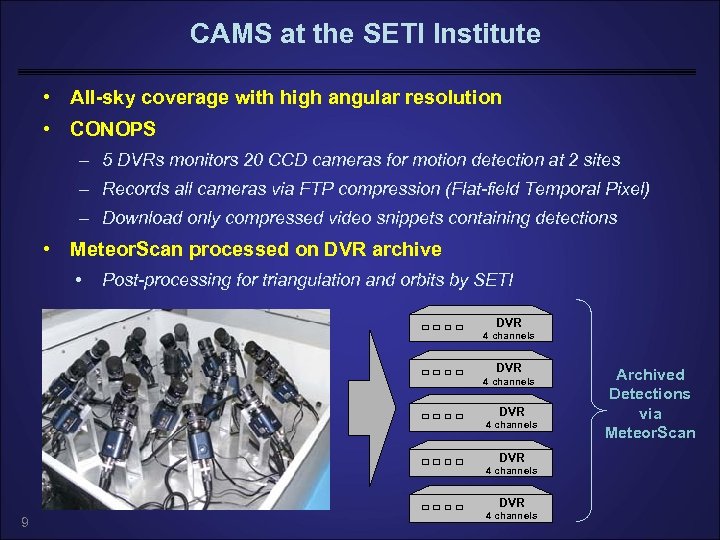 CAMS at the SETI Institute • All-sky coverage with high angular resolution • CONOPS – 5 DVRs monitors 20 CCD cameras for motion detection at 2 sites – Records all cameras via FTP compression (Flat-field Temporal Pixel) – Download only compressed video snippets containing detections • Meteor. Scan processed on DVR archive • Post-processing for triangulation and orbits by SETI DVR 4 channels DVR 9 4 channels Archived Detections via Meteor. Scan
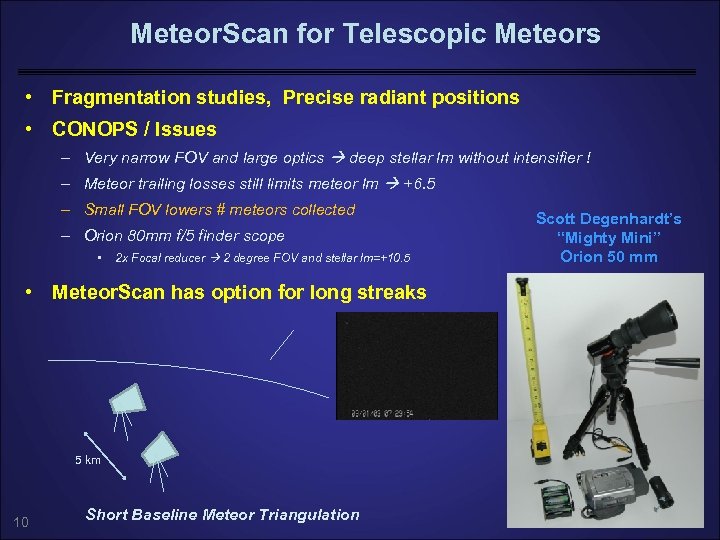 Meteor. Scan for Telescopic Meteors • Fragmentation studies, Precise radiant positions • CONOPS / Issues – Very narrow FOV and large optics deep stellar lm without intensifier ! – Meteor trailing losses still limits meteor lm +6. 5 – Small FOV lowers # meteors collected – Orion 80 mm f/5 finder scope • 2 x Focal reducer 2 degree FOV and stellar lm=+10. 5 • Meteor. Scan has option for long streaks 5 km 10 Short Baseline Meteor Triangulation Scott Degenhardt’s “Mighty Mini” Orion 50 mm
 Transient Video Detection Applications • LFI Detector for the Spanish Fireball Network • Massive Compact Halo Object Detection • Lunar Meteoroid Impact Flash Detection • Meteor Tracking System • Meteor Simulation for ZHR 11
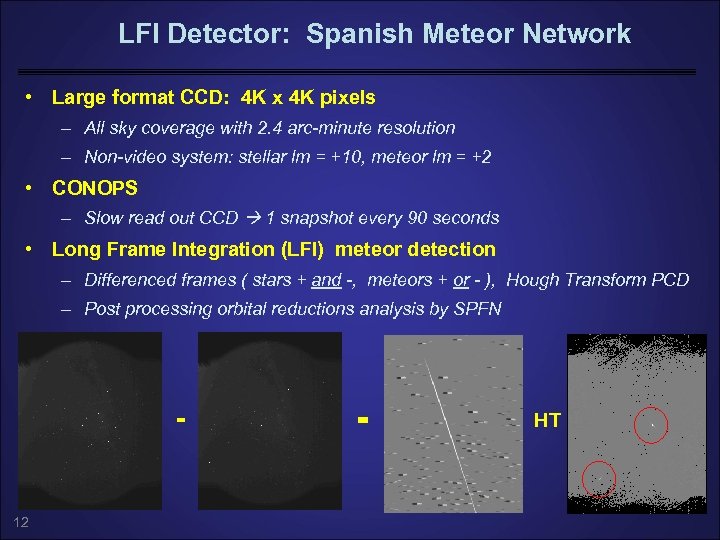 LFI Detector: Spanish Meteor Network • Large format CCD: 4 K x 4 K pixels – All sky coverage with 2. 4 arc-minute resolution – Non-video system: stellar lm = +10, meteor lm = +2 • CONOPS – Slow read out CCD 1 snapshot every 90 seconds • Long Frame Integration (LFI) meteor detection – Differenced frames ( stars + and -, meteors + or - ), Hough Transform PCD – Post processing orbital reductions analysis by SPFN - 12 = HT
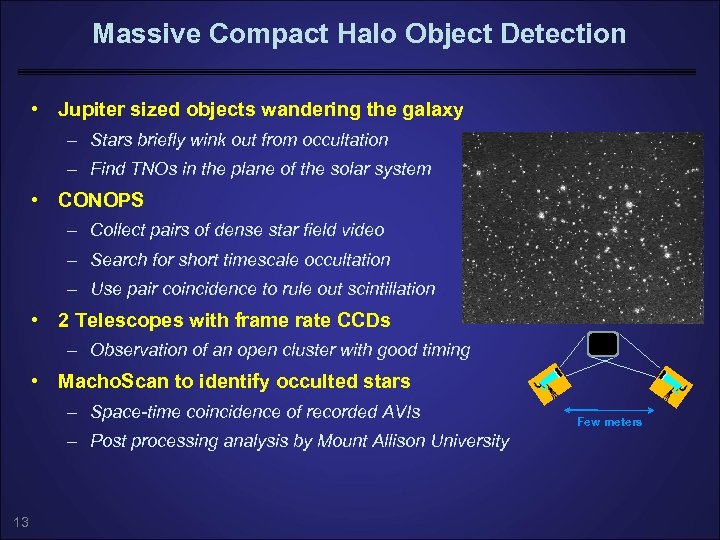 Massive Compact Halo Object Detection • Jupiter sized objects wandering the galaxy – Stars briefly wink out from occultation – Find TNOs in the plane of the solar system • CONOPS – Collect pairs of dense star field video – Search for short timescale occultation – Use pair coincidence to rule out scintillation • 2 Telescopes with frame rate CCDs – Observation of an open cluster with good timing • Macho. Scan to identify occulted stars – Space-time coincidence of recorded AVIs – Post processing analysis by Mount Allison University 13 Few meters
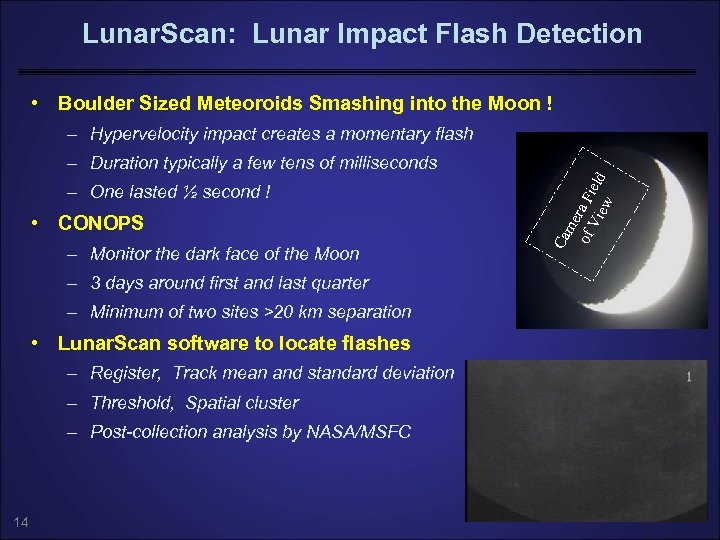 Lunar. Scan: Lunar Impact Flash Detection • Boulder Sized Meteoroids Smashing into the Moon ! – Hypervelocity impact creates a momentary flash – One lasted ½ second ! • CONOPS – Monitor the dark face of the Moon – 3 days around first and last quarter – Minimum of two sites >20 km separation • Lunar. Scan software to locate flashes – Register, Track mean and standard deviation – Threshold, Spatial cluster – Post-collection analysis by NASA/MSFC 14 Ca me of ra Fi Vi eld ew – Duration typically a few tens of milliseconds
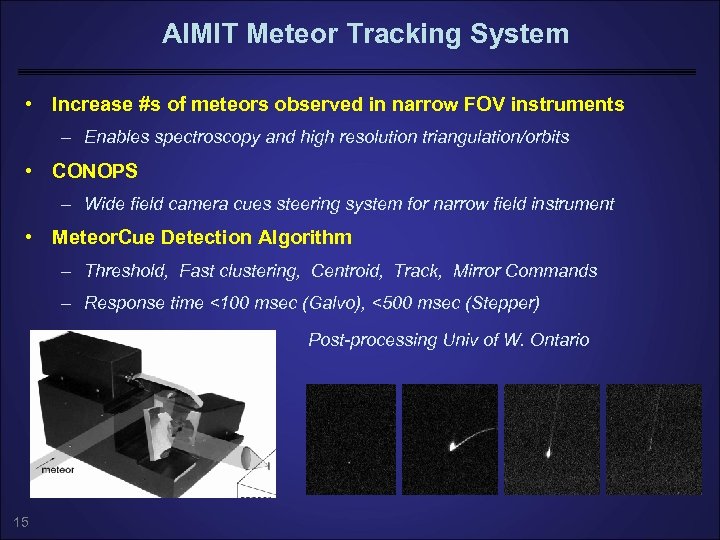 AIMIT Meteor Tracking System • Increase #s of meteors observed in narrow FOV instruments – Enables spectroscopy and high resolution triangulation/orbits • CONOPS – Wide field camera cues steering system for narrow field instrument • Meteor. Cue Detection Algorithm – Threshold, Fast clustering, Centroid, Track, Mirror Commands – Response time <100 msec (Galvo), <500 msec (Stepper) – 15 Post-processing Univ of W. Ontario
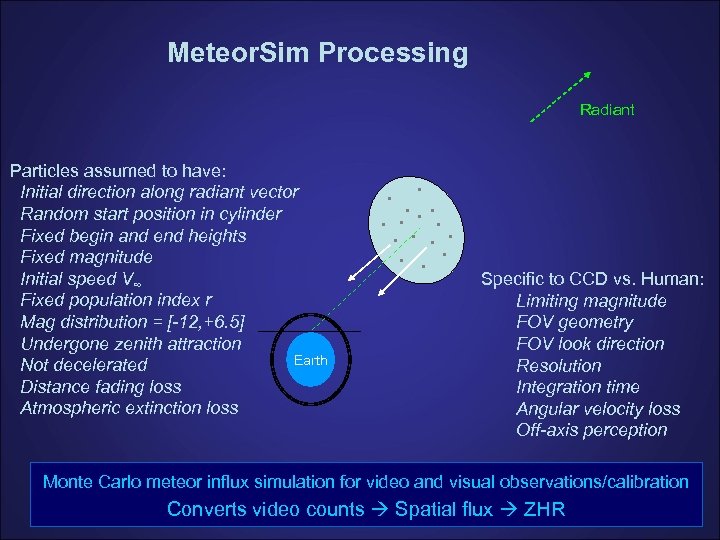 Meteor. Sim Processing Radiant Particles assumed to have: Initial direction along radiant vector Random start position in cylinder Fixed begin and end heights Fixed magnitude Initial speed V∞ Fixed population index r Mag distribution = [-12, +6. 5] Undergone zenith attraction Earth Not decelerated Distance fading loss Atmospheric extinction loss . . . . Specific to CCD vs. Human: Limiting magnitude FOV geometry FOV look direction Resolution Integration time Angular velocity loss Off-axis perception Monte Carlo meteor influx simulation for video and visual observations/calibration Converts video counts Spatial flux ZHR
 Algorithmic Backup Charts • Meteor. Cue • Lunar. Scan • Streak Detection – Matched Filter – Orientation Kernel – Fast Clustering 17
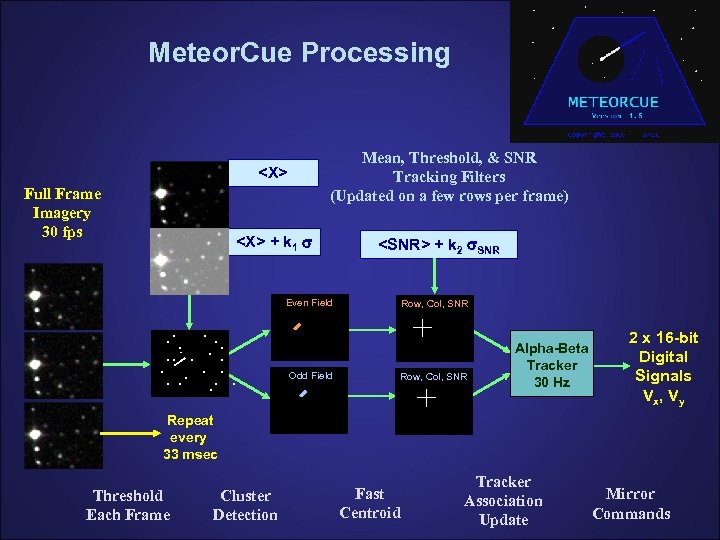 Meteor. Cue Processing Mean, Threshold, & SNR Tracking Filters (Updated on a few rows per frame)
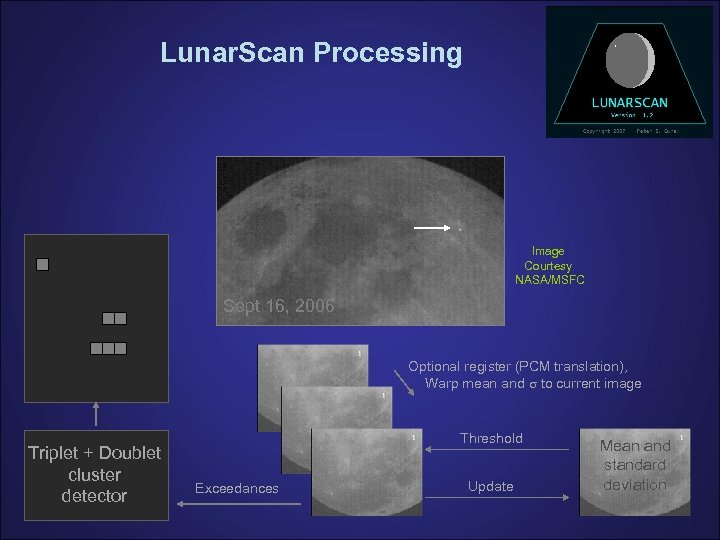 Lunar. Scan Processing Image Courtesy NASA/MSFC Sept 16, 2006 Optional register (PCM translation), Warp mean and s to current image Triplet + Doublet cluster detector Threshold Exceedances Update Mean and standard deviation
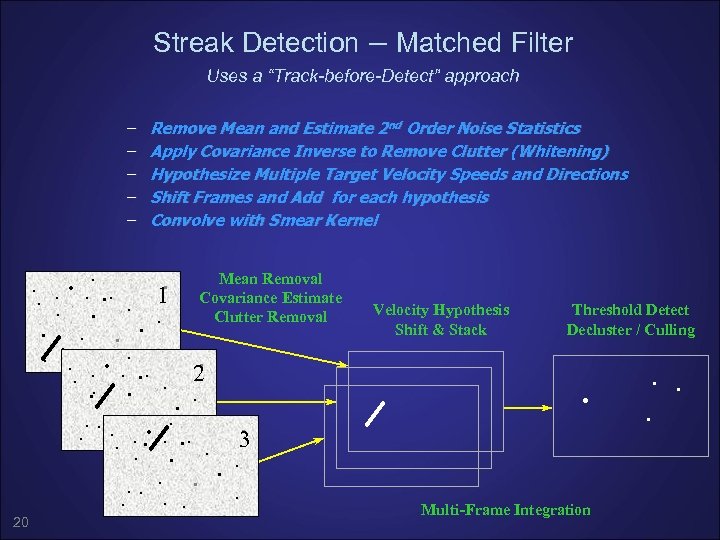 Streak Detection – Matched Filter Uses a “Track-before-Detect” approach Remove Mean and Estimate 2 nd Order Noise Statistics Apply Covariance Inverse to Remove Clutter (Whitening) Hypothesize Multiple Target Velocity Speeds and Directions Shift Frames and Add for each hypothesis Convolve with Smear Kernel – – – . . . . 2 . . . . 3. . . 20 . . Mean Removal Covariance Estimate Clutter Removal 1 . . Velocity Hypothesis Shift & Stack Threshold Detect Decluster / Culling . Multi-Frame Integration . . .
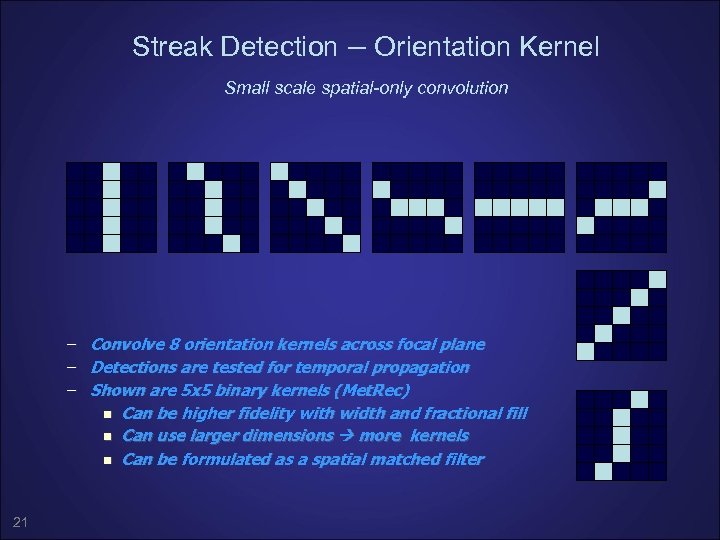 Streak Detection – Orientation Kernel Small scale spatial-only convolution – – – 21 Convolve 8 orientation kernels across focal plane Detections are tested for temporal propagation Shown are 5 x 5 binary kernels (Met. Rec) n Can be higher fidelity with width and fractional fill n Can use larger dimensions more kernels n Can be formulated as a spatial matched filter
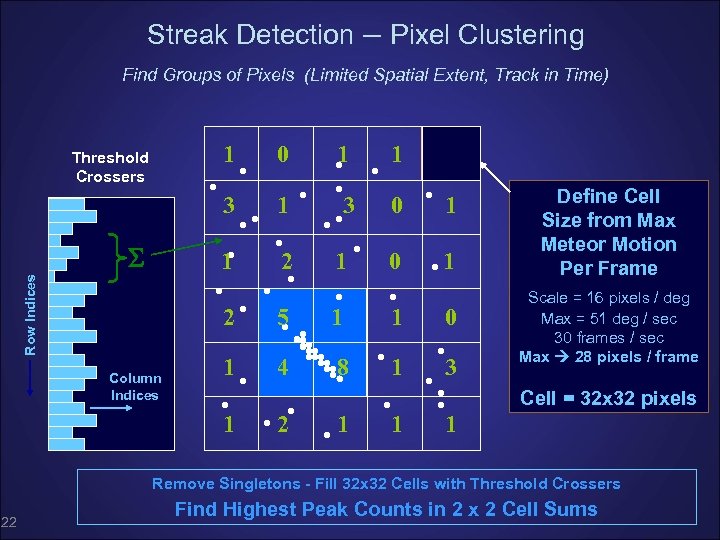 Streak Detection – Pixel Clustering Find Groups of Pixels (Limited Spatial Extent, Track in Time) 1 Row Indices 1 1 1 3 0 1 1 S 0 3 Threshold Crossers 2 0 1 1 2 Column Indices 5 1 1 0 1 4 8 1 3 Define Cell Size from Max Meteor Motion Per Frame Scale = 16 pixels / deg Max = 51 deg / sec 30 frames / sec Max 28 pixels / frame Cell = 32 x 32 pixels 1 2 1 1 1 Remove Singletons - Fill 32 x 32 Cells with Threshold Crossers 22 Find Highest Peak Counts in 2 x 2 Cell Sums