 Скачать презентацию Metatextual games in the novel The Book of
e1214292289d40b78c2320eaaed9fbc1.ppt
- Количество слайдов: 9



Metatextual games in the novel The Book of Metopolis by Ştefan Bănulescu Ph. D student Mihaela Vatamanu, “Alexandru Ioan Cuza” University of Iasi, Romania dumitreasamihaelablue@yahoo. com
Objectives of research: In this paper we propose an analysis of the way in which metatextual elements appear in the novel The Book of Metopolis by Ștefan Bănulescu. *Ștefan Bănulescu (1926 -1998) is a talented Romanian writer associated to the generation of writers of the 1960’s. Books published: Iarna bărbaților/ Men’s Winter (1965), Cântece de Câmpie/ Songs of the Plains (1968), Scrisori provinciale/ Provincial Letters (1976), Cartea de la Metopolis/ The Book of Metopolis (the first book of the tetralogy Cartea Milionarului/ The Book of the Millionaire, 1977), Scrisori din Provincia de Sud-Est sau O bătălie cu povestiri/ Letters from the South-Eastern Province or A Battle of Stories (1994), Elegii la sfârșit de secol/ Elegies at the End of the Century (1999).
Methodology: This approach is based on the application of Gerard Genette’s conceits of formal narratology as well as on the text’s stratification in layers (the narrative text disposed like a Chinese box) following the pattern of Lucien Dällenbach’s theory of the mirror in the text. Also we applied the notion of circular reading, or (re)reading – terms introduced in Romanian literature criticism by Matei Călinescu – as a main instrument of an adequate understanding of Bănulescu’s text.
Main ideas in the article: - Bănulescu’s originality is once again revealed at this level of the narrative technique too. - The text is mainly about the Millionaire, inhabitant of Metopolis, and his attempt of collecting all the stories in the city with the aim of putting them together in a book. - The characters brought in the foreground of the plot enjoy their own stories thus the book that the Millionaire wants to write consists of multiple narrative kernels. - When referring to the novel The Book of Metopolis, one could unmistakably consider it a book with windows. - As a first-degree narrator of the text, the Millionaire also uses some second-degree narrators, like the General Marosin and the Topometrist, who were the only ones to have witnessed the course of some events.
Main ideas in the article: -The action is thus perceived through more angles and some hypothesis overturn in order to be replaced by new ones. - The text creates the impression that it continuously changes under the reader’s eyes, without ever coming to a final shape. - New details always seem to appear possibly resulting in a complete change of perspective. - As the incipit does not prepare a traditional novel framework at all, the end is long in coming, outlined through the perspective of a theatre bill, synthesising the allusions of the Byzantine world that the author wants or seems to sketch here.
Conclusions: • Ștefan Bănulescu proves himself a skillful handler of the “mise en abyme” technique. • The text leaves the impression that its author is always playing with the reader, thus making necessary the permanent practice of circular reading.
Minimal bibliography: • Bănulescu, Ș. (2005). Opere/ Works, volumes I-II (Volume I: Iarna bărbaţilor/ Men’s Winter; Cartea Milionarului; Proză eseistică/ The Book of the Millionaire; Essays Volume II: Proză memorialistică/ Biographical Prose; Publicistică/ Journalism; Corespondenţă/ Correspondence), Edition by Oana Soare, Preface by Eugen Simion. București: The National Foundation for Science and Art Publishing House, Univers Enciclopedic Publishing House. • Călinescu, M. (2003. ) A citi, a reciti. Către o poetică a relecturii – cu un capitol românesc inedit despre Mateiu I. Caragiale – To read, to read again: towards a poetic of reading (again), translation from English by Virgil Stanciu, Iași: Polirom Publishing House.
• Dällenbach L. (1977). Le Récit spéculaire, Paris: Seuils. • Hutcheon, L. (2002). Poetica postmodernismului/ A Poetics of Postmodernism, translation from English by Dan Popescu, București: Univers Publishing House. • Genette, G. (1994). Introducere în arhitext/ Introduction to the architext, translation from French by Ion Pop, București: Univers Publishing House.
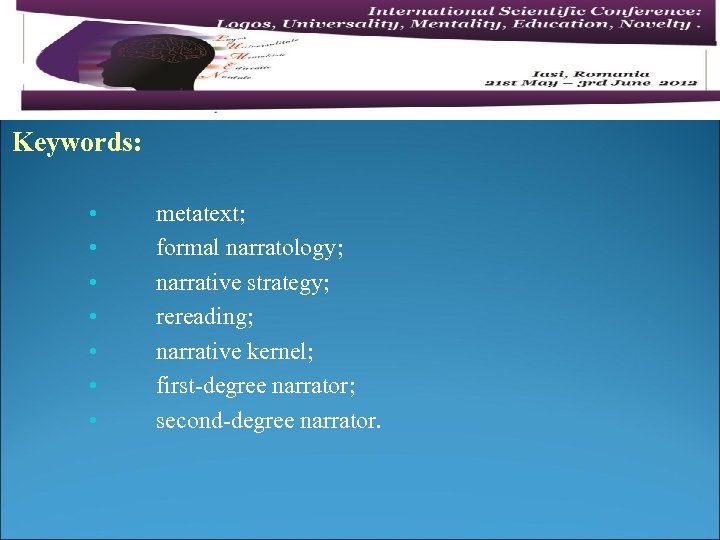
Keywords: • • metatext; formal narratology; narrative strategy; rereading; narrative kernel; first-degree narrator; second-degree narrator.
Скачать презентацию Metatextual games in the novel The Book of
e1214292289d40b78c2320eaaed9fbc1.ppt