


 Скачать презентацию Metals Star Formation at High Redshift Len
a053ce3496e19216ef5aa7b5b2091358.ppt
- Количество слайдов: 69
 Metals & Star Formation at High Redshift Len Cowie STSc. I March 2006
 Metals & Star formation at z=6 & (re)ionization § We know the intergalactic gas is ionized at z= 6. § We now know that there are substantial amounts of metals in the intergalactic/galactic gas at z=6. NEW! o What are the sources that did this? o Are the various star formation rates that we have consistent? o Do we have enough light to understand the ionization and metals?
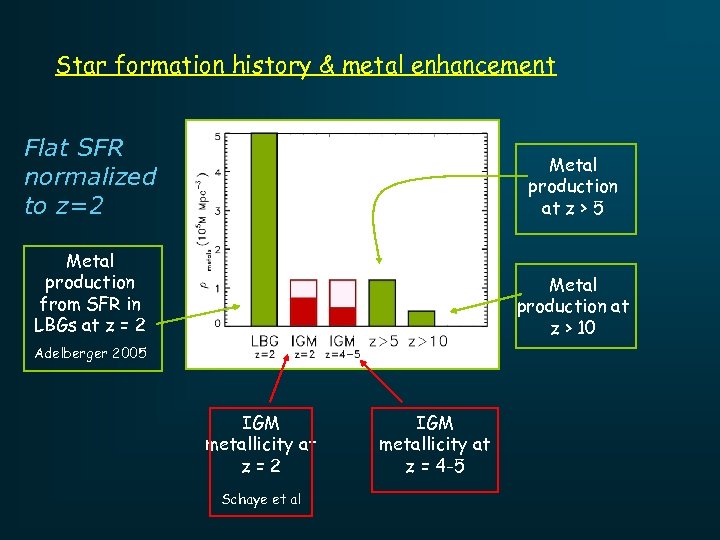
 Metals in the IGM --- Questions • Can we see metals at high redshift? • How does the early Universe evolve into the low redshift universe? • How does the overall star formation history relate to the history of IGM metal enhancement? Are they consistent? NO for break measurements!! YES !!
 Metals in the IGM • How can we measure the ultra-high z star formation? Most direct – measure the metal content of the universe at high redshift. High-z metals come from high-z sources and provide an integrated measure of the preceding star formation. (Always going to be a lower limit since we will miss some of the metals, ionization corrections, etc…. )
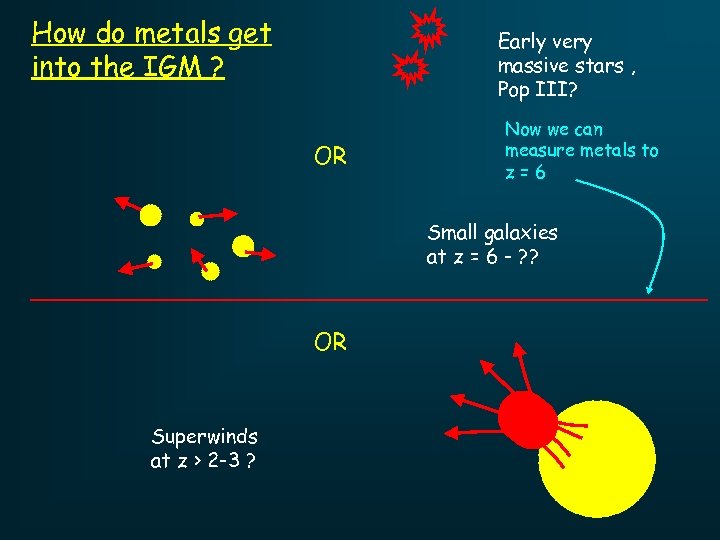 How do metals get into the IGM ? Early very massive stars , Pop III? OR Now we can measure metals to z=6 Small galaxies at z = 6 - ? ? OR Superwinds at z > 2 -3 ?
 How do we measure metals at ultra-high z? Apart from the neutral hydrogen of the Lyman forest, we have only a very limited number of absorption lines that we can detect in the intergalactic gas : § Most of the information on the lowest density component comes from CIV with limited ionization information from the Si. IV and CII lines outside the forest and other lines that lie in the forest (e. g. Si. III, CIII) and some information on the hotter gas from OVI … but OVI lies in the Lyman forest. § For the higher density gas most of the low redshift information comes from DLA metallicity measurements. However, at high z the forest saturates and we can no longer find the DLAs. We CAN still measure OI, CII and Si. II.
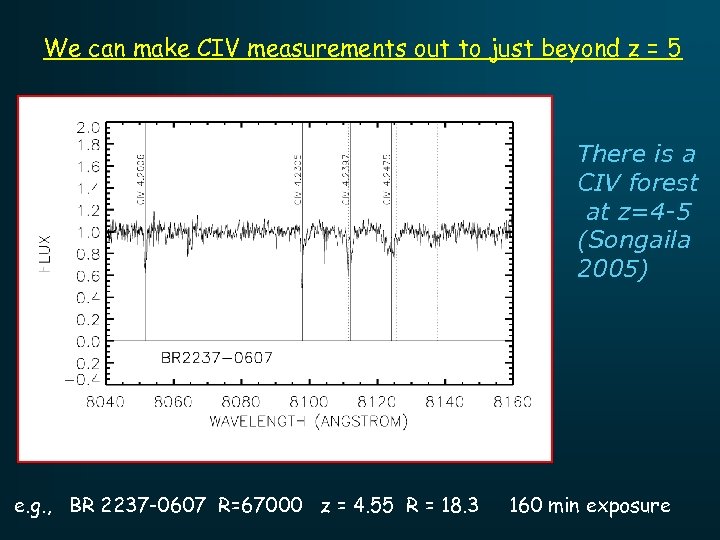 We can make CIV measurements out to just beyond z = 5 There is a CIV forest at z=4 -5 (Songaila 2005) e. g. , BR 2237 -0607 R=67000 z = 4. 55 R = 18. 3 160 min exposure
 Statistical methods --- POD technique We would like to make a more objective analysis than the Voigt profile fitting provides & also achieve the maximum sensitivity the data can provide Best way to do this is by correlating features in the spectra --the so-called pixel optical depth techniques, or “POD”s Original POD : HI optical depth traced using the Lyman series was cross-correlated with the CIV absorption line optical depths (Cowie & Songaila 1998). This method has been refined and used with great success by Schaye, Aguirre and collaborators (Schaye et al 2003 …) But : it is not well suited to high redshift as the L alpha forest begins to blanket….
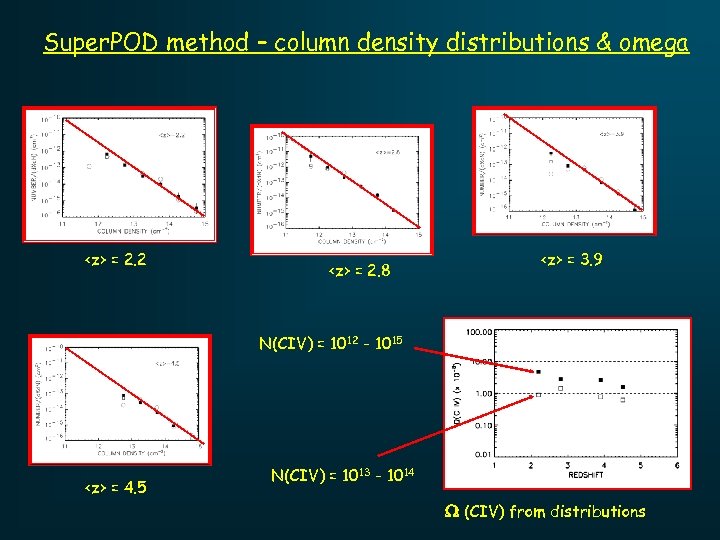
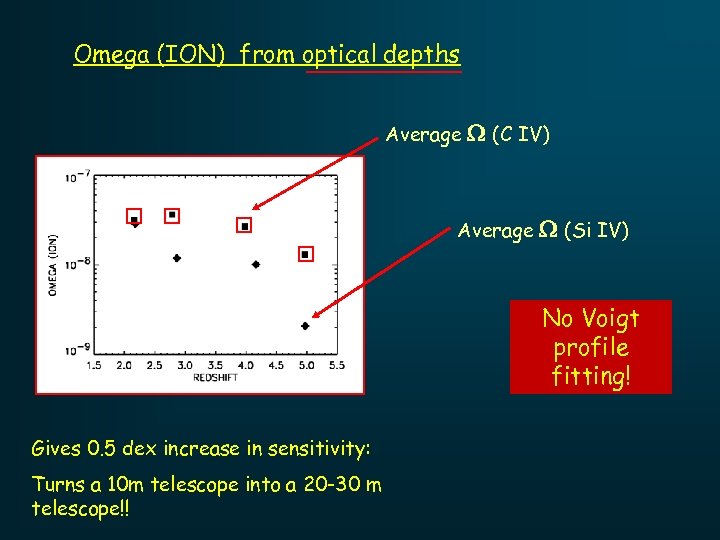
 Super. POD (“Superposed Pixel Optical Depths”) The optimal approach to this problem is to use the doublet structure of the CIV and Si. IV absorption lines. Analysis of the absorption in this way lets us take maximum advantage of the spectra and, since it avoids the subjectivity of Voigt profile fitting, can be subject to analysis of incompleteness and bias. Use only the doublet information Find all positions in the optical depth vs wavelength plot where the ratio of the optical depths in the two members of the doublet approximately satisfies the 2: 1 condition (Songaila 2005)
 Super. POD method – column density distributions & omega
 Omega (ION) from optical depths Average W (C IV) Average W (Si IV) No Voigt profile fitting! Gives 0. 5 dex increase in sensitivity: Turns a 10 m telescope into a 20 -30 m telescope!!
 Status of CIV evolution: Essentially the current situation is that, within the variation in the CIV/HI ratio, we see CIV in the IGM to the column density limits that we can detect it to and to the redshift of z =5 that we can measure to using optical spectrographs. The distribution functions and total density are remarkably invariant!
 Star formation history & metal enhancement Flat SFR normalized to z=2 Metal production at z > 5 Metal production from SFR in LBGs at z = 2 Metal production at z > 10 Adelberger 2005 IGM metallicity at z=2 Schaye et al IGM metallicity at z = 4 -5
 Already … somewhat of a problem! How do we produce that many metals before z=5? Though this is a rather crude calculation. But it gets worse….
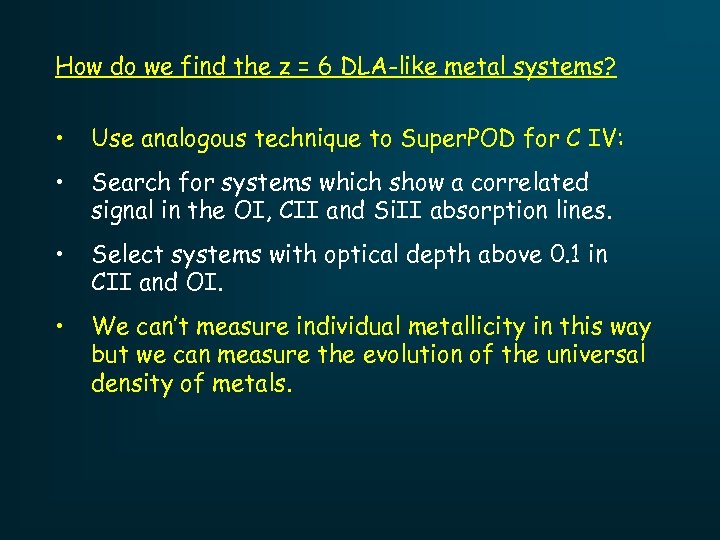
 Going beyond z = 5 … At z > 5 we lose the CIV and then the Si. IV from the optical window. We can still measure lower ionization lines (OI, CII and Si. II) since these are at shorter wavelengths (around 1300 A). These lines are primarily found in the high column density neutral H systems at low redshifts but they may also start to be found in the more diffuse gas at ultra high z if the ionization parameter starts to drop. SO: HOW TO FIND THESE LINES ? ?
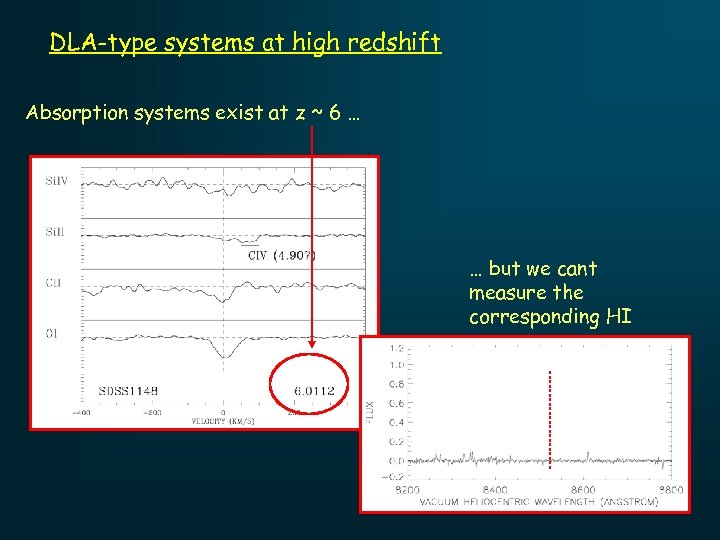 DLA-type systems at high redshift Absorption systems exist at z ~ 6 … … but we cant measure the corresponding HI
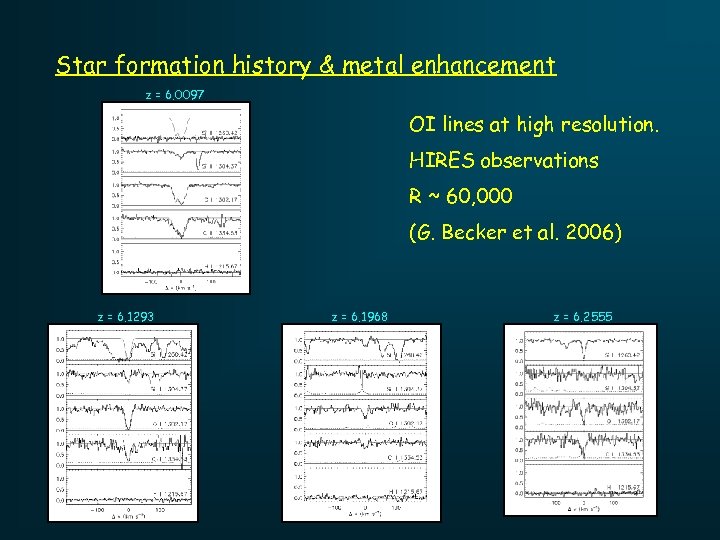 Star formation history & metal enhancement z = 6. 0097 OI lines at high resolution. HIRES observations R ~ 60, 000 (G. Becker et al. 2006) z = 6. 1293 z = 6. 1968 z = 6. 2555
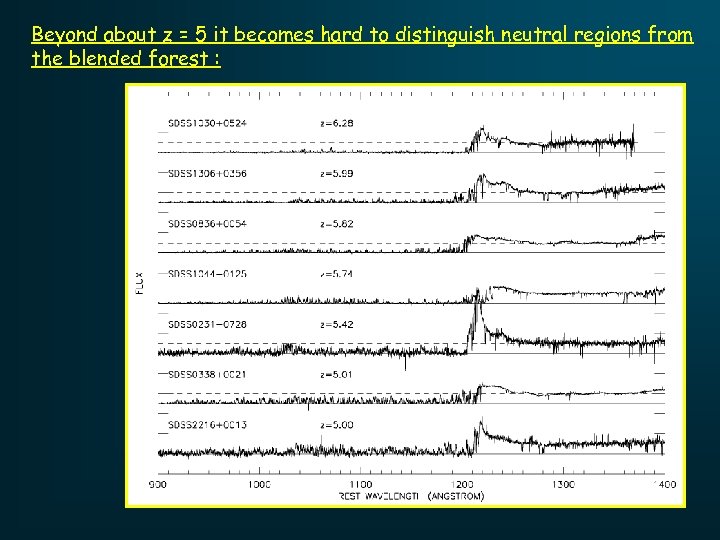 Beyond about z = 5 it becomes hard to distinguish neutral regions from the blended forest :
 How do we find the z = 6 DLA-like metal systems? • Use analogous technique to Super. POD for C IV: • Search for systems which show a correlated signal in the OI, CII and Si. II absorption lines. • Select systems with optical depth above 0. 1 in CII and OI. • We can’t measure individual metallicity in this way but we can measure the evolution of the universal density of metals.
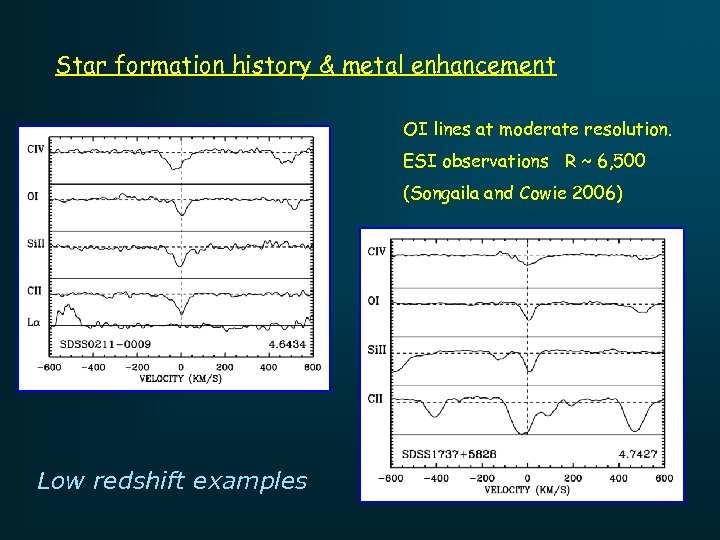 Star formation history & metal enhancement OI lines at moderate resolution. ESI observations R ~ 6, 500 (Songaila and Cowie 2006) Low redshift examples
 How do we find the z = 6 DLA-like metal systems? • At z < 5 there is a one-to-one correspondence between systems chosen this way and the DLAs. • There are no strong low-ionization metal systems that do not have an associated DLA or vice-versa.
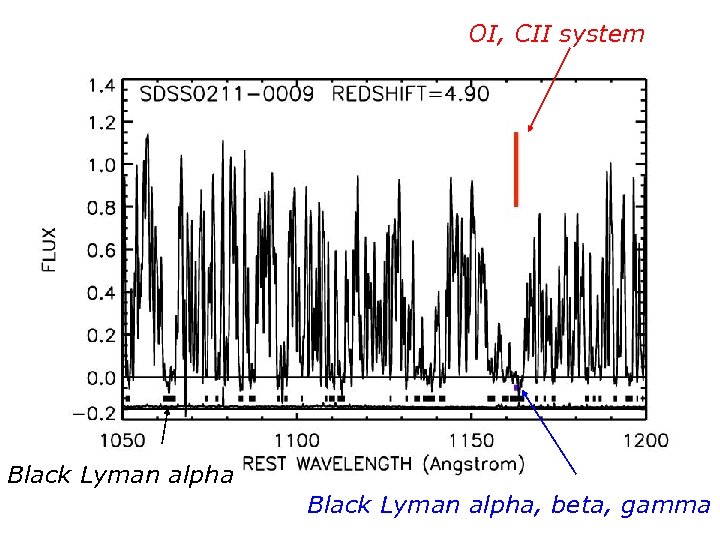 OI, CII system Black Lyman alpha, beta, gamma
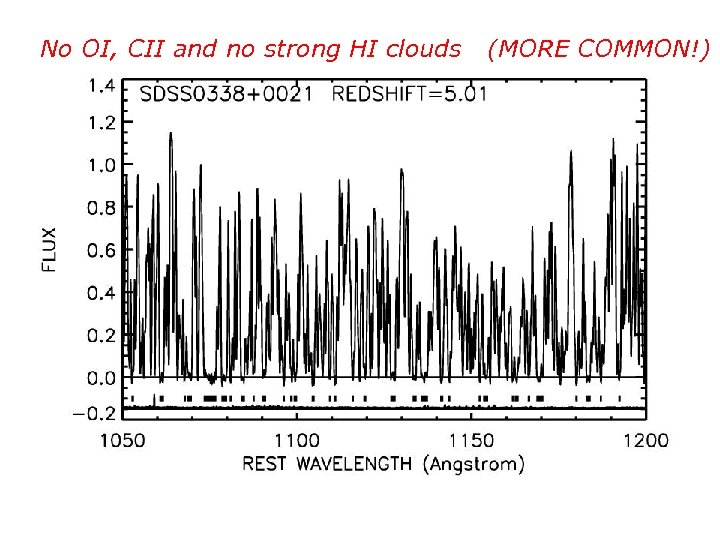 No OI, CII and no strong HI clouds (MORE COMMON!)
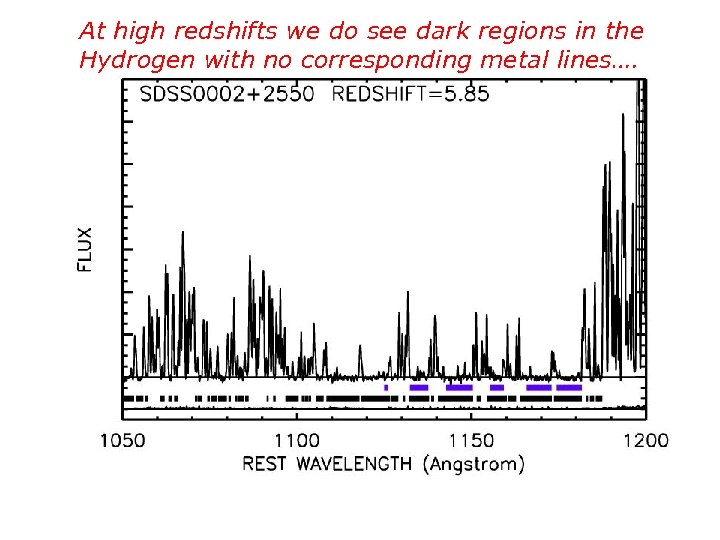 At high redshifts we do see dark regions in the Hydrogen with no corresponding metal lines….
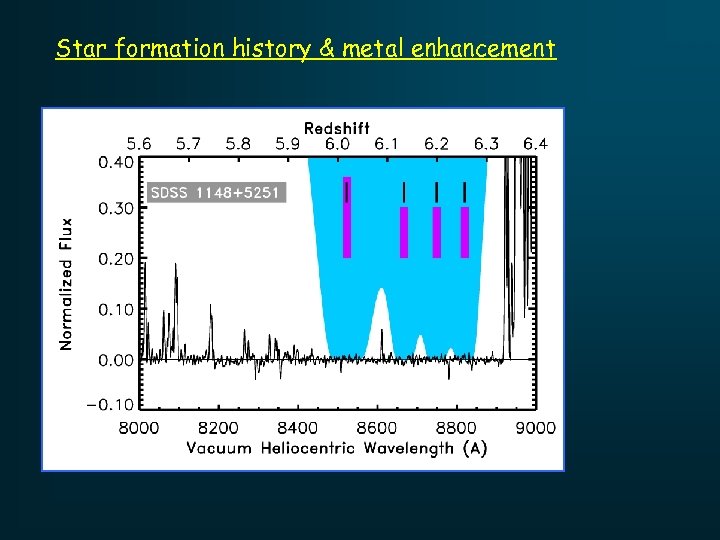
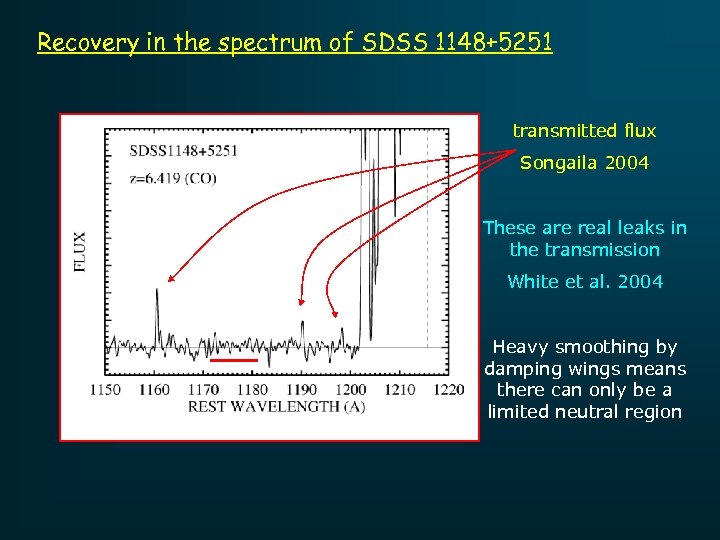 Recovery in the spectrum of SDSS 1148+5251 transmitted flux Songaila 2004 These are real leaks in the transmission White et al. 2004 Heavy smoothing by damping wings means there can only be a limited neutral region
 Star formation history & metal enhancement
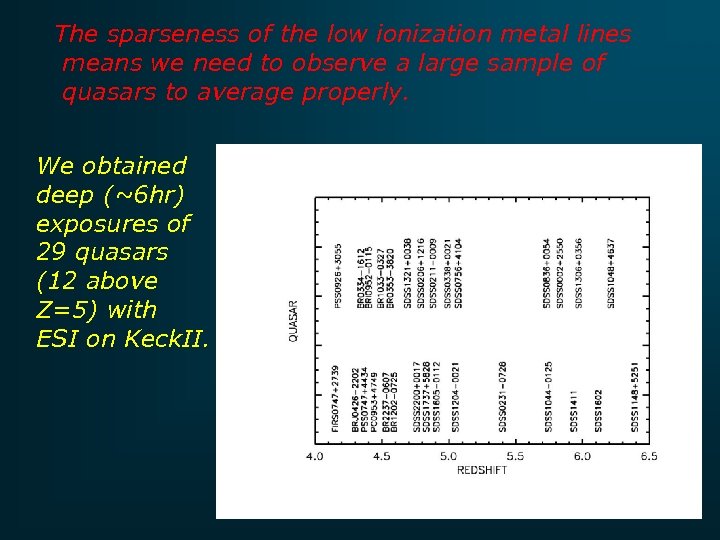 The sparseness of the low ionization metal lines means we need to observe a large sample of quasars to average properly. We obtained deep (~6 hr) exposures of 29 quasars (12 above Z=5) with ESI on Keck. II.
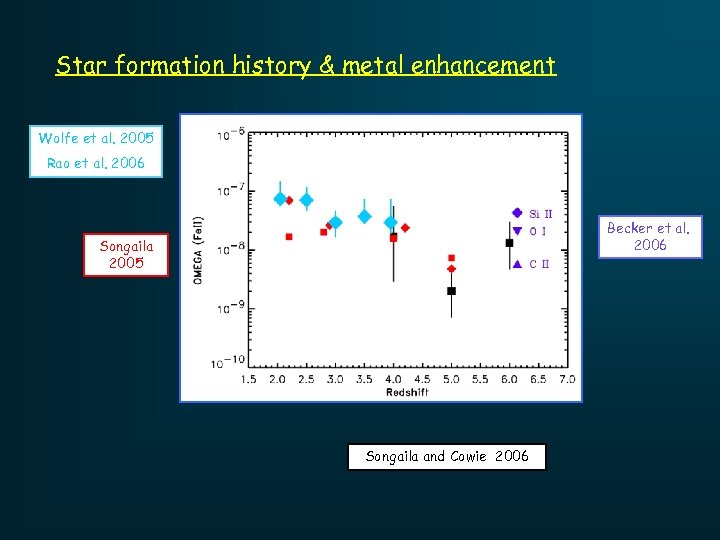 Star formation history & metal enhancement Wolfe et al. 2005 Rao et al. 2006 Becker et al. 2006 Songaila 2005 Songaila and Cowie 2006
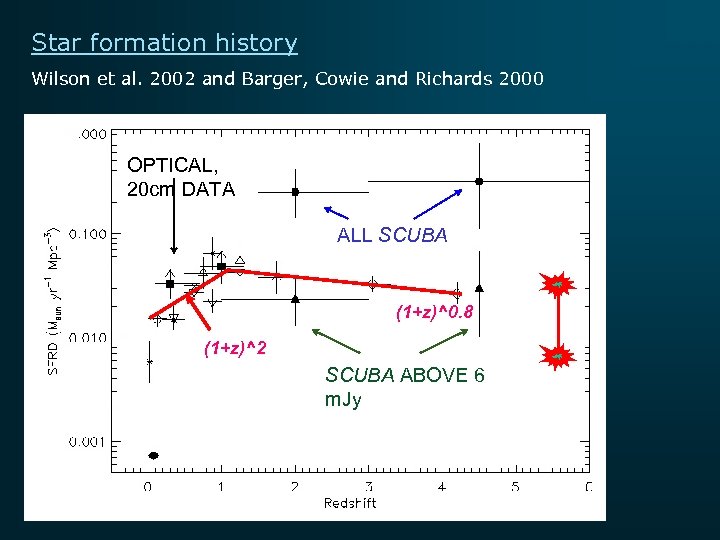
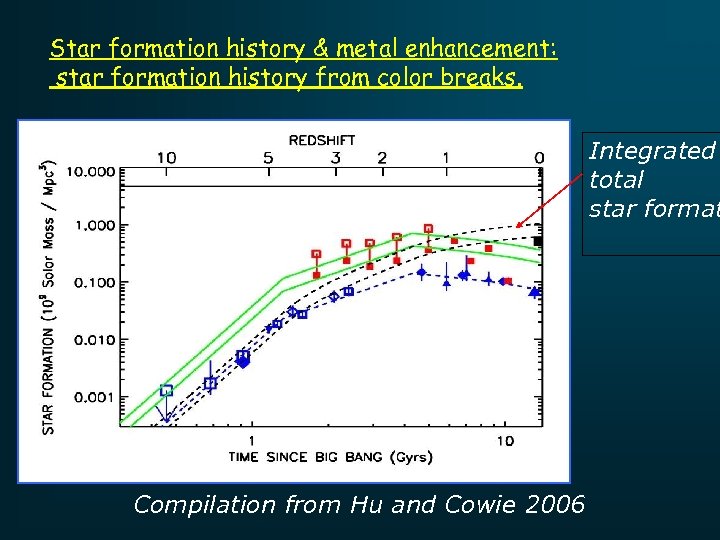 Star formation history & metal enhancement: star formation history from color breaks. Integrated total star format Compilation from Hu and Cowie 2006
 The actual drop is still uncertain but evidence suggests a decline in star formation density by a factor of between 4 and 6 between z=3 and z=6, assuming no large change in the luminosity function. BUT there are major caveats: • • • Cosmic variance is expected to be 50% for a field the size of the UDF: could the UDF just be very underdense? Is there a lot of contamination in the low end LF? (This goes the other way…) There is some evidence for a change in the LF (more faint galaxies)… i. e are we measuring most of the stars?
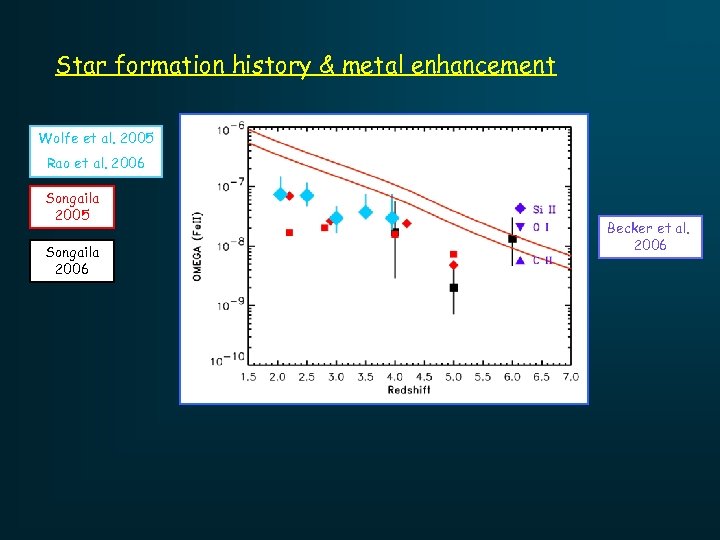 Star formation history & metal enhancement Wolfe et al. 2005 Rao et al. 2006 Songaila 2005 Songaila 2006 Becker et al. 2006
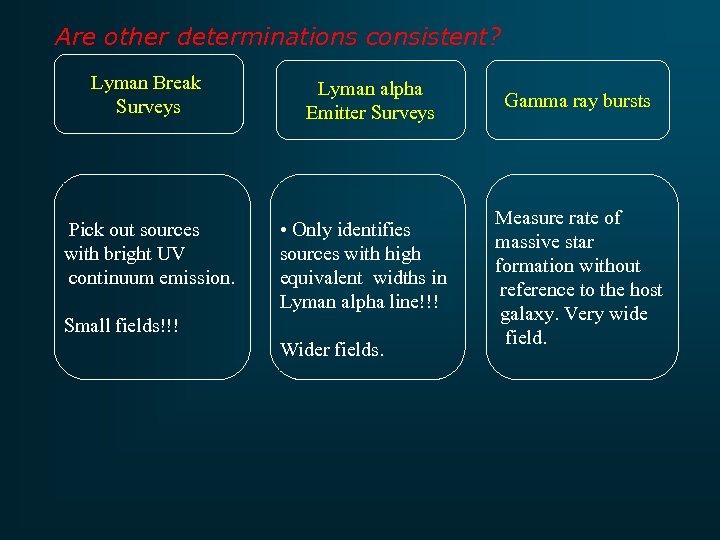 Are other determinations consistent? Lyman Break Surveys Pick out sources with bright UV continuum emission. Lyman alpha Emitter Surveys • Only identifies sources with high equivalent widths in Lyman alpha line!!! Small fields!!! Wider fields. Gamma ray bursts Measure rate of massive star formation without reference to the host galaxy. Very wide field.
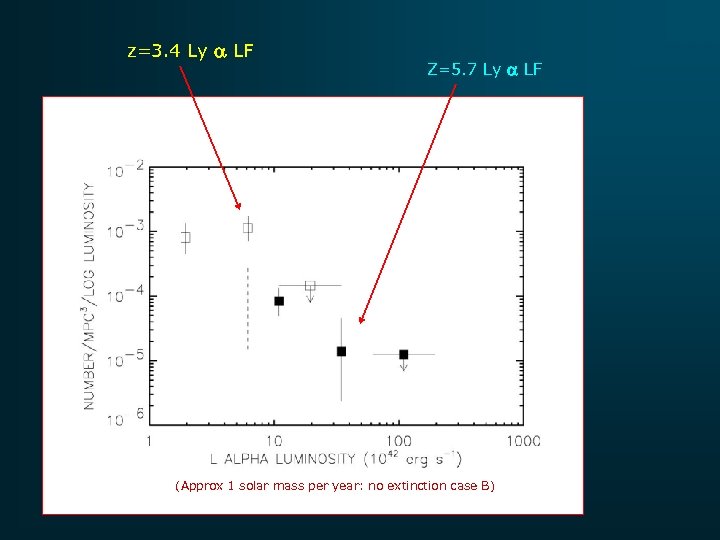
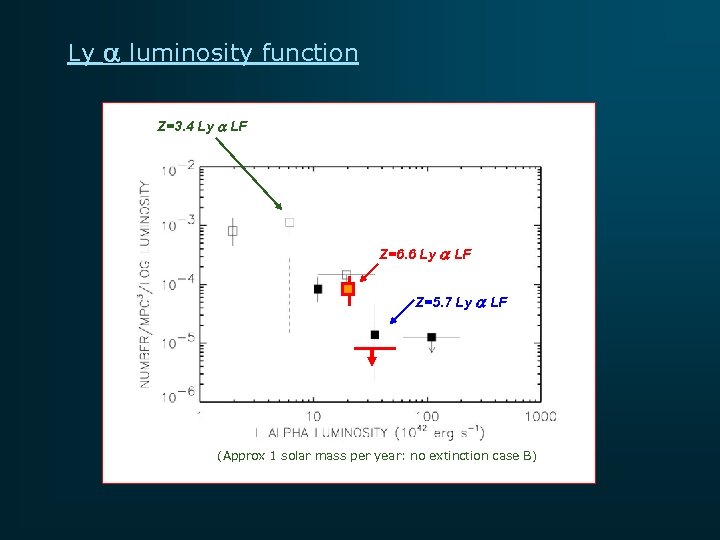
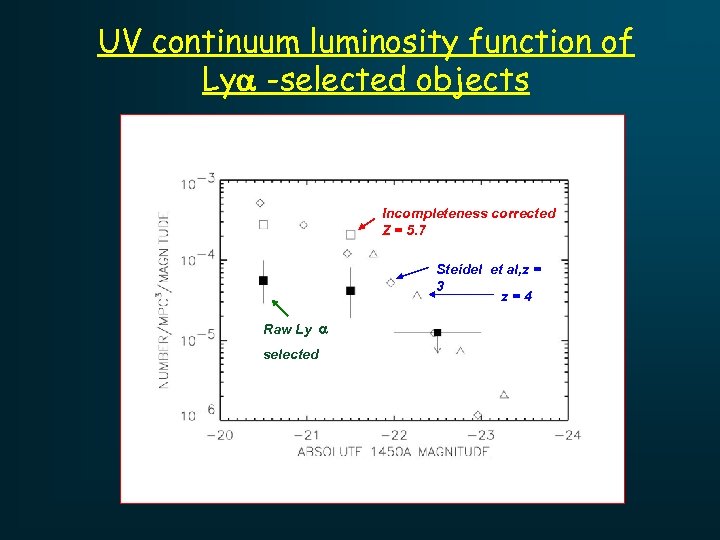
 Ly a searches with narrow-band filters or direct spectroscopic techniques (Hu et al 2002, Taniguchi et al. 2004 , Ellis et al 2004, Hu et al. 2004, Malhotra & Rhoads… etc. ) can provide large homogeneous samples of galaxies at these redshifts which probe fainter in the luminosity function than the color break selected galaxies. CAVEAT : Only a fraction of the color-selected objects have Ly a emission --- perhaps 20% at z = 3 (Steidel et al. )
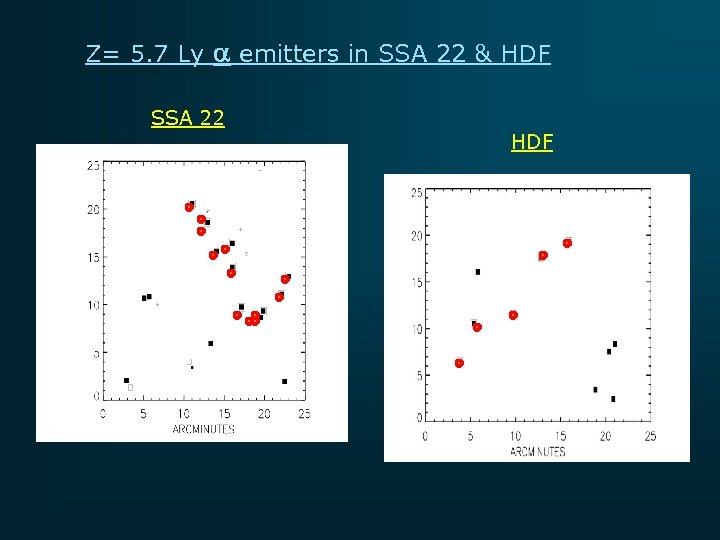
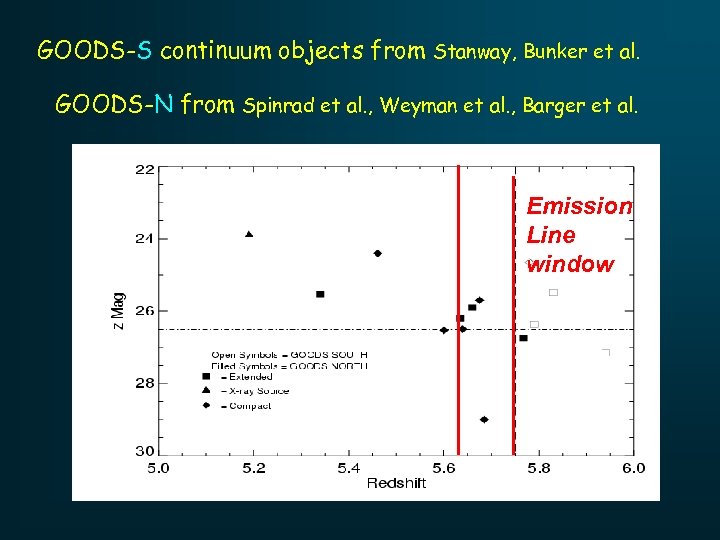
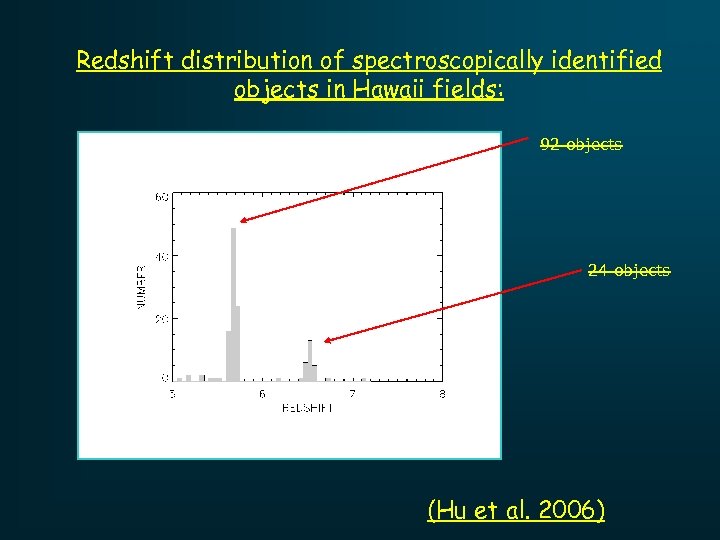 Redshift distribution of spectroscopically identified objects in Hawaii fields: 92 objects 24 objects (Hu et al. 2006)
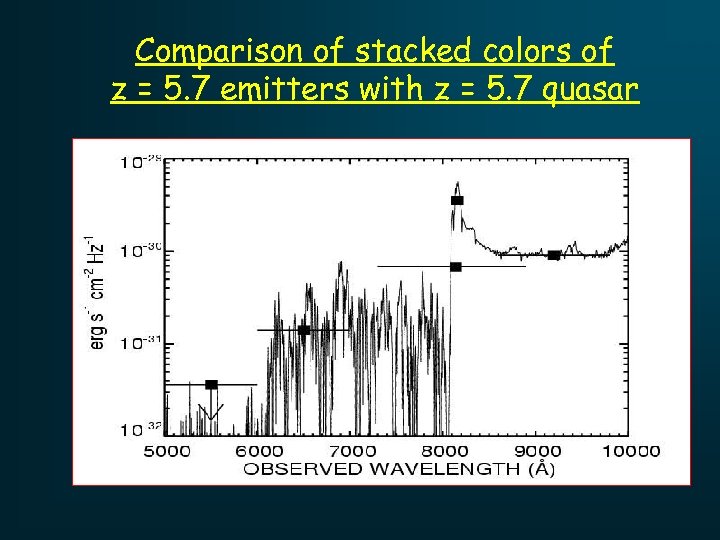 Comparison of stacked colors of z = 5. 7 emitters with z = 5. 7 quasar
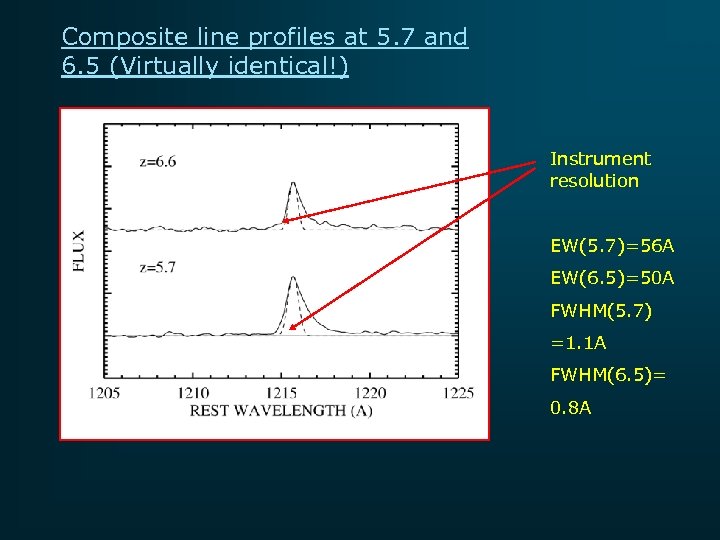
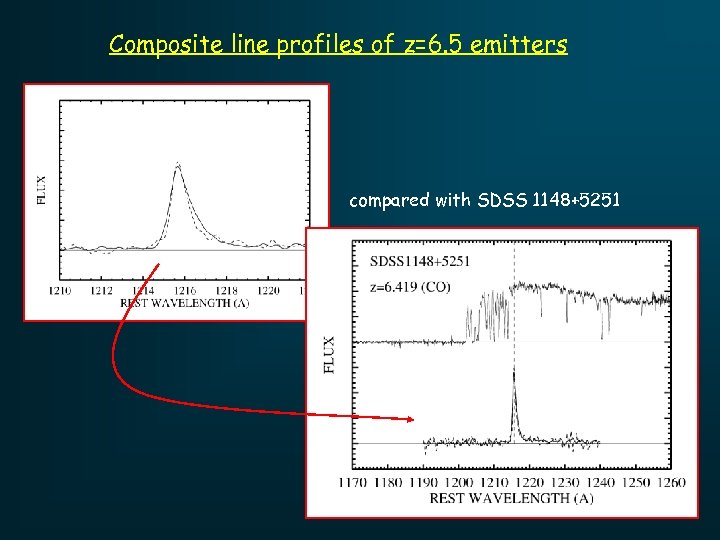 Composite line profiles of z=6. 5 emitters compared with SDSS 1148+5251
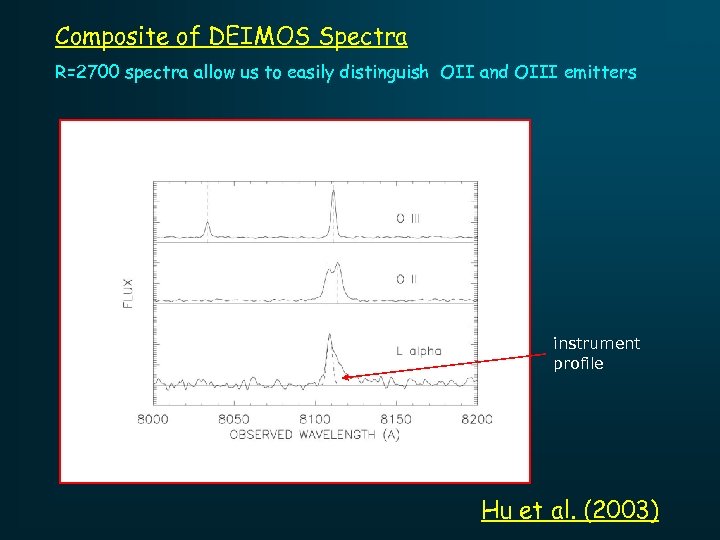
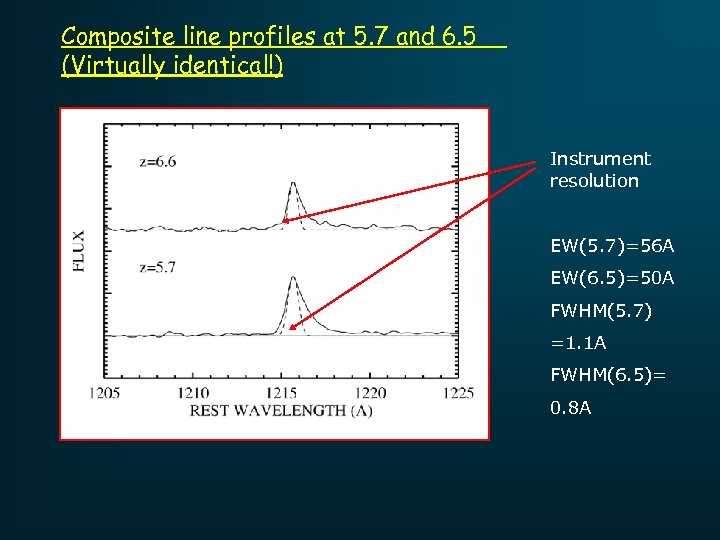 Composite line profiles at 5. 7 and 6. 5 (Virtually identical!) Instrument resolution EW(5. 7)=56 A EW(6. 5)=50 A FWHM(5. 7) =1. 1 A FWHM(6. 5)= 0. 8 A
 Does this mean conditions are the same in the IGM at z = 5. 7 and z = 6. 5? Maybe not (Madau, Haiman, Loeb, Gnedin, etc…. ) : • More luminous objects may self shield themselves by ionizing the gas around them. • Even for lower luminosity objects: • • Clustered or neighboring objects may also ionize the region around the object. Preferred (low density) lines of sight may be ionized and we may have strong selection bias in our object sample.
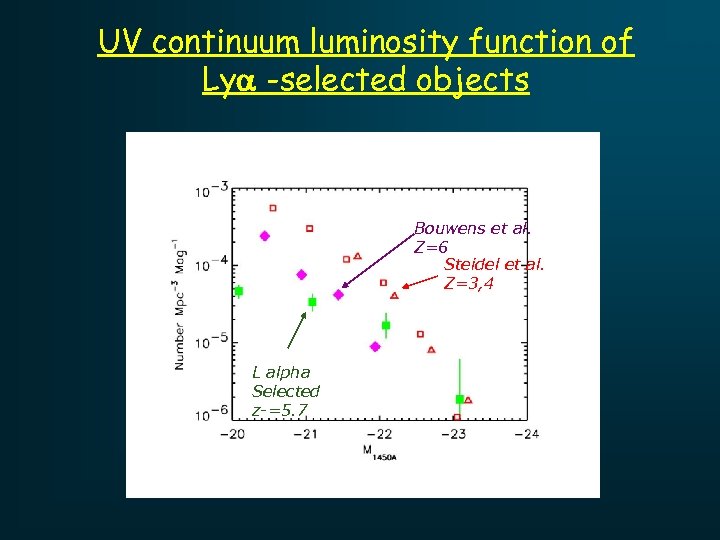 UV continuum luminosity function of Lya -selected objects Bouwens et al. Z=6 Steidel et al. Z=3, 4 L alpha Selected z-=5. 7
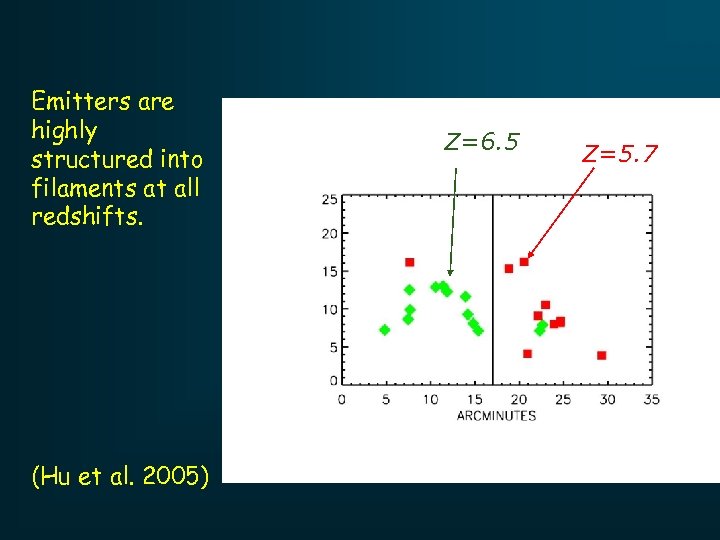 Emitters are highly structured into filaments at all redshifts. (Hu et al. 2005) Z=6. 5 Z=5. 7
 Gamma ray bursts
 Gamma-ray bursts provide a totally different approach: • Assume rate of GRBs as a function of redshift is proportional to the star formation rate … (Madau, Lamb & Reichart, Bromm & Loeb, etc. ) • Advantages : Highly complete and direct observations of the massive stars. Not biased against small galaxies or subject to cosmic variance. • Big question : We have to assume that the selection of GRBs from massive stars is invariant as a function of redshift. • Alternate method : just locate the host galaxies with the GRBs and then use these to measure the star formation history. May be very powerful.
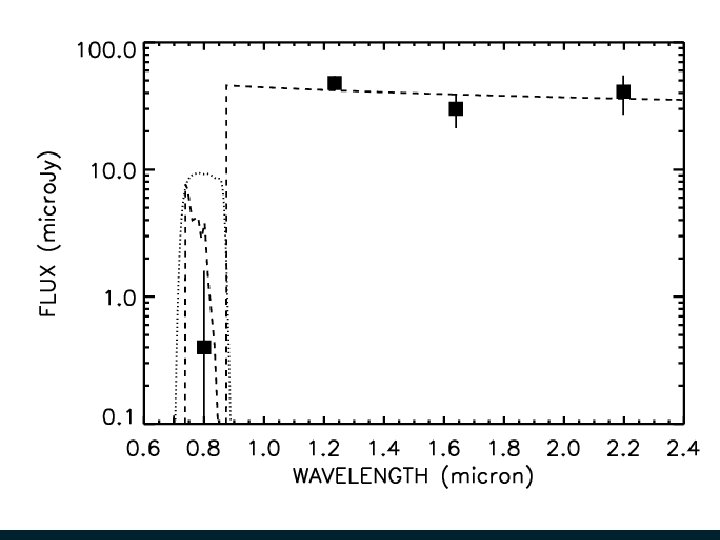
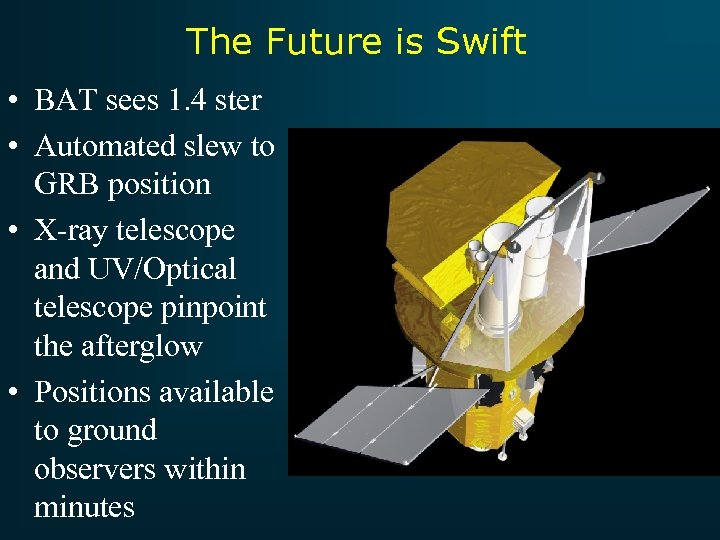
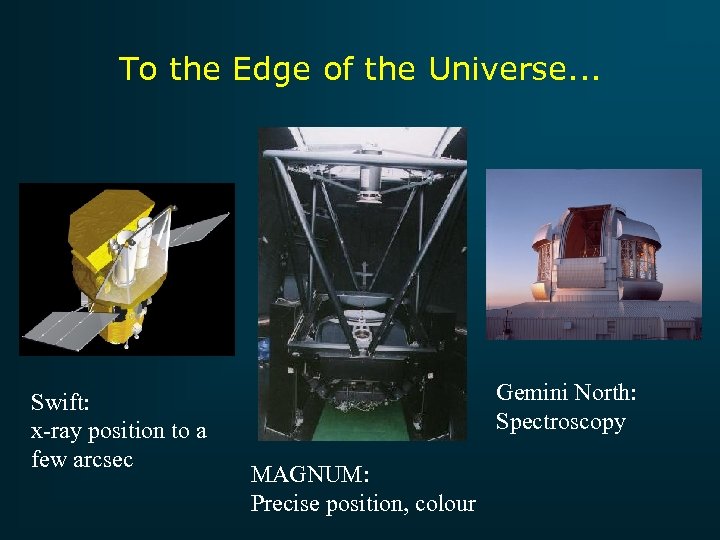
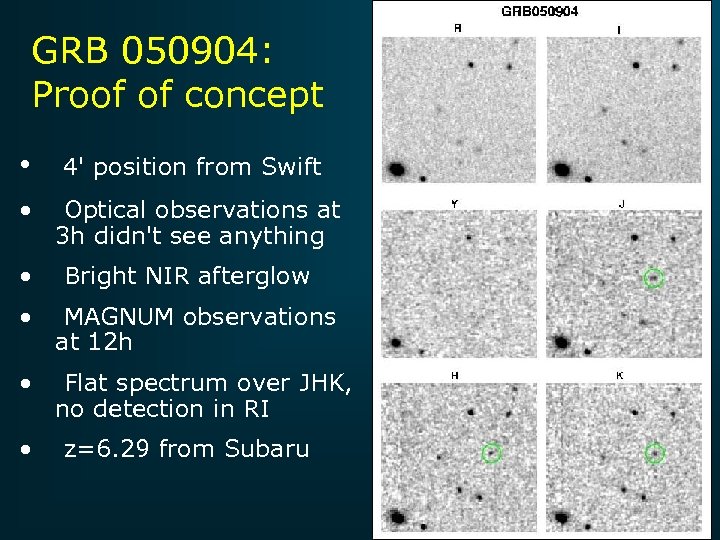 GRB 050904: Proof of concept • 4' position from Swift • Optical observations at 3 h didn't see anything • Bright NIR afterglow • MAGNUM observations at 12 h • Flat spectrum over JHK, no detection in RI • z=6. 29 from Subaru
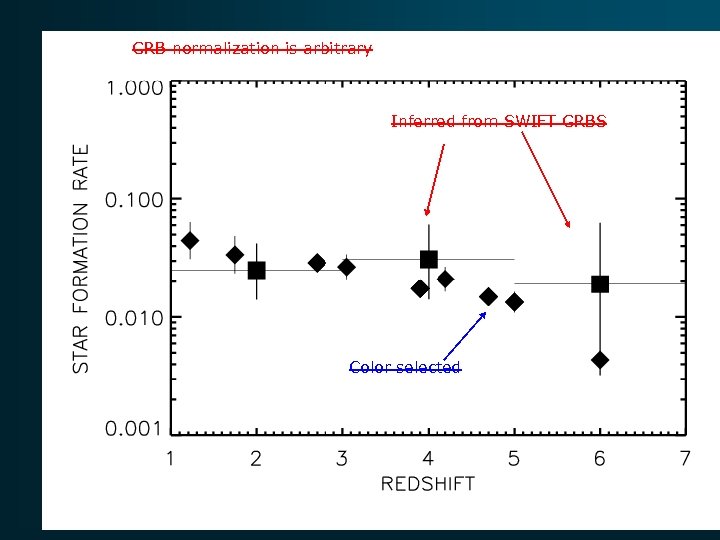 GRB normalization is arbitrary Inferred from SWIFT GRBS Color selected
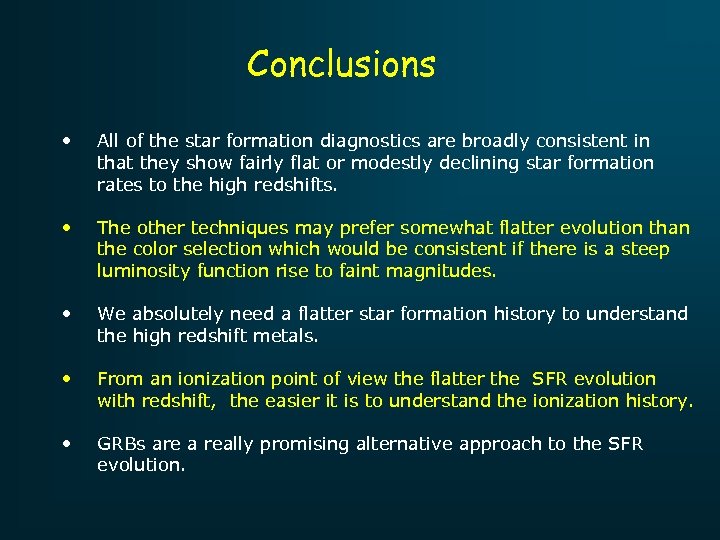 Conclusions • All of the star formation diagnostics are broadly consistent in that they show fairly flat or modestly declining star formation rates to the high redshifts. • The other techniques may prefer somewhat flatter evolution than the color selection which would be consistent if there is a steep luminosity function rise to faint magnitudes. • We absolutely need a flatter star formation history to understand the high redshift metals. • From an ionization point of view the flatter the SFR evolution with redshift, the easier it is to understand the ionization history. • GRBs are a really promising alternative approach to the SFR evolution.
 z=3. 4 Ly a LF Z=5. 7 Ly a LF (Approx 1 solar mass per year: no extinction case B)
 Ly a luminosity function Z=3. 4 Ly a LF Z=6. 6 Ly a LF Z=5. 7 Ly a LF (Approx 1 solar mass per year: no extinction case B)
 Star formation history Wilson et al. 2002 and Barger, Cowie and Richards 2000 OPTICAL, 20 cm DATA ALL SCUBA (1+z)^0. 8 (1+z)^2 SCUBA ABOVE 6 m. Jy
 Z= 5. 7 Ly a emitters in SSA 22 & HDF SSA 22 HDF
 Composite line profiles at 5. 7 and 6. 5 (Virtually identical!) Instrument resolution EW(5. 7)=56 A EW(6. 5)=50 A FWHM(5. 7) =1. 1 A FWHM(6. 5)= 0. 8 A
 IS ANY OF THIS DEFINITIVE? (probably not) Need many lines of sight to properly average in the quasars. 1148 may be anomalous. For the galactic L alpha lines (Madau, Haiman, Loeb, Gnedin, etc…. ) More luminous objects may self shield themselves by ionizing the gas around them. Even for lower luminosity objects: Clustered or neighboring objects may also ionize the region around the object. Preferred (low density) lines of sight may be ionized and we may have strong selection bias in our object sample. But for the moment I would say the balance of evidence is that reionization is at higher redshifts.
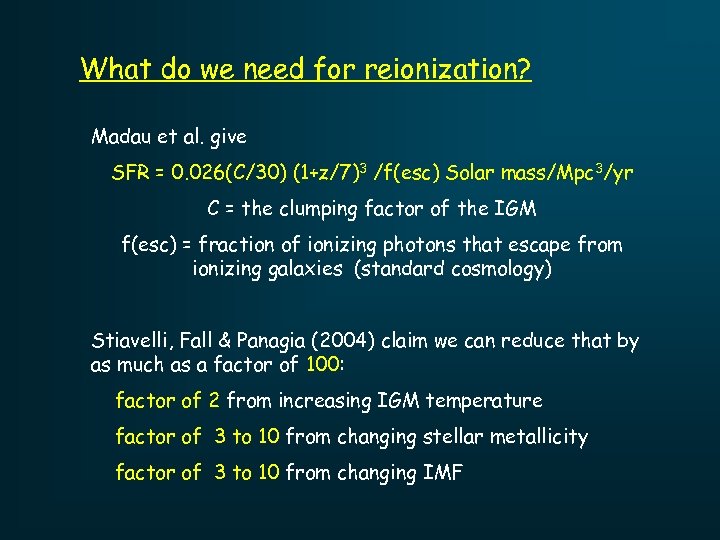
 What do we need for reionization? Madau et al. give SFR = 0. 026(C/30) (1+z/7)3 /f(esc) Solar mass/Mpc 3/yr C = the clumping factor of the IGM f(esc) = fraction of ionizing photons that escape from ionizing galaxies (tandard cosmology) Stiavelli, Fall & Panagia (2004) claim we can reduce that by as much as a factor of 100: factor of 2 from increasing IGM temperature factor of 3 to 10 from changing stellar metallicity factor of 3 to 10 from changing IMF
 Ly a searches with narrow-band filters or direct spectroscopic techniques (Hu et al 2002, Taniguchi et al. 2004 , Ellis et al 2004, Hu et al. 2004, Malhotra and Rhoads… etc. ) can provide large homogeneous samples of galaxies at these redshifts which probe fainter in the luminosity function than the color break selected galaxies. Caveat: only a fraction of the color-selected objects have Ly a emission (perhaps 20% at z=3 from Steidel et al)
 Gamma ray bursts provide a totally different approach Assume rate of gamma ray bursts as a function of redshift is proportional to the star formation rate. . (Madau, Lamb and Reichart, Bromm and Loeb and others) Advantages: Highly complete and direct observations of the massive stars. Not biased against small galaxies or subject to cosmic variance. Big question: we have to assume that the selection of GRBs from massive stars is invariant as a function of redshift. Alternate method: just locate the host galaxies with the GRB and then use these to measure the star formation history. This may be very powerful.
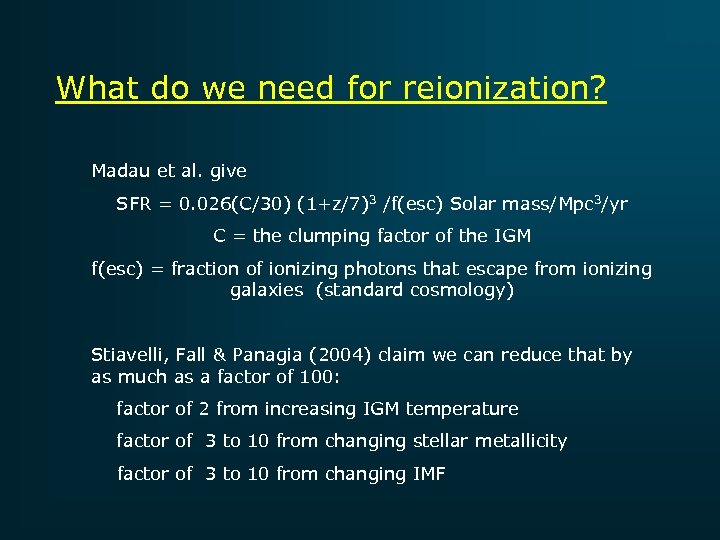 What do we need for reionization? Madau et al. give SFR = 0. 026(C/30) (1+z/7)3 /f(esc) Solar mass/Mpc 3/yr C = the clumping factor of the IGM f(esc) = fraction of ionizing photons that escape from ionizing galaxies (standard cosmology) Stiavelli, Fall & Panagia (2004) claim we can reduce that by as much as a factor of 100: factor of 2 from increasing IGM temperature factor of 3 to 10 from changing stellar metallicity factor of 3 to 10 from changing IMF
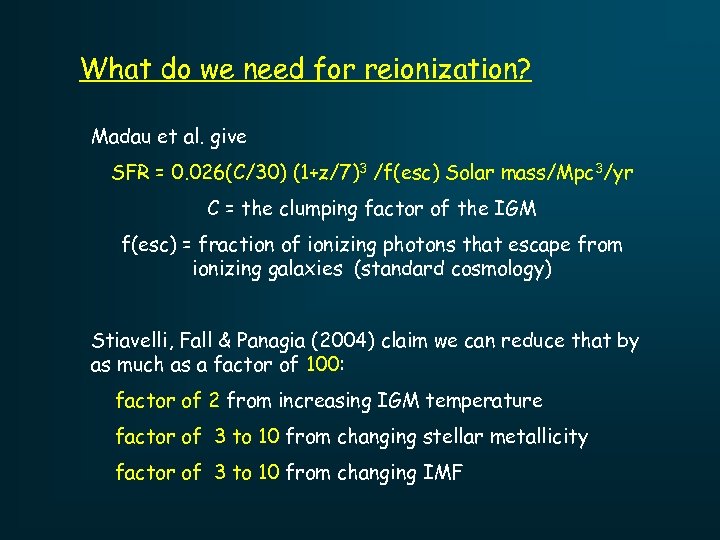 What do we need for reionization? Madau et al. give SFR = 0. 026(C/30) (1+z/7)3 /f(esc) Solar mass/Mpc 3/yr C = the clumping factor of the IGM f(esc) = fraction of ionizing photons that escape from ionizing galaxies (standard cosmology) Stiavelli, Fall & Panagia (2004) claim we can reduce that by as much as a factor of 100: factor of 2 from increasing IGM temperature factor of 3 to 10 from changing stellar metallicity factor of 3 to 10 from changing IMF
 What ionizing flux do we need? • The IGM is certainly ionized below z=6 irrespective of the exact redshift of reionization. • Below this redshift we can infer the evolution of the required ionizing flux from the evolution of the forest transmission.
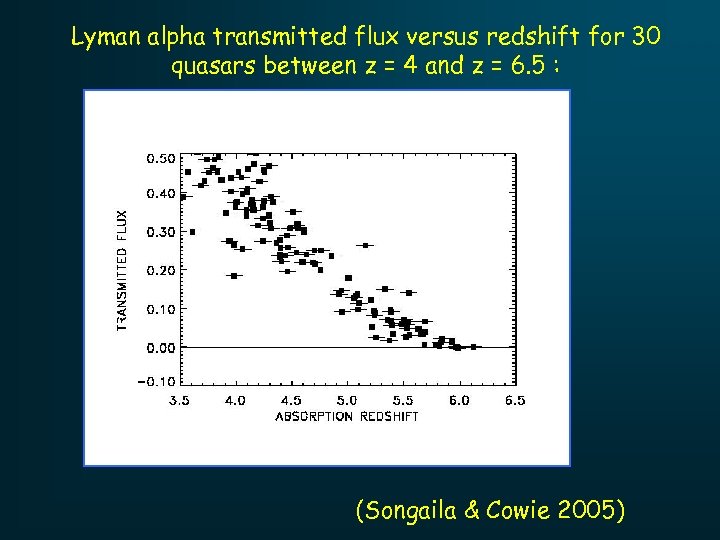 Lyman alpha transmitted flux versus redshift for 30 quasars between z = 4 and z = 6. 5 : (Songaila & Cowie 2005)
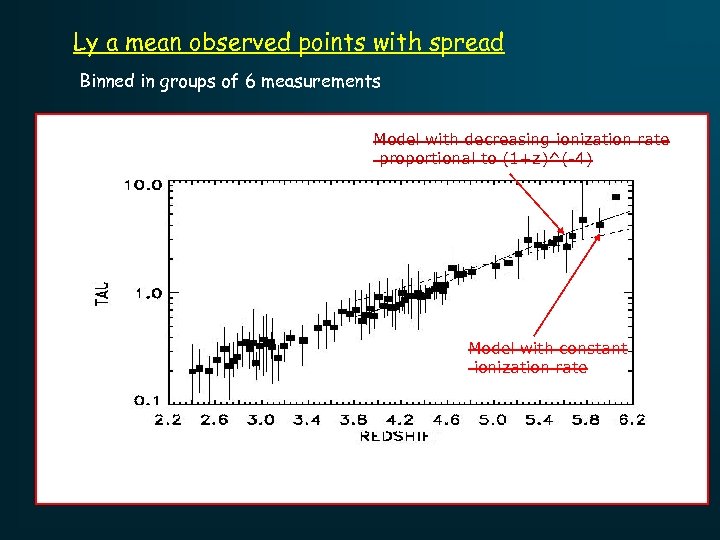 Ly a mean observed points with spread Binned in groups of 6 measurements Model with decreasing ionization rate proportional to (1+z)^(-4) Single points Open symbols : White Becker gap et al. 2003 Model with constant ionization rate
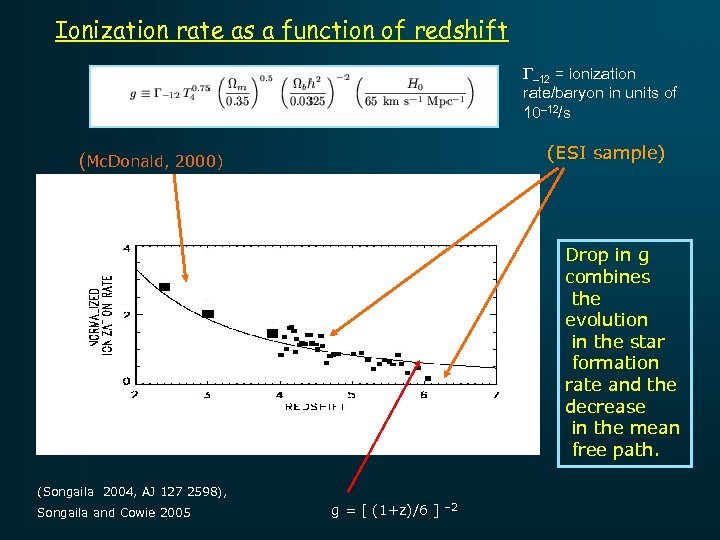 Ionization rate as a function of redshift G-12 = ionization rate/baryon in units of 10 -12/s (ESI sample) (Mc. Donald, 2000) Drop in g combines the evolution in the star formation rate and the decrease in the mean free path. (Songaila 2004, AJ 127 2598), Songaila and Cowie 2005 g = [ (1+z)/6 ] – 2
 Does this mean conditions are the same in the IGM at z = 5. 7 and z = 6. 5? Maybe not (Madau, Haiman, Loeb, Gnedin, etc…. ) : • More luminous objects may self shield themselves by ionizing the gas around them. • Even for lower luminosity objects: • • Clustered or neighboring objects may also ionize the region around the object. Preferred (low density) lines of sight may be ionized and we may have strong selection bias in our object sample.
 Composite of DEIMOS Spectra R=2700 spectra allow us to easily distinguish OII and OIII emitters instrument profile Hu et al. (2003)
 What do we need for reionization? Madau et al. give SFR = 0. 026(C/30) (1+z/7)3 /f(esc) Solar mass/Mpc 3/yr C = the clumping factor of the IGM f(esc) = fraction of ionizing photons that escape from ionizing galaxies (standard cosmology) Stiavelli, Fall & Panagia (2004) claim we can reduce that by as much as a factor of 100: factor of 2 from increasing IGM temperature factor of 3 to 10 from changing stellar metallicity factor of 3 to 10 from changing IMF
 Implications for comoving star formation rate (SFR) • Relation depends on the evolution of the photon mean free path or the clumping factor in the gas : • Cen & Mc. Donald (2002) give SFR proportional to G(1+z)1+b where b is in the range 0 - 2 • This would give a flat or slowly declining SFR with redshift depending on the adopted fit. The maximum decline from z = 3 to z = 6 would be about a factor of 2 (taking b = 0 and a (1+z)-2 dependence for G).
 The Future is Swift • BAT sees 1. 4 ster • Automated slew to GRB position • X-ray telescope and UV/Optical telescope pinpoint the afterglow • Positions available to ground observers within minutes
 UV continuum luminosity function of Lya -selected objects Incompleteness corrected Z = 5. 7 Steidel et al, z = 3 z=4 Raw Ly a selected
 To the Edge of the Universe. . . Swift: x-ray position to a few arcsec Gemini North: Spectroscopy MAGNUM: Precise position, colour
 GOODS-S continuum objects from Stanway, Bunker et al. GOODS-N from Spinrad et al. , Weyman et al. , Barger et al. Emission Line window