 Скачать презентацию Metal-Insulator Transitions in Complex Oxides probed by Compton
16be465e4ffb0546bc9f7a971db0ccd6.ppt
- Количество слайдов: 22



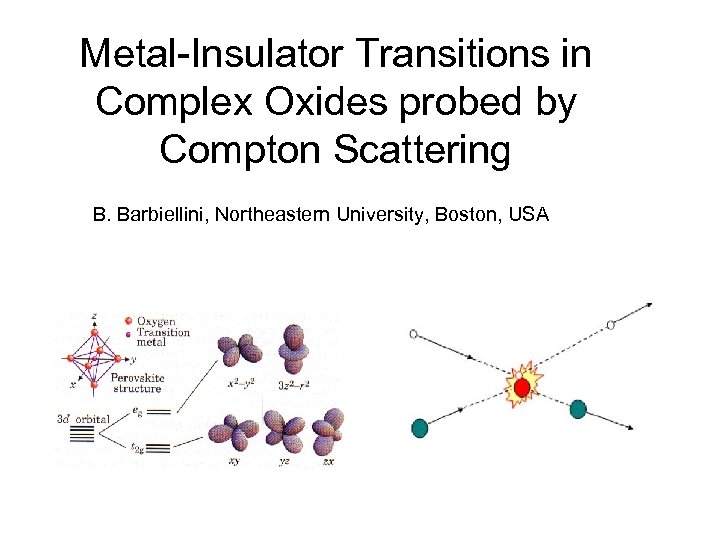
Metal-Insulator Transitions in Complex Oxides probed by Compton Scattering B. Barbiellini, Northeastern University, Boston, USA
![q q q q q Theory Group, Northeastern [NU] Arun Bansil [NU] Robert](https://present5.com/presentation/16be465e4ffb0546bc9f7a971db0ccd6/image-2.jpg "q q q q q Theory Group, Northeastern [NU] Arun Bansil [NU] Robert")
q q q q q Theory Group, Northeastern [NU] Arun Bansil [NU] Robert S. Markiewicz [NU] Bernardo Barbiellini [NU] Peter Mijnarends [NU & Delft, Holland] Stanislas Kaprzyk [NU & AGH, Poland] Matti Lindroos [NU & TTKK, Finland] Jouko Nieminen [ “ “ ] Seppo Sahrakorpi [NU] Dan Nissenbaum [NU]* Ville Arpiainen [TTKK, Finland] Hsin Lin [NU]* Tanmoy Das [NU] Wael Al-Sawai [NU] Susmita Basak [NU] Ray Wang [NU] Cristian Kusko [Romania] Millard Baublitz [NU and Boston U. ] Many Experimental Collaborations
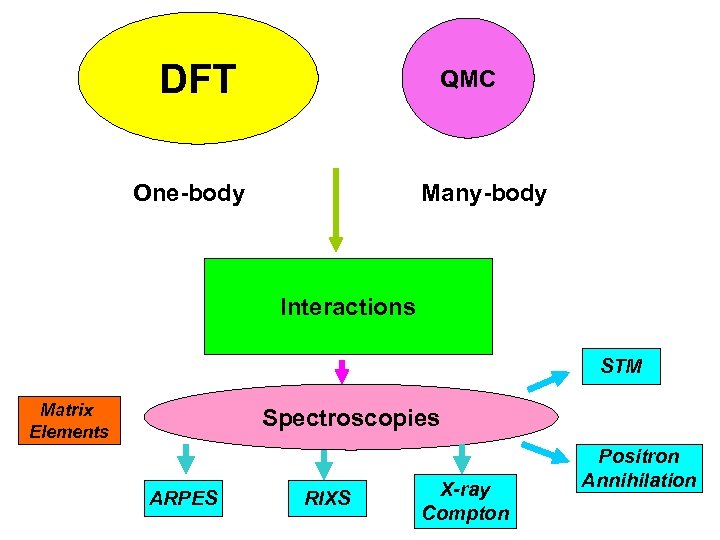
DFT QMC One-body Many-body Interactions STM Matrix Elements Spectroscopies ARPES RIXS X-ray Compton Positron Annihilation
Motivation & Outline • Coulomb repulsion tends to localize individual d electrons on atoms. • Hybridization with the oxygen p electron states tends to de-localize the d electrons. • These competing effects explain the MIT. • Compton scattering is a unique MIT probe in Y 1 -x. Prx. Cu 3 O 7, La 2 -2 x. Sr 1+2 x. Mn 2 O 7, Fe 3 O 4.
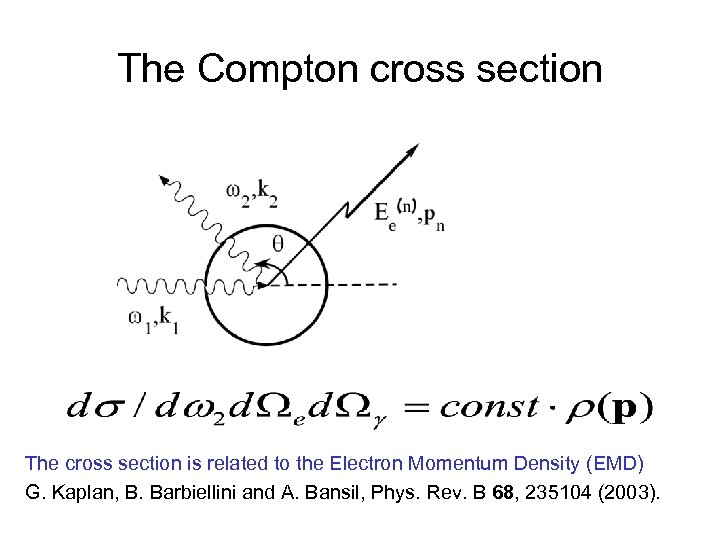
The Compton cross section The cross section is related to the Electron Momentum Density (EMD) G. Kaplan, B. Barbiellini and A. Bansil, Phys. Rev. B 68, 235104 (2003).
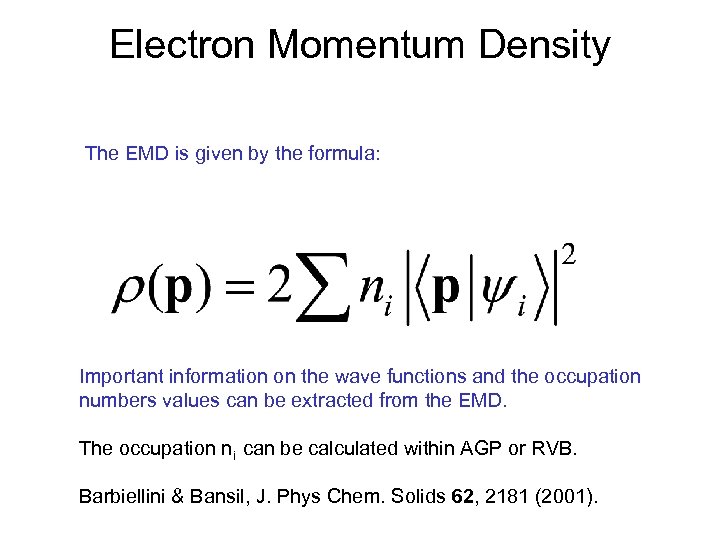
Electron Momentum Density The EMD is given by the formula: Important information on the wave functions and the occupation numbers values can be extracted from the EMD. The occupation ni can be calculated within AGP or RVB. Barbiellini & Bansil, J. Phys Chem. Solids 62, 2181 (2001).
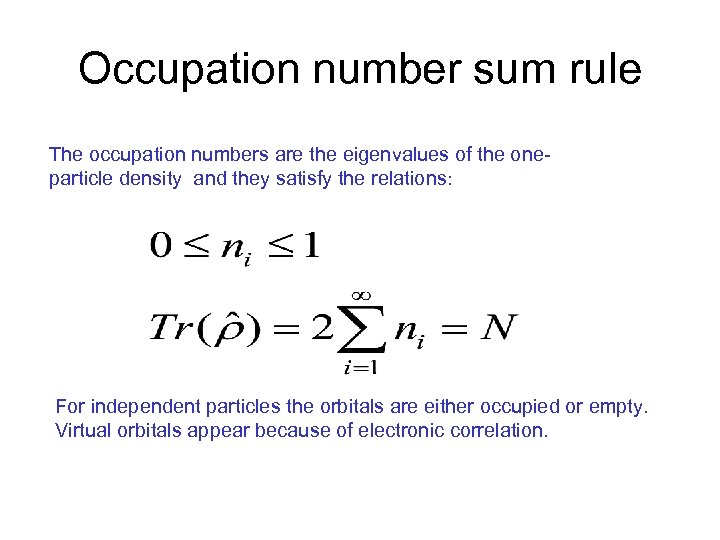
Occupation number sum rule The occupation numbers are the eigenvalues of the oneparticle density and they satisfy the relations: For independent particles the orbitals are either occupied or empty. Virtual orbitals appear because of electronic correlation.
![MIT in RBa 2 Cu 3 O 7 (R=Y or Pr) The [100]-[110] Compton](https://present5.com/presentation/16be465e4ffb0546bc9f7a971db0ccd6/image-8.jpg "MIT in RBa 2 Cu 3 O 7 (R=Y or Pr) The [100]-[110] Compton")
MIT in RBa 2 Cu 3 O 7 (R=Y or Pr) The [100]-[110] Compton profile anisotropy displays a remarkable difference between insulating PBCO and metallic YBCO. The theory gives good agreement for the shape in the metallic YBCO but it must be rescaled. A. Shukla, B. Barbiellini, A. Erb, A. A. Manuel, T. Buslaps V. Honkimaki and P. Suortti, Phys. Rev. B 59, 12127 (1999); ESRF Highlights (1997)
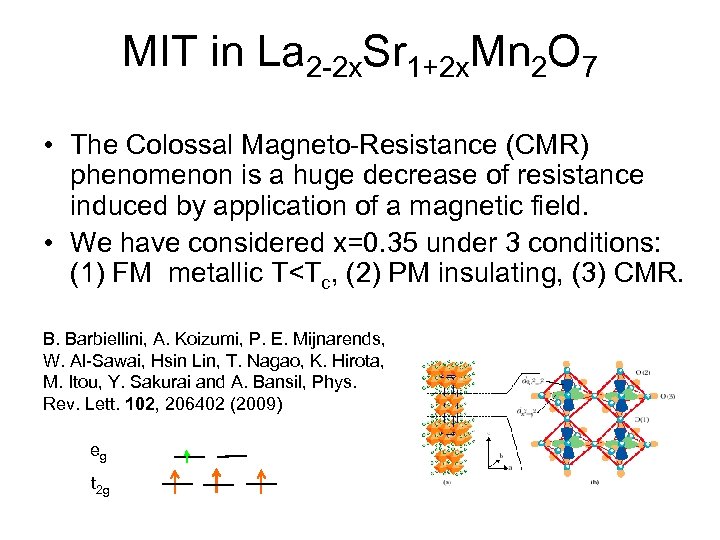
MIT in La 2 -2 x. Sr 1+2 x. Mn 2 O 7 • The Colossal Magneto-Resistance (CMR) phenomenon is a huge decrease of resistance induced by application of a magnetic field. • We have considered x=0. 35 under 3 conditions: (1) FM metallic T<Tc, (2) PM insulating, (3) CMR. B. Barbiellini, A. Koizumi, P. E. Mijnarends, W. Al-Sawai, Hsin Lin, T. Nagao, K. Hirota, M. Itou, Y. Sakurai and A. Bansil, Phys. Rev. Lett. 102, 206402 (2009) eg t 2 g
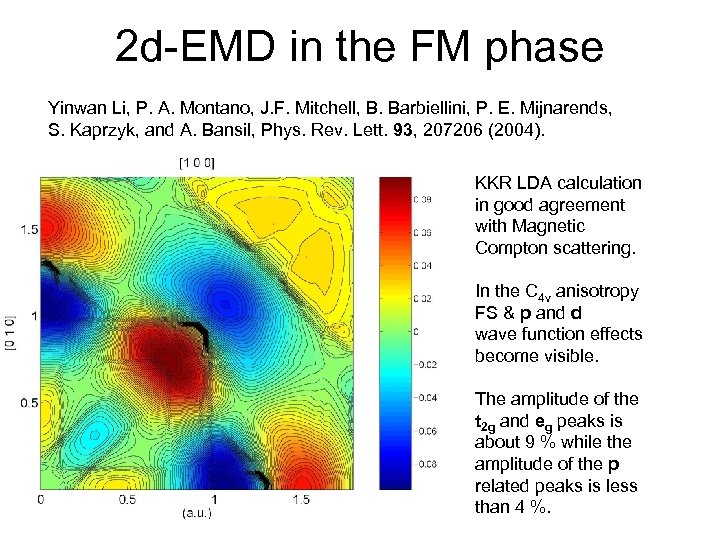
2 d-EMD in the FM phase Yinwan Li, P. A. Montano, J. F. Mitchell, B. Barbiellini, P. E. Mijnarends, S. Kaprzyk, and A. Bansil, Phys. Rev. Lett. 93, 207206 (2004). KKR LDA calculation in good agreement with Magnetic Compton scattering. In the C 4 v anisotropy FS & p and d wave function effects become visible. The amplitude of the t 2 g and eg peaks is about 9 % while the amplitude of the p related peaks is less than 4 %.
![[100]-[110] CP anisotropy Oxygen p electrons play a major role at low momentum range.](https://present5.com/presentation/16be465e4ffb0546bc9f7a971db0ccd6/image-11.jpg "[100]-[110] CP anisotropy Oxygen p electrons play a major role at low momentum range.")
[100]-[110] CP anisotropy Oxygen p electrons play a major role at low momentum range.
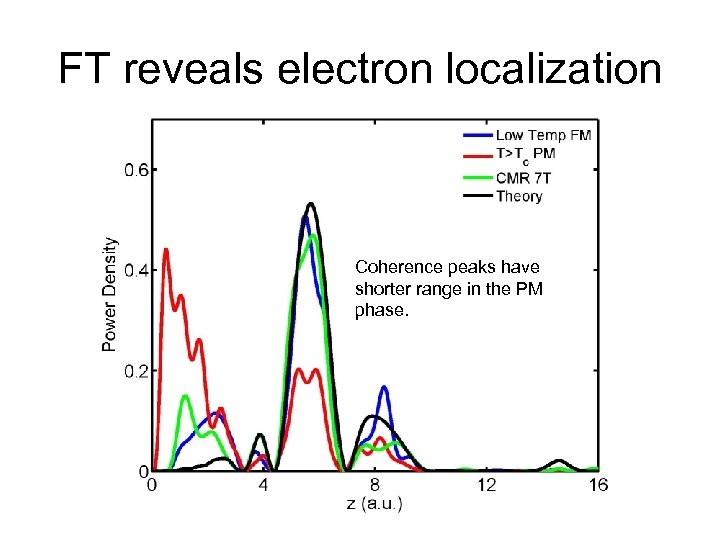
FT reveals electron localization Coherence peaks have shorter range in the PM phase.
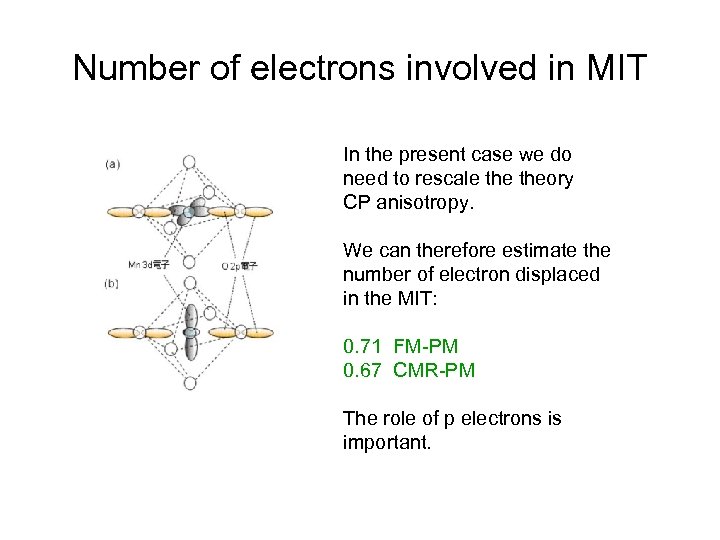
Number of electrons involved in MIT In the present case we do need to rescale theory CP anisotropy. We can therefore estimate the number of electron displaced in the MIT: 0. 71 FM-PM 0. 67 CMR-PM The role of p electrons is important.
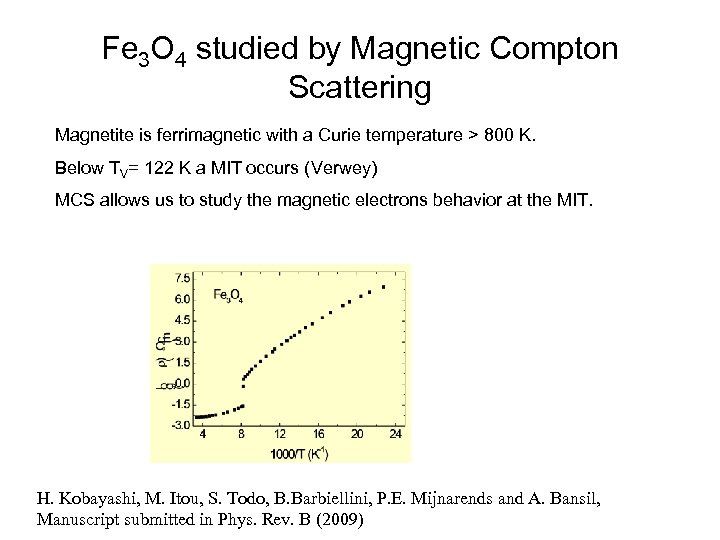
Fe 3 O 4 studied by Magnetic Compton Scattering Magnetite is ferrimagnetic with a Curie temperature > 800 K. Below TV= 122 K a MIT occurs (Verwey) MCS allows us to study the magnetic electrons behavior at the MIT. H. Kobayashi, M. Itou, S. Todo, B. Barbiellini, P. E. Mijnarends and A. Bansil, Manuscript submitted in Phys. Rev. B (2009)
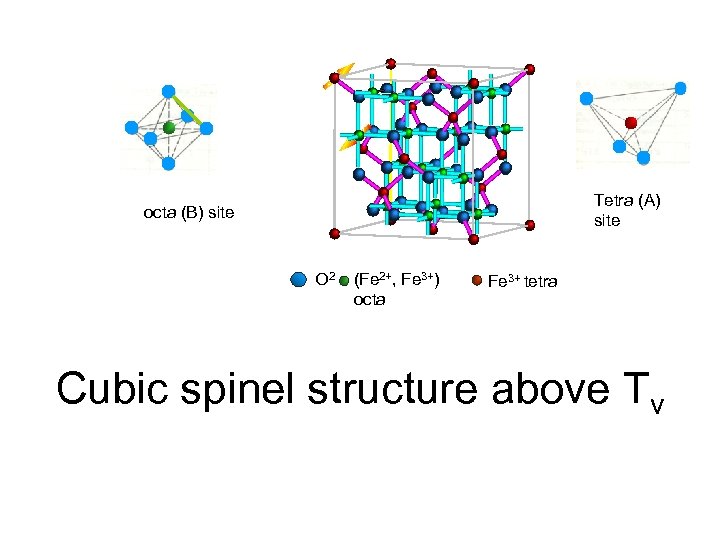
Tetra (A) site octa (B) site O 2 - (Fe 2+, Fe 3+) octa Fe 3+ tetra Cubic spinel structure above Tv
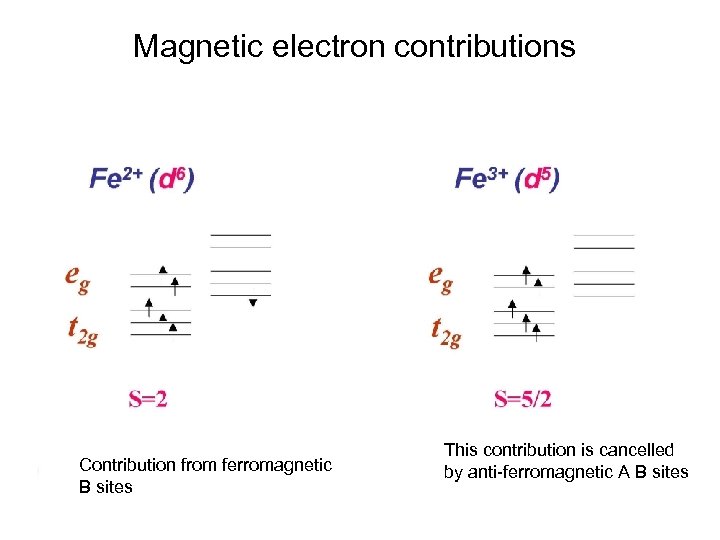
Magnetic electron contributions Contribution from ferromagnetic B sites This contribution is cancelled by anti-ferromagnetic A B sites
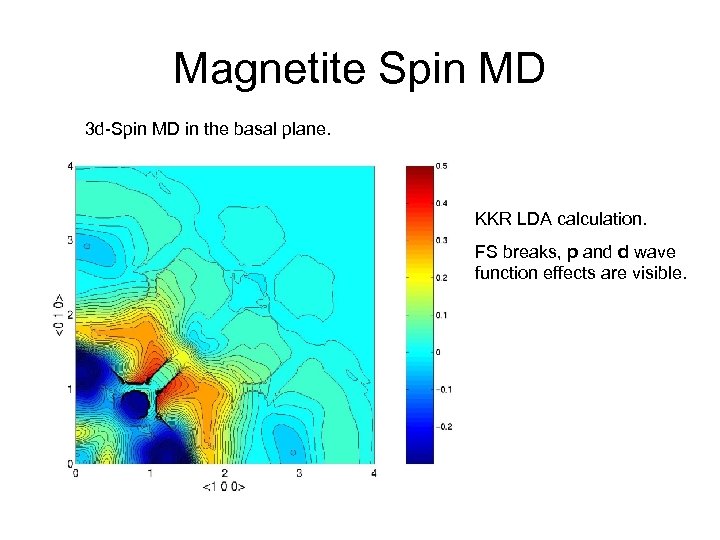
Magnetite Spin MD 3 d-Spin MD in the basal plane. KKR LDA calculation. FS breaks, p and d wave function effects are visible.
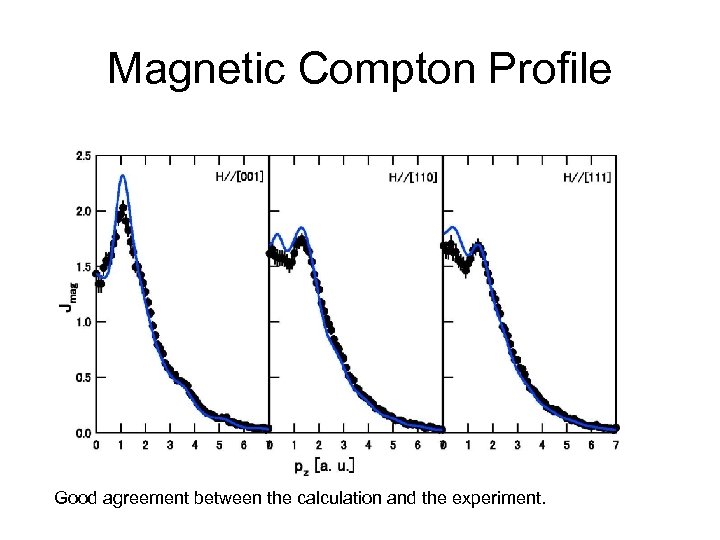
Magnetic Compton Profile Good agreement between the calculation and the experiment.
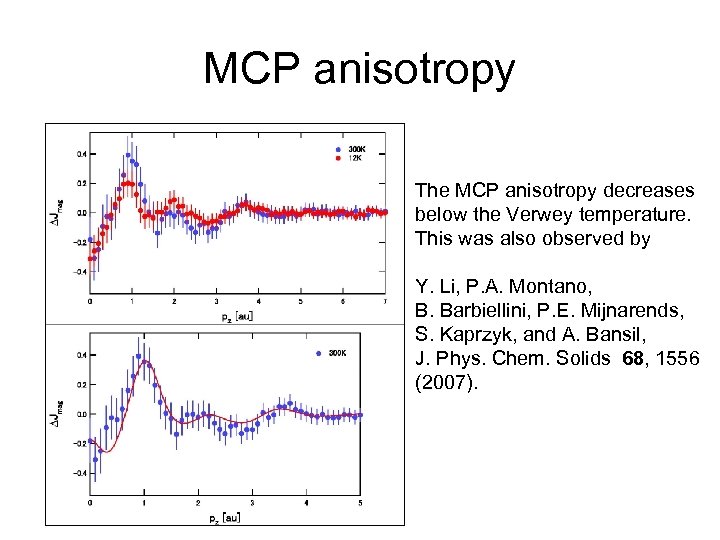
MCP anisotropy The MCP anisotropy decreases below the Verwey temperature. This was also observed by Y. Li, P. A. Montano, B. Barbiellini, P. E. Mijnarends, S. Kaprzyk, and A. Bansil, J. Phys. Chem. Solids 68, 1556 (2007).
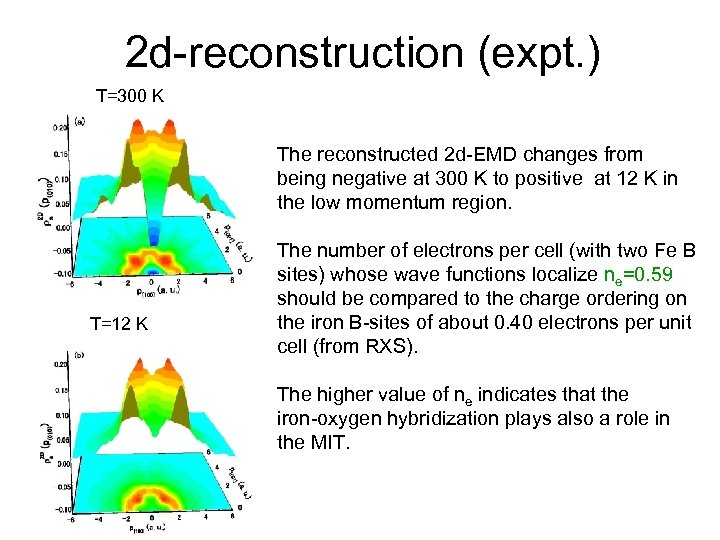
2 d-reconstruction (expt. ) T=300 K The reconstructed 2 d-EMD changes from being negative at 300 K to positive at 12 K in the low momentum region. T=12 K The number of electrons per cell (with two Fe B sites) whose wave functions localize ne=0. 59 should be compared to the charge ordering on the iron B-sites of about 0. 40 electrons per unit cell (from RXS). The higher value of ne indicates that the iron-oxygen hybridization plays also a role in the MIT.
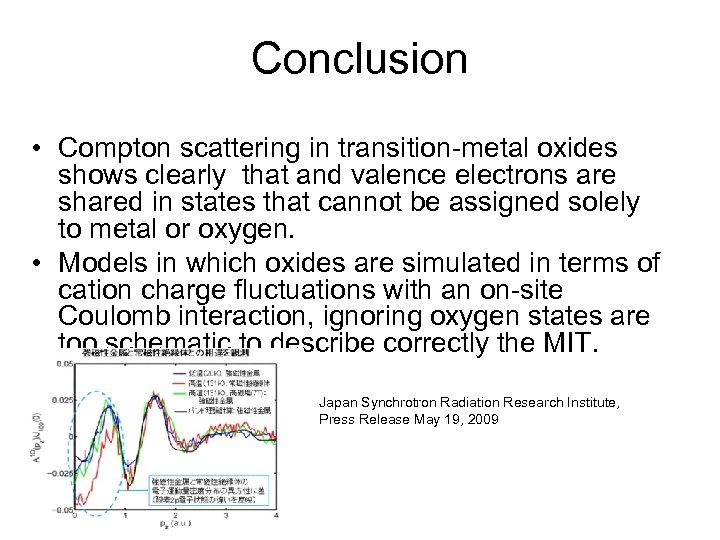
Conclusion • Compton scattering in transition-metal oxides shows clearly that and valence electrons are shared in states that cannot be assigned solely to metal or oxygen. • Models in which oxides are simulated in terms of cation charge fluctuations with an on-site Coulomb interaction, ignoring oxygen states are too schematic to describe correctly the MIT. Japan Synchrotron Radiation Research Institute, Press Release May 19, 2009
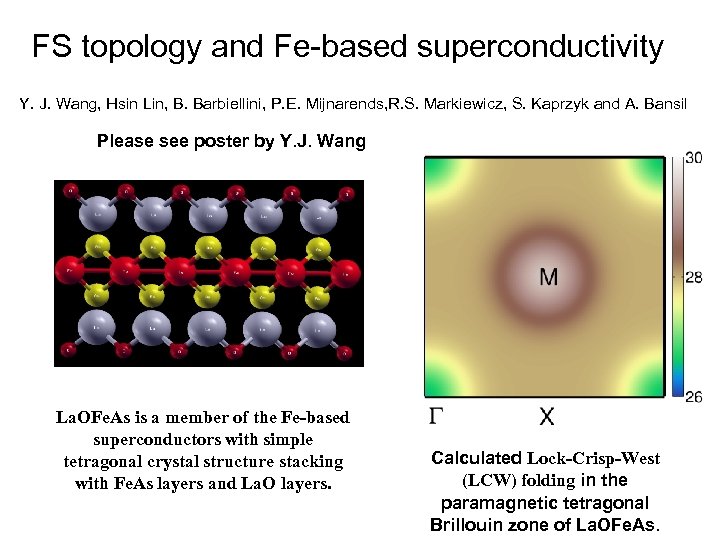
FS topology and Fe-based superconductivity Y. J. Wang, Hsin Lin, B. Barbiellini, P. E. Mijnarends, R. S. Markiewicz, S. Kaprzyk and A. Bansil Please see poster by Y. J. Wang La. OFe. As is a member of the Fe-based superconductors with simple tetragonal crystal structure stacking with Fe. As layers and La. O layers. Calculated Lock-Crisp-West (LCW) folding in the paramagnetic tetragonal Brillouin zone of La. OFe. As.
Скачать презентацию Metal-Insulator Transitions in Complex Oxides probed by Compton
16be465e4ffb0546bc9f7a971db0ccd6.ppt