


 Скачать презентацию Messages from Te Kotahitanga for Teacher Education P
b049c0fa25360042c2ba0373fd5145ca.ppt
- Количество слайдов: 65
 Messages from Te Kotahitanga for Teacher Education. P. R. I. D. E. Workshop Apia, Samoa. Russell Bishop University of Waikato New Zealand 28 th Nov- 2 nd Dec, 2005 1
 Te Kotahitanga is a wholeschool, systemic change programme targeted at improving Maori students’ educational achievement. 2
 Model for Sustainable Change • Focus on Maori student achievement • Change in classroom practice • New institutions and structures • Professional leadership • Spread to include others • Governance • Ownership by the school 3
 The vision of Te Kotahitanga To promote a series of interactions at all levels within schools based upon selfdetermining individuals interacting within non-dominating relations of inter-dependence. 4
 This vision comes from a kaupapa Maori approach to education Kaupapa Maori education promotes Maori people’s aspirations for self-determination in relation to other people. 5
 Challenge Number 1 7
 The major challenge that faces us as educators today is the continuing disparities of outcome throughout our education system. 8
 • The Problem; • Children of minoritised groups consistently attain lower achievement levels in schools. • These students; 9
 • Are overrepresented in special education programmes • And in vocational classes • And in low stream classes • Enroll in pre-school and tertiary institutions in lower proportions. • And leave school early • with fewer qualifications 10
 How we respond to this challenge will seriously affect how successful we will be in reducing disparities and improving achievement. 11
 The status quo in New Zealand is one where educational disparities are ethnically based. 12
 • • • Are we defensive – I’m alright? Do we deny the problem exists? Do we blame others? Do we accept responsibility? Do we act? 13
 And above all: • Is what we are currently doing in education changing the status quo, or perpetuating it. • Whom the gods wish to destroy, they first make mad. • The first sign of madness is our trying to bring about change whilst continuing to do the same as before, again and again, with the same results. 14
 Are our current and future educators able to produce equitable outcomes for children of different ethnic, racial, cultural, class & language groups. 16
 Message No: 1 • We need to improve minoritised students’ achievement. This needs to be a priority goal for educators. • Do we and our students know how to set and measure achievement goals for minoritised students? • Do we know what to do with the information if and when we get it? 17
 Challenge Number 2 18
 Teacher Positioning • the increasing irrelevance of deficit positioning as a theoretical space from which to develop teaching practice. 19
 In Te Kotahitanga we have identified that when teachers are located within deficit positions: • they blame others for educational disparities • they exhibit feelings of helplessness • they reject their personal and professional responsibility and agency 20
 When teachers actively reject deficit and blaming explanations: • They accept personal and professional responsibility for their part in the learning relationship • They are clear that they have agency; they are active agents of change • They know how and what to do in their classrooms • They report being re-invigorated as teachers. 21
 Message No. 2 22
 • All educators, including students entering Teacher Education programmes, Lecturers, and Advisors holding a variety of positions on all these challenges. • We need ongoing opportunities to identify, examine and critically reflect upon the positions taken in reference to the challenges facing us as educators. • Do we provide our students with these opportunities? How? 23
 • Critical reflection must involve students and staff having ongoing opportunities to gather evidence of the impact of the positions they hold on student learning. • This will necessarily involve those currently outside of the current reference groups 24
 Professionals accept responsibility for their actions • The plague of blame needs to be replaced with a culture of agency • Teachers need to know how to change their practice through using evidence. 25
 Challenge Number 3 26
 The call for evidence • the increasing demand that critical reflection must be evidence-based rather than assumptionbased. • the increasing call for all educational practice to be evidence-based ie evidence should inform educators’ problem-solving, and inform changes that need to be made to their practice. • increasing evidence that student experiences are extremely useful to inform and modify our practice. 27
 Message No. 3 • Can we and our students use data to identify how minoritised student’s experiences, participation and learning is improving. Data such as; • Student Experiences of Being Minoritised • Student Participation • absenteeism • suspensions • engagement • Student Achievement 28
 Challenge no. 4 29
 Realisations about learning • The increasing realisation that learning involves constructing knowledge with others rather than receiving it from others. • The increasing realisation that knowledge is not gender or culture-free and that it is always created and promoted for a purpose, and often these purposes promote the language, culture and values of those in power 30
 Message no 4 The increasing realisation that teachers can construct contexts wherein students are able to bring their cultural experiences to the learning conversation, despite the teacher ‘not knowing’ about these experiences and ways of making sense of the world. 31
 Challenge No. 5 32
 Relationships between sectors of the profession 33
 • the increasing demand for relevance between pre-service education and inservice education, professional development, teaching practice and research. • international research that identifies little if any linkages between pre-service teacher education and in-service practice. 34
 • The increasing concern about the frailty of a the ‘silo’ model for preparing pre-service teachers. • The continued criticism of tertiary teacher education providers from their graduates, their profession, the public and the media. 35
 • I hear from teacher educators, teacher support staff, school teachers and educational researchers that what they are doing is sufficient, necessary and adequate. • These notions are supported by the review process that is commonly used. 36
 The increasing demand that students enter the workforce prepared for classroom interactions and able to inform their practice through appropriate assessment of student learning. 37
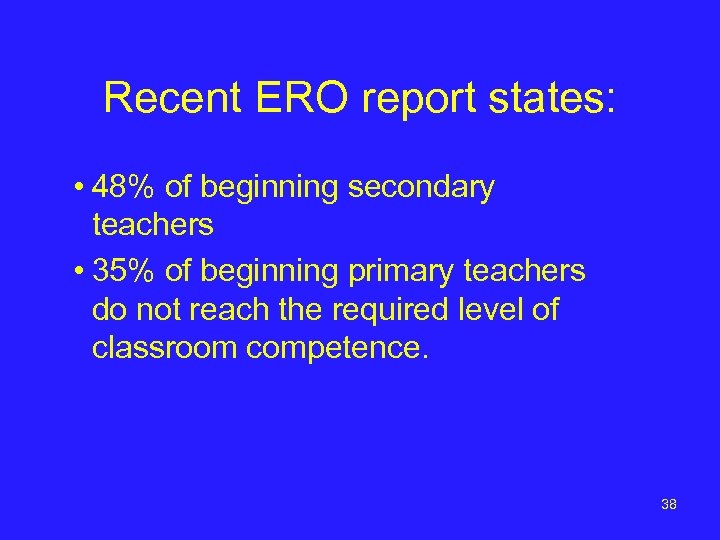 Recent ERO report states: • 48% of beginning secondary teachers • 35% of beginning primary teachers do not reach the required level of classroom competence. 38
 A recent survey of 360 teachers, 60% of whom had been to teacher education institutions in the past 5 years, showed that they wanted to teach in ways they had learnt there. 39
 AND YET… 44
 • The dominant classroom interaction is active teacher and passive students, despite aspirations to the contrary. • This might signal the pervasiveness of transmission education (blame the schools) OR • It might indicate the lack of student preparedness and the reliance upon the school for practical training (blame the teacher educators). 47
 Message No. 5 48
 Participants need to integrate theory and practice of teaching and learning (including using evidence of teacher behaviour and student achievement formative purposes) in a systematic manner so that they can practice what they learn. 49
 • Pre-service teachers need to receive objective analysis and feedback of their classroom interactions in an ongoing manner upon which they critically reflect in a collaborative, problem-solving setting. • Pre-service teachers need to learn to use evidence of student participation and achievement to inform their practice, (to change classroom interaction patterns for instance). 50
 Challenge No. 6 The Challenge of Research 51
 Recent PBRF report states: • 75% of staff involved in teaching degree level courses are not involved in research. • The area with the lowest quality of research and with the lowest assessed research performance is Teacher Education. 52
 Therefore • If change is necessary to address disparities • And research is a major way of informing and promoting change through the systematic production of evidence to inform our practice • And if Teacher Educators/Advisors are not involved in research, what mechanism are we using to inform our practice? 53
 Message no. 6 54
 We as teacher educators may not have a means of addressing the status quo which is maintaining the disparities that we say we want to reduce. 55
 Challenge No. 7 Professional Learning. We know that professional learning is best when; 56
 Professional Learning. • it is on-site, ongoing, continuous, supported, and research driven. • it emulates the learning relationships that are intended for classrooms. • it is based on feedback and collaborative problem-solving. 57
 Message no. 7 58
 The need for Professional Learning Opportunities • There needs to be a strong investment in creating staff professional learning opportunities at all levels of the system. • If we are to produce teachers who impact on student achievement, we as teacher educators must model these practices ourselves in a coherent manner that is in turn, supported by facilitators. 59
 So, how do we bring about change? 60
 We need to collaboratively reflect upon our positioning in regard to the challenges presented here. However, what is our collective response? 61
 • Defensive • Denial • Blame • Acceptance • Action 62
 To respond to these challenges “Ostrich Response”. Do nothing/ We DO know better/ We are doing this all already/ Blame/ Denial. • A reconsideration of the content, form and function of the pre- and in-service curriculum • Disestablish current teacher education provision-relocate within schools with appropriate support. 63
 • Option 2 means that structures are needed within institutions that promote collaboration among staff who currently teach school curriculum areas, professional courses and staff who support students/teachers in school 64
 A model for Implementation G. E. P. R. I. S. P. 65
 Goals What are your goals? You have to decide, as a collective, that is with all people involved, what your goals are. 66
 Experiences What are the current educational experiences of ‘your’ teachers and ‘their’ students? 67
 Positioning • What is the current positioning of yourself, your staff, the teachers you work with and what effect does this have upon you reaching your goal? • Who is limiting your potential/ability to reach your goals? 68
 Relationships • How would you describe the relationships in your institution? • How would you describe your relationships with in-service teachers? 69
 Interactions What are the main pedagogic interactions within your institution? That your teachers use? What use do you and they make of evidence? 70
 Strategies What range of strategies are used in your institution? What range of assessment strategies do you use? How do you use them? 71
 Planning How does the planning by your staff aim to achieve the goals? How would you know if you had met your goals? 72
 Ma Te Runga Rawa koutou, e tiaki, e manaaki. r. bishop@waikato. ac. nz 73