


 Скачать презентацию Message of the Land Pira Sudham 1
38e1dd0062595f771a58ad317428355d.ppt
- Количество слайдов: 75
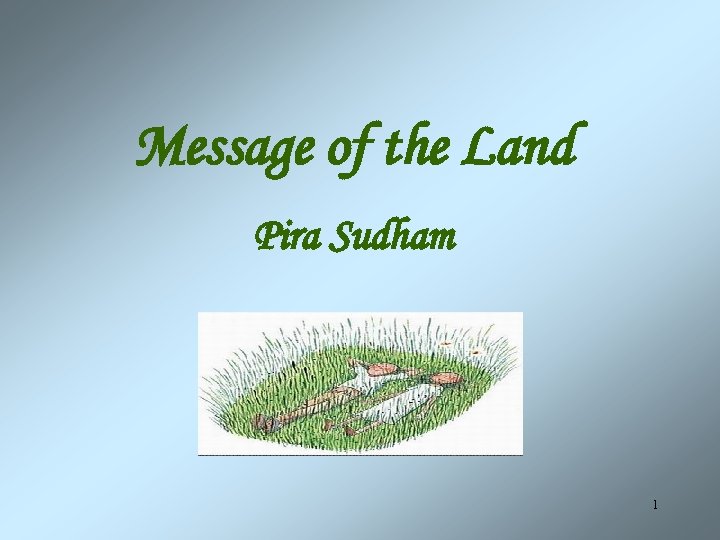 Message of the Land Pira Sudham 1
 • About the Author: About the Text figures of speech / word study / understanding • In-class Discussion 2
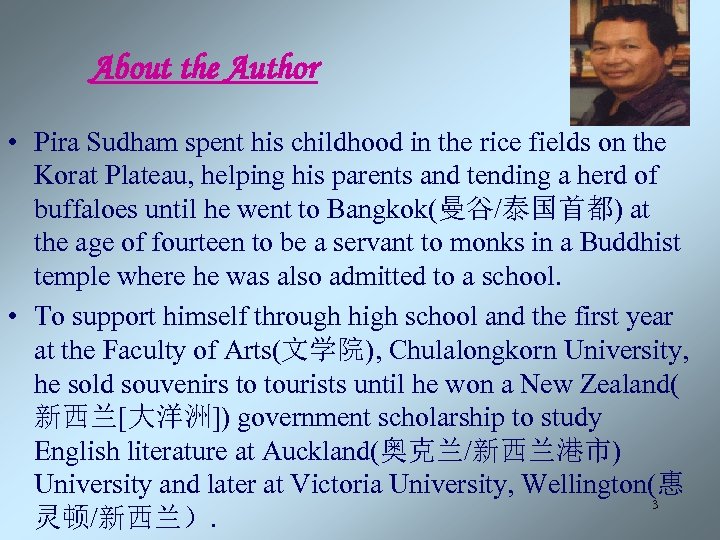 About the Author • Pira Sudham spent his childhood in the rice fields on the Korat Plateau, helping his parents and tending a herd of buffaloes until he went to Bangkok(曼谷/泰国首都) at the age of fourteen to be a servant to monks in a Buddhist temple where he was also admitted to a school. • To support himself through high school and the first year at the Faculty of Arts(文学院), Chulalongkorn University, he sold souvenirs to tourists until he won a New Zealand( 新西兰[大洋洲]) government scholarship to study English literature at Auckland(奥克兰/新西兰港市) University and later at Victoria University, Wellington(惠 3 灵顿/新西兰).
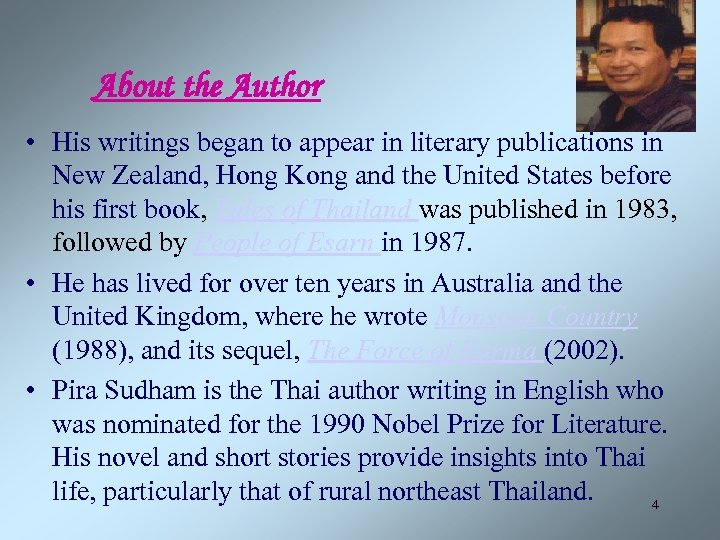 About the Author • His writings began to appear in literary publications in New Zealand, Hong Kong and the United States before his first book, Tales of Thailand was published in 1983, followed by People of Esarn in 1987. • He has lived for over ten years in Australia and the United Kingdom, where he wrote Monsoon Country (1988), and its sequel, The Force of Karma (2002). • Pira Sudham is the Thai author writing in English who was nominated for the 1990 Nobel Prize for Literature. His novel and short stories provide insights into Thai life, particularly that of rural northeast Thailand. 4
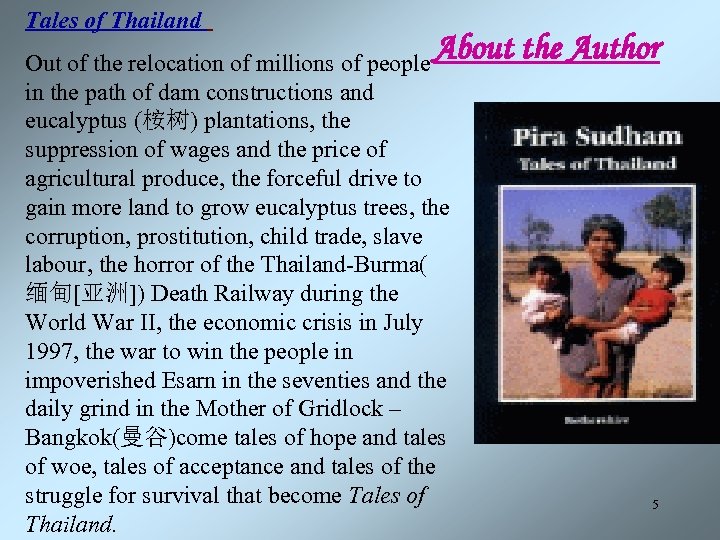 Tales of Thailand About the Author Out of the relocation of millions of people in the path of dam constructions and eucalyptus (桉树) plantations, the suppression of wages and the price of agricultural produce, the forceful drive to gain more land to grow eucalyptus trees, the corruption, prostitution, child trade, slave labour, the horror of the Thailand-Burma( 缅甸[亚洲]) Death Railway during the World War II, the economic crisis in July 1997, the war to win the people in impoverished Esarn in the seventies and the daily grind in the Mother of Gridlock – Bangkok(曼谷)come tales of hope and tales of woe, tales of acceptance and tales of the struggle for survival that become Tales of Thailand. 5
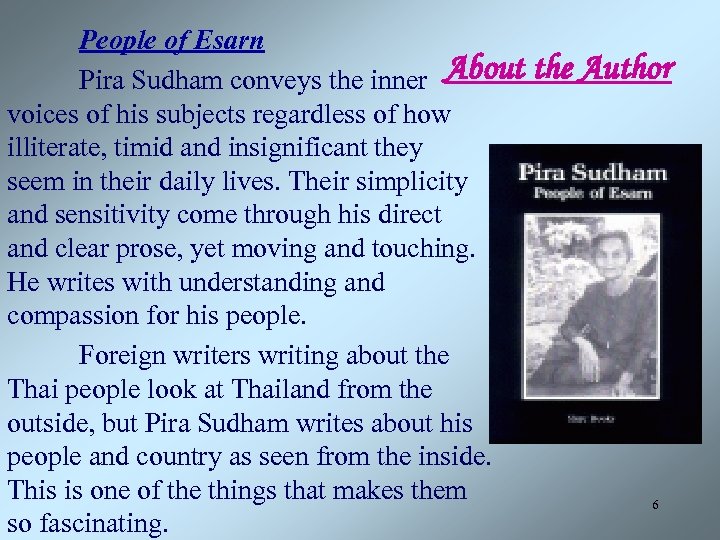 People of Esarn Pira Sudham conveys the inner About the Author voices of his subjects regardless of how illiterate, timid and insignificant they seem in their daily lives. Their simplicity and sensitivity come through his direct and clear prose, yet moving and touching. He writes with understanding and compassion for his people. Foreign writers writing about the Thai people look at Thailand from the outside, but Pira Sudham writes about his people and country as seen from the inside. This is one of the things that makes them 6 so fascinating.
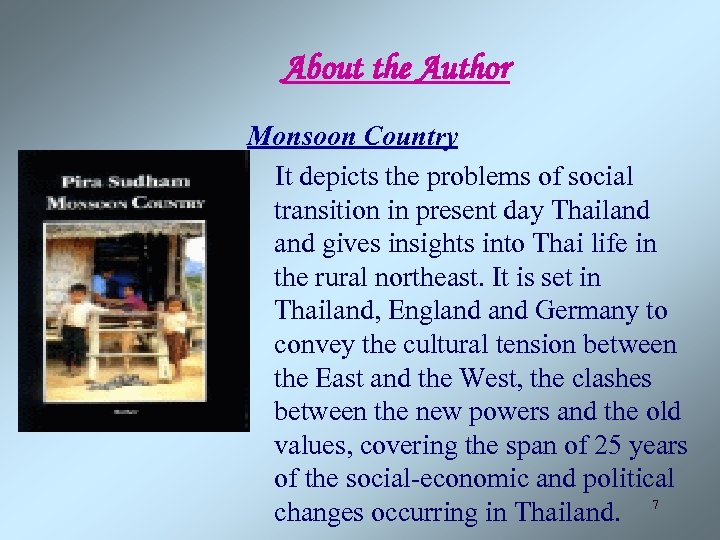 About the Author Monsoon Country It depicts the problems of social transition in present day Thailand gives insights into Thai life in the rural northeast. It is set in Thailand, England Germany to convey the cultural tension between the East and the West, the clashes between the new powers and the old values, covering the span of 25 years of the social-economic and political changes occurring in Thailand. 7
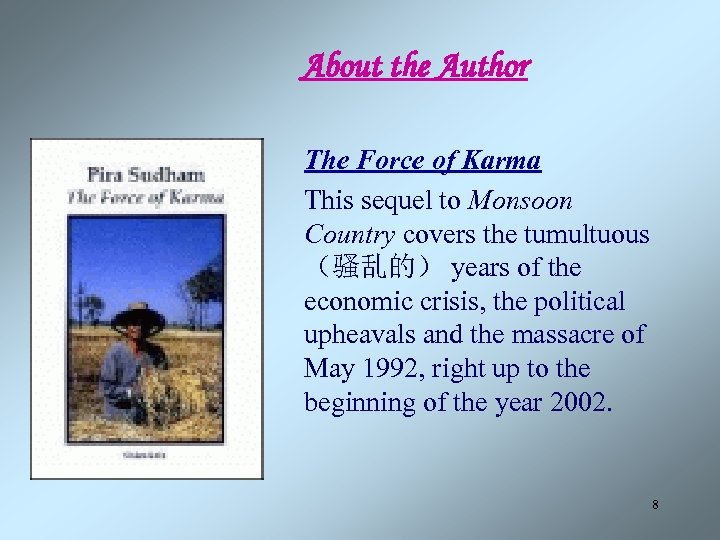 About the Author The Force of Karma This sequel to Monsoon Country covers the tumultuous (骚乱的) years of the economic crisis, the political upheavals and the massacre of May 1992, right up to the beginning of the year 2002. 8
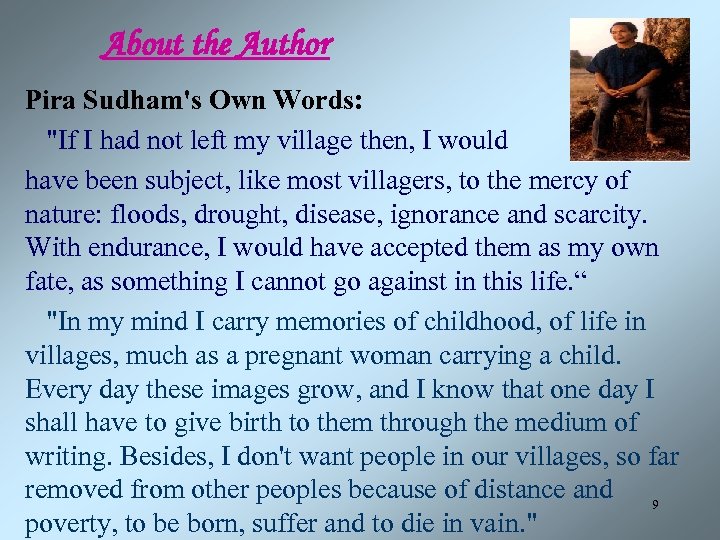 About the Author Pira Sudham's Own Words: "If I had not left my village then, I would have been subject, like most villagers, to the mercy of nature: floods, drought, disease, ignorance and scarcity. With endurance, I would have accepted them as my own fate, as something I cannot go against in this life. “ "In my mind I carry memories of childhood, of life in villages, much as a pregnant woman carrying a child. Every day these images grow, and I know that one day I shall have to give birth to them through the medium of writing. Besides, I don't want people in our villages, so far removed from other peoples because of distance and 9 poverty, to be born, suffer and to die in vain. "
 Essay based on the interview • Interviewer: the author • Interviewees: the farmer and his wife • Topic: life in the countryside 10
 • What is the style of writing adopted in the text? Colloquial ---small and simple words ---short sentences ---straightforward language 11
 About the Text Structure Part 1: The wife’s speech (para. 1 - 3 ) The wife tells us briefly about each member of her family and how all her children left. (para. 4 - 7 ) This part focuses on the changes that she finds she can’t adjust to. Part 2: The farmer’s speech The farmer tells us what he (para. 8 - 11) thinks are the roots of all evils. He also tells us what joys he finds in life and in farming. 12
 1. What the farmer’s wife says (1 -7) • A. Her family and their land (1 -3) • ---How she inherited the land • ---How her four children live and work in cities • ---How she and her husband persisted in working on their land 13
 B. Changes in the village the farmer’s wife does not like (4 -7) • • ---People have to pay their neighbors for services ---Plastic things have replaced village crafts ---Young people copy fashions of city people ---She thinks certain things, such as religious beliefs and traditions should not change • ---She wouldn’t change and doesn’t complain about their hardships 14
 2. What the farmer says(8 -11) • The reason for his silence---he knows the root of all evils (8 -9) • His worry—who he will give his land to when he dies (10) • His love of the land (10 -11) • 1. He finds joy in farming • 2. He never wants to leave his land hopes he can pass on the land’s secret message to his grandchildren 15
 v. What are the changes that have taken place in the village in recent years? v. What are the significances of “pigs”, “water buffaloes” and “jeans” to the woman and the young people? v. How does the woman present the changes in her speech? v. What is the woman’s philosophy of life? 16
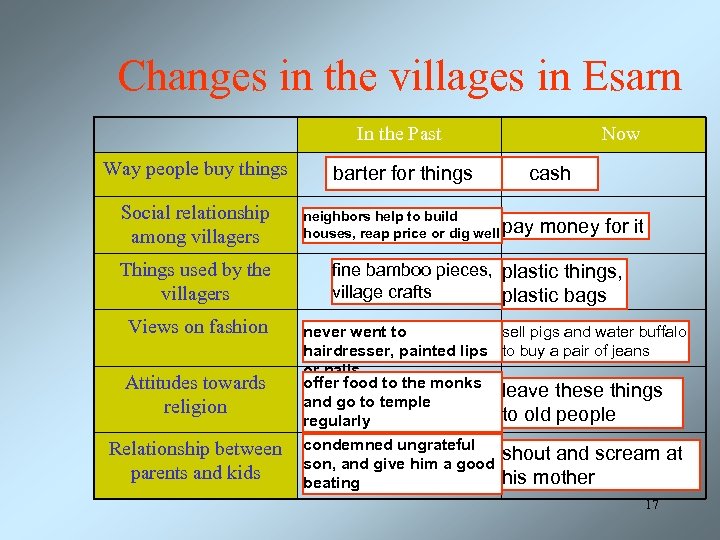 Changes in the villages in Esarn In the Past Way people buy things Social relationship among villagers Things used by the villagers Views on fashion Attitudes towards religion Relationship between parents and kids barter for things Now cash neighbors help to build houses, reap price or dig well pay money for it fine bamboo pieces, plastic things, village crafts plastic bags never went to sell pigs and water buffalo hairdresser, painted lips to buy a pair of jeans or nails offer food to the monks leave these things and go to temple to old people regularly condemned ungrateful shout and scream at son, and give him a good his mother beating 17
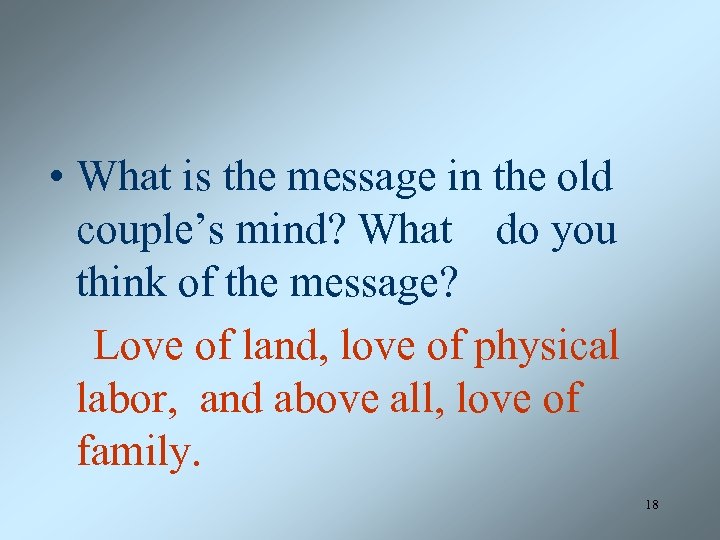 • What is the message in the old couple’s mind? What do you think of the message? Love of land, love of physical labor, and above all, love of family. 18
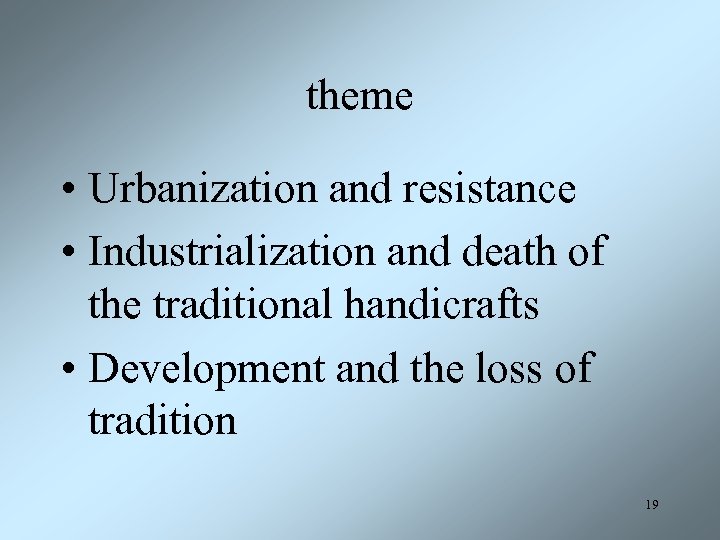 theme • Urbanization and resistance • Industrialization and death of the traditional handicrafts • Development and the loss of tradition 19
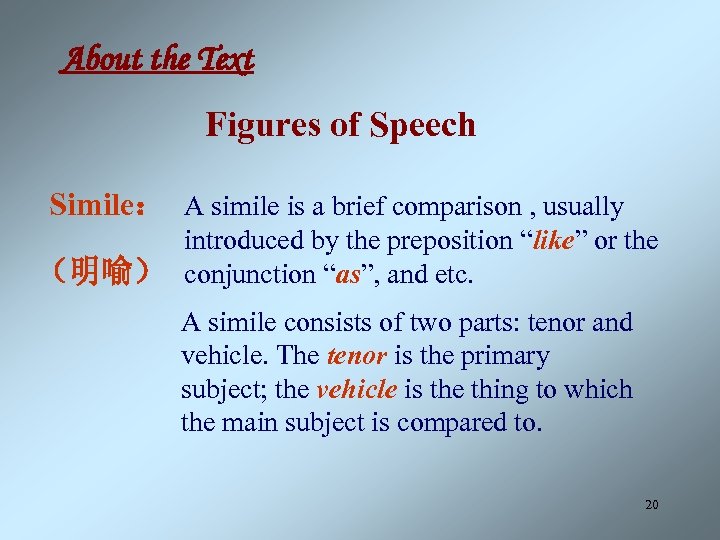 About the Text Figures of Speech Simile: A simile is a brief comparison , usually introduced by the preposition “like” or the (明喻) conjunction “as”, and etc. A simile consists of two parts: tenor and vehicle. The tenor is the primary subject; the vehicle is the thing to which the main subject is compared to. 20
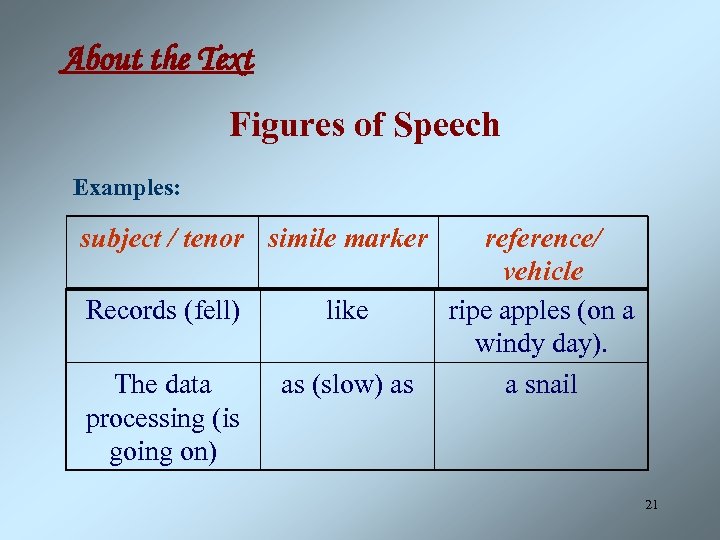 About the Text Figures of Speech Examples: subject / tenor simile marker Records (fell) like The data processing (is going on) as (slow) as reference/ vehicle ripe apples (on a windy day). a snail 21
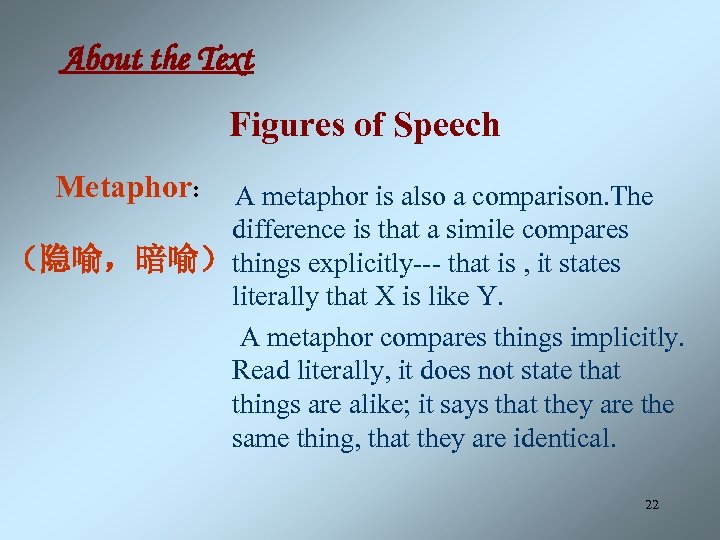 About the Text Figures of Speech Metaphor: A metaphor is also a comparison. The difference is that a simile compares (隐喻,暗喻) things explicitly--- that is , it states literally that X is like Y. A metaphor compares things implicitly. Read literally, it does not state that things are alike; it says that they are the same thing, that they are identical. 22
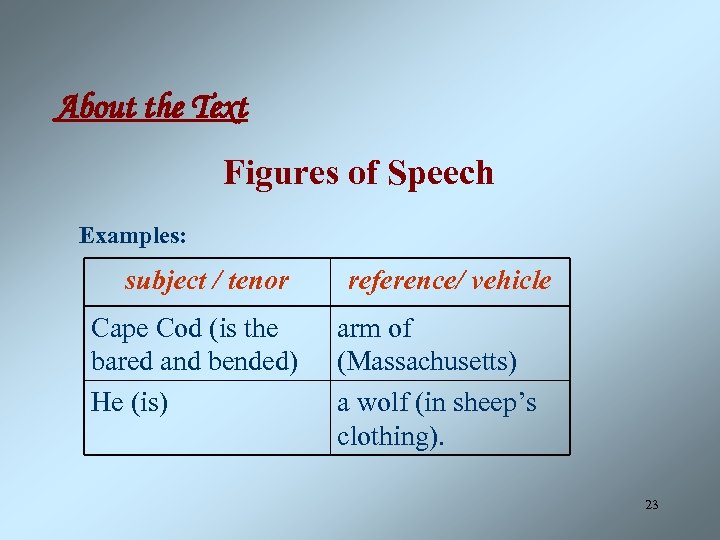 About the Text Figures of Speech Examples: subject / tenor Cape Cod (is the bared and bended) He (is) reference/ vehicle arm of (Massachusetts) a wolf (in sheep’s clothing). 23
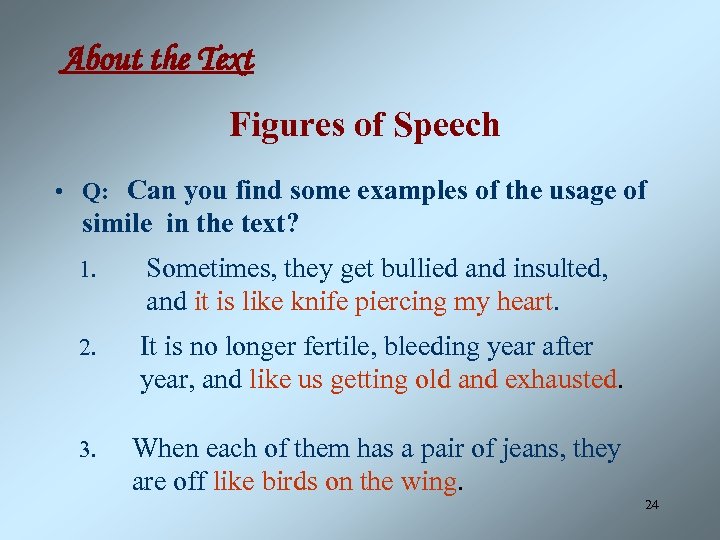 About the Text Figures of Speech • Q: Can you find some examples of the usage of simile in the text? 1. Sometimes, they get bullied and insulted, and it is like knife piercing my heart. 2. It is no longer fertile, bleeding year after year, and like us getting old and exhausted. 3. When each of them has a pair of jeans, they are off like birds on the wing. 24
 1. My husband moved into our house as is the way with us in Esarn. (When we got married) my husband came to live in our house. It was the tradition here in Esarn that the bridegroom should come to live with the bride’s family. 2. Often they sent some money to us and tell us that they are doing well. I know this is not always true. … although they always tell us that everything is fine with them. I know they also have difficulties and problems. They just do not tell us because they don’t want us to worry. 25
 3. Sometimes, they get bullied and insulted, and it is like a knife piercing my heart. When I hear about their hardships, I feel very sad. 4. It’s easier for my husband. He has ears which don’t hear, a mouth which doesn’t speak, and eyes that don’t see. News about my children’s problems doesn’t make my husband as sad. He doesn’t bother about what is happening around us and to our 26 children. He never says anything about them.
 5. All of them remain my children in spite of their long absence. Although they are often away for a long time, I love and care about them as always because they are my children. 6. Our piece of land is small, and it is no longer fertile, bleeding year after year, and like us, getting old and exhausted. Our land is getting poorer with each passing year, like us who are getting old, weak and 27 tired.
 7. Only ten years ago, you could darter for things, but now it’s all cash. 8. Just ten years ago, you could exchange one thing for another, but today we have to use money to get everything we need. 9. 8. In my day, if I were to put on a pair of trousers like they do now, lightning would strike me. When I was young, I surely would be punished by God if I ever wore the kind of trousers they wear today. 28
 9. My eyes do see--- they see more than they should. My ears do hear---they hear more than is good for me. I’m not what my wife says I am. I do see and hear--I see and hear too much evil, too many ugly and terrible things, things that I wish I did not have to see and hear. And this is not good for me. 10. Still the land could not tie them down or call them back. My children grew up and happy days on this land. But this couldn’t prevent them from leaving or making them return. 29
 Word Study marry: vt. /vi. They married young. John is going to marry Jane. marry sb off He married his daughter off to a rich man. married: a. be married to sb. He is married to a famous writer. married to sth. : dedicated to sth He is married to his work. marriage: n. 30
 now and then: now and again; occasionally here and there: everywhere ups and downs: alternate good and bad luck 盛衰, 沉浮 ins and outs: the details and complexities (of sth) 详情、细节; 底细, 来龙去脉 31
 in spite of: (used as a prep. ) regardless of; despite 尽管下雨我还是出去了。 I went out in spite of the rain. despite (prep. ): without being affected by 尽管天气不好,我们的假期仍过得很愉快。 Despite the bad weather we enjoyed our holiday. regardless of: (used as a prep. ) (infml) paying no attention to 他怎么想就怎么说,不考虑别人的情绪。 He says what he thinks, regardless of other people's feelings. 32
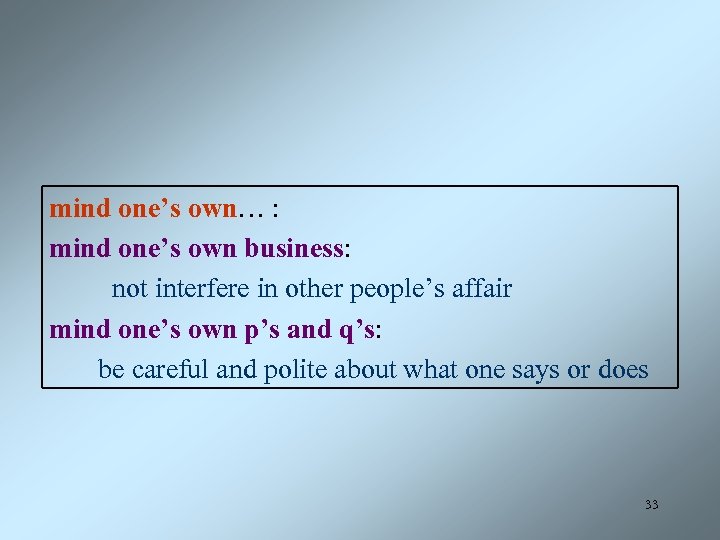 mind one’s own… : mind one’s own business: not interfere in other people’s affair mind one’s own p’s and q’s: be careful and polite about what one says or does 33
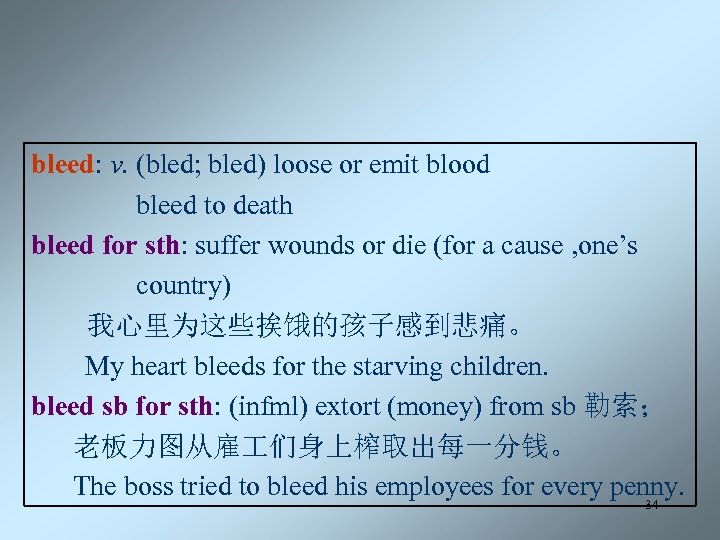 bleed: v. (bled; bled) loose or emit blood bleed to death bleed for sth: suffer wounds or die (for a cause , one’s country) 我心里为这些挨饿的孩子感到悲痛。 My heart bleeds for the starving children. bleed sb for sth: (infml) extort (money) from sb 勒索; 老板力图从雇 们身上榨取出每一分钱。 The boss tried to bleed his employees for every penny. 34
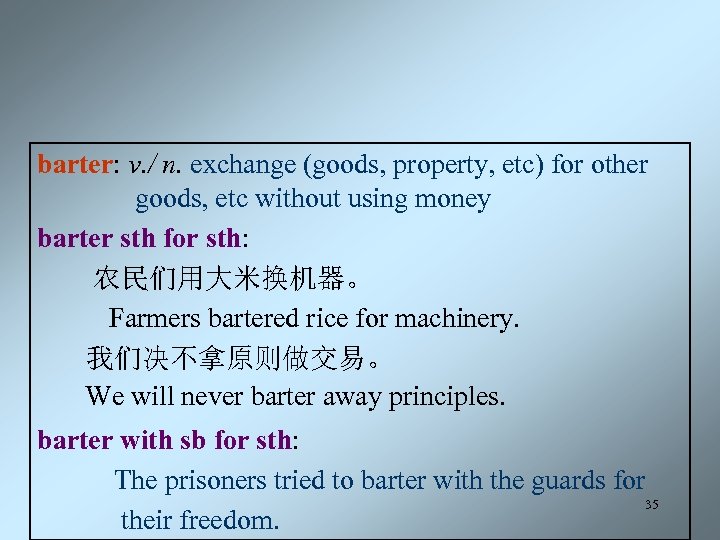 barter: v. / n. exchange (goods, property, etc) for other goods, etc without using money barter sth for sth: 农民们用大米换机器。 Farmers bartered rice for machinery. 我们决不拿原则做交易。 We will never barter away principles. barter with sb for sth: The prisoners tried to barter with the guards for 35 their freedom.
 • I had to barter with the locals for food. • In the local market, meat and vegetables are bartered for electrical goods. 36
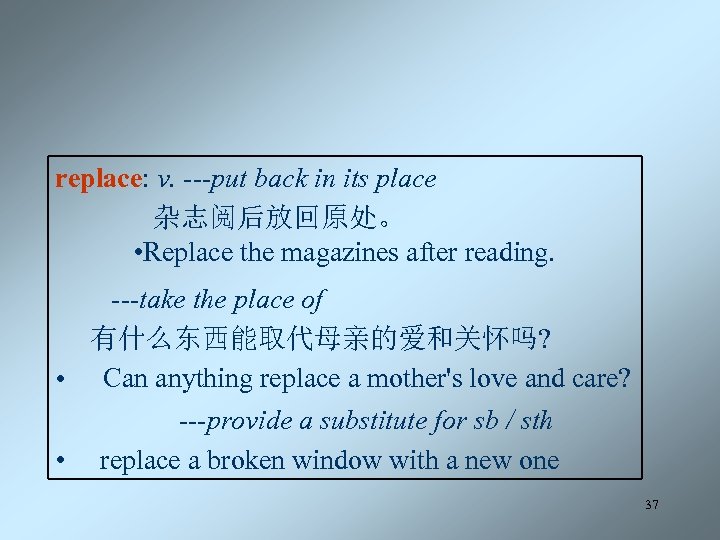 replace: v. ---put back in its place 杂志阅后放回原处。 • Replace the magazines after reading. ---take the place of 有什么东西能取代母亲的爱和关怀吗? • Can anything replace a mother's love and care? ---provide a substitute for sb / sth • replace a broken window with a new one 37
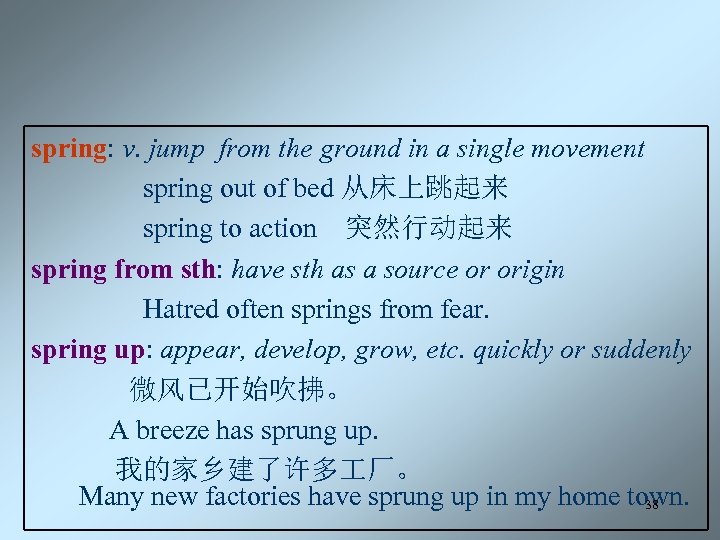 spring: v. jump from the ground in a single movement spring out of bed 从床上跳起来 spring to action 突然行动起来 spring from sth: have sth as a source or origin Hatred often springs from fear. spring up: appear, develop, grow, etc. quickly or suddenly 微风已开始吹拂。 A breeze has sprung up. 我的家乡建了许多 厂。 Many new factories have sprung up in my home town. 38
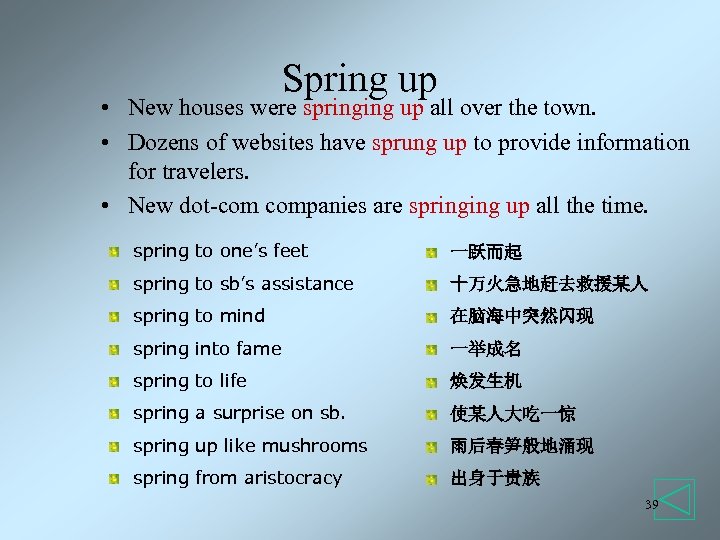 Spring up • New houses were springing up all over the town. • Dozens of websites have sprung up to provide information for travelers. • New dot-com companies are springing up all the time. spring to one’s feet 一跃而起 spring to sb’s assistance 十万火急地赶去救援某人 spring to mind 在脑海中突然闪现 spring into fame 一举成名 spring to life 焕发生机 spring a surprise on sb. 使某人大吃一惊 spring up like mushrooms 雨后春笋般地涌现 spring from aristocracy 出身于贵族 39
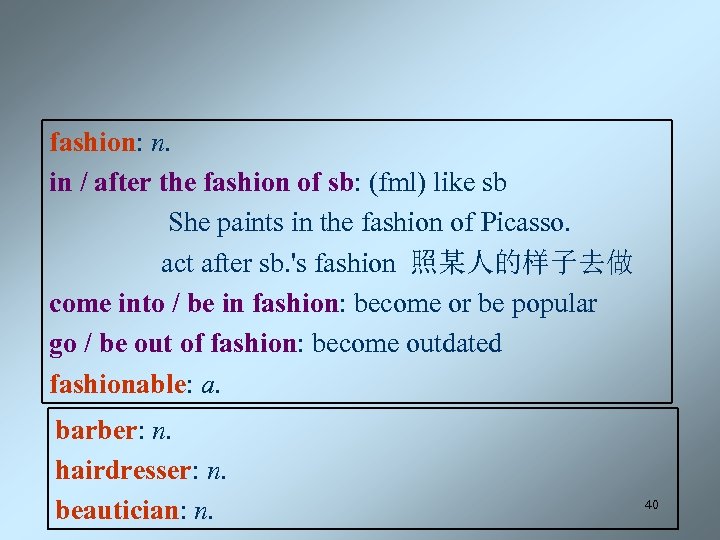 fashion: n. in / after the fashion of sb: (fml) like sb She paints in the fashion of Picasso. act after sb. 's fashion 照某人的样子去做 come into / be in fashion: become or be popular go / be out of fashion: become outdated fashionable: a. barber: n. hairdresser: n. beautician: n. 40
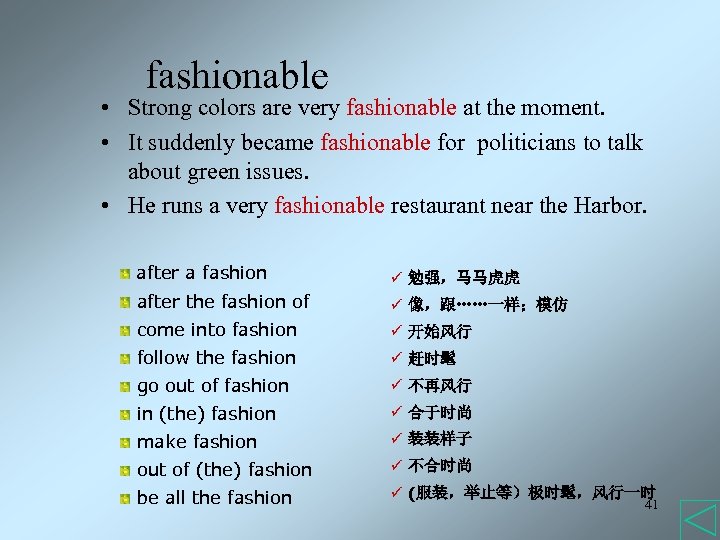 fashionable • Strong colors are very fashionable at the moment. • It suddenly became fashionable for politicians to talk about green issues. • He runs a very fashionable restaurant near the Harbor. after a fashion ü 勉强,马马虎虎 after the fashion of ü 像,跟……一样;模仿 come into fashion ü 开始风行 follow the fashion ü 赶时髦 go out of fashion ü 不再风行 in (the) fashion ü 合于时尚 make fashion ü 装装样子 out of (the) fashion ü 不合时尚 be all the fashion ü (服装,举止等)极时髦,风行一时 41
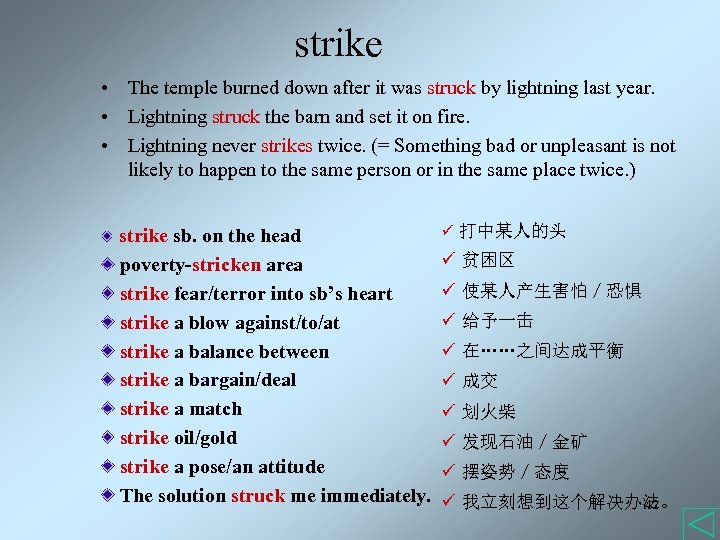 strike • The temple burned down after it was struck by lightning last year. • Lightning struck the barn and set it on fire. • Lightning never strikes twice. (= Something bad or unpleasant is not likely to happen to the same person or in the same place twice. ) strike sb. on the head poverty-stricken area strike fear/terror into sb’s heart strike a blow against/to/at strike a balance between strike a bargain/deal strike a match strike oil/gold strike a pose/an attitude The solution struck me immediately. ü 打中某人的头 ü 贫困区 ü 使某人产生害怕/恐惧 ü 给予一击 ü 在……之间达成平衡 ü 成交 ü 划火柴 ü 发现石油/金矿 ü 摆姿势/态度 ü 我立刻想到这个解决办法。 42
 tend to • People tend to need less sleep as they get older. • Young children tend to get sick more often than adults. • Recent studies show that girls tend to be better at languages than boys. 43
 condemn v. a. to disapprove sth. or sb. , esp. because you think it is morally wrong b. to give judgment against • Local authorities have been condemned for failing to tackle the problem of homelessness. • The law has been condemned as an attack on personal liberty. • He was found guilty and condemned to death. 44
 occur: v. happen 事故发生在五点钟。 The accident occurred at five o'clock. occurrence: n. event; incident, happening incident: n. unimportant or minor things happened event: n. a happening of importance 45
 a bag of bones: a very thin person or animal. 骨瘦如柴的人 The cat was just a bag of bones. bag and baggage: with all one’s belongings, often suddenly or secretly ; adv带着全部财产 Her tenant left, bag and baggage, without paying the rent. be in the bag: (of an result, outcome) be as desired [俗]确实无疑, 稳操胜券 Her re-election is in the bag of moonshine 无稽之谈 46
 rag: n. torn, , odd cloth I use a rag to clean my bike. rags: (pl. ) old, worn or torn clothes 这件衬衫已穿得破烂不堪。 The shirt was worn to rags. 47
 on the wing • This area is noted for butterflies in summer, and in August the purple hairstreak will be on the wing. • John shot the duck on the wing. The early bird catches the worm. 早起的鸟儿有虫吃。 A bird in the hand is worth two in the bush. 双鸟在林不如一鸟在手。 Birds of a feather flock together. 物以类聚,人以群分。 It’s an ill bird that fouls its own nest. 恶鸟渎巢(指家丑不可外扬) Kill two birds with one stone. 一石二鸟(一举两得) 48
 heal v. a. (esp. of wounds) ( to cause) to become healthy and sound b. to (help sb. ) become mentally or emotionally strong again after a bad experience • It took three months for my arm to heal properly. • The trauma (心灵创伤) of divorce can often be healed by successful remarriage. • Time heals all sorrows. 49
 shimmer v. /n. to shine with a soft light that looks as if it shakes slightly • The lake shimmered in the moonlight. • He’d reached to click off the light, and the room shimmered again with the faintest light from the moon. • She likes the shimmer of glasses in the candlelight. Synonyms: shine gleam glimmer flash glow beam 50
 pass on to hand or give sth. to sb. else, esp. after receiving or using it oneself • I passed her message on to her mother. • Pass the book on to me when you’ve finished with it. • It was discovered that he had been passing secrets on to the Russians whilst working at the Pentagon (五角大楼). 51
 pass sth on to sb: hand or give sth to sb else, Pass the book on to me when you’ve finished with it. 请把这句话传给你的老板。 Please pass the word to your boss. pass sth down: (esp passive) pass sth from one generation to the next 这些珠宝在我们家代代相传已有好几百年的历史了。 These jewels have been passed down in our family from generation to generation for hundreds of years. pass sth up: (infml) refuse to accept a chance, an opportunity, 永远不要放弃学习的机会 Never pass up a chance to 52 learn.
 phrases • Belong to--- to be owned by sb • Who does the bag on the seat belong to? 53
 It is/was…. . that/who… • It was my sister who went to teach in a village school upon graduation. • It was in Shanghai that I first met Professor Li. 54
 As… • As is often the case, the boy was late for class. 55
 Afford sth/to do sth • Quite a lot of Chinese families can afford cars. • At the moment I can’t afford a trip to Europe. He told me that the firm could not afford to pay such large salaries. 56
 Be off---be away from a place • My father is off to Russia next week. 57
 In spite of • The children went out to play in spite of the cold. 58
 Used to do sth…but no longe • ---used to show a change • They used to com and see their parents every week, but no longer. 59
 Fill---to make or become full • I filled thermos bottle with hot water. • The room was filling quickly. • Be filled with---to be full of sth • The house is filled with smoke. 60
 Have no use for sth • When boys started school, he had no use for his toys and gave them away. 61
 As for sb/sth • ---used when you start to talk about sth hew that is connected with what you have been talking about • Labor is cheap. Land is available. as for money, we can borrow from the bank. 62
 as for • As for you, I never want to see you here again. • As for the burglar, he escaped through the window. • As for my past, I’m not telling you anything. • Cf. as against 与……比较,与……相对照 as from/as of 自……起 as to/as regards 关于,至于 63
 Occur to sb • ---to come into one’s mind • A happy thought occurred to me while I was surfing the internet. • It never occurred to her that he might be cheating her. 64
 Similar expressions: • • • have an idea have a thought cross sb’s mind enter sb’s mind strike come/spring to mind 65
 At peace with sth • The country is finally at peace with its neighbors. • He’s at peace with their decision. (he has accepted their decision). 66
 be at peace with in a situation in which there is no war or fighting; in harmony with • The two countries are at peace with each other. • The country is at peace with its neighbors for the first time in years. • If you do this, you will not be at peace with me in the future. be at peace with oneself 心平气和 make one’s peace with (同……)和解,修好 may sb. rest in peace 愿某人的灵魂安息 a peace settlement 和平解决 conclude (sign) a peace 缔结(签订)合约 67
 Feel pity for sb • ---have a strong feeling of sadness or symapthy for sb/sth • I feel deep pity for parents who lost their children in the earthquake. 68
 Force sth on/upon sb • ---to cause sb to accept sth that they do not want • Her husband tried to force his will on her. • Parents should never force their values on their children. 69
 • Complain of ---to tell other people that sth is making you feel ill/unhappy诉苦 • The patient complained of a bad headache. • Complain about---to say that sth is wrong or not satisfactory抱怨, 抗议,发牢骚 • Many students complain about food served in the university canteens. 70
 Every inch of sth/somewhere • ---all of a thing or place • The police searched every inch of the house. • Every inch of her bedroom wall is covered with photos of her favorite football stars. 71
 Tie sb down • Few young people want to be tied down to the same job all their lives. 72
 tie sb down to sth: restrict sb to certain conditions Children do tie you down, don’t they? tie sb up: --- (use passive) occupy sb so that he has no time for other things I’m tied up in a meeting until 3 p. m. . 交通因意外事故而受阻。 The traffic was tied up by the accident. tie n. 这场比赛打成平局。 The game ended in a tie. 73
 • She didn't want to be tied down by a full-time job. • A plan of union ties the negotiations down to real facts and real pieces of church life. tie. . . up a. to tie sb. 's arms, legs, etc. so that they cannot move b. to be very busy, so that you cannot do anything else * Her hair was tied up in a hair net and the hat was removed and placed to the right of her chest. * I’m sorry, he’s tied up at the moment. Could you call back later? 74
 Be/get back on one’s feet • --to be in a healthy condition after an illness or injury康复 • The doctor says she’d be back on her feet again in a couple of days. • ---to be in a good position or condition • The country’s economy is finally back on its feet. 75