


 Скачать презентацию Mesopotamian Timeline WSU 1993 http www wsu edu dee MESO TIMELINE
ffd11643c3a7598eea906b9dbe46c097.ppt
- Количество слайдов: 156
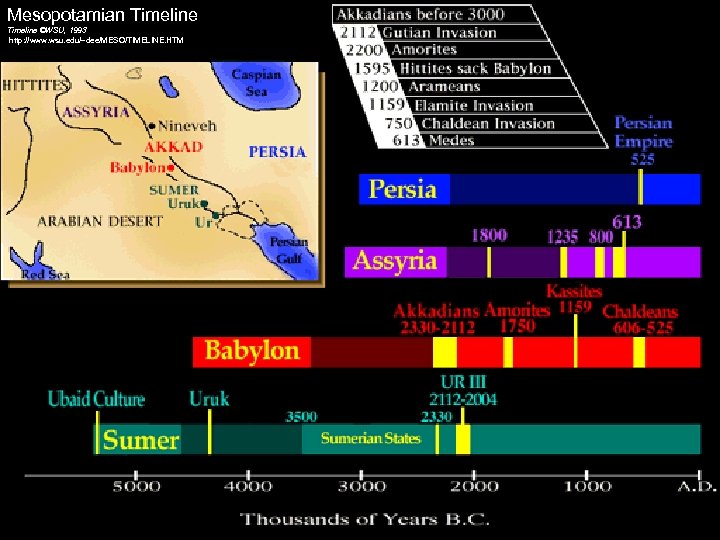
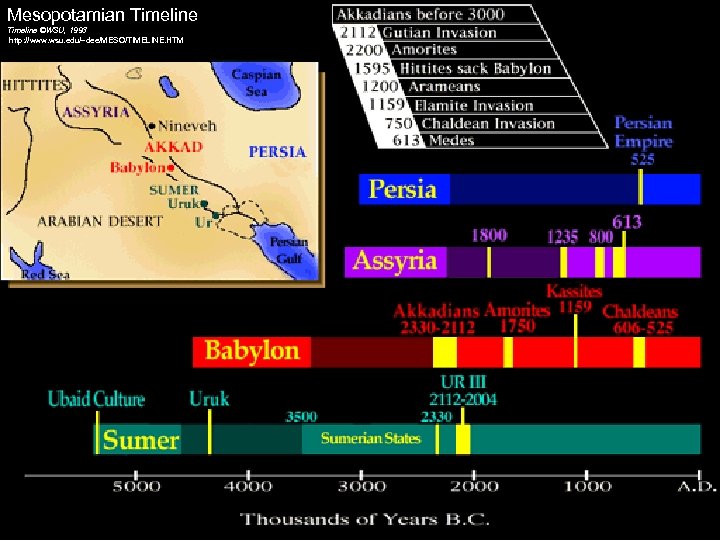 Mesopotamian Timeline ©WSU, 1993 http: //www. wsu. edu/~dee/MESO/TIMELINE. HTM
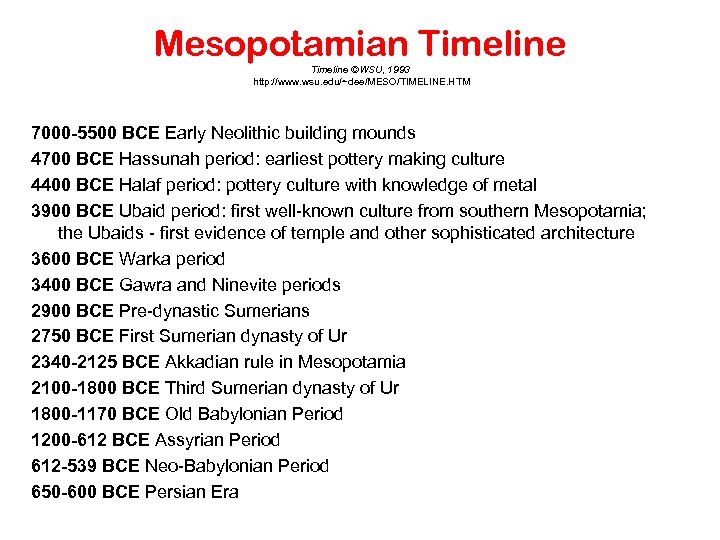 Mesopotamian Timeline ©WSU, 1993 http: //www. wsu. edu/~dee/MESO/TIMELINE. HTM 7000 -5500 BCE Early Neolithic building mounds 4700 BCE Hassunah period: earliest pottery making culture 4400 BCE Halaf period: pottery culture with knowledge of metal 3900 BCE Ubaid period: first well known culture from southern Mesopotamia; the Ubaids first evidence of temple and other sophisticated architecture 3600 BCE Warka period 3400 BCE Gawra and Ninevite periods 2900 BCE Pre dynastic Sumerians 2750 BCE First Sumerian dynasty of Ur 2340 -2125 BCE Akkadian rule in Mesopotamia 2100 -1800 BCE Third Sumerian dynasty of Ur 1800 -1170 BCE Old Babylonian Period 1200 -612 BCE Assyrian Period 612 -539 BCE Neo Babylonian Period 650 -600 BCE Persian Era
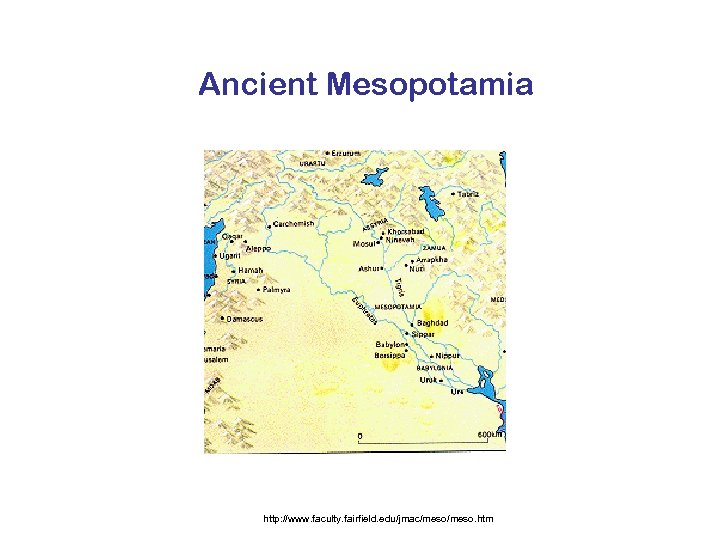 Ancient Mesopotamia http: //www. faculty. fairfield. edu/jmac/meso. htm
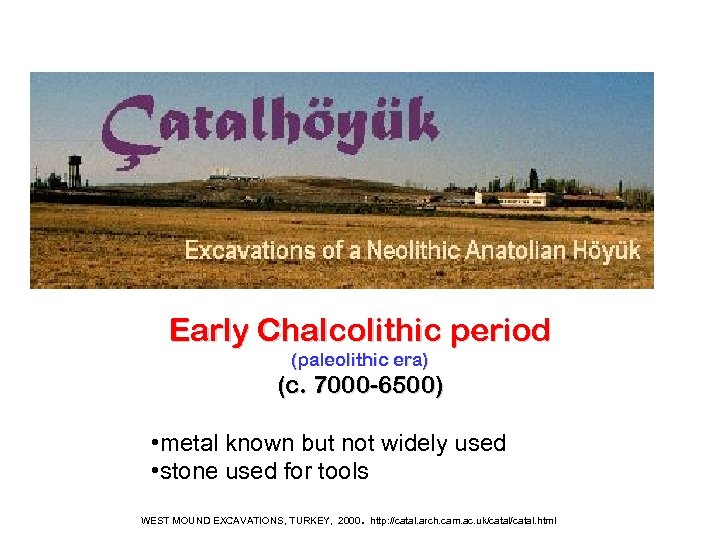 Early Chalcolithic period (paleolithic era) (c. 7000 -6500) • metal known but not widely used • stone used for tools. WEST MOUND EXCAVATIONS, TURKEY, 2000 http: //catal. arch. cam. ac. uk/catal. html
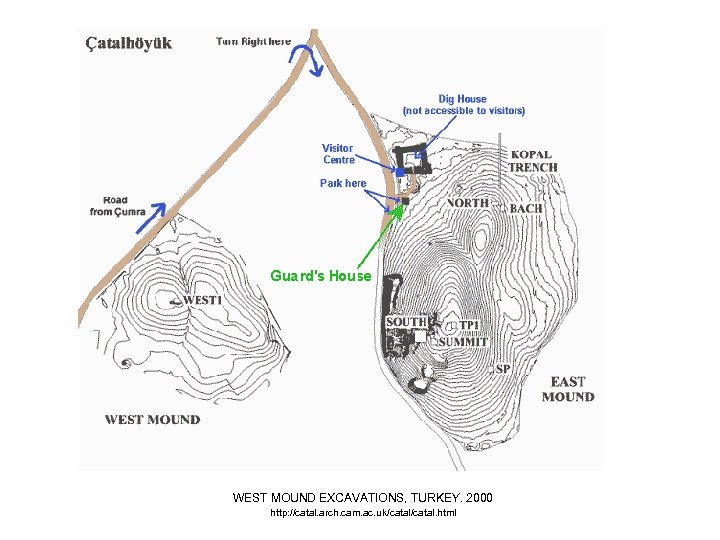 WEST MOUND EXCAVATIONS, TURKEY. 2000 http: //catal. arch. cam. ac. uk/catal. html
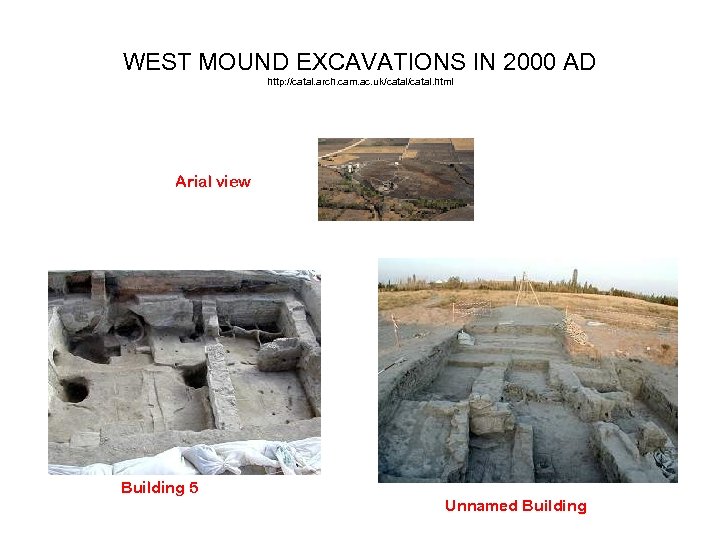 WEST MOUND EXCAVATIONS IN 2000 AD http: //catal. arch. cam. ac. uk/catal. html Arial view Building 5 Unnamed Building
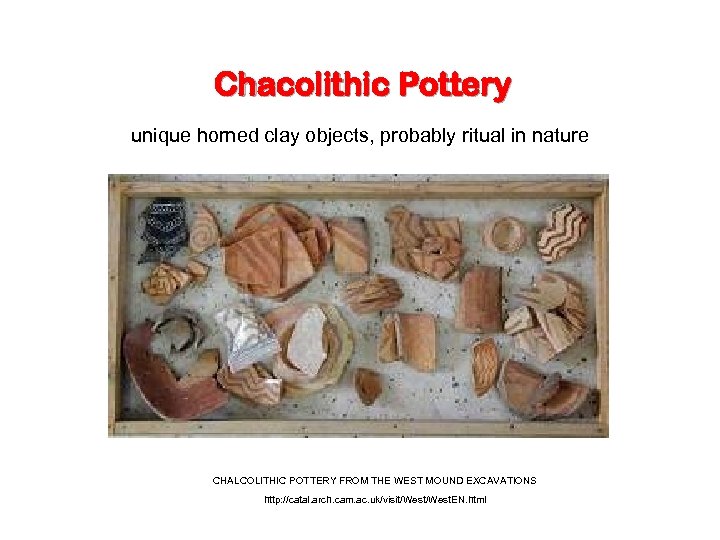 Chacolithic Pottery unique horned clay objects, probably ritual in nature CHALCOLITHIC POTTERY FROM THE WEST MOUND EXCAVATIONS http: //catal. arch. cam. ac. uk/visit/West. EN. html
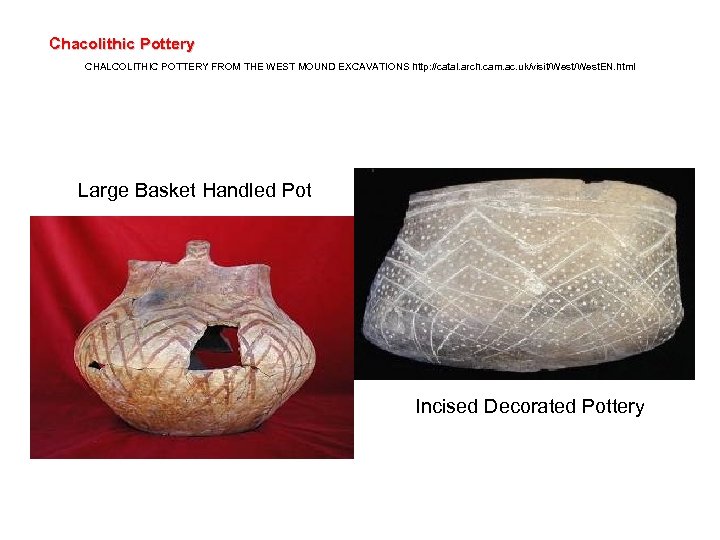 Chacolithic Pottery CHALCOLITHIC POTTERY FROM THE WEST MOUND EXCAVATIONS http: //catal. arch. cam. ac. uk/visit/West. EN. html Large Basket Handled Pot Incised Decorated Pottery
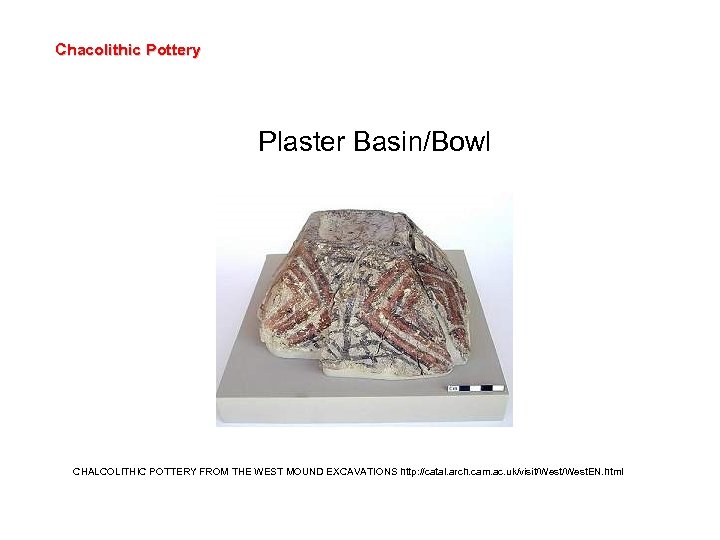 Chacolithic Pottery Plaster Basin/Bowl CHALCOLITHIC POTTERY FROM THE WEST MOUND EXCAVATIONS http: //catal. arch. cam. ac. uk/visit/West. EN. html
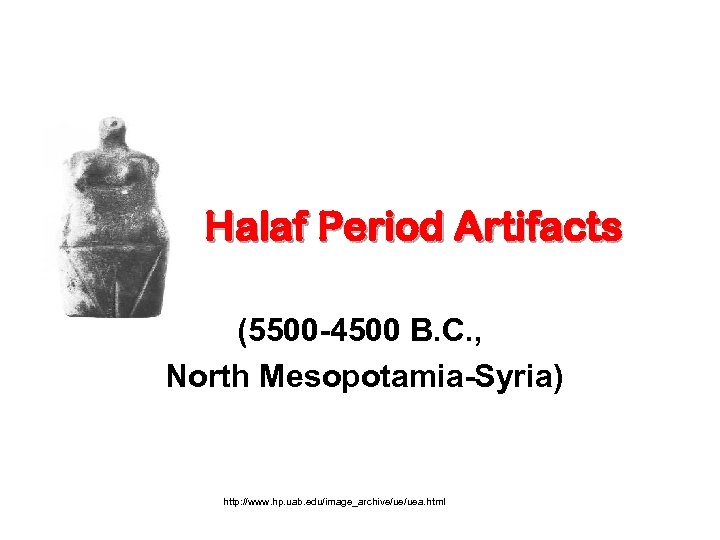 Halaf Period Artifacts (5500 -4500 B. C. , North Mesopotamia-Syria) http: //www. hp. uab. edu/image_archive/ue/uea. html
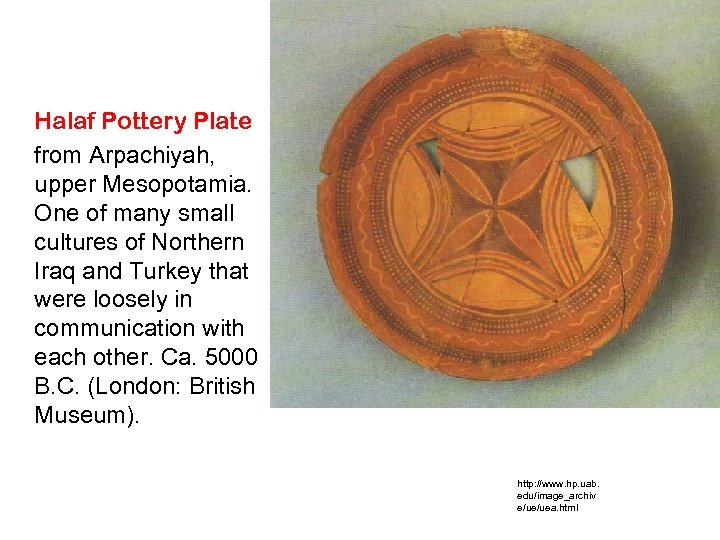 Halaf Pottery Plate from Arpachiyah, upper Mesopotamia. One of many small cultures of Northern Iraq and Turkey that were loosely in communication with each other. Ca. 5000 B. C. (London: British Museum). http: //www. hp. uab. edu/image_archiv e/ue/uea. html
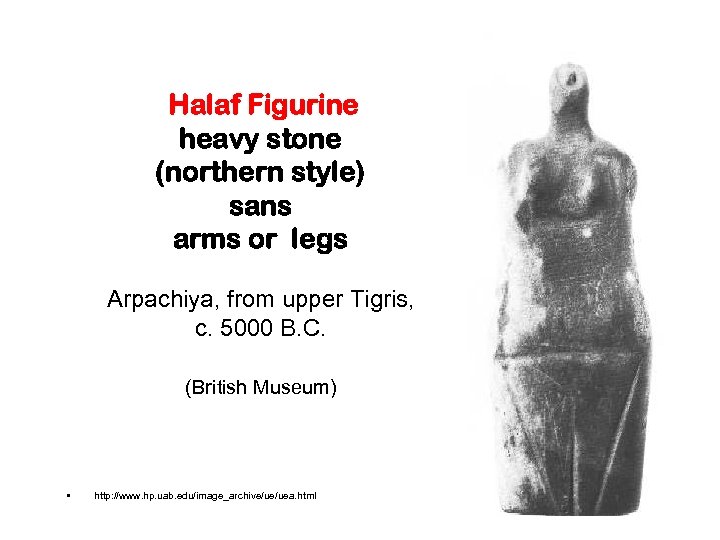 Halaf Figurine heavy stone (northern style) sans arms or legs Arpachiya, from upper Tigris, c. 5000 B. C. (British Museum) • http: //www. hp. uab. edu/image_archive/ue/uea. html
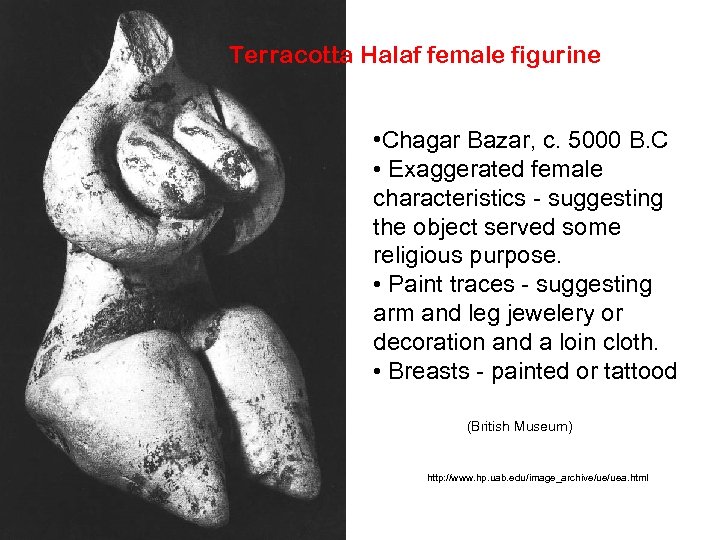 Terracotta Halaf female figurine • Chagar Bazar, c. 5000 B. C • Exaggerated female characteristics suggesting the object served some religious purpose. • Paint traces suggesting arm and leg jewelery or decoration and a loin cloth. • Breasts painted or tattood (British Museum) http: //www. hp. uab. edu/image_archive/ue/uea. html
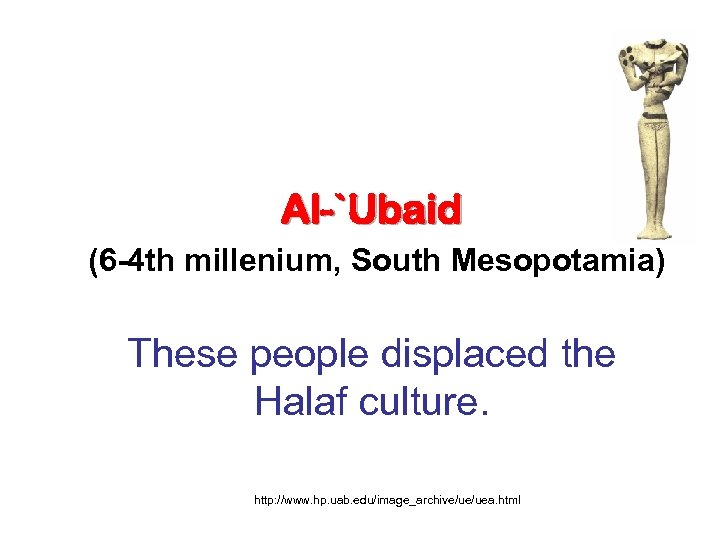 Al-`Ubaid (6 -4 th millenium, South Mesopotamia) These people displaced the Halaf culture. http: //www. hp. uab. edu/image_archive/ue/uea. html
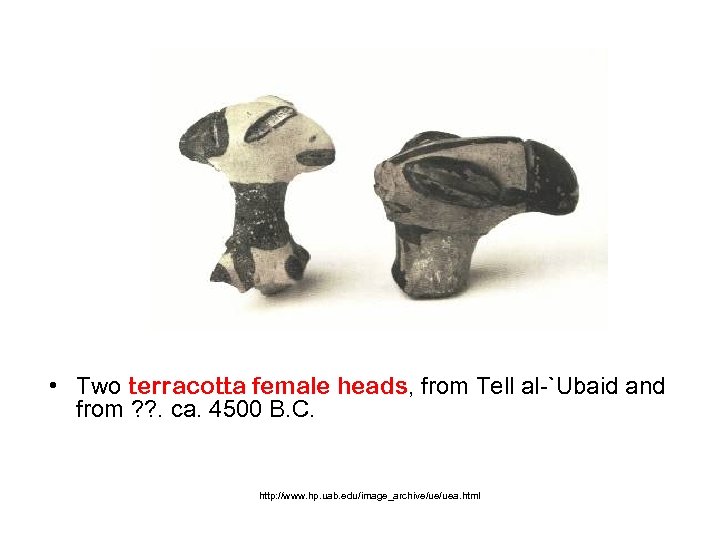 • Two terracotta female heads, from Tell al `Ubaid and from ? ? . ca. 4500 B. C. http: //www. hp. uab. edu/image_archive/ue/uea. html
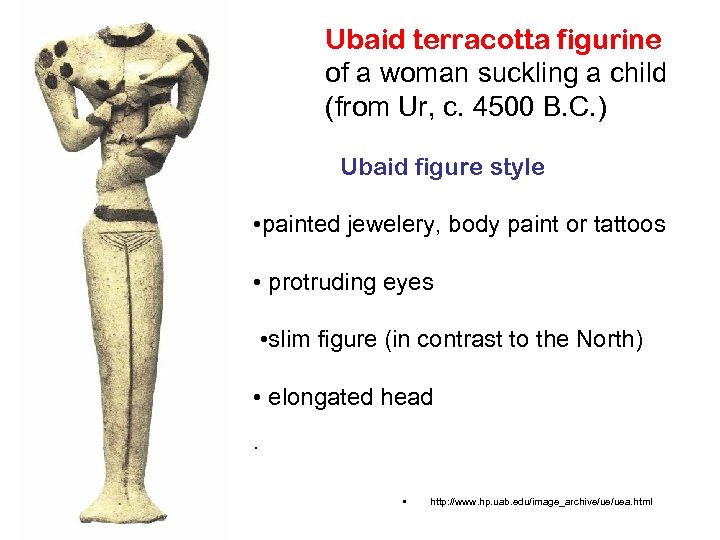 Ubaid terracotta figurine of a woman suckling a child (from Ur, c. 4500 B. C. ) Ubaid figure style • painted jewelery, body paint or tattoos • protruding eyes • slim figure (in contrast to the North) • elongated head . • http: //www. hp. uab. edu/image_archive/ue/uea. html
 What do you think?
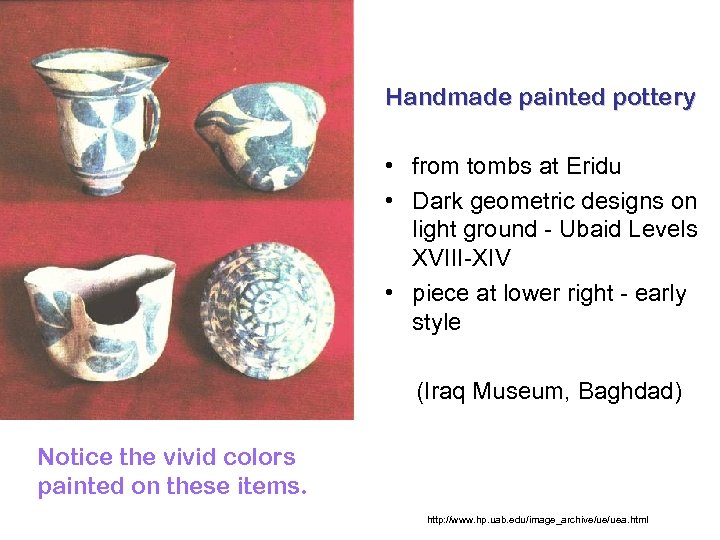 Handmade painted pottery • from tombs at Eridu • Dark geometric designs on light ground Ubaid Levels XVIII XIV • piece at lower right early style (Iraq Museum, Baghdad) Notice the vivid colors painted on these items. http: //www. hp. uab. edu/image_archive/ue/uea. html
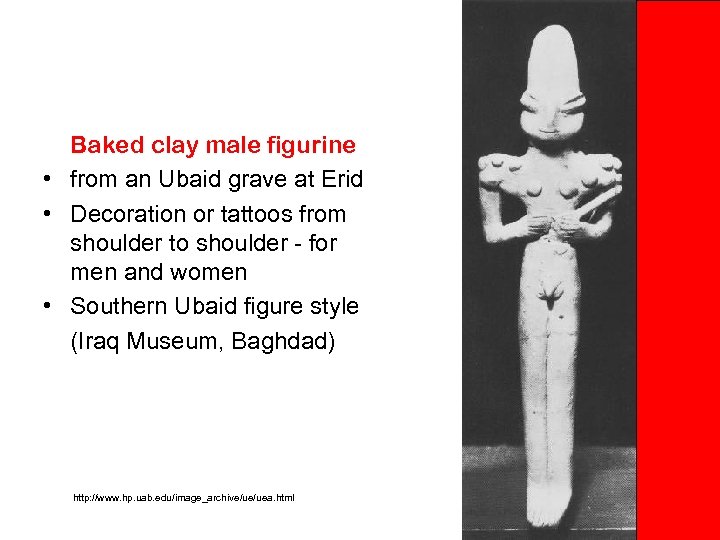 Baked clay male figurine • from an Ubaid grave at Erid • Decoration or tattoos from shoulder to shoulder for men and women • Southern Ubaid figure style (Iraq Museum, Baghdad) http: //www. hp. uab. edu/image_archive/ue/uea. html
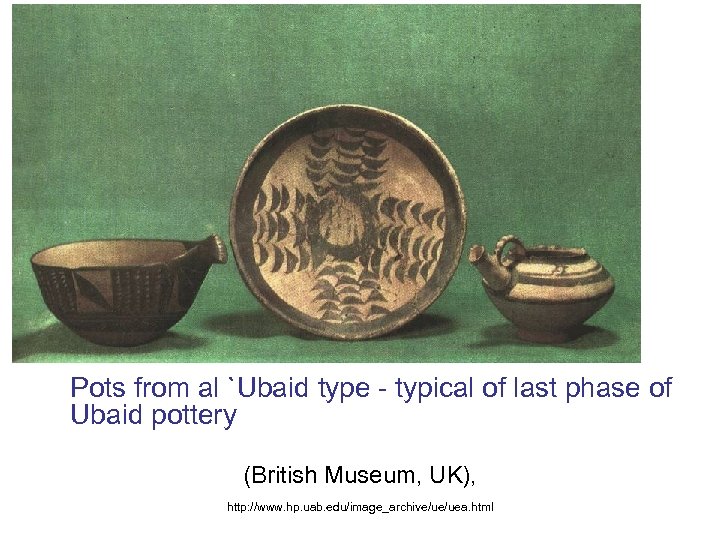 Pots from al `Ubaid type typical of last phase of Ubaid pottery (British Museum, UK), http: //www. hp. uab. edu/image_archive/ue/uea. html
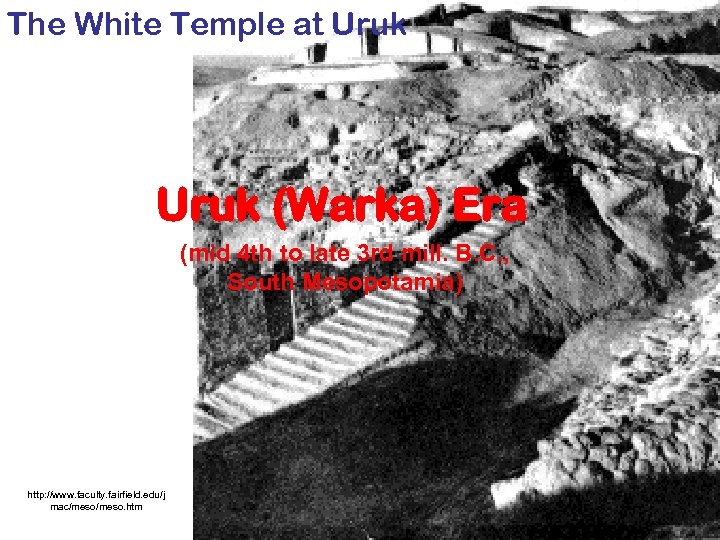 The White Temple at Uruk (Warka) Era (mid 4 th to late 3 rd mill. B. C. , South Mesopotamia) http: //www. faculty. fairfield. edu/j mac/meso. htm
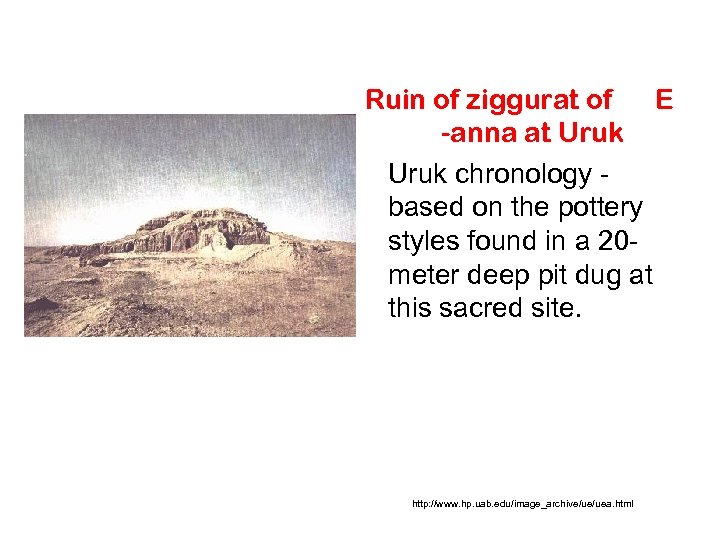 Ruin of ziggurat of E -anna at Uruk chronology based on the pottery styles found in a 20 meter deep pit dug at this sacred site. http: //www. hp. uab. edu/image_archive/ue/uea. html
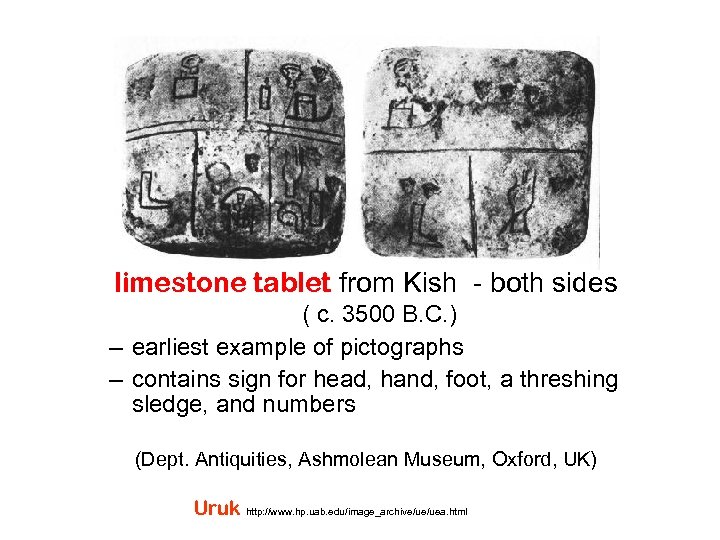 limestone tablet from Kish both sides ( c. 3500 B. C. ) – earliest example of pictographs – contains sign for head, hand, foot, a threshing sledge, and numbers (Dept. Antiquities, Ashmolean Museum, Oxford, UK) Uruk http: //www. hp. uab. edu/image_archive/ue/uea. html
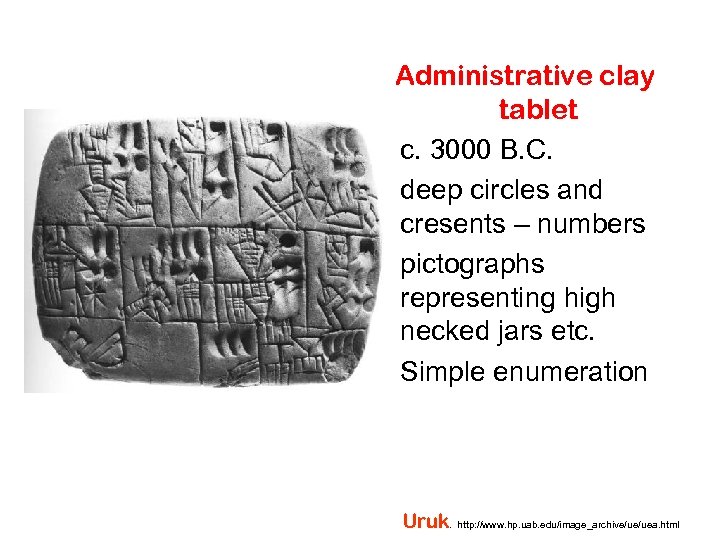 • • Administrative clay tablet c. 3000 B. C. deep circles and cresents – numbers pictographs representing high necked jars etc. Simple enumeration Uruk. http: //www. hp. uab. edu/image_archive/ue/uea. html
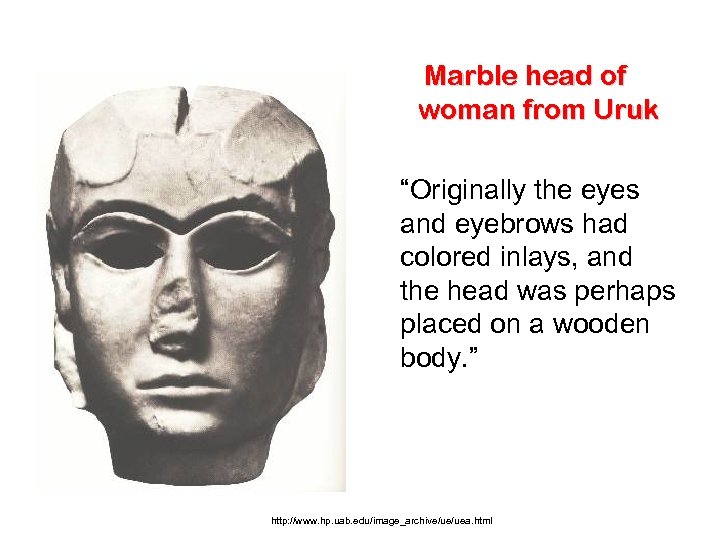 Marble head of woman from Uruk “Originally the eyes and eyebrows had colored inlays, and the head was perhaps placed on a wooden body. ” http: //www. hp. uab. edu/image_archive/ue/uea. html
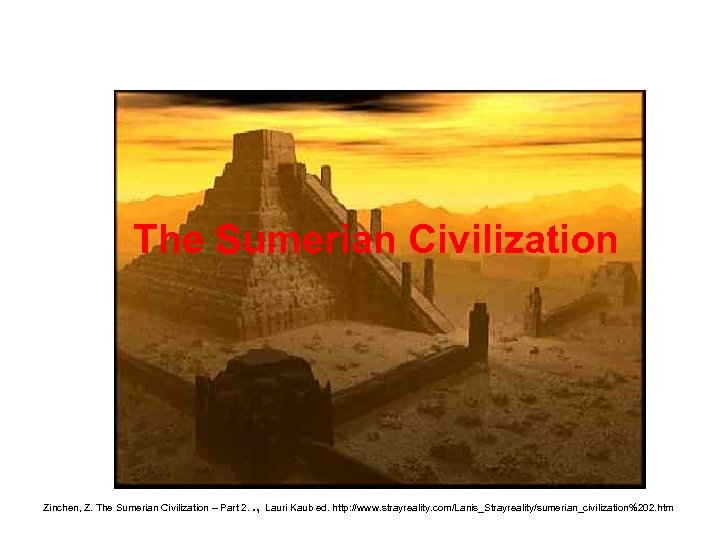 The Sumerian Civilization . , Lauri Kaub ed. http: //www. strayreality. com/Lanis_Strayreality/sumerian_civilization%202. htm Zinchen, Z. The Sumerian Civilization – Part 2.
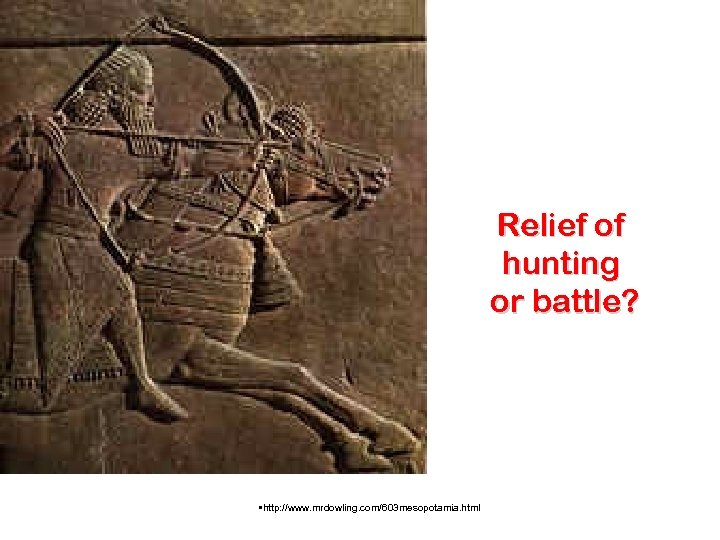 Relief of hunting or battle? • http: //www. mrdowling. com/603 mesopotamia. html
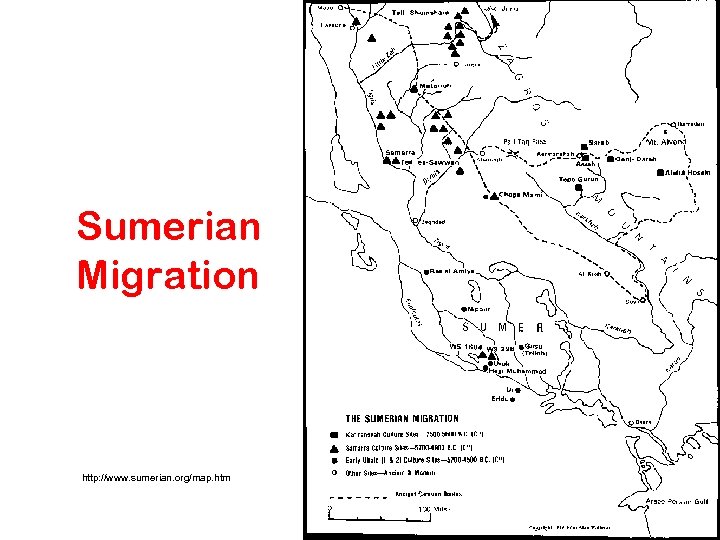 Sumerian Migration http: //www. sumerian. org/map. htm
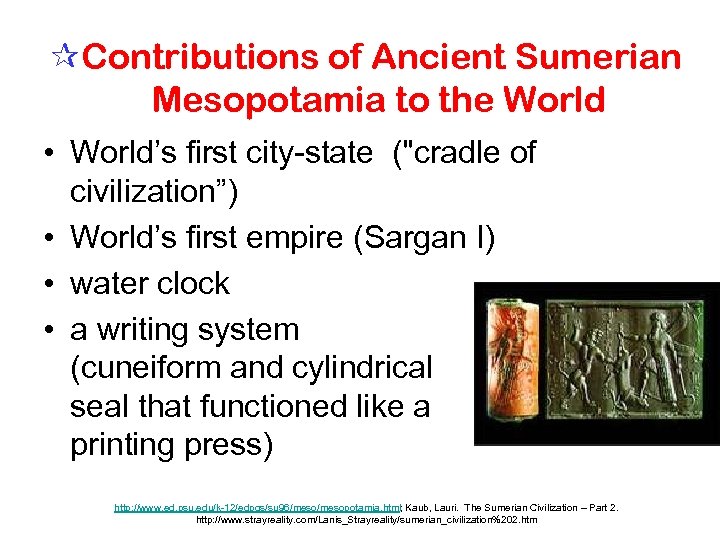 Contributions of Ancient Sumerian Mesopotamia to the World • World’s first city state ("cradle of civilization”) • World’s first empire (Sargan I) • water clock • a writing system (cuneiform and cylindrical seal that functioned like a printing press) http: //www. ed. psu. edu/k 12/edpgs/su 96/mesopotamia. html; Kaub, Lauri. The Sumerian Civilization – Part 2. http: //www. strayreality. com/Lanis_Strayreality/sumerian_civilization%202. htm
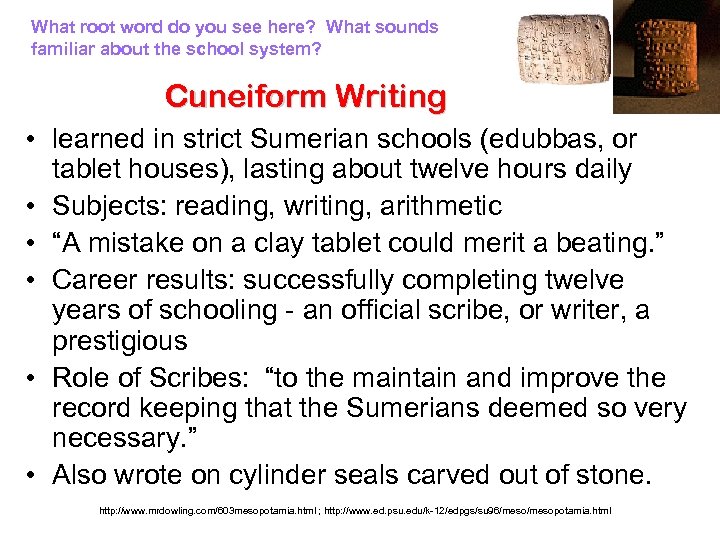 What root word do you see here? What sounds familiar about the school system? Cuneiform Writing • learned in strict Sumerian schools (edubbas, or tablet houses), lasting about twelve hours daily • Subjects: reading, writing, arithmetic • “A mistake on a clay tablet could merit a beating. ” • Career results: successfully completing twelve years of schooling an official scribe, or writer, a prestigious • Role of Scribes: “to the maintain and improve the record keeping that the Sumerians deemed so very necessary. ” • Also wrote on cylinder seals carved out of stone. http: //www. mrdowling. com/603 mesopotamia. html ; http: //www. ed. psu. edu/k 12/edpgs/su 96/mesopotamia. html
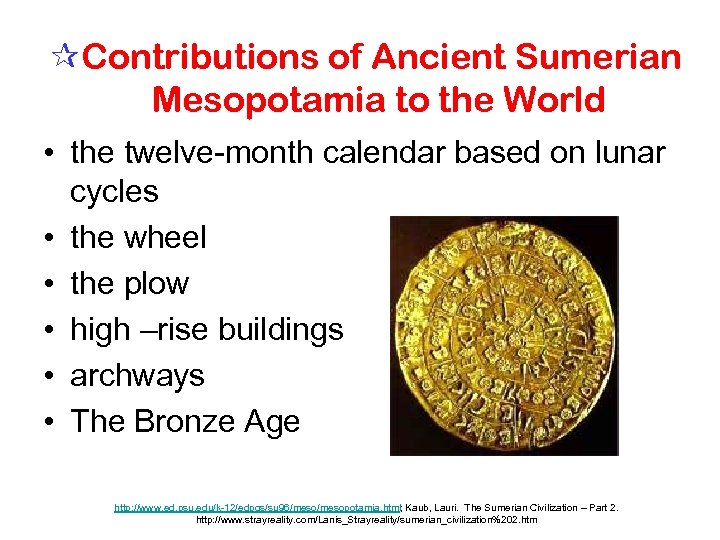 Contributions of Ancient Sumerian Mesopotamia to the World • the twelve month calendar based on lunar cycles • the wheel • the plow • high –rise buildings • archways • The Bronze Age http: //www. ed. psu. edu/k 12/edpgs/su 96/mesopotamia. html; Kaub, Lauri. The Sumerian Civilization – Part 2. http: //www. strayreality. com/Lanis_Strayreality/sumerian_civilization%202. htm
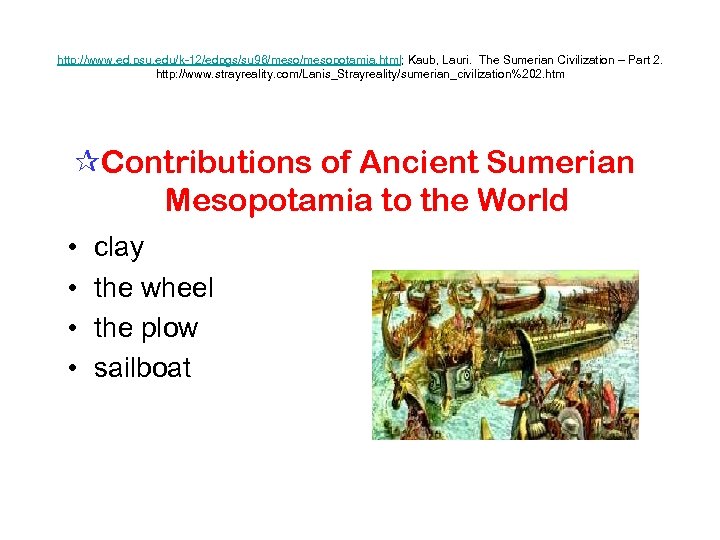 http: //www. ed. psu. edu/k 12/edpgs/su 96/mesopotamia. html; Kaub, Lauri. The Sumerian Civilization – Part 2. http: //www. strayreality. com/Lanis_Strayreality/sumerian_civilization%202. htm Contributions of Ancient Sumerian Mesopotamia to the World • • clay the wheel the plow sailboat
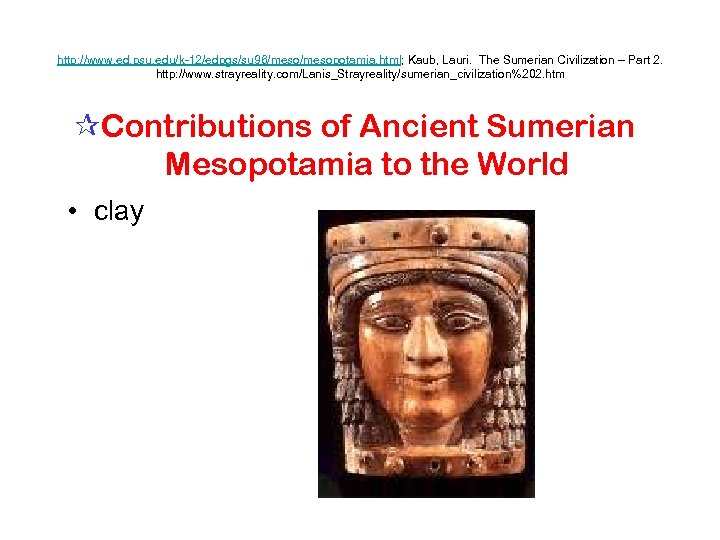 http: //www. ed. psu. edu/k 12/edpgs/su 96/mesopotamia. html; Kaub, Lauri. The Sumerian Civilization – Part 2. http: //www. strayreality. com/Lanis_Strayreality/sumerian_civilization%202. htm Contributions of Ancient Sumerian Mesopotamia to the World • clay
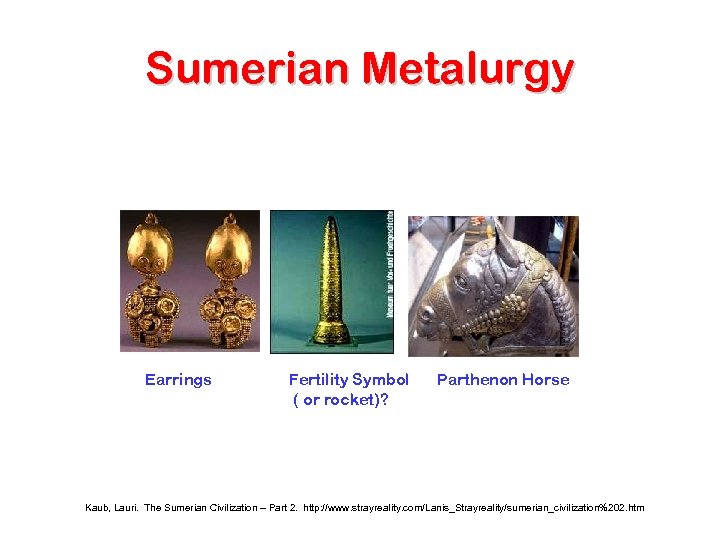 Sumerian Metalurgy Earrings Fertility Symbol ( or rocket)? Parthenon Horse Kaub, Lauri. The Sumerian Civilization – Part 2. http: //www. strayreality. com/Lanis_Strayreality/sumerian_civilization%202. htm
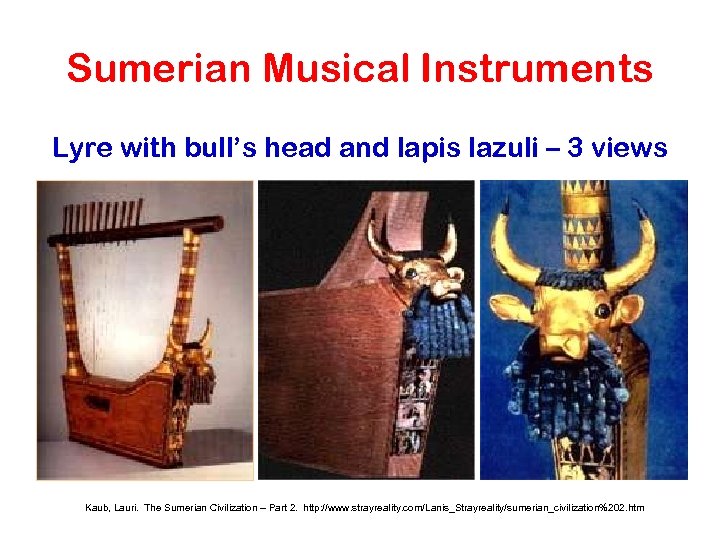 Sumerian Musical Instruments Lyre with bull’s head and lapis lazuli – 3 views Kaub, Lauri. The Sumerian Civilization – Part 2. http: //www. strayreality. com/Lanis_Strayreality/sumerian_civilization%202. htm
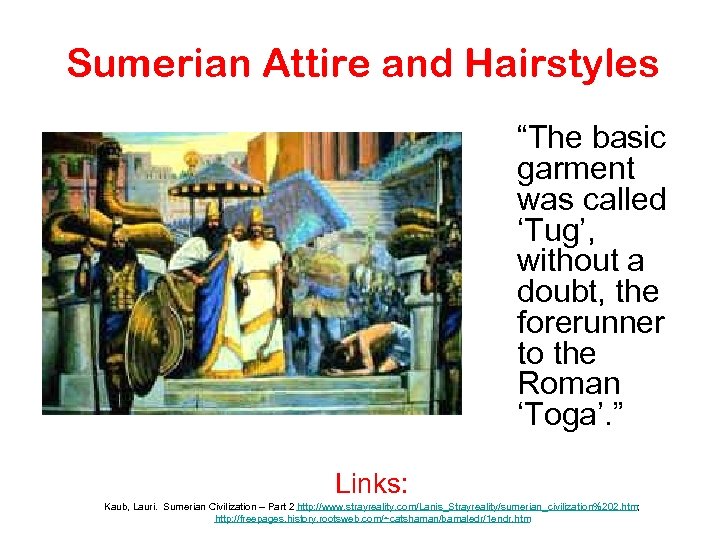 Sumerian Attire and Hairstyles “The basic garment was called ‘Tug’, without a doubt, the forerunner to the Roman ‘Toga’. ” Links: Kaub, Lauri. Sumerian Civilization – Part 2 http: //www. strayreality. com/Lanis_Strayreality/sumerian_civilization%202. htm; http: //freepages. history. rootsweb. com/~catshaman/bamaledr/1 endr. htm
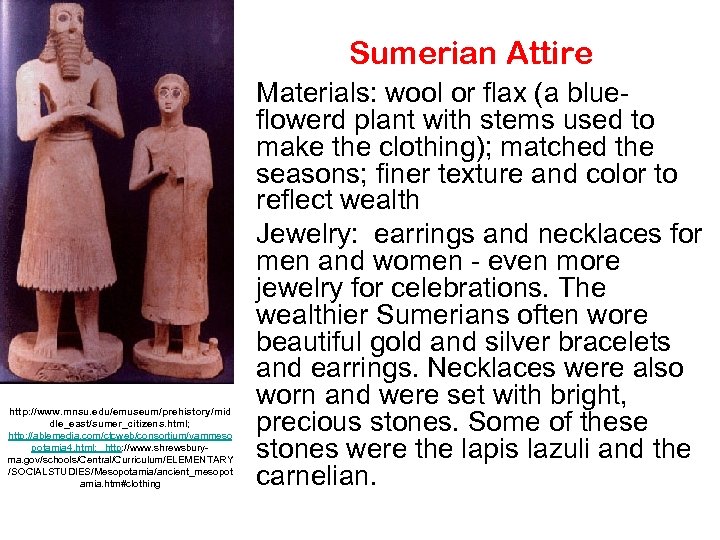 Sumerian Attire http: //www. mnsu. edu/emuseum/prehistory/mid dle_east/sumer_citizens. html; http: //ablemedia. com/ctcweb/consortium/vammeso potamia 4. html; http: //www. shrewsbury ma. gov/schools/Central/Curriculum/ELEMENTARY /SOCIALSTUDIES/Mesopotamia/ancient_mesopot amia. htm#clothing Materials: wool or flax (a blue flowerd plant with stems used to make the clothing); matched the seasons; finer texture and color to reflect wealth Jewelry: earrings and necklaces for men and women even more jewelry for celebrations. The wealthier Sumerians often wore beautiful gold and silver bracelets and earrings. Necklaces were also worn and were set with bright, precious stones. Some of these stones were the lapis lazuli and the carnelian.
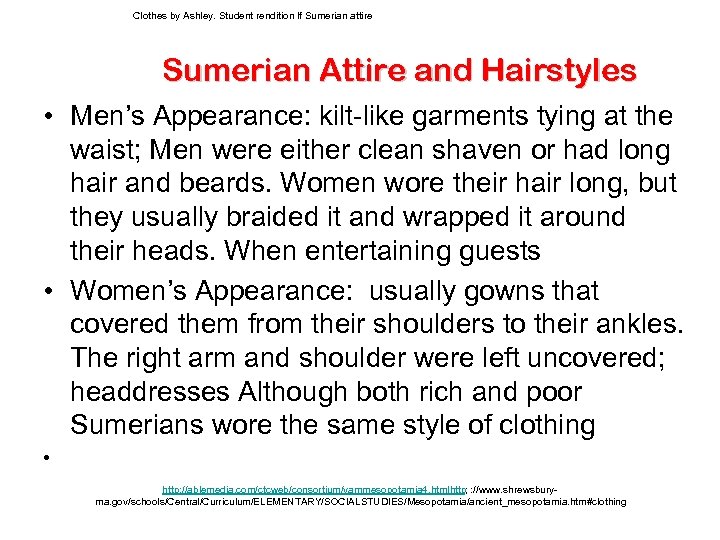 Clothes by Ashley. Student rendition lf Sumerian attire Sumerian Attire and Hairstyles • Men’s Appearance: kilt like garments tying at the waist; Men were either clean shaven or had long hair and beards. Women wore their hair long, but they usually braided it and wrapped it around their heads. When entertaining guests • Women’s Appearance: usually gowns that covered them from their shoulders to their ankles. The right arm and shoulder were left uncovered; headdresses Although both rich and poor Sumerians wore the same style of clothing • http: //ablemedia. com/ctcweb/consortium/vammesopotamia 4. htmlhttp; : //www. shrewsbury ma. gov/schools/Central/Curriculum/ELEMENTARY/SOCIALSTUDIES/Mesopotamia/ancient_mesopotamia. htm#clothing
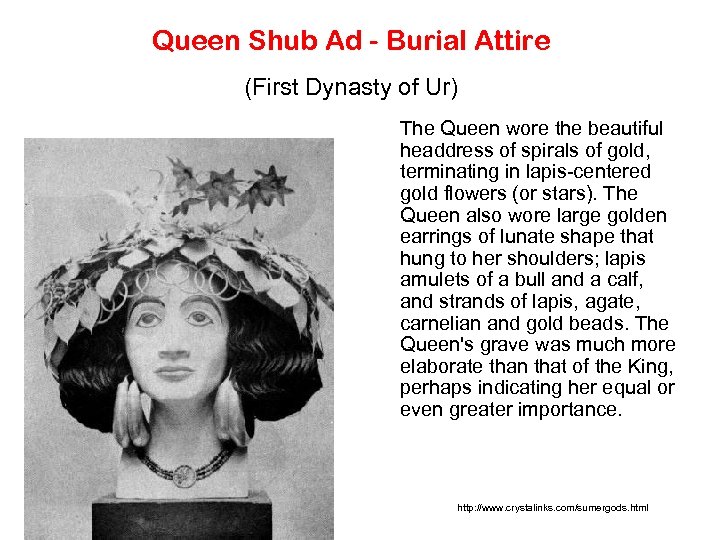 Queen Shub Ad - Burial Attire (First Dynasty of Ur) The Queen wore the beautiful headdress of spirals of gold, terminating in lapis centered gold flowers (or stars). The Queen also wore large golden earrings of lunate shape that hung to her shoulders; lapis amulets of a bull and a calf, and strands of lapis, agate, carnelian and gold beads. The Queen's grave was much more elaborate than that of the King, perhaps indicating her equal or even greater importance. http: //www. crystalinks. com/sumergods. html
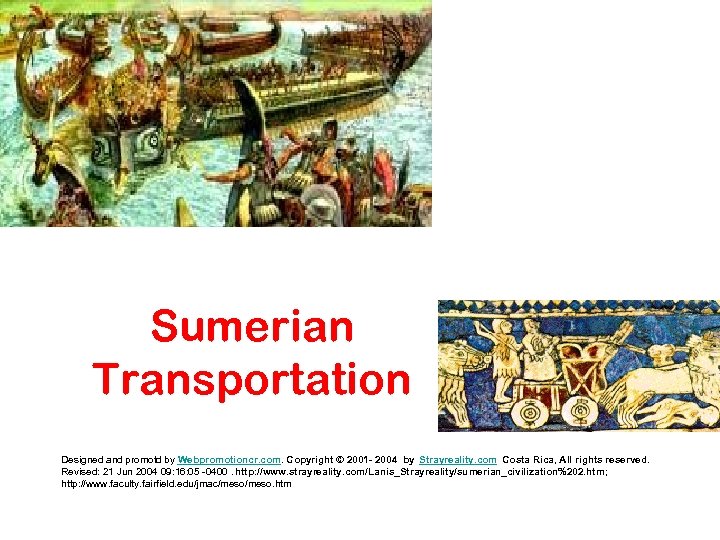 Sumerian Transportation Designed and promotd by Webpromotioncr. com. Copyright © 2001 - 2004 by Strayreality. com Costa Rica, All rights reserved. Revised: 21 Jun 2004 09: 16: 05 0400. http: //www. strayreality. com/Lanis_Strayreality/sumerian_civilization%202. htm; http: //www. faculty. fairfield. edu/jmac/meso. htm
 Composition of Sumerian Homes – earliest – reeds – Later - sun-dried mud- bricks • Modest - one story high with an open court in the center, around which there were several rooms. • Wealthy - homes two stories high with approximately twelve rooms, including servants' quarters and whitewashed walls inside and outside to project the appearance of affluence and cleanliness • private chapels and mausoleums – possibly on estates of wealthier people
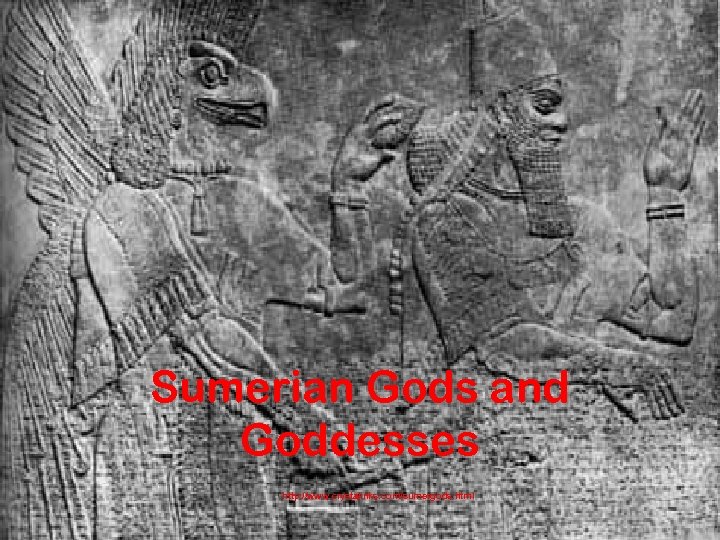 Sumerian Gods and Goddesses http: //www. crystalinks. com/sumergods. html
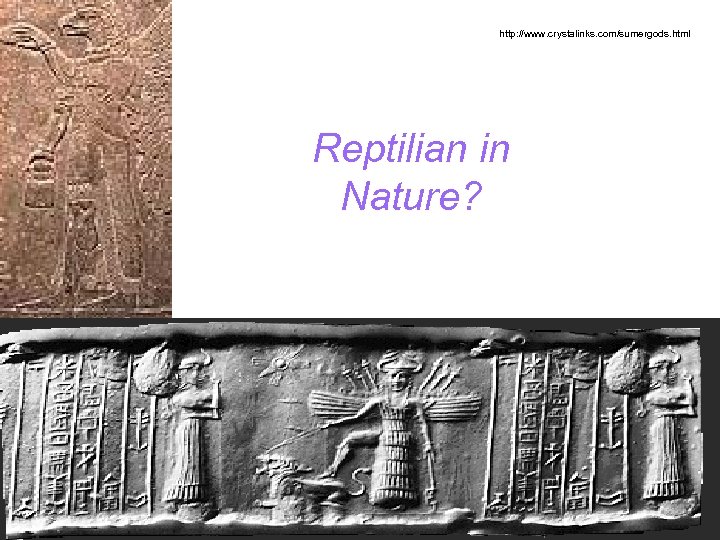 http: //www. crystalinks. com/sumergods. html Reptilian in Nature?
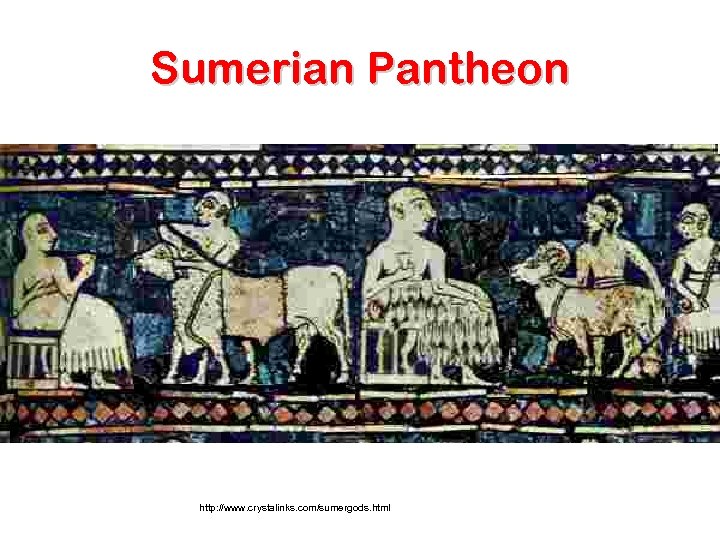 Sumerian Pantheon http: //www. crystalinks. com/sumergods. html
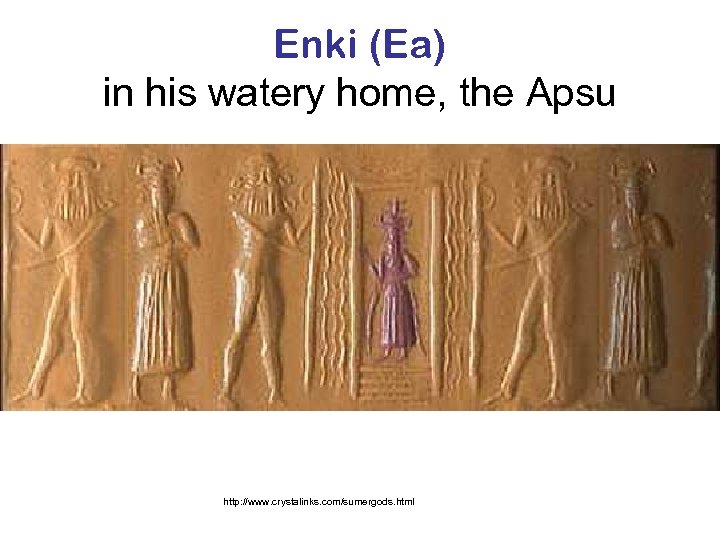 Enki (Ea) in his watery home, the Apsu http: //www. crystalinks. com/sumergods. html
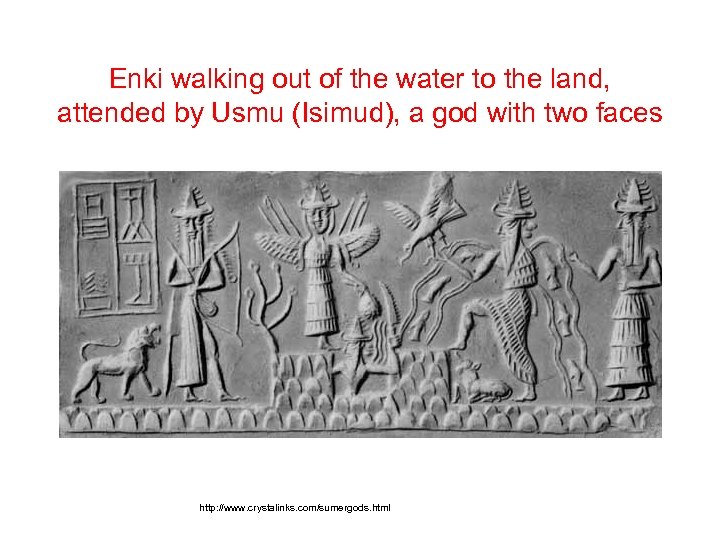 Enki walking out of the water to the land, attended by Usmu (Isimud), a god with two faces http: //www. crystalinks. com/sumergods. html
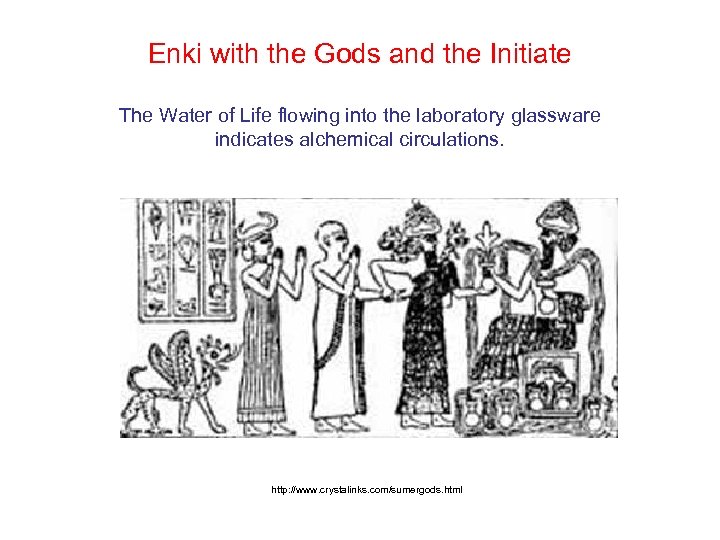 Enki with the Gods and the Initiate The Water of Life flowing into the laboratory glassware indicates alchemical circulations. http: //www. crystalinks. com/sumergods. html
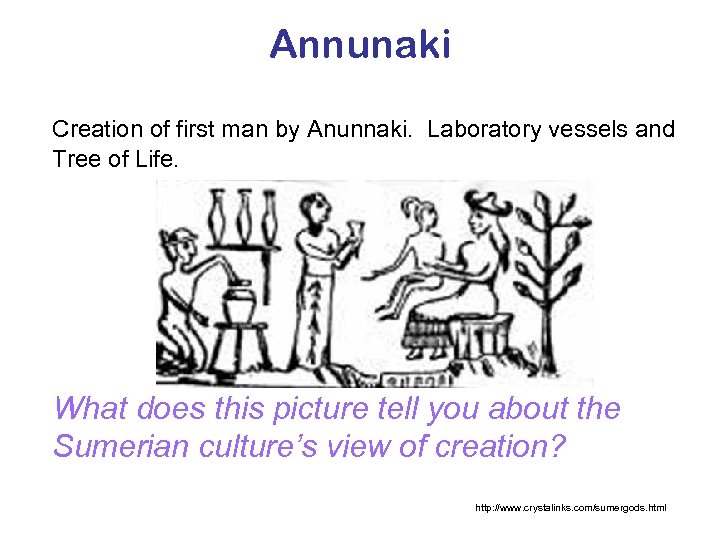 Annunaki Creation of first man by Anunnaki. Laboratory vessels and Tree of Life. What does this picture tell you about the Sumerian culture’s view of creation? http: //www. crystalinks. com/sumergods. html
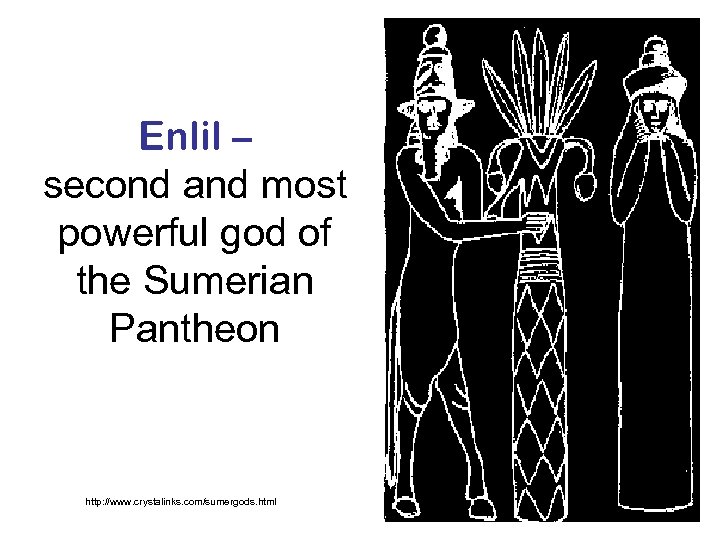 Enlil – second and most powerful god of the Sumerian Pantheon http: //www. crystalinks. com/sumergods. html
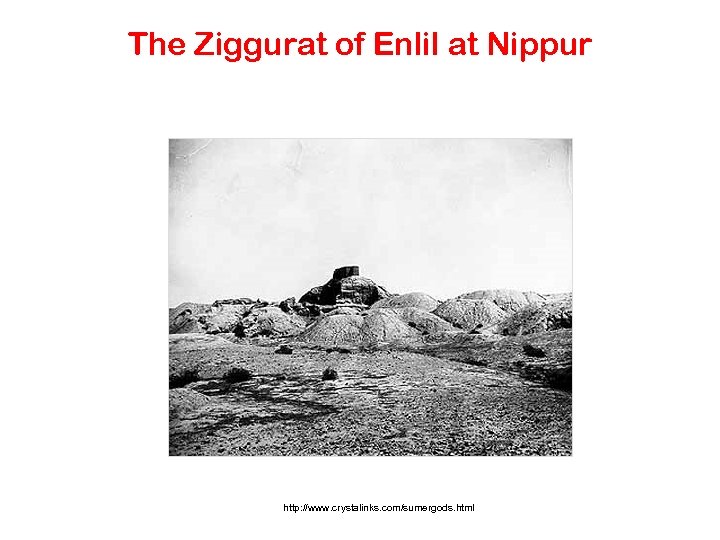 The Ziggurat of Enlil at Nippur http: //www. crystalinks. com/sumergods. html
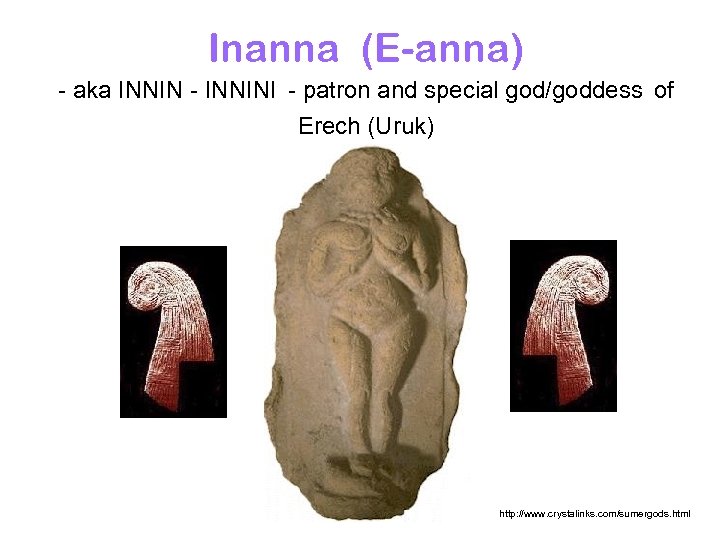 Inanna (E-anna) aka INNINI patron and special god/goddess of Erech (Uruk) http: //www. crystalinks. com/sumergods. html
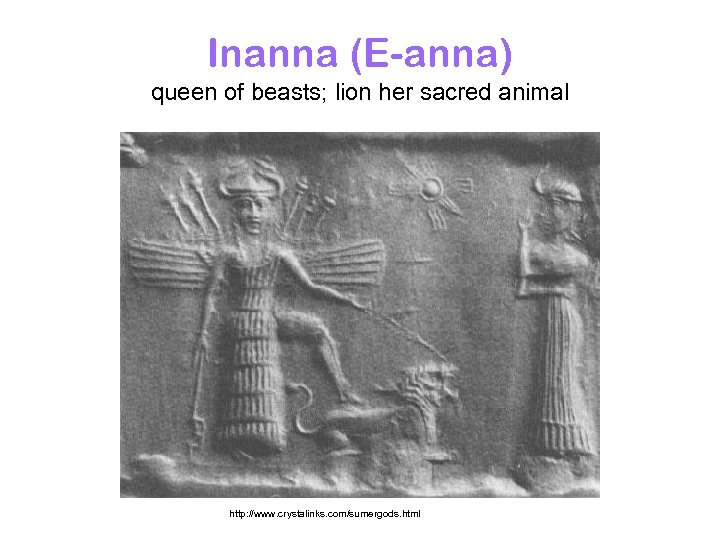 Inanna (E-anna) queen of beasts; lion her sacred animal http: //www. crystalinks. com/sumergods. html
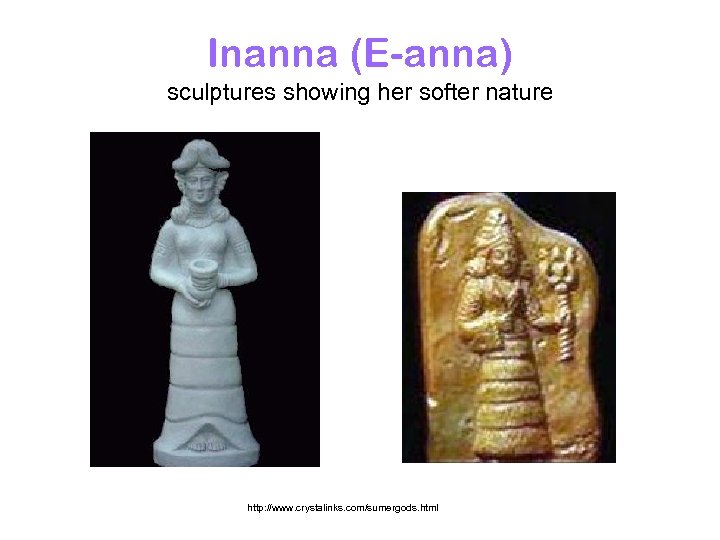 Inanna (E-anna) sculptures showing her softer nature http: //www. crystalinks. com/sumergods. html
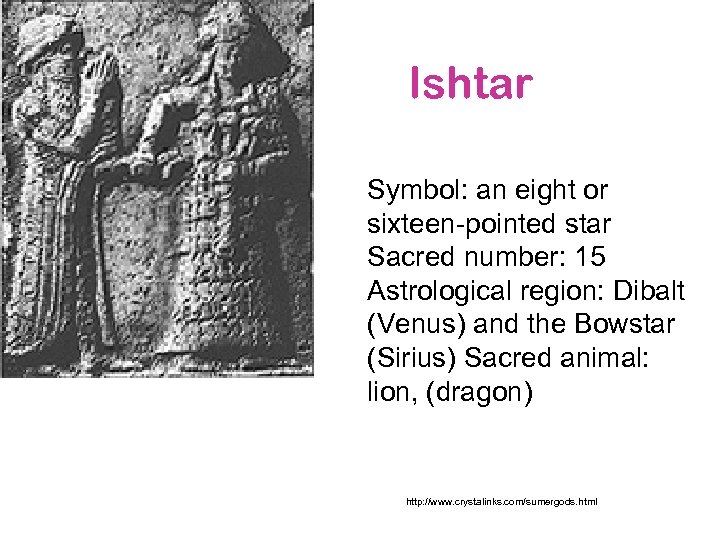 Ishtar Symbol: an eight or sixteen pointed star Sacred number: 15 Astrological region: Dibalt (Venus) and the Bowstar (Sirius) Sacred animal: lion, (dragon) http: //www. crystalinks. com/sumergods. html
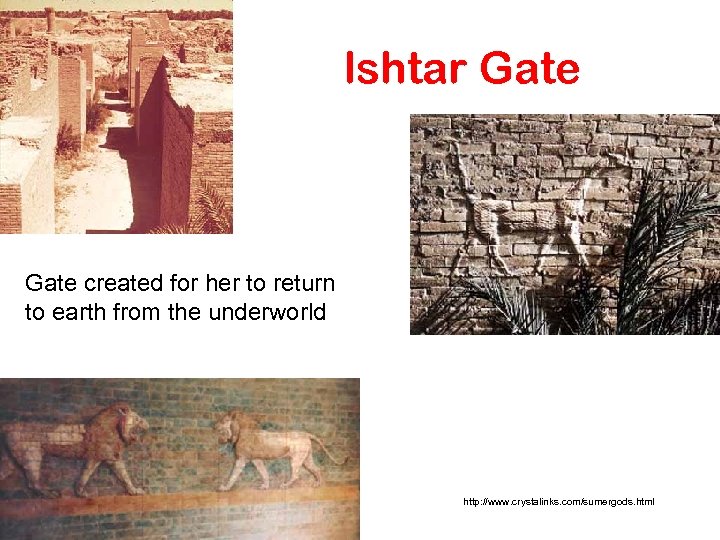 Ishtar Gate created for her to return to earth from the underworld http: //www. crystalinks. com/sumergods. html
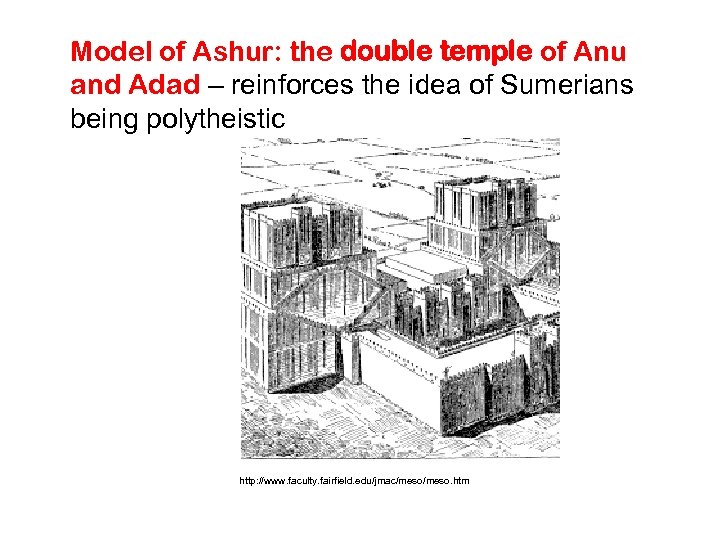 Model of Ashur: the double temple of Anu and Adad – reinforces the idea of Sumerians being polytheistic http: //www. faculty. fairfield. edu/jmac/meso. htm
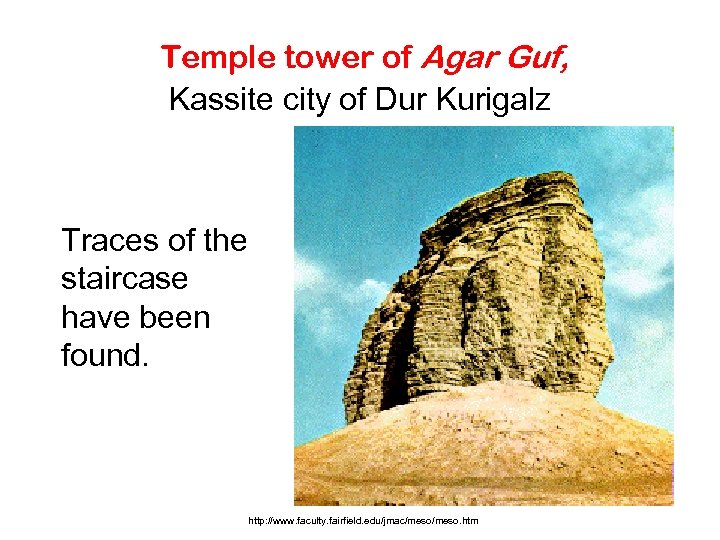 Temple tower of Agar Guf, Kassite city of Dur Kurigalz Traces of the staircase have been found. http: //www. faculty. fairfield. edu/jmac/meso. htm
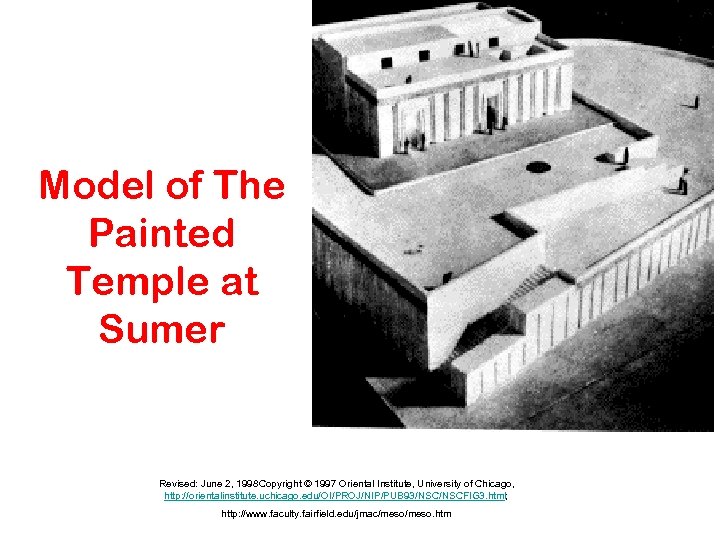 Model of The Painted Temple at Sumer Revised: June 2, 1998 Copyright © 1997 Oriental Institute, University of Chicago, http: //orientalinstitute. uchicago. edu/OI/PROJ/NIP/PUB 93/NSCFIG 3. html; http: //www. faculty. fairfield. edu/jmac/meso. htm
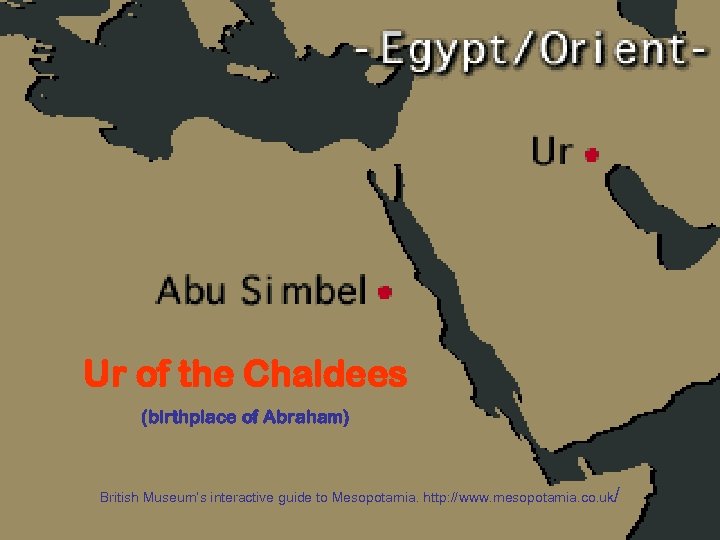 Ur of the Chaldees (birthplace of Abraham) British Museum’s interactive guide to Mesopotamia. http: //www. mesopotamia. co. uk/
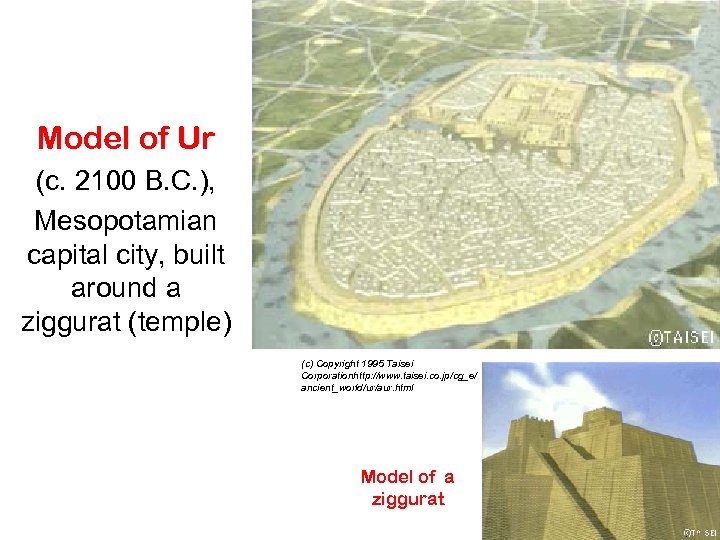 Model of Ur (c. 2100 B. C. ), Mesopotamian capital city, built around a ziggurat (temple) (c) Copyright 1995 Taisei Corporationhttp: //www. taisei. co. jp/cg_e/ ancient_world/ur/aur. html Model of a ziggurat
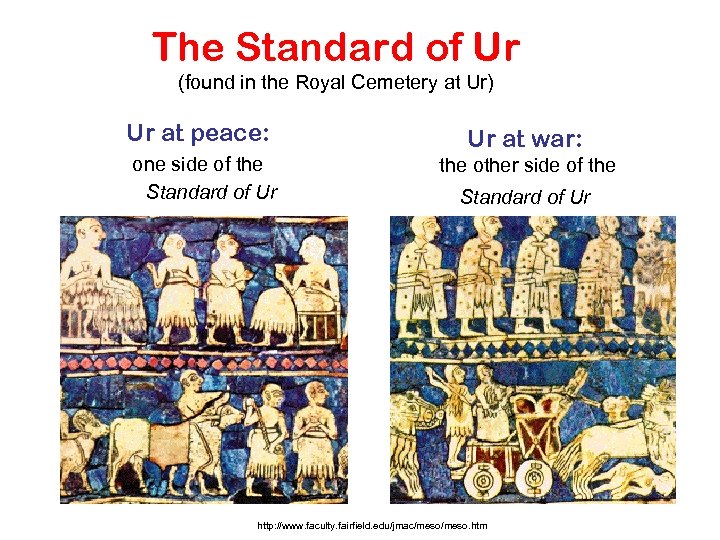 The Standard of Ur (found in the Royal Cemetery at Ur) Ur at peace: Ur at war: one side of the Standard of Ur the other side of the Standard of Ur http: //www. faculty. fairfield. edu/jmac/meso. htm
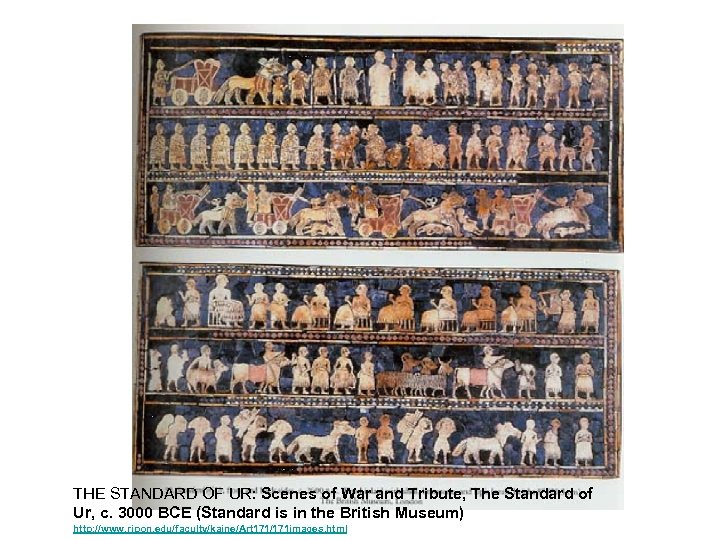 THE STANDARD OF UR: Scenes of War and Tribute, The Standard of Ur, c. 3000 BCE (Standard is in the British Museum) http: //www. ripon. edu/faculty/kaine/Art 171/171 images. html
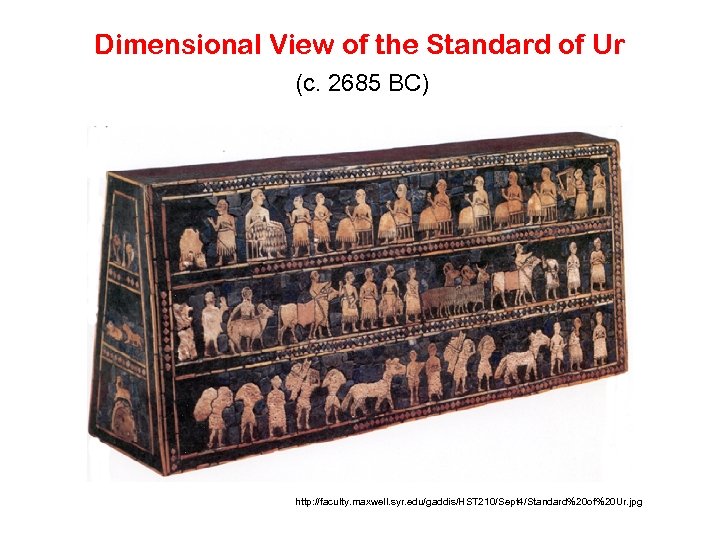 Dimensional View of the Standard of Ur (c. 2685 BC) http: //faculty. maxwell. syr. edu/gaddis/HST 210/Sept 4/Standard%20 of%20 Ur. jpg
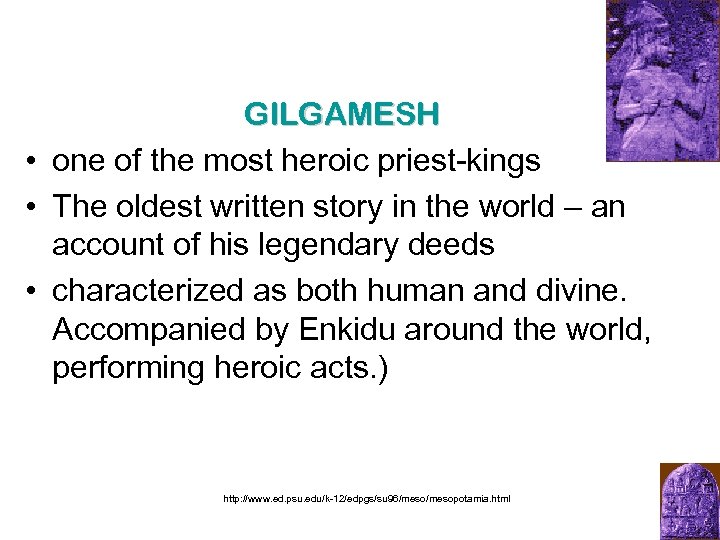 GILGAMESH • one of the most heroic priest kings • The oldest written story in the world – an account of his legendary deeds • characterized as both human and divine. Accompanied by Enkidu around the world, performing heroic acts. ) http: //www. ed. psu. edu/k 12/edpgs/su 96/mesopotamia. html
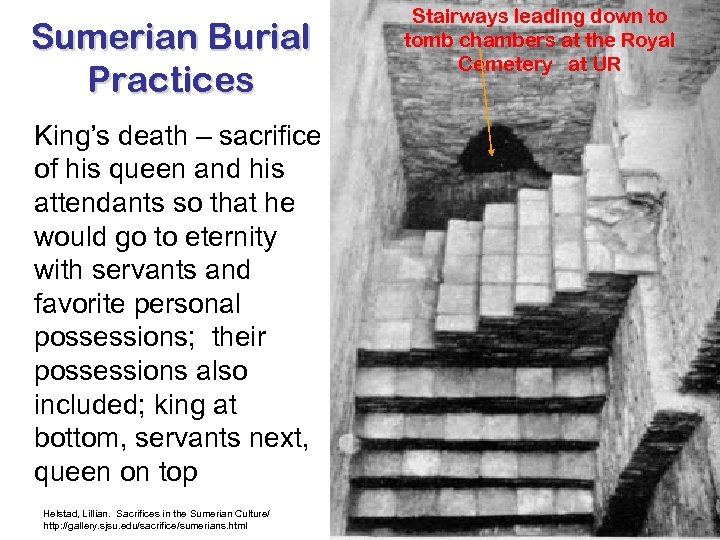 Sumerian Burial Practices King’s death – sacrifice of his queen and his attendants so that he would go to eternity with servants and favorite personal possessions; their possessions also included; king at bottom, servants next, queen on top Helstad, Lillian. Sacrifices in the Sumerian Culture/ http: //gallery. sjsu. edu/sacrifice/sumerians. html Stairways leading down to tomb chambers at the Royal Cemetery at UR
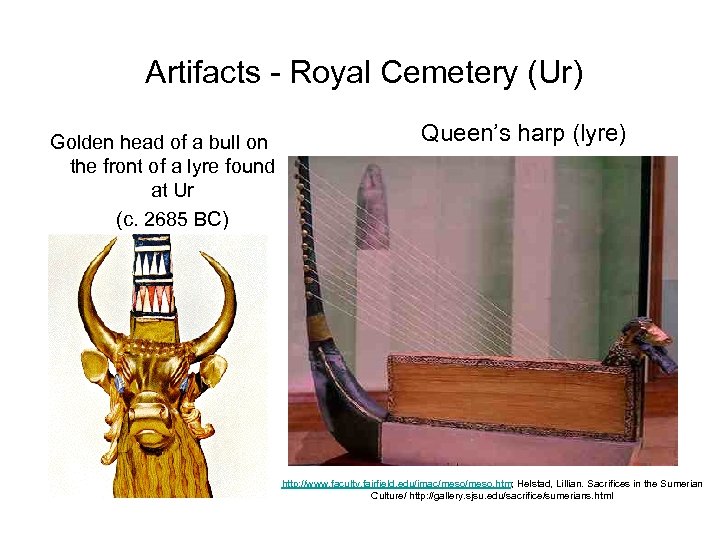 Artifacts Royal Cemetery (Ur) Golden head of a bull on the front of a lyre found at Ur (c. 2685 BC) Queen’s harp (lyre) http: //www. faculty. fairfield. edu/jmac/meso. htm; Helstad, Lillian. Sacrifices in the Sumerian Culture/ http: //gallery. sjsu. edu/sacrifice/sumerians. html
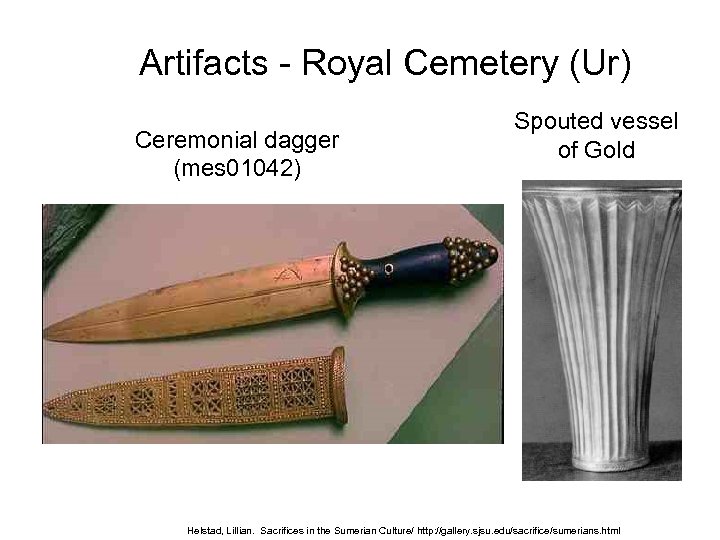 Artifacts Royal Cemetery (Ur) Ceremonial dagger (mes 01042) Spouted vessel of Gold Helstad, Lillian. Sacrifices in the Sumerian Culture/ http: //gallery. sjsu. edu/sacrifice/sumerians. html
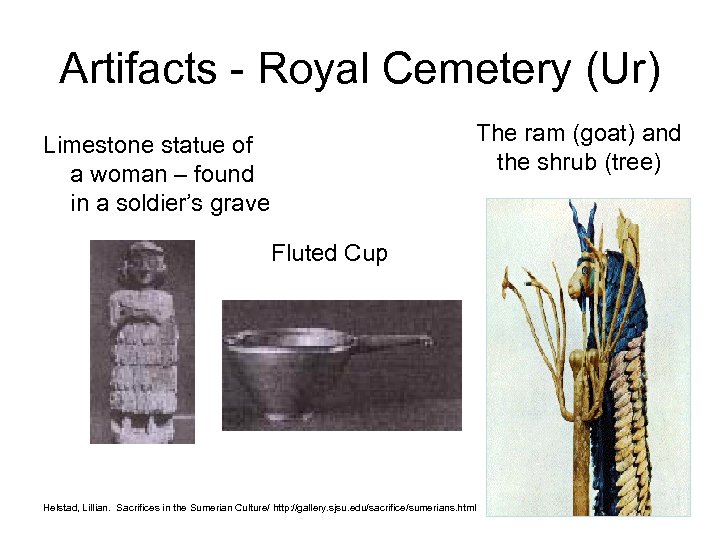 Artifacts Royal Cemetery (Ur) The ram (goat) and the shrub (tree) Limestone statue of a woman – found in a soldier’s grave Fluted Cup Helstad, Lillian. Sacrifices in the Sumerian Culture/ http: //gallery. sjsu. edu/sacrifice/sumerians. html
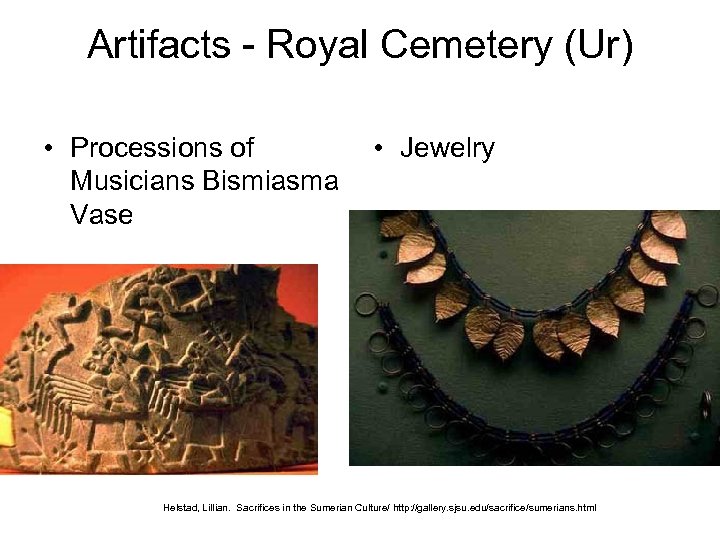 Artifacts Royal Cemetery (Ur) • Processions of • Jewelry Musicians Bismiasma Vase Helstad, Lillian. Sacrifices in the Sumerian Culture/ http: //gallery. sjsu. edu/sacrifice/sumerians. html
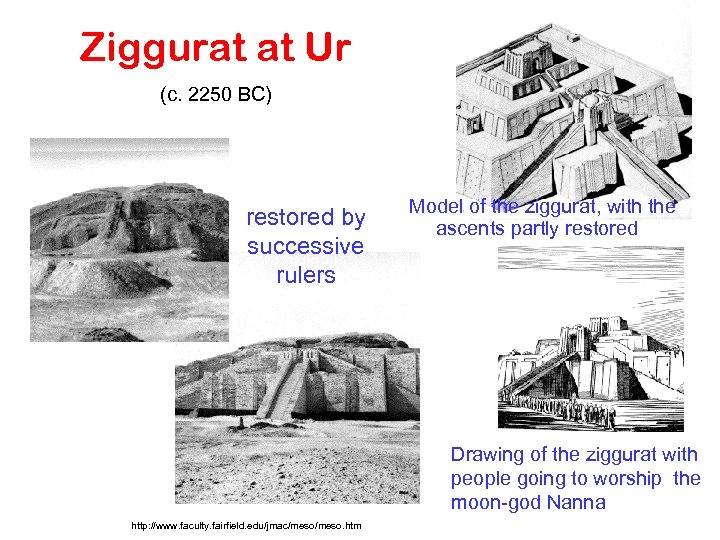 Ziggurat at Ur (c. 2250 BC) restored by successive rulers Model of the ziggurat, with the ascents partly restored Drawing of the ziggurat with people going to worship the moon god Nanna http: //www. faculty. fairfield. edu/jmac/meso. htm
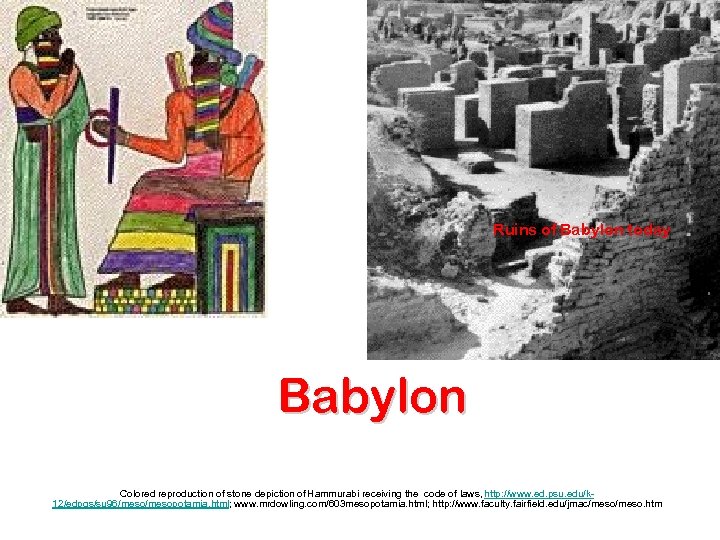 Ruins of Babylon today Babylon Colored reproduction of stone depiction of Hammurabi receiving the code of laws, http: //www. ed. psu. edu/k 12/edpgs/su 96/mesopotamia. html; www. mrdowling. com/603 mesopotamia. html; http: //www. faculty. fairfield. edu/jmac/meso. htm
 Achievements of Hammurabi of Babylon • Amorite city state ruler who united large number of city states (c. 1800 BCE) • improved the irrigation system, tax system, and government housing system • united the people under one religion • provided uniformity among the city states by enacting a code of law (282 laws "An eye for an eye, a tooth for a tooth. ")
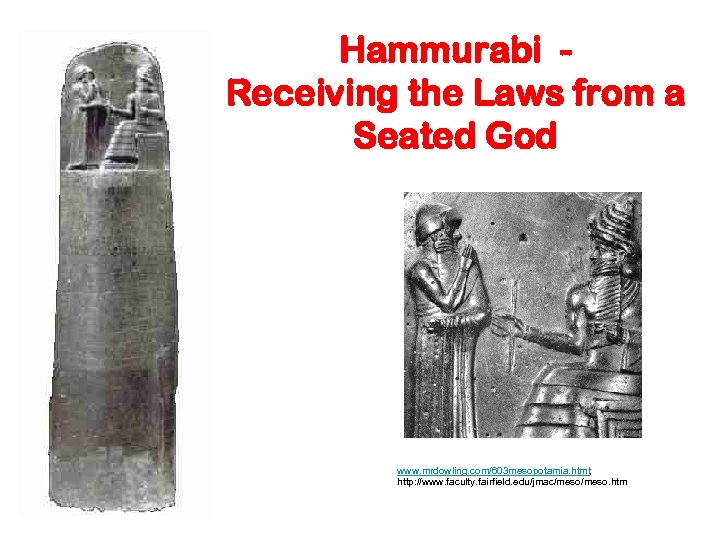 Hammurabi Receiving the Laws from a Seated God www. mrdowling. com/603 mesopotamia. html; http: //www. faculty. fairfield. edu/jmac/meso. htm
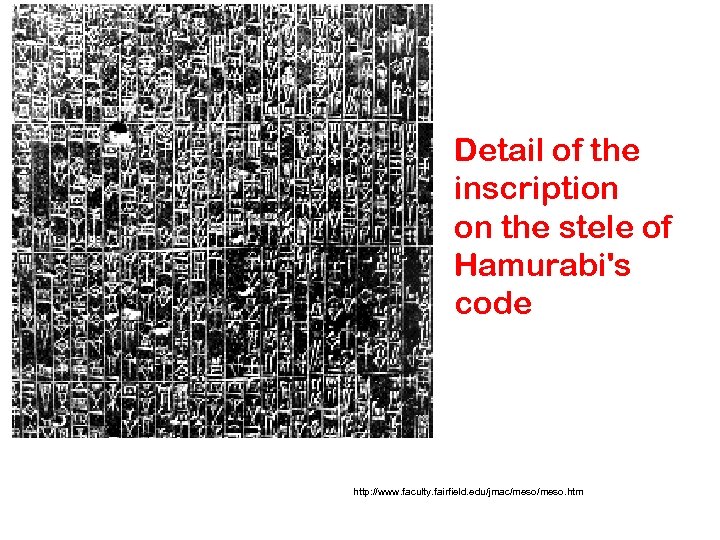 Detail of the inscription on the stele of Hamurabi's code http: //www. faculty. fairfield. edu/jmac/meso. htm
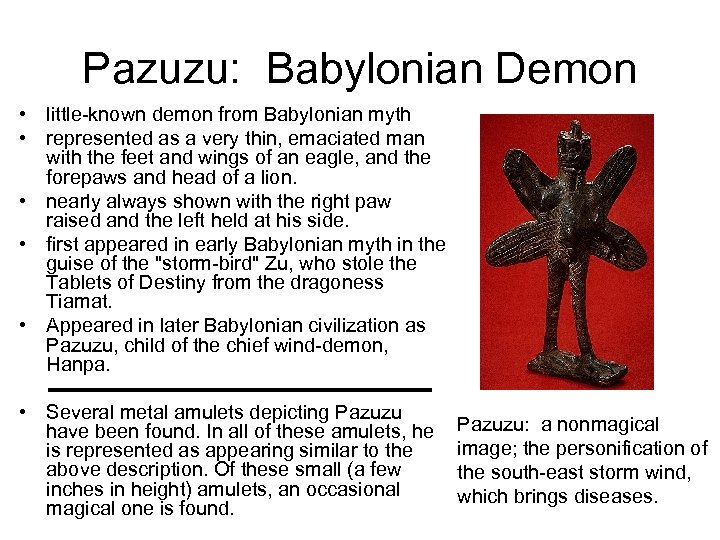 Pazuzu: Babylonian Demon • little known demon from Babylonian myth • represented as a very thin, emaciated man with the feet and wings of an eagle, and the forepaws and head of a lion. • nearly always shown with the right paw raised and the left held at his side. • first appeared in early Babylonian myth in the guise of the "storm bird" Zu, who stole the Tablets of Destiny from the dragoness Tiamat. • Appeared in later Babylonian civilization as Pazuzu, child of the chief wind demon, Hanpa. • Several metal amulets depicting Pazuzu have been found. In all of these amulets, he is represented as appearing similar to the above description. Of these small (a few inches in height) amulets, an occasional magical one is found. Pazuzu: a nonmagical image; the personification of the south east storm wind, which brings diseases.
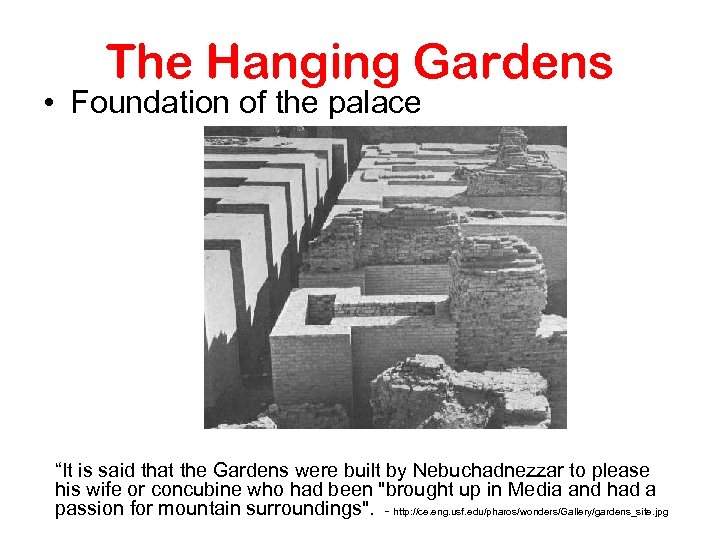 The Hanging Gardens • Foundation of the palace “It is said that the Gardens were built by Nebuchadnezzar to please his wife or concubine who had been "brought up in Media and had a passion for mountain surroundings". http: //ce. eng. usf. edu/pharos/wonders/Gallery/gardens_site. jpg
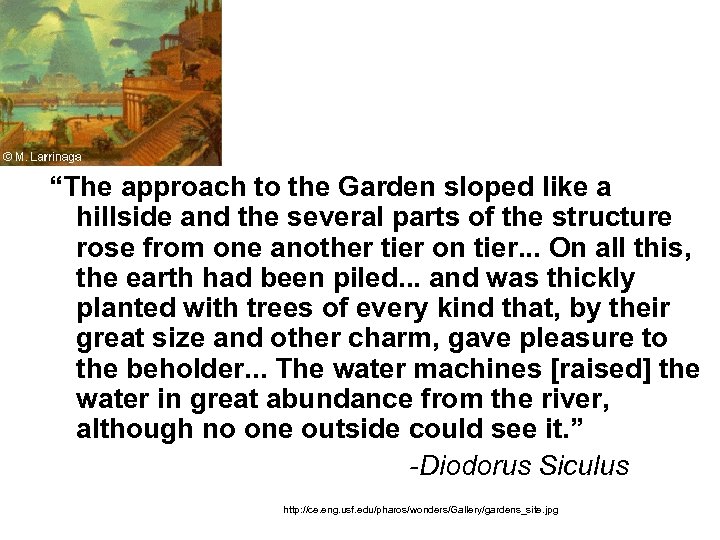 “The approach to the Garden sloped like a hillside and the several parts of the structure rose from one another tier on tier. . . On all this, the earth had been piled. . . and was thickly planted with trees of every kind that, by their great size and other charm, gave pleasure to the beholder. . . The water machines [raised] the water in great abundance from the river, although no one outside could see it. ” -Diodorus Siculus http: //ce. eng. usf. edu/pharos/wonders/Gallery/gardens_site. jpg
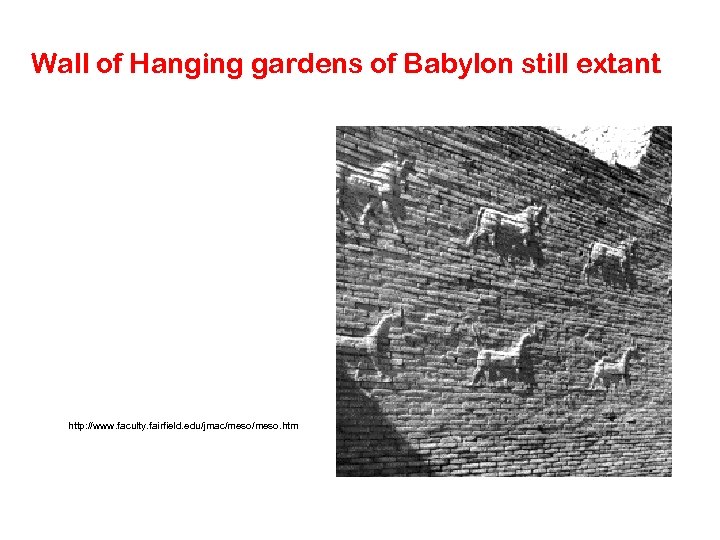 Wall of Hanging gardens of Babylon still extant http: //www. faculty. fairfield. edu/jmac/meso. htm
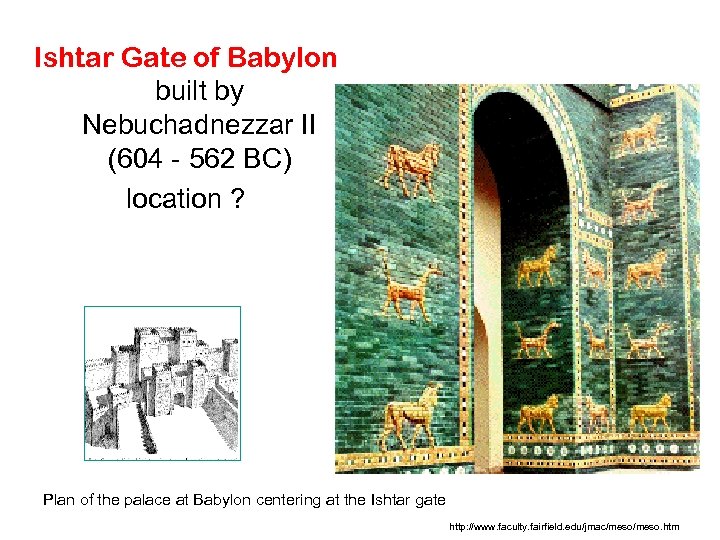 Ishtar Gate of Babylon built by Nebuchadnezzar II (604 562 BC) location ? Plan of the palace at Babylon centering at the Ishtar gate http: //www. faculty. fairfield. edu/jmac/meso. htm
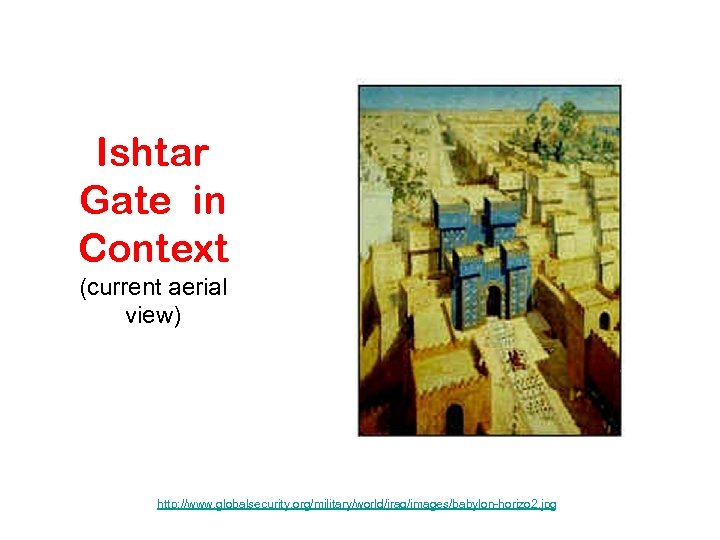 Ishtar Gate in Context (current aerial view) http: //www. globalsecurity. org/military/world/iraq/images/babylon horizo 2. jpg
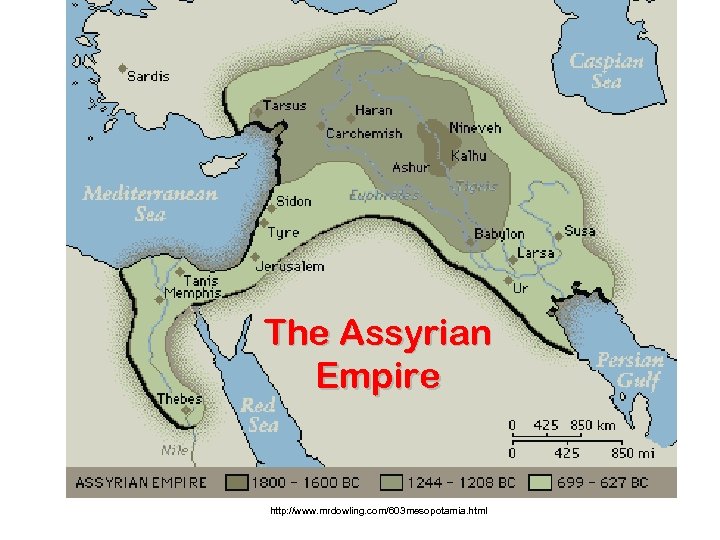 The Assyrian Empire http: //www. mrdowling. com/603 mesopotamia. html
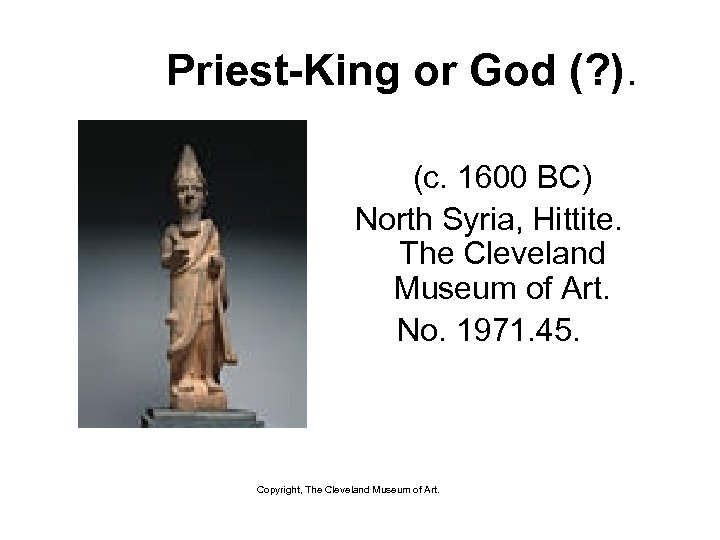 Priest-King or God (? ). (c. 1600 BC) North Syria, Hittite. The Cleveland Museum of Art. No. 1971. 45. Copyright, The Cleveland Museum of Art.
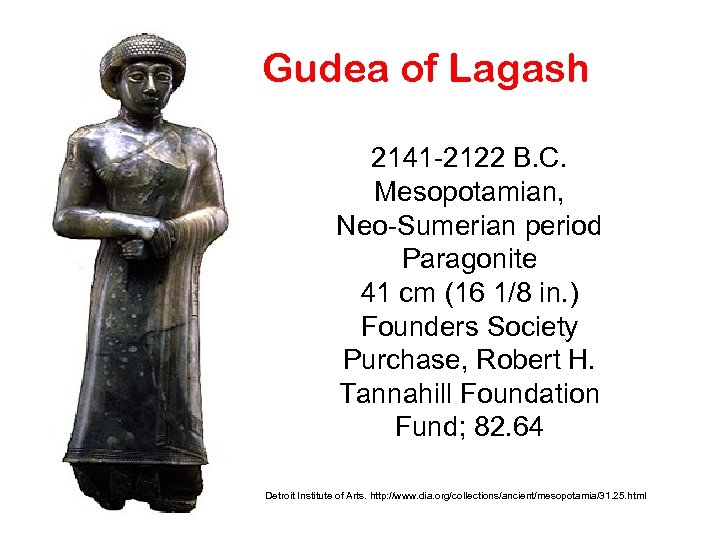 Gudea of Lagash 2141 2122 B. C. Mesopotamian, Neo Sumerian period Paragonite 41 cm (16 1/8 in. ) Founders Society Purchase, Robert H. Tannahill Foundation Fund; 82. 64 Detroit Institute of Arts. http: //www. dia. org/collections/ancient/mesopotamia/31. 25. html
 Assyrian Achievements • dammed the rivers leading into Babylon to deprive the Babylonians of water • conquered all of Mesopotamia and expanded it as far as Egypt • developed powerful armies with iron weapons • used chariots, and battering rams What is the significance of these accomplishments? http: //www. mrdowling. com/603 mesopotamia. html
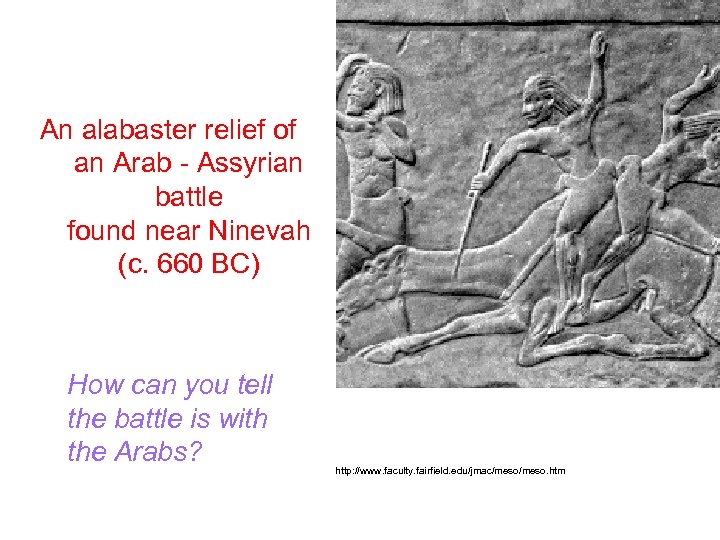 An alabaster relief of an Arab Assyrian battle found near Ninevah (c. 660 BC) How can you tell the battle is with the Arabs? http: //www. faculty. fairfield. edu/jmac/meso. htm
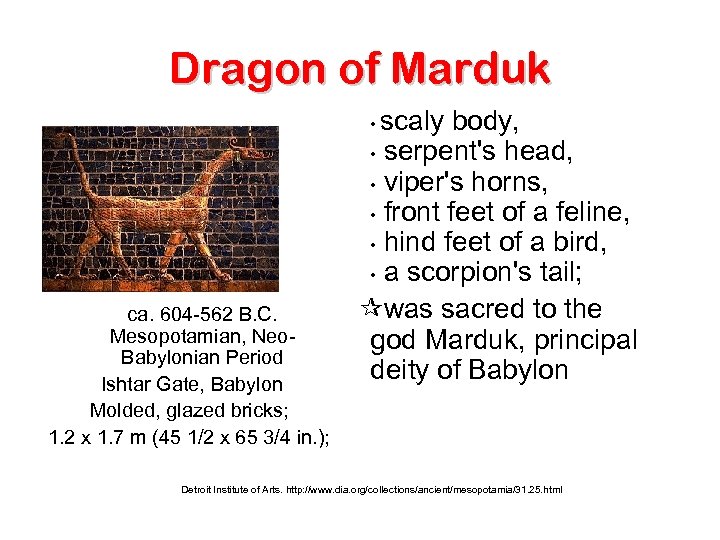 Dragon of Marduk scaly body, • serpent's head, • viper's horns, • front feet of a feline, • hind feet of a bird, • a scorpion's tail; was sacred to the god Marduk, principal deity of Babylon • ca. 604 562 B. C. Mesopotamian, Neo Babylonian Period Ishtar Gate, Babylon Molded, glazed bricks; 1. 2 x 1. 7 m (45 1/2 x 65 3/4 in. ); Detroit Institute of Arts. http: //www. dia. org/collections/ancient/mesopotamia/31. 25. html
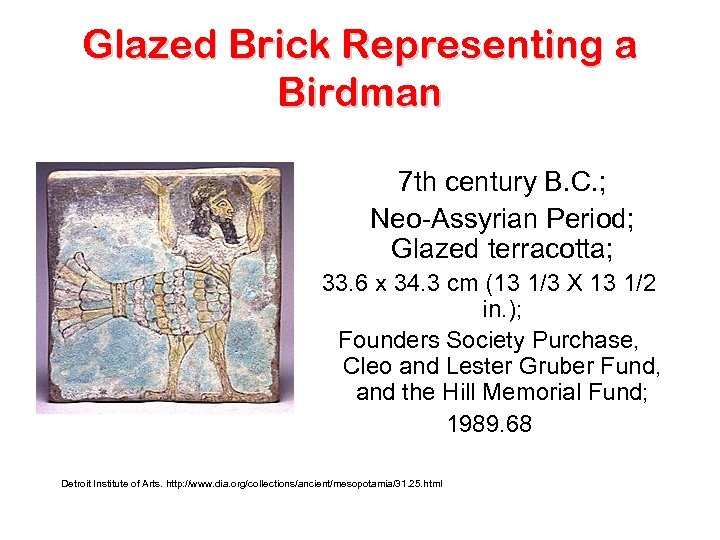 Glazed Brick Representing a Birdman 7 th century B. C. ; Neo Assyrian Period; Glazed terracotta; 33. 6 x 34. 3 cm (13 1/3 X 13 1/2 in. ); Founders Society Purchase, Cleo and Lester Gruber Fund, and the Hill Memorial Fund; 1989. 68 Detroit Institute of Arts. http: //www. dia. org/collections/ancient/mesopotamia/31. 25. html
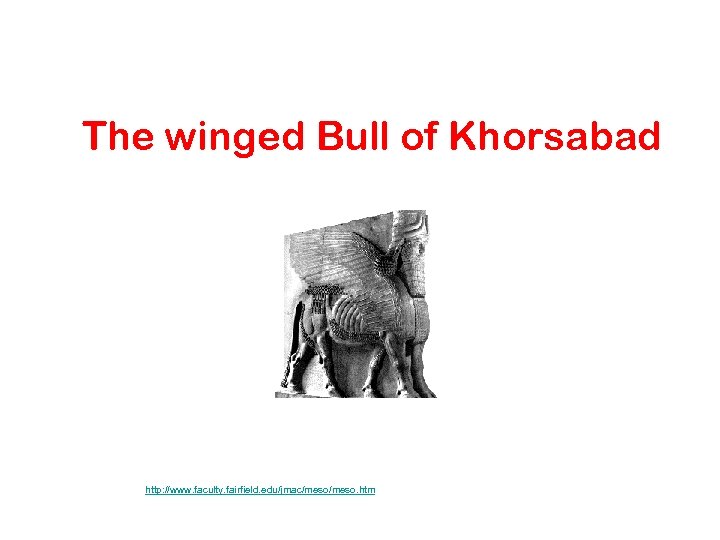 The winged Bull of Khorsabad http: //www. faculty. fairfield. edu/jmac/meso. htm
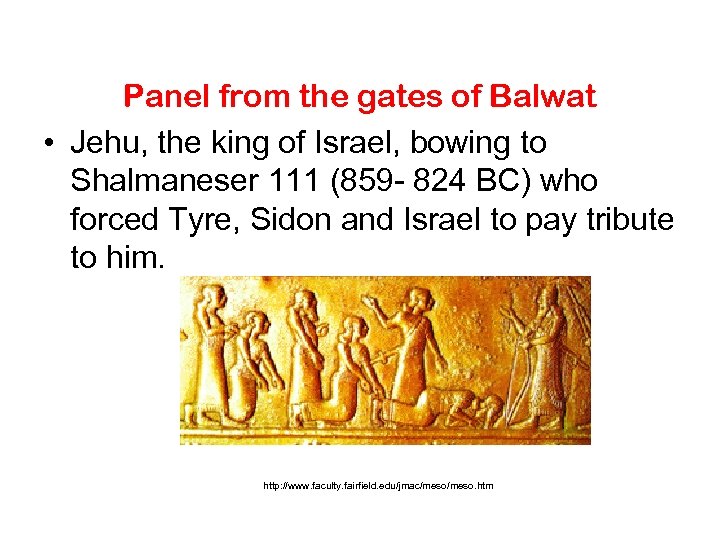 Panel from the gates of Balwat • Jehu, the king of Israel, bowing to Shalmaneser 111 (859 824 BC) who forced Tyre, Sidon and Israel to pay tribute to him. http: //www. faculty. fairfield. edu/jmac/meso. htm
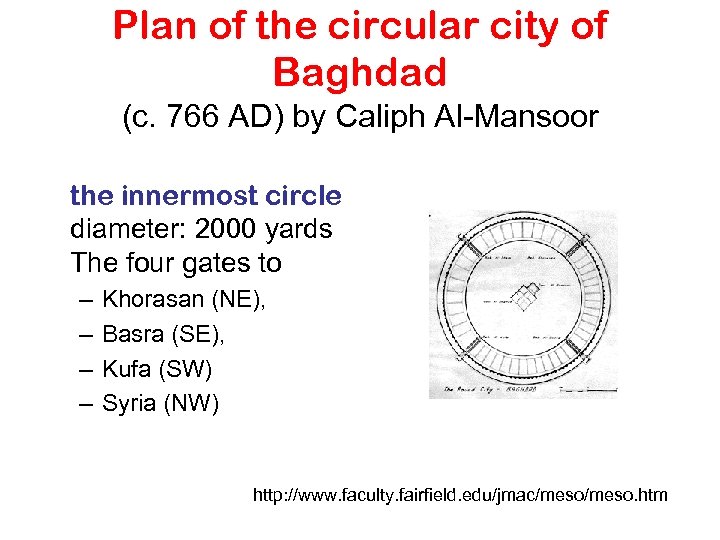 Plan of the circular city of Baghdad (c. 766 AD) by Caliph Al Mansoor the innermost circle diameter: 2000 yards The four gates to – – Khorasan (NE), Basra (SE), Kufa (SW) Syria (NW) http: //www. faculty. fairfield. edu/jmac/meso. htm
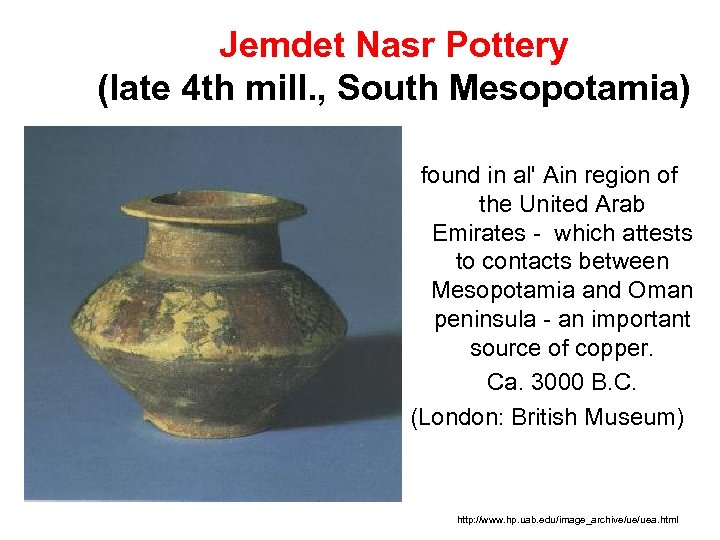 Jemdet Nasr Pottery (late 4 th mill. , South Mesopotamia) found in al' Ain region of the United Arab Emirates which attests to contacts between Mesopotamia and Oman peninsula an important source of copper. Ca. 3000 B. C. (London: British Museum) http: //www. hp. uab. edu/image_archive/ue/uea. html
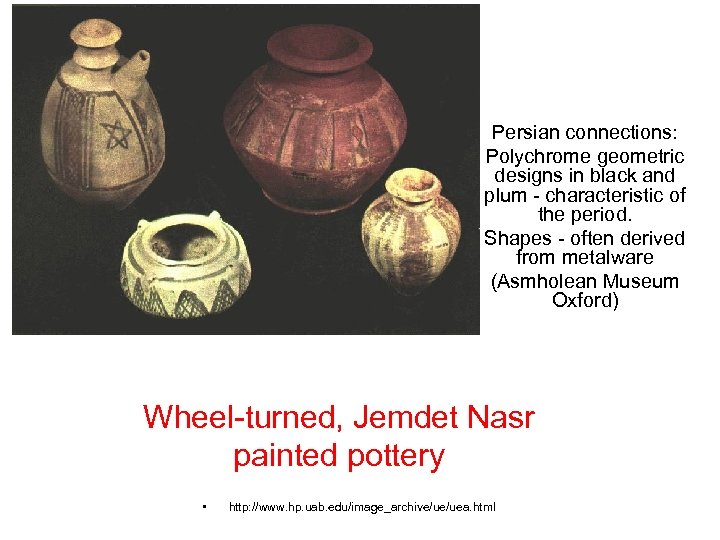 • Persian connections: • Polychrome geometric designs in black and plum characteristic of the period. • Shapes often derived from metalware • (Asmholean Museum Oxford) Wheel turned, Jemdet Nasr painted pottery • http: //www. hp. uab. edu/image_archive/ue/uea. html
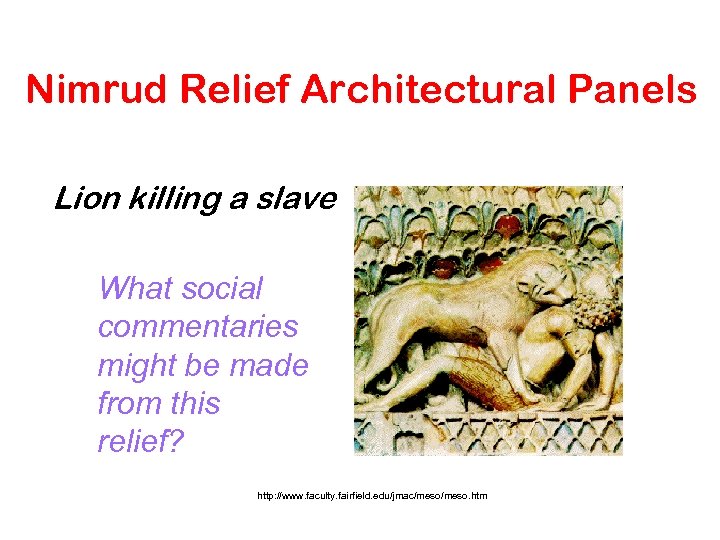 Nimrud Relief Architectural Panels Lion killing a slave What social commentaries might be made from this relief? http: //www. faculty. fairfield. edu/jmac/meso. htm
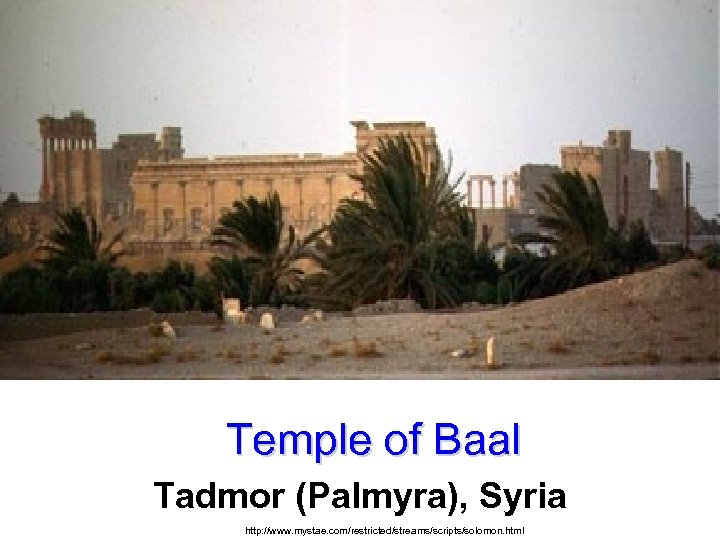 Temple of Baal Tadmor (Palmyra), Syria http: //www. mystae. com/restricted/streams/scripts/solomon. html
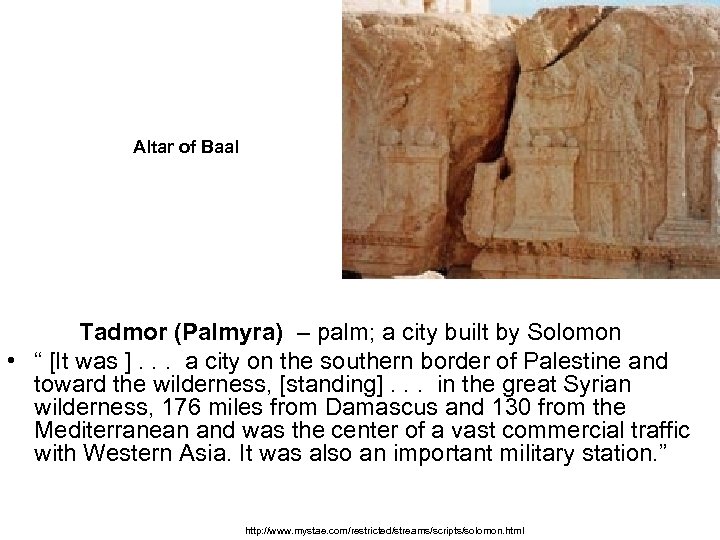 Altar of Baal Tadmor (Palmyra) – palm; a city built by Solomon • “ [It was ]. . . a city on the southern border of Palestine and toward the wilderness, [standing]. . . in the great Syrian wilderness, 176 miles from Damascus and 130 from the Mediterranean and was the center of a vast commercial traffic with Western Asia. It was also an important military station. ” http: //www. mystae. com/restricted/streams/scripts/solomon. html
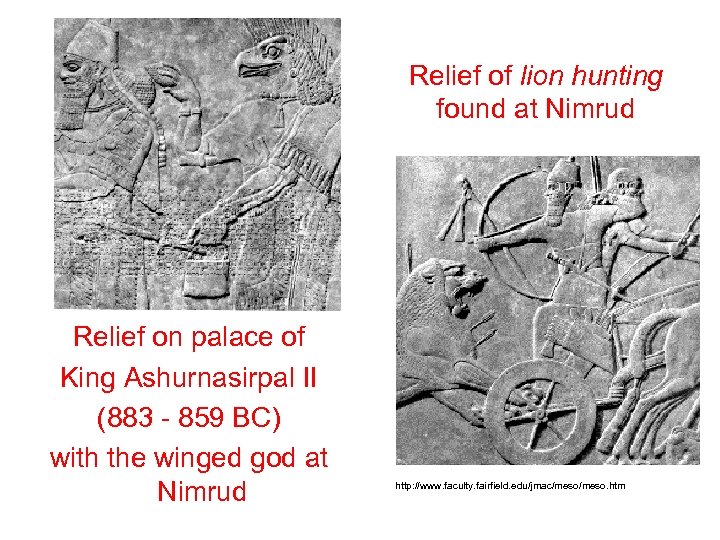 Relief of lion hunting found at Nimrud Relief on palace of King Ashurnasirpal II (883 859 BC) with the winged god at Nimrud http: //www. faculty. fairfield. edu/jmac/meso. htm
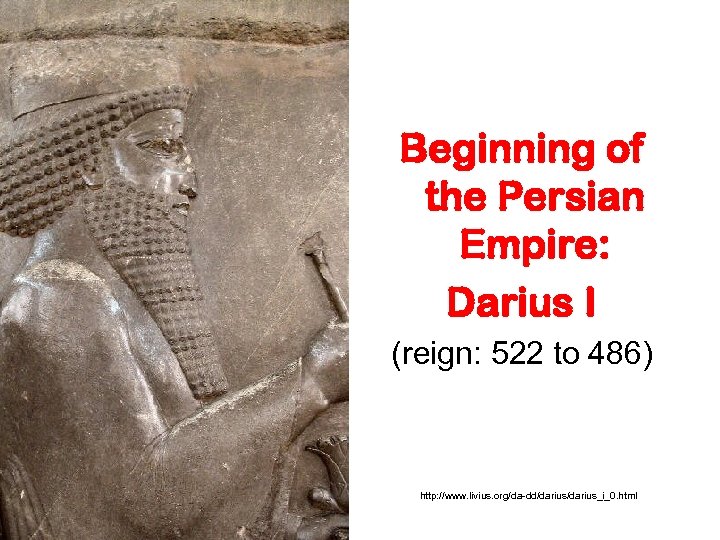 Beginning of the Persian Empire: Darius I (reign: 522 to 486) http: //www. livius. org/da dd/darius_i_0. html
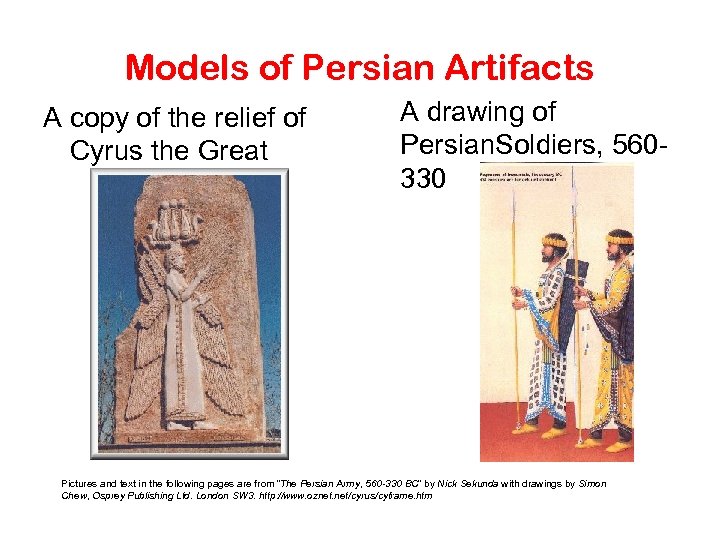 Models of Persian Artifacts A copy of the relief of Cyrus the Great A drawing of Persian. Soldiers, 560 330 Pictures and text in the following pages are from "The Persian Army, 560 -330 BC" by Nick Sekunda with drawings by Simon Chew, Osprey Publishing Ltd. London SW 3. http: //www. oznet. net/cyrus/cyframe. htm
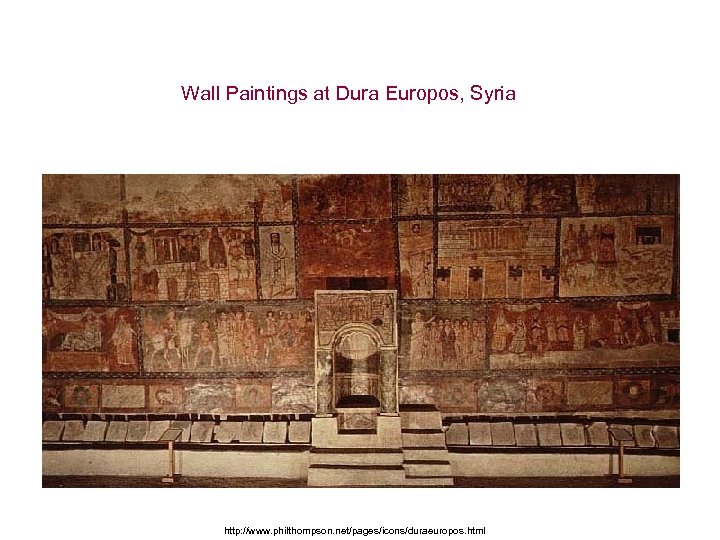 Wall Paintings at Dura Europos, Syria http: //www. philthompson. net/pages/icons/duraeuropos. html
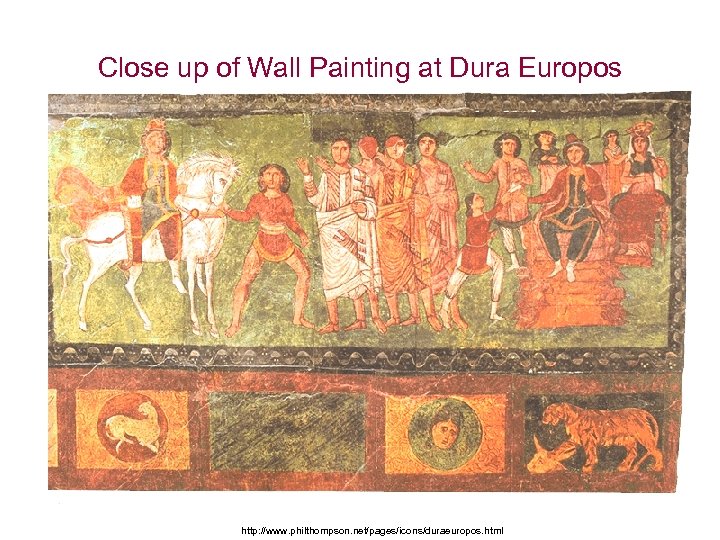 Close up of Wall Painting at Dura Europos http: //www. philthompson. net/pages/icons/duraeuropos. html
 “Dura Europos in Syria was founded by Alexander's lieutenant, Seleucus Nicator. The town was closely linked with Palmyra, serving as an important forward line of defense against Persians. It was captured and destroyed by the Sassanids in 256 AD shortly before the fall of the Syrian Metropolis itself. ” http: //www. philthompson. net/pages/icons/duraeuropos. html
 What are the artistic contributions or recognizable stylistic traits of the Mesopotamians?
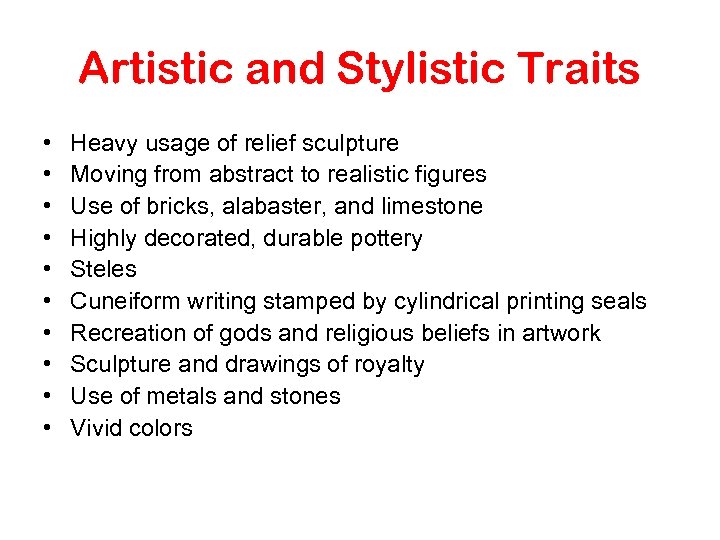 Artistic and Stylistic Traits • • • Heavy usage of relief sculpture Moving from abstract to realistic figures Use of bricks, alabaster, and limestone Highly decorated, durable pottery Steles Cuneiform writing stamped by cylindrical printing seals Recreation of gods and religious beliefs in artwork Sculpture and drawings of royalty Use of metals and stones Vivid colors
 Mesopotamian Timeline ©WSU, 1993 http: //www. wsu. edu/~dee/MESO/TIMELINE. HTM
 Sources British Museum’s interactive guide to Mesopotamia. http: //www. mesopotamia. co. uk/ http: //www. ed. psu. edu/k 12/edpgs/su 96/mesopotamia. html Classicas Technology Center. Mesopotamia Artifacts by Ashley and Kamario http: //ablemedia. com/ctcweb/consortium/vammesopotamia 4. html Cleveland Museum of Art. Crystal, Ellie. Metaphysical and Science Website. Sumerian Gods and Goddesses. http: //www. crystalinks. com/sumergods. html Detroit Institute of Arts. http: //www. dia. org/collections/ancient/mesopotamia/31. 25. html Secunda, Nick with drawings by Simon Chew, The Persian Army, 560 -330 BC, Osprey Publishing Ltd. London SW 3. http: //www. oznet. net/cyrus/cyframe. htm Helstad, Lillian. Sacrifices in the Sumerian Culture/ http: //gallery. sjsu. edu/sacrifice/sumerians. html “Pazuzu” Image created on 19 February 2000; last modified on 19 February 2000. © 1995 2004 Encyclopedia Mythica. All rights reserved. http: //www. pantheon. org/areas/gallery/mythology/asia/mesopotamian/pazuzu. html The Sumerian People. http: //www. mnsu. edu/emuseum/prehistory/ middle_east/sumer_citizens. html http: //www. fordham. edu/halsall/ancient/asbook 03. html Taylor, Andrew. ataylor 1@student. northpark. edu October 6, 1998 http: //www. northpark. edu/history/Web. Chron/Middle. East/Rev. Mesopot. html Zitchen, Z. , Sumerian Civilization – Part 2. Laur Kaub ed. http: //www. strayreality. com/Lanis_Strayreality/sumerian_civilization%202. htm Copyright © 2001 2004 by Strayreality. com Costa Rica, All rights reserved. Revised: 21 Jun 2004 09: 16: 05 0400 Annonynous articles, authors http: //www. faculty. fairfield. edu/jmac/meso. htm http: //faculty. maxwell. syr. edu/gaddis/HST 210/Sept 4/Standard%20 of%20 Ur. jpg http: //freepages. history. rootsweb. com/~catshaman/bamaledr/1 endr. htm; LINK http: //www. globalsecurity. org/military/world/iraq/images/babylon horizo 2. jpg http: //www. fortunecity. com/roswell/arkham/80/pazuzu. html http: //www. mrdowling. com/603 mesopotamia. html http: //www. ripon. edu/faculty/kaine/Art 171/171 images. html http: //www. sumerian. org/map. htm http: //www. wsu. edu/~dee/MESO/TIMELINE. HTM
 Secondary Sources Bibliography for Helstad, Lillian. Sacrifices in the Sumerian Culture/ http: //gallery. sjsu. edu/sacrifice/sumerians. html Ceram, C. W. Gods, Graves, & Scholars. New York: Alfred A. Knopf, Inc. , 1967. Clark, Grahame. Prehistoric Societies. New York: Alfred A. Knopf Inc. , 1965. Davies, Nigel. Human Sacrifice: In History & Today. New York: William Morrow and Company Inc. , 1981. Kramer, Samuel Noah. The Sumerians: their history, culture, and character. Chicago: Chicago Press, 1963. Tierney, Patrick. The Highest Altar: The Story of Human Sacrifice. England: Viking Penguin, 1989. Woolley, Leonard. Excavations at Ur. New York: Crowell Company, 1965. Woolley, Leonard. History of Mankind. United States: UNESCO, 1963 Woolley, Leonard. The Sumerians. London: Oxford University Press, 1965. Bibliography Sources for http: //www. faculty. fairfield. edu/jmac/meso. htm A SHORT HISTORY of ARCHITECTURE IN IRAQ (3, 000 B. C. 1258 AD) Samuel M. Ronaya, Lecturer, Al Hikma University, Baghdad 5000 YEARS OF THE ART OF MESOPOTAMIA, BY EVA STROMMENGER, PHOTOGRAPHS BY MAX HIRMER, ABRAMS, NEW YORK: 1964 ANCIENT IRAQ, by GEORGES ROUX, LONDON: ALLEN & UNWIN: 1964 TWIN RIVERS By SETON LLOYD OXFORD UNIVERSITY PRESS: BOMBAY 1947 HISTORY BEGINS AT S U M E R, by Samuel Noah Kramer Doubleday Anchor Books: Garden City, New York: 1959 EARLY MESOPOTAMIA AND IRAN by M. E. L. Mallowan Mc. GRAW HILL NEW YORK 1969 Bibliography Sources for The Sumerian People. http: //www. mnsu. edu/ emuseum/prehistory/ middle_east/sumer_citizens. html Tom B. Jones, "Sumer, " Grolier Electronic Encyclopedia, 1993; Samuel Noah Kramer, Cradle of Civilization, New York: Time Incorporated, 1969; World History, Volume One, St. Paul, MN: West Publishing Company, 1991; http: //www. ee. ucl. ac. uk/~lheagney/mesopotamia/SUMER. html

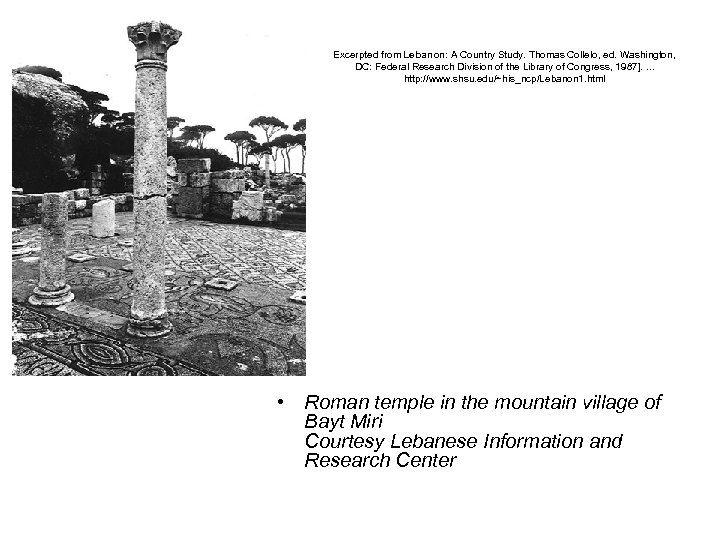 Excerpted from Lebanon: A Country Study. Thomas Collelo, ed. Washington, DC: Federal Research Division of the Library of Congress, 1987]. . http: //www. shsu. edu/~his_ncp/Lebanon 1. html • Roman temple in the mountain village of Bayt Miri Courtesy Lebanese Information and Research Center
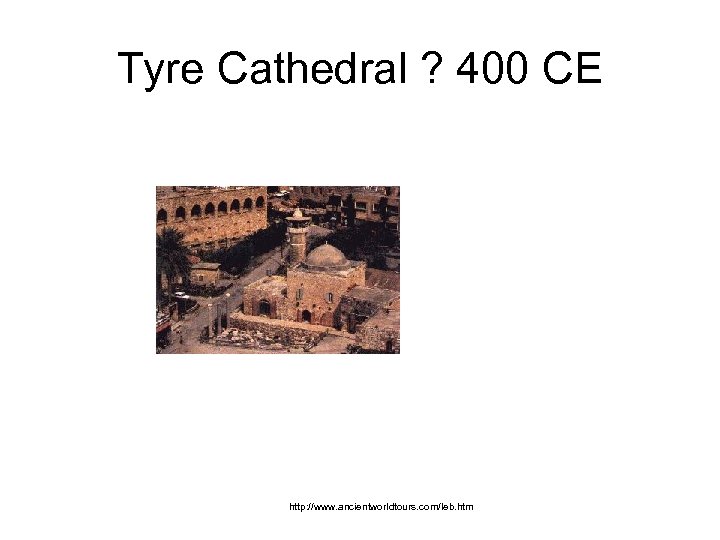 Tyre Cathedral ? 400 CE http: //www. ancientworldtours. com/leb. htm
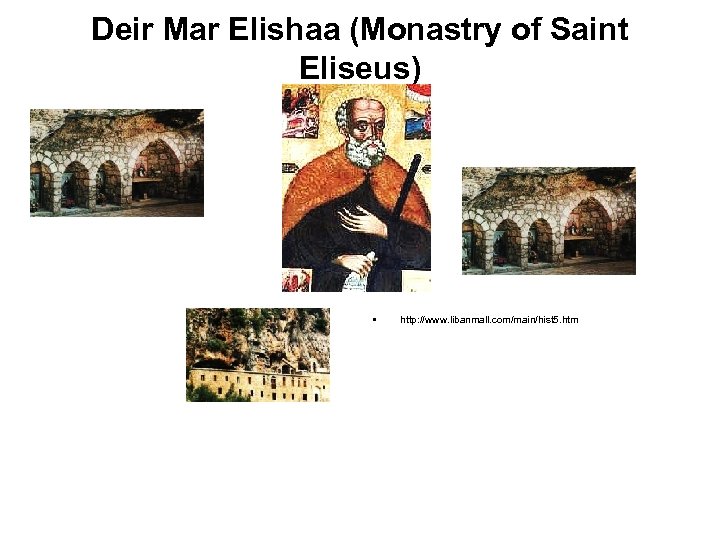 Deir Mar Elishaa (Monastry of Saint Eliseus) • http: //www. libanmall. com/main/hist 5. htm
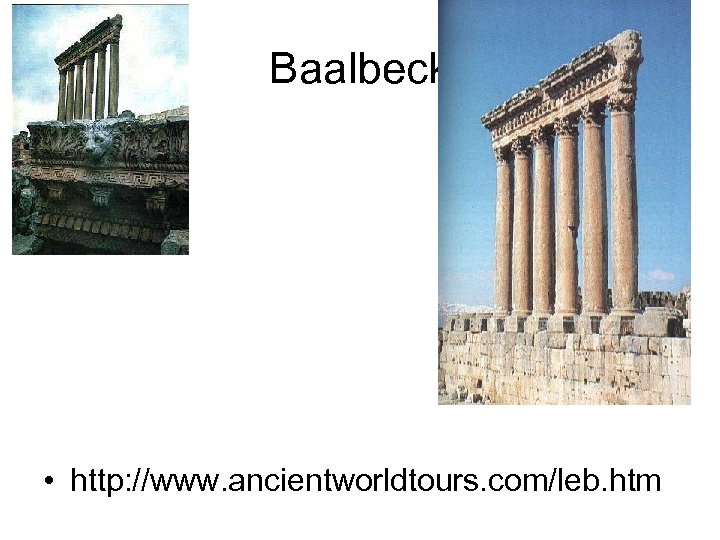 Baalbeck • http: //www. ancientworldtours. com/leb. htm
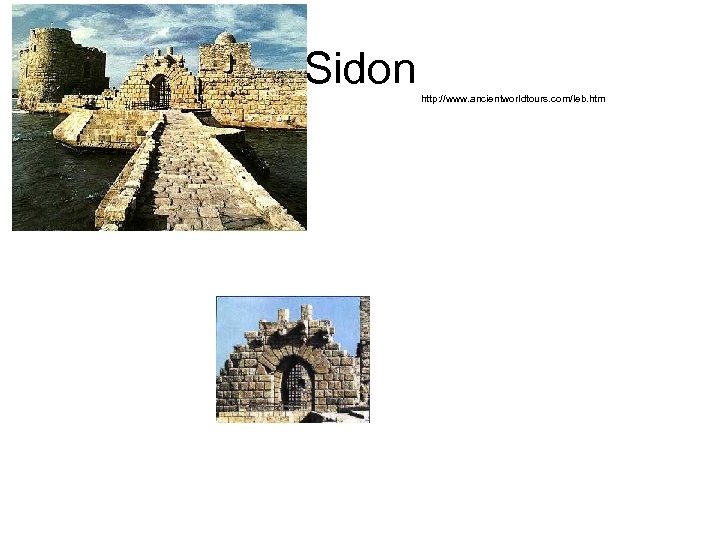 Sidon http: //www. ancientworldtours. com/leb. htm

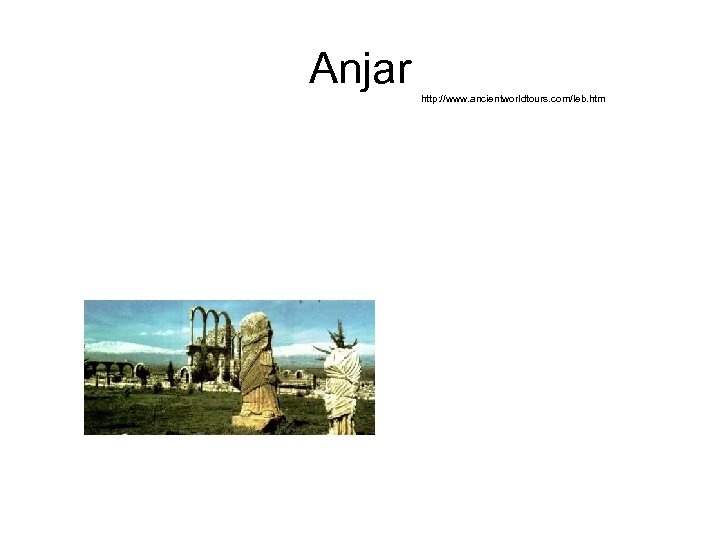 Anjar http: //www. ancientworldtours. com/leb. htm
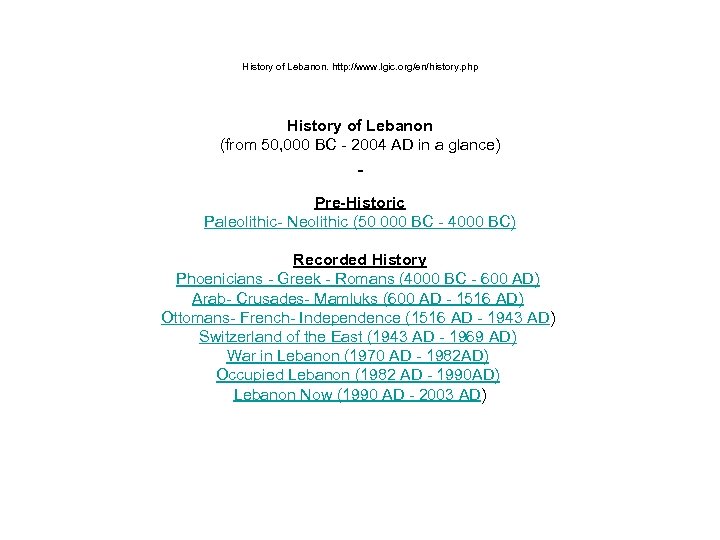 History of Lebanon. http: //www. lgic. org/en/history. php History of Lebanon (from 50, 000 BC 2004 AD in a glance) Pre-Historic Paleolithic Neolithic (50 000 BC 4000 BC) Recorded History Phoenicians Greek Romans (4000 BC 600 AD) Arab Crusades Mamluks (600 AD 1516 AD) Ottomans French Independence (1516 AD 1943 AD) Switzerland of the East (1943 AD 1969 AD) War in Lebanon (1970 AD 1982 AD) Occupied Lebanon (1982 AD 1990 AD) Lebanon Now (1990 AD 2003 AD)
 • Pre-Historic • (50, 000 BC – 10, 000 BC) Paleolithic Period • The evidence of tools found in caves along the coast of Lebanon shows that it was inhabited all through the classic stages of human development: Paleolithic, Neolithic, the bronze, and the iron working periods. Neanderthal and Cro Magnon people were making flint tools in this region around 50, 000 years ago. • (10 000 BC- 4000 BC) Neolithic Period • Village life followed the domestication of plants and animals with the Neolithic Revolution starting around 10, 000 BC. The traces of the coastal settlements in Lebanon date back to around 9000 BC in Byblos, favoring it’s founding among the earliest ‘communities’ during this period. • 4000 BC - 600 AD
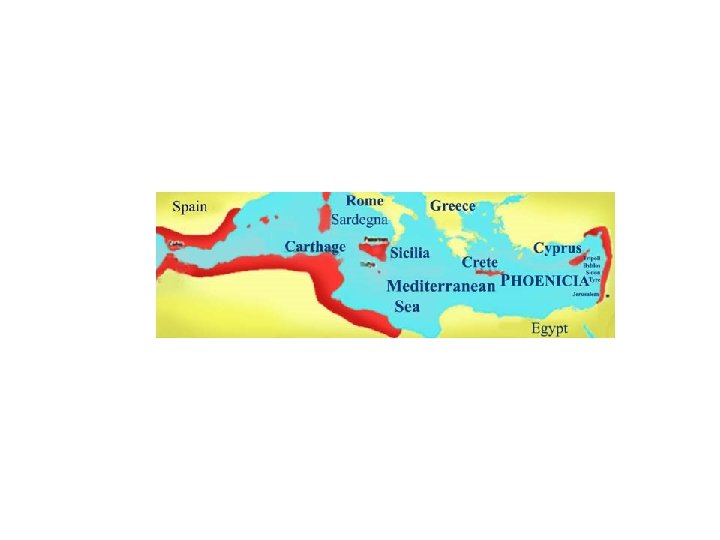
 • • • The recorded history shows a group of coastal cities and heavily forested mountains inhabited by a Semitic people, the Canaanites, around 4000 BC. These early inhabitants referred to themselves according to their city of origin, and called their nation Canaan. They lived in the narrow East Mediterranean cost and the parallel strip mountains of Lebanon. Around 2800 BC Canaanites traded cedar timber, olive oil and wine from Byblos for metals and ivory from Egypt. The Coastal cities fell to Amorites around 2000 BC, and to Egyptians from round 1800 until 1200 BC when they recovered independence. The Canaanites who inhabited that area were called Phoenicians by the Greeks (from the Greek word phoinos, meaning ‘red’) in a reference to the unique purple dye the Phoenicians produced from murex seashells. The Phoenicians mastered the art of navigation and dominated the Mediterranean Sea trade for over 500 years. They excelled in producing textiles, carving ivory and working with metal and glass. The Phoenicians built several local cities East of the Mediterranean among which are: Byblos, Tyre, Sidon, Berytus (Beirut), Tripoli, Arvad Island City, Baalbek and Caesarea. They established trade routes to Europe and Western Asia. Phoenician ships circumnavigated Africa a thousand years before those of the Portuguese. They founded colonies wherever they ventured on the North and South of the Mediterranean in Cyprus, Rhodes, Crete, Malta, Sicily, Sardinia, Marseilles, Cadiz, and Carthage around the first Millennium B. C.
 • Inventing the Alphabet • Around 1600 B. C. the Phoenicians invented the alphabet, and passed them onto the world. The Greeks adopted the 22 letter alphabet from the Phoenicians which has led to the Latin letters of present day. • Constructing Kings David and Solomon Palaces and Temple • The Phoenician king Hiram of Tyre (989 936 BC) built a palace for David and two palaces and a temple for Solomon. The Bible provides a vast amount of information about them. The Phoenicians built David’s Palace and Solomon’s Temple. They also built King Solomon two palaces, of which one was called 'Forest of Lebanon'. Craftsmen of Phoenicia used Lebanon’s cedar and metal to accomplish the work around the mid of the tenth century BC. (for Details)
 Images in Bekaa Region American University of Beirut. http: //almashriq. hiof. no/ddc/projects/mot/photobas e/images/MT 3/JPEG 0248. html
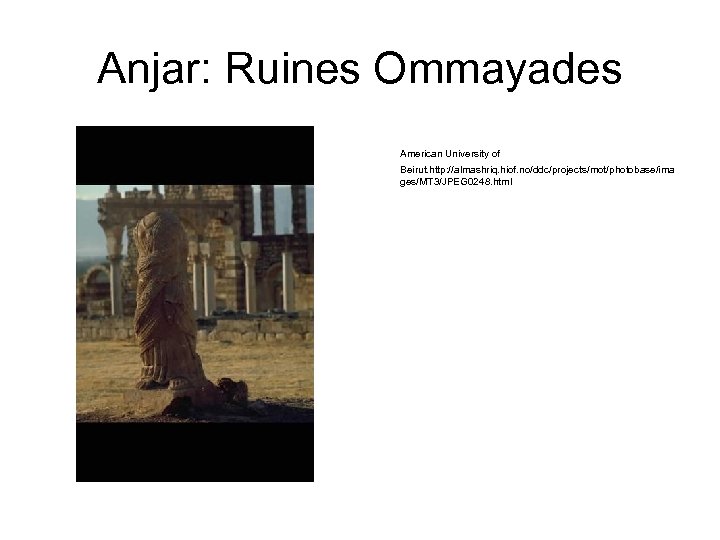 Anjar: Ruines Ommayades American University of Beirut. http: //almashriq. hiof. no/ddc/projects/mot/photobase/ima ges/MT 3/JPEG 0248. html
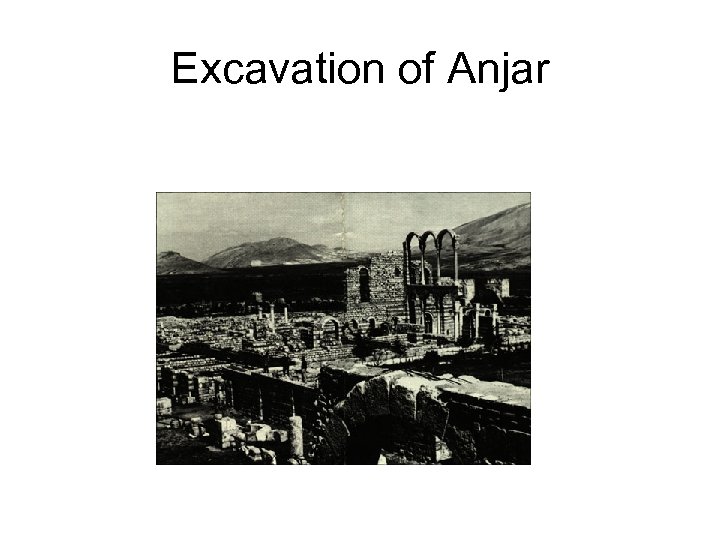 Excavation of Anjar
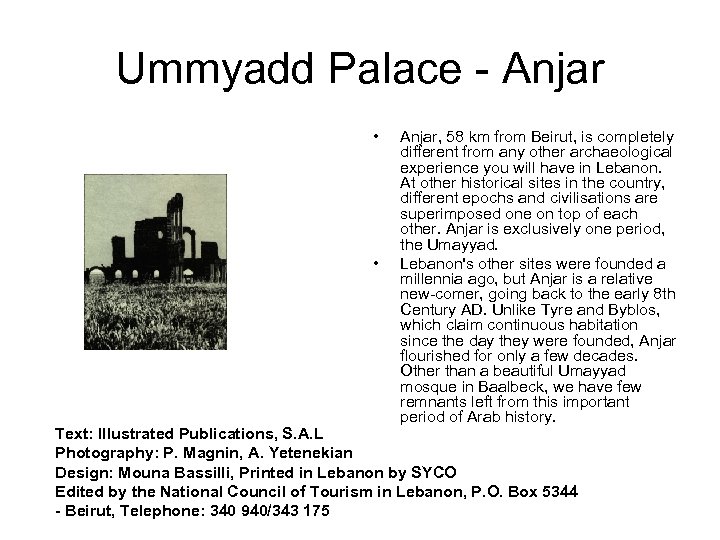 Ummyadd Palace Anjar • • Anjar, 58 km from Beirut, is completely different from any other archaeological experience you will have in Lebanon. At other historical sites in the country, different epochs and civilisations are superimposed one on top of each other. Anjar is exclusively one period, the Umayyad. Lebanon's other sites were founded a millennia ago, but Anjar is a relative new comer, going back to the early 8 th Century AD. Unlike Tyre and Byblos, which claim continuous habitation since the day they were founded, Anjar flourished for only a few decades. Other than a beautiful Umayyad mosque in Baalbeck, we have few remnants left from this important period of Arab history. Text: Illustrated Publications, S. A. L Photography: P. Magnin, A. Yetenekian Design: Mouna Bassilli, Printed in Lebanon by SYCO Edited by the National Council of Tourism in Lebanon, P. O. Box 5344 - Beirut, Telephone: 340 940/343 175
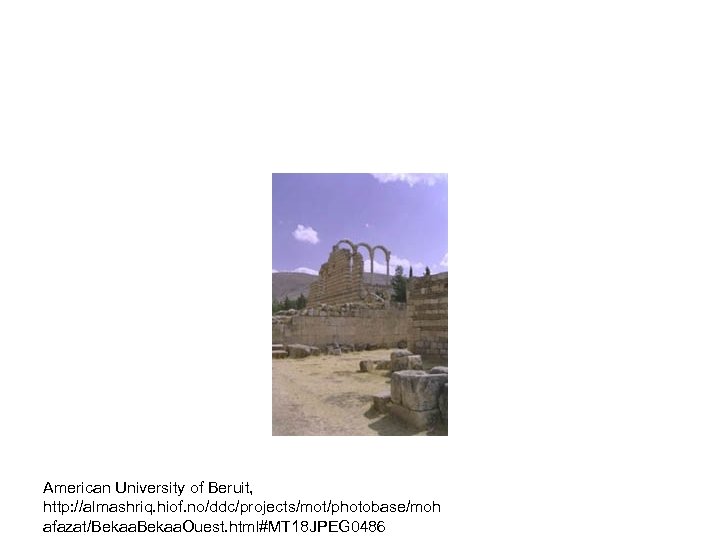 American University of Beruit, http: //almashriq. hiof. no/ddc/projects/mot/photobase/moh afazat/Bekaa. Ouest. html#MT 18 JPEG 0486
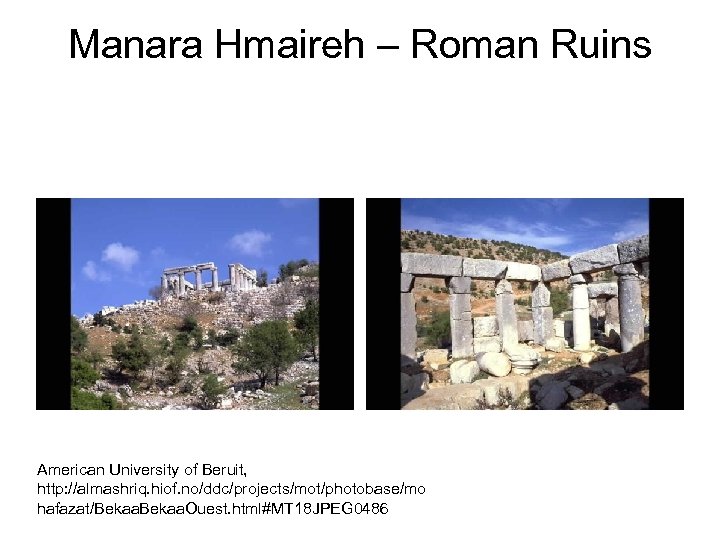 Manara Hmaireh – Roman Ruins American University of Beruit, http: //almashriq. hiof. no/ddc/projects/mot/photobase/mo hafazat/Bekaa. Ouest. html#MT 18 JPEG 0486
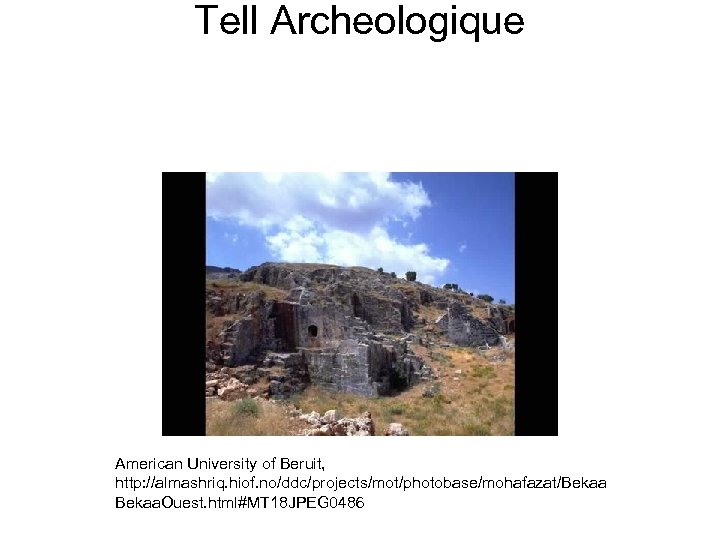 Tell Archeologique American University of Beruit, http: //almashriq. hiof. no/ddc/projects/mot/photobase/mohafazat/Bekaa. Ouest. html#MT 18 JPEG 0486
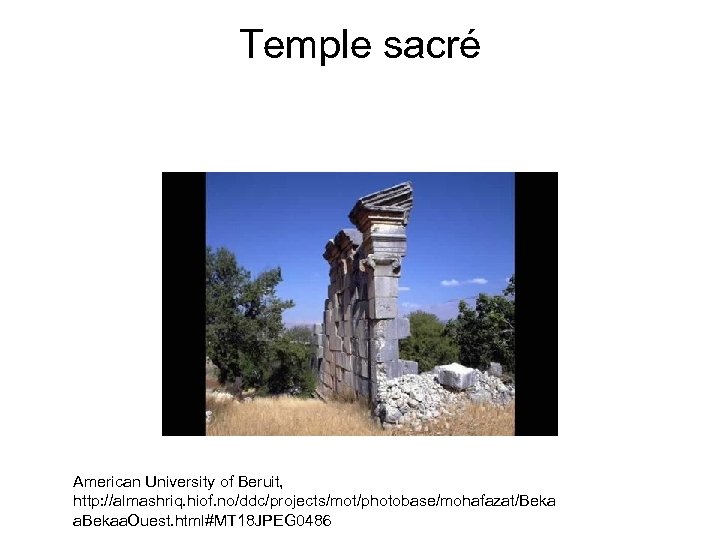 Temple sacré American University of Beruit, http: //almashriq. hiof. no/ddc/projects/mot/photobase/mohafazat/Beka a. Bekaa. Ouest. html#MT 18 JPEG 0486
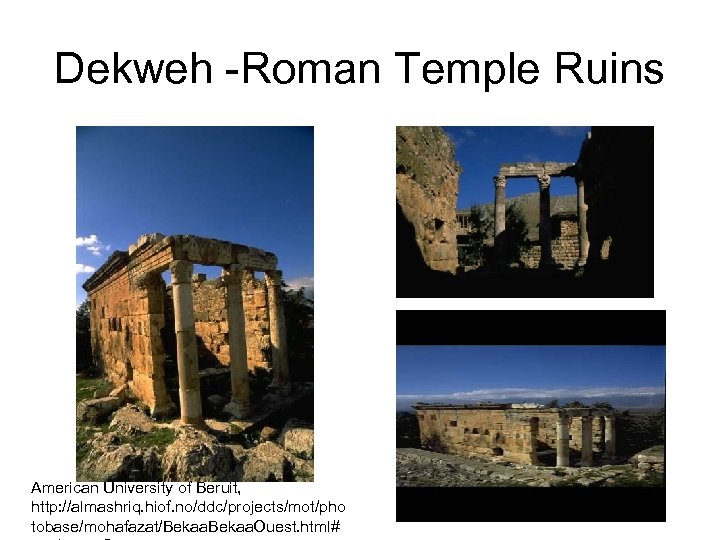 Dekweh Roman Temple Ruins American University of Beruit, http: //almashriq. hiof. no/ddc/projects/mot/pho tobase/mohafazat/Bekaa. Ouest. html#
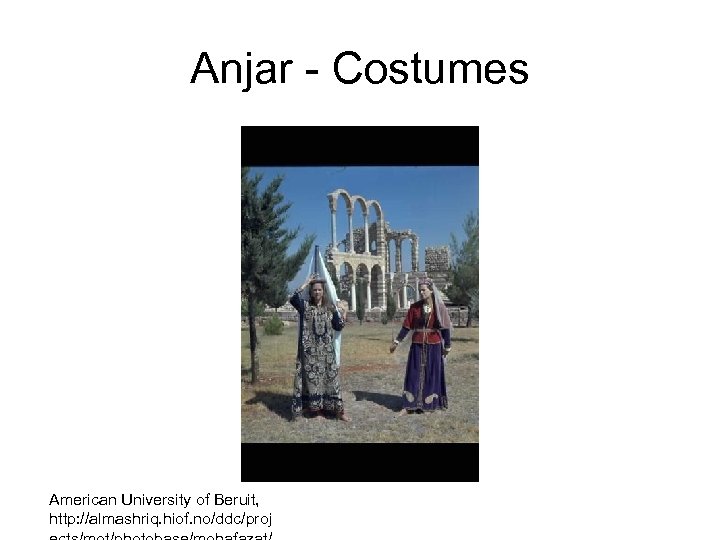 Anjar Costumes American University of Beruit, http: //almashriq. hiof. no/ddc/proj
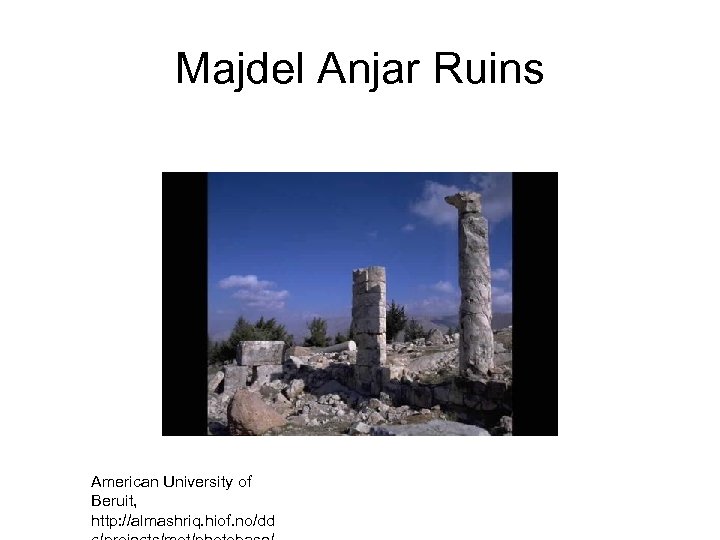 Majdel Anjar Ruins American University of Beruit, http: //almashriq. hiof. no/dd
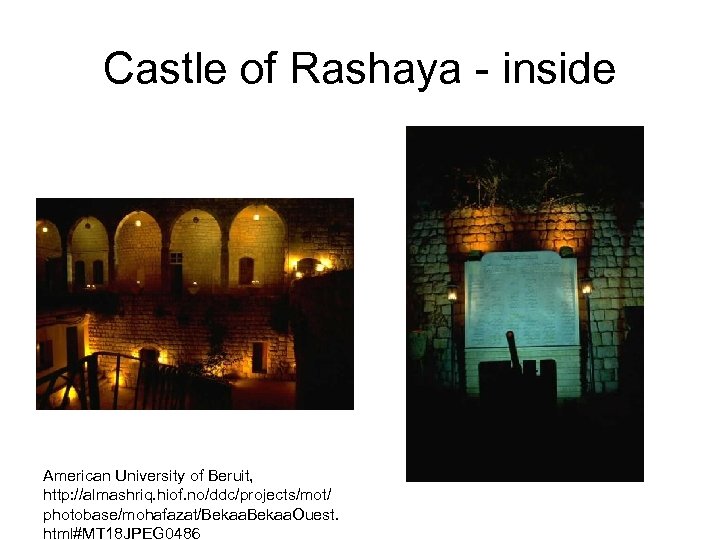 Castle of Rashaya inside American University of Beruit, http: //almashriq. hiof. no/ddc/projects/mot/ photobase/mohafazat/Bekaa. Ouest. html#MT 18 JPEG 0486
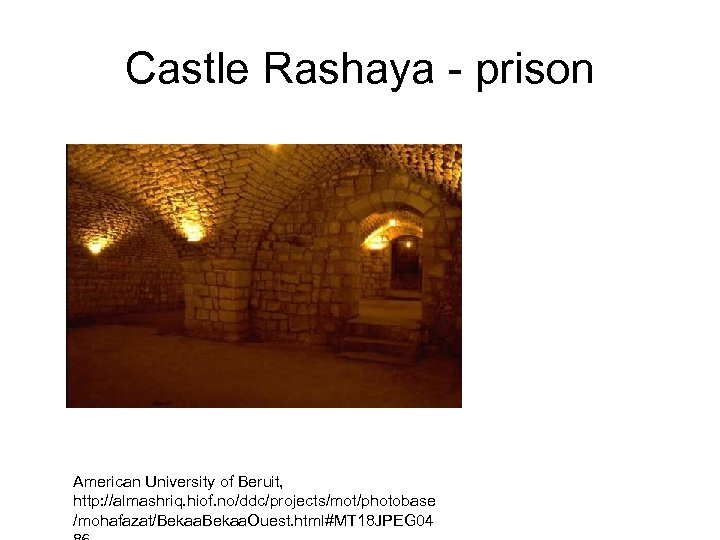 Castle Rashaya prison American University of Beruit, http: //almashriq. hiof. no/ddc/projects/mot/photobase /mohafazat/Bekaa. Ouest. html#MT 18 JPEG 04
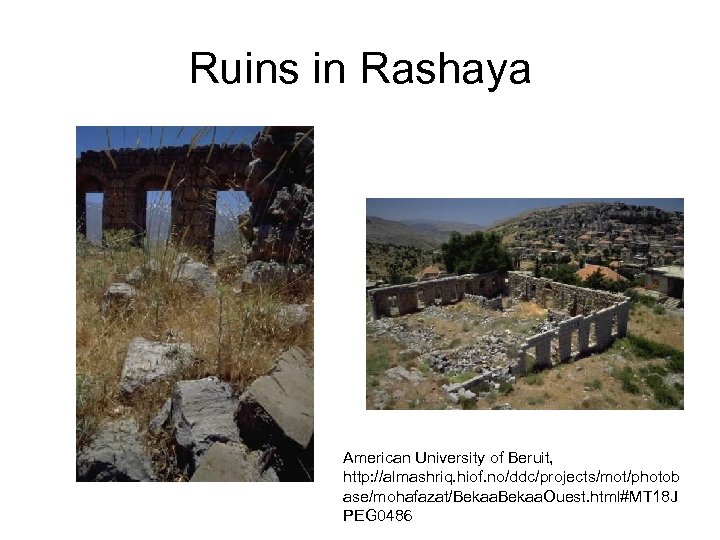 Ruins in Rashaya American University of Beruit, http: //almashriq. hiof. no/ddc/projects/mot/photob ase/mohafazat/Bekaa. Ouest. html#MT 18 J PEG 0486
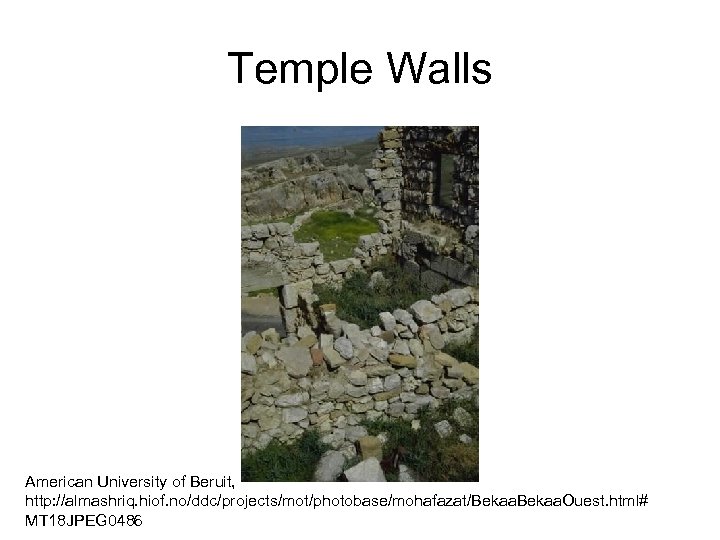 Temple Walls American University of Beruit, http: //almashriq. hiof. no/ddc/projects/mot/photobase/mohafazat/Bekaa. Ouest. html# MT 18 JPEG 0486
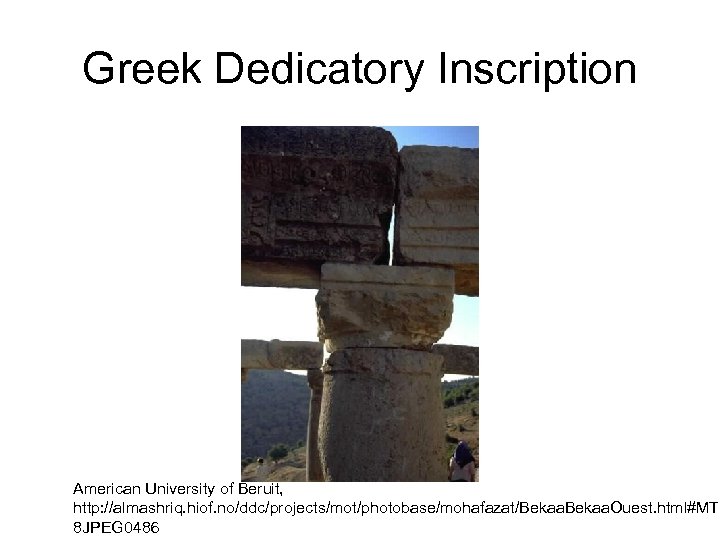 Greek Dedicatory Inscription American University of Beruit, http: //almashriq. hiof. no/ddc/projects/mot/photobase/mohafazat/Bekaa. Ouest. html#MT 1 8 JPEG 0486
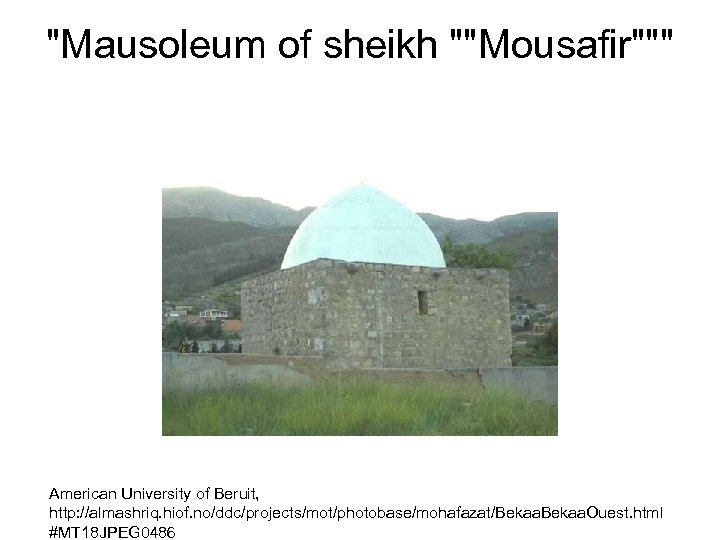 "Mausoleum of sheikh ""Mousafir""" American University of Beruit, http: //almashriq. hiof. no/ddc/projects/mot/photobase/mohafazat/Bekaa. Ouest. html #MT 18 JPEG 0486

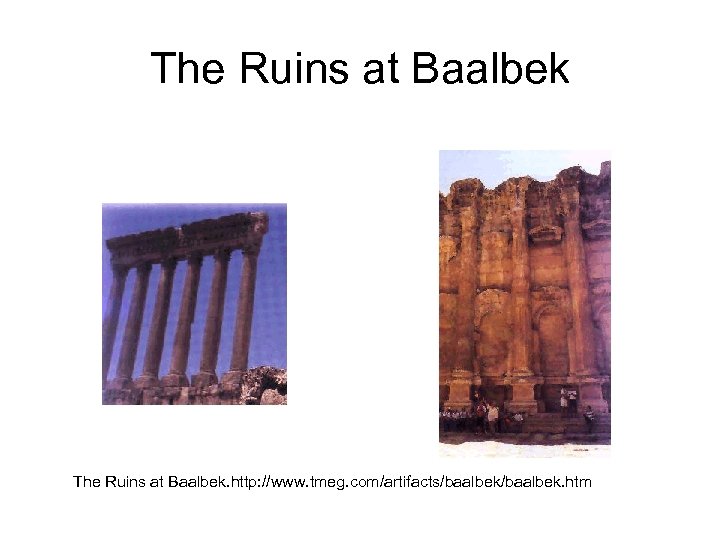 The Ruins at Baalbek. http: //www. tmeg. com/artifacts/baalbek. htm
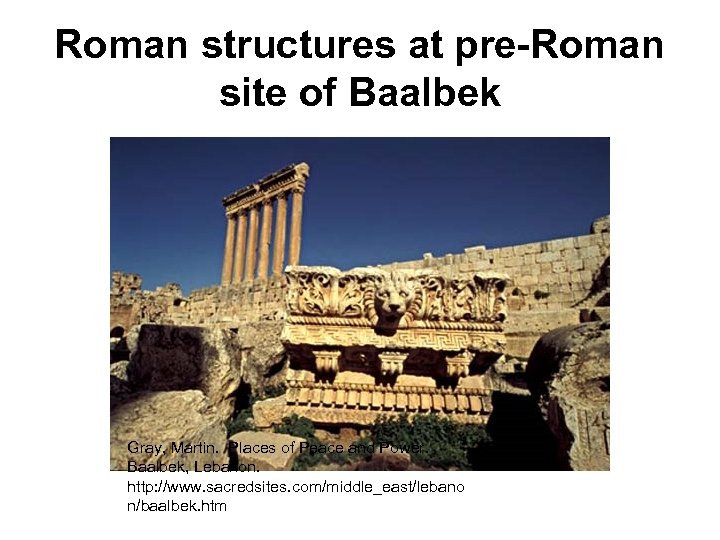
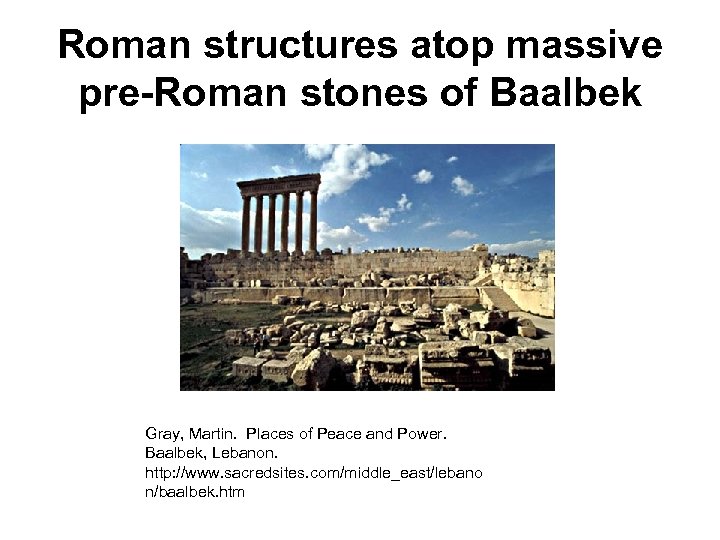
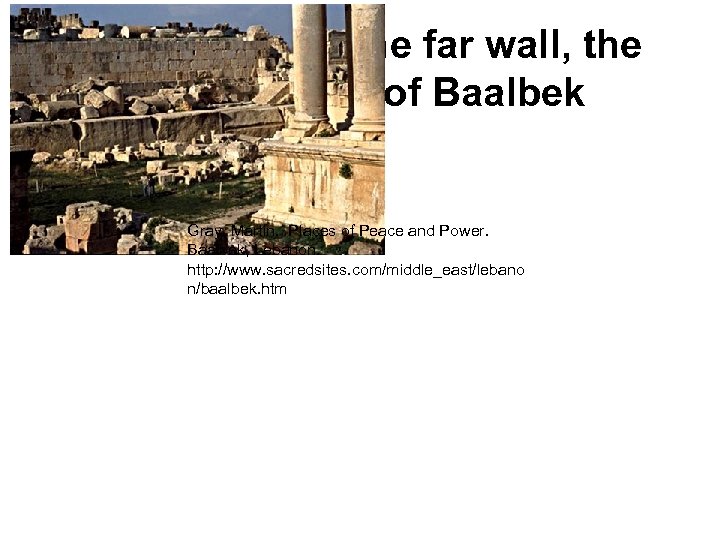
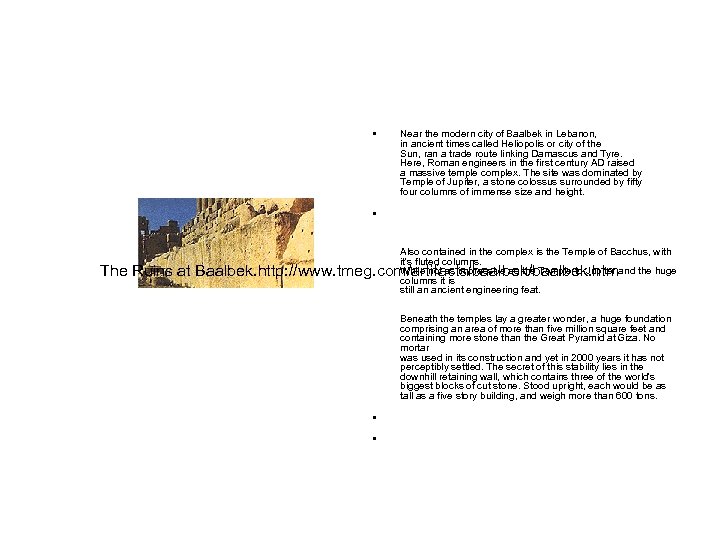 • • Near the modern city of Baalbek in Lebanon, in ancient times called Heliopolis or city of the Sun, ran a trade route linking Damascus and Tyre. Here, Roman engineers in the first century AD raised a massive temple complex. The site was dominated by Temple of Jupiter, a stone colossus surrounded by fifty four columns of immense size and height. Also contained in the complex is the Temple of Bacchus, with it's fluted columns. While not as impressive as the Temple to Jupiter and the huge columns it is still an ancient engineering feat. The Ruins at Baalbek. http: //www. tmeg. com/artifacts/baalbek. htm Beneath the temples lay a greater wonder, a huge foundation comprising an area of more than five million square feet and containing more stone than the Great Pyramid at Giza. No mortar was used in its construction and yet in 2000 years it has not perceptibly settled. The secret of this stability lies in the downhill retaining wall, which contains three of the world's biggest blocks of cut stone. Stood upright, each would be as tall as a five story building, and weigh more than 600 tons. • •
 The Ruins at Baakbek
 Roman structures at pre-Roman site of Baalbek Gray, Martin. Places of Peace and Power. Baalbek, Lebanon. http: //www. sacredsites. com/middle_east/lebano n/baalbek. htm
 Roman structures atop massive pre-Roman stones of Baalbek Gray, Martin. Places of Peace and Power. Baalbek, Lebanon. http: //www. sacredsites. com/middle_east/lebano n/baalbek. htm
 At the base of the far wall, the great stones of Baalbek Gray, Martin. Places of Peace and Power. Baalbek, Lebanon. http: //www. sacredsites. com/middle_east/lebano n/baalbek. htm
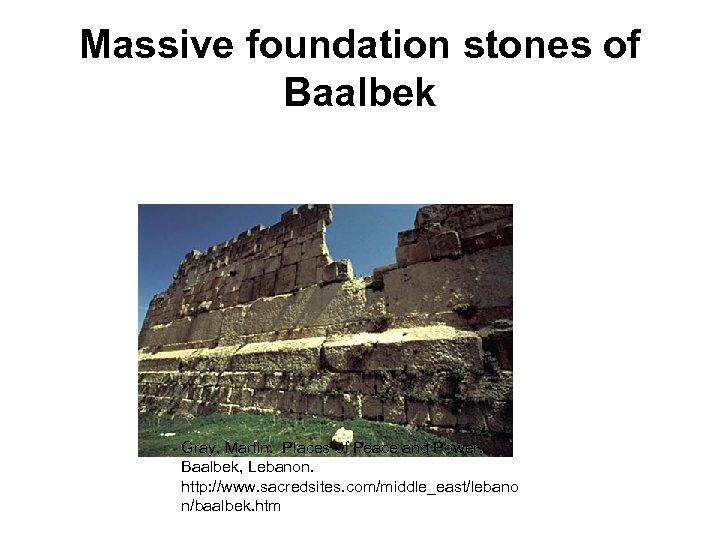 Massive foundation stones of Baalbek Gray, Martin. Places of Peace and Power. Baalbek, Lebanon. http: //www. sacredsites. com/middle_east/lebano n/baalbek. htm
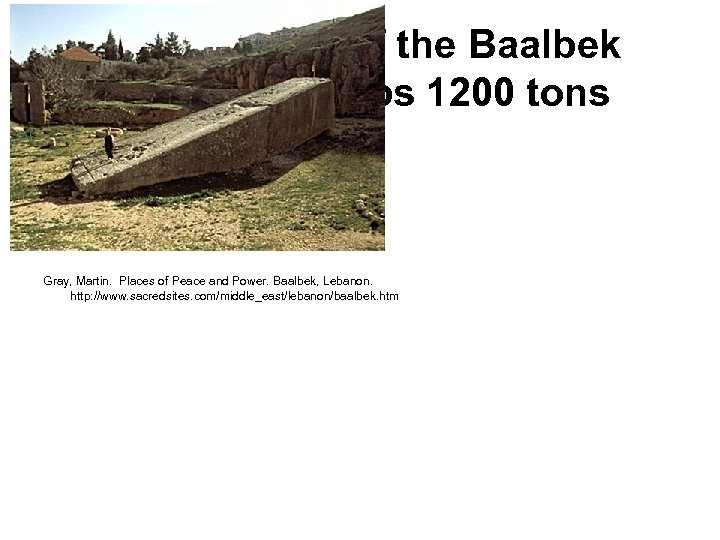 The greatest of the Baalbek stones, perhaps 1200 tons Gray, Martin. Places of Peace and Power. Baalbek, Lebanon. http: //www. sacredsites. com/middle_east/lebanon/baalbek. htm

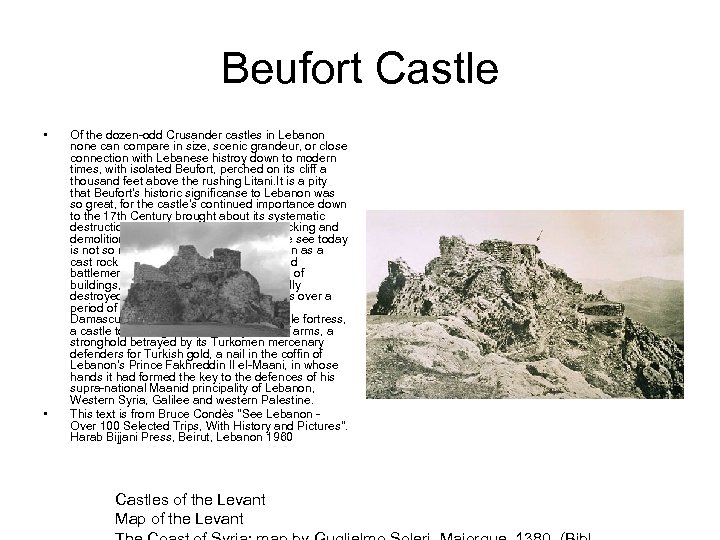 Beufort Castle • • Of the dozen odd Crusander castles in Lebanon none can compare in size, scenic grandeur, or close connection with Lebanese histroy down to modern times, with isolated Beufort, perched on its cliff a thousand feet above the rushing Litani. It is a pity that Beufort's historic significanse to Lebanon was so great, for the castle's continued importance down to the 17 th Century brought about its systematic destruction at the hands of an expert wrecking and demolition crew in the year 1615. What we see today is not so much a picturesque medieval ruin as a cast rock pile obscuring broken towers and battlements a perfectly defensless mass of buildings, mostly underground, scientifically destroyed by gunpower and wrecking bars over a period of 40 days by Turkish Pasha of Damascus. This was end of an impregnable fortress, a castle too strong to be taken by force of arms, a stronghold betrayed by its Turkomen mercenary defenders for Turkish gold, a nail in the coffin of Lebanon's Prince Fakhreddin II el Maani, in whose hands it had formed the key to the defences of his supra national Maanid principality of Lebanon, Western Syria, Galilee and western Palestine. This text is from Bruce Condès "See Lebanon Over 100 Selected Trips, With History and Pictures". Harab Bijjani Press, Beirut, Lebanon 1960 Castles of the Levant Map of the Levant
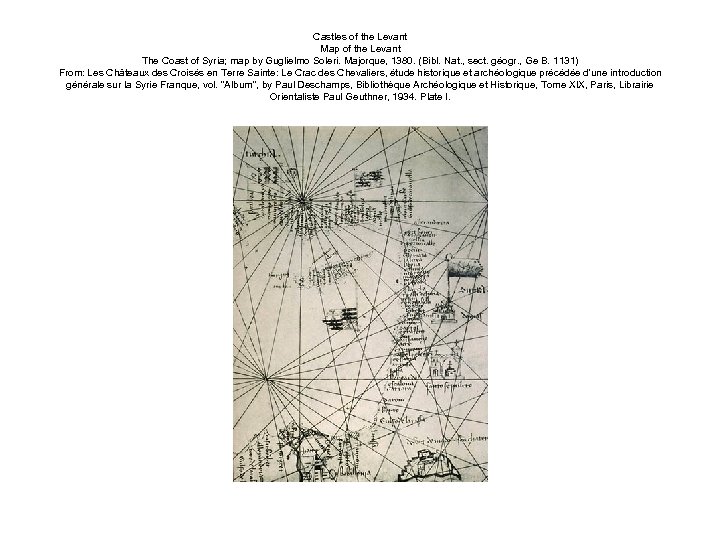 Castles of the Levant Map of the Levant The Coast of Syria; map by Guglielmo Soleri. Majorque, 1380. (Bibl. Nat. , sect. géogr. , Ge B. 1131) From: Les Châteaux des Croisés en Terre Sainte: Le Crac des Chevaliers, étude historique et archéologique précédée d'une introduction générale sur la Syrie Franque, vol. "Album", by Paul Deschamps, Bibliothèque Archéologique et Historique, Tome XIX, Paris, Librairie Orientaliste Paul Geuthner, 1934. Plate I.
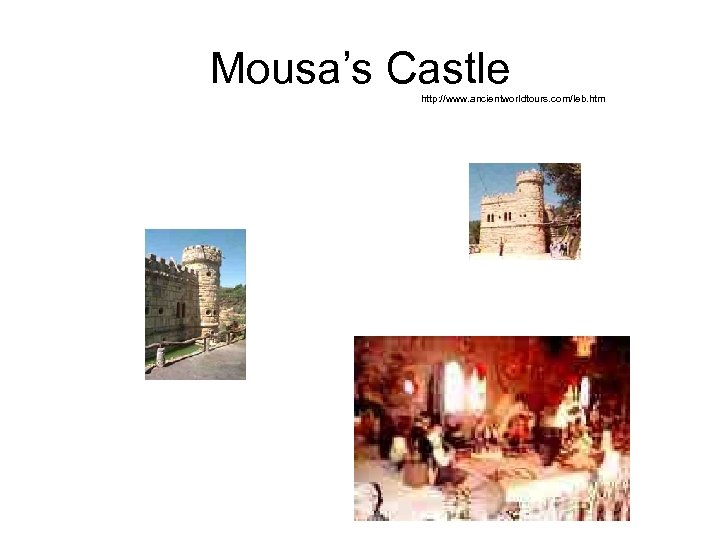 Mousa’s Castle http: //www. ancientworldtours. com/leb. htm
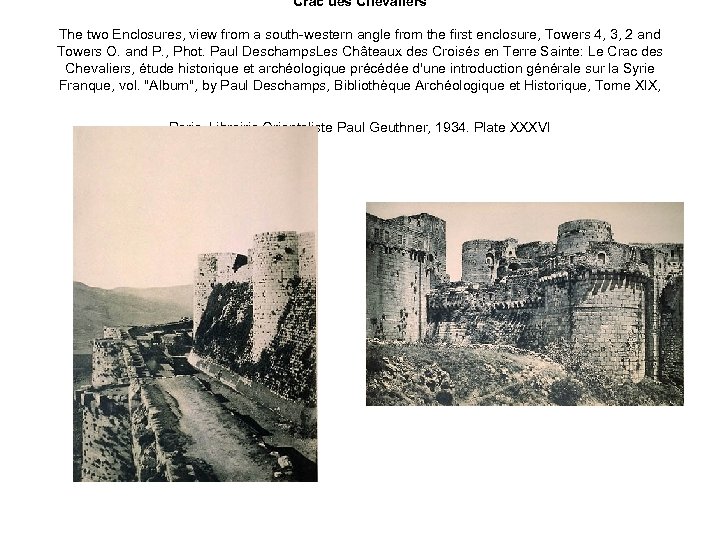 Crac des Chevaliers The two Enclosures, view from a south western angle from the first enclosure, Towers 4, 3, 2 and Towers O. and P. , Phot. Paul Deschamps. Les Châteaux des Croisés en Terre Sainte: Le Crac des Chevaliers, étude historique et archéologique précédée d'une introduction générale sur la Syrie Franque, vol. "Album", by Paul Deschamps, Bibliothèque Archéologique et Historique, Tome XIX, Paris, Librairie Orientaliste Paul Geuthner, 1934. Plate XXXVI
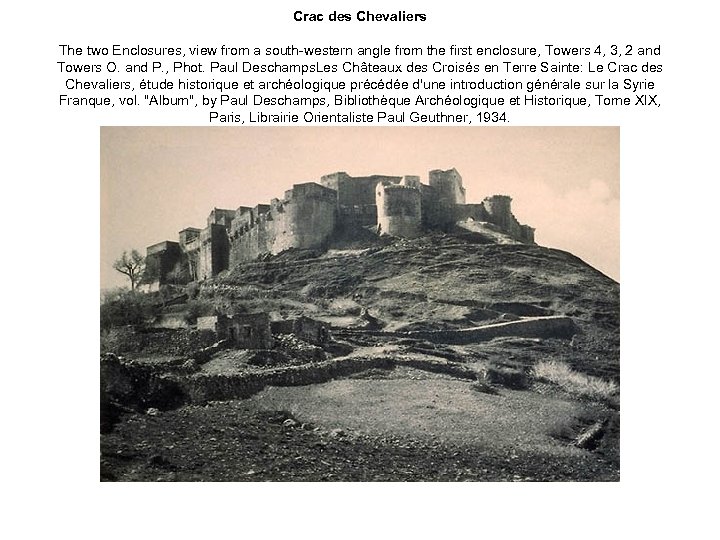 Crac des Chevaliers The two Enclosures, view from a south western angle from the first enclosure, Towers 4, 3, 2 and Towers O. and P. , Phot. Paul Deschamps. Les Châteaux des Croisés en Terre Sainte: Le Crac des Chevaliers, étude historique et archéologique précédée d'une introduction générale sur la Syrie Franque, vol. "Album", by Paul Deschamps, Bibliothèque Archéologique et Historique, Tome XIX, Paris, Librairie Orientaliste Paul Geuthner, 1934.
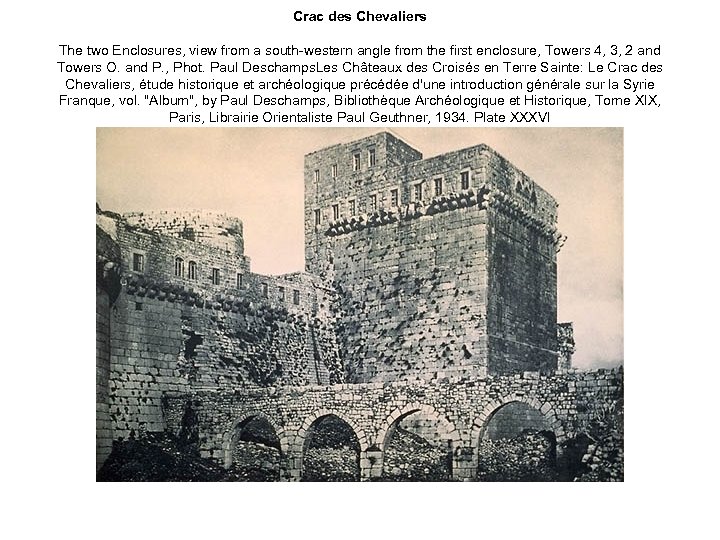 Crac des Chevaliers The two Enclosures, view from a south western angle from the first enclosure, Towers 4, 3, 2 and Towers O. and P. , Phot. Paul Deschamps. Les Châteaux des Croisés en Terre Sainte: Le Crac des Chevaliers, étude historique et archéologique précédée d'une introduction générale sur la Syrie Franque, vol. "Album", by Paul Deschamps, Bibliothèque Archéologique et Historique, Tome XIX, Paris, Librairie Orientaliste Paul Geuthner, 1934. Plate XXXVI
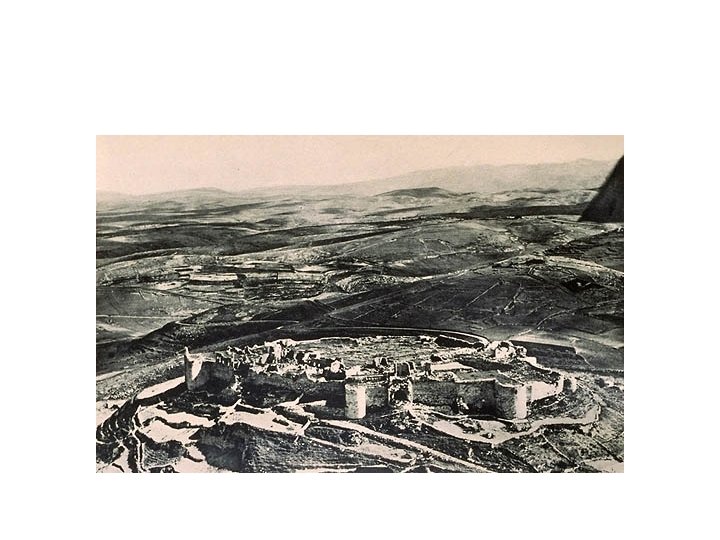
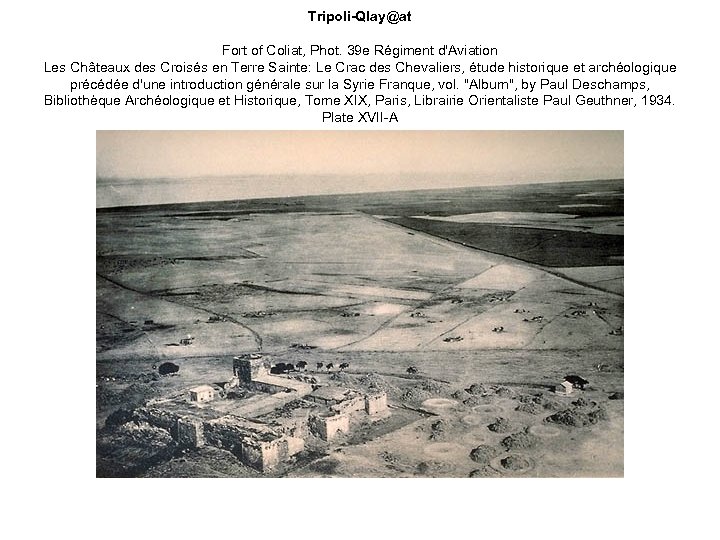 Tripoli-Qlay@at Fort of Coliat, Phot. 39 e Régiment d'Aviation Les Châteaux des Croisés en Terre Sainte: Le Crac des Chevaliers, étude historique et archéologique précédée d'une introduction générale sur la Syrie Franque, vol. "Album", by Paul Deschamps, Bibliothèque Archéologique et Historique, Tome XIX, Paris, Librairie Orientaliste Paul Geuthner, 1934. Plate XVII A
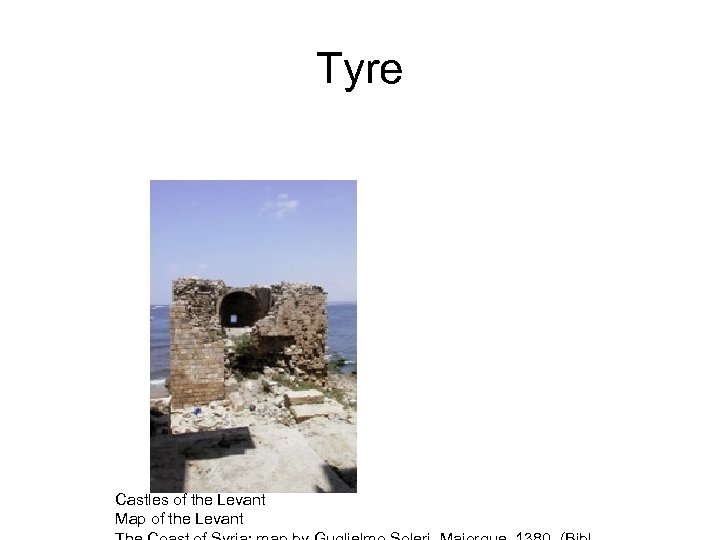 Tyre Castles of the Levant Map of the Levant