


 Скачать презентацию MERRELL K W ERVIN R A
e92a16db1ffd71a5df4a723f5e94f2fd.ppt
- Количество слайдов: 16
 MERRELL, K. W. , ERVIN, R. A. , & PEACOCK, G. G. (2006). SCHOOL PSYCHOLOGY FOR THE 21 ST CENTURY: FOUNDATIONS AND PRACTICES. Chapters 10 and 11
 School psychology for the 21 st century: Foundations and practices. Chapter 10: The School Psychologist’s Role in Prevention and Intervention Part 2: Mental Health and Social-Emotional Behavior
 Mental Health Services Only 20% of students who need mental health services. 70 -80% of those get them within the schools 16%-22% of children have dx disorder 4% -8% with significant issues ~12% of children receive SPED services Services fall within three categories Psychiatric disorders Problem and at-risk behaviors Delinquency
 ADHD Data ADHD Percents (more disorder than ADHD) 44% have one 33% have two 10% have three Types of Comorbidity Conduct Disorder Anxiety Disorder Academic problems 50% with ADHD are in SPED Early intervention with ADHD decreases comorbidity
 Psychostimulants for Tx of ADHD Effective in most children with ADHD Medication alone is useful. Therapy alone is useful. Together = best. Side effects: Delayed onset of sleep Headaches Stomachaches Anxiety Withdrawal Tics
 Diagnostics Diagnoses: “constellations of covarying behaviors that can help to inform the “what” of behavior. ” Can provide a quick description of the problem. Examines: common etiology, mechanism, or function Organize our thinking on the problem Can (not always) link dx to tx through research-based methods (Evidence Based Practice) Do NOT get stuck in thinking that the problem you are seeing is completely tied to the dx. Child can have two separate problems Child can have different reactions to a problem Problem may be antecedent but some other consequence is sustaining the behavior. (A-B-C)
 Problem Solving Model What is the problem? Did it work? Why is it occurring? What should be done about it?
 Prevention Models Primary (universal supports) Secondary (targeted supports “at-risk”) Tertiary (already experiencing problems) Data driven When prevention doesn’t happen 1% - 5%: Children with severe behavior problems 50%: Office referrals from severe behavior problems
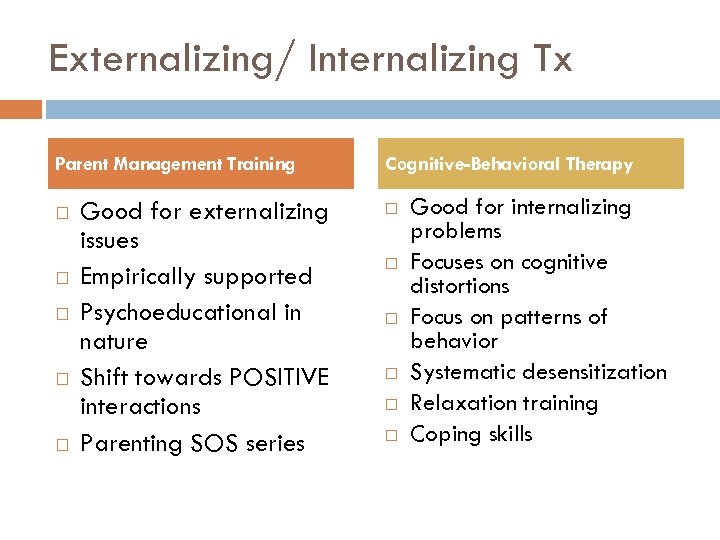 Externalizing/ Internalizing Tx Parent Management Training Good for externalizing issues Empirically supported Psychoeducational in nature Shift towards POSITIVE interactions Parenting SOS series Cognitive-Behavioral Therapy Good for internalizing problems Focuses on cognitive distortions Focus on patterns of behavior Systematic desensitization Relaxation training Coping skills
 School Psychologists Need to Be: Aware of the nature, scope, complexity, and developmental trajectories of student mental health and social-emotional issues that point to the need for early detection, primary prevention, and intervention. Knowledgeable about evidence-based treatments for addressing these concerns. Prepared to interact with professionals from medicine, clinical psychology, and community care to ensure access to treatment. Experts in the application of a data-oriented problemsolving approach to management of primary, secondary, and tertiary intervention efforts.
 School psychology for the 21 st century: Foundations and practices. Chapter 11: The School Psychologist’s Role in Facilitating Systems Change
 The School Context Technology advances and changing dynamics of the workforce. Increased heterogeneity of the student population and increased number, severity, and complexity of student needs The push for evidence-based practices and increased accountability despite diminishing resources. Change as a unifying feature of the challenges facing school systems.
 Skills for Systems Change Understanding human behavior from a social systems perspective. Ability to use collaborative planning and problemsolving procedures. Familiarity with principles for organization change Problem-solving and planning cycles of a school from an organizational perspective. The characteristics of an operating school district from a systemic perspective. The steps in a strategic planning process.
 Systems-Change Theory “Two or more individuals whose interaction is intended to produce a desired outcome. ” Rules of System: When one part changes, it effects change in other parts. Learn how the different parts of the system work together. Identify who the “change agents” are in the system Focus: Teaching skills needed Building the capacity for systems to adopt new skills
 Steps to Systems Change Catalyst for change Target visible problems Establishing a coalition of groups Staffing the campaign Assemble the right information Launch the campaign Steps to Systems Change Creating readiness Vision and leadership Identify the problem Getting stakeholder buyin Infrastructure Redesign Initial implementation Institutionalization Ongoing evolution
 Discussion: Page 239 #4 Read question #4 on Page 239 of your textbook for this chapter. Feel free to discuss this topic on the Blackboard forum.