


 Скачать презентацию MERGERS AND ACQUISITIONS http www investopedia com university mergers
Mergers and acquisitions.pptx
- Количество слайдов: 47
 MERGERS AND ACQUISITIONS http: //www. investopedia. com/university/mergers/
 Defining M&A One plus one makes three: this equation is the special alchemy of a merger or an acquisition. The key principle behind buying a company is to create shareholder value over and above that of the sum of the two companies. Two companies together are more valuable than two separate companies - at least, that's the reasoning behind M&A. This rationale is particularly alluring to companies when times are tough. Strong companies will act to buy other companies to create a more competitive,
 Distinction between Mergers and Acquisitions Although they are often uttered in the same breath and used as though they were synonymous, the terms merger and acquisition mean slightly different things. When one company takes over another and clearly established itself as the new owner, the purchase is called an acquisition. From a legal point of view, the target company ceases to exist, the buyer "swallows" the business and the buyer's stock continues to be traded. In the pure sense of the term, a merger happens when two firms, often of about the same size, agree to go forward as a single new company rather than remain separately owned and operated. This kind of action is more precisely referred to as a "merger of equals. " Both companies' stocks are surrendered and new company stock is issued in its place. For example, both Daimler-Benz and Chrysler ceased to exist when the two firms merged, and a new company, Daimler. Chrysler, was created.
 Merger “is” and “isn’t” In practice, however, actual mergers of equals don't happen very often. Usually, one company will buy another and, as part of the deal's terms, simply allow the acquired firm to proclaim that the action is a merger of equals, even if it's technically an acquisition. Being bought out often carries negative connotations, therefore, by describing the deal as a merger, deal makers and top managers try to make the takeover more palatable. . A purchase deal will also be called a merger when both CEOs agree that joining together is in the best interest of both of their companies. But when the deal is unfriendly - that is, when the target company does not want to be purchased – it is always regarded as an acquisition. Whether a purchase is considered a merger or an acquisition really depends on whether the purchase is friendly or hostile and how it is announced. In other words, the real difference lies in how the purchase is communicated to and received by the target company's board of directors, employees and shareholders.
 Synergy may be in…. • Staff reductions - Mergers tend to mean job losses. Money is saved from reducing the number of staff members from accounting, marketing and other departments, including former CEO, who leaves with a compensation package. • Economies of scale. Whether it's purchasing stationery or a new corporate IT system, a bigger company placing the orders can save more on costs. Mergers also translate into improved purchasing power to buy equipment or office
 . . or. . • Acquiring new technology - To stay competitive, companies need to stay on top of technological developments and their business applications. By buying a smaller company with unique technologies, a large company can maintain or develop a competitive edge. • Improved market reach and industry visibility - Companies buy companies to reach new markets and grow revenues and earnings. A merge may expand two companies' marketing and distribution, giving them new sales opportunities. A merger can also improve a company's standing in the investment community: bigger firms often have an easier time raising capital than smaller ones.
 Varieties of Mergers From the perspective of business structures, there is a whole host of different mergers. Here a few types, distinguished by the relationship between the two companies that are merging: • Horizontal merger - Two companies that are in direct competition and share the same product lines and markets. • Vertical merger - A customer and company or a supplier and company. Think of a cone supplier merging with an ice cream maker. • Market-extension merger - Two companies that sell the same products in different markets. • Product-extension merger - Two companies selling different but related products in the same market. • Conglomeration - Two companies that have no common business areas.
 Merger types There are two types of mergers that are distinguished by how the merger is financed. Each has certain implications for the companies involved and for investors: • Purchase Mergers - As the name suggests, this kind of merger occurs when one company purchases another. The purchase is made with cash or through the issue of some kind of debt instrument; the sale is taxable. Acquiring companies often prefer this type of merger because it can provide them with a tax benefit. Acquired assets can be writtenup to the actual purchase price, and the difference between the book value and the purchase price of the assets can depreciate annually, reducing taxes payable by the acquiring company. • Consolidation Mergers - With this merger, a brand new company is formed and both companies are bought and combined under the new entity. The tax terms are the same as those of a purchase merger.
 Acquisitions Unlike all mergers, all acquisitions involve one firm purchasing another - there is no exchange of stock or consolidation as a new company. Acquisitions are often congenial, and all parties feel satisfied with the deal. Other times, acquisitions are more hostile. In an acquisition, as in some of the merger deals we discuss above, a company can buy another company with cash, stock or a combination of the two. Another possibility, which is common in smaller deals, is for one company to
 Reverse merger Another type of acquisition is a reverse merger, a deal that enables a private company to get publiclylisted in a relatively short time period. A reverse merger occurs when a private company that has strong prospects and is eager to raise financing buys a publicly-listed shell company, usually one with no business and limited assets. The private company reverse merges into the public company, and together they become an entirely new public corporation with tradable shares.
 Comparative ratios The following are two examples of the many comparative metrics on which acquiring companies may base their offers: • Price-Earnings Ratio (P/E Ratio) - With the use of this ratio, an acquiring company makes an offer that is a multiple of the earnings of the target company. Looking at the P/E for all the stocks within the same industry group will give the acquiring company good guidance for what the target's P/E multiple should be. • Enterprise-Value-to-Sales Ratio (EV/Sales) - With this ratio, the acquiring company makes an offer as a multiple of the revenues, again, while being aware of the price-to-sales ratio of other companies in the industry.
 Replacement cost In a few cases, acquisitions are based on the cost of replacing the target company. For simplicity's sake, suppose the value of a company is simply the sum of all its equipment and staffing costs. The acquiring company can literally order the target to sell at that price, or it will create a competitor for the same cost. Naturally, it takes a long time to assemble good management, acquire property and get the right equipment. This method of establishing a price certainly wouldn't make much sense in a service industry where the key assets - people and ideas - are hard to value and develop.
 Replacement cost In a few cases, acquisitions are based on the cost of replacing the target company. For simplicity's sake, suppose the value of a company is simply the sum of all its equipment and staffing costs. The acquiring company can literally order the target to sell at that price, or it will create a competitor for the same cost. Naturally, it takes a long time to assemble good management, acquire property and get the right equipment. This method of establishing a price certainly wouldn't make much sense in a service industry where the key assets - people and ideas - are hard to value and develop.
 Replacement cost In a few cases, acquisitions are based on the cost of replacing the target company. For simplicity's sake, suppose the value of a company is simply the sum of all its equipment and staffing costs. The acquiring company can literally order the target to sell at that price, or it will create a competitor for the same cost. Naturally, it takes a long time to assemble good management, acquire property and get the right equipment. This method of establishing a price certainly wouldn't make much sense in a service industry where the key assets - people and ideas - are hard to value and develop.
 Replacement cost In a few cases, acquisitions are based on the cost of replacing the target company. For simplicity's sake, suppose the value of a company is simply the sum of all its equipment and staffing costs. The acquiring company can literally order the target to sell at that price, or it will create a competitor for the same cost. Naturally, it takes a long time to assemble good management, acquire property and get the right equipment. This method of establishing a price certainly wouldn't make much sense in a service industry where the key assets - people and ideas - are hard to value and develop.
 Discounted Cash Flow (DCF) A key valuation tool in M&A, discounted cash flow analysis determines a company's current value according to its estimated future cash flows. Forecasted free cash flows (operating profit + depreciation + amortization of goodwill – capital expenditures – cash taxes - change in working capital) are discounted to a present value using the company's weighted average costs of capital (WACC). Admittedly, DCF is tricky to get right, but few tools can rival this valuation method.
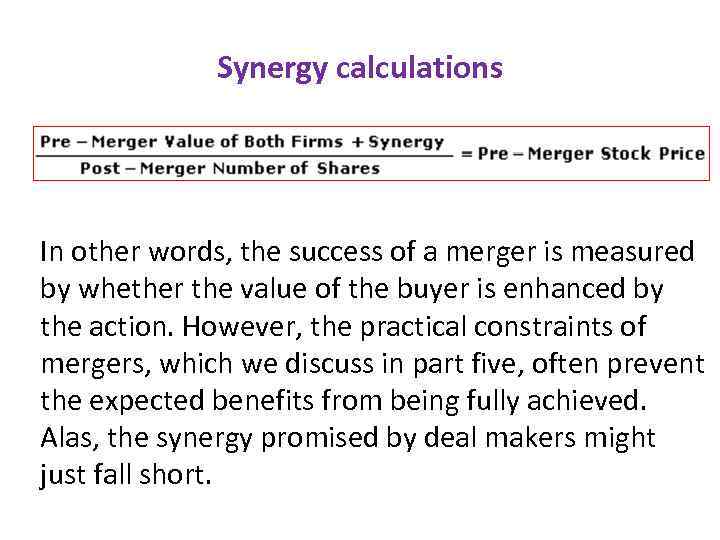 Synergy calculations In other words, the success of a merger is measured by whether the value of the buyer is enhanced by the action. However, the practical constraints of mergers, which we discuss in part five, often prevent the expected benefits from being fully achieved. Alas, the synergy promised by deal makers might just fall short.
 What 2 look 4 • A reasonable purchase price - A premium of, say, 10% above the market price seems within the bounds of level-headedness. A premium of 50%, on the other hand, requires synergy of stellar proportions for the deal to make sense. Stay away from companies that participate in such contests. • Cash transactions - Companies that pay in cash tend to be more careful when calculating bids and valuations come closer to target. When stock is used as the currency for acquisition, discipline can go by the wayside. • Sensible appetite – An acquiring company should be targeting a company that is smaller and in businesses that the acquiring company knows intimately. Synergy is hard to create from companies in disparate business areas. Sadly, companies have a bad habit of biting off more than they can chew in mergers.
 Starting offer When the CEO and top managers of a company decide that they want to do a merger or acquisition, they start with a tender offer. The process typically begins with the acquiring company carefully and discreetly buying up shares in the target company, or building a position. Once the acquiring company starts to purchase shares in the open market, it is restricted to buying 5% of the total outstanding shares before it must file with the SEC. In the filing, the company must formally declare how many shares it owns and whether it intends to buy the company or keep the shares purely as an investment. Working with financial advisors and investment bankers, the acquiring company will arrive at an overall price that it's willing to pay for its target in cash, shares or both. The tender offer is then frequently advertised in the business press, stating the offer price and the deadline by which the shareholders in the target company must accept (or reject) it.
 Counter. Strike • Accept the Terms of the Offer • Attempt to Negotiate - The tender offer price may not be high enough for the target company's shareholders to accept, or the specific terms of the deal may not be attractive. In a merger, there may be much at stake for the management of the target - their jobs, in particular. If they're not satisfied with the terms laid out in the tender offer, the target's management may try to work out more agreeable terms that let them keep their jobs or, even better, send them off with a nice, big compensation package. Not surprisingly, highly sought-after target companies that are the object of several bidders will have greater latitude for negotiation. Furthermore, managers have more negotiating power if they can show that they are crucial to the merger's future success.
 Not so fast…. • Execute a Poison Pill or Some Other Hostile Takeover Defense – A poison pill scheme can be triggered by a target company when a hostile suitor acquires a predetermined percentage of company stock. To execute its defense, the target company grants all shareholders - except the acquiring company - options to buy additional stock at a dramatic discount. This dilutes the acquiring company's share and intercepts its control of the company. • Find a White Knight - As an alternative, the target company's management may seek out a friendlier potential acquiring company, or white knight. If a white knight is found, it will offer an equal or higher price for the shares than the hostile bidder.
 Demergers (Break-ups) As mergers capture the imagination of many investors and companies, the idea of getting smaller might seem counterintuitive. But corporate break-ups, or demergers, can be very attractive options for companies and their shareholders.
 Advantages The rationale behind a spinoff, tracking stock or carve-out is that "the parts are greater than the whole. " These corporate restructuring techniques, which involve the separation of a business unit or subsidiary from the parent, can help a company raise additional equity funds. A break-up can also boost a company's valuation by providing powerful incentives to the people who work in the separating unit, and help the parent's management to focus on core operations. Most importantly, shareholders get better information about the business unit because it issues separate financial statements. This is particularly useful when a company's traditional line of business differs from the separated business unit. With separate financial disclosure, investors are better equipped to gauge the value of the parent corporation. The parent company might attract more investors and, ultimately, more capital.
 Advantages (cont’d) Also, separating a subsidiary from its parent can reduce internal competition for corporate funds. For investors, that's great news: it curbs the kind of negative internal wrangling that can compromise the unity and productivity of a company. For employees of the new separate entity, there is a publicly traded stock to motivate and reward them. Stock options in the parent often provide little incentive to subsidiary managers, especially because their efforts are buried in the firm's overall performance.
 Disadvantages De-merged firms are likely to be substantially smaller than their parents, possibly making it harder to tap credit markets and costlier finance that may be affordable only for larger companies. And the smaller size of the firm may mean it has less representation on major indexes, making it more difficult to attract interest from institutional investors. Meanwhile, there are the extra costs that the parts of the business face if separated. When a firm divides itself into smaller units, it may be losing the synergy that it had as a larger entity. For instance, the division of expenses such as marketing, administration and research and development (R&D) into different business units may cause redundant costs without increasing overall revenues because it issues separate financial statements. This is particularly useful when a company's traditional line of business differs from the separated business unit.
 Disadvantages (cont’d) With separate financial disclosure, investors are better equipped to gauge the value of the parent corporation. The parent company might attract more investors and, ultimately, more capital. Also, separating a subsidiary from its parent can reduce internal competition for corporate funds. For investors, that's great news: it curbs the kind of negative internal wrangling that can compromise the unity and productivity of a company. For employees of the new separate entity, there is a publicly traded stock to motivate and reward them. Stock options in the parent often provide little incentive to subsidiary managers, especially because their efforts are buried in the firm's overall performance.
 Restructuring Methods There are several restructuring methods: • doing an outright sell-off, • doing an equity carve-out, • spinning off a unit to existing shareholders • issuing tracking stock. Each has advantages and disadvantages for companies and investors. All of these deals are quite complex.
 Sell-Offs A sell-off, also known as a divestiture, is the outright sale of a company subsidiary. Normally, sell-offs are done because the subsidiary doesn't fit into the parent company's core strategy. The market may be undervaluing the combined businesses due to a lack of synergy between the parent and subsidiary. As a result, management and the board decide that the subsidiary is better off under different ownership. Besides getting rid of an unwanted subsidiary, sell-offs also raise cash, which can be used to pay off debt. In the late 1980 s and early 1990 s, corporate raiders would use debt to finance acquisitions. Then, after making a purchase they would sell-off its subsidiaries to raise cash to service the debt. The raiders‘ method certainly makes sense if the sum of the parts is greater than the whole. When it isn't, deals are unsuccessful.
 Equity Carve-Outs More and more companies are using equity carve-outs to boost shareholder value. A parent firm makes a subsidiary public through an initial public offering (IPO) of shares, amounting to a partial selloff. A new publicly-listed company is created, but the parent keeps a controlling stake in the newly traded subsidiary. A carve-out is a strategic avenue a parent firm may take when one of its subsidiaries is growing faster and carrying higher valuations than other businesses owned by the parent. A carve-out generates cash because shares in the subsidiary are sold to the public, but the issue also unlocks the value of the subsidiary unit and enhances the parent's shareholder value.
 Carve-out governance The new legal entity of a carve-out has a separate board, but in most carveouts, the parent retains some control. In these cases, some portion of the parent firm's board of directors may be shared. Since the parent has a controlling stake, meaning both firms have common shareholders, the connection between the two will likely be strong.
 Warnings That said, sometimes companies carve-out a subsidiary not because it's doing well, but because it is a burden. Such an intention won't lead to a successful result, especially if a carved-out subsidiary is too loaded with debt, or had trouble even when it was a part of the parent and is lacking an established track record for growing revenues and profits. Carve-outs can also create unexpected friction between the parent and subsidiary. Problems can arise as managers of the carved-out company must be accountable to their public shareholders as well as the owners of the parent company. This can create divided loyalties.
 Spinoffs A spinoff occurs when a subsidiary becomes an independent entity. The parent firm distributes shares of the subsidiary to its shareholders through a stock dividend. Since this transaction is a dividend distribution, no cash is generated. Thus, spinoffs are unlikely to be used when a firm needs to finance growth or deals. Like the carve-out, the subsidiary becomes a separate legal entity with a distinct management and board.
 More spinoffs Like carve-outs, spinoffs are usually about separating a healthy operation. In most cases, spinoffs unlock hidden shareholder value. For the parent company, it sharpens management focus. For the spinoff company, management doesn't have to compete for the parent's attention and capital. Once they are set free, managers can explore new opportunities. Investors, however, should beware of throw-away subsidiaries the parent created to separate legal liability or to offload debt. Once spinoff shares are issued to parent company shareholders, some shareholders may be tempted to quickly dump these shares on the market, depressing the share valuation.
 Tracking Stock A tracking stock is a special type of stock issued by a publicly held company to track the value of one segment of that company. The stock allows the different segments of the company to be valued differently by investors. Let's say a slow-growth company trading at a low price-earnings ratio (P/E ratio) happens to have a fast growing business unit. The company might issue a tracking stock so the market can value the new business separately from the old one and at a significantly higher P/E rating.
 Tracking stock cont’d Why would a firm issue a tracking stock rather than spinning-off or carving-out its fast growth business for shareholders? The company retains control over the subsidiary; the two businesses can continue to enjoy synergies and share marketing, administrative support functions, a headquarters and so on. Finally, and most importantly, if the tracking stock climbs in value, the parent company can use the tracking stock it owns to make acquisitions. Still, shareholders need to remember that tracking stocks are class B, meaning they don't grant shareholders the same voting rights as those of the main stock. Each share of tracking stock may have only a half or a quarter of a vote. In rare cases, holders of tracking stock have no vote at all.
 Conclusions • • A merger can happen when two companies decide to combine into one entity or when one company buys another. An acquisition always involves the purchase of one company by another. The functions of synergy allow for the enhanced cost efficiency of a new entity made from two smaller ones - synergy is the logic behind mergers and acquisitions. Acquiring companies use various methods to value their targets. Some of these methods are based on comparative ratios - such as the P/E and P/S ratios - replacement cost or discounted cash flow analysis. An M&A deal can be executed by means of a cash transaction, stock-for-stock transaction or a combination of both. A transaction struck with stock is not taxable. Break up or de-merger strategies can provide companies with opportunities to raise additional equity funds, unlock hidden shareholder value and sharpen management focus. De-mergers can occur by means of divestitures, carve-outs spinoffs or tracking stocks. Mergers can fail for many reasons including a lack of management foresight, the inability to overcome practical challenges and loss of revenue momentum from a neglect of day-to-day operations.
 MERGERS: GOOD…. BAD… UGLY http: //www. rasmussen. edu/degrees/business/blog/best-and-worst-corporate-mergers/
 Disney-Pixar Mickey and Nemo. Pinocchio and “Toy Story. ” Cinderella and “Cars. ” The merger of legendary Walt Disney and everything-we-create-kids-adore Pixar was a match made in cartoon heaven. Disney had released all of Pixar’s movies before, but with their contract about to run out after the release of “Cars, ” the merger made perfect sense. With the merger, the two companies could collaborate freely and easily. Did the merger work? Well, take a look at the successful movies that Disney and Pixar have put out since: “WALL-E, ” “Up, ” and “Bolt. ” Pixar has plans for twice-yearly films, unthinkable before the merger, and has certainly gained the expert advice from Disney when it comes to advertising, marketing plugs, and merchandising. When it comes to marketing to children, no one does it better than Disney. Even pre-merger cartoon “Cars” got the Disney treatment and remains a top seller in merchandising amongst 4 year old boys (just ask my nephew).
 Sirius/XM radio merger On July 29, 2008, satellite radio officially had one provider when Sirius Satellite Radio joined forces with rival XM Satellite Radio. The merger was officially announced over a year before, in February 2007, but the actual merger was delayed due to one tiny problem – when satellite radio first began in 1997, the FCC granted only two licenses under one condition: that either of the holders would not acquire control of the other. Oops. So Sirius and XM filed the proper paperwork with the FCC, allowed the FCC to investigate the merger, and waited patiently for the approval they needed. And although time will tell if the new Sirius XM company will succeed in the long-run, I consider this merger a success due to the number of big names recently added to their roster (Oprah, Howard Stern, Martha Stewart), as well having the foresight to combine forces in a down market.
 Exxon-Mobil Big oil got even bigger in 1999, when Exxon and Mobil signed a $81 billion agreement to merge and form Exxon Mobil. Not only did Exxon Mobil become the largest company in the world, it reunited its 19 th century former selves, John D. Rockefeller’s Standard Oil Company of New Jersey (Exxon) and Standard Oil Company of New York (Mobil). The merger was so big, in fact, that the FTC required a massive restructuring of many of Exxon & Mobil’s gas stations, in order to avoid outright monopolization (despite the FTC’s 4 -0 approval of the merger). Exxon. Mobil remains the strongest leader in the oil market, with a huge hold on the international market and dramatic earnings. In 2008, Exxon. Mobil occupied all ten spots in the “Top Ten Corporate Quarterly Earnings” (earning more than $11 billion in one quarter) and it remains one of the world’s largest publicly held company (second only to Walmart).
 New York Central and Pennsylvania Railroad Merger failures didn’t exist in just the past few decades. In 1968, the New York Central and Pennsylvania railroads merged to become to the 6 th largest corporation (at the time) in America, Penn Central. Yet two years later, they filed for bankruptcy protection. The merger seemed right on paper, but these railroads were actually century-old rivals, desperately trying to avoid the trend towards cars and airplanes and away from trains. But these trends continuing anyways and the railroads found themselves unable to keep up with the rising costs of employees, government regulations, and facing major cost-cutting. Others also claim a lack of long-term planning, culture clashes between the two railroads, and poor management. Sometimes, rivals just can’t get along, even in the face of mutual crisis.
 Daimler Benz/Chrysler ($37 B) In 1998, Mercedes-Benz manufacturer Daimler Benz merged with U. S. auto maker Chrysler to create Daimler Chrysler for $37 billion. The logic was obvious: create a trans-Atlantic car-making powerhouse that would dominate the markets. But by 2007, Daimler Benz sold Chrysler to the Cerberus Capital Management firm, which specializes in restructuring troubled companies, for a mere $7 billion. What happened? It may be another case of corporate culture clash. Chrysler was nowhere near the league of high-end Daimler Benz, and many felt that Daimler strutted in and tried to tell the Chrysler side how things are done. Such clashes always work to undermine the new alliance; combine that with dragging sales and a recession, and you have a recipe for corporate divorce.
 Mattel/The Learning Company ($3. 5 B) Mattel has remained a childhood staple for decades, and in 1999, it attempted to tap into the educational software market by scooping up almost-bankrupt The Learning Company (creators of great learning-is-fun games like Carmen Sandiego & Myst). Less than a year later, The Learning Company lost $206 million, taking down Mattel’s profit with it. By 2000, Mattel was losing $1. 5 million a day and its stock prices kept dropping. The Learning Company was sold by the end of 2000, but Mattel was forced to lay off 10% of its employees in order to cut costs.
 Sears / Kmart Towards the end of the twentieth century, department store legend Sears found itself slowly failing, stuck in between the success of low-end big-box stores like Target and Walmart, and high-end department stores like Saks Fifth Avenue. Hedge-fund investor Eddie Lampert purchased both a failing Sears and Kmart in 2005, and merged them to become Sears Holdings. However, Sears Holdings continued the downward spiral of both companies. Some blame their focus on “soft goods” (clothes and home goods) rather than hard goods (Kenmore appliances and tools). Others think Sears tried to compete with mega giant Walmart with a variety of stores - Sears Essentials, for instance – that were utter failures. In any case, by 2007, Lampert was named the America’s Worst CEO, and Sears Holdings remains on the brink of utter failure, especially in light of the recent recession.
 Sprint/Nextel In 2005, another major communication merger occurred, this time between Sprint and Nextel Communications. These two companies believed that merging opposite ends of a market’s spectrum – personal cell phones and home service from Sprint, and business/infrastructure/transportation market from Nextel – would create one big happy communication family (for only $35 billion). But the family did not stay together long; soon after the merger, Nextel executives and managers left the new company in droves, claiming that the two cultures could not get along. And at the same time, the economy started to take a turn for the worse, and customers (private and business alike) expected more and more from their providers. Competition from AT&T, Verizon, and the i. Phone drove down sales, and Sprint/Nextel began lay-offs. Its stocks plummeted, and for all those involved, the merger clearly failed.
 AOL/Time Warner At the height of the Internet craze, two media merged together to form (what was seen as) a revolutionary move to fuse the old with the new. In 2001, old-school media giant Time Warner consolidated with American Online (AOL), the Internet and email provider of the people, for a whopping $111 billion. It was considered the combining of the best of both worlds: print and electronic, together at last! But the synergy of these two dynamically different companies never occurred. The dot-com bust, and the decline of dial-up Internet access (which AOL refused to give up) spelled disaster for the new company. Since the merger, Time Warner’s stock has dropped 80%. In fact, this past May, the CEO of Time Warner, Jeff Bewkes, embarrassingly announced that the marriage of AOL and Time Warner was dissolved.
 Quaker/Snapple In 1994, grocery store legend Quaker Oats purchased the new-kid-on-the-block, Snapple, for $1. 7 billion. Fresh from their success with Gatorade, Quaker Oats wanted to make Snapple drinks just as popular. Despite criticisms from Wall Street that they paid $1 billion too much for the fruity drinks, Quaker Oats dove head-first into a new marketing campaign and set out to bring Snapple to every grocery store and chain restaurant they could. However, their efforts failed miserably. Snapple had become so successful because they marketed to small, independent stores; the brand just couldn’t hold its own in large grocery stores and other retailers nationally. Pepsi and Coca-Cola themselves began releasing Snapple-like drinks and the general public’s new-found taste for Snapple beverages was beginning to wane. After just 27 months, Quaker Oats sold Snapple for $300 million (or, for those of you doing the math, a loss of $1. 6 million for each day that the company owned Snapple). CEO William Smithsburg’s reputation was forever tarnished, and numerous executives were fired.