 Скачать презентацию Mercury Stabilization Lessons Learned University of Cincinnati ALTER
8eb7ca86503bf655d3654d7e49f987ac.ppt
- Количество слайдов: 18



Mercury Stabilization Lessons Learned University of Cincinnati ALTER Facility May 2002 Linda Rieser Jian Zhang Haishan Piao Li Meng
Mercury Stabilization - Lessons Learned • Surrogate Development • Constant p. H Leaching • Optimization of Sulfide Stabilization for Mercury - Containing wastes > 260 ppm
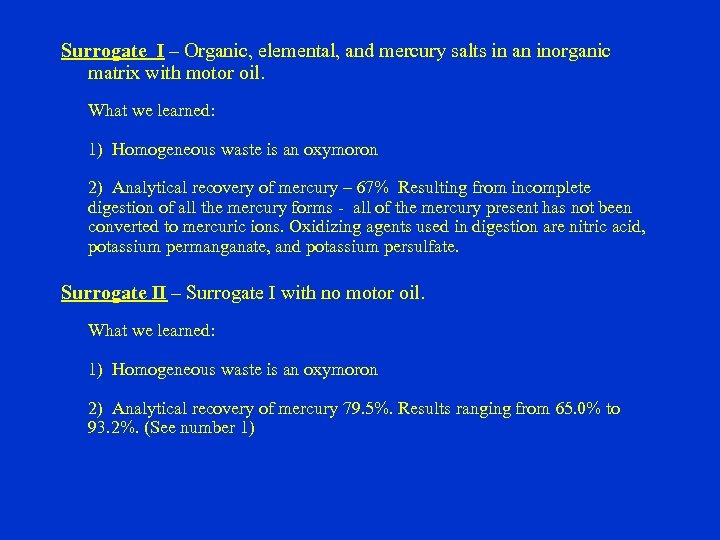
Surrogate I – Organic, elemental, and mercury salts in an inorganic matrix with motor oil. What we learned: 1) Homogeneous waste is an oxymoron 2) Analytical recovery of mercury – 67% Resulting from incomplete digestion of all the mercury forms - all of the mercury present has not been converted to mercuric ions. Oxidizing agents used in digestion are nitric acid, potassium permanganate, and potassium persulfate. Surrogate II – Surrogate I with no motor oil. What we learned: 1) Homogeneous waste is an oxymoron 2) Analytical recovery of mercury 79. 5%. Results ranging from 65. 0% to 93. 2%. (See number 1)
Surrogate Sludge I Composition (with motor oil)
Analytical Results for Surrogate Sludge I
Analytical Results for Surrogate Sludge II
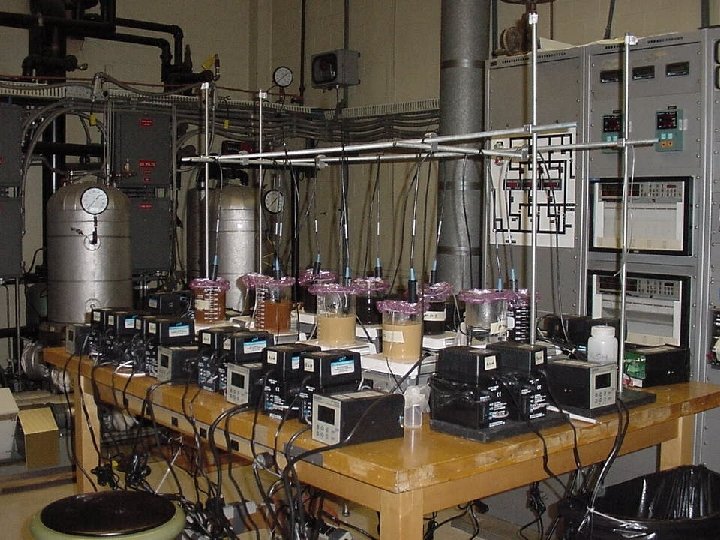
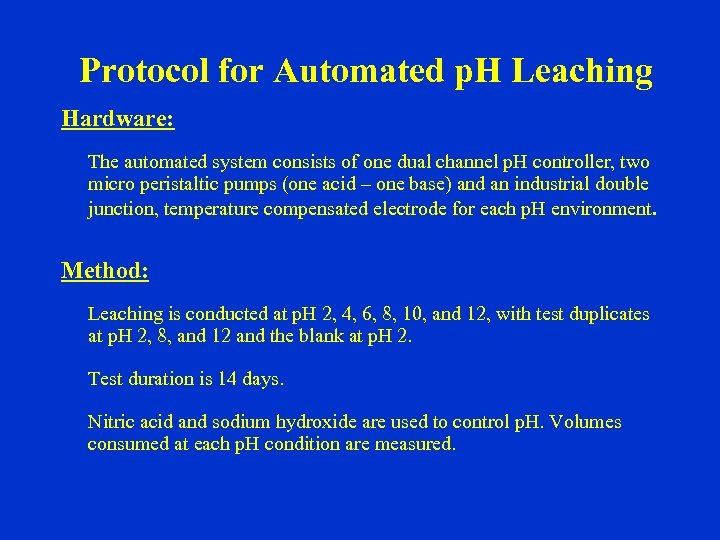
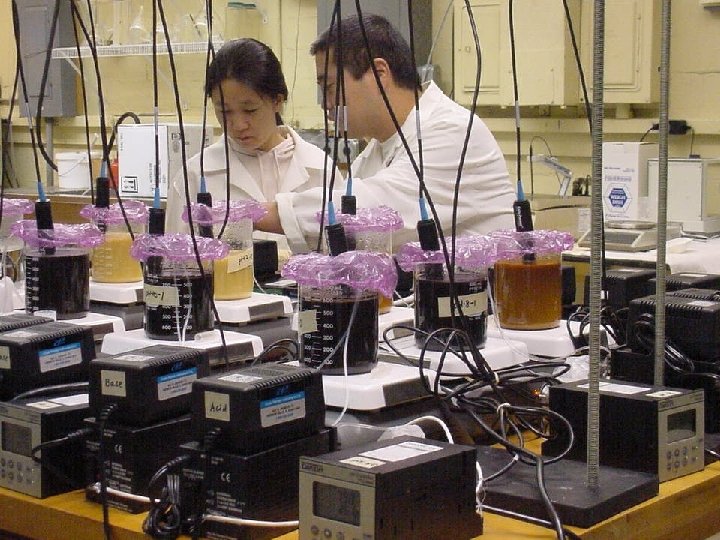
Protocol for Automated p. H Leaching Hardware: The automated system consists of one dual channel p. H controller, two micro peristaltic pumps (one acid – one base) and an industrial double junction, temperature compensated electrode for each p. H environment. Method: Leaching is conducted at p. H 2, 4, 6, 8, 10, and 12, with test duplicates at p. H 2, 8, and 12 and the blank at p. H 2. Test duration is 14 days. Nitric acid and sodium hydroxide are used to control p. H. Volumes consumed at each p. H condition are measured.
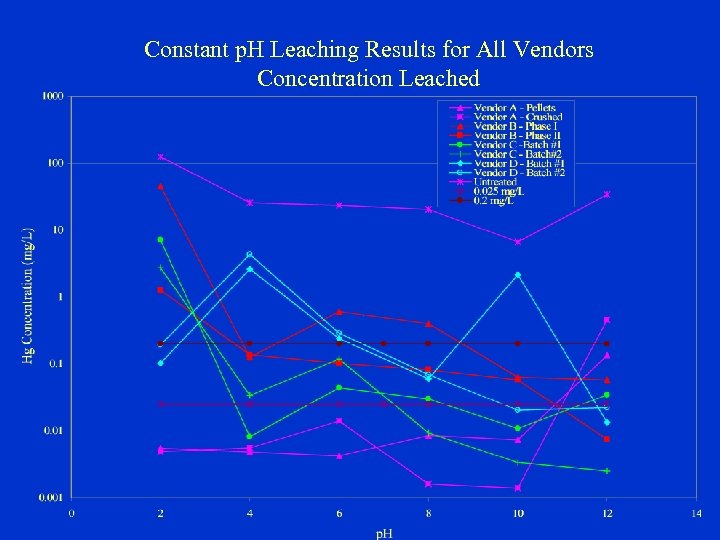
Constant p. H Leaching Results for All Vendors Concentration Leached
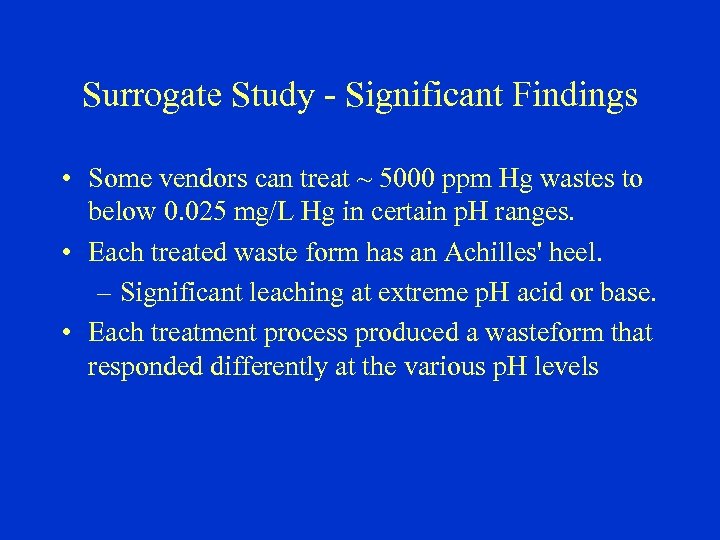
Surrogate Study - Significant Findings • Some vendors can treat ~ 5000 ppm Hg wastes to below 0. 025 mg/L Hg in certain p. H ranges. • Each treated waste form has an Achilles' heel. – Significant leaching at extreme p. H acid or base. • Each treatment process produced a wasteform that responded differently at the various p. H levels
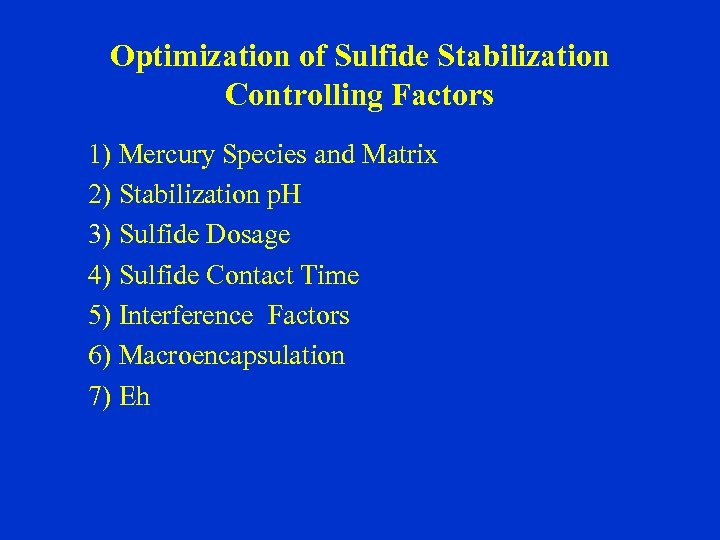
Optimization of Sulfide Stabilization Controlling Factors 1) Mercury Species and Matrix 2) Stabilization p. H 3) Sulfide Dosage 4) Sulfide Contact Time 5) Interference Factors 6) Macroencapsulation 7) Eh
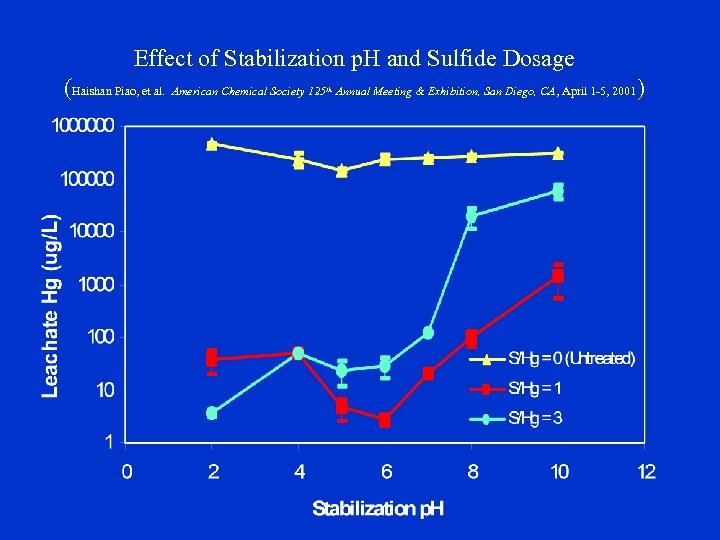
Effect of Stabilization p. H and Sulfide Dosage (Haishan Piao, et al. American Chemical Society 125 th Annual Meeting & Exhibition, San Diego, CA, April 1 -5, 2001 )
Effect of Sulfide Contact Time (Haishan Piao, et al. American Chemical Society 125 th Annual Meeting & Exhibition, San Diego, CA, April 1 -5, 2001)
Interference Factors Constant p. H Leaching Results for Hg. Se Percentage Leached
Interference Factors (Haishan Piao, et al. American Chemical Society 223 rd Annual Meeting & Exhibition, Orlando, Florida, April 7 -11, 2002)
Effect of macroencapsulation Constant p. H Leaching Results Percentage Leached

Surrogate Waste leaching
Скачать презентацию Mercury Stabilization Lessons Learned University of Cincinnati ALTER
8eb7ca86503bf655d3654d7e49f987ac.ppt