


 Скачать презентацию MEND 7 -13 Training Mind Insert date here
77f23f67e2b30967004e8f0ef10b0cda.ppt
- Количество слайдов: 72
 MEND 7 -13 Training Mind Insert date here
 Overview • Designed by Dr Paul Chadwick - psychologist specializing in child obesity management • Based on models of behavior change • Deceptively simple, yet based on complex underlying theories • Empowers parents by giving them behavior change skills to encourage their own children to be more active & eat healthfully 1
 MIND principles • Not just the “MIND” sessions • Mind Magic: − Cleverly designed so that psychological principles operate − Delivered by non-experts in psychology − Just follow structured session plans……………. • Evidence-based psychological principles − Learning through facilitation and empowerment − Structured goal setting and rewards − Social learning − Sustainability: Appetite regulation, behavior change, habit development (Mind & Nutrition) 2
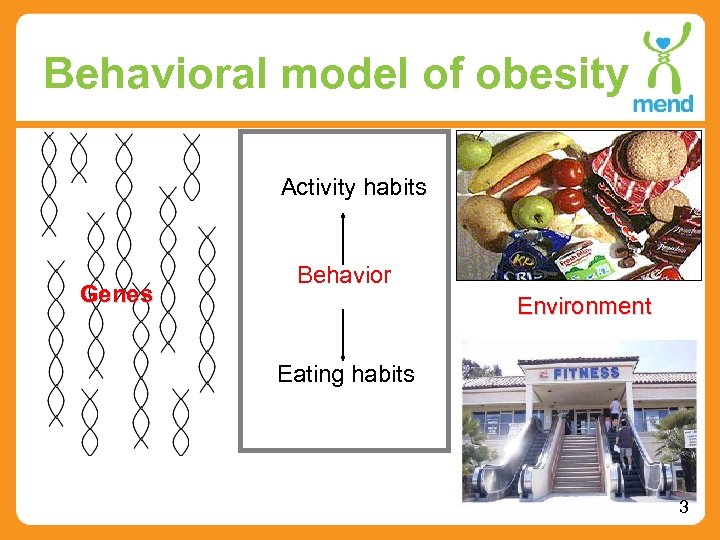 Behavioral model of obesity Activity habits Genes Behavior Environment Eating habits 3
 Behavioral approach unhealthy behavior can be unlearned 4
 What helps you learn? Activity: Think back to a time when you learned a complex skill, e. g. , learning to drive or how to play a sport • What helped you achieve that? • What qualities did the person who helped you have? 5
 What helps you learn? • Repetition • Rehearsal • Feedback • Patience • Nonjudgmental attitude • Support • Creativity 6
 Themes • Goals and Rewards • Triggers − Internal − External • Modeling 7
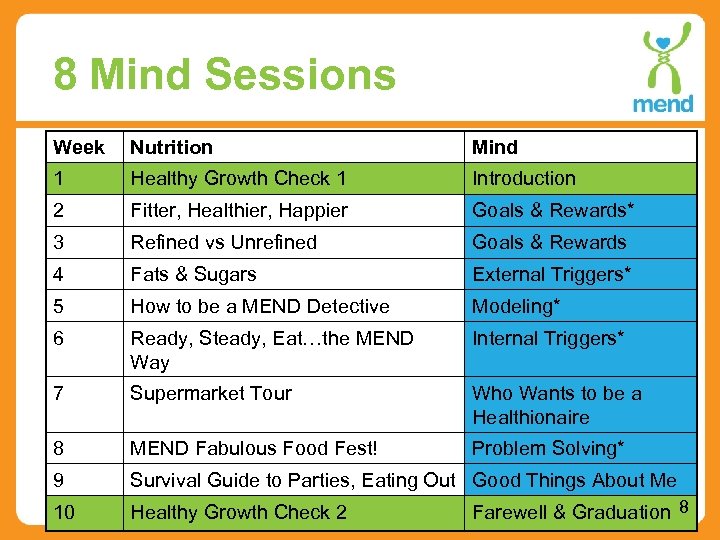 8 Mind Sessions Week Nutrition Mind 1 Healthy Growth Check 1 Introduction 2 Fitter, Healthier, Happier Goals & Rewards* 3 Refined vs Unrefined Goals & Rewards 4 Fats & Sugars External Triggers* 5 How to be a MEND Detective Modeling* 6 Ready, Steady, Eat…the MEND Way Internal Triggers* 7 Supermarket Tour Who Wants to be a Healthionaire 8 MEND Fabulous Food Fest! Problem Solving* 9 Survival Guide to Parties, Eating Out Good Things About Me 10 Healthy Growth Check 2 Farewell & Graduation 8
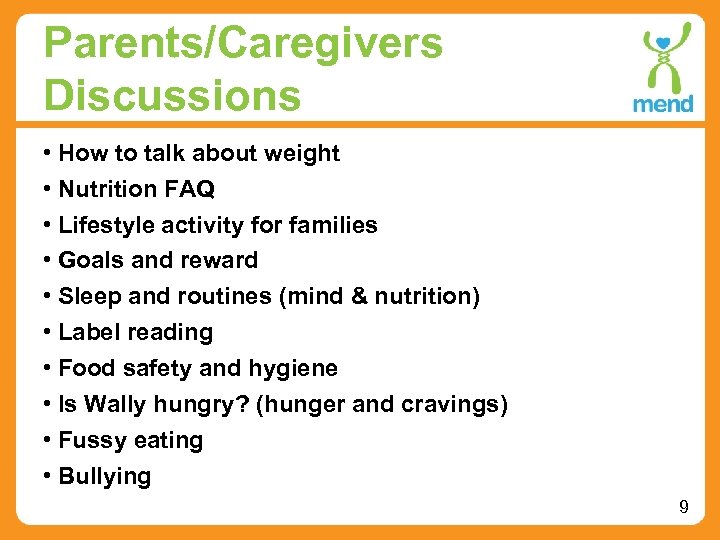 Parents/Caregivers Discussions • How to talk about weight • Nutrition FAQ • Lifestyle activity for families • Goals and reward • Sleep and routines (mind & nutrition) • Label reading • Food safety and hygiene • Is Wally hungry? (hunger and cravings) • Fussy eating • Bullying 9
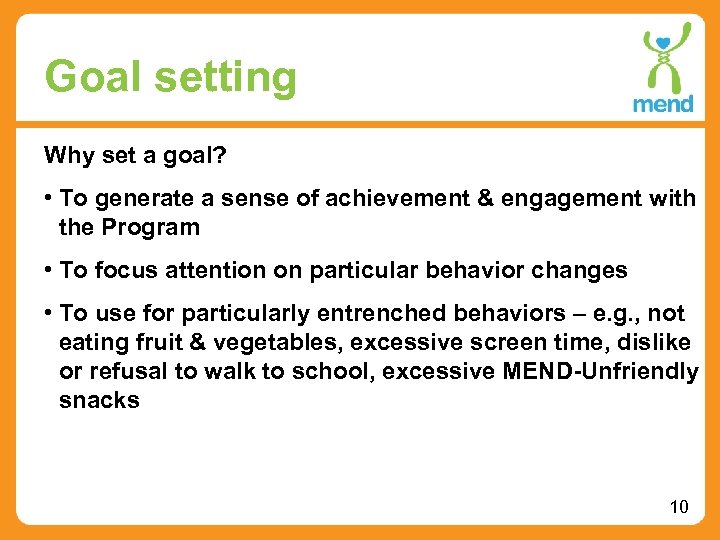 Goal setting Why set a goal? • To generate a sense of achievement & engagement with the Program • To focus attention on particular behavior changes • To use for particularly entrenched behaviors – e. g. , not eating fruit & vegetables, excessive screen time, dislike or refusal to walk to school, excessive MEND-Unfriendly snacks 10
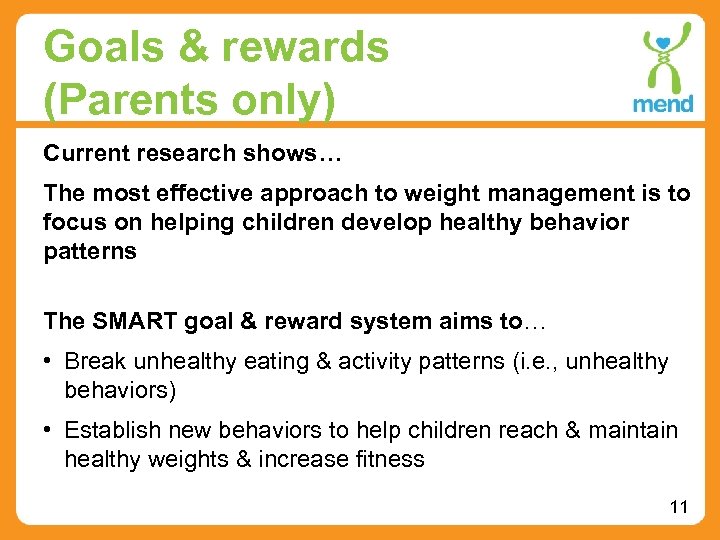 Goals & rewards (Parents only) Current research shows… The most effective approach to weight management is to focus on helping children develop healthy behavior patterns The SMART goal & reward system aims to… • Break unhealthy eating & activity patterns (i. e. , unhealthy behaviors) • Establish new behaviors to help children reach & maintain healthy weights & increase fitness 11
 Goals & rewards (Parents only) • Establish ground rules for parents • Familiarize parents with the principles of SMART goals & rewards 12
 Discussion • Who has used SMART goals & rewards? • How? 13
 Goal setting: SMART • S • M • A • R • T 14
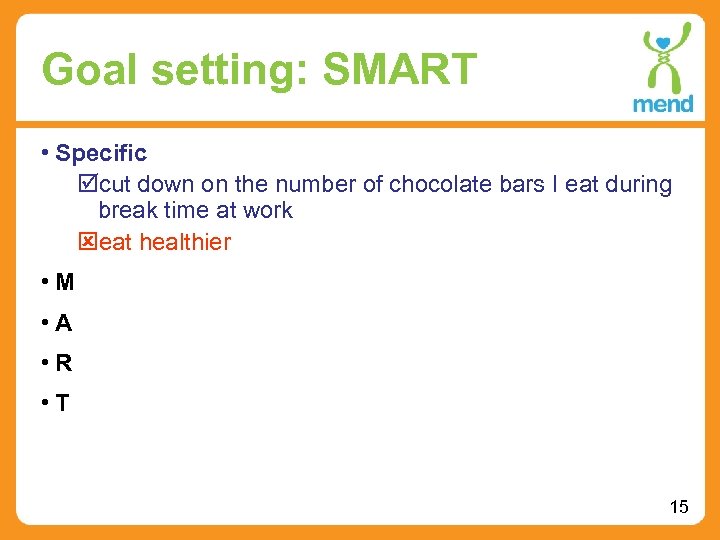 Goal setting: SMART • Specific þcut down on the number of chocolate bars I eat during break time at work ýeat healthier • M • A • R • T 15
 Goal setting: SMART • Specific • M • A • R • T 16
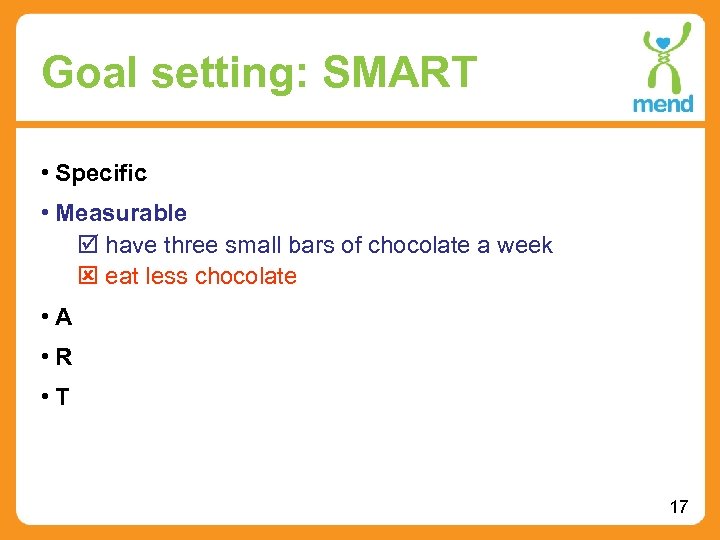 Goal setting: SMART • Specific • Measurable þ have three small bars of chocolate a week ý eat less chocolate • A • R • T 17
 Goal setting: SMART • Specific • Measurable • A • R • T 18
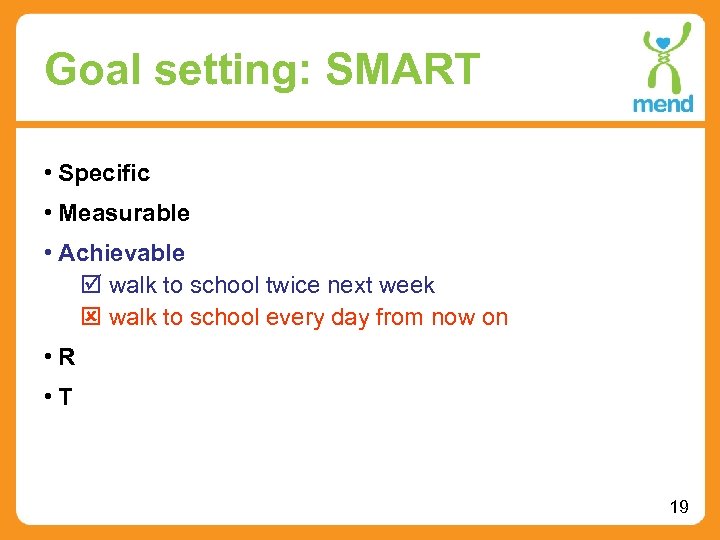 Goal setting: SMART • Specific • Measurable • Achievable þ walk to school twice next week ý walk to school every day from now on • R • T 19
 Goal setting: SMART • Specific • Measurable • Achievable • R • T 20
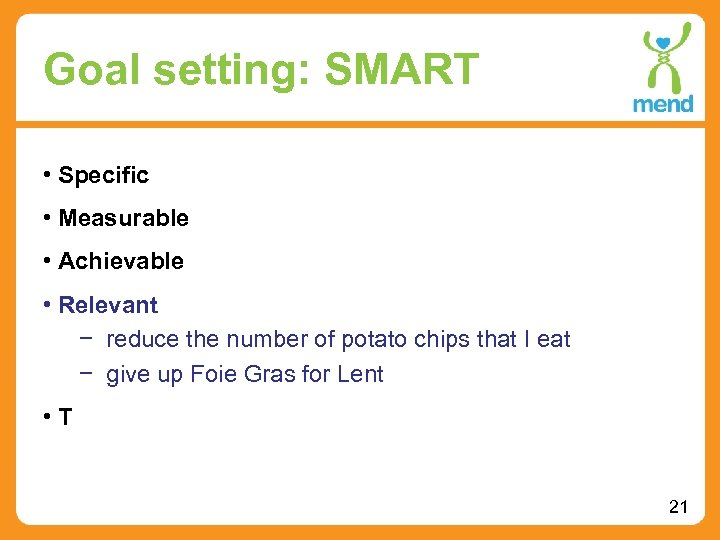 Goal setting: SMART • Specific • Measurable • Achievable • Relevant − reduce the number of potato chips that I eat − give up Foie Gras for Lent • T 21
 Goal setting: SMART • Specific • Measurable • Achievable • Relevant • T 22
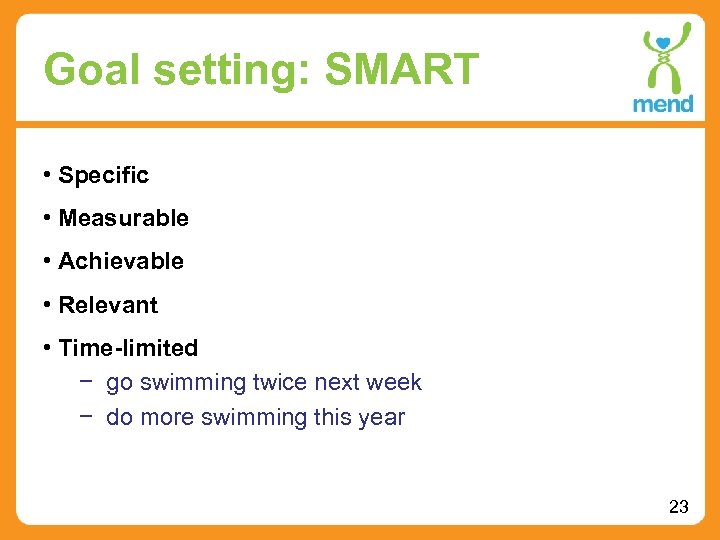 Goal setting: SMART • Specific • Measurable • Achievable • Relevant • Time-limited − go swimming twice next week − do more swimming this year 23
 SMART or not? 24
 Reward systems • The principle: • Behavior (B) is influenced by what happens before it (A) & after it (C) • The technique - positive reinforcement: • Behaviors followed by something pleasant are more likely to occur again 25
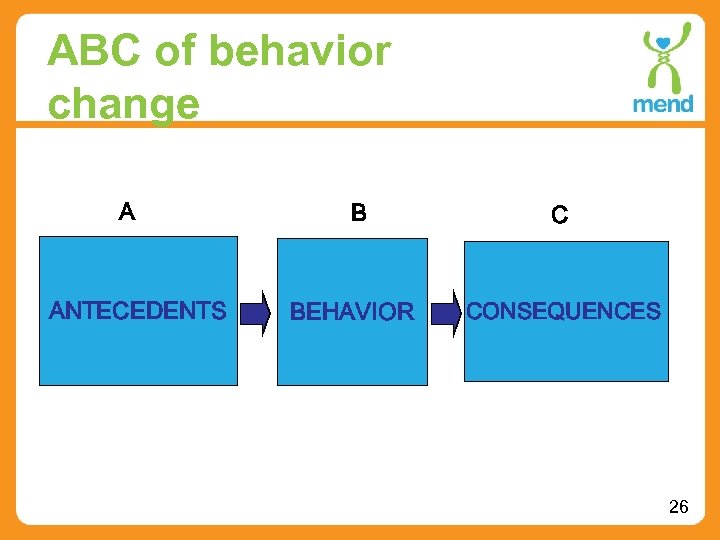 ABC of behavior change A ANTECEDENTS B C BEHAVIOR CONSEQUENCES 26
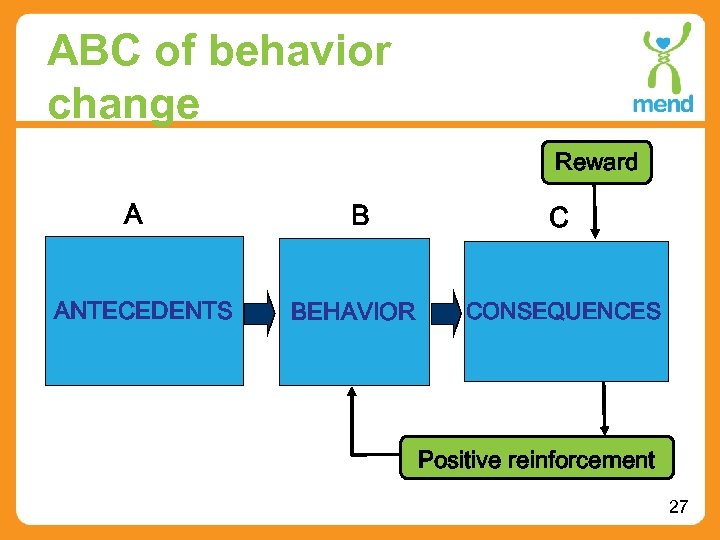 ABC of behavior change Reward A ANTECEDENTS B C BEHAVIOR CONSEQUENCES Positive reinforcement 27
 Reward Do’s • Parents to record progress • Formally acknowledge the child’s achievement of their goal & praise them for getting their reward • Small frequent rewards are more effective than large distant ones • Degree of reward should match the magnitude of the effort required • Make them meaningful to the child • No goal - no reward 28
 Reward Don’ts • Don’t set rewards that might not be possible to achieve • Parents should not discuss their children’s failure to achieve their goal while they are angry or upset with them • Parents should never use their children’s failure as a means of emphasizing negative aspects of their personality • Avoid making them feel like a failure – always congratulate them for trying & suggest setting an easier goal or ask if there is anything the family can do to help • Withholding rewards should not be used as punishment • Avoid using food as a reward – this can set up comfort eating 29
 Rewards brainstorm 30
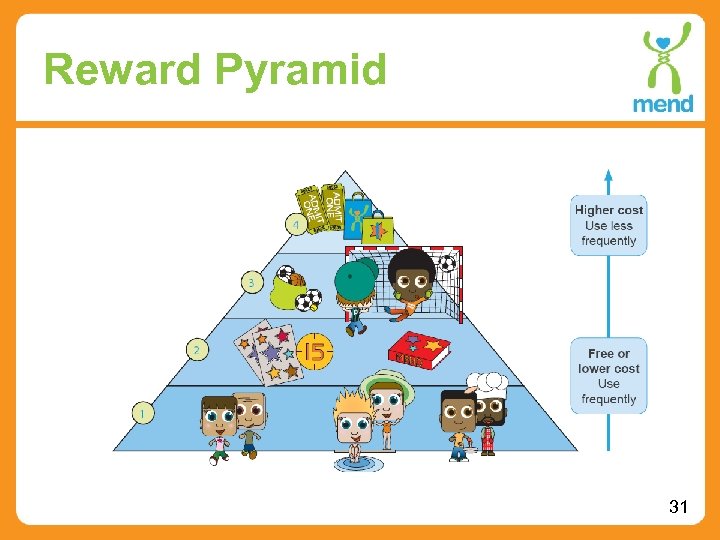 Reward Pyramid 31
 Goals & rewards (Parents and children) • Introduce children to the concept of goals & rewards • Teach children how to realistically set SMART nutrition & physical activity goals that they will be able to stick to − NOT SMART principles • Activity: John the basketball player 32
 Parent & child goal setting activity • Children & parents pair up to agree on 2 SMART goals & a weekly reward for the duration of the Program − 1 Nutrition goal − 1 Physical activity goal • Write down each child’s 2 goals & weekly reward 33
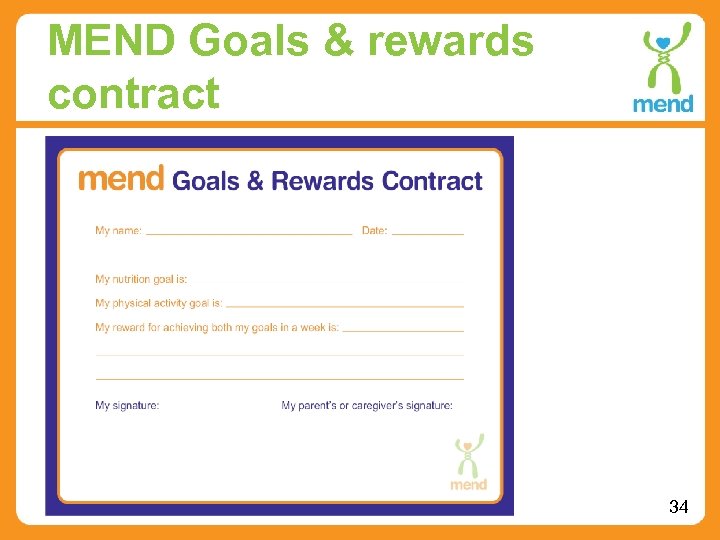 MEND Goals & rewards contract 34
 SMART Goals & rewards • Leader to create the Goals & Rewards Star Chart by the following MIND session • Leader to check children’s progress each week & hand out sticker − Children only get a sticker if they achieve BOTH goals − Be firm but fair with the children − Check that parent gives reward − What to do if the child fails to achieve goal? • Children get stickers even if they miss a session 35
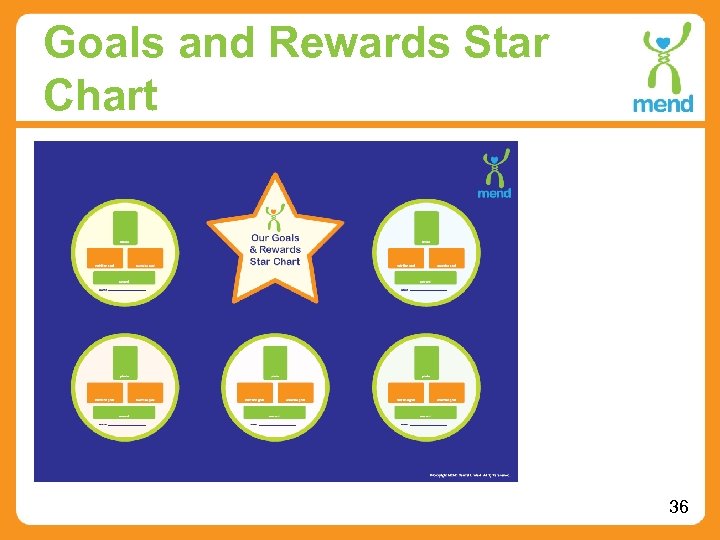 Goals and Rewards Star Chart 36
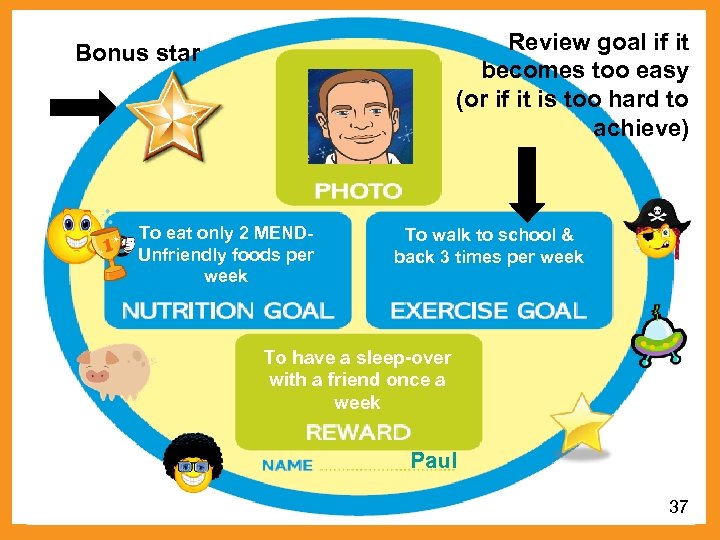 Review goal if it becomes too easy (or if it is too hard to achieve) Bonus star To eat only 2 MENDUnfriendly foods per week To walk to school & back 3 times per week To have a sleep-over with a friend once a week Paul 37
 Group reward • Group reward if all children get at least 8 stickers on the chart • Children to give suggestions for group reward • Keep a running list & ask children to vote for their favorite (Mind 6 session) • Ask families to contribute an amount (or choose a free group reward) − Remind families a few weeks later 38
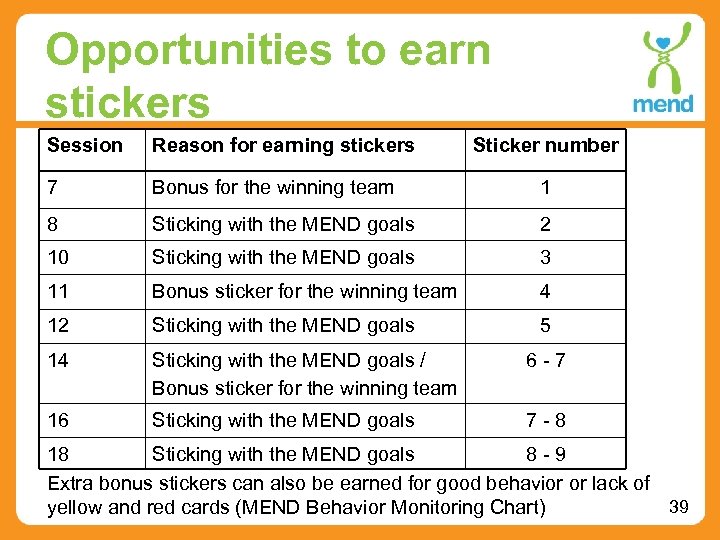 Opportunities to earn stickers Session Reason for earning stickers Sticker number 7 Bonus for the winning team 1 8 Sticking with the MEND goals 2 10 Sticking with the MEND goals 3 11 Bonus sticker for the winning team 4 12 Sticking with the MEND goals 5 14 Sticking with the MEND goals / Bonus sticker for the winning team 6 -7 16 Sticking with the MEND goals 7 -8 18 Sticking with the MEND goals 8 -9 Extra bonus stickers can also be earned for good behavior or lack of 39 yellow and red cards (MEND Behavior Monitoring Chart)
 Behavior Monitoring Chart • Rewards sustained good behavior during the Program • Can be used for the Exercise sessions as well as the Mind & Nutrition sessions if behavior is a problem • Should be introduced after Session 5 – when children learn about the group chart • Verbal warning - yellow card - red card • 2 weeks (i. e. , 4 sessions) with no yellow or red card Bonus Star 40
 Triggers • Internal and external triggers • Often internal & external triggers interact to produce a specific pattern of unhealthy behavior 41
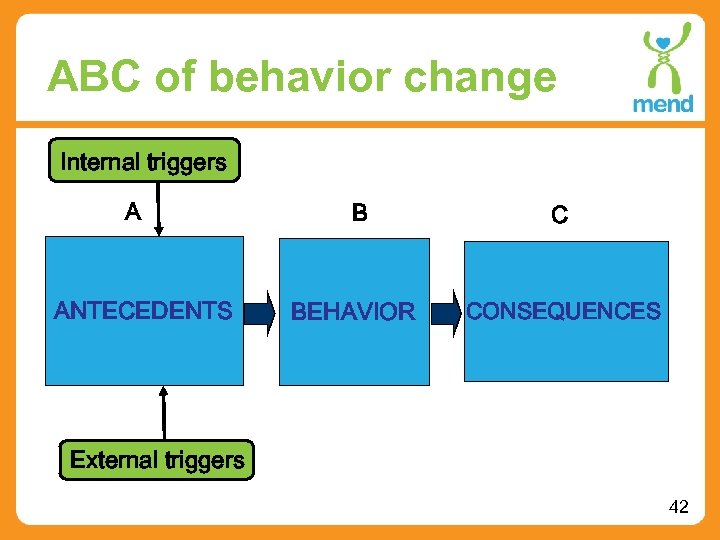 ABC of behavior change Internal triggers A ANTECEDENTS B C BEHAVIOR CONSEQUENCES External triggers 42
 What are external triggers? • A trigger is something that causes a certain behavior − e. g. , walking past a candy store causes you to buy candy • Using triggers to reduce unhealthy behaviors & increase healthy behaviors can be very effective • Using goals & rewards promotes positive behavior changes • Also important to reduce triggers that cause us to do something unhealthy or not to do something healthy − e. g. , you get home from work & plan on going to the gym, but when you see your slippers & TV, you lose all your willpower and succumb to your comfy sofa! 43
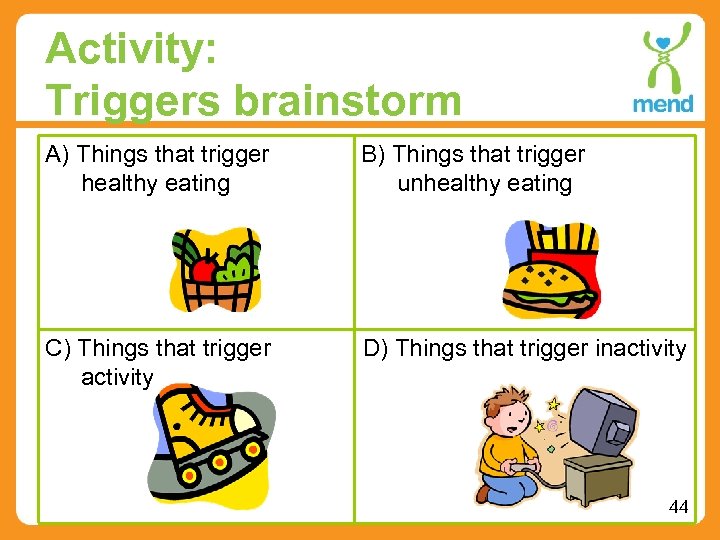 Activity: Triggers brainstorm A) Things that trigger healthy eating B) Things that trigger unhealthy eating C) Things that trigger activity D) Things that trigger inactivity 44
 What are internal triggers? • Internal triggers: Thoughts or sensations inside a person that cause them to behave in a certain way • The role of internal triggers can be more complex than external triggers • Help parents to think about using behavior change techniques to deal with internal triggers 45
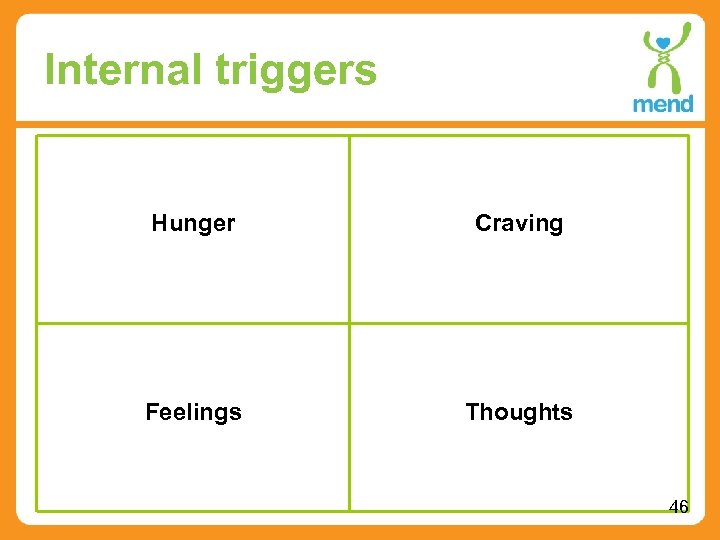 Internal triggers Hunger Craving Feelings Thoughts 46
 Hunger & cravings • Hunger physiological − Usually anything will do − Gets worse over time • Craving psychological − Usually just for 1 particular food − Usually disappears after 20 min • “Is Wally hungry? ” quiz (Session 15 handout) 47
 Feelings that may cause overeating • Loneliness • Stress/anxiety • Sadness • Boredom • Distraction-style techniques are advisable unless you are a qualified mental health professional 48
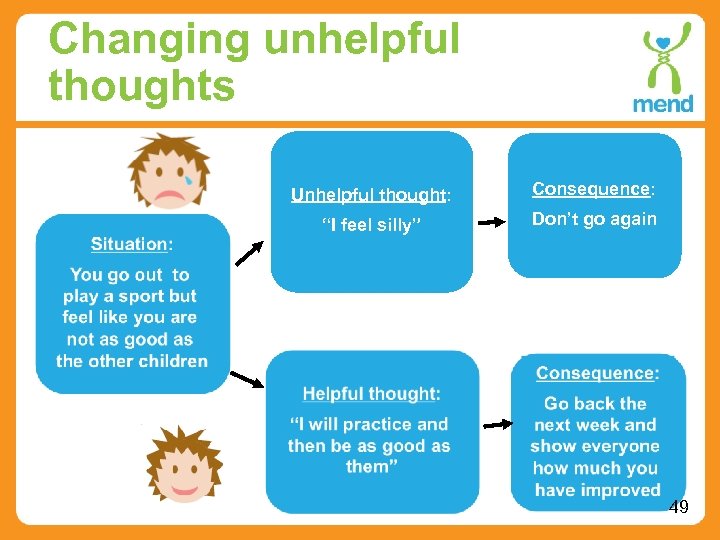 Changing unhelpful thoughts Unhelpful thought: Consequence: “I feel silly” Don’t go again 49
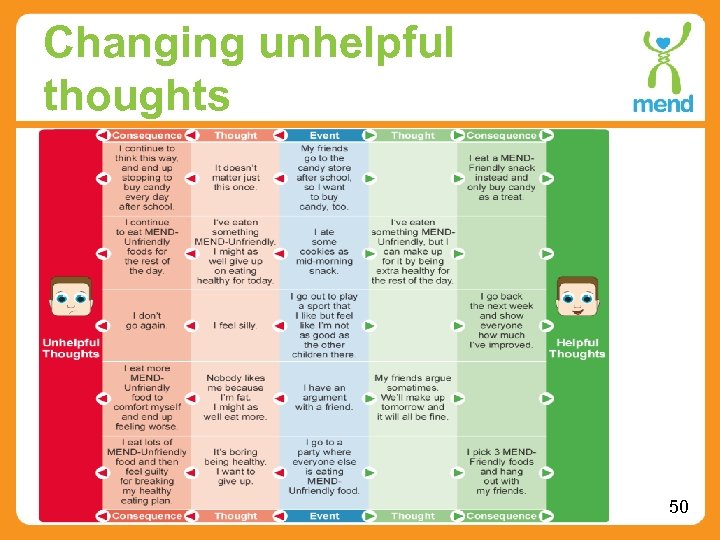 Changing unhelpful thoughts 50
 The process of changing thoughts • Changing unhelpful thoughts to helpful ones requires practice & support • Children’s thinking patterns are generally easier to change than adults • …but like changing any habit, it is still hard work! 52
 Note: • Unless you are a qualified mental health professional, it is not advisable that you engage in individual work with children & families about the way a child thinks & feels about food, activity & themselves • Although this is rare, some families may require guidance from a professional specializing in child mental health or eating disorders • It is appropriate to talk about these issues if you feel they are hampering a family’s ability to benefit from the Program • If you suspect this may be the case, please contact a qualified professional who will be able to recommend further action 53
 Modeling • Learn how to identify parents’ own habits & actions that influence their children’s behavior • Help them to transform those unhealthy behaviors into healthy ones 54
 Why is modeling a useful concept • Do as I say, not as I do − parent sits in front of the TV and eats a bag of chips while telling the child to go outside & play • Children learn by example… − from their peers difficult to change − from media heroes difficult to change − from their parents can change 55
 Modeling: Activity: Watch MEND video Healthy behaviors/Unhealthy behaviors • Some parents may find some aspects of this session to be challenging • No parents can be perfect all the time • Not our intention to preach or judge their parenting skills 56
 Refer to if issues arise… • Have family see PCP for evaluation • If questions, call Dr. >>>>for guidance 57
 MEND 7 -13 Experience • Use the manuals and resources • Identify a role for each member of the group − Leaders (Theory & Exercise) − Program Assistant • Working with groups--key skills to focus on − Reflecting back − Brainstorming − Boundary setting 58
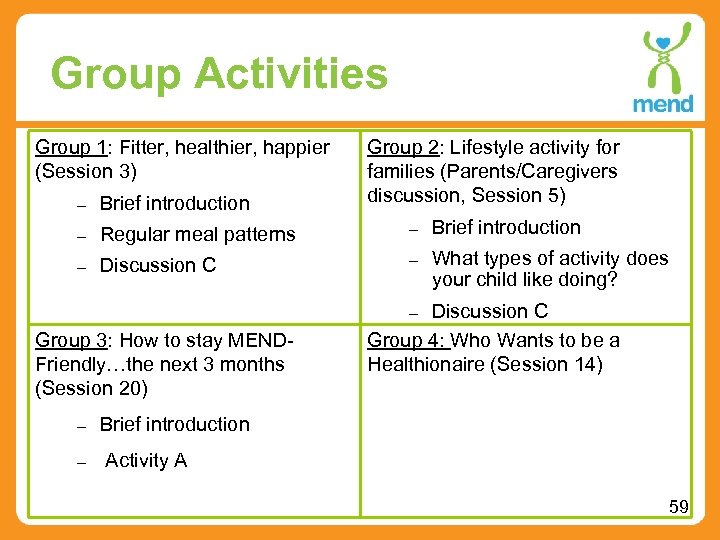 Group Activities Group 1: Fitter, healthier, happier (Session 3) Group 2: Lifestyle activity for families (Parents/Caregivers discussion, Session 5) – Brief introduction – Regular meal patterns – Brief introduction – Discussion C – What types of activity does your child like doing? Discussion C Group 4: Who Wants to be a Healthionaire (Session 14) – Group 3: How to stay MENDFriendly…the next 3 months (Session 20) – – Brief introduction Activity A 59
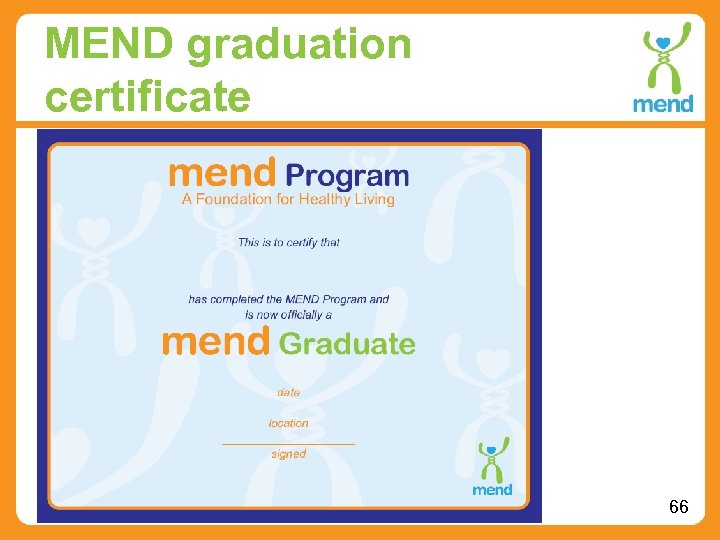
 Session 20 - Farewell • Conclude the MEND 7 -13 Program • Create a real sense of achievement • Conduct the graduation ceremony • Get meaningful feedback • How to staying MEND-Friendly. . . the next 3 months − MEND Star Targets and Star Tracker − Goal setting 62
 “In your community” • Handout that shows different types of local programs and activities to help families stay MEND-Friendly − MEND member activities, e. g. , ongoing exercise sessions − Local recreation facilities, summer camps − Places to play and be active − Community sports and activity programs, classes − Afterschool programs • Encourage children to be MEND-Friendly & active • Template available from the Regional Manager, and on OMMS in early 2010 63
 Feedback Be sure you get meaningful feedback & report back to MEND 64
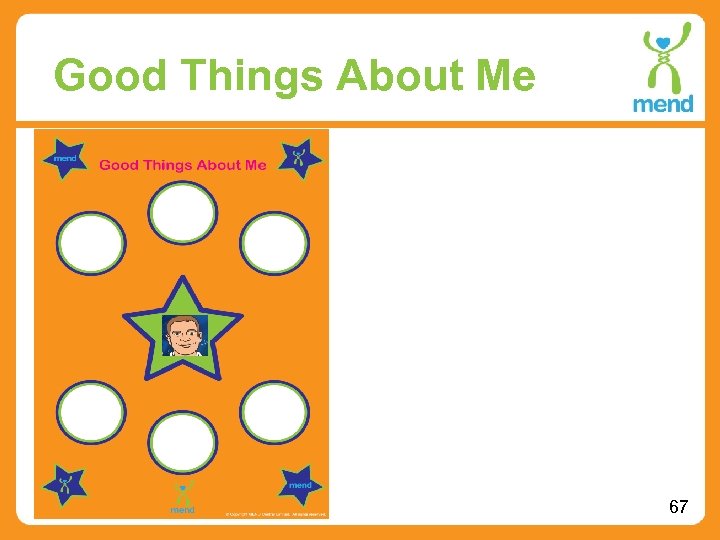
 MEND graduation ceremony • Graduation certificates • “What’s Good About Me” poster • Announce whether the group has successfully earned their group reward 65
 MEND graduation certificate 66
 Good Things About Me 67
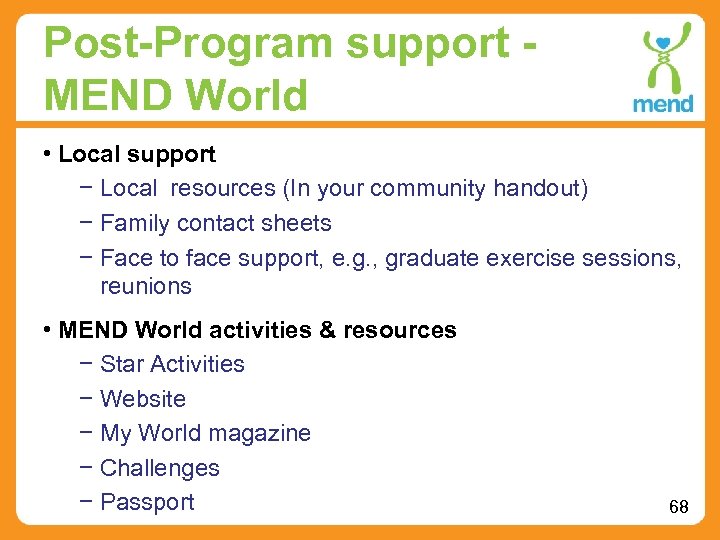 Post-Program support MEND World • Local support − Local resources (In your community handout) − Family contact sheets − Face to face support, e. g. , graduate exercise sessions, reunions • MEND World activities & resources − Star Activities − Website − My World magazine − Challenges − Passport 68
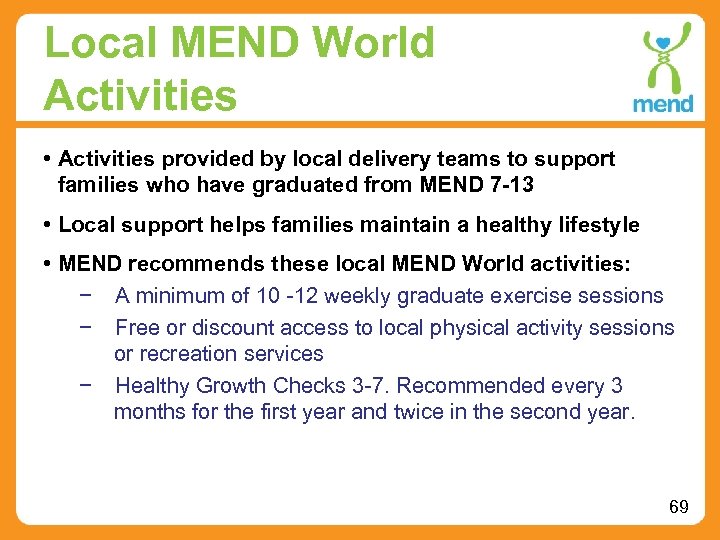 Local MEND World Activities • Activities provided by local delivery teams to support families who have graduated from MEND 7 -13 • Local support helps families maintain a healthy lifestyle • MEND recommends these local MEND World activities: − A minimum of 10 -12 weekly graduate exercise sessions − Free or discount access to local physical activity sessions or recreation services − Healthy Growth Checks 3 -7. Recommended every 3 months for the first year and twice in the second year. 69
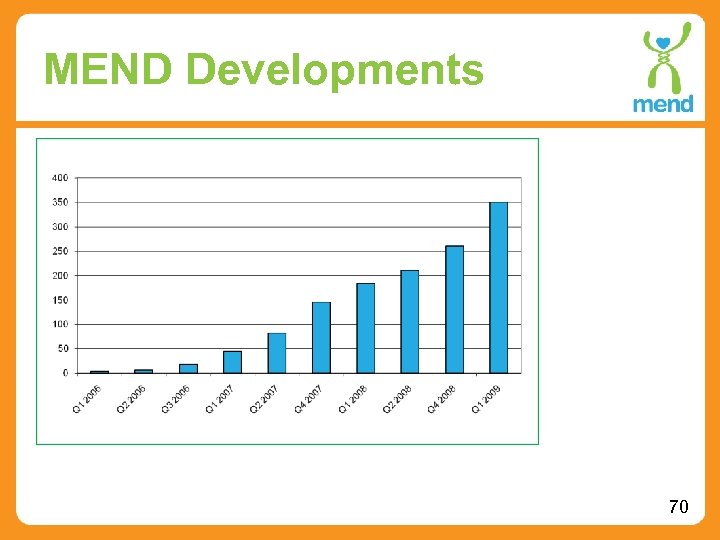 MEND Developments 70
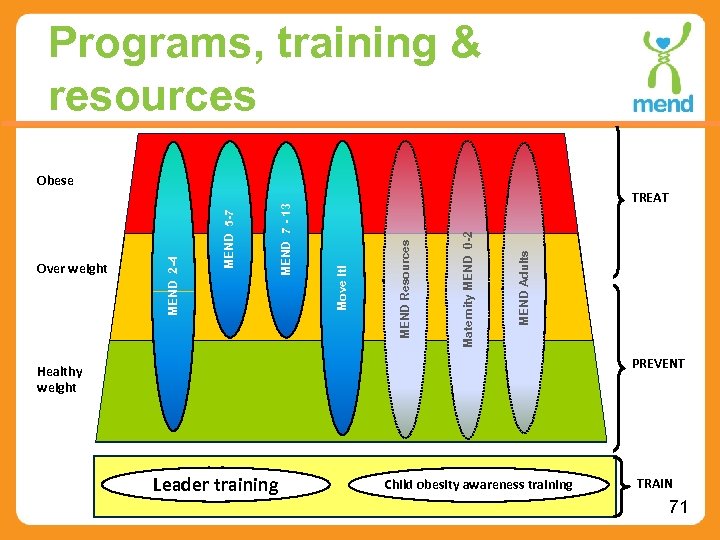 Programs, training & resources MEND Adults Maternity MEND 0 -2 MEND Resources TREAT Move It! MEND 7 - 13 MEND 5 -7 Over weight MEND 2 -4 Obese PREVENT Healthy weight Leader training Child obesity awareness training TRAIN 71
 72
72
 Conclusion • One thing you learned, or that has surprised you, from today • Evaluation • Assessments − Please put your name and other information on your assessment and return to Regional Manager 73
 Enjoy being a MEND Leader! www. mendfoundation. org 74