 Скачать презентацию MEMT Alignment-based MT System Combination with Linguistic and
8ce19c9fd6e62650ca7671d45a0a41ca.ppt
- Количество слайдов: 26



MEMT: Alignment-based MT System Combination with Linguistic and Statistical Features Alon Lavie Language Technologies Institute Carnegie Mellon University 19 November 2011 Joint work with: Kenneth Heafield, Greg Hanneman and Michael Denkowski
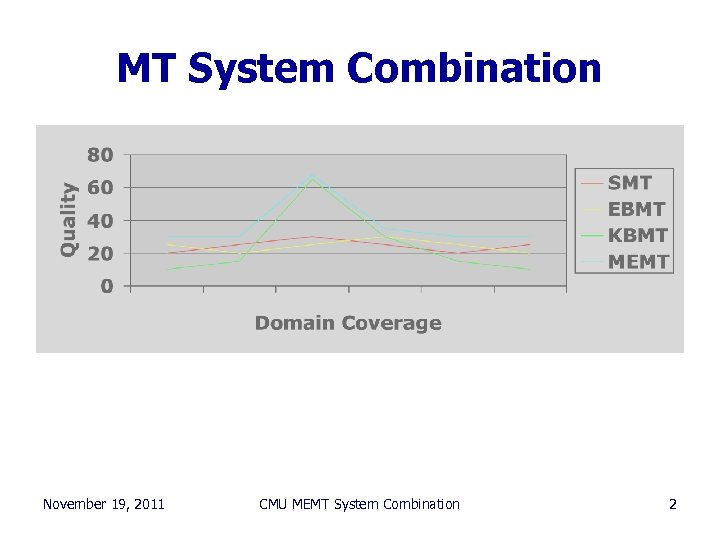
MT System Combination November 19, 2011 CMU MEMT System Combination 2
MT System Combination • Idea: apply several MT engines to each input in parallel and combine their output translations • Goal: leverage the strengths and diversity of different MT engines to generate an improved translation system • Particularly useful in assimilation scenarios where input is uncontrolled and diverse in domain, genre, style or other characteristics • Can result in significant gains in translation quality November 19, 2011 CMU MEMT System Combination 3
Main Issues and Challenges • Selecting the “best” output among the engines (on a sentence-by-sentence basis), or generating a deeper combination of the translation output from the original engines? – Selecting between engines is easier – Synthetically combining them can potentially produce greater improvements in translation quality • What information is available from each of the MT engines? • How do we determine if a synthetically combined translation is better than the originals? November 19, 2011 CMU MEMT System Combination 4
Consensus Network Approach • Main Ideas: – Collapse the collection of linear strings of multiple translations into a minimal consensus network (“sausage” graph) that represents how they align • How are the system outputs aligned? – One translation acts as the “back-bone” and determines the main ordering of words – Decode: find the path through the network that has the best score • Main Weaknesses: – Search is limited to selecting among aligned alternatives along the back-bone – Prone to dropping words due to “epsilon” arcs – Long distance alternations can result in repetitions November 19, 2011 CMU MEMT System Combination 5
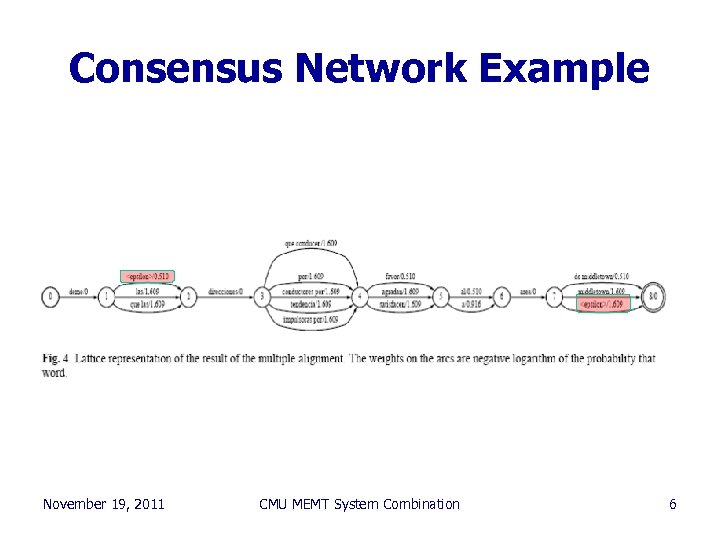
Consensus Network Example November 19, 2011 CMU MEMT System Combination 6
CMU’s Alignment-based Multi-Engine System Combination • Works with any MT engines – Assumes original MT systems are “black-boxes” – no internal information other than the translations themselves • Explores broader search spaces than other MT system combination approaches using linguistically-based and statistical features • Achieves state-of-the-art performance in research evaluations over past couple of years • Developed over last five years under research funding from several government grants (DARPA, Do. D and NSF) November 19, 2011 CMU MEMT System Combination 7
Alignment-based MEMT Two Stage Approach: 1. Align: Identify and align equivalent words and phrases across the translations provided by the engines 2. Decode: search the space of synthetic combinations of words/phrases and select the highest scoring combined translation Example: 1. announced afghan authorities on saturday reconstituted four intergovernmental committees 2. The Afghan authorities on Saturday the formation of the four committees of government November 19, 2011 CMU MEMT System Combination 8
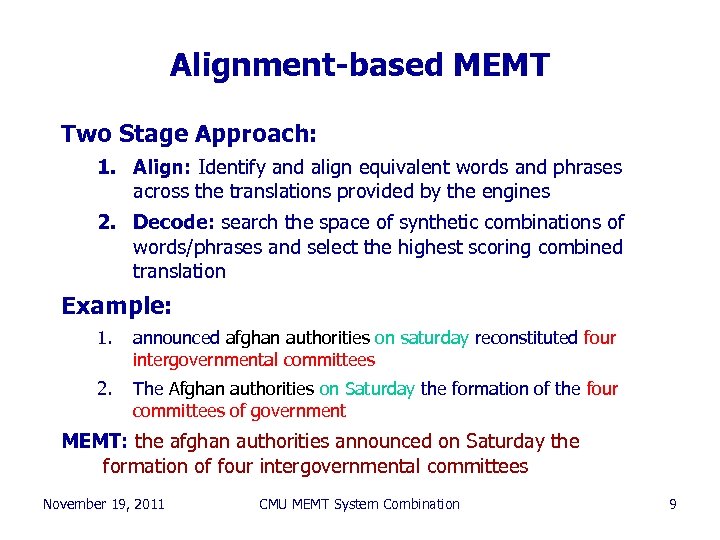
Alignment-based MEMT Two Stage Approach: 1. Align: Identify and align equivalent words and phrases across the translations provided by the engines 2. Decode: search the space of synthetic combinations of words/phrases and select the highest scoring combined translation Example: 1. announced afghan authorities on saturday reconstituted four intergovernmental committees 2. The Afghan authorities on Saturday the formation of the four committees of government MEMT: the afghan authorities announced on Saturday the formation of four intergovernmental committees November 19, 2011 CMU MEMT System Combination 9
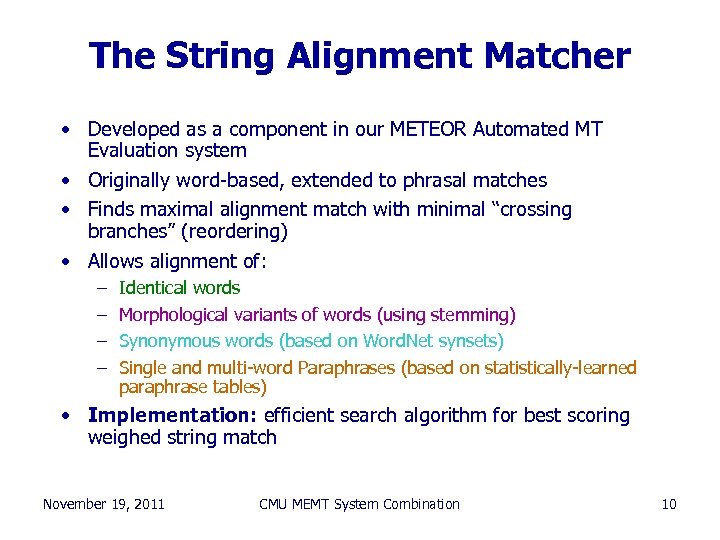
The String Alignment Matcher • Developed as a component in our METEOR Automated MT Evaluation system • Originally word-based, extended to phrasal matches • Finds maximal alignment match with minimal “crossing branches” (reordering) • Allows alignment of: – – Identical words Morphological variants of words (using stemming) Synonymous words (based on Word. Net synsets) Single and multi-word Paraphrases (based on statistically-learned paraphrase tables) • Implementation: efficient search algorithm for best scoring weighed string match November 19, 2011 CMU MEMT System Combination 10
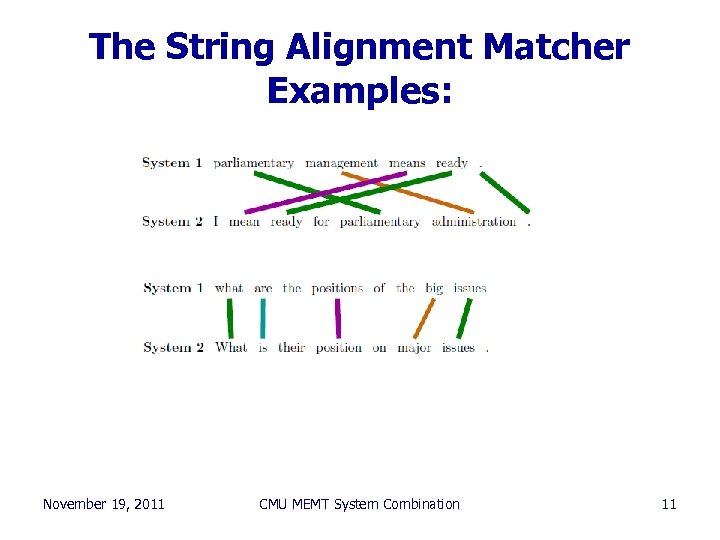
The String Alignment Matcher Examples: November 19, 2011 CMU MEMT System Combination 11
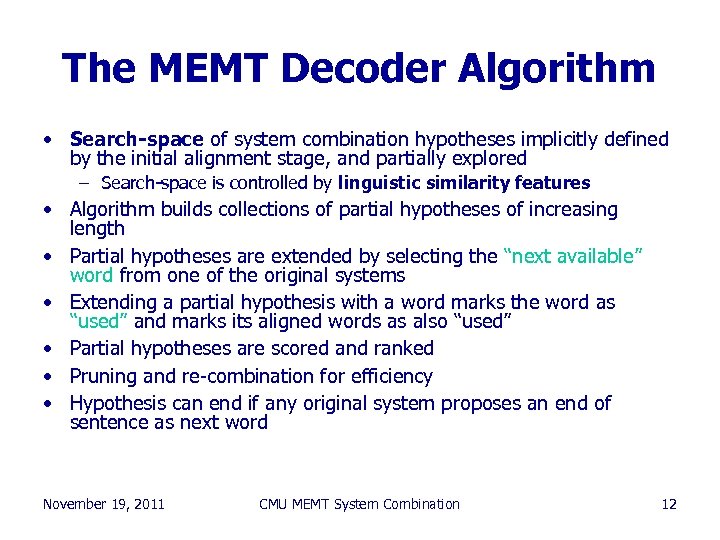
The MEMT Decoder Algorithm • Search-space of system combination hypotheses implicitly defined by the initial alignment stage, and partially explored – Search-space is controlled by linguistic similarity features • Algorithm builds collections of partial hypotheses of increasing length • Partial hypotheses are extended by selecting the “next available” word from one of the original systems • Extending a partial hypothesis with a word marks the word as “used” and marks its aligned words as also “used” • Partial hypotheses are scored and ranked • Pruning and re-combination for efficiency • Hypothesis can end if any original system proposes an end of sentence as next word November 19, 2011 CMU MEMT System Combination 12
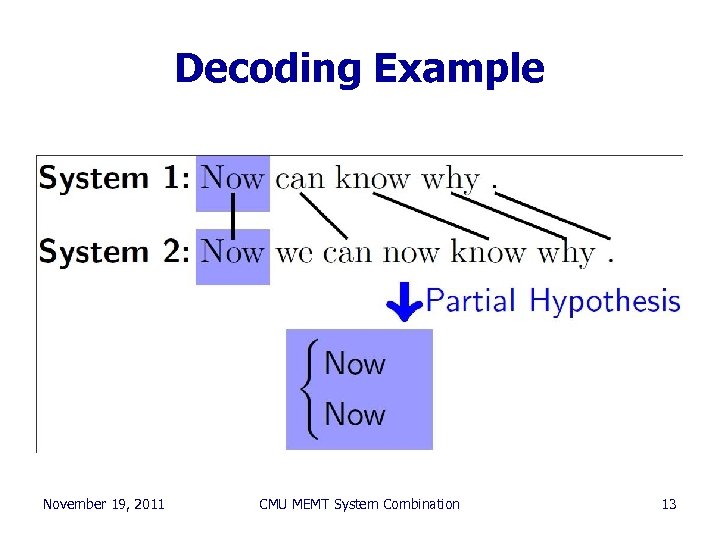
Decoding Example November 19, 2011 CMU MEMT System Combination 13
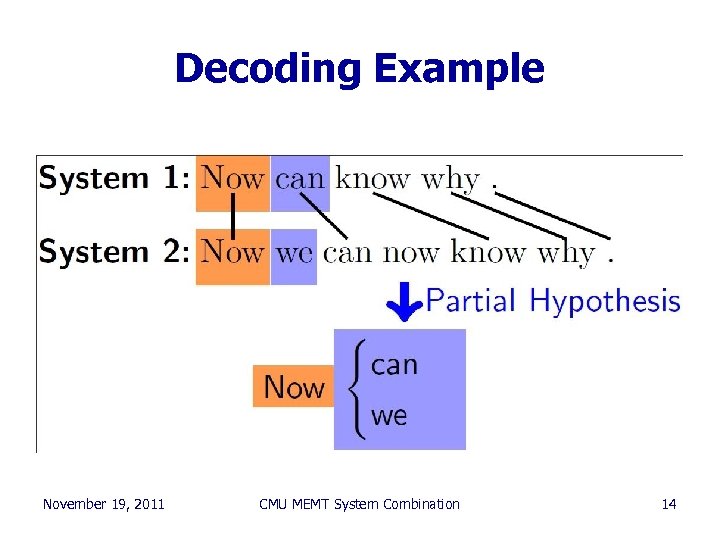
Decoding Example November 19, 2011 CMU MEMT System Combination 14
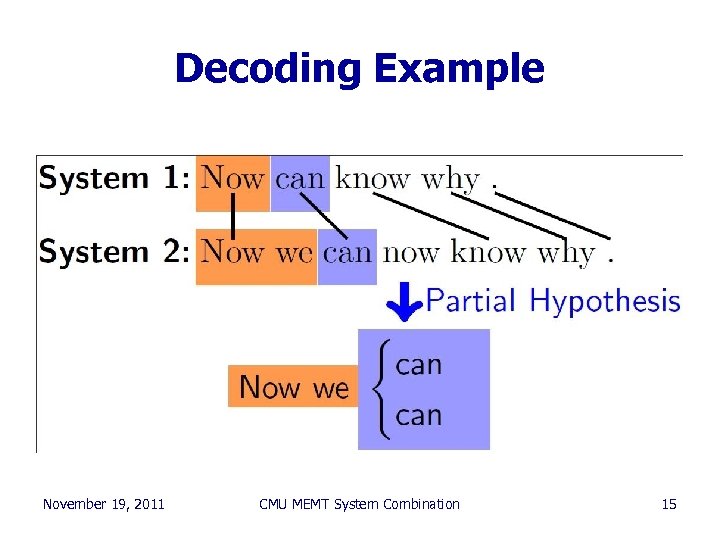
Decoding Example November 19, 2011 CMU MEMT System Combination 15
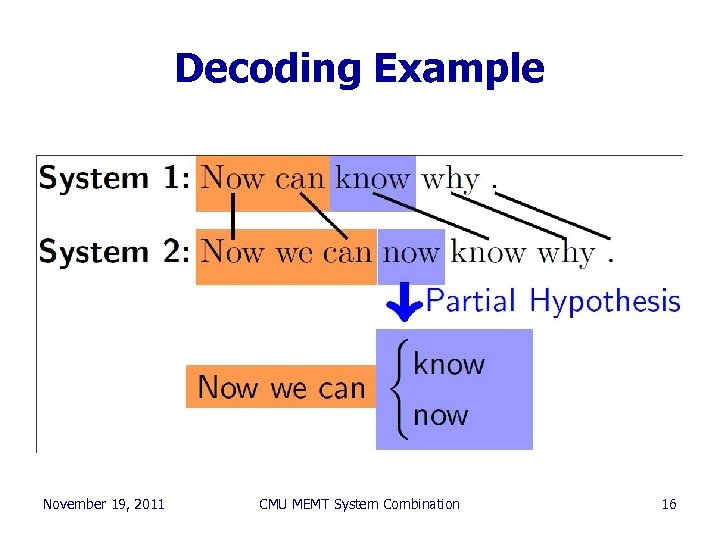
Decoding Example November 19, 2011 CMU MEMT System Combination 16
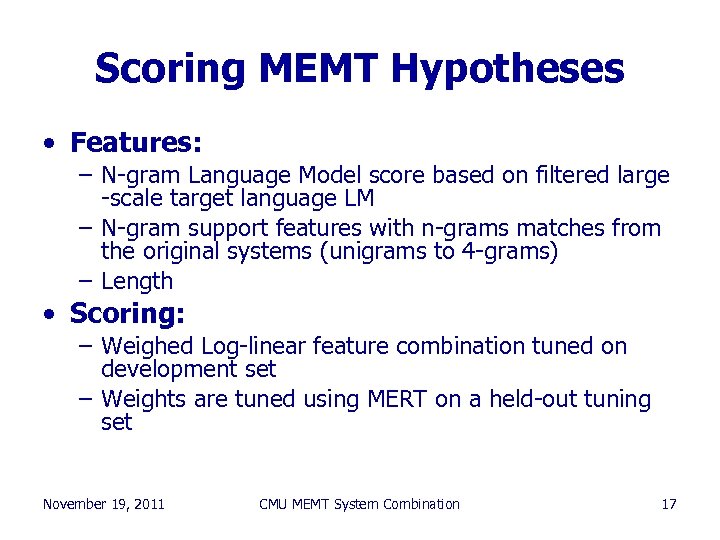
Scoring MEMT Hypotheses • Features: – N-gram Language Model score based on filtered large -scale target language LM – N-gram support features with n-grams matches from the original systems (unigrams to 4 -grams) – Length • Scoring: – Weighed Log-linear feature combination tuned on development set – Weights are tuned using MERT on a held-out tuning set November 19, 2011 CMU MEMT System Combination 17
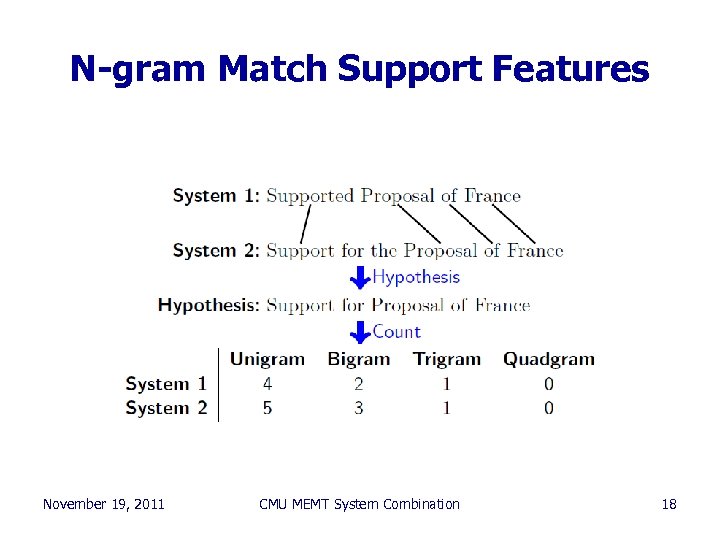
N-gram Match Support Features November 19, 2011 CMU MEMT System Combination 18
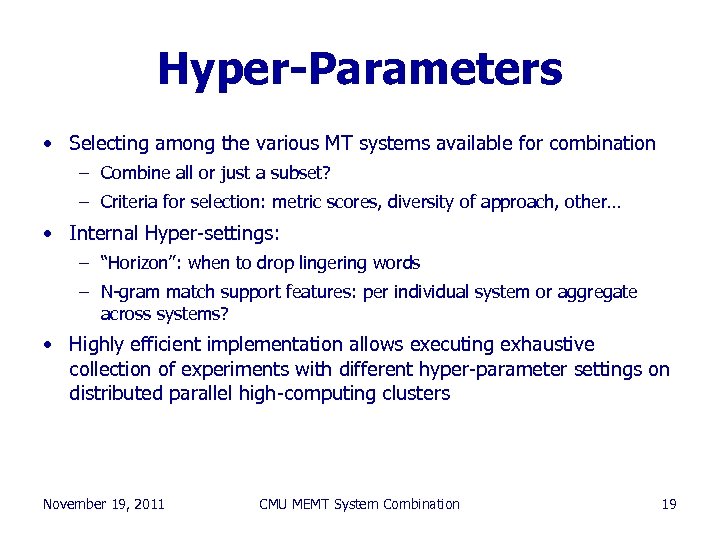
Hyper-Parameters • Selecting among the various MT systems available for combination – Combine all or just a subset? – Criteria for selection: metric scores, diversity of approach, other… • Internal Hyper-settings: – “Horizon”: when to drop lingering words – N-gram match support features: per individual system or aggregate across systems? • Highly efficient implementation allows executing exhaustive collection of experiments with different hyper-parameter settings on distributed parallel high-computing clusters November 19, 2011 CMU MEMT System Combination 19
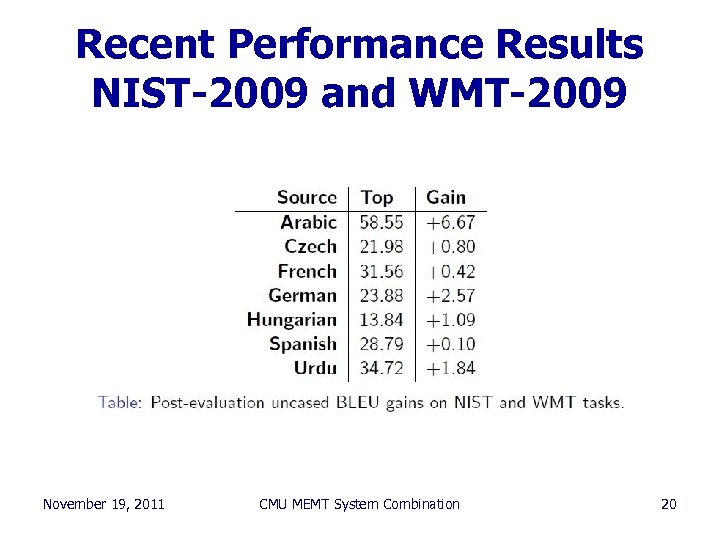
Recent Performance Results NIST-2009 and WMT-2009 November 19, 2011 CMU MEMT System Combination 20
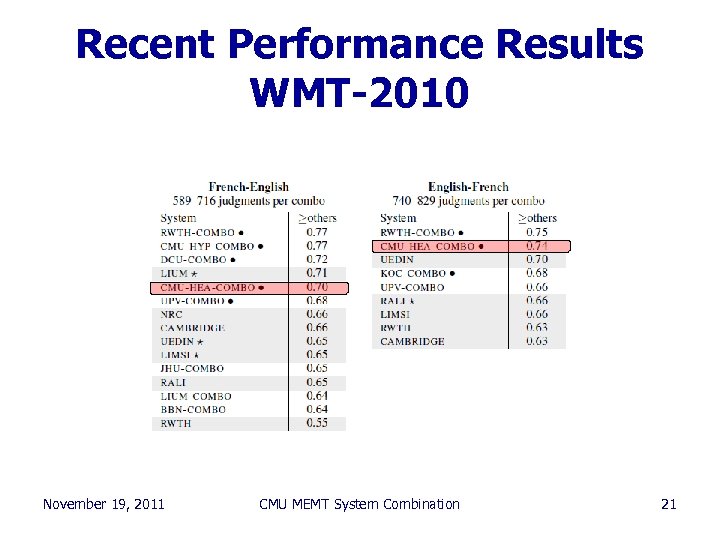
Recent Performance Results WMT-2010 November 19, 2011 CMU MEMT System Combination 21
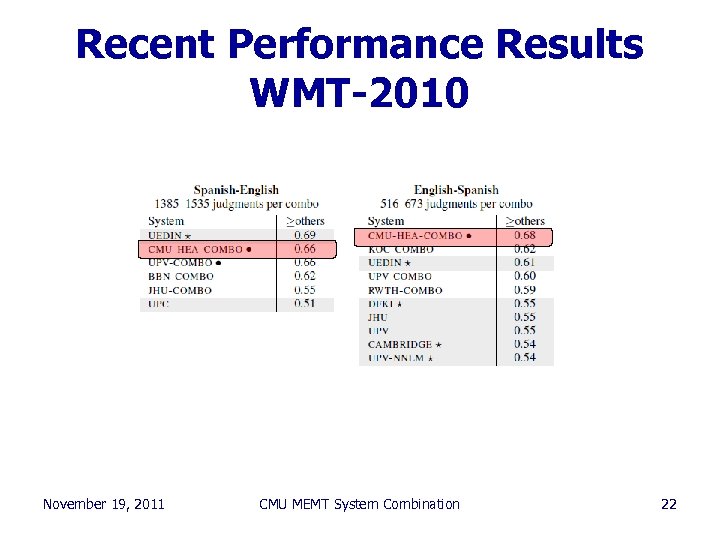
Recent Performance Results WMT-2010 November 19, 2011 CMU MEMT System Combination 22
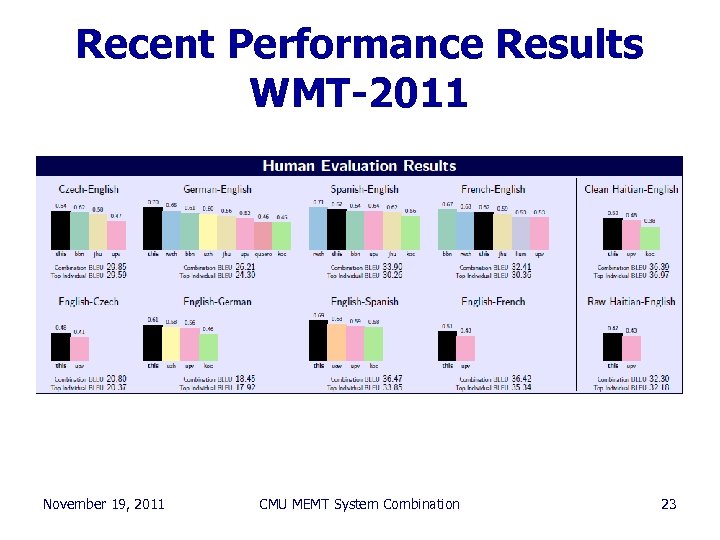
Recent Performance Results WMT-2011 November 19, 2011 CMU MEMT System Combination 23
![Smoothing MERT in SMT [Cettolo, Bertoldi and Federico 2011] • Interesting application of MT](https://present5.com/presentation/8ce19c9fd6e62650ca7671d45a0a41ca/image-24.jpg "Smoothing MERT in SMT [Cettolo, Bertoldi and Federico 2011] • Interesting application of MT")
Smoothing MERT in SMT [Cettolo, Bertoldi and Federico 2011] • Interesting application of MT system combination to overcome instability of MERT optimization in SMT – Perform MERT multiple times – Use the CMU MEMT system to combine the different instances of the same MT system November 19, 2011 CMU MEMT System Combination 24
CMU MEMT System is Open Source • http: //kheafield. com/code/memt/ • Open Source, LGPL license • Freely available for research and commercial use November 19, 2011 CMU MEMT System Combination 25
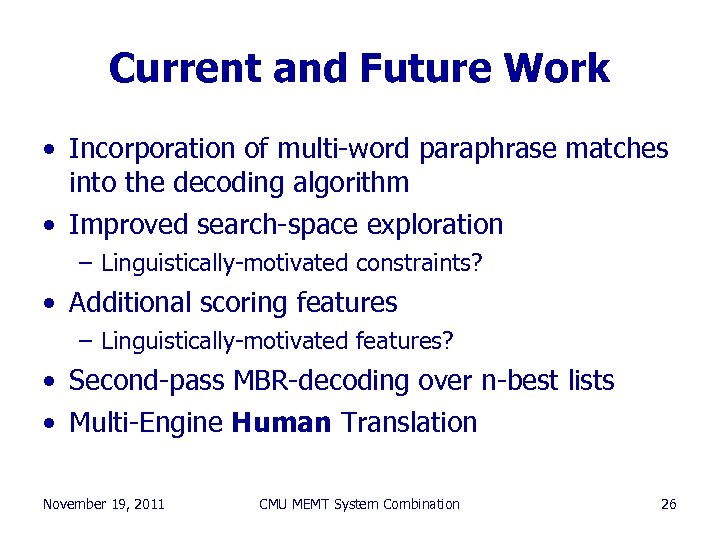
Current and Future Work • Incorporation of multi-word paraphrase matches into the decoding algorithm • Improved search-space exploration – Linguistically-motivated constraints? • Additional scoring features – Linguistically-motivated features? • Second-pass MBR-decoding over n-best lists • Multi-Engine Human Translation November 19, 2011 CMU MEMT System Combination 26
Скачать презентацию MEMT Alignment-based MT System Combination with Linguistic and
8ce19c9fd6e62650ca7671d45a0a41ca.ppt