


 Скачать презентацию Memory The persistence of learning over time through
89fc9a96ba69f2887757cb94355bc420.ppt
- Количество слайдов: 58
 Memory The persistence of learning over time through the storage and retrieval of information.
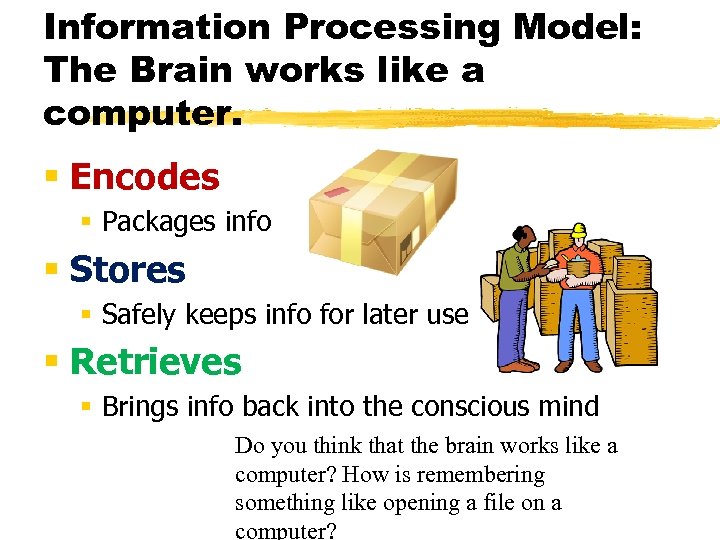 Information Processing Model: The Brain works like a computer. § Encodes § Packages info § Stores § Safely keeps info for later use § Retrieves § Brings info back into the conscious mind Do you think that the brain works like a computer? How is remembering something like opening a file on a computer?
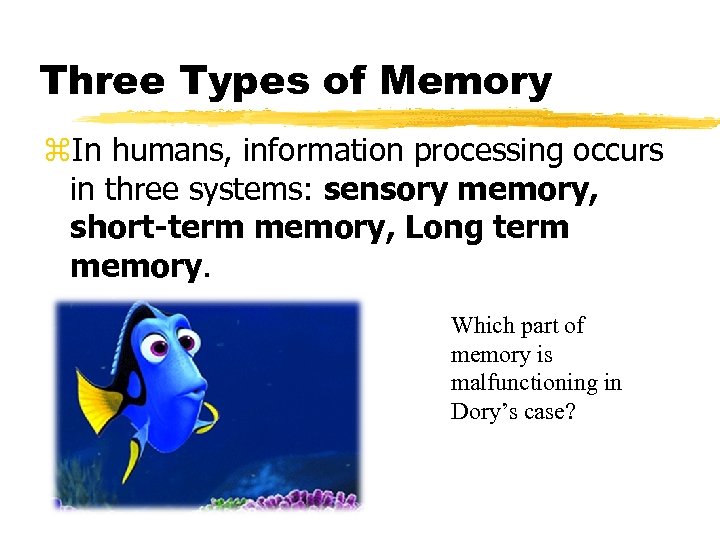 Three Types of Memory z. In humans, information processing occurs in three systems: sensory memory, short-term memory, Long term memory. Which part of memory is malfunctioning in Dory’s case?
 Let’s Examine our own thought process z. Get out a blank piece of paper and write down all responses that come to mind in the order that they occur Your Task: Name the seven dwarfs from “Snow White”
 How difficult was this task? Was it Easy or Hard Memory is the persistence of learning over time What are some factors that made it easy or hard? To name the 7 dwarfs we must z. Get the info into our brain (encoding) z. Retain it over time (storage) z. Get it back out (retrieval)
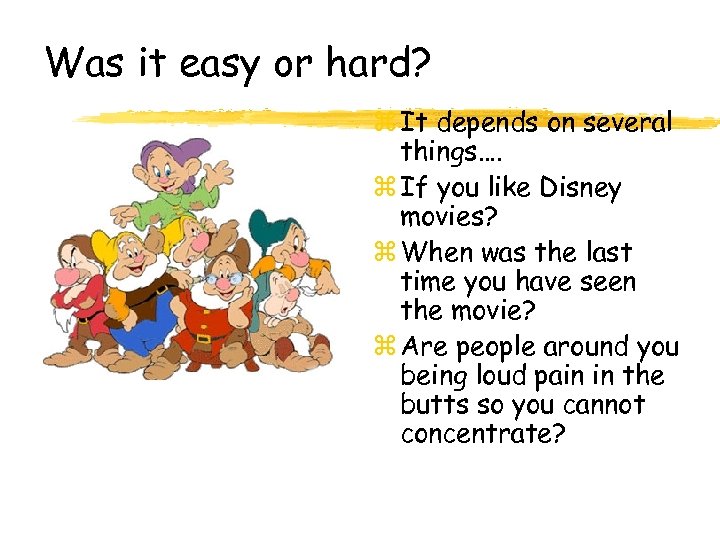 Was it easy or hard? z It depends on several things…. z If you like Disney movies? z When was the last time you have seen the movie? z Are people around you being loud pain in the butts so you cannot concentrate?
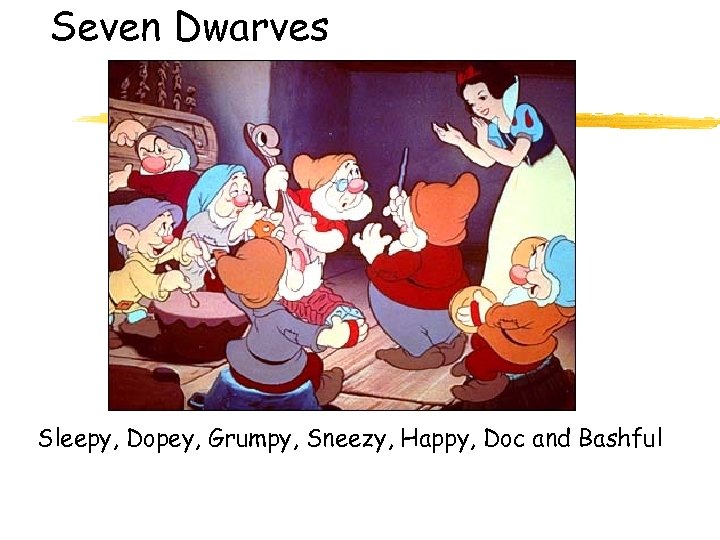 Seven Dwarves Sleepy, Dopey, Grumpy, Sneezy, Happy, Doc and Bashful
 Myers’ PSYCHOLOGY (7 th Ed) Chapter 9 Memory James A. Mc. Cubbin, Ph. D Clemson University Worth Publishers
 Memory § persistence of learning over time via the storage and retrieval of information § Flashbulb Memory § a clear memory of an emotionally significant moment or event
 Memory § Memory as Information Processing § similar to a computer § write to file § save to disk § read from disk § Encoding § the processing of information into the memory system § i. e. , extracting meaning
 Memory § Storage § the retention of encoded information over time § Retrieval § process of getting information out of memory
 Memory § Sensory Memory § the immediate, initial recording of sensory information in the memory system § Working Memory § focuses more on the processing of briefly stored information
 Memory § Short-Term Memory § activated memory that holds a few items briefly § look up a phone number, then quickly dial before the information is forgotten § Long-Term Memory § the relatively permanent and limitless storehouse of the memory system
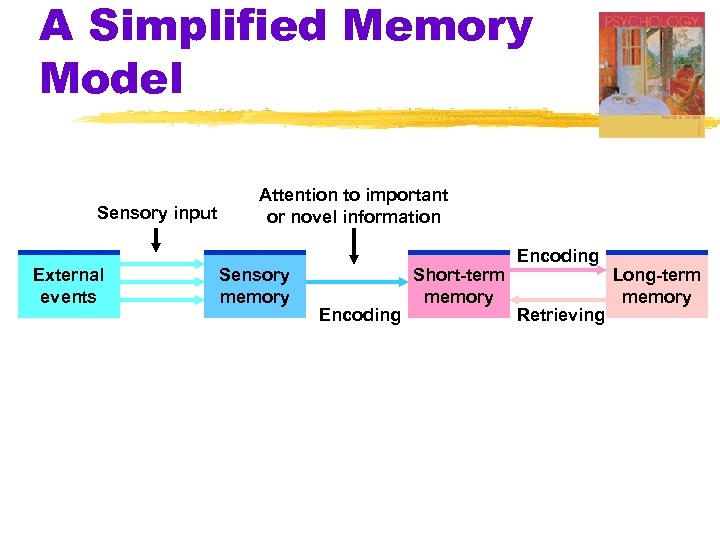 A Simplified Memory Model Sensory input External events Attention to important or novel information Sensory memory Encoding Short-term memory Encoding Retrieving Long-term memory
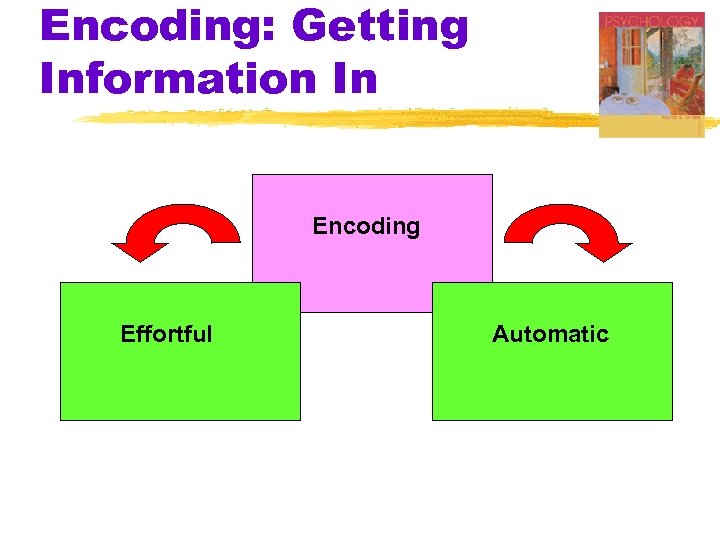 Encoding: Getting Information In Encoding Effortful Automatic
 Encoding § Automatic Processing § unconscious encoding of incidental information § space § time § frequency § well-learned information § word meanings § we can learn automatic processing § reading backwards
 Encoding § Effortful Processing § requires attention and conscious effort § Rehearsal § conscious repetition of information § to maintain it in consciousness § to encode it for storage
 Encoding § Ebbinghaus used nonsense syllables § TUV ZOF GEK WAV § the more times practiced on Day 1, the fewer repetitions to relearn on Day 2 § Spacing Effect § distributed practice yields better longterm retention than massed practice
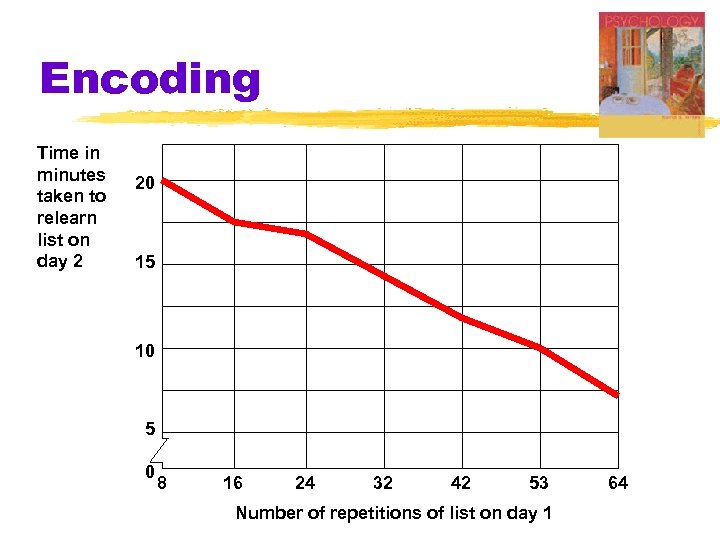 Encoding Time in minutes taken to relearn list on day 2 20 15 10 5 0 8 16 24 32 42 53 Number of repetitions of list on day 1 64
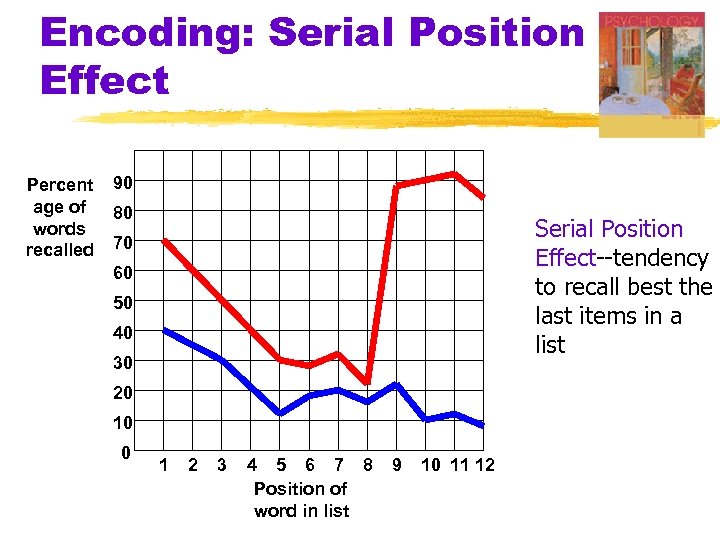 Encoding: Serial Position Effect Percent age of words recalled 90 80 Serial Position Effect--tendency to recall best the last items in a list 70 60 50 40 30 20 10 0 1 2 3 4 5 6 7 8 Position of word in list 9 10 11 12
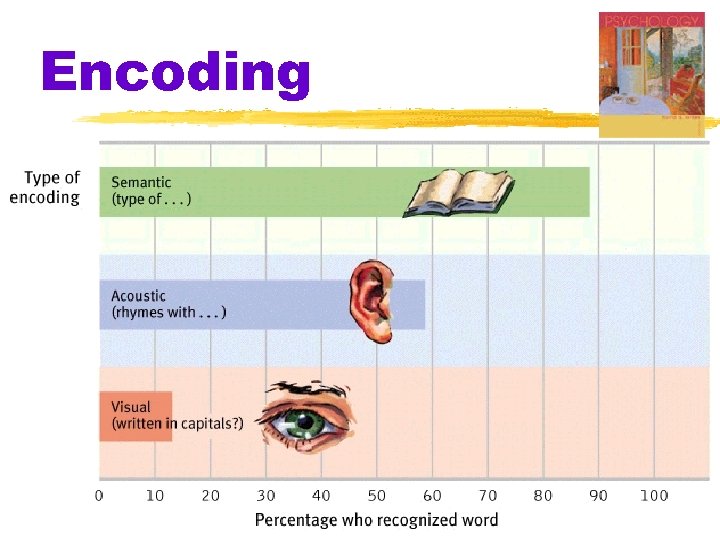
 What Do We Encode? § Semantic Encoding § encoding of meaning § including meaning of words § Acoustic Encoding § encoding of sound § especially sound of words § Visual Encoding § encoding of picture images
 Encoding
 Encoding § Imagery § mental pictures § a powerful aid to effortful processing, especially when combined with semantic encoding § Mnemonics § memory aids § especially those techniques that use vivid imagery and organizational devices
 Encoding § Chunking § organizing items into familiar, manageable units § like horizontal organization--1776149218121941 § often occurs automatically § use of acronyms § HOMES--Huron, Ontario, Michigan, Erie, Superior § ARITHMETIC--A Rat In Tom’s House Might Eat Tom’s Ice Cream
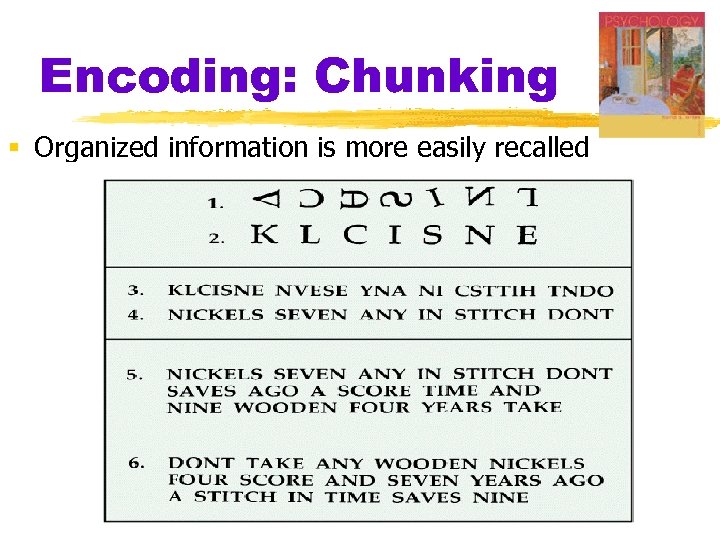 Encoding: Chunking § Organized information is more easily recalled
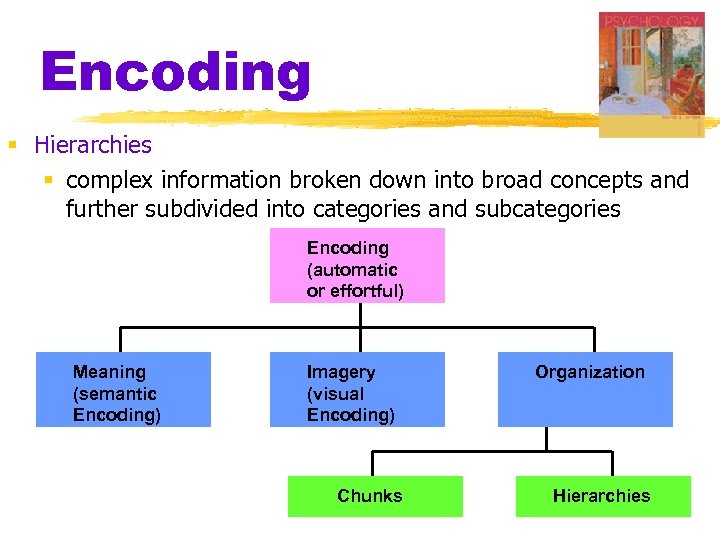 Encoding § Hierarchies § complex information broken down into broad concepts and further subdivided into categories and subcategories Encoding (automatic or effortful) Meaning (semantic Encoding) Imagery (visual Encoding) Chunks Organization Hierarchies
 Storage: Retaining Information § Iconic Memory § a momentary sensory memory of visual stimuli § a photographic or picture image memory lasting no more that a few tenths of a second § Echoic Memory § momentary sensory memory of auditory stimuli
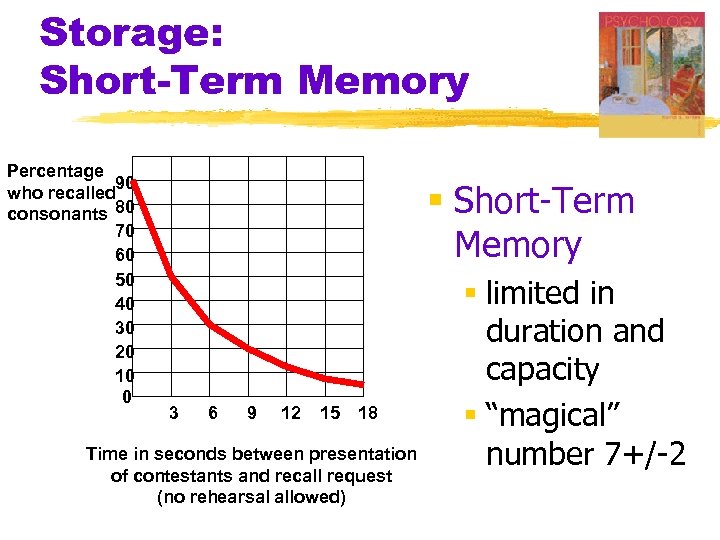 Storage: Short-Term Memory Percentage 90 who recalled consonants 80 70 60 50 40 30 20 10 0 § Short-Term Memory 3 6 9 12 15 18 Time in seconds between presentation of contestants and recall request (no rehearsal allowed) § limited in duration and capacity § “magical” number 7+/-2
 Storage: Long-Term Memory § How does storage work? § Karl Lashley (1950) § rats learn maze § lesion cortex § test memory § Synaptic changes § Long-term Potentiation § increase in synapse’s firing potential after brief, rapid stimulation § Strong emotions make for stronger memories § some stress hormones boost learning and retention
 Storage: Long-Term Memory § Amnesia--the loss of memory § Explicit Memory § memory of facts and experiences that one can consciously know and declare § also called declarative memory § hippocampus--neural center in limbic system that helps process explicit memories for storage § Implicit Memory § retention independent of conscious recollection § also called procedural memory
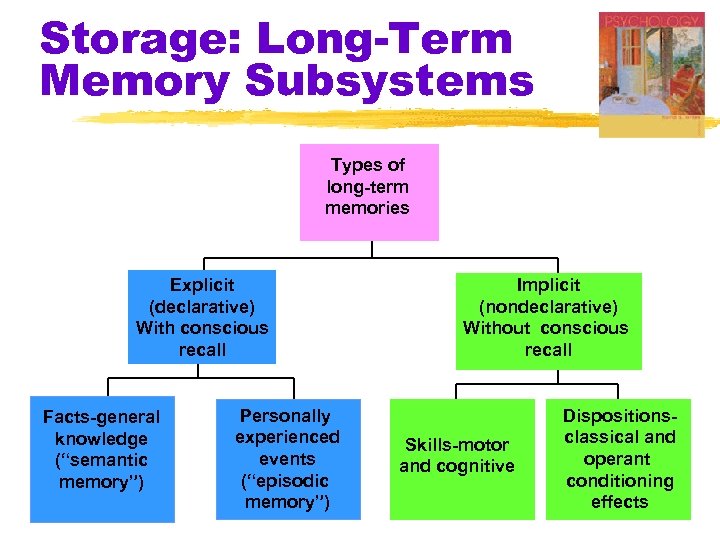 Storage: Long-Term Memory Subsystems Types of long-term memories Explicit (declarative) With conscious recall Facts-general knowledge (“semantic memory”) Personally experienced events (“episodic memory”) Implicit (nondeclarative) Without conscious recall Skills-motor and cognitive Dispositionsclassical and operant conditioning effects
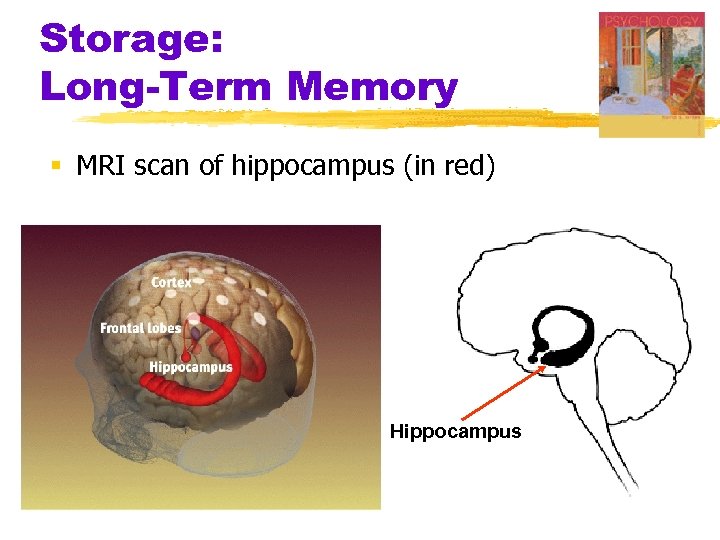 Storage: Long-Term Memory § MRI scan of hippocampus (in red) Hippocampus
 Retrieval: Getting Information Out § Recall § measure of memory in which the person must retrieve information learned earlier § as on a fill-in-the blank test § Recognition § Measure of memory in which the person has only to identify items previously learned § as on a multiple-choice test
 Retrieval § Relearning § memory measure that assesses the amount of time saved when learning material a second time § Priming § activation, often unconsciously, of particular associations in memory
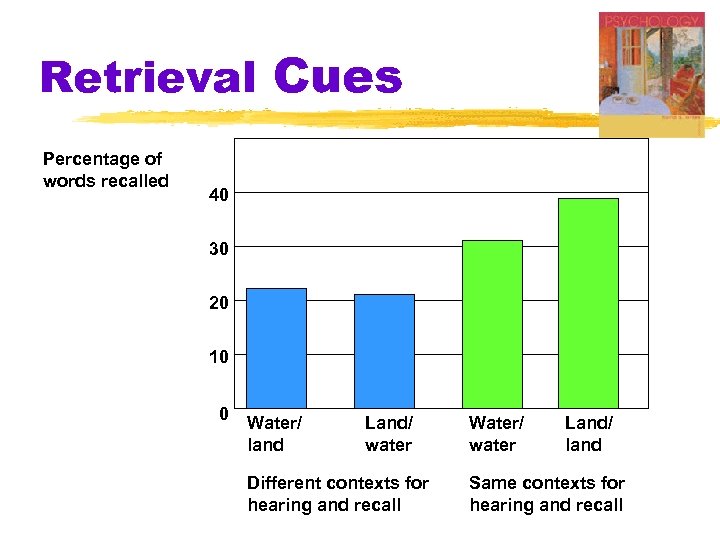 Retrieval Cues Percentage of words recalled 40 30 20 10 0 Water/ land Land/ water Different contexts for hearing and recall Water/ water Land/ land Same contexts for hearing and recall
 Retrieval Cues § Deja Vu (French)--already seen § cues from the current situation may subconsciously trigger retrieval of an earlier similar experience § "I've experienced this before. " § Mood-congruent Memory § tendency to recall experiences that are consistent with one’s current mood § memory, emotions, or moods serve as retrieval cues § State-dependent Memory § what is learned in one state (while one is high, drunk, or depressed) can more easily be remembered when in same state
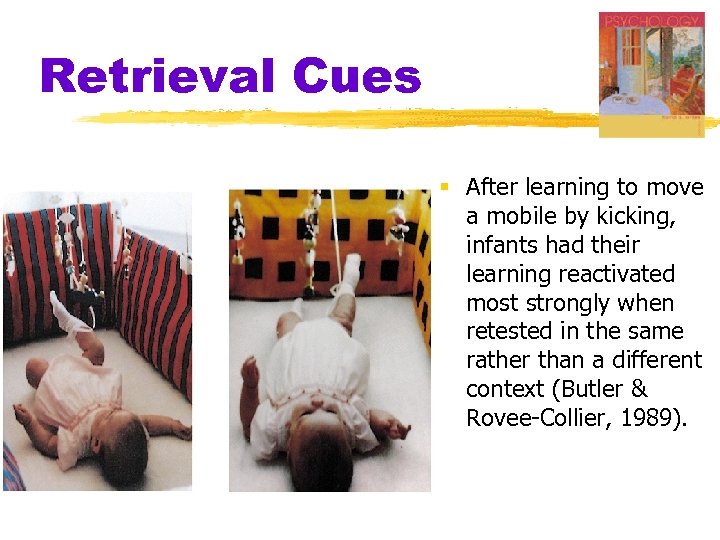 Retrieval Cues § After learning to move a mobile by kicking, infants had their learning reactivated most strongly when retested in the same rather than a different context (Butler & Rovee-Collier, 1989).
 Reasons for Forgetting z. Encoding failure y. Not storing information in the first place z. Decay y. Fading of memory traces in neurons x. Especially a problem with sensory memories and STM z. Cue-dependent y“tip of the tongue” Forgetting may be a result from retrieval failure rather than encoding or storage y. If you have the right trigger, you will remember
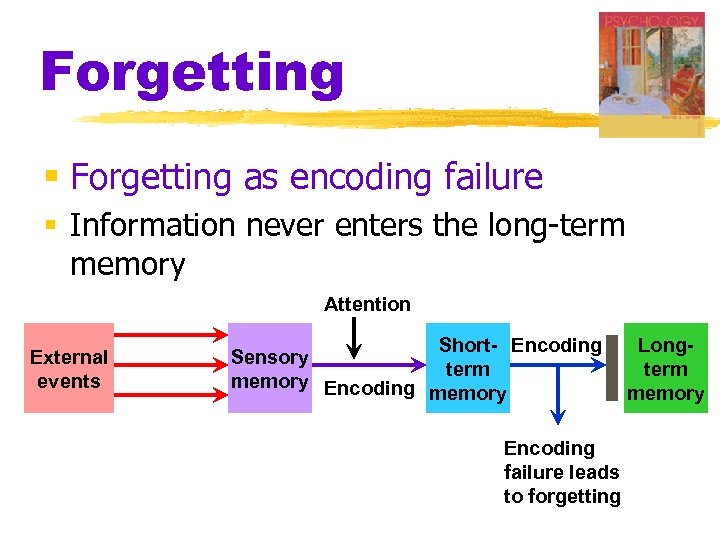 Forgetting § Forgetting as encoding failure § Information never enters the long-term memory Attention External events Short- Encoding Sensory term memory Encoding failure leads to forgetting Longterm memory
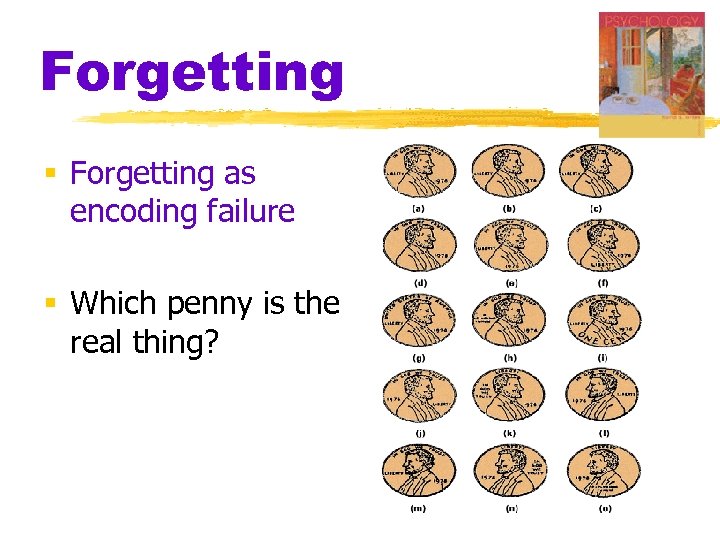 Forgetting § Forgetting as encoding failure § Which penny is the real thing?
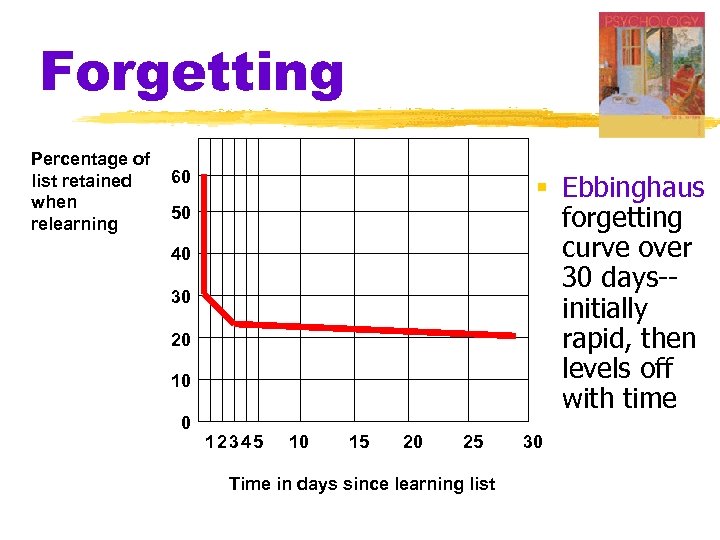 Forgetting Percentage of list retained when relearning 60 § Ebbinghaus forgetting curve over 30 days-initially rapid, then levels off with time 50 40 30 20 10 0 12345 10 15 20 25 Time in days since learning list 30
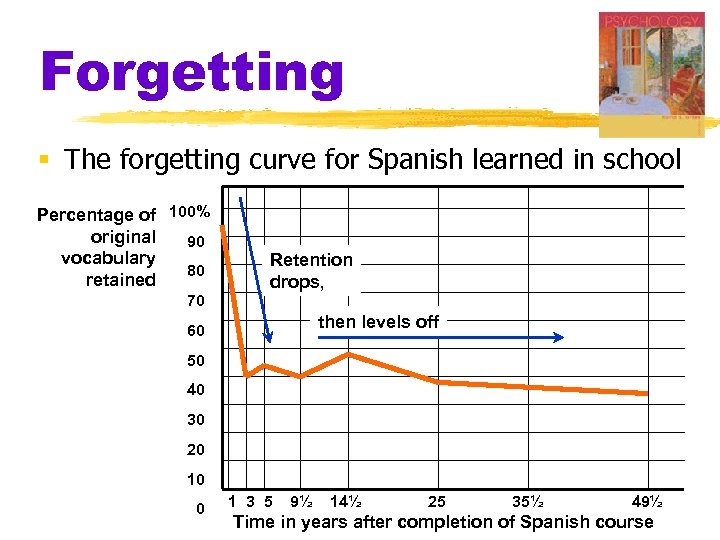 Forgetting § The forgetting curve for Spanish learned in school Percentage of 100% original 90 vocabulary 80 retained Retention drops, 70 then levels off 60 50 40 30 20 10 0 1 3 5 9½ 14½ 25 35½ 49½ Time in years after completion of Spanish course
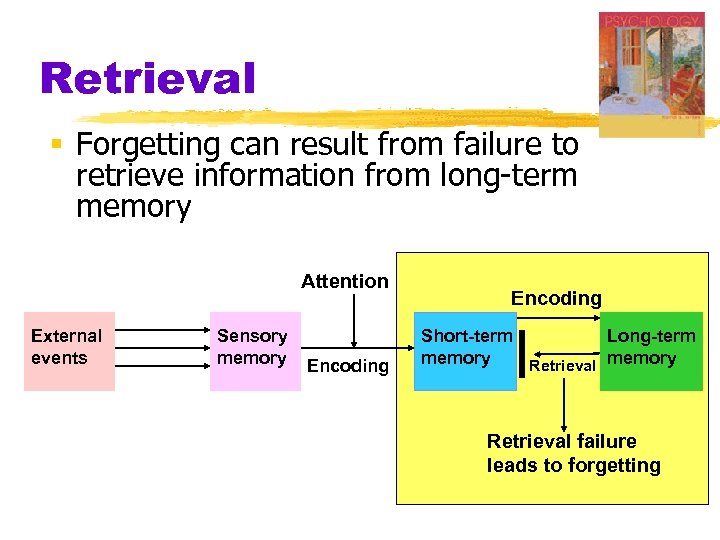 Retrieval § Forgetting can result from failure to retrieve information from long-term memory Attention External events Sensory memory Encoding Short-term Long-term memory Retrieval failure leads to forgetting
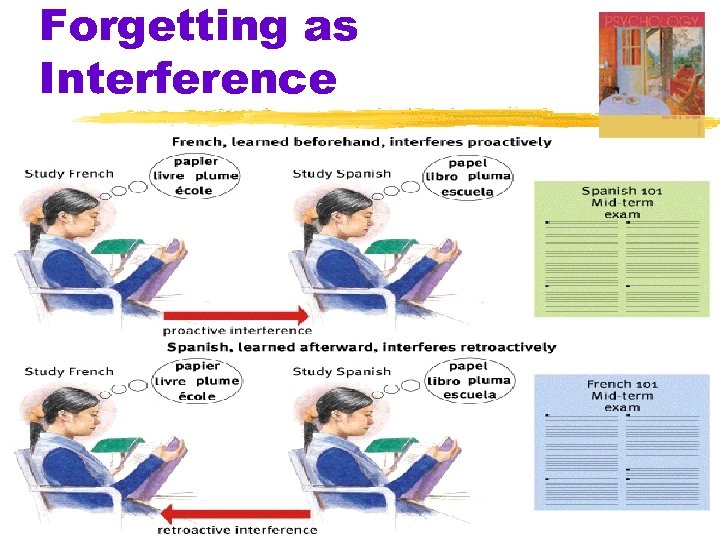
 Forgetting as Interference § Learning some items may disrupt retrieval of other information § Proactive (forward acting) Interference § disruptive effect of prior learning on recall of new information § Retroactive (backwards acting) Interference § disruptive effect of new learning on recall of old information
 Forgetting as Interference
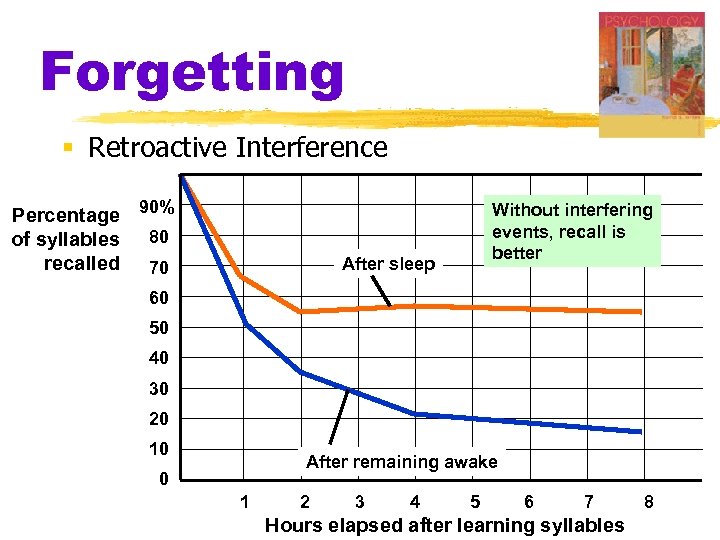 Forgetting § Retroactive Interference Percentage 90% of syllables 80 recalled 70 Without interfering events, recall is better After sleep 60 50 40 30 20 10 After remaining awake 0 1 2 3 4 5 6 7 Hours elapsed after learning syllables 8
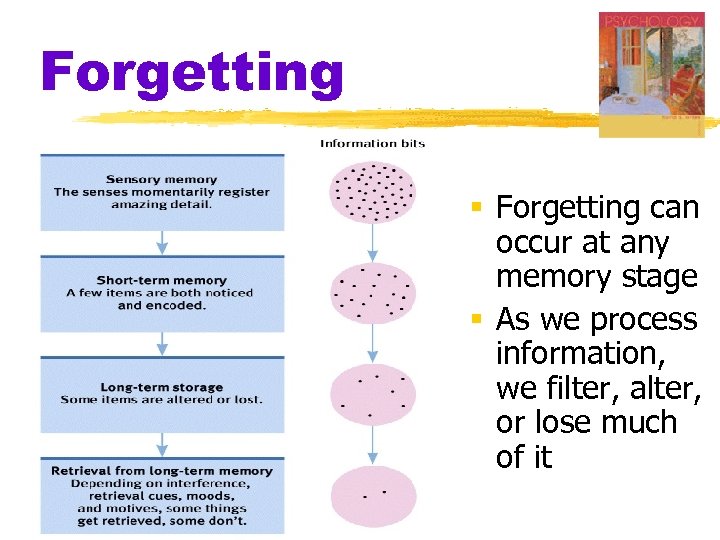 Forgetting § Forgetting can occur at any memory stage § As we process information, we filter, alter, or lose much of it
 Forgetting. Interference § Motivated Forgetting § people unknowingly revise memories § Repression § defense mechanism that banishes from consciousness anxiety-arousing thoughts, feelings, and memories
 Memory Construction § We filter information and fill in missing pieces § Misinformation Effect § incorporating misleading information into one's memory of an event § Source Amnesia § attributing to the wrong source an event that we experienced, heard about, read about, or imagined (misattribution)
 Memory Construction Depiction of actual accident § Eyewitnesses reconstruct memories when questioned Leading question: “About how fast were the cars going when they smashed into each other? ” Memory construction
 Memory Construction § Memories of Abuse § Repressed or Constructed? § Child sexual abuse does occur § Some adults do actually forget such episodes § False Memory Syndrome § condition in which a person’s identity and relationships center around a false but strongly believed memory of traumatic experience § sometimes induced by well-meaning therapists
 Memory Construction § Most people can agree on the following: Injustice happens Incest happens Forgetting happens Recovered memories are commonplace Memories recovered under hypnosis or drugs are especially unreliable § Memories of things happening before age 3 are unreliable § Memories, whether false or real, are upsetting § § §
 Improve Your Memory § Study repeatedly to boost recall § Spend more time rehearsing or actively thinking about the material § Make material personally meaningful § Use mnemonic devices § associate with peg words--something already stored § make up story § chunk--acronyms
 Improve Your Memory § Activate retrieval cues--mentally recreate situation and mood § Recall events while they are fresh-before you encounter misinformation § Minimize interference § Test your own knowledge § rehearse § determine what you do not yet know
 Reconstructive memory z. The process of piecing together memories by fitting them to a meaningful plan or organization. z. Accounts for much of the inaccuracy of our recollections. We fill in gaps with assumptions because we are uncomfortable with the gaps. Once we've done this, distinguishing what actually happened from what we filled in is almost impossible.
 A TWA Boeing 747 had just taken off from Miami International Airport for Los Angeles when a passenger near the rear of the aircraft announced that the plane was being taken over by the People's Revolutionary Army for the liberation of the oppressed. The hijacker then held a 357 magnum to the head of Jack Swanson, a flight attendant, and forced him to open the cockpit door. There, the hijacker confronted the pilot, Jane Randall, and ordered her to change the course for Cuba. The pilot radioed the Miami Air Traffic Control Center to report the situation but then suddenly hurled the microphone at the hijacker, who fell backward through the open cockpit door and onto the floor, where angry passengers took over from there. The plane landed in Miami a few minutes later and the hijacker was arrested.
 telling of the story are usually quite predictable and follow some basic principles of constructive memory. z describe how the story changed with the retelling z First, the story will get progressively shorter as some non-distinctive details -- the type of airplane, the name of the revolutionary group, and sometimes, the flight's origin and destination -- are left out. This is sometimes referred to as "leveling. " (Particularly distinctive details, such as the calibre of the gun, and, especially for female students, the gender of the pilot, are often retained; this is sometimes referred to as "sharpening. ")
 Video Questions z. Living with Amnesia