


 Скачать презентацию Memory Stores and Memory Processes What is your
072e270a3f8d80adf96657948c6003d7.ppt
- Количество слайдов: 54
 Memory Stores and Memory Processes What is your first memory? 2002/03/12 Psyc 202 -005, Copyright Jason Harrison 1
 Technological metaphors Plato: memory as an aviary, as a wax tablet Middle ages: memory as a book, as an empty cabinet 1944: Our memories are card-indexes consulted, and then put back in disorder by authorities whom we do not control (Cyril Connolly) 1950 s: memory as a telephone system 1960 s: present: memory as a kind of computer 2002/03/12 Psyc 202 -005, Copyright Jason Harrison 2
 Memory • Change blindness: – we don’t remember everything about a scene – but we do remember lots • Stores: What types of memory do we have? • Processes: How do these memory types work? 2002/03/12 Psyc 202 -005, Copyright Jason Harrison 3
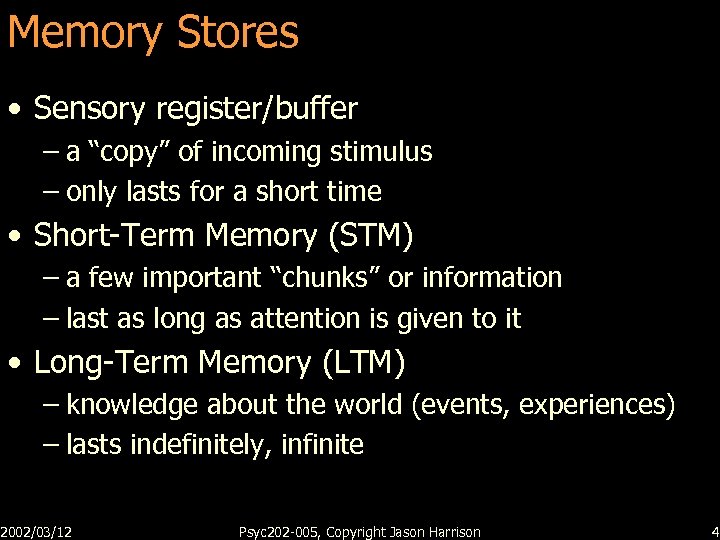 Memory Stores • Sensory register/buffer – a “copy” of incoming stimulus – only lasts for a short time • Short-Term Memory (STM) – a few important “chunks” or information – last as long as attention is given to it • Long-Term Memory (LTM) – knowledge about the world (events, experiences) – lasts indefinitely, infinite 2002/03/12 Psyc 202 -005, Copyright Jason Harrison 4
 Memory Processes • Encoding – putting information into a store • Maintenance – keeping it "alive” • Retrieval – finding encoded information 2002/03/12 Psyc 202 -005, Copyright Jason Harrison 5
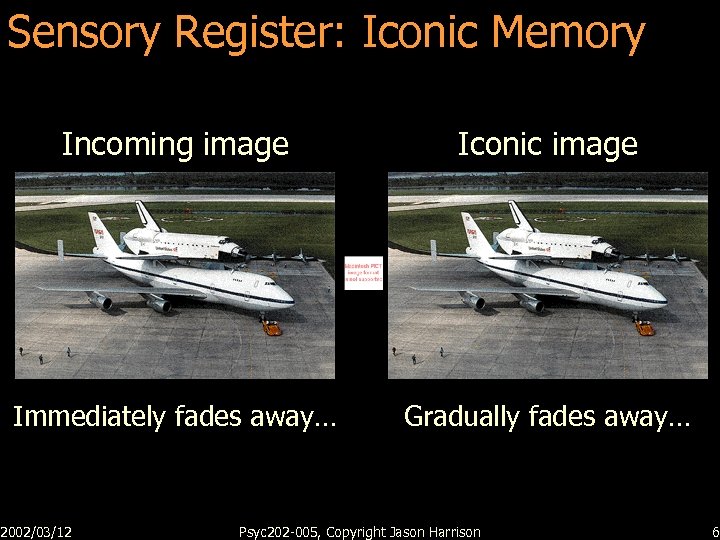 Sensory Register: Iconic Memory Incoming image Iconic image Immediately fades away… Gradually fades away… 2002/03/12 Psyc 202 -005, Copyright Jason Harrison 6
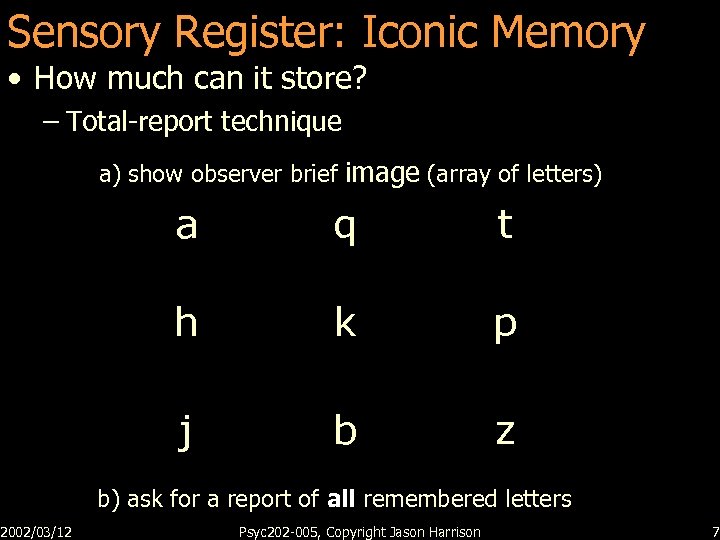 Sensory Register: Iconic Memory • How much can it store? – Total-report technique 2002/03/12 a) show observer brief image (array of letters) a q t h k p j b z b) ask for a report of all remembered letters Psyc 202 -005, Copyright Jason Harrison 7
 Total-Report Technique: results • Observers can reliably report 4 -5 items • Does this mean that only 4 -5 items can be stored? • No: – May only mean that 4 -5 items can be reported before items are forgotten. – Response mechanism (attention? ) takes time, iconic memory decays while reporting. • How to test? 2002/03/12 Psyc 202 -005, Copyright Jason Harrison 8
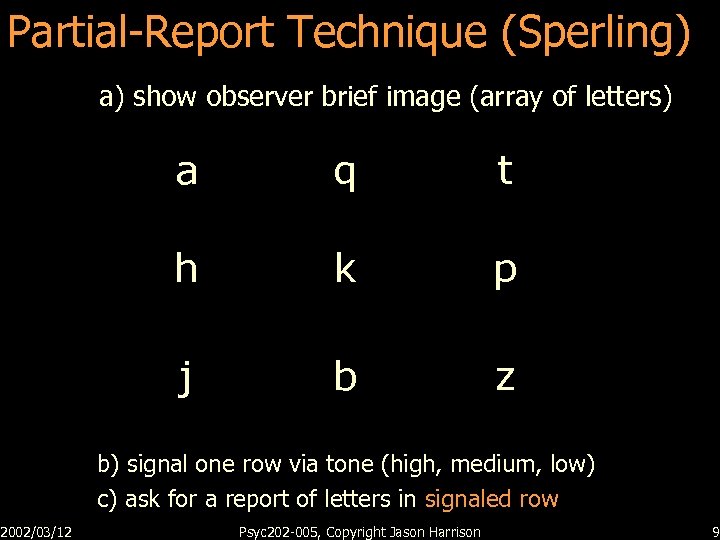 Partial-Report Technique (Sperling) 2002/03/12 a) show observer brief image (array of letters) a q t h k p j b z b) signal one row via tone (high, medium, low) c) ask for a report of letters in signaled row Psyc 202 -005, Copyright Jason Harrison 9
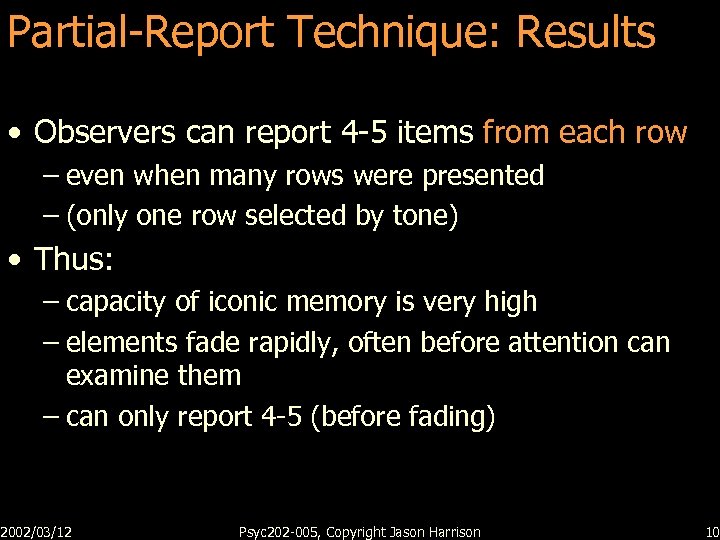 Partial-Report Technique: Results • Observers can report 4 -5 items from each row – even when many rows were presented – (only one row selected by tone) • Thus: – capacity of iconic memory is very high – elements fade rapidly, often before attention can examine them – can only report 4 -5 (before fading) 2002/03/12 Psyc 202 -005, Copyright Jason Harrison 10
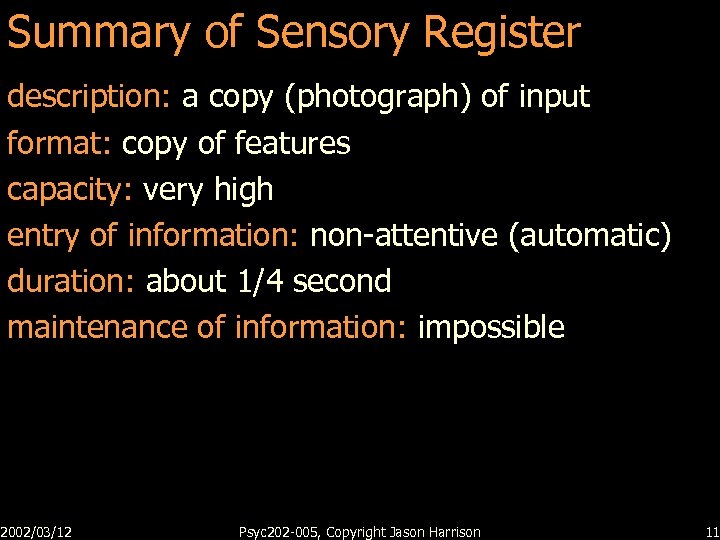 Summary of Sensory Register description: a copy (photograph) of input format: copy of features capacity: very high entry of information: non-attentive (automatic) duration: about 1/4 second maintenance of information: impossible 2002/03/12 Psyc 202 -005, Copyright Jason Harrison 11
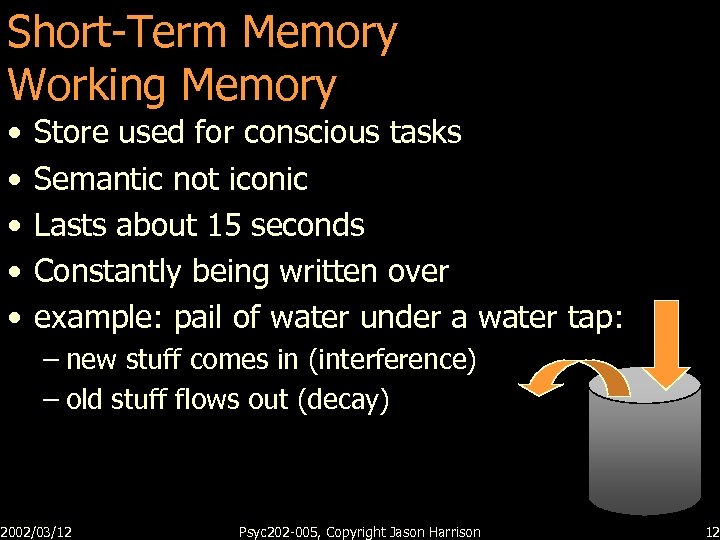 Short-Term Memory Working Memory • • • Store used for conscious tasks Semantic not iconic Lasts about 15 seconds Constantly being written over example: pail of water under a water tap: – new stuff comes in (interference) – old stuff flows out (decay) 2002/03/12 Psyc 202 -005, Copyright Jason Harrison 12
 Short-Term Memory (Working Memory) • is short term memory limited in size or duration? Test: briefly present subject with three consonants GCH When light goes on (after several seconds) say what the consonants were 2002/03/12 Psyc 202 -005, Copyright Jason Harrison 13
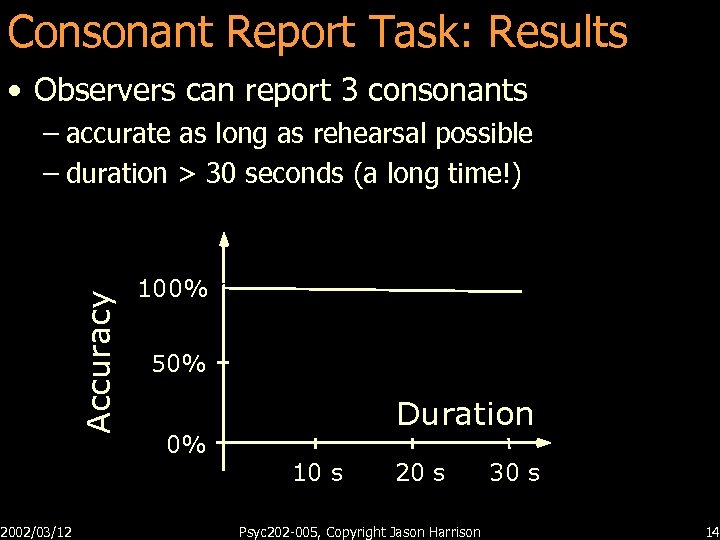 Consonant Report Task: Results • Observers can report 3 consonants 2002/03/12 Accuracy – accurate as long as rehearsal possible – duration > 30 seconds (a long time!) 100% 50% 0% Duration 10 s 20 s Psyc 202 -005, Copyright Jason Harrison 30 s 14
 Decay of Short-Term Memory • information quickly decays when rehearsal stops Briefly present subject with three consonants Then have them count backwards by 3 s out loud from given number KBS 504 When light goes on (after several seconds) say what the consonants were 2002/03/12 Psyc 202 -005, Copyright Jason Harrison 15
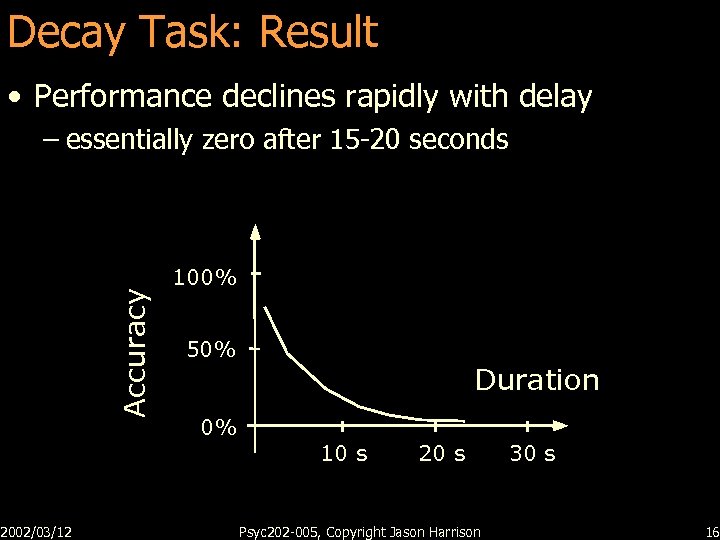 Decay Task: Result • Performance declines rapidly with delay 2002/03/12 Accuracy – essentially zero after 15 -20 seconds 100% 50% 0% Duration 10 s 20 s Psyc 202 -005, Copyright Jason Harrison 30 s 16
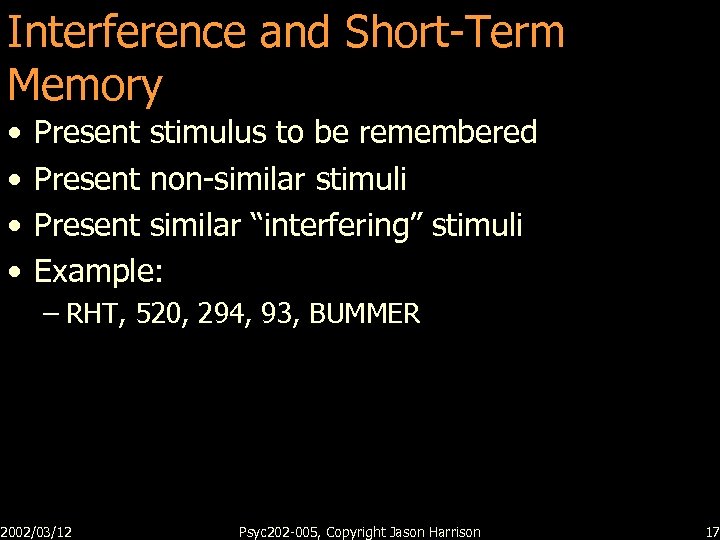 Interference and Short-Term Memory • • Present stimulus to be remembered Present non-similar stimuli Present similar “interfering” stimuli Example: – RHT, 520, 294, 93, BUMMER 2002/03/12 Psyc 202 -005, Copyright Jason Harrison 17
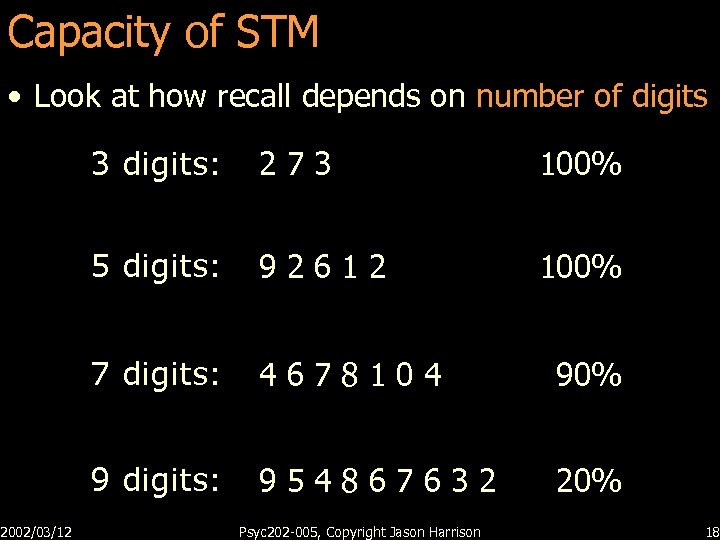 Capacity of STM • Look at how recall depends on number of digits 2002/03/12 3 digits: 273 100% 5 digits: 92612 100% 7 digits: 4678104 90% 9 digits: 954867632 20% Psyc 202 -005, Copyright Jason Harrison 18
 Capacity of STM • Number of digits recalled: digit span • Generically, capacity of STM: memory span • Miller: memory span is 7(± 2) items – this is true for vision, audition, etc. – “the magical number 7” • But. . 7 what? • What is an “item” • What are the units of STM? 2002/03/12 Psyc 202 -005, Copyright Jason Harrison 19
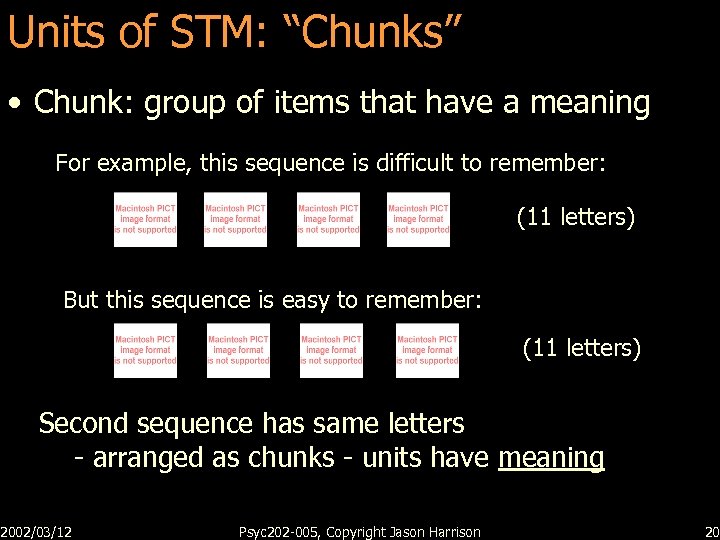 Units of STM: “Chunks” • Chunk: group of items that have a meaning For example, this sequence is difficult to remember: (11 letters) But this sequence is easy to remember: (11 letters) Second sequence has same letters - arranged as chunks - units have meaning 2002/03/12 Psyc 202 -005, Copyright Jason Harrison 20
 Methods for Searching STM • Phone up movie theatre and listen to list of movies currently playing • Answer the question: – Are they playing A Beautiful Mind? • To answer this question you could: – Parallel search – Serial, self-terminating search – Serial, exhaustive search • Which one is most plausible? • What are the implications of each one? 2002/03/12 Psyc 202 -005, Copyright Jason Harrison 21
 Searching STM (Sternberg) • Have subject remember 2 items in STM – e. g. , W X – ask whether an item was in list (X? ) – measure time taken to say “yes” or “no” • Increase number of items to 3 – e. g. , A X U • Repeat process for 4 items, 5 items, etc… • Look at time to say “yes” or “no” versus number of items in memory 2002/03/12 Psyc 202 -005, Copyright Jason Harrison 22
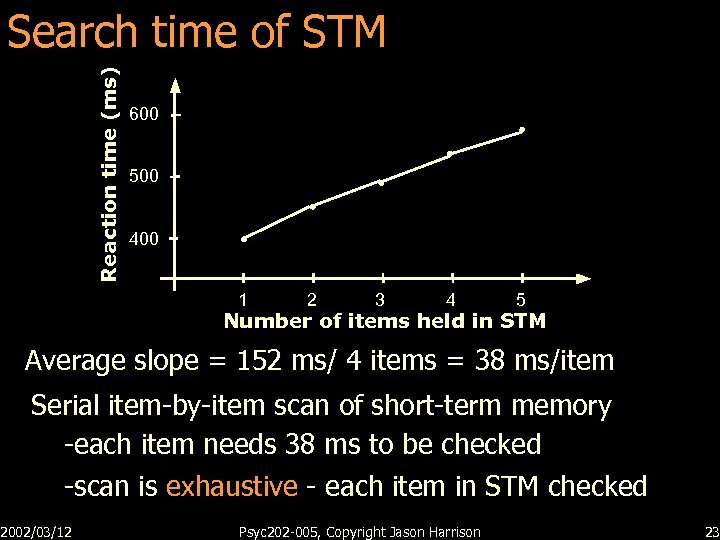 Reaction time (ms) Search time of STM 600 500 400 1 2 3 4 5 Number of items held in STM Average slope = 152 ms/ 4 items = 38 ms/item Serial item-by-item scan of short-term memory -each item needs 38 ms to be checked -scan is exhaustive - each item in STM checked 2002/03/12 Psyc 202 -005, Copyright Jason Harrison 23
 Applications of STM • Used for Many perceptual/cognitive tasks – tracking items across space – doing addition/subtraction – temporarily remembering phone numbers • Specialized STM systems for vision, audition, spatial, faces, etc. • Baddeley: general purpose “working memory” system 2002/03/12 Psyc 202 -005, Copyright Jason Harrison 24
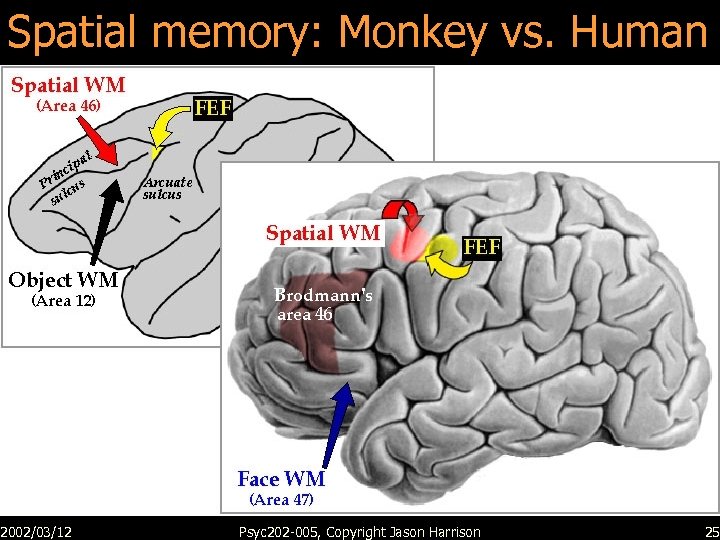 Spatial memory: Monkey vs. Human 2002/03/12 Psyc 202 -005, Copyright Jason Harrison 25
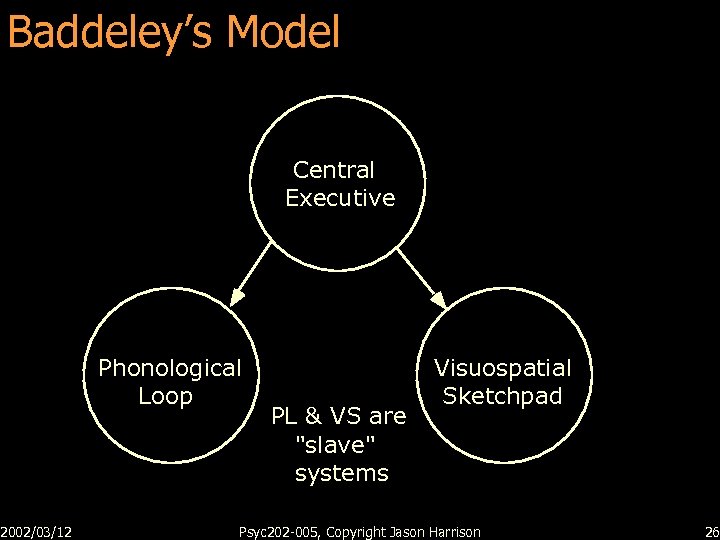 Baddeley’s Model 2002/03/12 Central Executive Phonological Loop PL & VS are "slave" systems Visuospatial Sketchpad Psyc 202 -005, Copyright Jason Harrison 26
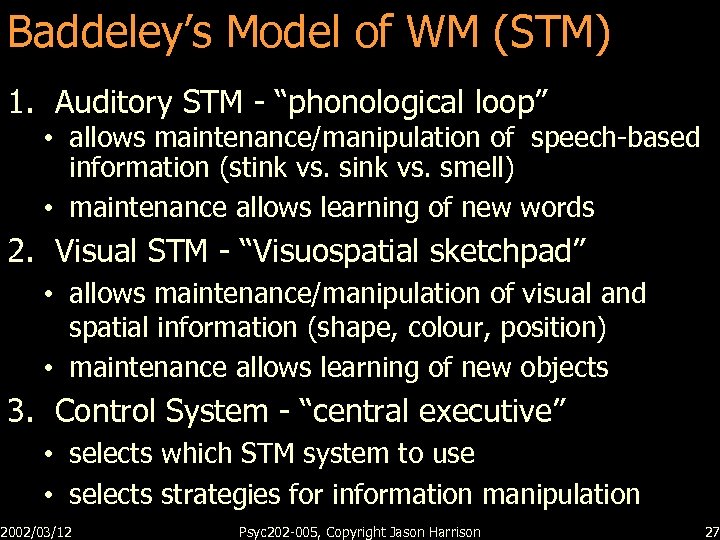 Baddeley’s Model of WM (STM) 1. Auditory STM - “phonological loop” • allows maintenance/manipulation of speech-based information (stink vs. smell) • maintenance allows learning of new words 2. Visual STM - “Visuospatial sketchpad” • allows maintenance/manipulation of visual and spatial information (shape, colour, position) • maintenance allows learning of new objects 3. Control System - “central executive” • selects which STM system to use • selects strategies for information manipulation 2002/03/12 Psyc 202 -005, Copyright Jason Harrison 27
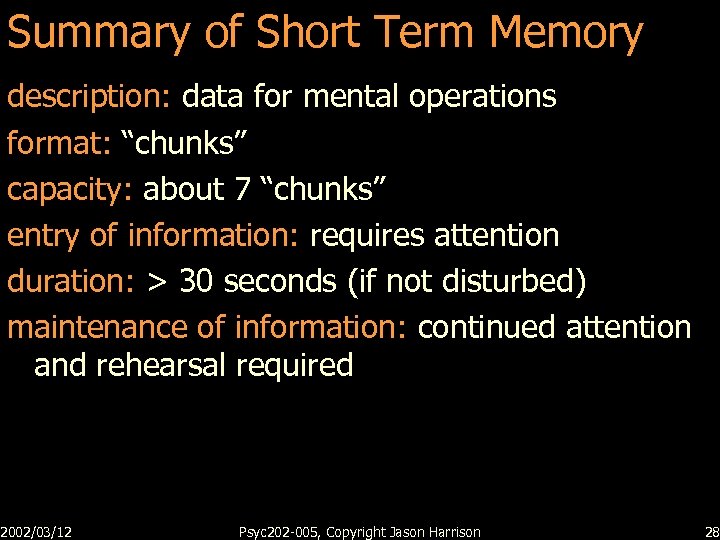 Summary of Short Term Memory description: data for mental operations format: “chunks” capacity: about 7 “chunks” entry of information: requires attention duration: > 30 seconds (if not disturbed) maintenance of information: continued attention and rehearsal required 2002/03/12 Psyc 202 -005, Copyright Jason Harrison 28
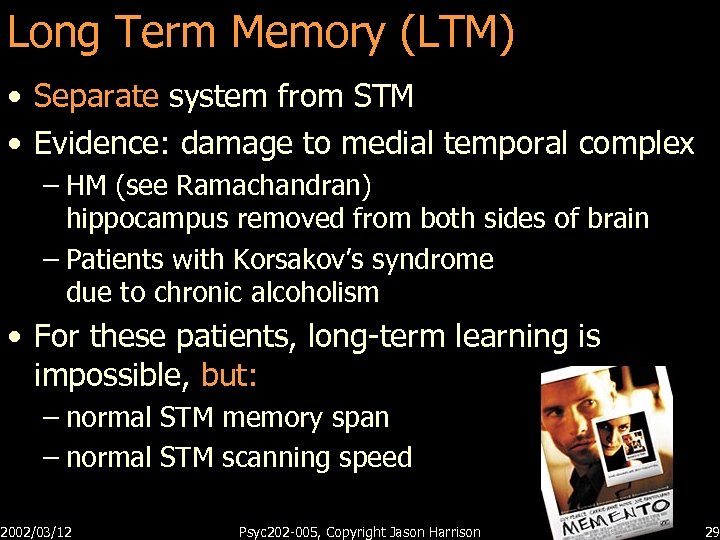 Long Term Memory (LTM) • Separate system from STM • Evidence: damage to medial temporal complex – HM (see Ramachandran) hippocampus removed from both sides of brain – Patients with Korsakov’s syndrome due to chronic alcoholism • For these patients, long-term learning is impossible, but: – normal STM memory span – normal STM scanning speed 2002/03/12 Psyc 202 -005, Copyright Jason Harrison 29
 Capacity of LTM • Essentially unlmited -- can always add more • But, this does not mean that everything is available later… • Recall different from Recognition 2002/03/12 Psyc 202 -005, Copyright Jason Harrison 30
 Recall versus Recognition • Recall – What did your learn in class today? – need to generate facts, ideas • Recognition – Did you learn about LTM in class today? – need to verify given facts, ideas • Which is more difficult? 2002/03/12 Psyc 202 -005, Copyright Jason Harrison 31
 Conway, Cohen & Stanhope (1991) • Test what was learned in university classes – recall of names and concepts – interval between 3 to 12 years • How much of this kind of knowledge is remembered and for how long? • Are some types of knowledge better remembered than others ? • Does knowledge undergo structural changes over time? • Do older people forget faster than young people? • Is very long term retention superior when students originally obtained high grades? • Do they remember it better if they found the material very interesting when they studied it? 2002/03/12 Psyc 202 -005, Copyright Jason Harrison 32
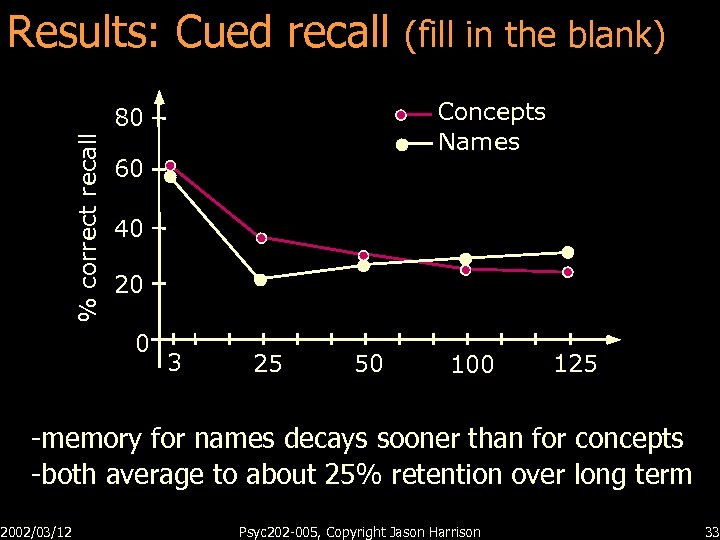 Results: Cued recall (fill in the blank) Concepts Names % correct recall 80 60 40 20 0 3 25 50 100 125 -memory for names decays sooner than for concepts -both average to about 25% retention over long term 2002/03/12 Psyc 202 -005, Copyright Jason Harrison 33
 Serial Position Effect (Rundus) • Does recall accuracy depend on position in list? • List of 20 nouns, one every 5 seconds – cat, ball, house, truck, pencil, vase, hose, book, lake… • Test recall as function of position • Two effects: primacy and recency 2002/03/12 Psyc 202 -005, Copyright Jason Harrison 34
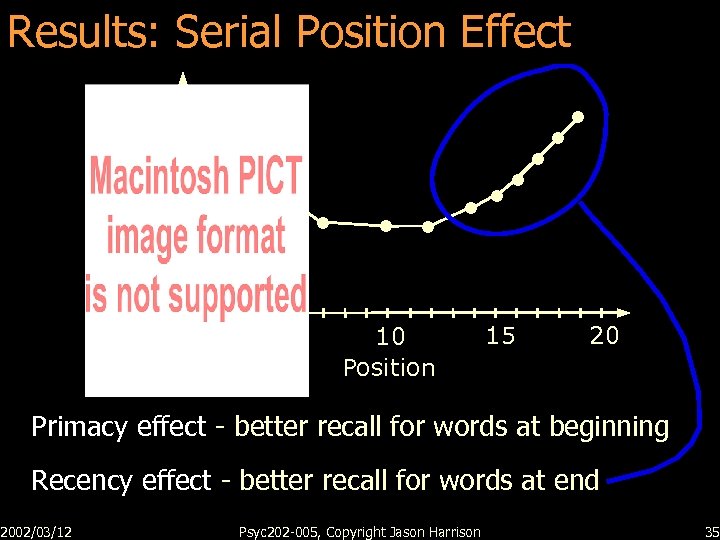 % correct recall Results: Serial Position Effect 80 60 40 20 0 1 5 10 Position 15 20 Primacy effect - better recall for words at beginning Recency effect - better recall for words at end 2002/03/12 Psyc 202 -005, Copyright Jason Harrison 35
 Primacy and Recency Effects • Primacy effect is due to… – greater rehearsal of items – more rehearsal, more chance to get into LTM – if rehearsal prevented, primacy effect disappears • Recency effect is due to… – items still in STM – if use of STM prevented (introduce another task before testing) recency effect disappears 2002/03/12 Psyc 202 -005, Copyright Jason Harrison 36
 Types of LTM • Most studies test for retention of words and concepts: semantic memory – general knowledge – not connected to any particular time or place – e. g. , • meanings of words, • random facts about world • rules of multiplication • What other type of memory is there? 2002/03/12 Psyc 202 -005, Copyright Jason Harrison 37
 Episodic Memory • knowledge connected to a particular time or place • not general – particular time or place or people • e. g. , – dinner I ate yesterday – house I lived in when I was 10 – what I did Sunday afternoon • often autobiographical events 2002/03/12 Psyc 202 -005, Copyright Jason Harrison 38
 Semantic versus Episodic Memory • Semantic: – who is the president of UBC? • Episodic: – when did you first hear of Martha Piper? • Amnesiacs generally more affected at level of episodic memory • Episodic memory forms basis for mental imagery – generation of internal images (e. g. , mom’s face) 2002/03/12 Psyc 202 -005, Copyright Jason Harrison 39
 Mental Imagery • Internal genration of “images” • Provides answers to questions about particular things: – Where is the clock tower in relation to the Main Library? • Kosslyn – experiments on brain activity – imagery is vision “run backwards” 2002/03/12 Psyc 202 -005, Copyright Jason Harrison 40
 Vision: forward process • input activates visual cortex (V 1) • this activates higher centres 2002/03/12 Psyc 202 -005, Copyright Jason Harrison 41
 Imagery: backwards process • higher centres activate V 1 • activation of V 1 gives “visual impression” • 5% of population cannot do this 2002/03/12 Psyc 202 -005, Copyright Jason Harrison 42
 Application of mental imagery Roman Room (“Method of Loci”) • 1. 2. 3. used by Roman orators to memorize long speeches Pick a place you know well (e. g. , your bedroom) Find a path to travel around the room Find items that suggest topics to be remembered • e. g, hospital, doctor, cash 4. Place small-scale versions of these along path • according to order of speech 5. To recall, imagine walking around room • path helps you remember items • items help you remember topics 2002/03/12 Psyc 202 -005, Copyright Jason Harrison 43
 Improving LTM • “Use it or lose it” – LTM doesn’t become stronger with use – But techniques you use do! • To improve memory retention – More rehearsal (e. g. , writing, review) • increase probability of transfer to LTM – More connections to existing knowledge • either semantic or episodic memories – Sleep (8+ hours every night) 2002/03/12 • memory consolidation occurs during REM Psyc 202 -005, Copyright Jason Harrison 44
 Any other types of memory? • Explicit memory – semantic – episodic • Implicit memory – procedural – priming 2002/03/12 Psyc 202 -005, Copyright Jason Harrison 45
 Implicit Memory • Memory formed without awareness – you didn’t try to remember it but you did anyway – you didn’t try to recall it but you did anyway • Two main types – procedural memory: how to do things – priming: bias towards recall based on cue 2002/03/12 Psyc 202 -005, Copyright Jason Harrison 46
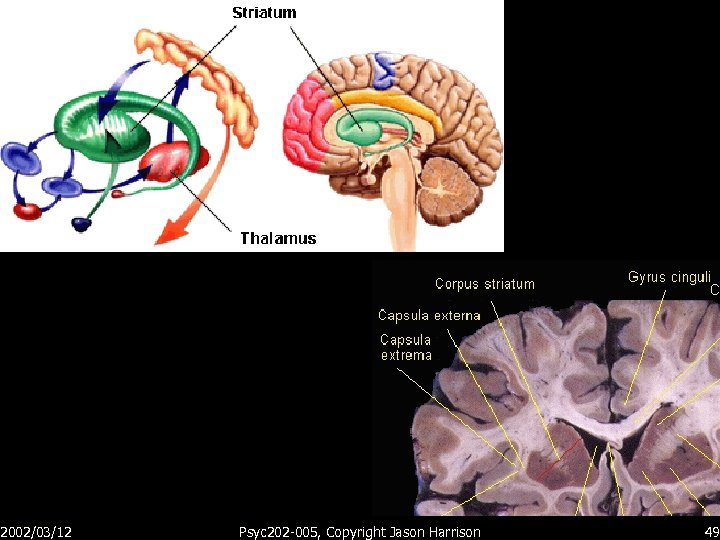
 Procedural Memory: Notes • memory for actions, operations, skills, etc. – e. g, how to tie shoelaces, ride a bike, start your car • “automatic” but difficult to know how you do something: – can only start at particular points – memory not easily accessed consciously • May involve “zombie” – procedural amnesia when striatum damaged (part of midbrain near neocortex) – HM has procedural memory (hippocampus removed; striatum intact) 2002/03/12 Psyc 202 -005, Copyright Jason Harrison 47
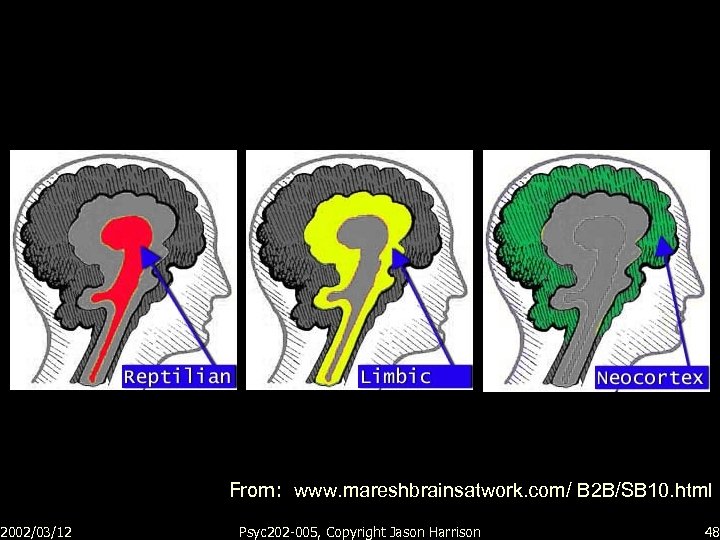 2002/03/12 From: www. mareshbrainsatwork. com/ B 2 B/SB 10. html Psyc 202 -005, Copyright Jason Harrison 48
 2002/03/12 Psyc 202 -005, Copyright Jason Harrison 49
 Priming • Facilitation of a ability to recognize words, images based on prior exposure • May not consciously remember prior exposure • May not consciously see “prime” • Increase of 5 -10% over non-primed stimuli • e. g. , – prime with word -- show incomplete word -- ask for completions – prime with named images -- show many more images -- ask for their names 2002/03/12 Psyc 202 -005, Copyright Jason Harrison 50
 Priming with words 2002/03/12 clown Psyc 202 -005, Copyright Jason Harrison 51
 Priming with words • Complete the word: 2002/03/12 c l o_ _ Psyc 202 -005, Copyright Jason Harrison 52
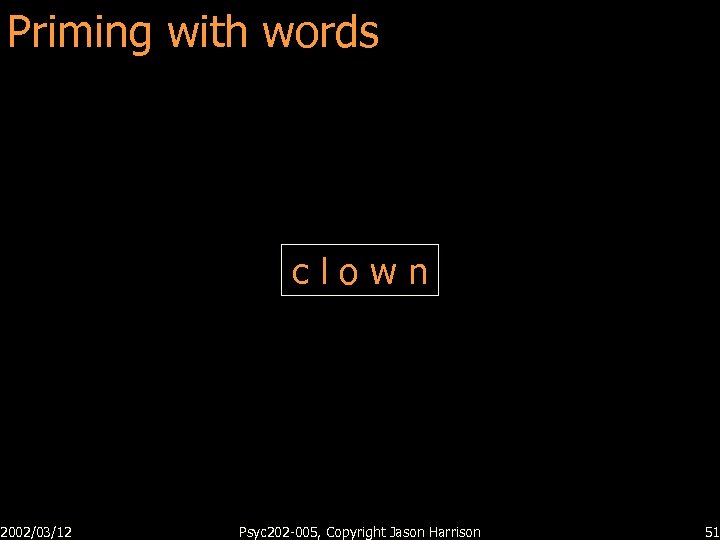
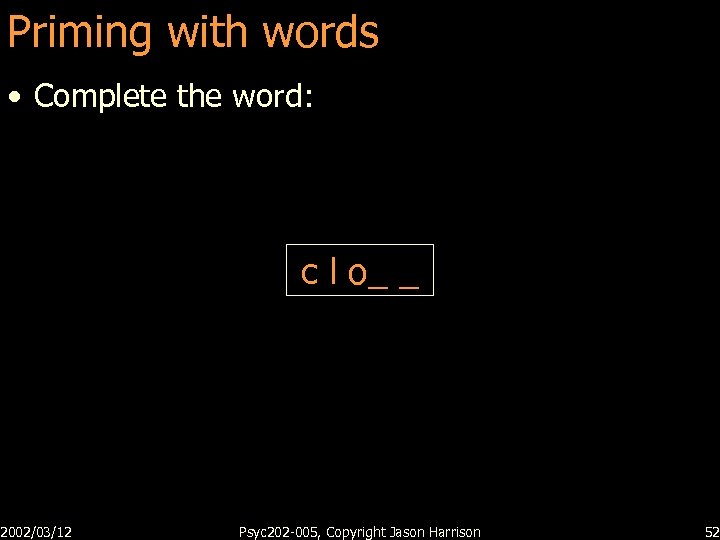
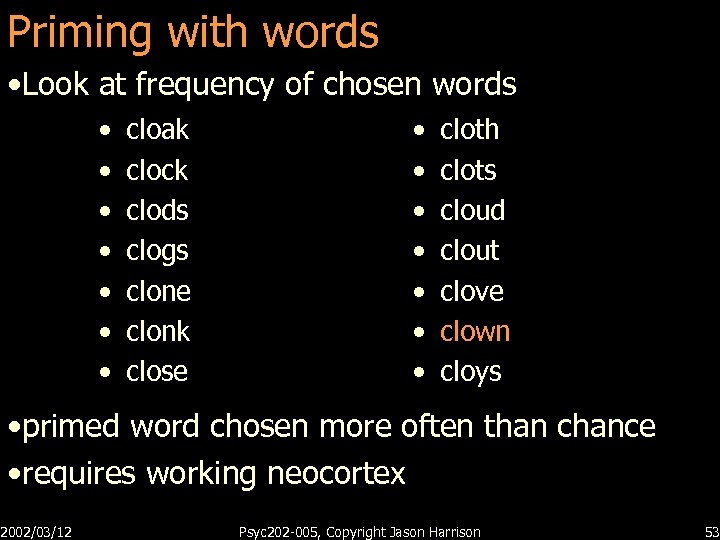 Priming with words • Look at frequency of chosen words • • cloak clock clods clogs clone clonk close • • cloth clots cloud clout clove clown cloys • primed word chosen more often than chance • requires working neocortex 2002/03/12 Psyc 202 -005, Copyright Jason Harrison 53
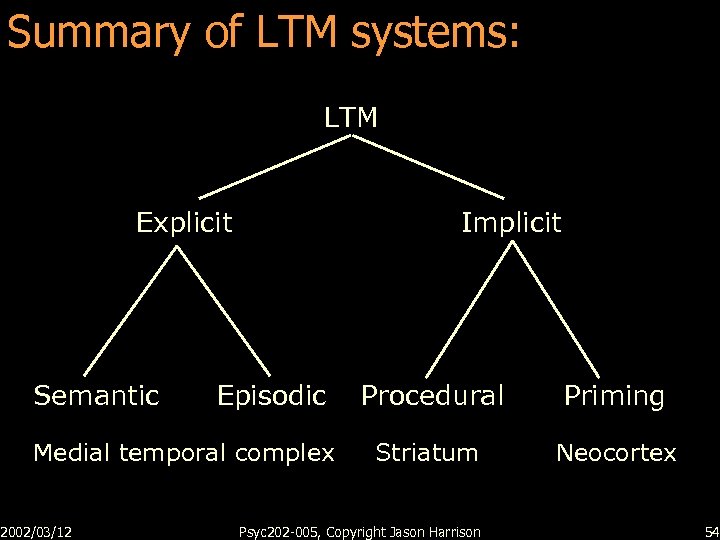 Summary of LTM systems: LTM Explicit Semantic Implicit Episodic Medial temporal complex 2002/03/12 Procedural Priming Striatum Neocortex Psyc 202 -005, Copyright Jason Harrison 54