


 Скачать презентацию MEMORY OPTIMIZATION Christer Ericson Sony Computer Entertainment Santa
0b43b3885bce7fa4c169869bdfd1d886.ppt
- Количество слайдов: 60
 MEMORY OPTIMIZATION Christer Ericson Sony Computer Entertainment, Santa Monica (christer_ericson@playstation. sony. com)
 Talk contents 1/2 ► Problem statement § Why “memory optimization? ” ► Brief architecture overview § The memory hierarchy ► Optimizing for (code and) data cache § General suggestions § Data structures ►… ►Prefetching and preloading ►Structure layout ►Tree structures ►Linearization caching
 Talk contents 2/2 ►… ► Aliasing § Abstraction penalty problem § Alias analysis (type-based) § ‘restrict’ pointers § Tips for reducing aliasing
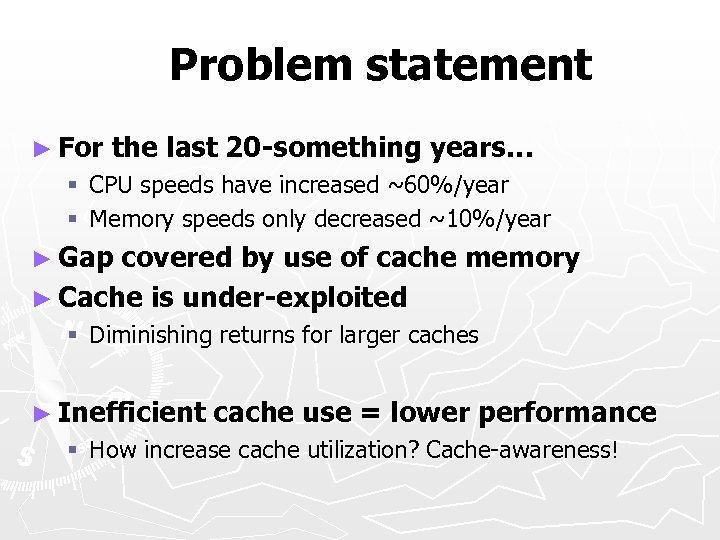 Problem statement ► For the last 20 -something years… § CPU speeds have increased ~60%/year § Memory speeds only decreased ~10%/year ► Gap covered by use of cache memory ► Cache is under-exploited § Diminishing returns for larger caches ► Inefficient cache use = lower performance § How increase cache utilization? Cache-awareness!
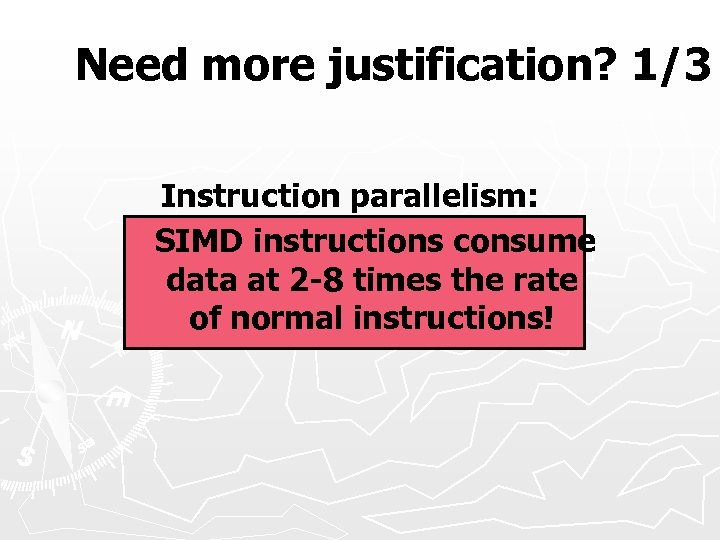 Need more justification? 1/3 Instruction parallelism: SIMD instructions consume data at 2 -8 times the rate of normal instructions!
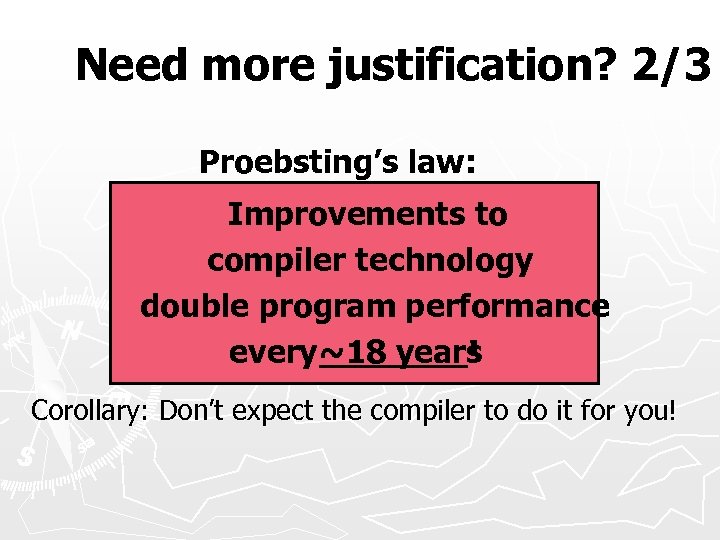 Need more justification? 2/3 Proebsting’s law: Improvements to compiler technology double program performance every ~18 years ! Corollary: Don’t expect the compiler to do it for you!
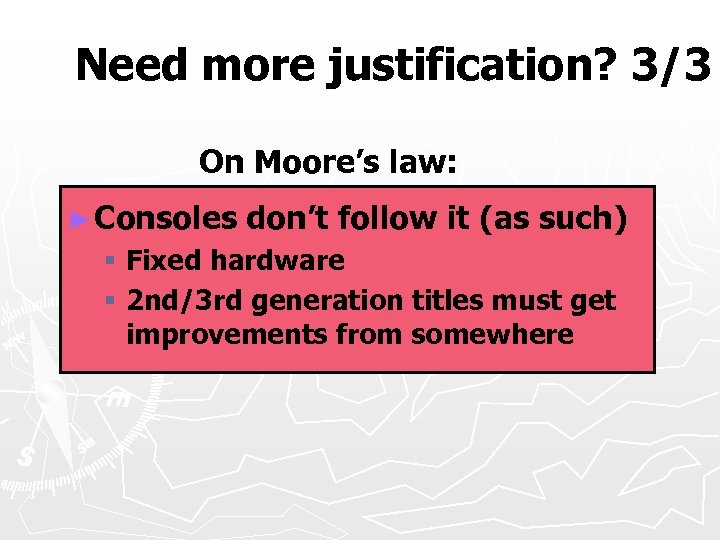 Need more justification? 3/3 On Moore’s law: ► Consoles don’t follow it (as such) § Fixed hardware § 2 nd/3 rd generation titles must get improvements from somewhere
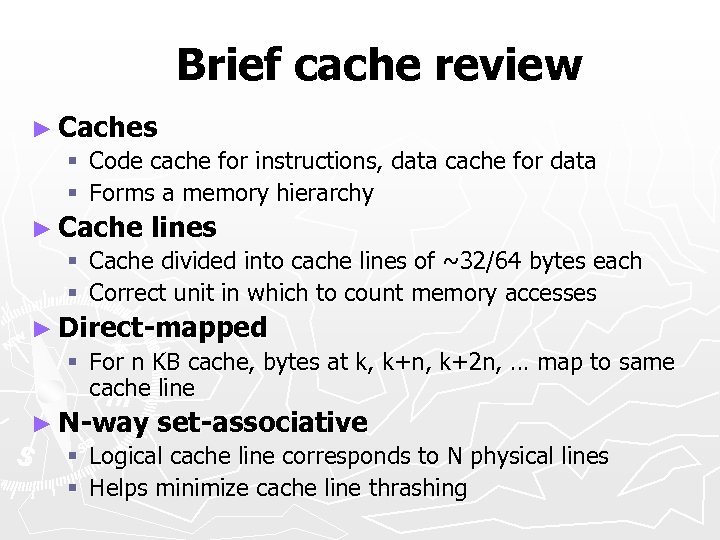 Brief cache review ► Caches § Code cache for instructions, data cache for data § Forms a memory hierarchy ► Cache lines § Cache divided into cache lines of ~32/64 bytes each § Correct unit in which to count memory accesses ► Direct-mapped § For n KB cache, bytes at k, k+n, k+2 n, … map to same cache line ► N-way set-associative § Logical cache line corresponds to N physical lines § Helps minimize cache line thrashing
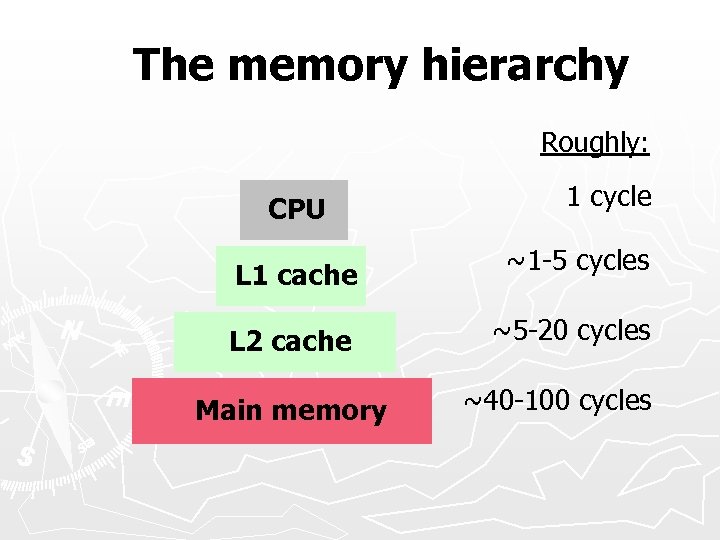 The memory hierarchy Roughly: CPU L 1 cache L 2 cache Main memory 1 cycle ~1 -5 cycles ~5 -20 cycles ~40 -100 cycles
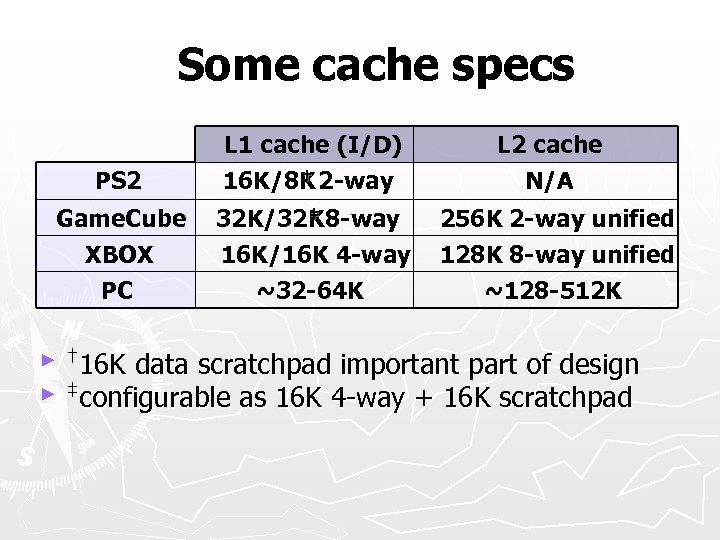 Some cache specs PS 2 L 1 cache (I/D) † 16 K/8 K 2 -way Game. Cube XBOX ‡ 32 K/32 K 8 -way 16 K/16 K 4 -way 256 K 2 -way unified 128 K 8 -way unified PC ~32 -64 K ~128 -512 K ► ► † 16 K L 2 cache N/A data scratchpad important part of design ‡configurable as 16 K 4 -way + 16 K scratchpad
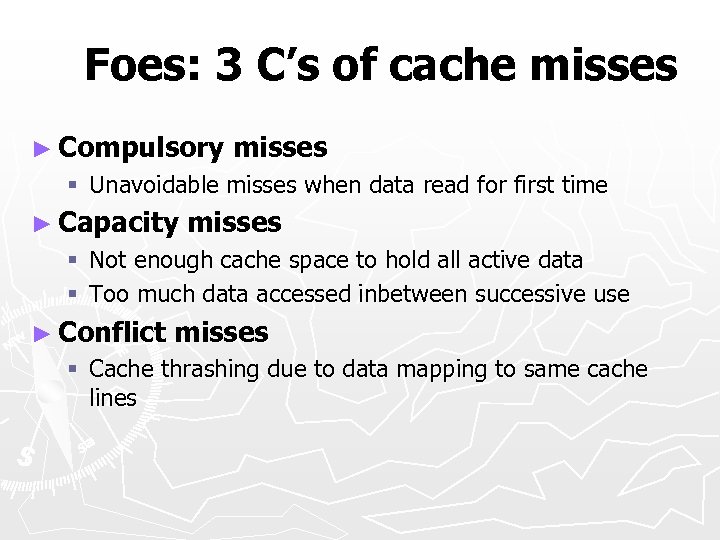 Foes: 3 C’s of cache misses ► Compulsory misses § Unavoidable misses when data read for first time ► Capacity misses § Not enough cache space to hold all active data § Too much data accessed inbetween successive use ► Conflict misses § Cache thrashing due to data mapping to same cache lines
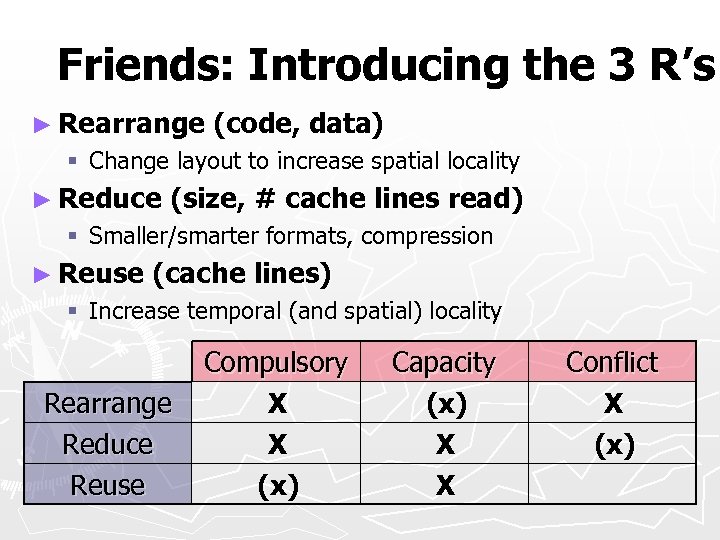 Friends: Introducing the 3 R’s ► Rearrange (code, data) § Change layout to increase spatial locality ► Reduce (size, # cache lines read) § Smaller/smarter formats, compression ► Reuse (cache lines) § Increase temporal (and spatial) locality Rearrange Reduce Reuse Compulsory X X (x) Capacity (x) X X Conflict X (x)
 Measuring cache utilization ► Profile § CPU performance/event counters ►Give memory access statistics ►But not access patterns (e. g. stride) § Commercial products ►SN Systems’ Tuner, Metrowerks’ CATS, Intel’s VTune § Roll your own gcc ‘-p’ option + define _mcount() ►Instrument code with calls to logging class ►In § Do back-of-the-envelope comparison ► Study the generated code
 Code cache optimization 1/2 ► Locality § Reorder functions ►Manually within file ►Reorder object files during linking (order in makefile) ►__attribute__ ((section ("xxx"))) in gcc § Adapt coding style ►Monolithic functions ►Encapsulation/OOP is less code cache friendly § Moving target § Beware various implicit functions (e. g. fptodp)
 Code cache optimization 2/2 ► Size § Beware: inlining, unrolling, large macros § KISS ►Avoid featuritis ►Provide multiple copies (also helps locality) § Loop splitting and loop fusion § Compile for size (‘-Os’ in gcc) § Rewrite in asm (where it counts) ► Again, study generated code § Build intuition about code generated
 Data cache optimization ► Lots and lots of stuff… § “Compressing” data § Blocking and strip mining § Padding data to align to cache lines § Plus other things I won’t go into ► What I will talk about… § Prefetching and preloading data into cache § Cache-conscious structure layout § Tree data structures § Linearization caching § Memory allocation § Aliasing and “anti-aliasing”
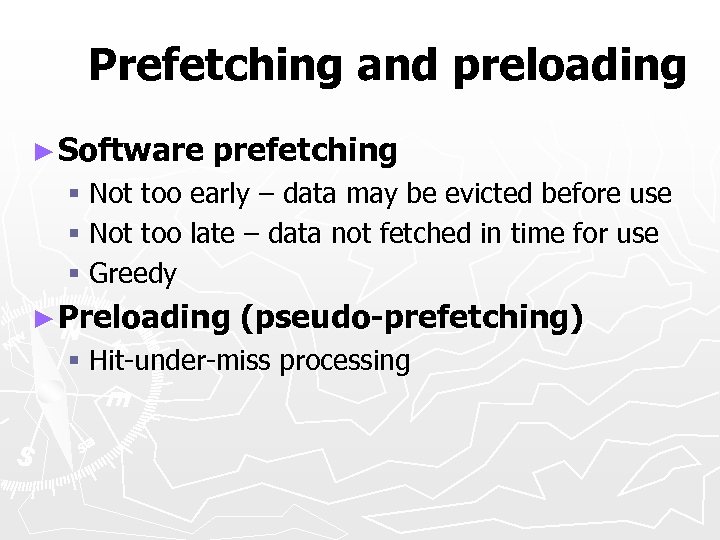 Prefetching and preloading ► Software prefetching § Not too early – data may be evicted before use § Not too late – data not fetched in time for use § Greedy ► Preloading (pseudo-prefetching) § Hit-under-miss processing
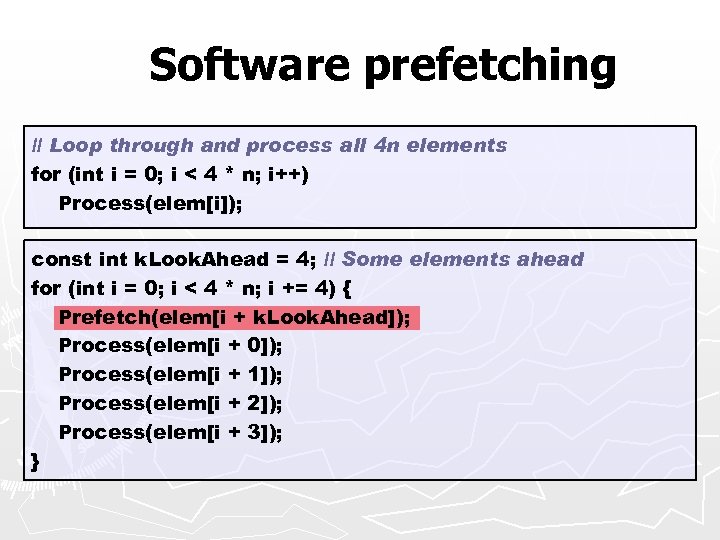 Software prefetching // Loop through and process all 4 n elements for (int i = 0; i < 4 * n; i++) Process(elem[i]); const int k. Look. Ahead = 4; // Some elements ahead for (int i = 0; i < 4 * n; i += 4) { Prefetch(elem[i + k. Look. Ahead]); Process(elem[i + 0]); Process(elem[i + 1]); Process(elem[i + 2]); Process(elem[i + 3]); }
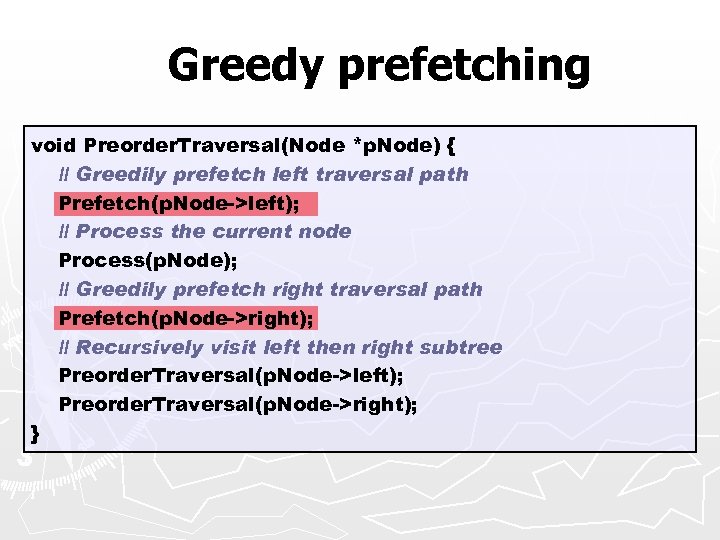 Greedy prefetching void Preorder. Traversal(Node *p. Node) { // Greedily prefetch left traversal path Prefetch(p. Node->left); // Process the current node Process(p. Node); // Greedily prefetch right traversal path Prefetch(p. Node->right); // Recursively visit left then right subtree Preorder. Traversal(p. Node->left); Preorder. Traversal(p. Node->right); }
![Preloading (pseudo-prefetch) Elem a = elem[0]; for (int i = 0; i < 4](https://present5.com/presentation/0b43b3885bce7fa4c169869bdfd1d886/image-20.jpg "Preloading (pseudo-prefetch) Elem a = elem[0]; for (int i = 0; i < 4") Preloading (pseudo-prefetch) Elem a = elem[0]; for (int i = 0; i < 4 * n; i += 4) { Elem e = elem[i + 4]; // Cache Elem b = elem[i + 1]; // Cache Elem c = elem[i + 2]; // Cache Elem d = elem[i + 3]; // Cache Process(a); Process(b); Process(c); Process(d); a = e; } miss, non-blocking hit hit (NB: This code reads one element beyond the end of the elem array. )
Preloading (pseudo-prefetch) Elem a = elem[0]; for (int i = 0; i < 4 * n; i += 4) { Elem e = elem[i + 4]; // Cache Elem b = elem[i + 1]; // Cache Elem c = elem[i + 2]; // Cache Elem d = elem[i + 3]; // Cache Process(a); Process(b); Process(c); Process(d); a = e; } miss, non-blocking hit hit (NB: This code reads one element beyond the end of the elem array. )
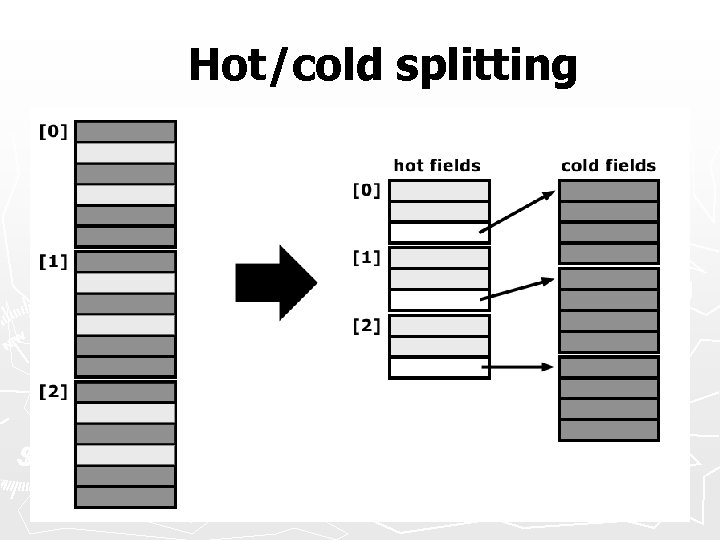
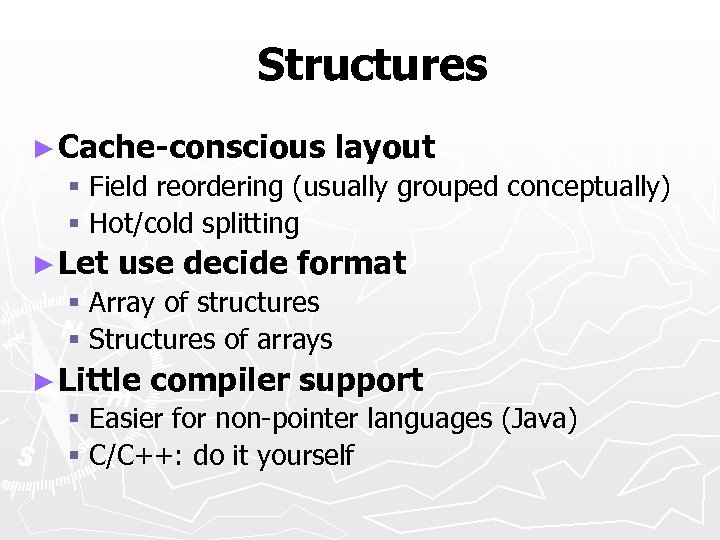 Structures ► Cache-conscious layout § Field reordering (usually grouped conceptually) § Hot/cold splitting ► Let use decide format § Array of structures § Structures of arrays ► Little compiler support § Easier for non-pointer languages (Java) § C/C++: do it yourself
![Field reordering struct S { void *key; int count[20]; S *p. Next; }; void](https://present5.com/presentation/0b43b3885bce7fa4c169869bdfd1d886/image-22.jpg "Field reordering struct S { void *key; int count[20]; S *p. Next; }; void") Field reordering struct S { void *key; int count[20]; S *p. Next; }; void Foo(S *p, void *key, int k) { while (p) { if (p->key == key) { p->count[k]++; break; } p = p->p. Next; } } struct S { void *key; S *p. Next; int count[20]; }; ► Likely accessed together so store them together!
Field reordering struct S { void *key; int count[20]; S *p. Next; }; void Foo(S *p, void *key, int k) { while (p) { if (p->key == key) { p->count[k]++; break; } p = p->p. Next; } } struct S { void *key; S *p. Next; int count[20]; }; ► Likely accessed together so store them together!
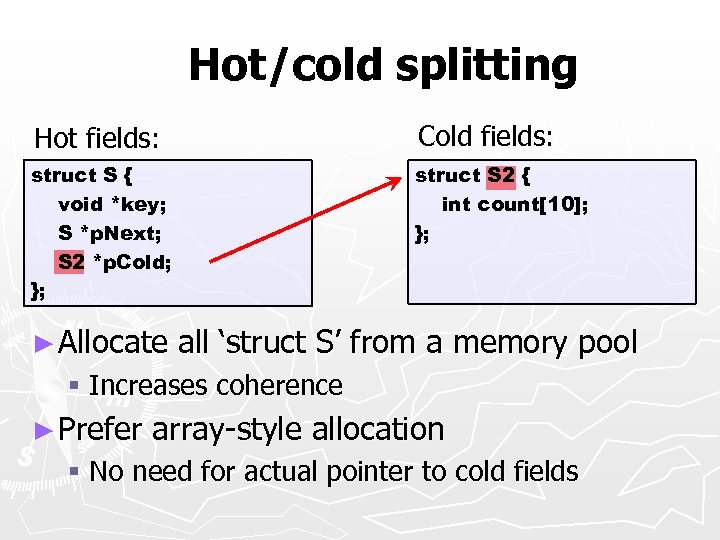 Hot/cold splitting Hot fields: Cold fields: struct S { void *key; S *p. Next; S 2 *p. Cold; }; struct S 2 { int count[10]; }; ► Allocate all ‘struct S’ from a memory pool § Increases coherence ► Prefer array-style allocation § No need for actual pointer to cold fields
 Hot/cold splitting
![Beware compiler padding struct Y { int 8 a, pad_a[7]; int 64 b; int](https://present5.com/presentation/0b43b3885bce7fa4c169869bdfd1d886/image-25.jpg "Beware compiler padding struct Y { int 8 a, pad_a[7]; int 64 b; int") Beware compiler padding struct Y { int 8 a, pad_a[7]; int 64 b; int 8 c, pad_c[1]; int 16 d, pad_d[2]; int 64 e; float f, pad_f[1]; }; struct Z { int 64 b; int 64 e; float f; int 16 d; int 8 a; int 8 c; }; Decreasing size! struct X { int 8 a; int 64 b; int 8 c; int 16 d; int 64 e; float f; }; Assuming 4 -byte floats, for most compilers sizeof(X) == 40, sizeof(Y) == 40, and sizeof(Z) == 24.
Beware compiler padding struct Y { int 8 a, pad_a[7]; int 64 b; int 8 c, pad_c[1]; int 16 d, pad_d[2]; int 64 e; float f, pad_f[1]; }; struct Z { int 64 b; int 64 e; float f; int 16 d; int 8 a; int 8 c; }; Decreasing size! struct X { int 8 a; int 64 b; int 8 c; int 16 d; int 64 e; float f; }; Assuming 4 -byte floats, for most compilers sizeof(X) == 40, sizeof(Y) == 40, and sizeof(Z) == 24.
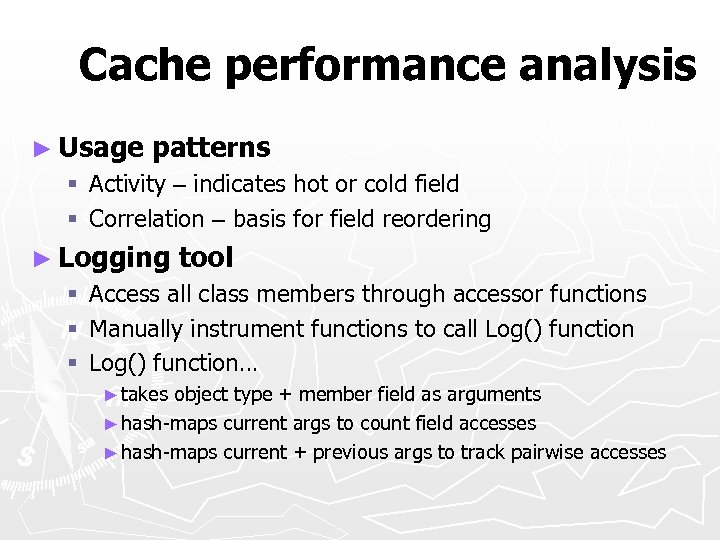 Cache performance analysis ► Usage patterns § Activity – indicates hot or cold field § Correlation – basis for field reordering ► Logging § § § tool Access all class members through accessor functions Manually instrument functions to call Log() function… ► takes object type + member field as arguments ► hash-maps current args to count field accesses ► hash-maps current + previous args to track pairwise accesses
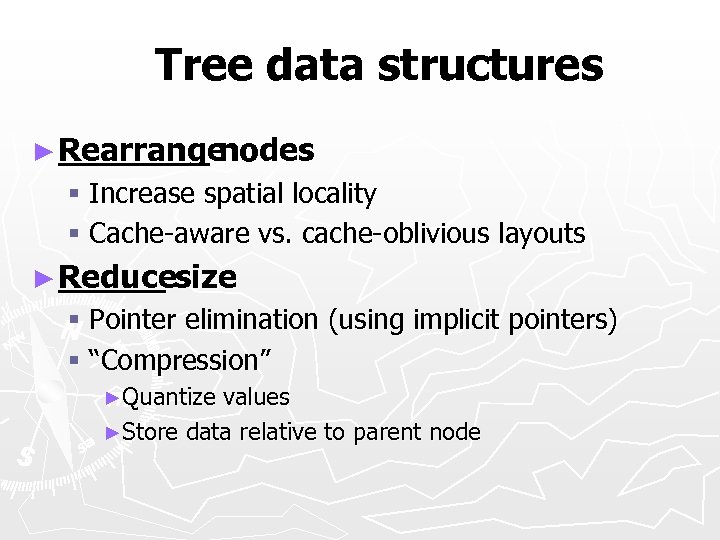 Tree data structures ► Rearrange nodes § Increase spatial locality § Cache-aware vs. cache-oblivious layouts ► Reducesize § Pointer elimination (using implicit pointers) § “Compression” ►Quantize values ►Store data relative to parent node
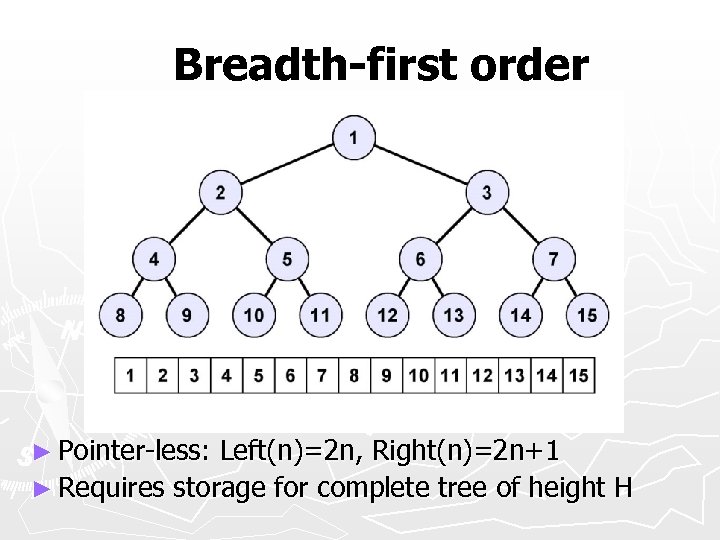 Breadth-first order ► Pointer-less: Left(n)=2 n, Right(n)=2 n+1 ► Requires storage for complete tree of height H
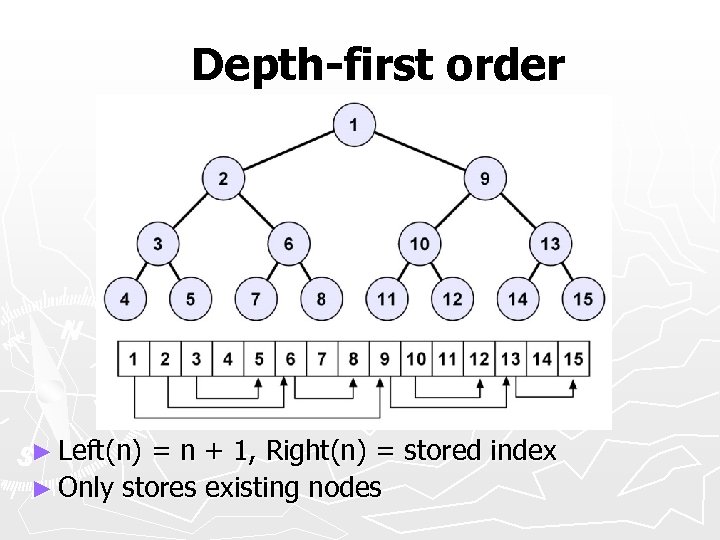 Depth-first order ► Left(n) = n + 1, Right(n) = stored index ► Only stores existing nodes
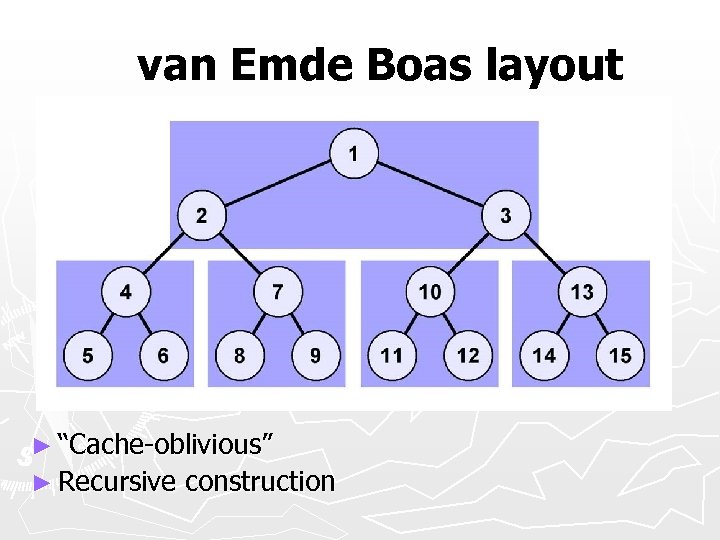 van Emde Boas layout ► “Cache-oblivious” ► Recursive construction
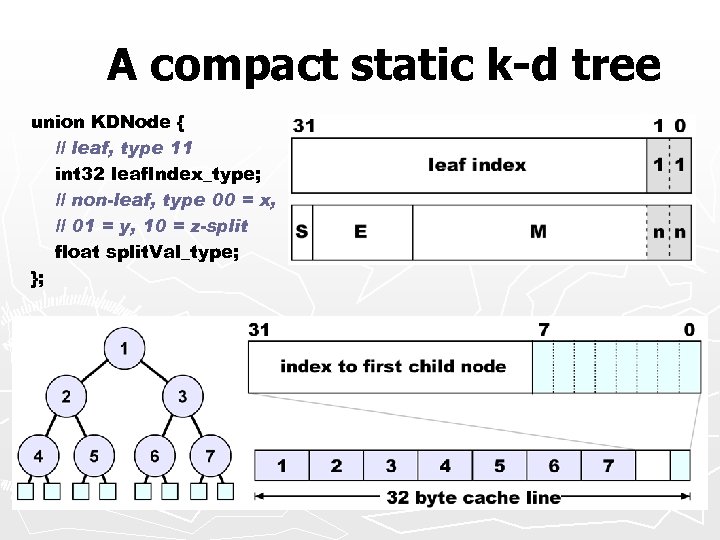 A compact static k-d tree union KDNode { // leaf, type 11 int 32 leaf. Index_type; // non-leaf, type 00 = x, // 01 = y, 10 = z-split float split. Val_type; };
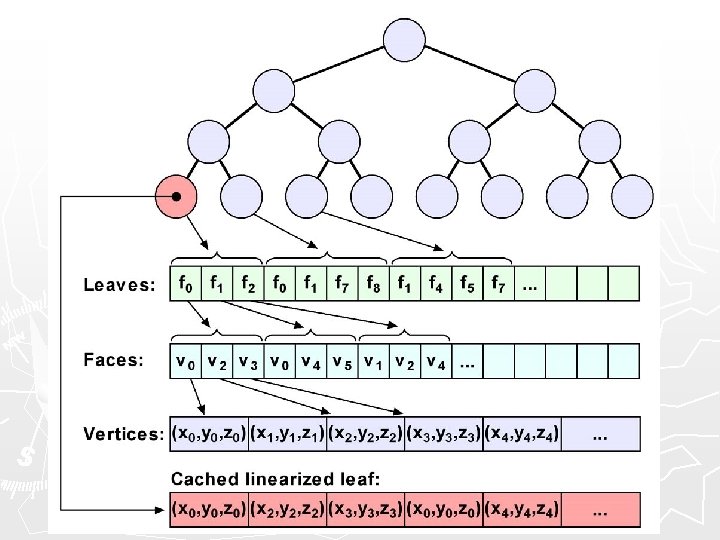
 Linearization caching ► Nothing better than linear data § Best possible spatial locality § Easily prefetchable ► So linearize data at runtime! § Fetch data, store linearized in a custom cache § Use it to linearize… ►hierarchy traversals ►indexed data ►other random-access stuff
 Memory allocation policy ► Don’t allocate from heap, use pools § No block overhead § Keeps data together § Faster too, and no fragmentation ► Free ASAP, reuse immediately § Block is likely in cache so reuse its cachelines § First fit, using free list
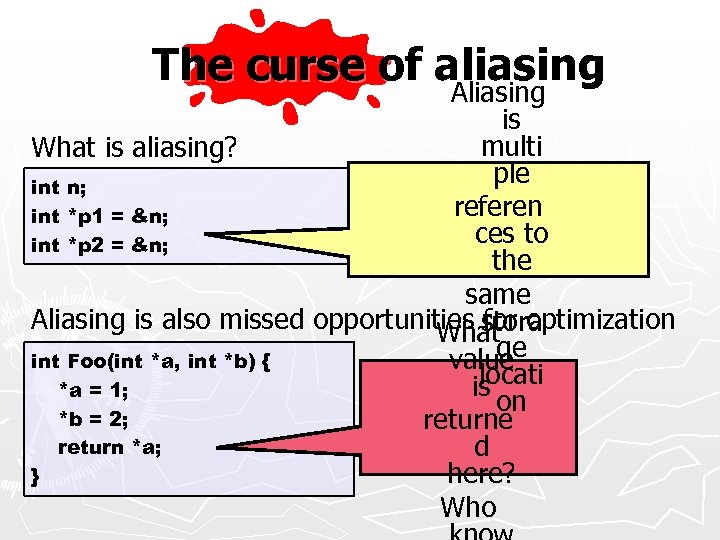 The curse of aliasing Aliasing is multi What is aliasing? ple int n; referen int *p 1 = &n; ces to int *p 2 = &n; the same Aliasing is also missed opportunities stora for What optimization ge int Foo(int *a, int *b) { value locati is *a = 1; on *b = 2; returne return *a; d } here? Who
 The curse of aliasing ► What is causing aliasing? § Pointers § Global variables/class members make it worse ► What is the problem with aliasing? § Hinders reordering/elimination of loads/stores ►Poisoning data cache ►Negatively affects instruction scheduling ►Hinders common subexpression elimination (CSE), loop-invariant code motion, constant/copy propagation, etc.
 How do we do ‘anti-aliasing’? ► What can be done about aliasing? § Better languages ►Less aliasing, lower abstraction penalty† § Better compilers ►Alias analysis such as type-based alias analysis† § Better programmers (aiding the compiler) ►That’s you, after the next 20 slides! § Leap of faith ►-fno-aliasing † To be defined
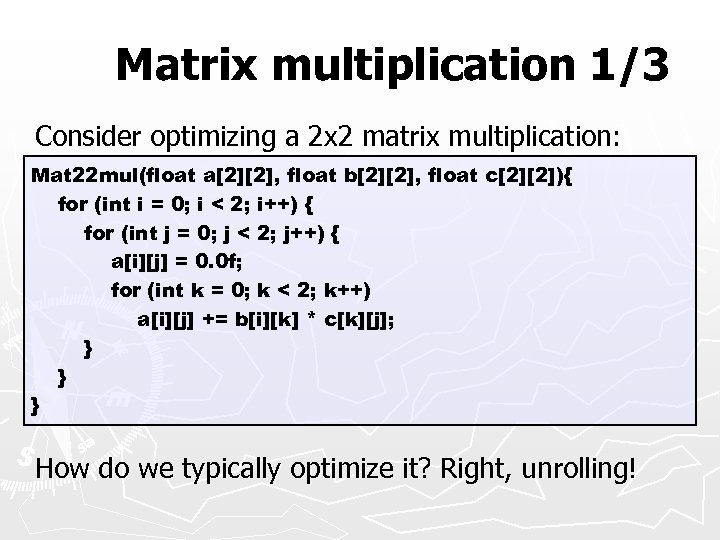 Matrix multiplication 1/3 Consider optimizing a 2 x 2 matrix multiplication: Mat 22 mul(float a[2][2], float b[2][2], float c[2][2]){ for (int i = 0; i < 2; i++) { for (int j = 0; j < 2; j++) { a[i][j] = 0. 0 f; for (int k = 0; k < 2; k++) a[i][j] += b[i][k] * c[k][j]; } } } How do we typically optimize it? Right, unrolling!
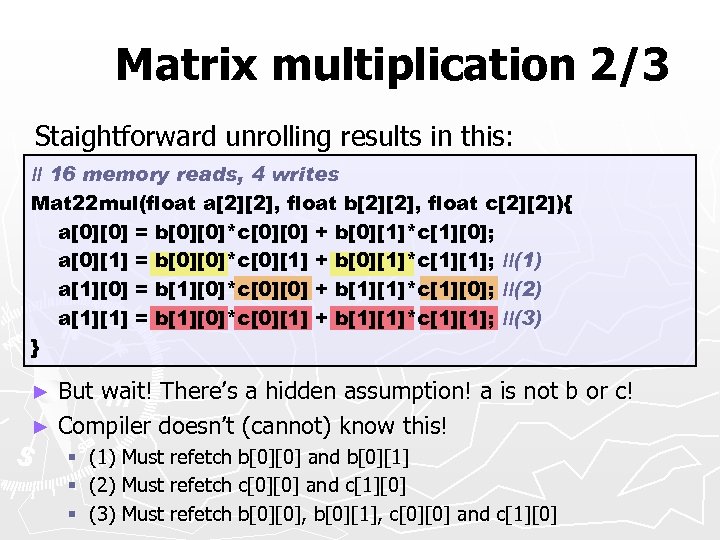 Matrix multiplication 2/3 Staightforward unrolling results in this: // 16 memory reads, 4 writes Mat 22 mul(float a[2][2], float b[2][2], float c[2][2]){ a[0][0] = b[0][0]*c[0][0] + b[0][1]*c[1][0]; a[0][1] = b[0][0]*c[0][1] + b[0][1]*c[1][1]; //(1) a[1][0] = b[1][0]*c[0][0] + b[1][1]*c[1][0]; //(2) a[1][1] = b[1][0]*c[0][1] + b[1][1]*c[1][1]; //(3) } But wait! There’s a hidden assumption! a is not b or c! ► Compiler doesn’t (cannot) know this! ► § § § (1) Must refetch b[0][0] and b[0][1] (2) Must refetch c[0][0] and c[1][0] (3) Must refetch b[0][0], b[0][1], c[0][0] and c[1][0]
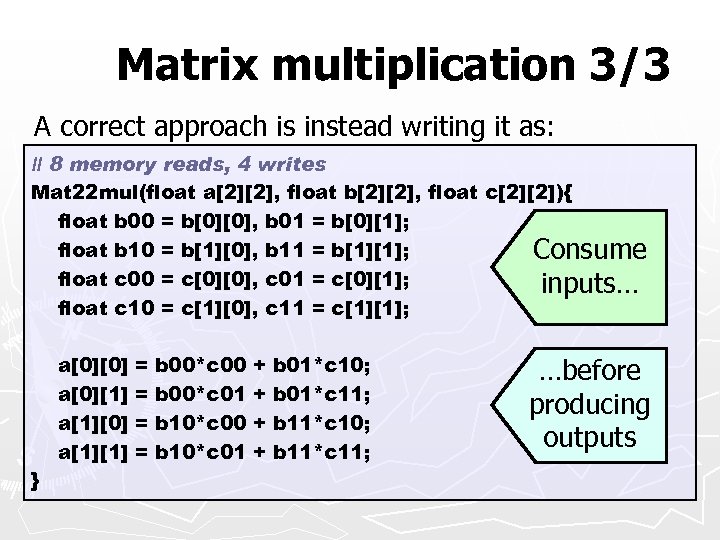 Matrix multiplication 3/3 A correct approach is instead writing it as: // 8 memory reads, 4 writes Mat 22 mul(float a[2][2], float b[2][2], float c[2][2]){ float b 00 = b[0][0], b 01 = b[0][1]; float b 10 = b[1][0], b 11 = b[1][1]; Consume float c 00 = c[0][0], c 01 = c[0][1]; inputs… float c 10 = c[1][0], c 11 = c[1][1]; a[0][0] a[0][1] a[1][0] a[1][1] } = = b 00*c 00 b 00*c 01 b 10*c 00 b 10*c 01 + + b 01*c 10; b 01*c 11; b 11*c 10; b 11*c 11; …before producing outputs
 Abstraction penalty problem ► Higher levels of abstraction have a negative effect on optimization § Code broken into smaller generic subunits § Data and operation hiding ►Cannot make local copy of e. g. internal pointers ►Cannot hoist constant expressions out of loops ► Especially because of aliasing issues
 C++ abstraction penalty ► Lots of (temporary) objects § Iterators § Matrix/vector classes around ► Objects live in heap/stack § Thus subject to aliasing § Makes tracking of current member value very difficult § But tracking required to keep values in registers! ► Implicit aliasing through the this pointer § Class members are virtually as bad as global variables
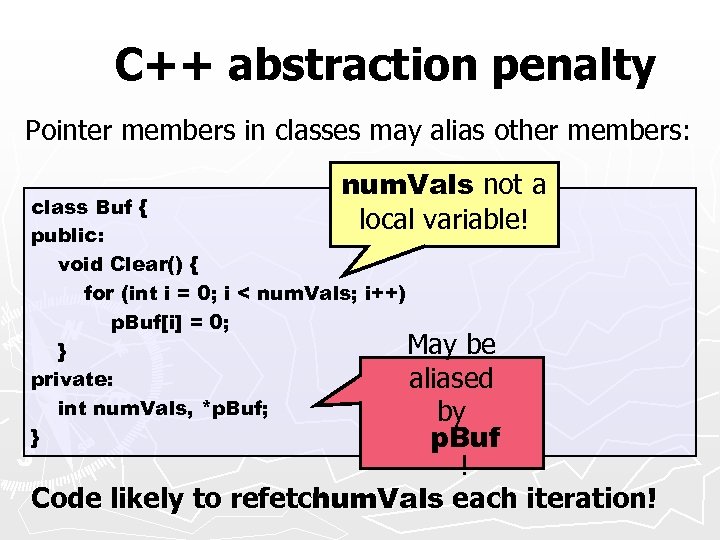 C++ abstraction penalty Pointer members in classes may alias other members: num. Vals not a local variable! class Buf { public: void Clear() { for (int i = 0; i < num. Vals; i++) p. Buf[i] = 0; May be } private: aliased int num. Vals, *p. Buf; by } p. Buf ! Code likely to refetch num. Vals each iteration!
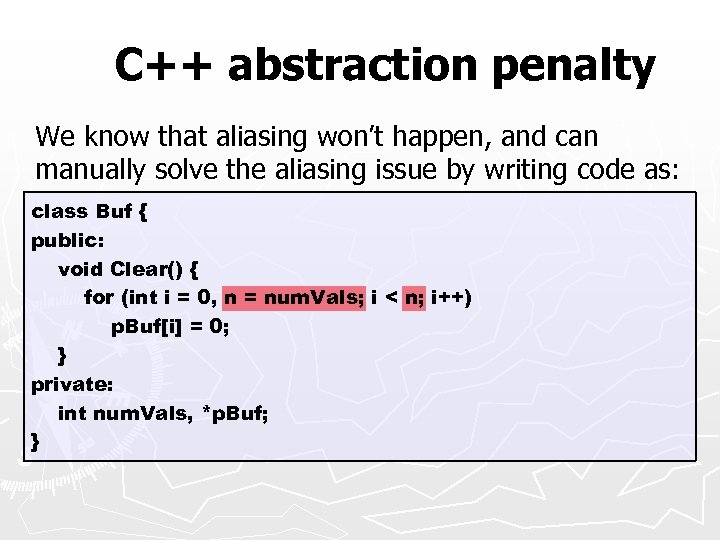 C++ abstraction penalty We know that aliasing won’t happen, and can manually solve the aliasing issue by writing code as: class Buf { public: void Clear() { for (int i = 0, n = num. Vals; i < n; i++) p. Buf[i] = 0; } private: int num. Vals, *p. Buf; }
![C++ abstraction penalty Since p. Buf[i] can only alias num. Vals in the first](https://present5.com/presentation/0b43b3885bce7fa4c169869bdfd1d886/image-45.jpg "C++ abstraction penalty Since p. Buf[i] can only alias num. Vals in the first") C++ abstraction penalty Since p. Buf[i] can only alias num. Vals in the first iteration, a quality compiler can fix this problem by peeling the loop once, turning it into: void Clear() { if (num. Vals >= 1) { p. Buf[0] = 0; for (int i = 1, n = num. Vals; i < n; i++) p. Buf[i] = 0; } } Q: Does your compiler do this optimization? !
C++ abstraction penalty Since p. Buf[i] can only alias num. Vals in the first iteration, a quality compiler can fix this problem by peeling the loop once, turning it into: void Clear() { if (num. Vals >= 1) { p. Buf[0] = 0; for (int i = 1, n = num. Vals; i < n; i++) p. Buf[i] = 0; } } Q: Does your compiler do this optimization? !
 Type-based alias analysis ► Some aliasing the compiler can catch § A powerful tool is type-based alias analysis Use language types to disambiguate memory references!
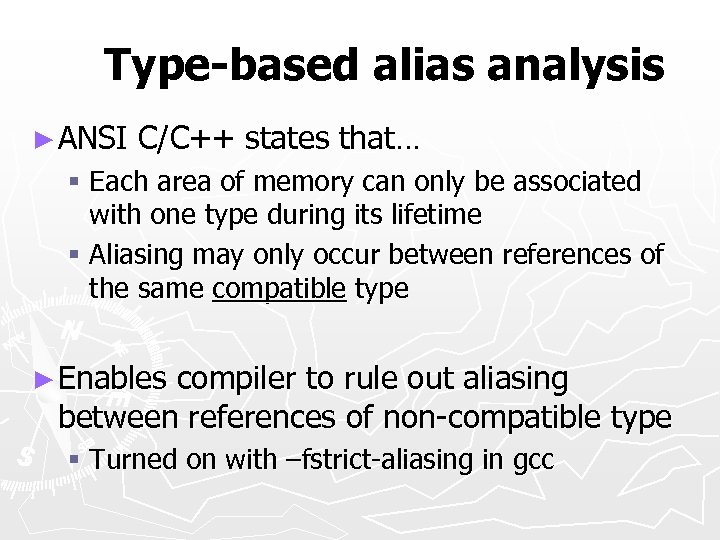 Type-based alias analysis ► ANSI C/C++ states that… § Each area of memory can only be associated with one type during its lifetime § Aliasing may only occur between references of the same compatible type ► Enables compiler to rule out aliasing between references of non-compatible type § Turned on with –fstrict-aliasing in gcc
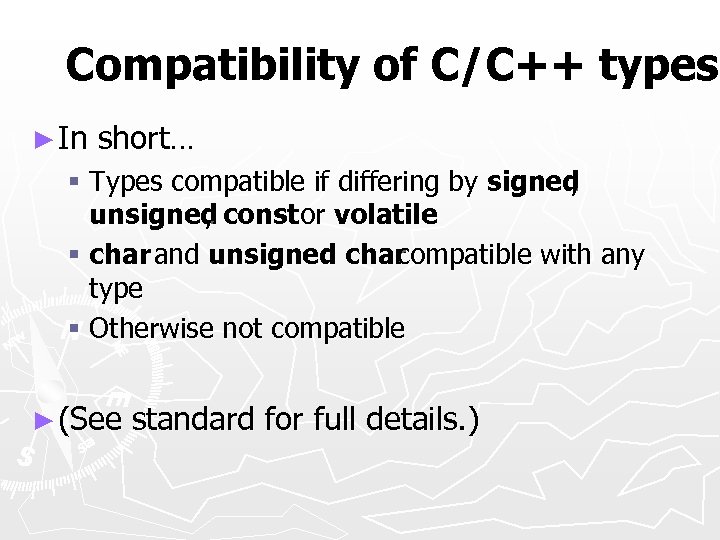 Compatibility of C/C++ types ► In short… § Types compatible if differing by signed , unsigned const or volatile , § char and unsigned char compatible with any type § Otherwise not compatible ► (See standard for full details. )
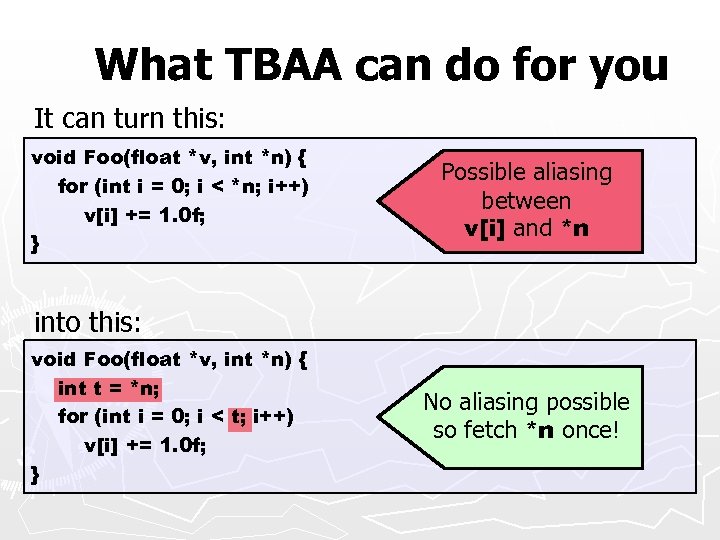 What TBAA can do for you It can turn this: void Foo(float *v, int *n) { for (int i = 0; i < *n; i++) v[i] += 1. 0 f; } Possible aliasing between v[i] and *n into this: void Foo(float *v, int *n) { int t = *n; for (int i = 0; i < t; i++) v[i] += 1. 0 f; } No aliasing possible so fetch *n once!
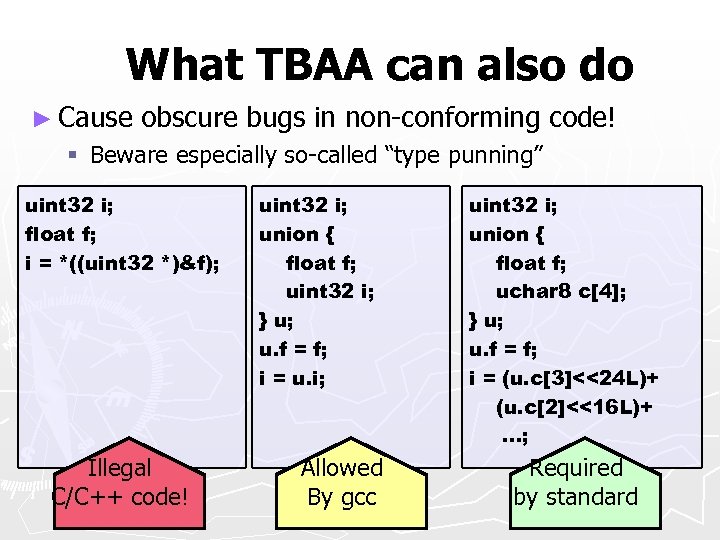 What TBAA can also do ► Cause obscure bugs in non-conforming code! § Beware especially so-called “type punning” uint 32 i; float f; i = *((uint 32 *)&f); Illegal C/C++ code! uint 32 i; union { float f; uint 32 i; } u; u. f = f; i = u. i; Allowed By gcc uint 32 i; union { float f; uchar 8 c[4]; } u; u. f = f; i = (u. c[3]<<24 L)+ (u. c[2]<<16 L)+. . . ; Required by standard
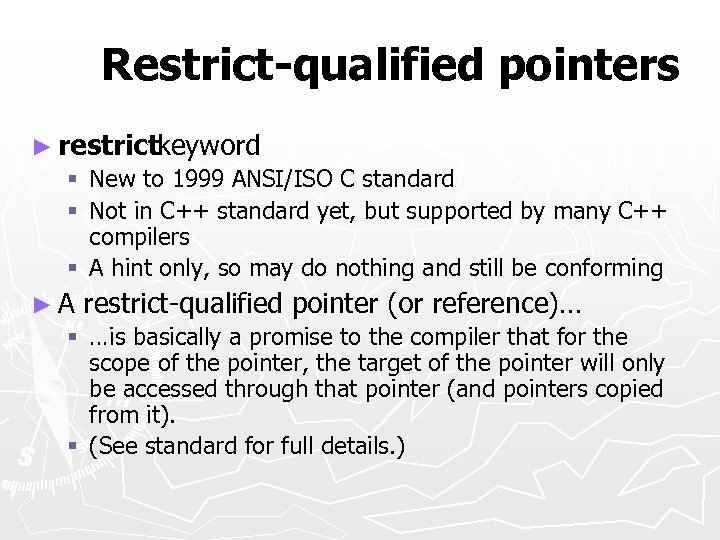 Restrict-qualified pointers ► restrictkeyword § New to 1999 ANSI/ISO C standard § Not in C++ standard yet, but supported by many C++ compilers § A hint only, so may do nothing and still be conforming ►A restrict-qualified pointer (or reference)… § …is basically a promise to the compiler that for the scope of the pointer, the target of the pointer will only be accessed through that pointer (and pointers copied from it). § (See standard for full details. )
![Using the restrict keyword Given this code: void Foo(float v[], float *c, int n)](https://present5.com/presentation/0b43b3885bce7fa4c169869bdfd1d886/image-52.jpg "Using the restrict keyword Given this code: void Foo(float v[], float *c, int n)") Using the restrict keyword Given this code: void Foo(float v[], float *c, int n) { for (int i = 0; i < n; i++) v[i] = *c + 1. 0 f; } You really want the compiler to treat it as if written: void Foo(float v[], float *c, int n) { float tmp = *c + 1. 0 f; for (int i = 0; i < n; i++) v[i] = tmp; } But because of possible aliasing it cannot!
Using the restrict keyword Given this code: void Foo(float v[], float *c, int n) { for (int i = 0; i < n; i++) v[i] = *c + 1. 0 f; } You really want the compiler to treat it as if written: void Foo(float v[], float *c, int n) { float tmp = *c + 1. 0 f; for (int i = 0; i < n; i++) v[i] = tmp; } But because of possible aliasing it cannot!
![Using the restrict keyword For example, the code might be called as: float a[10];](https://present5.com/presentation/0b43b3885bce7fa4c169869bdfd1d886/image-53.jpg "Using the restrict keyword For example, the code might be called as: float a[10];") Using the restrict keyword For example, the code might be called as: float a[10]; a[4] = 0. 0 f; Foo(a, &a[4], 10); giving for the first version: v[] = 1, 1, 1, 2, 2, 2 and for the second version: v[] = 1, 1, 1, 1 The compiler must be conservative, and cannot perform the optimization!
Using the restrict keyword For example, the code might be called as: float a[10]; a[4] = 0. 0 f; Foo(a, &a[4], 10); giving for the first version: v[] = 1, 1, 1, 2, 2, 2 and for the second version: v[] = 1, 1, 1, 1 The compiler must be conservative, and cannot perform the optimization!
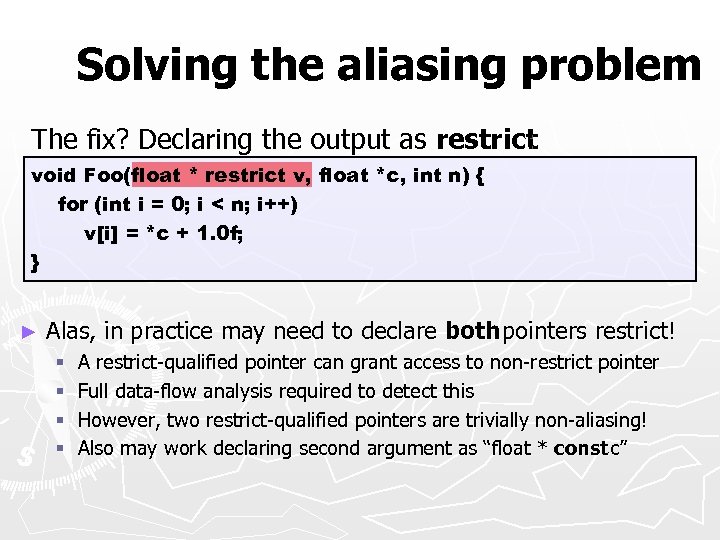 Solving the aliasing problem The fix? Declaring the output as restrict : void Foo(float * restrict v, float *c, int n) { for (int i = 0; i < n; i++) v[i] = *c + 1. 0 f; } ► Alas, in practice may need to declare both pointers restrict! § § A restrict-qualified pointer can grant access to non-restrict pointer Full data-flow analysis required to detect this However, two restrict-qualified pointers are trivially non-aliasing! Also may work declaring second argument as “float * const c”
![‘const’ doesn’t help Some might think this would work: void Foo(float v[], const float](https://present5.com/presentation/0b43b3885bce7fa4c169869bdfd1d886/image-55.jpg "‘const’ doesn’t help Some might think this would work: void Foo(float v[], const float") ‘const’ doesn’t help Some might think this would work: void Foo(float v[], const float *c, int n) { for (int i = 0; i < n; i++) v[i] = *c + 1. 0 f; } Since *c is const, v[i] cannot write to it, right? ► Wrong! const promises almost nothing! § Says *c is const through c, not that *c is const in general § Can be cast away § For detecting programming errors, not fixing aliasing
‘const’ doesn’t help Some might think this would work: void Foo(float v[], const float *c, int n) { for (int i = 0; i < n; i++) v[i] = *c + 1. 0 f; } Since *c is const, v[i] cannot write to it, right? ► Wrong! const promises almost nothing! § Says *c is const through c, not that *c is const in general § Can be cast away § For detecting programming errors, not fixing aliasing
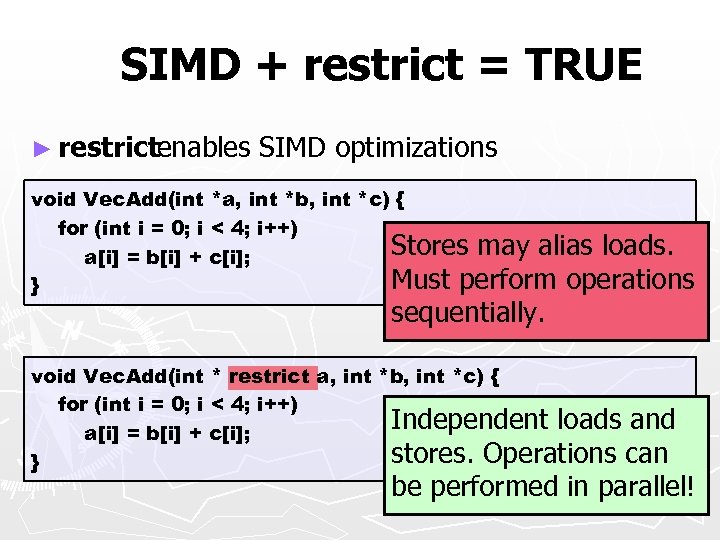 SIMD + restrict = TRUE ► restrictenables SIMD optimizations void Vec. Add(int *a, int *b, int *c) { for (int i = 0; i < 4; i++) Stores may alias loads. a[i] = b[i] + c[i]; Must perform operations } sequentially. void Vec. Add(int * restrict a, int *b, int *c) { for (int i = 0; i < 4; i++) Independent loads and a[i] = b[i] + c[i]; stores. Operations can } be performed in parallel!
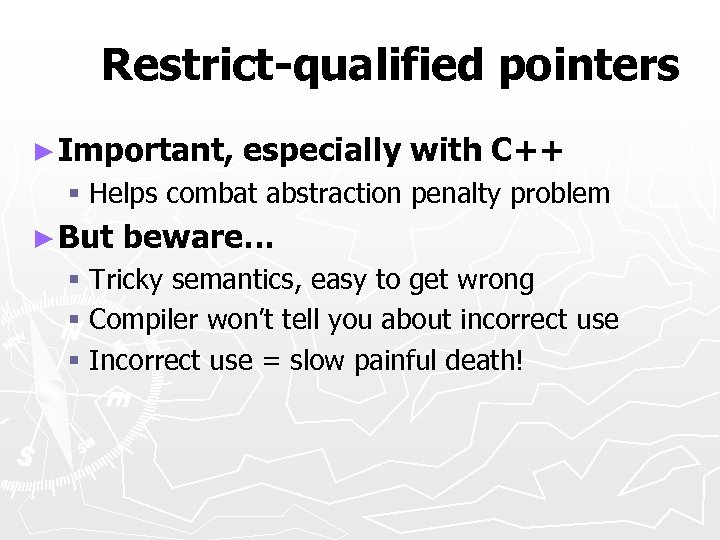 Restrict-qualified pointers ► Important, especially with C++ § Helps combat abstraction penalty problem ► But beware… § Tricky semantics, easy to get wrong § Compiler won’t tell you about incorrect use § Incorrect use = slow painful death!
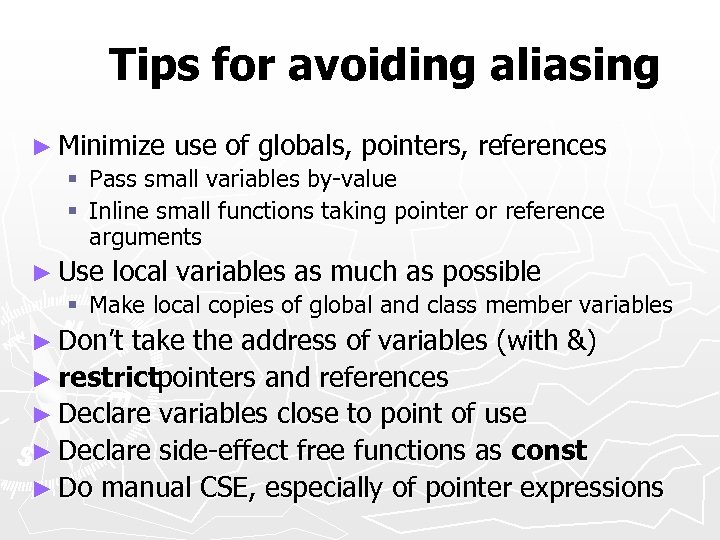 Tips for avoiding aliasing ► Minimize use of globals, pointers, references § Pass small variables by-value § Inline small functions taking pointer or reference arguments ► Use local variables as much as possible § Make local copies of global and class member variables ► Don’t take the address of variables (with &) ► restrictpointers and references ► Declare variables close to point of use ► Declare side-effect free functions as const ► Do manual CSE, especially of pointer expressions
 That’s it!– Resources 1/2 Ericson, Christer. Real-time collision detection. Morgan. Kaufmann, 2005. (Chapter on memory optimization) ► Mitchell, Mark. Type-based alias analysis. Dr. Dobb’s journal, October 2000. ► Robison, Arch. Restricted pointers are coming. C/C++ Users Journal, July 1999. ► http: //www. cuj. com/articles/1999/9907 d/9907 d. htm Chilimbi, Trishul. Cache-conscious data structures - design and implementation. Ph. D Thesis. University of Wisconsin, Madison, 1999. ► Prokop, Harald. Cache-oblivious algorithms. Master’s Thesis. MIT, June, 1999. ►… ►
 Resources 2/2 ► ► … Gavin, Andrew. Stephen White. Teaching an old dog new bits: How console developers are able to improve performance when the hardware hasn’t changed. Gamasutra. November 12, 1999 http: //www. gamasutra. com/features/19991112/Gavin. White_01. htm Handy, Jim. The cache memory book. Academic Press, 1998. ► Macris, Alexandre. Pascal Urro. Leveraging the power of cache memory. Gamasutra. April 9, 1999 ► http: //www. gamasutra. com/features/19990409/cache_01. htm ► Gross, Ornit. Pentium III prefetch optimizations using the VTune performance analyzer. Gamasutra. July 30, 1999 http: //www. gamasutra. com/features/19990730/sse_prefetch_01. htm ► Truong, Dan. François Bodin. André Seznec. Improving cache behavior of dynamically allocated data structures.