 Скачать презентацию Memory Management for Self-Stabilizing Operating Systems Shlomi Dolev
ba399d108a9b8f31aca177fc5d370c14.ppt
- Количество слайдов: 22



Memory Management for Self-Stabilizing Operating Systems Shlomi Dolev and Reuven Yagel Computer Science Department Ben-Gurion University of the Negev, Beer-Sheva, Israel SSS’ 05
SOS - Motivation • Growing interest in self-* / autonomic computing systems • Self-stabilizing algorithms/programs assume hardware and operating system are also stabilizing • Pentium HALTING problem: “… if the ESP or SP register is 1 when the PUSH instruction is executed, the processor shuts down…” 2
Proposed solution • To build according to the well defined and understood paradigm of self-stabilization (traditionally used in distributed systems) • Thereby achieving: trustworthiness, dependability, self-healing, automatic recovery, adaptive systems, … 3
OS Reliability • Past examples: – Dijkstra, “THE” Multiprogramming System ’ 68 (Layered Approach) – Denning, Fault tolerant operating systems ’ 76 (Protection) – Key. KOS ‘ 85, EROS ’ 92 (Capabilities, Checkpoints) – Micro-kernel ~‘ 90, Exo-kernel ’ 94 (Minimal TCB) • Current – – JHU: The Coyotos Secure Operating System IBM: K 42, Autonomic Computing SUN: Solaris 10, Predictive Self-Healing MSR: Singularity, managed code OS 4
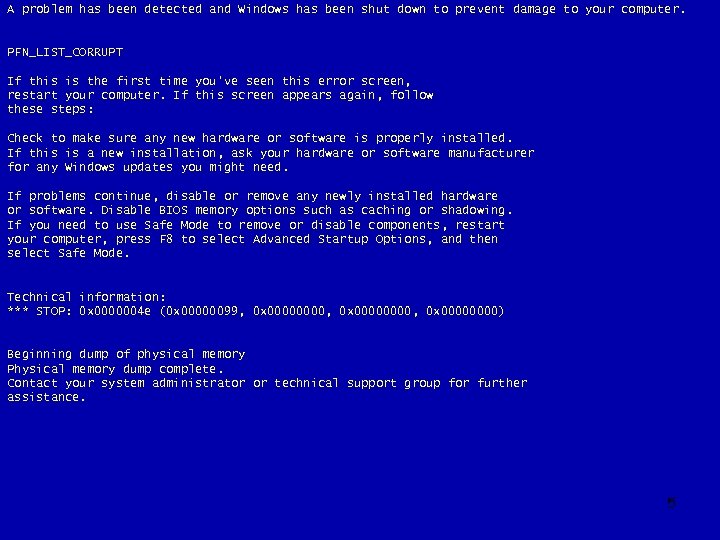
A problem has been detected and Windows has been shut down to prevent damage to your computer. PFN_LIST_CORRUPT If this is the first time you've seen this error screen, restart your computer. If this screen appears again, follow these steps: Check to make sure any new hardware or software is properly installed. If this is a new installation, ask your hardware or software manufacturer for any Windows updates you might need. If problems continue, disable or remove any newly installed hardware or software. Disable BIOS memory options such as caching or shadowing. If you need to use Safe Mode to remove or disable components, restart your computer, press F 8 to select Advanced Startup Options, and then select Safe Mode. Technical information: *** STOP: 0 x 0000004 e (0 x 00000099, 0 x 00000000, 0 x 0000) Beginning dump of physical memory Physical memory dump complete. Contact your system administrator or technical support group for further assistance. 5
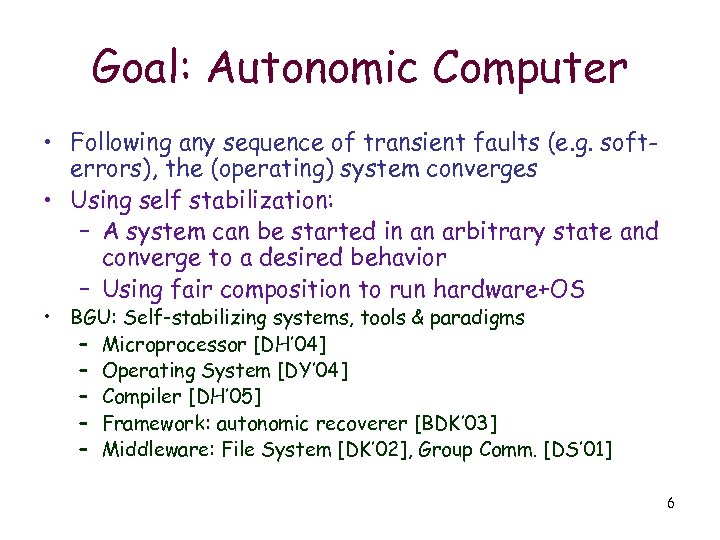
Goal: Autonomic Computer • Following any sequence of transient faults (e. g. softerrors), the (operating) system converges • Using self stabilization: – A system can be started in an arbitrary state and converge to a desired behavior – Using fair composition to run hardware+OS • BGU: Self-stabilizing systems, tools & paradigms – Microprocessor [DH’ 04] – Operating System [DY’ 04] – Compiler [DH’ 05] – Framework: autonomic recoverer [BDK’ 03] – Middleware: File System [DK’ 02], Group Comm. [DS’ 01] 6
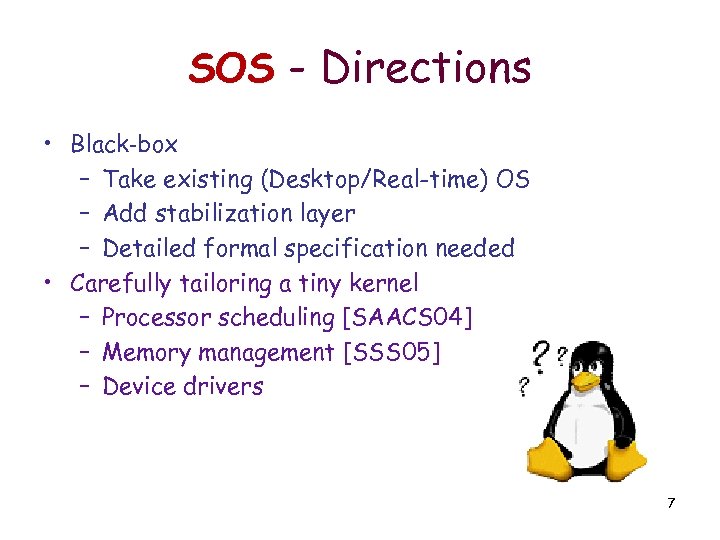
SOS - Directions • Black-box – Take existing (Desktop/Real-time) OS – Add stabilization layer – Detailed formal specification needed • Carefully tailoring a tiny kernel – Processor scheduling [SAACS 04] – Memory management [SSS 05] – Device drivers 7
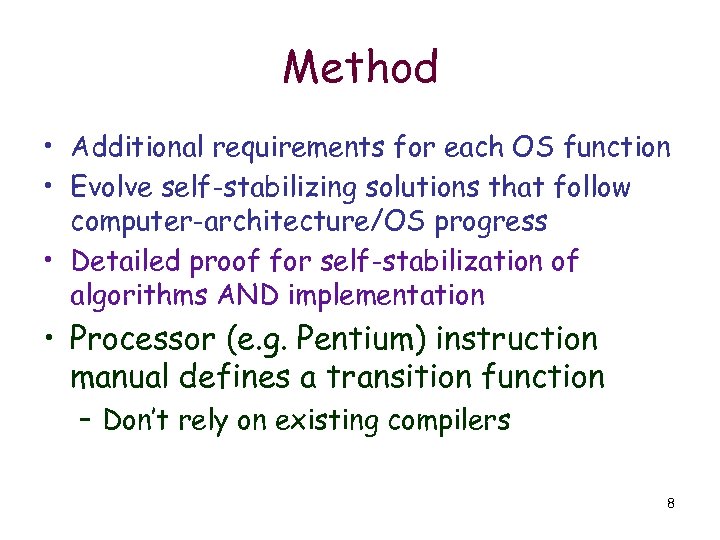
Method • Additional requirements for each OS function • Evolve self-stabilizing solutions that follow computer-architecture/OS progress • Detailed proof for self-stabilization of algorithms AND implementation • Processor (e. g. Pentium) instruction manual defines a transition function – Don’t rely on existing compilers 8
Assumptions • Whole soft-state can be corrupted (e. g. Program Counter) • Stabilization of other layers 9
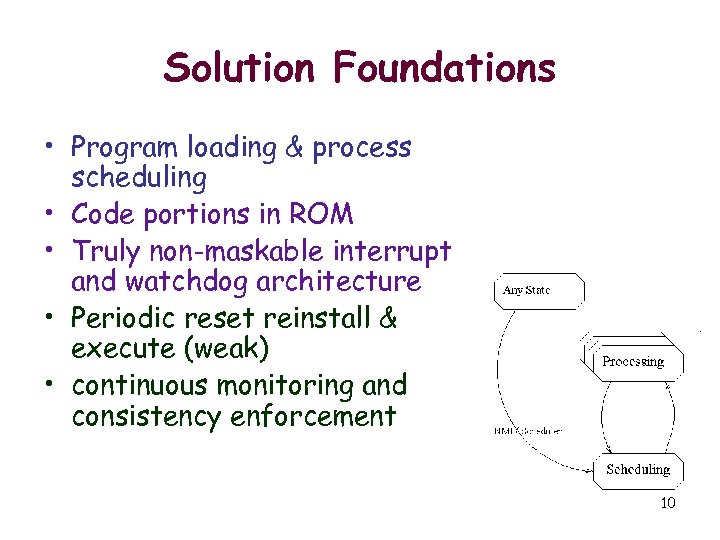
Solution Foundations • Program loading & process scheduling • Code portions in ROM • Truly non-maskable interrupt and watchdog architecture • Periodic reset reinstall & execute (weak) • continuous monitoring and consistency enforcement 10
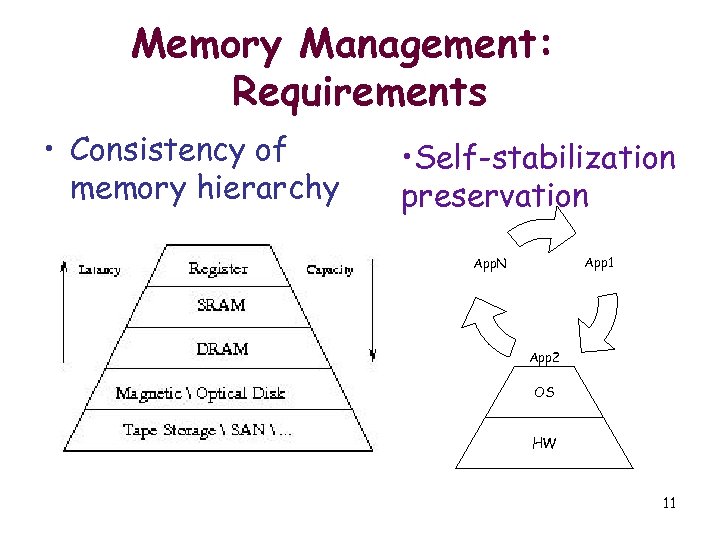
Memory Management: Requirements • Consistency of memory hierarchy • Self-stabilization preservation App 1 App. N App 2 OS HW 11
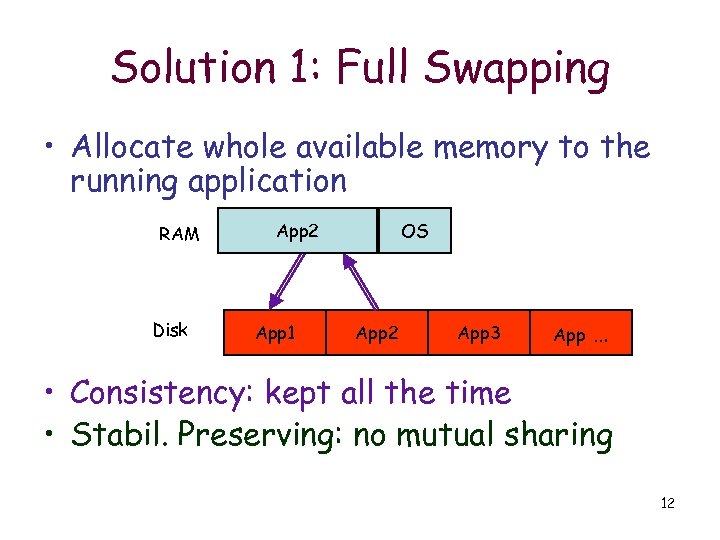
Solution 1: Full Swapping • Allocate whole available memory to the running application RAM Disk App 2 App 1 OS App 2 App 3 App … • Consistency: kept all the time • Stabil. Preserving: no mutual sharing 12
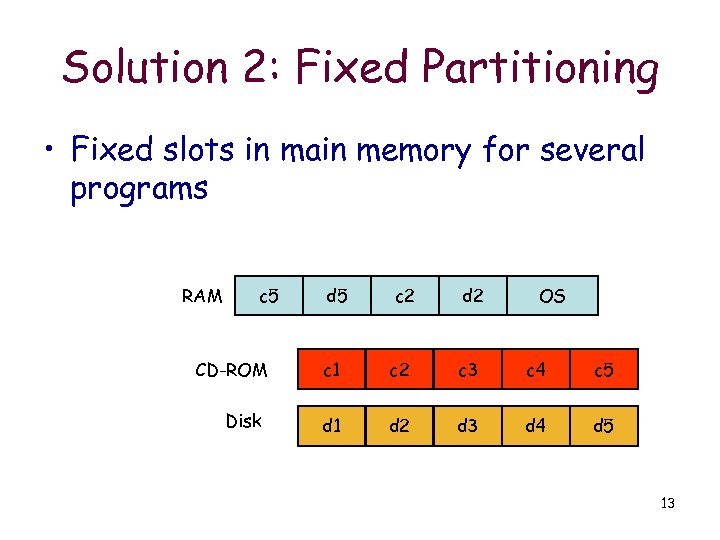
Solution 2: Fixed Partitioning • Fixed slots in main memory for several programs RAM c 5 CD-ROM Disk d 5 c 2 d 2 OS c 1 c 2 c 3 c 4 c 5 d 1 d 2 d 3 d 4 d 5 13
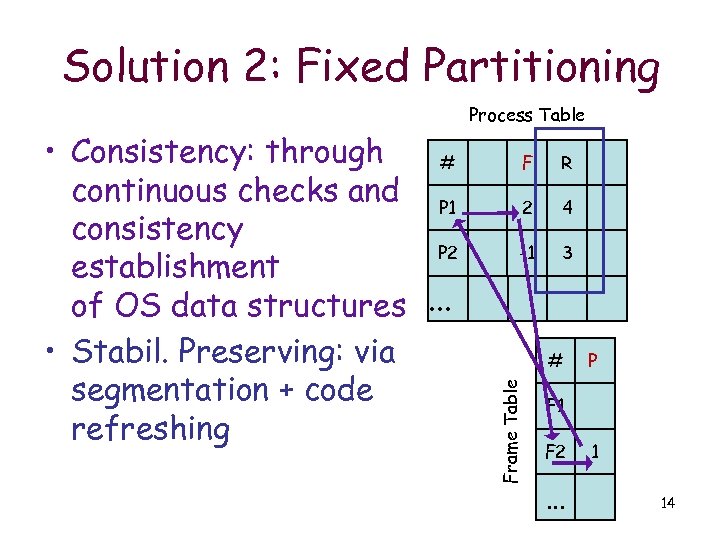
Solution 2: Fixed Partitioning Process Table F R 2 4 -1 3 # Frame Table • Consistency: through # continuous checks and P 1 consistency P 2 establishment of OS data structures. . . • Stabil. Preserving: via segmentation + code refreshing P F 1 F 2 … 1 14
Solution 3: Dynamic allocations • We want to allow applications to dynamically allocate memory • How can we avoid a process that (faultily) allocates the whole available memory? • What happens if a process “forgets” about its ownership? • Leasing 15
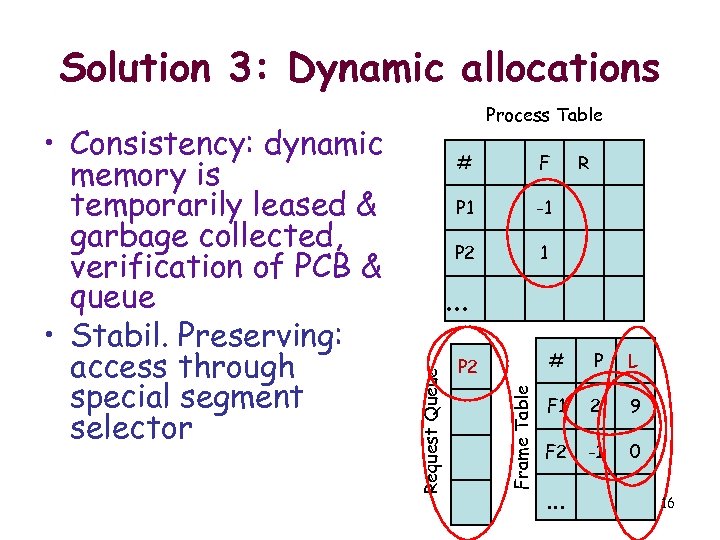
Solution 3: Dynamic allocations # F P 1 -1 2 P 2 R -1 1 . . . # P 2 Frame Table Request Queue • Consistency: dynamic memory is temporarily leased & garbage collected, verification of PCB & queue • Stabil. Preserving: access through special segment selector Process Table P L F 1 2 1 9 0 2 3 1 F 2 -1 1 0 2 3 1 … 16
Implementation • Pentium in real-mode, single address space – Simple – common for sensors/microcontrollers – Protected mode & VM mechanisms can be handled accordingly • Code size: ~1 -2 K – Tiny. OS ~1 K – Vx. Works ~102 K – Linux kernel ~4 M • Fault injection with the Bochs simulator 17
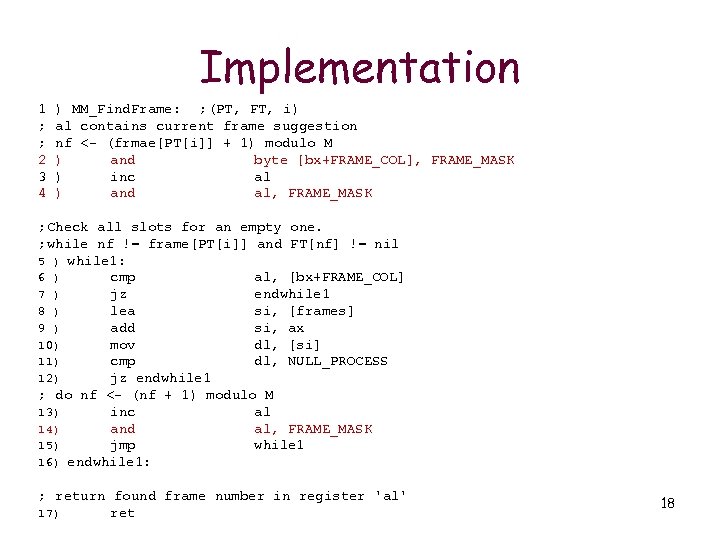
Implementation 1 ; ; 2 3 4 ) MM_Find. Frame: ; (PT, FT, i) al contains current frame suggestion nf <- (frmae[PT[i]] + 1) modulo M ) and byte [bx+FRAME_COL], FRAME_MASK ) inc al ) and al, FRAME_MASK ; Check all slots for an empty one. ; while nf != frame[PT[i]] and FT[nf] != nil 5 ) while 1: 6 ) cmp al, [bx+FRAME_COL] 7 ) jz endwhile 1 8 ) lea si, [frames] 9 ) add si, ax 10) mov dl, [si] 11) cmp dl, NULL_PROCESS 12) jz endwhile 1 ; do nf <- (nf + 1) modulo M 13) inc al 14) and al, FRAME_MASK 15) jmp while 1 16) endwhile 1: ; return found frame number in register 'al' 17) ret 18
19
Future Work • I/O device drivers – Major cause of operating systems failures – Co-operation of more than one microprocessor – Detailed driver / General monitoring layer • Gather the different parts • Micro-kernel / VMM 20
Conclusion • The work shows theoretical and practical ways to achieve the goal of a self-stabilizing OS • The (system) research community & industry can benefit from the foundation of self-stabilization • http: //www. cs. bgu. ac. il/~yagel/sos 21
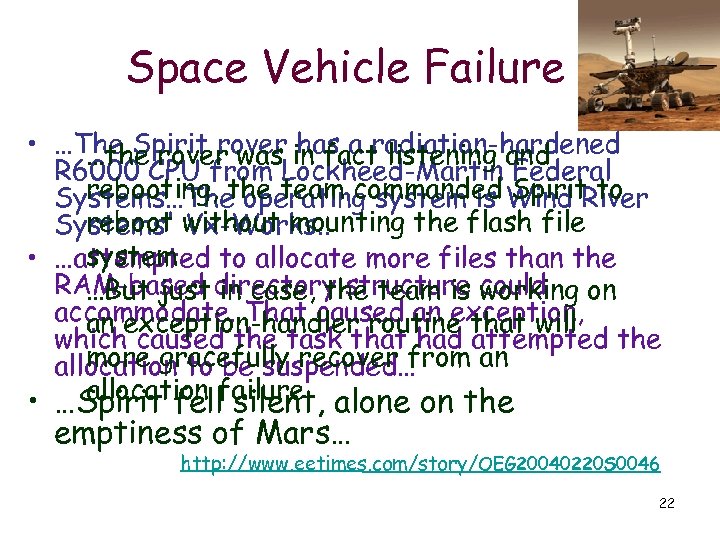
Space Vehicle Failure • …The Spirit rover in fact listening and …the rover was has a radiation-hardened R 6000 CPU from Lockheed-Martin Federal rebooting, the team commanded Spirit to Systems…The operating system is Wind River reboot Vx-Works. . Systems' without mounting the flash file system • …attempted to allocate more files than the RAM-based directory structure could on …But just in case, the team is working accommodate. That caused an exception, an exception-handler routine that will which caused the task that had attempted the more gracefully recover from an allocation to be suspended… allocation failure alone on the • …Spirit fell silent, emptiness of Mars… http: //www. eetimes. com/story/OEG 20040220 S 0046 22
Скачать презентацию Memory Management for Self-Stabilizing Operating Systems Shlomi Dolev
ba399d108a9b8f31aca177fc5d370c14.ppt