 Скачать презентацию Memory Management and Debugging V 22 0474 -001
a644deb8e782db7eecff2825dd41e6fe.ppt
- Количество слайдов: 53



Memory Management and Debugging V 22. 0474 -001 Software Engineering Lecture 19 Adapted from Prof. Necula CS 169, Berkeley 1
Outline • Overview of memory management – Why it is a software engineering issue • Styles of memory management – Malloc/free – Garbage collection – Regions • Detecting memory errors Adapted from Prof. Necula CS 169, Berkeley 2
Memory Management • A basic decision, because – Different memory management policies are difficult to mix • Best to stick with one in an application – Has a big impact on performance and quality • Different strategies better in different situations • Some more error prone than others Adapted from Prof. Necula CS 169, Berkeley 3
Distinguishing Characteristics • Allocation is always explicit • Deallocation – Explicit or implicit? • Safety – Checks that explicit deallocation is safe Adapted from Prof. Necula CS 169, Berkeley 4
Explicit Memory Management • Allocation and deallocation are explicit – Oldest style – C, C++ x = new Foo; … delete x; Adapted from Prof. Necula CS 169, Berkeley 5
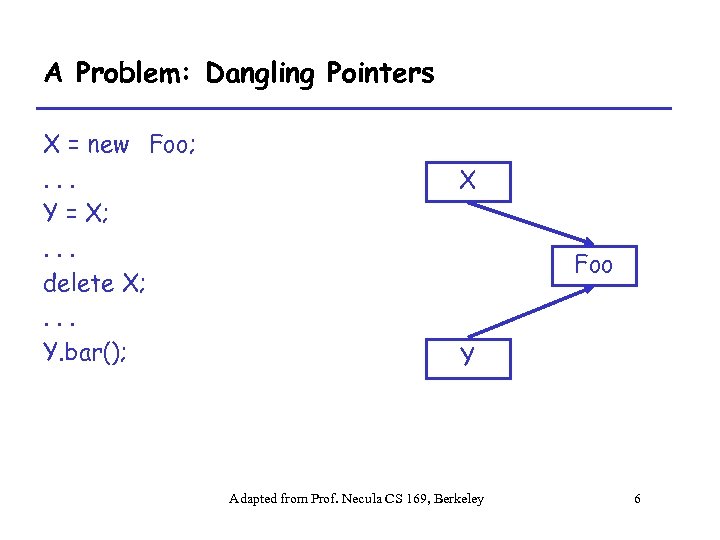
A Problem: Dangling Pointers X = new Foo; . . . Y = X; . . . delete X; . . . Y. bar(); X Foo Y Adapted from Prof. Necula CS 169, Berkeley 6
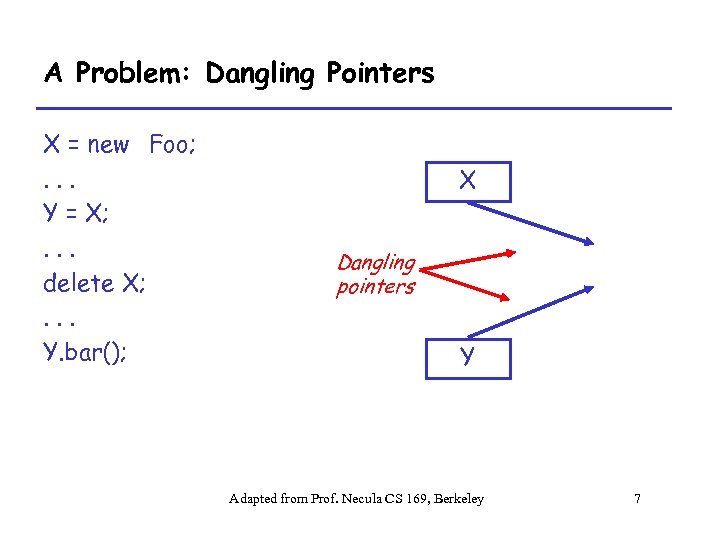
A Problem: Dangling Pointers X = new Foo; . . . Y = X; . . . delete X; . . . Y. bar(); X Dangling pointers Y Adapted from Prof. Necula CS 169, Berkeley 7
Notes • Dangling pointers are bad – A system crash waiting to happen • Storage bugs are hard to find – Visible effect far away (in time and program text) from the source • Not the only potentially bad memory bug in C Adapted from Prof. Necula CS 169, Berkeley 8
Notes, Continued • Explicit deallocation is not all bad • Gives the finest possible control over memory – May be important in memory-limited applications • Programmer is very conscious of how much memory is in use – This is good and bad • Allocation and deallocation fairly expensive Adapted from Prof. Necula CS 169, Berkeley 9
Automatic Memory Management • I. e. , automatic deallocation • This is an old problem: – studied since the 1950 s for LISP • There are well-known techniques for completely automatic memory management • Until recently unpopular outside of Lisp family languages Adapted from Prof. Necula CS 169, Berkeley 10
The Basic Idea • When an object is created, unused space is automatically allocated – – E. g. , new X As in all memory management systems • After a while there is no more unused space • Some space is occupied by objects that will never be used again – This space can be freed to be reused later Adapted from Prof. Necula CS 169, Berkeley 11
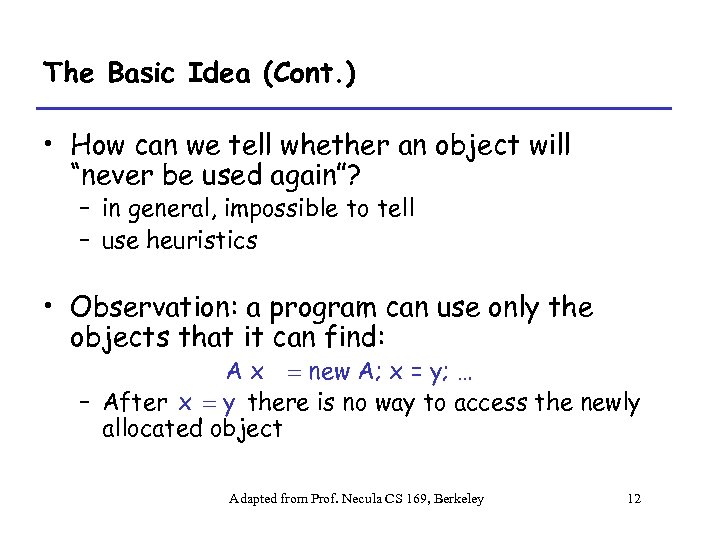
The Basic Idea (Cont. ) • How can we tell whether an object will “never be used again”? – in general, impossible to tell – use heuristics • Observation: a program can use only the objects that it can find: A x = new A; x = y; … – After x = y there is no way to access the newly allocated object Adapted from Prof. Necula CS 169, Berkeley 12
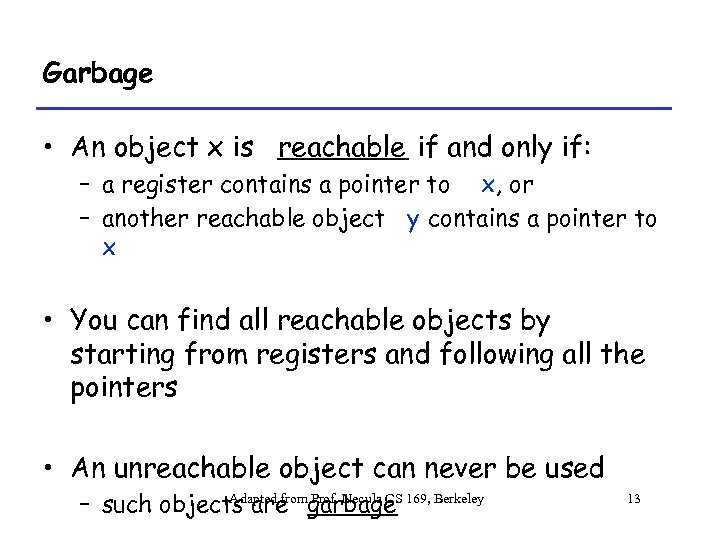
Garbage • An object x is reachable if and only if: – a register contains a pointer to x, or – another reachable object y contains a pointer to x • You can find all reachable objects by starting from registers and following all the pointers • An unreachable object can never be used Adapted from Prof. Necula CS – such objects are garbage 169, Berkeley 13
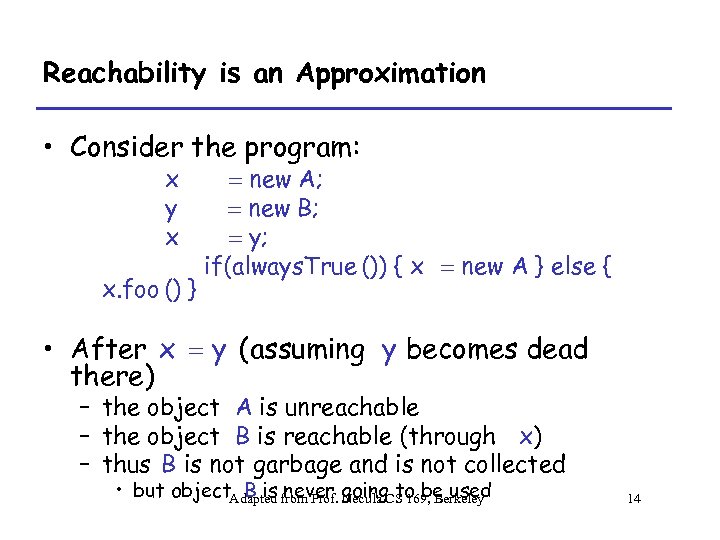
Reachability is an Approximation • Consider the program: x y x x. foo () } = new A; = new B; = y; if(always. True ()) { x = new A } else { • After x = y (assuming y becomes dead there) – the object A is unreachable – the object B is reachable (through x) – thus B is not garbage and is not collected • but object. Adapted from Prof. going. CS 169, Berkeley B is never Necula to be used 14
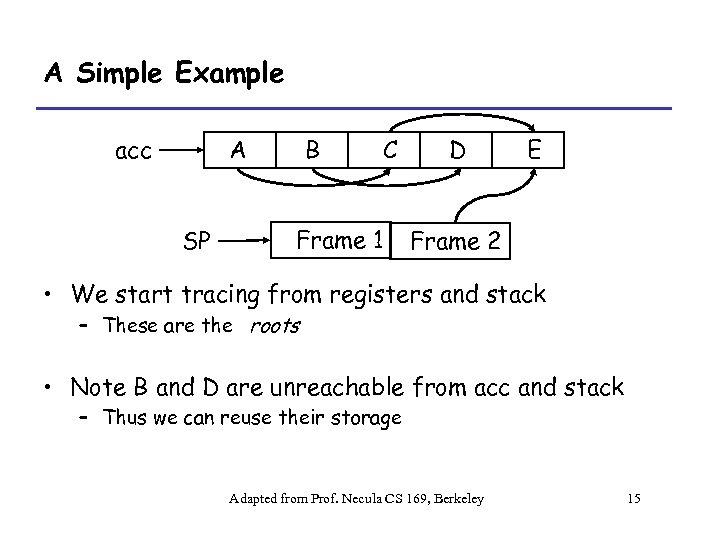
A Simple Example A acc SP B C Frame 1 D E Frame 2 • We start tracing from registers and stack – These are the roots • Note B and D are unreachable from acc and stack – Thus we can reuse their storage Adapted from Prof. Necula CS 169, Berkeley 15
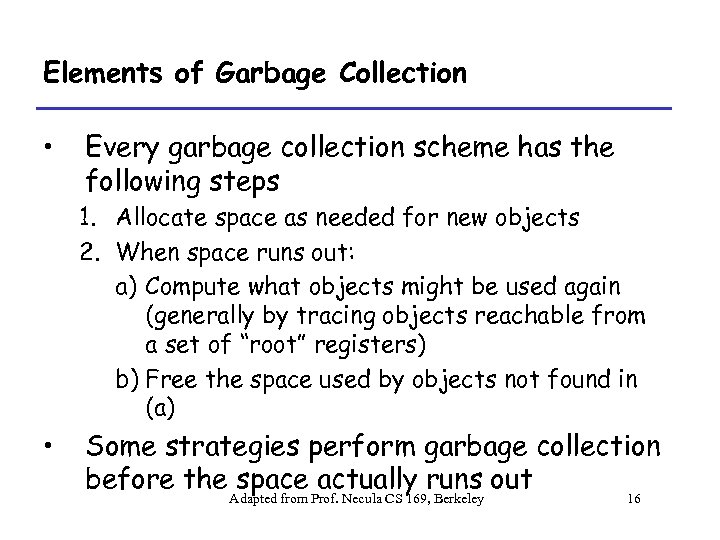
Elements of Garbage Collection • Every garbage collection scheme has the following steps 1. Allocate space as needed for new objects 2. When space runs out: a) Compute what objects might be used again (generally by tracing objects reachable from a set of “root” registers) b) Free the space used by objects not found in (a) • Some strategies perform garbage collection before the space actually runs out Adapted from Prof. Necula CS 169, Berkeley 16
Notes on Garbage Collection • Much safer than explicit memory management – Crashes due to memory errors disappear – And easy to use • But exacerbates other problems – Memory leaks can be hard to find • Because memory usage in general is hidden – Different GC approaches have different performance trade-offs Adapted from Prof. Necula CS 169, Berkeley 17
Notes (Continued) • Fastest GCs do not perform well if live data is significant percentage of physical memory • Should be < 30% • If > 50%, quite dramatic performance degradation • Pauses are not acceptable in some applications – Use real-time GC, which is more expensive • Allocation can be very fast • Amortized deallocation can be very fast, too Adapted from Prof. Necula CS 169, Berkeley 18
Finding Memory Leaks • A simple automatic technique is effective at finding memory leaks • Record allocations and accesses to objects • Periodically check – Live objects that have not been used in some time – These are likely leaked objects • This can find bugs Prof. Necula in 169, Berkeley even CS GC languages! Adapted from 19
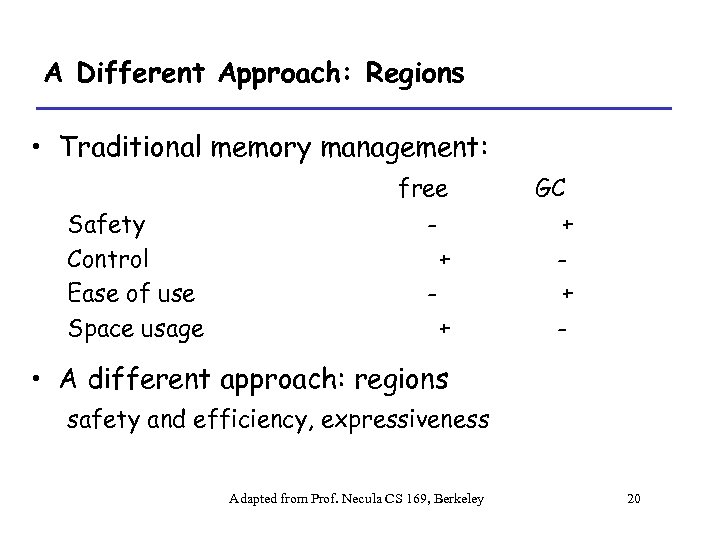
A Different Approach: Regions • Traditional memory management: Safety Control Ease of use Space usage free + + GC + + - • A different approach: regions safety and efficiency, expressiveness Adapted from Prof. Necula CS 169, Berkeley 20
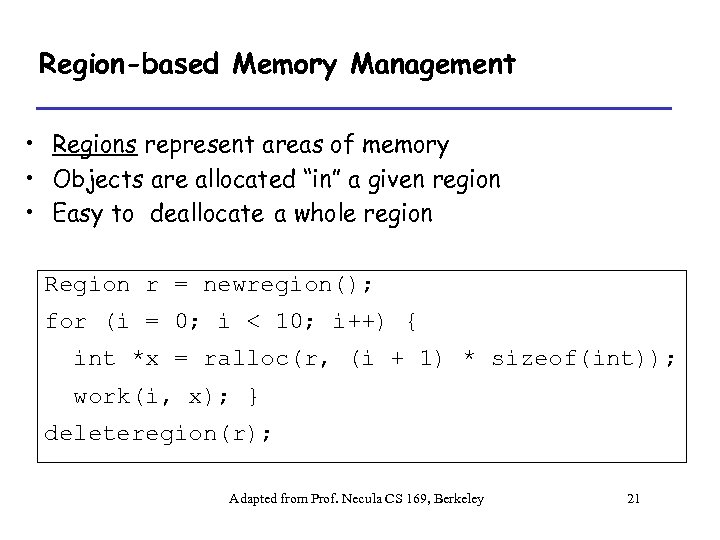
Region-based Memory Management • Regions represent areas of memory • Objects are allocated “in” a given region • Easy to deallocate a whole region Region r = newregion(); for (i = 0; i < 10; i++) { int *x = ralloc(r, (i + 1) * sizeof(int)); work(i, x); } deleteregion(r); Adapted from Prof. Necula CS 169, Berkeley 21
Why Regions ? • Performance • Locality benefits • Expressiveness • Memory safety Adapted from Prof. Necula CS 169, Berkeley 22
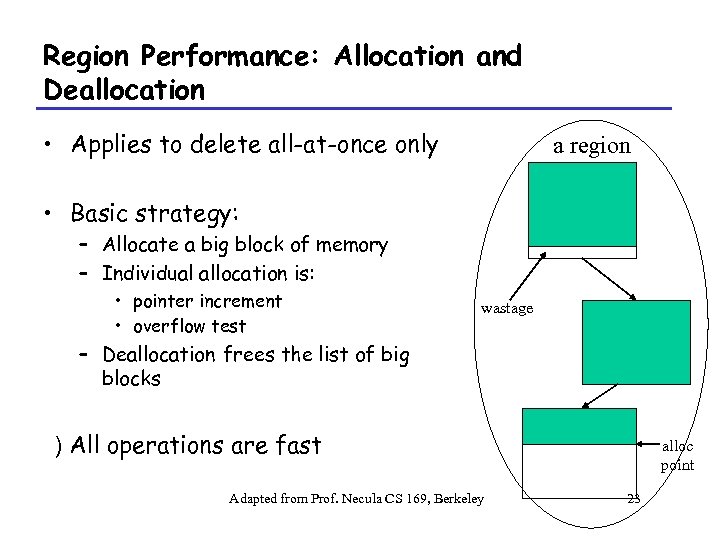
Region Performance: Allocation and Deallocation • Applies to delete all-at-once only a region • Basic strategy: – Allocate a big block of memory – Individual allocation is: • pointer increment • overflow test wastage – Deallocation frees the list of big blocks ) All operations are fast Adapted from Prof. Necula CS 169, Berkeley alloc point 23
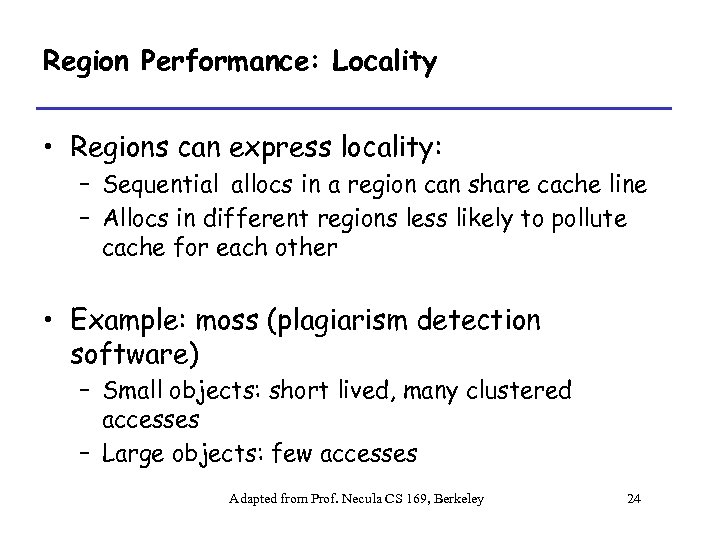
Region Performance: Locality • Regions can express locality: – Sequential allocs in a region can share cache line – Allocs in different regions less likely to pollute cache for each other • Example: moss (plagiarism detection software) – Small objects: short lived, many clustered accesses – Large objects: few accesses Adapted from Prof. Necula CS 169, Berkeley 24
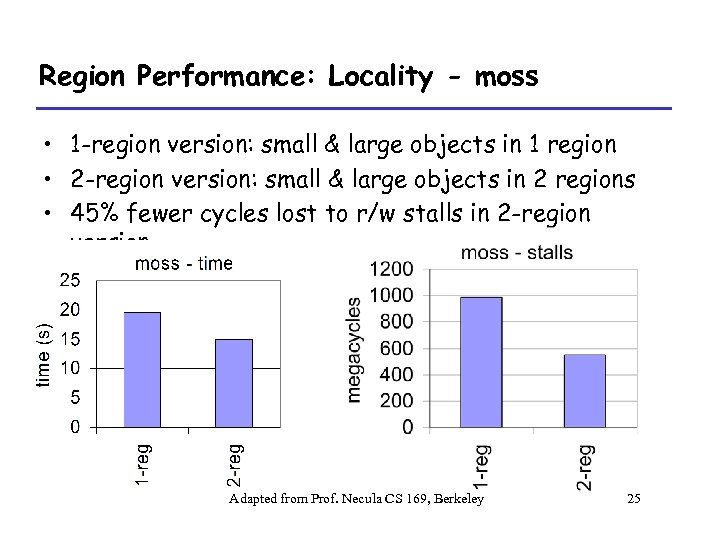
Region Performance: Locality - moss • 1 -region version: small & large objects in 1 region • 2 -region version: small & large objects in 2 regions • 45% fewer cycles lost to r/w stalls in 2 -region version Adapted from Prof. Necula CS 169, Berkeley 25
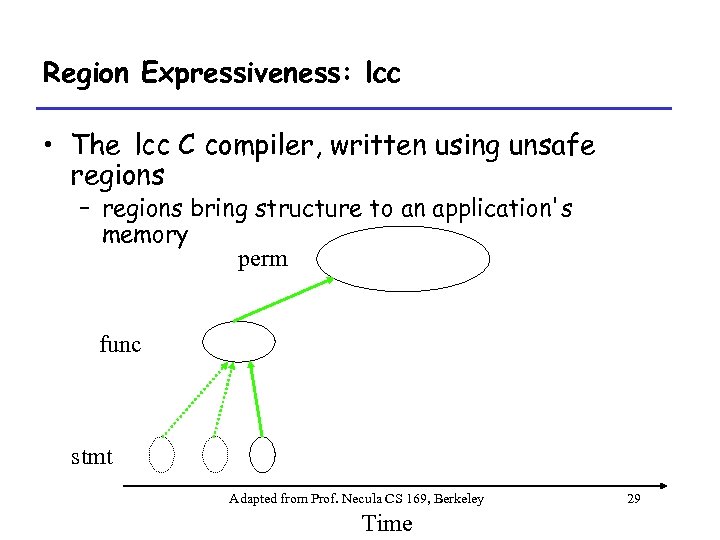
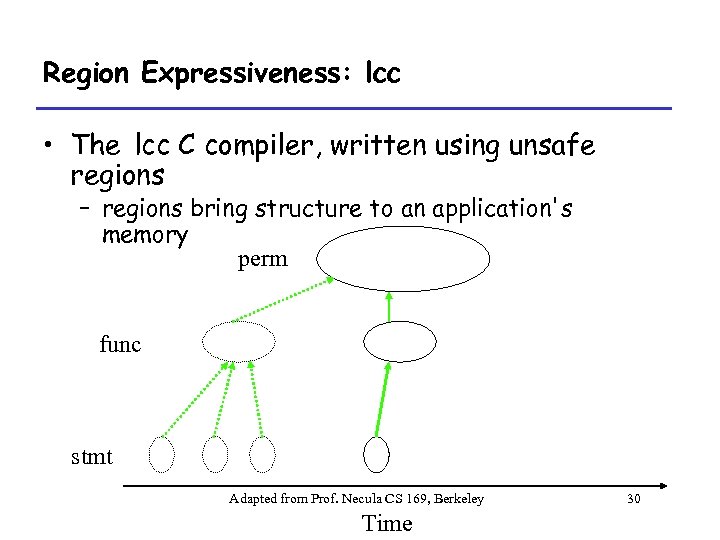
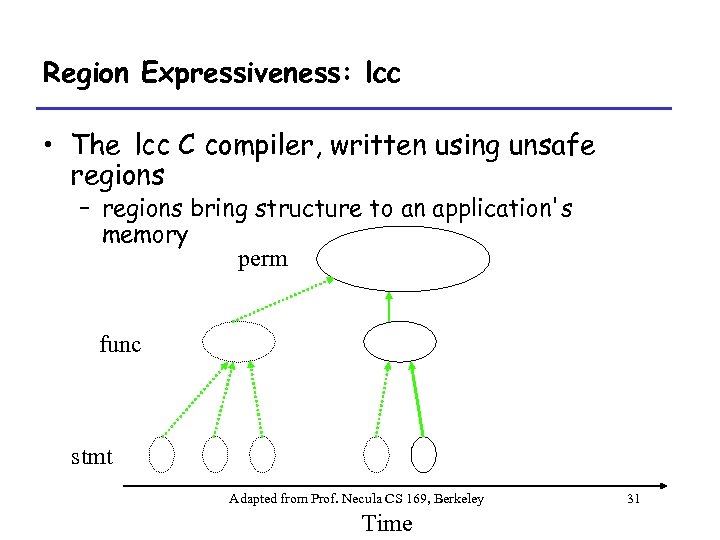
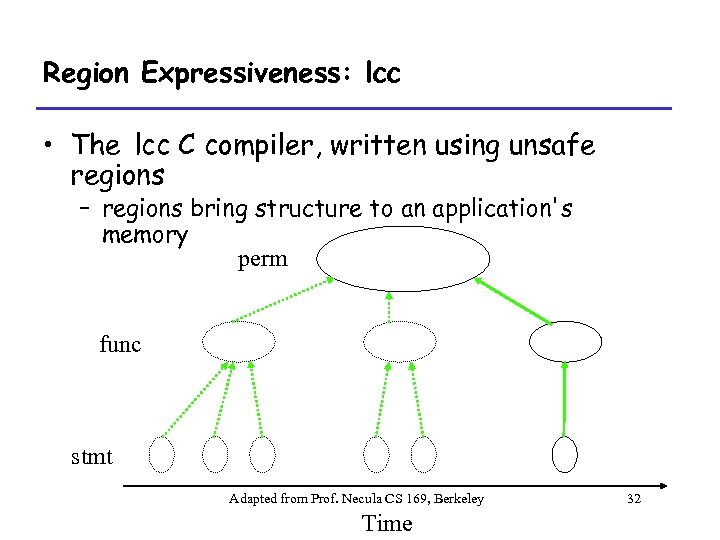
Region Expressiveness • Adds some structure to memory management • Few regions: – Easier to keep track of – Delay freeing to convenient "group" time • End of an iteration, closing a device, etc • No need to write "free this data structure" functions Adapted from Prof. Necula CS 169, Berkeley 26
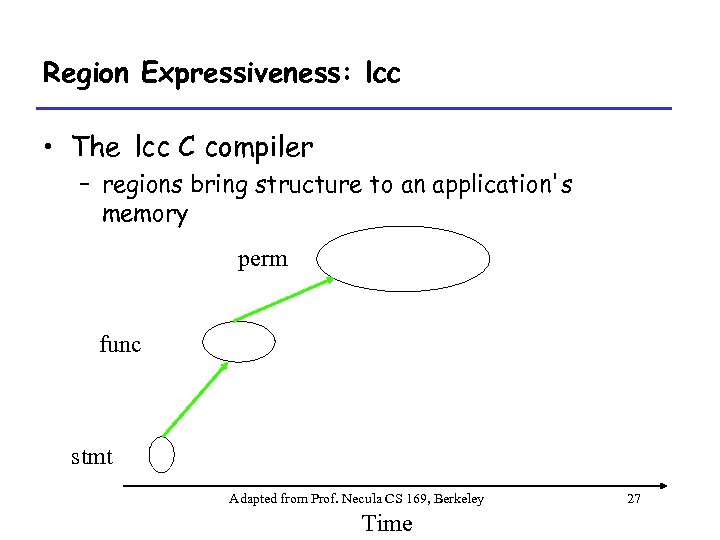
Region Expressiveness: lcc • The lcc C compiler – regions bring structure to an application's memory perm func stmt Adapted from Prof. Necula CS 169, Berkeley Time 27
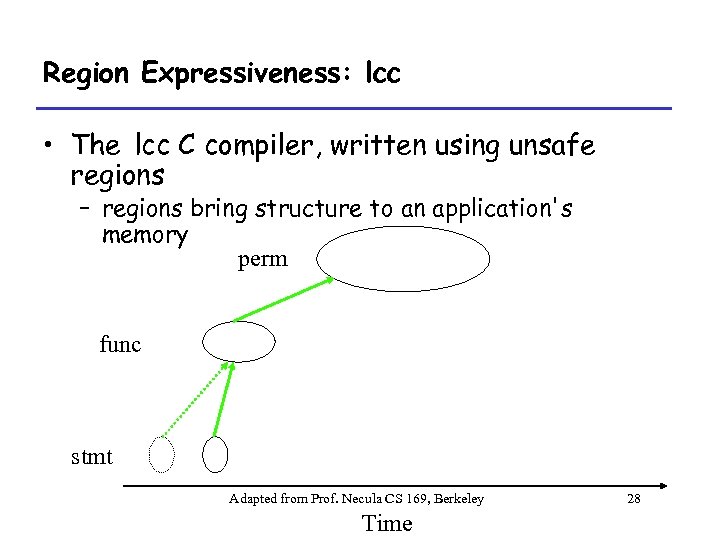
Region Expressiveness: lcc • The lcc C compiler, written using unsafe regions – regions bring structure to an application's memory perm func stmt Adapted from Prof. Necula CS 169, Berkeley Time 28
Region Expressiveness: lcc • The lcc C compiler, written using unsafe regions – regions bring structure to an application's memory perm func stmt Adapted from Prof. Necula CS 169, Berkeley Time 29
Region Expressiveness: lcc • The lcc C compiler, written using unsafe regions – regions bring structure to an application's memory perm func stmt Adapted from Prof. Necula CS 169, Berkeley Time 30
Region Expressiveness: lcc • The lcc C compiler, written using unsafe regions – regions bring structure to an application's memory perm func stmt Adapted from Prof. Necula CS 169, Berkeley Time 31
Region Expressiveness: lcc • The lcc C compiler, written using unsafe regions – regions bring structure to an application's memory perm func stmt Adapted from Prof. Necula CS 169, Berkeley Time 32
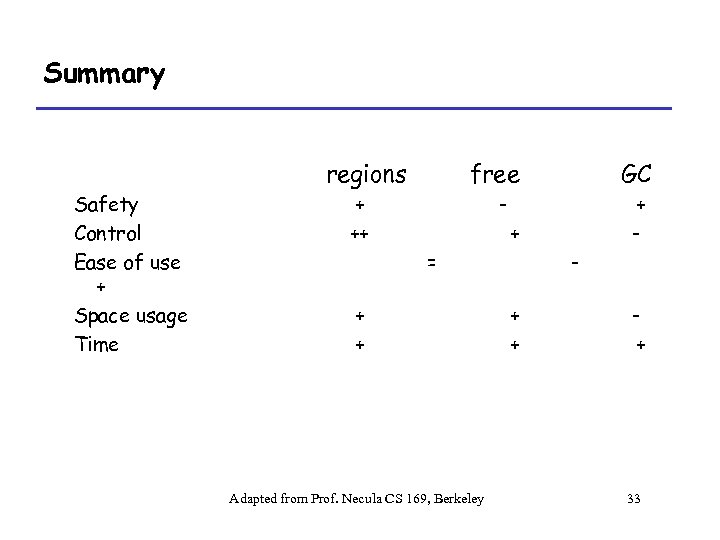
Summary regions Safety Control Ease of use + Space usage Time free + ++ GC - + = + + Adapted from Prof. Necula CS 169, Berkeley + + + 33
Region Notes • Regions are fast – Very fast allocation – Very fast (amortized) deallocation – Can express locality • Only known technique for doing so • Good for memory-intensive programs – Efficient and fast even if high % of memory in use Adapted from Prof. Necula CS 169, Berkeley 34
Region Notes (Continued) • Does waste some memory – In between malloc/free and GC • Requires more thought than GC – Have to organize allocations into regions Adapted from Prof. Necula CS 169, Berkeley 35
Summary • You must pay attention to memory management – Can affect the design of many system components • For applications with low-memory, no real time constraints, use GC – Easiest strategy for programmer • For high-memory or high-performance applications, use regions Adapted from Prof. Necula CS 169, Berkeley 36
Run-Time Monitoring • Recall from testing: – How do you know that a test succeeds? – Can check intermediate results, using assert • This is called run-time monitoring (RTM) – Makes testing more effective Adapted from Prof. Necula CS 169, Berkeley 37
What do we Monitor? • Check the result of computation – E. g. , the result of matrix inversion • Hardware-enforced monitoring – E. g. , division-by-zero, segmentation fault • Programmer-inserted monitoring – E. g. , assert statements Adapted from Prof. Necula CS 169, Berkeley 38
Automated Run-Time Monitoring • Given a property Q that must hold always • … and a program P • Produce a program P’ such that: – P’ always produces the same result as P – P’ has lots of assert(Q) statements, at all places where Q may be violated – P’ is called the instrumented program • We are interested in automatic instrumentation from Prof. Necula CS 169, Berkeley Adapted 39
RTM for Memory Safety • A technique for finding memory bugs – Applies to C and C++ • C/C++ are not type safe – Neither the compiler nor the runtime system enforces type abstractions • Possible to read or write outside of your intended data structure Adapted from Prof. Necula CS 169, Berkeley 40
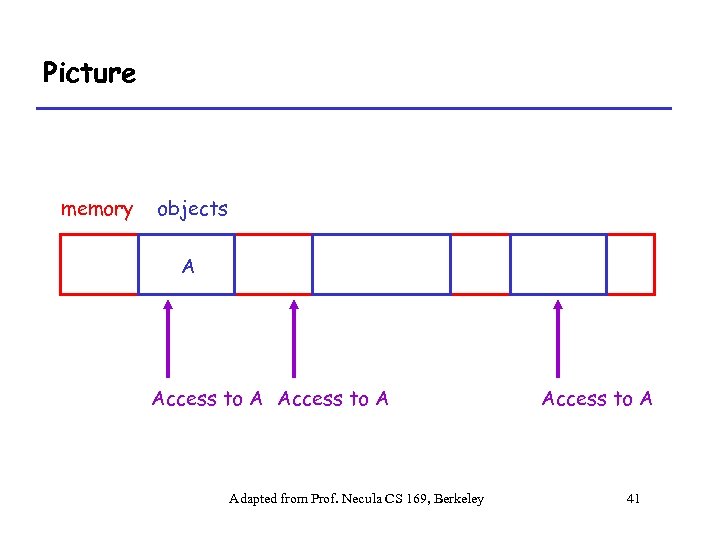
Picture memory objects A Access to A Adapted from Prof. Necula CS 169, Berkeley Access to A 41
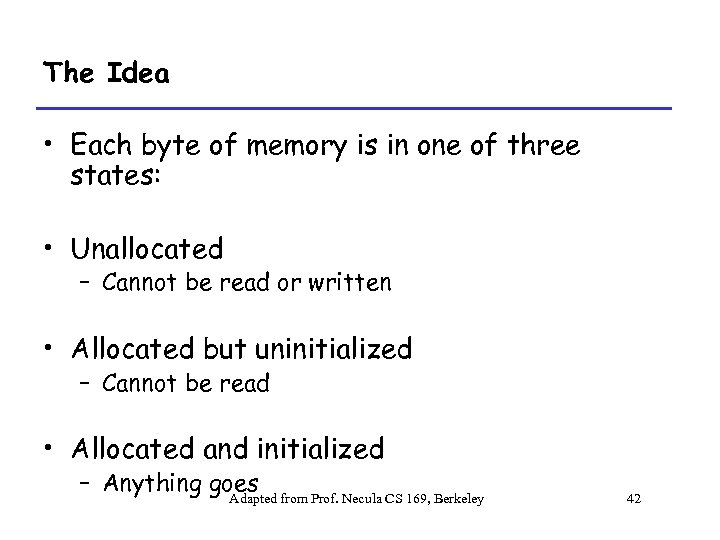
The Idea • Each byte of memory is in one of three states: • Unallocated – Cannot be read or written • Allocated but uninitialized – Cannot be read • Allocated and initialized – Anything goes from Prof. Necula CS 169, Berkeley Adapted 42
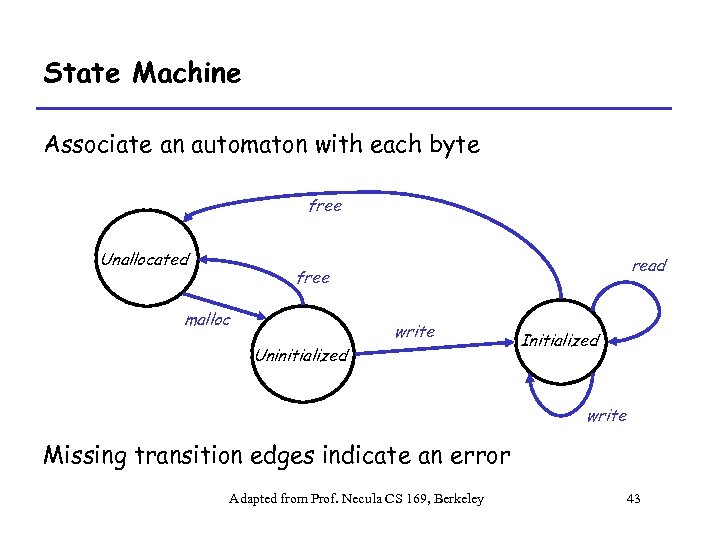
State Machine Associate an automaton with each byte free Unallocated read free malloc write Uninitialized Initialized write Missing transition edges indicate an error Adapted from Prof. Necula CS 169, Berkeley 43
Instrumentation • Check the state of each byte on each access • Binary instrumentation – Add code before each load and store – Represent states as giant array • 2 bits per byte of memory • 25% memory overhead – Catches byte-level errors – Won’t catch bit-level errors Adapted from Prof. Necula CS 169, Berkeley 44
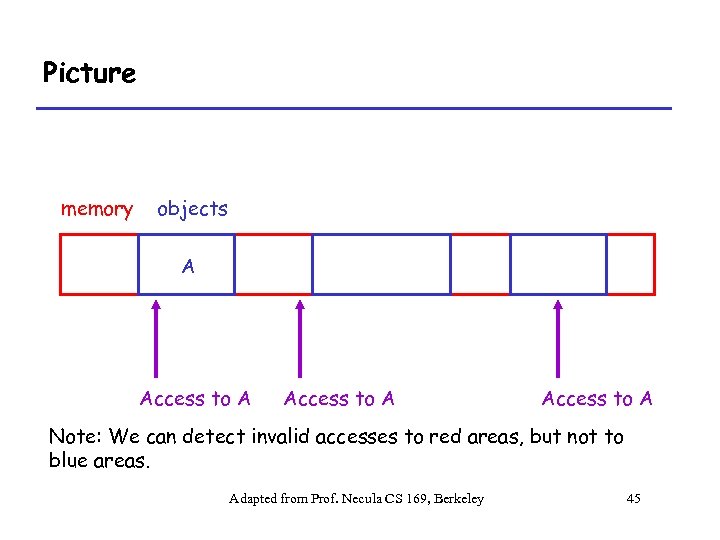
Picture memory objects A Access to A Note: We can detect invalid accesses to red areas, but not to blue areas. Adapted from Prof. Necula CS 169, Berkeley 45
Improvements • We can only detect bad accesses if they are to unallocated or uninitialized memory • So try to make most of the bad accesses be of those two forms – Especially, the common off-by-one errors Adapted from Prof. Necula CS 169, Berkeley 46
Red Zones • Leave buffer space between allocated objects – The “red zone” – In what state do we put this zone? • Guarantees that walking off the end of an array accesses unallocated memory Adapted from Prof. Necula CS 169, Berkeley 47
Aging Freed Memory • When memory is freed, do not reallocate immediately – Wait until the memory has “aged” • Helps catch dangling pointer errors • Red zones and aging are easily implemented in the malloc library Adapted from Prof. Necula CS 169, Berkeley 48
Another Class of Errors: Memory Leaks • A memory leak occurs when memory is allocated but never freed. • Memory leaks can be even more serious than memory corruption errors • We can find many memory leaks using techniques borrowed from garbage collection Adapted from Prof. Necula CS 169, Berkeley 49
The Basic Idea • Any memory with no pointers to it is leaked – There is no way to free this memory • Run a garbage collector – But don’t free any garbage – Just detect the garbage – Any inaccessible memory is leaked memory Adapted from Prof. Necula CS 169, Berkeley 50
Issues with C/C++ • It is sometimes hard to tell what is inaccessible in a C/C++ program • Cases – No pointers to a malloc’d block • Definitely garbage – No pointers to the head of a malloc’d block • Maybe garbage Adapted from Prof. Necula CS 169, Berkeley 51
Leak Detection Summary • From time to time, run a garbage collector – Use mark and sweep • Report areas of memory that are definitely or probably garbage – Need to report who malloc’d the blocks originally – Store this information in the red zone between objects Adapted from Prof. Necula CS 169, Berkeley 52
Tools for Memory Debugging • Purify – Robust industrial tool for detecting all major memory faults – Developed by Rational, now part of IBM • Valgrind – Open source tool for linux – http: // valgrind. org • “Poor man’s purify” – Implement basic memory checking at source code level – Sample project includes a simple debugger called simpurify Adapted from Prof. Necula CS 169, Berkeley 53
Скачать презентацию Memory Management and Debugging V 22 0474 -001
a644deb8e782db7eecff2825dd41e6fe.ppt