 Скачать презентацию Member of Spectrum Sciences Institute Dosimetry Research Board
13d3c9760418ae42faada2be58d0828d.ppt
- Количество слайдов: 16



Member of Spectrum Sciences Institute Dosimetry Research Board Specific Absorption Rate (SAR) An Overview and Status RABC Montreal 2007 Presented by Stuart Nicol APREL Laboratories Member of the Spectrum Sciences Institute © 2000 -2007 SSI and APREL Laboratories Montreal 2007 SAR 1 1
Member of Spectrum Sciences Institute Dosimetry Research Board RF Exposure and Measurement Standards • • • IEEE (USA & International) ICNRP, NCRP IEC (International) CENELEC (Europe) HC, IC, (Canada) Australia/New Zealand Standards(Australia) MIC (Korea) ARIB (Japan) IDA (Singapore) Other “derivative” country standards (China, Taiwan, Russia, Mexico, Brazil…) © 2000 -2007 SSI and APREL Laboratories Montreal 2007 SAR 2 2
Member of Spectrum Sciences Institute Dosimetry Research Board Published Experimental Measurement Methodology Standards • IEEE 1528 “Recommended Practice for Determining the Peak Spatial-Average Specific Absorption Rate (SAR) in the Human Body Due to Wireless Communications Devices: Experimental Techniques” (APREL Laboratories have 4 staff members recoded in the standard as technical contributors) • IEC 62209 “Human exposure to radio frequency fields from handheld and body-mounted wireless communication devices – Human models, instrumentation, and procedures – Part 1: Procedure to determine the Specific Absorption Rate (SAR) for hand-held devices used in close proximity of the ear (frequency range of 300 MHz to 3 GHz)” Both Standards Harmonized © 2000 -2007 SSI and APREL Laboratories Montreal 2007 SAR 3 3
Member of Spectrum Sciences Institute Dosimetry Research Board IEEE 1528 b Background (ICES-TC 34) Work started in 2005 • Two working groups (membership from Europe, Asia, North America) – WG 1 Douglas (Motorola) Experimental Measurements(> 65 members) • Recommended Practice for Determining the Spatial-Peak Specific Absorption Rate (SAR) in the Human Body Due to Wireless Communications Devices: Experimental Techniques – WG 2 Kainz (FDA) Computational Methods • P 1529 b Recommended Practice for Determining the Spatial. Peak Specific Absorption Rate (SAR) in the Human Body Due to Wireless Communications Devices: Computational Techniques • Objectives to define methodologies for determining SAR © 2000 -2007 SSI and APREL Laboratories Montreal 2007 SAR 4 4
Member of Spectrum Sciences Institute Dosimetry Research Board IEC 62209 Part 1 and 2 TC 106 WG 4 • One working group (membership from Europe, Asia, North America) – TC 106 Chairman Matthias Meier (Motorola) Title Human exposure to radio frequency fields from hand-held and body-mounted wireless communication devices – Human models, instrumentation, and procedures – Part 1: Procedure to determine the Specific Absorption Rate (SAR) for hand-held devices used in close proximity of the ear (frequency range of 300 MHz to 3 GHz). Human exposure to radio frequency fields from hand-held and body-mounted wireless communication devices - Human models, instrumentation, and procedures. Part 2: Procedure to determine the Specific Absorption Rate (SAR) in the head and body for 30 MHz to 6 GHz Handheld and Body-Mounted Devices used in close proximity to the Body. © 2000 -2007 SSI and APREL Laboratories Montreal 2007 SAR 5 5
Member of Spectrum Sciences Institute Dosimetry Research Board IEC & IEEE Standards Harmonization • Why harmonize? – Both standards groups accept that the head methodologies are sound so IEC decided to focus on extending frequency range and scope so as to apply the standard to other technologies • What are the implications? – Standards are becoming more complex (academic) where correction factors and uncertainty bias are becoming more applicable rather than physical quantification of measurements • How does/will this affect government regulators? – It can potentially effect post audit exercises where measurements will not be repeatable due to post processing factors © 2000 -2007 SSI and APREL Laboratories Montreal 2007 SAR 6 6
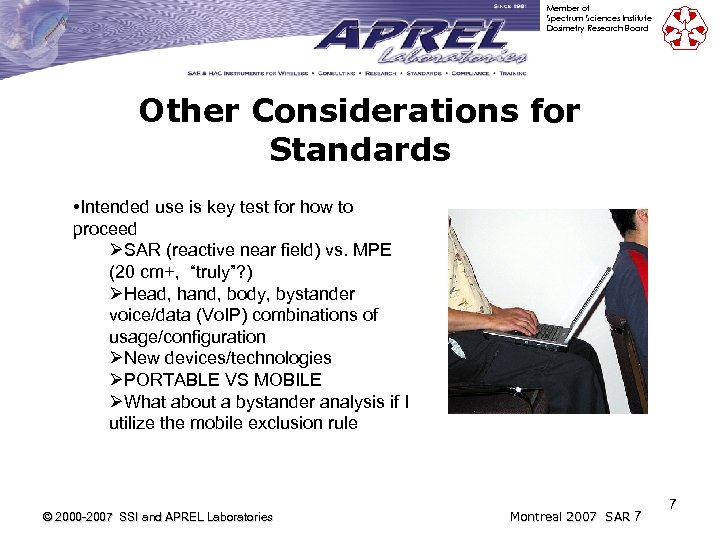
Member of Spectrum Sciences Institute Dosimetry Research Board Other Considerations for Standards • Intended use is key test for how to proceed ØSAR (reactive near field) vs. MPE (20 cm+, “truly”? ) ØHead, hand, body, bystander voice/data (Vo. IP) combinations of usage/configuration ØNew devices/technologies ØPORTABLE VS MOBILE ØWhat about a bystander analysis if I utilize the mobile exclusion rule © 2000 -2007 SSI and APREL Laboratories Montreal 2007 SAR 7 7
Member of Spectrum Sciences Institute Dosimetry Research Board Implementation/Approval Issues • RF exposure requirements have changed the game for approvals of devices • Duty cycles, accessories • Exclusions, apparent exclusions, and erring on the side of caution • UWB, Mi. MO, Wi. MAX, implantable devices, etc? © 2000 -2007 SSI and APREL Laboratories Montreal 2007 SAR 8 8
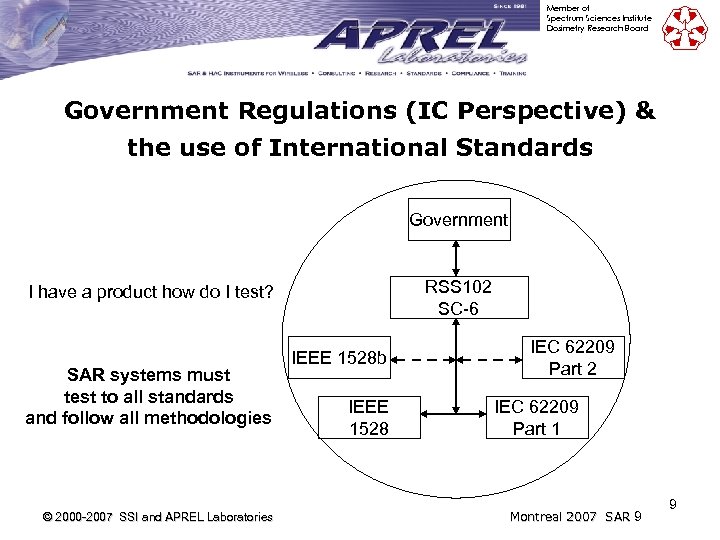
Member of Spectrum Sciences Institute Dosimetry Research Board Government Regulations (IC Perspective) & the use of International Standards Government RSS 102 SC-6 I have a product how do I test? SAR systems must test to all standards and follow all methodologies © 2000 -2007 SSI and APREL Laboratories IEEE 1528 b IEEE 1528 IEC 62209 Part 2 IEC 62209 Part 1 Montreal 2007 SAR 9 9
Member of Spectrum Sciences Institute Dosimetry Research Board SAR Test Evaluation Methods • Experimental methods include activities run on automated test systems e. g. ALSAS-10 U – SAR systems provide data up to 6 GHz – Requirements now for IEC/ISO 17025 accredited facilities – Homogenous assessments ONLY • Numerical methods include FDTD applications – – Can be used to support experimental activities Used for heterogeneous analysis Used for implantable heterogeneous studies Used for network planning efficiency and base station/repeaters positioning © 2000 -2007 SSI and APREL Laboratories Montreal 2007 SAR 10 10
Member of Spectrum Sciences Institute Dosimetry Research Board Applications • Device types (technologies) – Cellular Telephones, PDA’s, Laptop’s, Implantable, Body Worn, Telemetry • Manufacturers or integrators expect data from third parties (suppliers) ODM’s antenna manufacturers – – Module manufacturers occasionally don’t test Modular applications can be wide and varied This is safety High SAR high concern © 2000 -2007 SSI and APREL Laboratories Montreal 2007 SAR 11 11
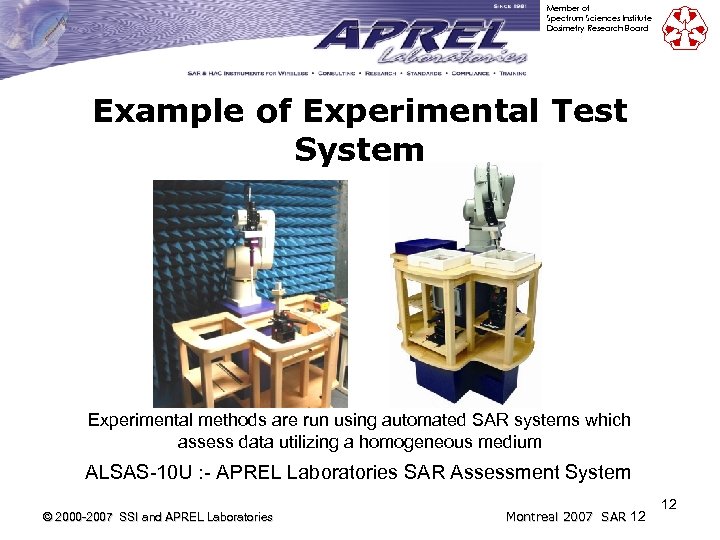
Member of Spectrum Sciences Institute Dosimetry Research Board Example of Experimental Test System Experimental methods are run using automated SAR systems which assess data utilizing a homogeneous medium ALSAS-10 U : - APREL Laboratories SAR Assessment System © 2000 -2007 SSI and APREL Laboratories Montreal 2007 SAR 12 12
Member of Spectrum Sciences Institute Dosimetry Research Board SAR Test Requirements • Head SAR in left and right, touch and tilt with antenna extended/retracted, device open and closed on the low mid and high channels for each mode • Body SAR to be tested inside or outside holster (belt clip) if no holster belt clip is available test either with 0 mm separation or 15 mm separation front and back, with accessories for low mid and high channels for each mode • Separation distances with respect to resonate source from tissue are now being excluded for some wireless devices • Area scan consisting of a minimum step resolution of 20 mm^2 providing adequate coverage of the device (1. 5 x device size or large enough to cover resonant point/antenna) • Zoom scan (volume 1 g or 10 g) consists of minimum 8 mm^2 (X & Y) and 5 mm in Z © 2000 -2007 SSI and APREL Laboratories Montreal 2007 SAR 13 13
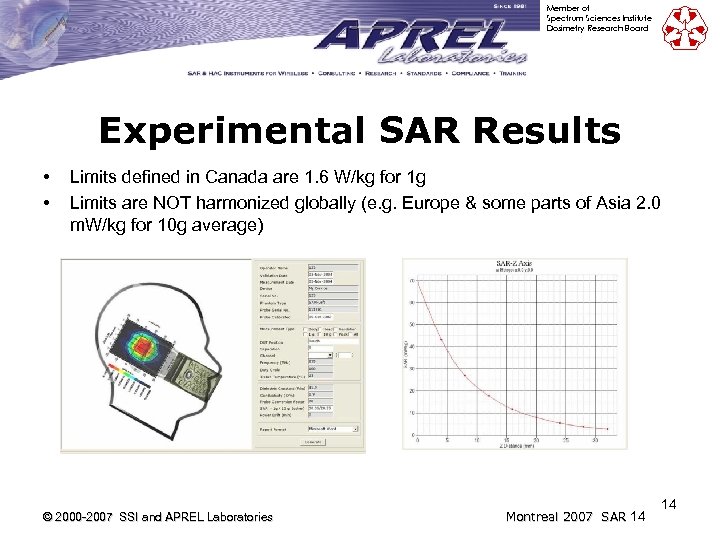
Member of Spectrum Sciences Institute Dosimetry Research Board Experimental SAR Results • • Limits defined in Canada are 1. 6 W/kg for 1 g Limits are NOT harmonized globally (e. g. Europe & some parts of Asia 2. 0 m. W/kg for 10 g average) © 2000 -2007 SSI and APREL Laboratories Montreal 2007 SAR 14 14
Member of Spectrum Sciences Institute Dosimetry Research Board Numerical Methods • Numerical SAR can be derived using FDTD code • Acceptable for some compliance applications • Strong tool for biological research • Used for circuit design • Excellent method for initial product development and final product improvements • Used for standards development (SAR, MPE and HAC) • Draw backs include time needed to produce and assess data • Limits will remain the same Standards are now being developed to allow for an accepted method to be used as a compliance alternative © 2000 -2007 SSI and APREL Laboratories Montreal 2007 SAR 15 15
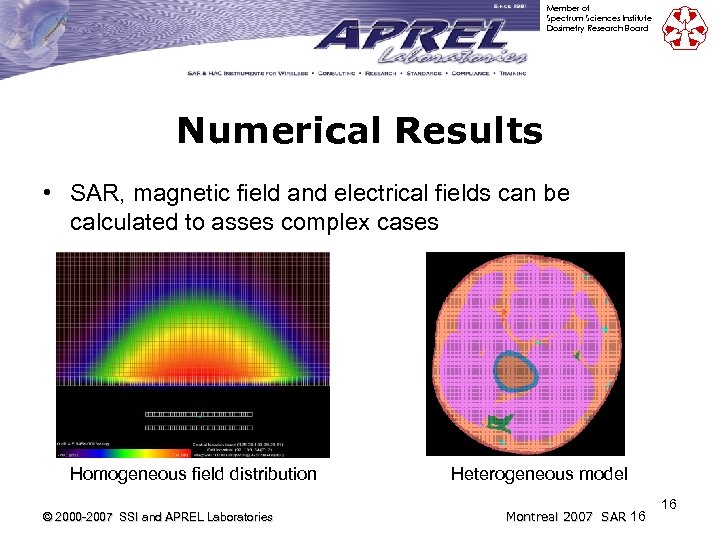
Member of Spectrum Sciences Institute Dosimetry Research Board Numerical Results • SAR, magnetic field and electrical fields can be calculated to asses complex cases Homogeneous field distribution © 2000 -2007 SSI and APREL Laboratories Heterogeneous model Montreal 2007 SAR 16 16
Скачать презентацию Member of Spectrum Sciences Institute Dosimetry Research Board
13d3c9760418ae42faada2be58d0828d.ppt