


 Скачать презентацию Meitzav 2011 -2012 Meitzav Growth and Effectiveness
47b2d4c166382d747e8aec2f60f453d2.ppt
- Количество слайдов: 73
 Meitzav 2011 -2012
 Meitzav Growth and Effectiveness Measures for Schools (GEM) - introduced by the Ministry of Education in 2002/3 set of school level indicators, with a A goal to enable principals to base their decisions on valid evidence Administered every second year to 5 th and 8 th (+ 2 nd grade for Mother Language)
 The Meitzav School Report includes information based on questionnaires and interviews on: Pedagogical Environment in the School Climate and Work Environment Student Achievements based on results from standardized national assessments Math, English, Mother Language (Hebrew/Arabic), and Science & Technology
 What to be aware of… Reallocation of your teaching time “Teaching to the test” Excessive test preparation Score inflation Gaming the system (incl. cheating) Excluding the weak students
 Challenges The length of the exam Getting the pupils (and teachers) to take it seriously Meeting with the principal’s expectations The level of the reading material The weaker pupils – getting them ready, motivated and helping them to feel good about themselves after the exam Working without dictionaries
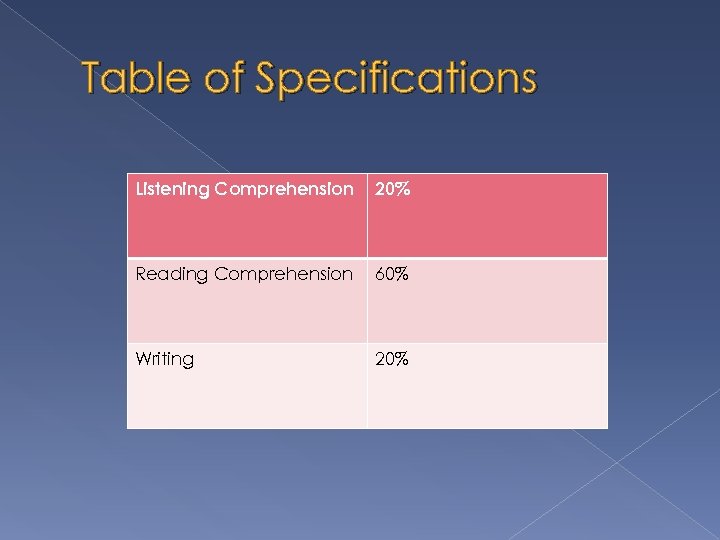 Table of Specifications Listening Comprehension 20% Reading Comprehension 60% Writing 20%
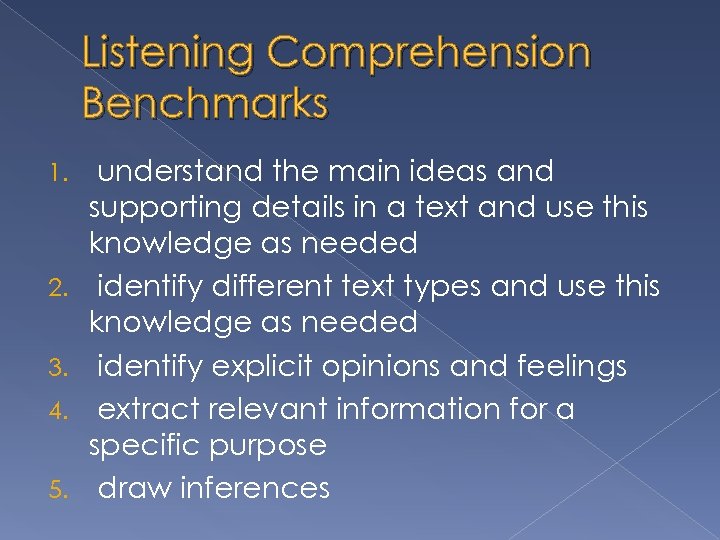 Listening Comprehension Benchmarks 1. 2. 3. 4. 5. understand the main ideas and supporting details in a text and use this knowledge as needed identify different text types and use this knowledge as needed identify explicit opinions and feelings extract relevant information for a specific purpose draw inferences
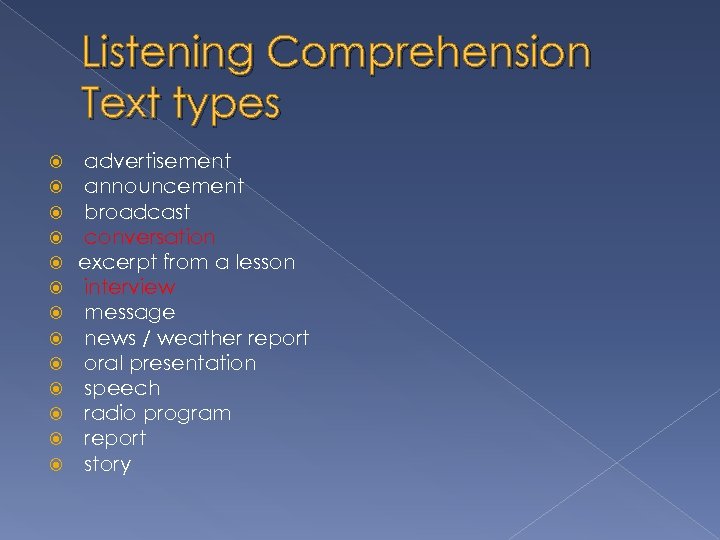 Listening Comprehension Text types advertisement announcement broadcast conversation excerpt from a lesson interview message news / weather report oral presentation speech radio program report story
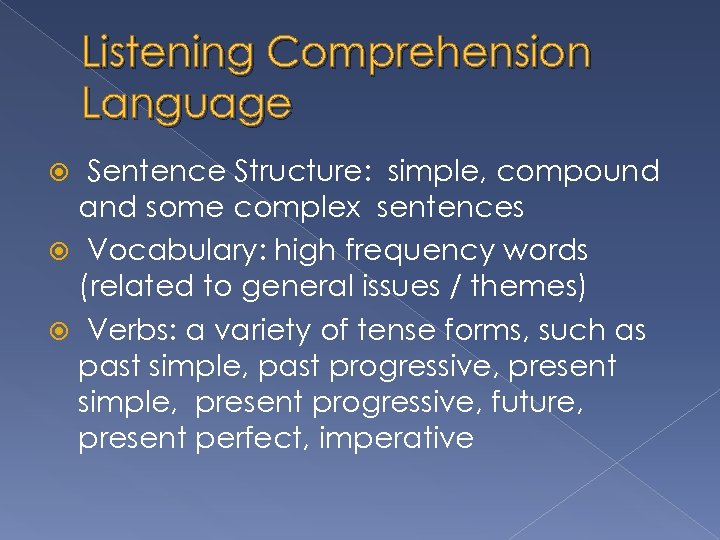 Listening Comprehension Language Sentence Structure: simple, compound and some complex sentences Vocabulary: high frequency words (related to general issues / themes) Verbs: a variety of tense forms, such as past simple, past progressive, present simple, present progressive, future, present perfect, imperative
 Listening Comprehension – length of texts Level One Approximately 80 – 100 seconds Level Two Approximately 100 – 120 seconds
 Listening Comprehension – item types filling in a chart / table graphic organizer matching multiple choice open-ended (e. g. wh-questions and sentence completion) sequencing
 Listening Comprehension – question categories Literal Integration Inference
 Listening Comprehension Language Sentence Structure: simple, compound and some complex sentences Vocabulary: high frequency words (related to general issues / themes) Verbs: a variety of tense forms, such as past simple, past progressive, present simple, present progressive, future, present perfect, imperative
 Listening תשע"א Task 1 page 6 Discourse features (text description) Text type: Classroom discussion Topic: Planning a reception for visitors from overseas Linguistic aspects of text: High frequency vocabulary, basic sentence structure, use of modals, sequence express
 Listening תשע"א Task 1 page 6 Mrs. Hill: Good morning, everyone. I have some exciting news for you. Next Monday a group of 8 th-grade students from England is coming to Israel and they will visit our school. The principal wants us to welcome them and invite them to our class. So, we need to think about what we can do together.
 Listening תשע"א Task 1 page 6 Do you have any ideas? Yes, Amir? Amir: Let's make a poster and hang it on the school gate. We'll write Welcome in big letters
 Listening תשע"א Task 1 page 6 Maya: A poster is great. Then, in class, we can talk about our countries, Israel and England Amir: And of course, we can talk about football. I can tell them all about Israeli football and they can tell us all about football in England! I love football.
 Listening תשע"א Task 1 page 6 Mrs. Hill: Yes, Amir, everyone knows you love playing football. You can all talk about your hobbies and see if you all enjoy the same things. After that, some of you can tell them about one of our school projects Rani: Yes! Let's tell them about the 'Clean the Beach Project.
 Listening תשע"א Task 1 page 6 Maya: We can show them photos of the beach before and after we cleaned it. Maybe they can tell us about their school project. Mrs. Hill: I'm sure they would like that. After the English lesson we can have breakfast together. We can make them an Israeli breakfast here in our classroom
 Listening תשע"א Task 1 page 6 Rani: We could all bring different food. I'll bring pita bread Maya: Pita bread is great. And I'll bring cheese. We'll also need cucumbers and tomatoes Amir: I'll bring a watermelon and orange juice
 Listening תשע"א Task 1 page 6 Mrs. Hill: Great ideas, everyone! We have a good plan for next Monday. We will have a welcome poster for our visitors on the school gate. In class we will talk about Israel and England your hobbies. After that we will tell them about the beach project and show them the pictures. Then we will have a delicious breakfast together. I'm sure our visitors will enjoy their time at our school
 Listening תשע"א Task 2 page 8 Discourse features (text description) Text type: Radio broadcast Topic: Music festival Linguistic aspects of text: High frequency vocabulary; simple, compound and complex sentence structure
 Listening תשע"א Task 2 page 8 Jack: Good evening! This is Jack Hanson from Music Radio on 70 FM. Welcome to our weekly music program. This week I'm speaking to you from the music festival in Green Park. There has been some great music here in the park every Thursday during the summer vacation. Tonight is the last night of the summer music festival. Let's talk to one of the young people here and find out more about what's happening tonight.
 Listening תשע"א Task 2 page 8 Jack: Hi. I'm Jack Hanson from Music Radio on 70 FM. What's your name? Mark: I'm Mark Jack: How old are you, Mark? Mark: I'm 14 years old Jack: Tell me Mark, is this your first time at the music festival this summer?
 Listening תשע"א Task 2 page 8 Mark: Oh no! My friends and I have been coming to the park every Thursday evening. We heard some of our favorite singers and musicians. We had a great time all summer. But tonight‘s festival is special Jack: What is special about it? Mark: Tonight all the musicians are teenagers and they all live here in town
 Listening תשע"א Task 2 page 8 Jack: That's really nice, so many young musicians and all from the same town! Do you know any of them Mark: Sure! I'm here to listen to my older sister Dina. She's 16 years old and a wonderful singer. She also plays the guitar. She was very young when she started playing guitar Jack: Does Dina write her own songs too? Mark: Yes, she does. She wrote a new song for tonight's show. She is going to sing it for the first time tonight and soon she will record it on a CD. Remember her name; I'm sure she will be famous one day.
 Listening תשע"א Task 2 page 8 Jack: She must be very good. I'm looking forward to hearing her sing. What about you, are you a musician too? Mark: Yes, we are all musicians in our family. I also play the guitar but I'm not as good as Dina. I don't write my own songs. Dina is the only one who writes songs in our family Jack: Thanks, Mark, and good luck to Dina. The music is about to begin. Next week's program will come to you from a very special concert in the desert. This is Jack Hanson from Music Radio on 7.
 Teaching recommendations for listening task A. practice their listening skills by using a variety of oral texts of differing lengths and levels of difficulty B. Work on these skills: identifying topics first at the paragraph level and then at the text level differentiating main ideas from supporting details
 Teaching recommendations for listening task classifying and categorizing (e. g. activity, place, time practicing information transfer (e. g. matching text to graphic representations, filling in a table
 Teaching recommendations for listening task recognizing connectors that signal organization (e. g. first, second, finally • therefore, as a result of, like, in contrast to, etc. ) and connectors that indicate a time frame
 Teaching recommendations for listening task using 'reference words' (e. g. 'it', 'this', 'that') to support understanding and applying strategies for retrieving their referents recognizing markers of negation practicing information transfer (e. g. , filling in an invitation, filling in a (table
 Teaching recommendations for listening task C. Items to practice with your pupils items that tap into the global aspects of a text (e. g. topic, main idea items that tap into the supporting ideas and details of a text (e. g examples, data)
 Reading Comprehension Benchmarks understand the main ideas and supporting details in a text and use this knowledge as needed understand the structure and conventions of different text types and use this knowledge as needed identify explicit opinions and feelings draw inferences in order to identify points of view in a text, distinguishing fact from opinion extract / interpret information from visual data extract relevant information for a specific purpose
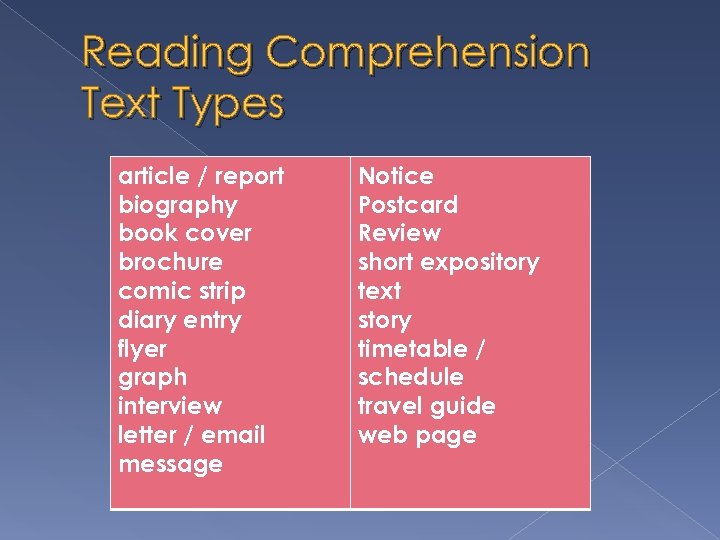 Reading Comprehension Text Types article / report biography book cover brochure comic strip diary entry flyer graph interview letter / email message Notice Postcard Review short expository text story timetable / schedule travel guide web page
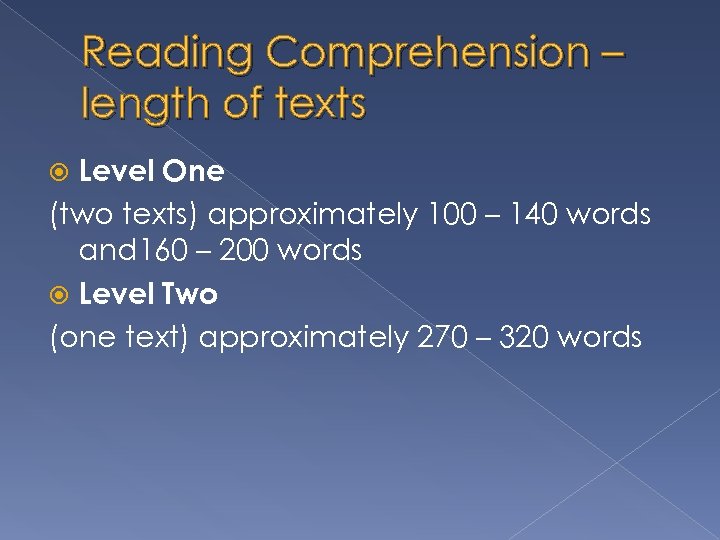 Reading Comprehension – length of texts Level One (two texts) approximately 100 – 140 words and 160 – 200 words Level Two (one text) approximately 270 – 320 words
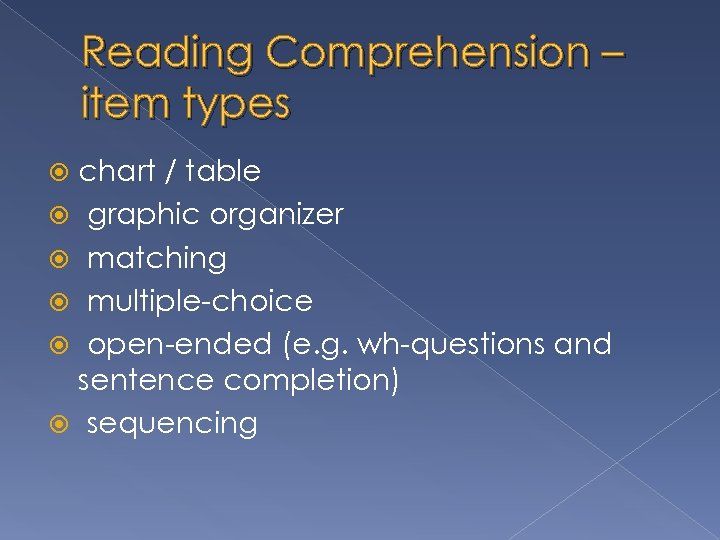 Reading Comprehension – item types chart / table graphic organizer matching multiple-choice open-ended (e. g. wh-questions and sentence completion) sequencing
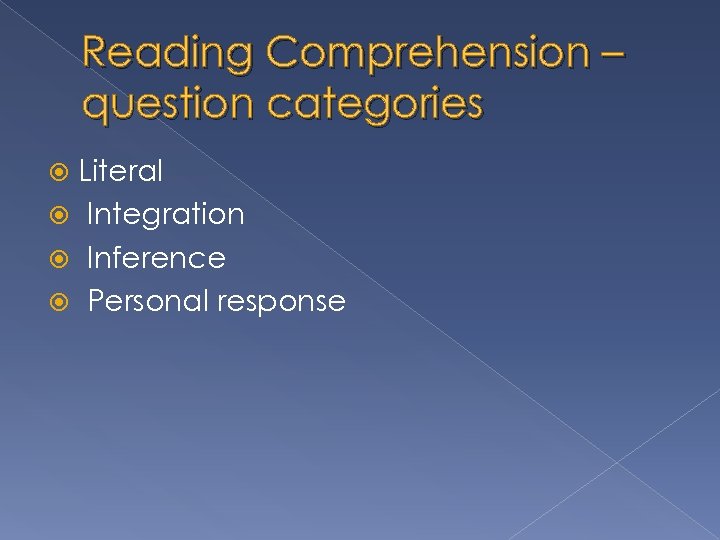 Reading Comprehension – question categories Literal Integration Inference Personal response
 Writing - Benchmarks describe people, places, things and events react to the content of something read or seen produce a short piece of coherent writing that conveys personal experiences express ideas and opinions about general topics and experiences using main ideas and supporting details
 Writing - Length 70 -80 words
 Writing – text types article (e. g. for school newspaper) description email extended form forum friendly letter opinion short composition story
 Writing – Assessment criteria Communicative Ability › › relevance clarity of message organization vocabulary Accuracy › use of basic syntactical and grammatical structures (word order and verb form) › spelling › basic punctuation and capitalization Length › writes at least 70 words
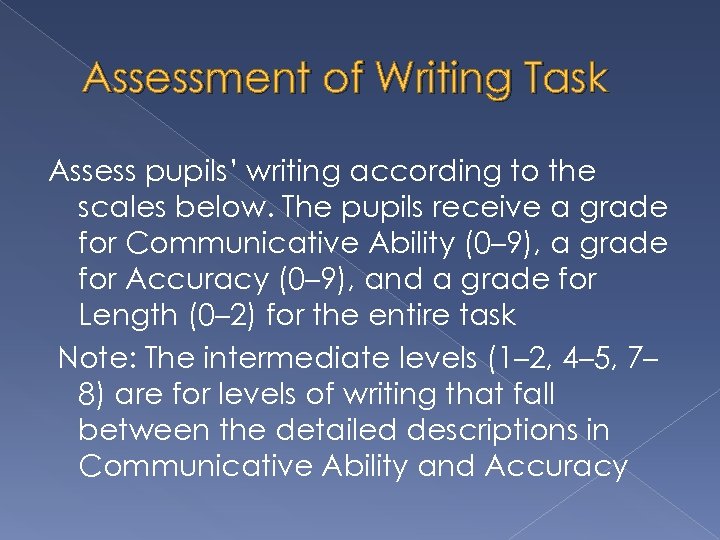 Assessment of Writing Task Assess pupils’ writing according to the scales below. The pupils receive a grade for Communicative Ability (0– 9), a grade for Accuracy (0– 9), and a grade for Length (0– 2) for the entire task Note: The intermediate levels (1– 2, 4– 5, 7– 8) are for levels of writing that fall between the detailed descriptions in Communicative Ability and Accuracy
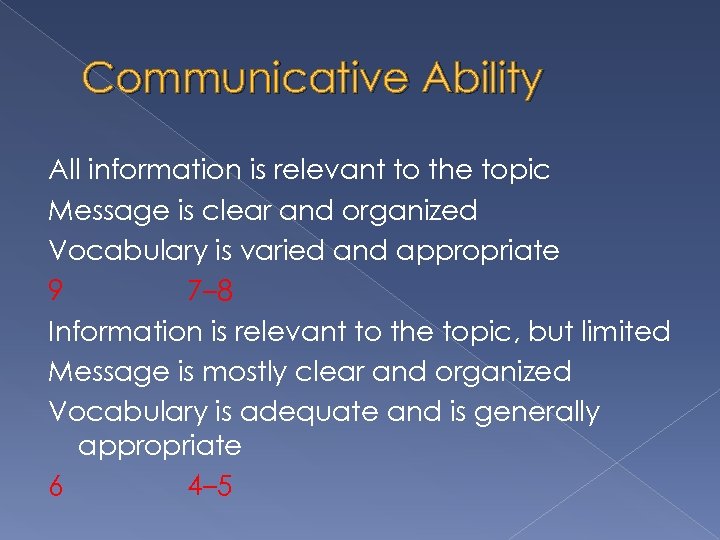 Communicative Ability All information is relevant to the topic Message is clear and organized Vocabulary is varied and appropriate 9 7– 8 Information is relevant to the topic, but limited Message is mostly clear and organized Vocabulary is adequate and is generally appropriate 6 4– 5
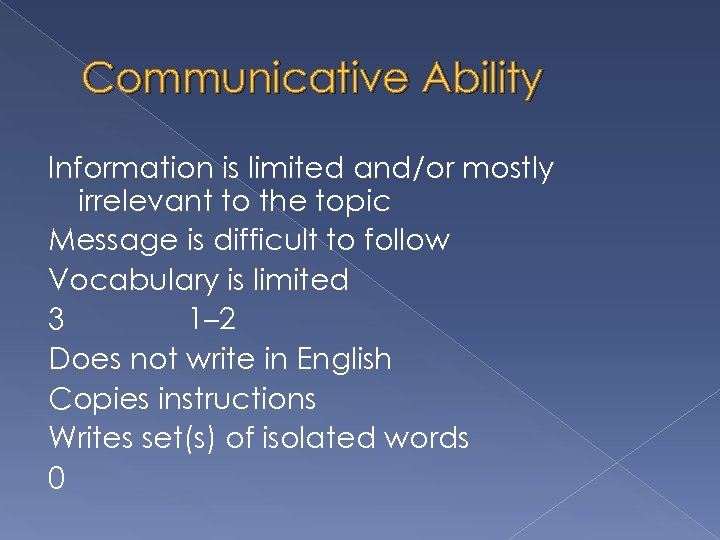 Communicative Ability Information is limited and/or mostly irrelevant to the topic Message is difficult to follow Vocabulary is limited 3 1– 2 Does not write in English Copies instructions Writes set(s) of isolated words 0
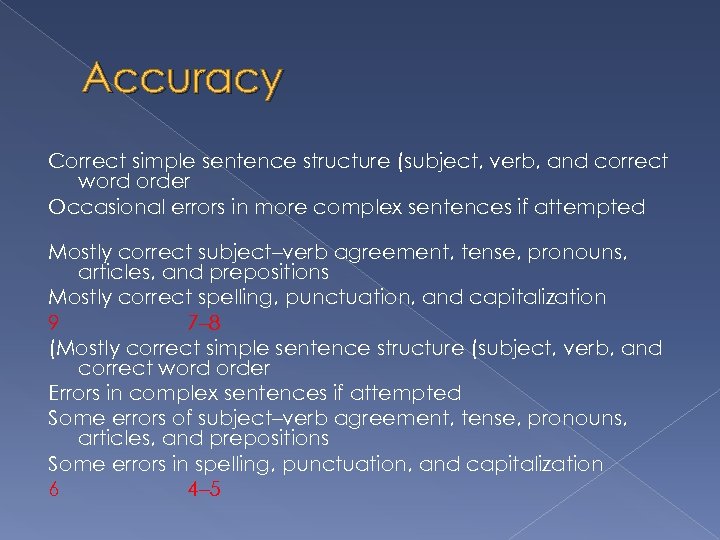 Accuracy Correct simple sentence structure (subject, verb, and correct word order Occasional errors in more complex sentences if attempted Mostly correct subject–verb agreement, tense, pronouns, articles, and prepositions Mostly correct spelling, punctuation, and capitalization 9 7– 8 (Mostly correct simple sentence structure (subject, verb, and correct word order Errors in complex sentences if attempted Some errors of subject–verb agreement, tense, pronouns, articles, and prepositions Some errors in spelling, punctuation, and capitalization 6 4– 5
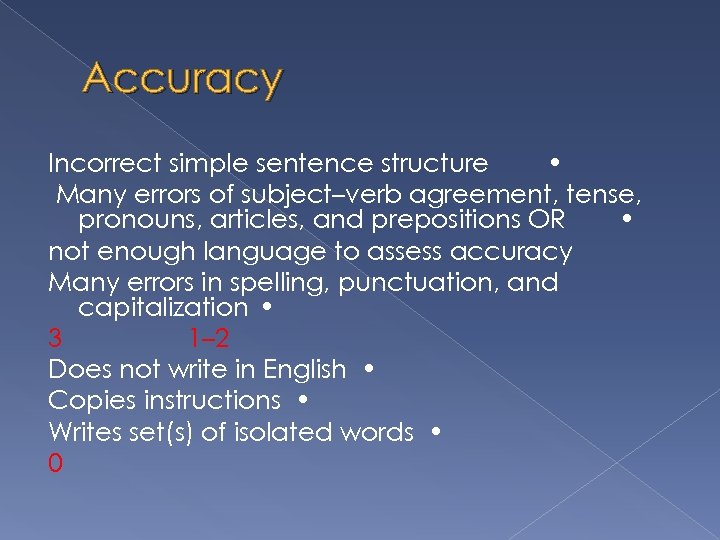 Accuracy Incorrect simple sentence structure • Many errors of subject–verb agreement, tense, pronouns, articles, and prepositions OR • not enough language to assess accuracy Many errors in spelling, punctuation, and capitalization • 3 1– 2 Does not write in English • Copies instructions • Writes set(s) of isolated words • 0
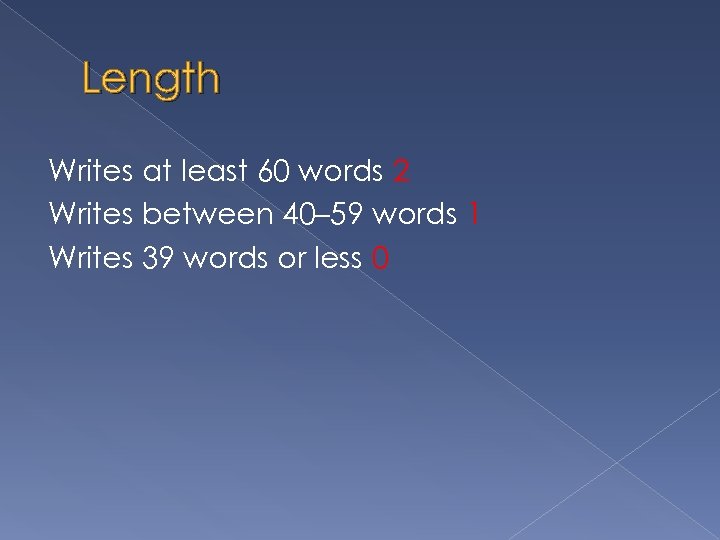 Length Writes at least 60 words 2 Writes between 40– 59 words 1 Writes 39 words or less 0
 Teaching recommendations for reading task A. Provide your pupils with many opportunities for reading a wide variety of texts independently. Have your pupils practice their reading skills by using a variety of texts of differing lengths and levels of difficulty.
 Teaching recommendations for reading task B. Skills to work on with your pupils recognizing different text types through previewing the text recognizing the general features of narratives, e. g. setting, characters, sequence of events, dilemma and resolution
 Teaching recommendations for reading task recognizing markers that indicate sequence differentiating main ideas from supporting details integrating detailed information into a (sub)topic or claim identifying cause-effect relationships
 Teaching recommendations for reading task C. Items and questions to practice with your pupils items that tap into the global aspects of a text (e. g. topic, main idea items that tap into the supporting ideas and details of a text, e. g examples, data items that tap into understanding how features of a text promote reading comprehension wh- questions and yes/no
 Strategies for Reading Marking the texts Finding key words in the questions Looking for definitions of unknown words italicized words Headings and sub-headings
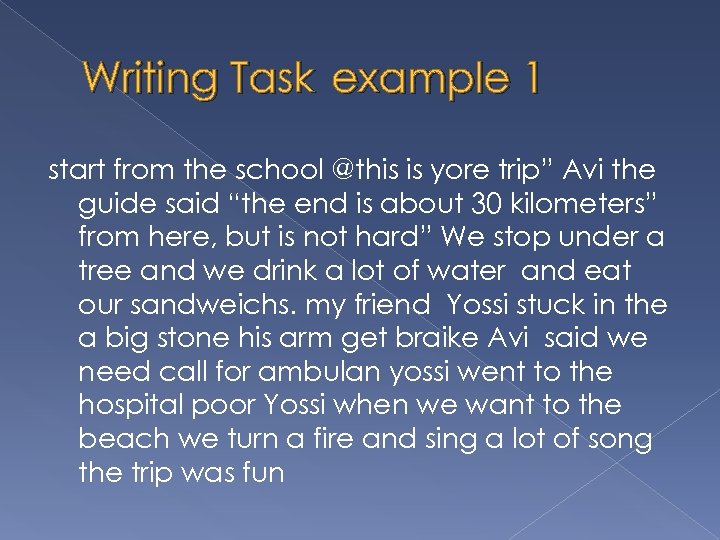 Writing Task example 1 start from the school @this is yore trip” Avi the guide said “the end is about 30 kilometers” from here, but is not hard” We stop under a tree and we drink a lot of water and eat our sandweichs. my friend Yossi stuck in the a big stone his arm get braike Avi said we need call for ambulan yossi went to the hospital poor Yossi when we want to the beach we turn a fire and sing a lot of song the trip was fun
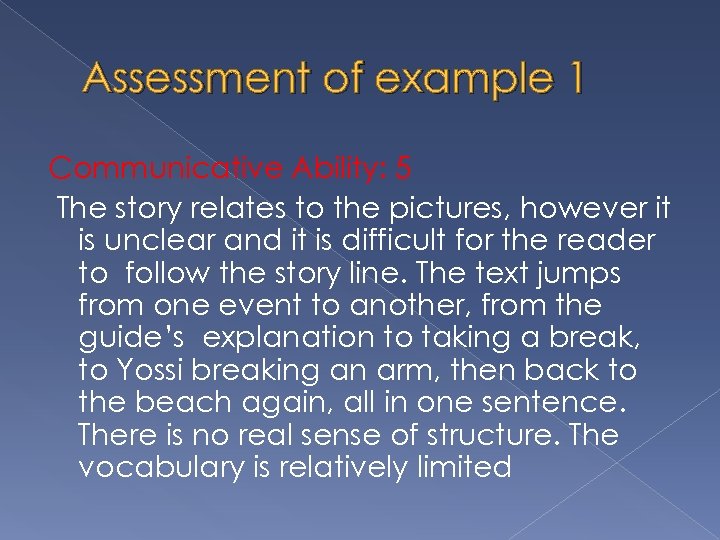 Assessment of example 1 Communicative Ability: 5 The story relates to the pictures, however it is unclear and it is difficult for the reader to follow the story line. The text jumps from one event to another, from the guide’s explanation to taking a break, to Yossi breaking an arm, then back to the beach again, all in one sentence. There is no real sense of structure. The vocabulary is relatively limited
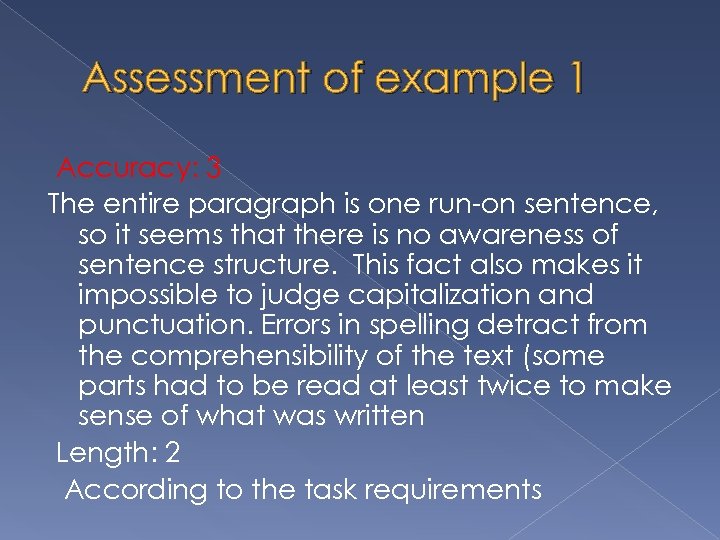 Assessment of example 1 Accuracy: 3 The entire paragraph is one run-on sentence, so it seems that there is no awareness of sentence structure. This fact also makes it impossible to judge capitalization and punctuation. Errors in spelling detract from the comprehensibility of the text (some parts had to be read at least twice to make sense of what was written Length: 2 According to the task requirements
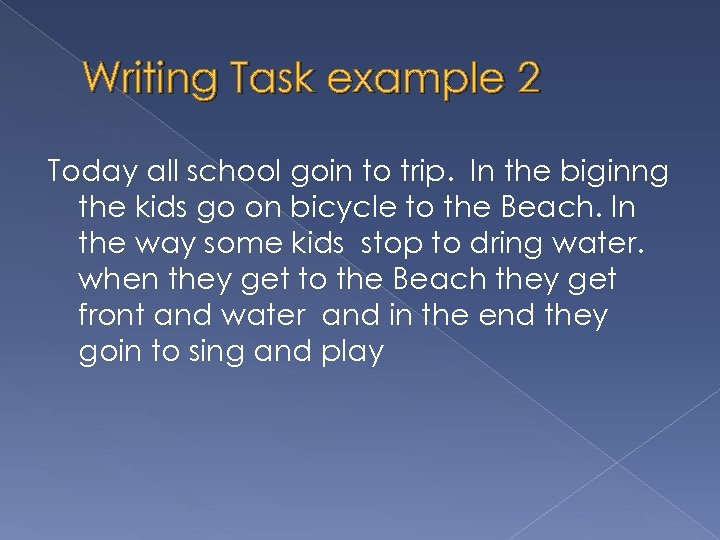 Writing Task example 2 Today all school goin to trip. In the biginng the kids go on bicycle to the Beach. In the way some kids stop to dring water. when they get to the Beach they get front and water and in the end they goin to sing and play
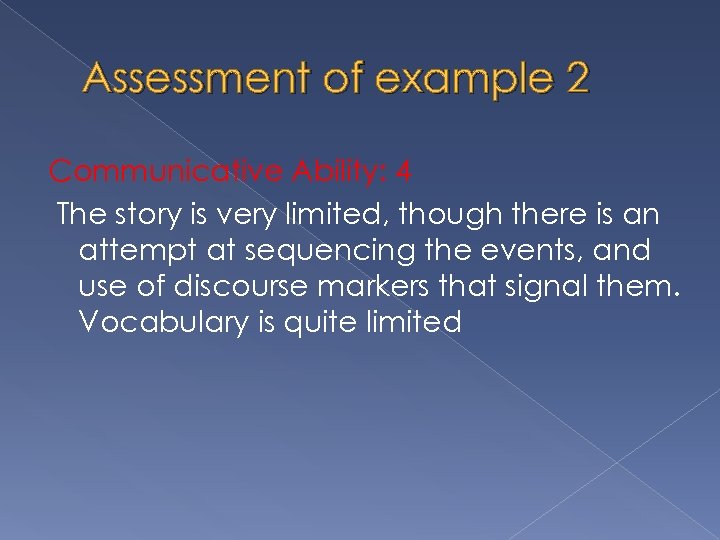 Assessment of example 2 Communicative Ability: 4 The story is very limited, though there is an attempt at sequencing the events, and use of discourse markers that signal them. Vocabulary is quite limited
 Assessment of example 2 Accuracy: 3 There are errors in capitalization (e. g. , Beach in the middle of the sentence), inconsistent use of tenses (confusion between present simple, present progressive and past simple), and spelling mistakes in common words (e. g. , gitar Length: 1
 Writing skills to work on sentence structure including simple and compound sentences basic writing conventions - capital letters, punctuation spelling conventions text coherence and cohesion the structure and conventions of text types
 No Dictionaries, so practice Vocabulary – extensive reading Reading a variety of texts without dictionaries Word order in sentences Parts of speech Guessing words in context
 Strategies for Writing Sentence structure Capital letters and punctuation Vocabulary and spelling
 Past Meitzav Exams Click here http: //cms. education. gov. il/Education. CMS /Units/Rama/Mivchaney. Madaf. Lamore 02 /Anglit. Kita. Chet/English 8 Heb. htm
 Tips for working with the weaker student Calm them down and tell them to “do what you can”. Practice with the 5 th grade Meitzav. Divide the 8 th grade exam into sections. Review wh questions.
 Tips for working with the weaker student Review common homonyms (red-read) Practice listening comprehension with different teachers from the school reading the parts.
 Learning Disabled Pupils Special Education pupils don’t have to be tested. The school decides how “shiluv” pupils should be tested. LD pupils should be tested the way they are usually tested in class. Hearing impaired pupils don’t do section A Visually impaired pupils get a magnified copy of the exam. No dictionary for these pupils either.
 The role of the English teacher Tell pupils that the exam starts with 2 listening tasks Tell the pupils to read the instructions and then start with Task 1 Dictionaries are not allowed Tell them to answer in ENGLISH Tell them how much time they have
 The role of the English teacher Explain that there is only ONE answer for the multiple choice questions and that the open-ended questions must be answered in English. Tell them to take the exam seriously. (Think of ideas how to motivate them to do so!)
 Pupils with LD The school counselor should have filled in a form with the names of the pupils who need to be in the ‘reading class. ’ Practice with these pupils at least once
 Pupils with LD Use the same teachers to read in the mock exam as in the real Meitzav exam All of the pupils are entitled to an extra 15 minutes
 On the Day of the Exam Make sure the pupils know which classrooms to go to. Lists on the doors help to avoid confusion. Arrange tape players for each of the classrooms. Organize English teachers for the reading class, preferably, the same teachers who did the mock exam.
 Motivating your pupils Encourage your pupils to do their best for their own pride and the pride of the school
 Putting it into perspective All of the approved textbooks teach according to the benchmarks Keep your pupils calm: If you don’t get stressed out by the exam, neither will they!
 http: //cms. education. gov. il/Education. C MS/Units/Mazkirut_Pedagogit/English/Me itzav_Info/Meitzav_Examinations. htm