


 Скачать презентацию Meeting The Skills Agenda Jeff Moses Wednesday 4
a32e867b95dfbe179c4debd98f7c5e34.ppt
- Количество слайдов: 30
 Meeting The Skills Agenda Jeff Moses Wednesday, 4 July 2007 ‘ We do not have qualifications deficits, we have skills deficits’. Ken Boston, Chief Executive, QCA
 Skills At the Forefront • Key Stage 3 – too academic • Key Stage 4 – poor attainment rates • Key Stage 5 – too narrow
 The Challenge Ahead • To create a learner-centred school system that better recognises the different learning needs of our young people. Mc. Gowan • Schools must continue to develop as learning environments not teaching environments. Leitch • Provide engaging, stimulating, and flexible learning programmes and pathways. ‘Vision Into Action’ • ‘It is not the strongest of the species that survives, nor the most intelligent, but the ones most responsive to change’ Charles Darwin; Theory of Evolution
 Skills and HE – The Future • • • Critical thinking Autonomous Learning Skills More Reflective Learners Skills not a volume and content-led curriculum Key Skills as the driver for developing inter personal skills • Curriculum breadth Dr Hywel M. Davies Head of Admissions and Recruitment University of Wales, Aberystwyth
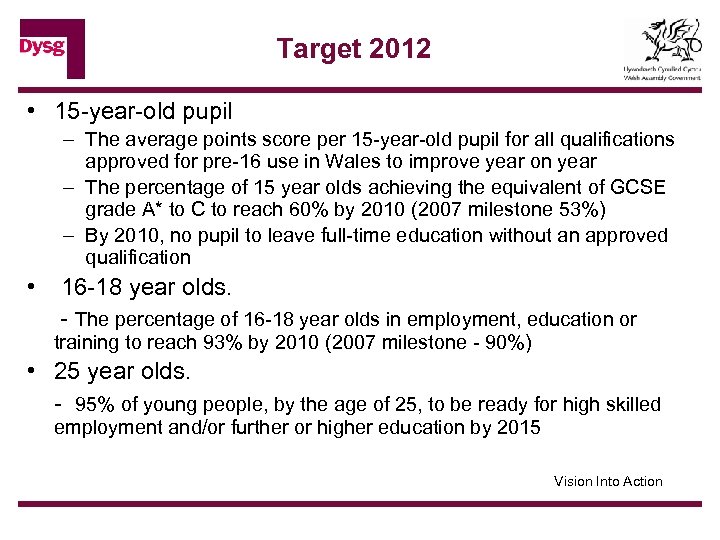 Target 2012 • 15 -year-old pupil – The average points score per 15 -year-old pupil for all qualifications approved for pre-16 use in Wales to improve year on year – The percentage of 15 year olds achieving the equivalent of GCSE grade A* to C to reach 60% by 2010 (2007 milestone 53%) – By 2010, no pupil to leave full-time education without an approved qualification • 16 -18 year olds. - The percentage of 16 -18 year olds in employment, education or training to reach 93% by 2010 (2007 milestone - 90%) • 25 year olds. - 95% of young people, by the age of 25, to be ready for high skilled employment and/or further or higher education by 2015 Vision Into Action
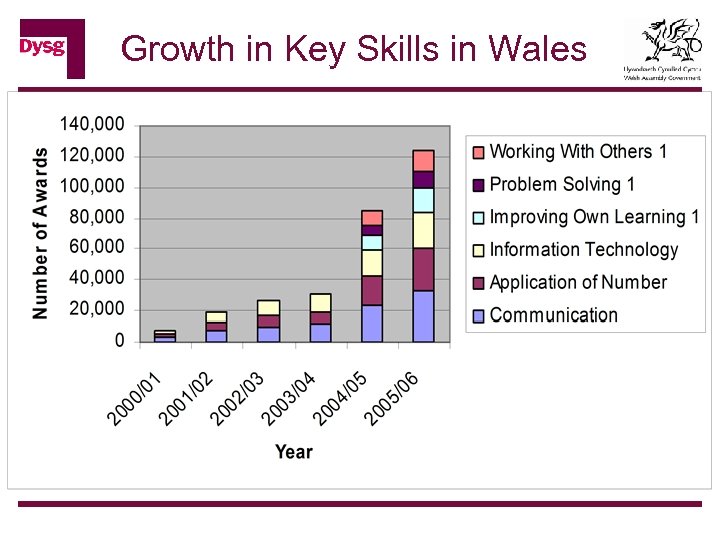 Growth in Key Skills in Wales
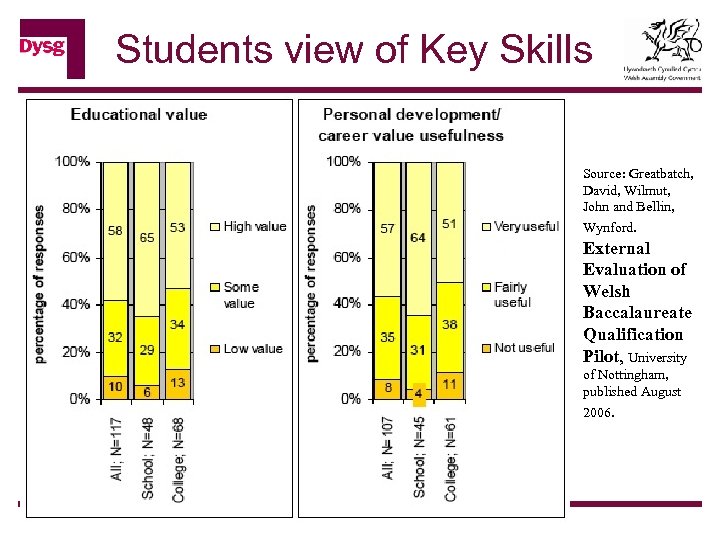 Students view of Key Skills Source: Greatbatch, David, Wilmut, John and Bellin, Wynford. External Evaluation of Welsh Baccalaureate Qualification Pilot, University of Nottingham, published August 2006.
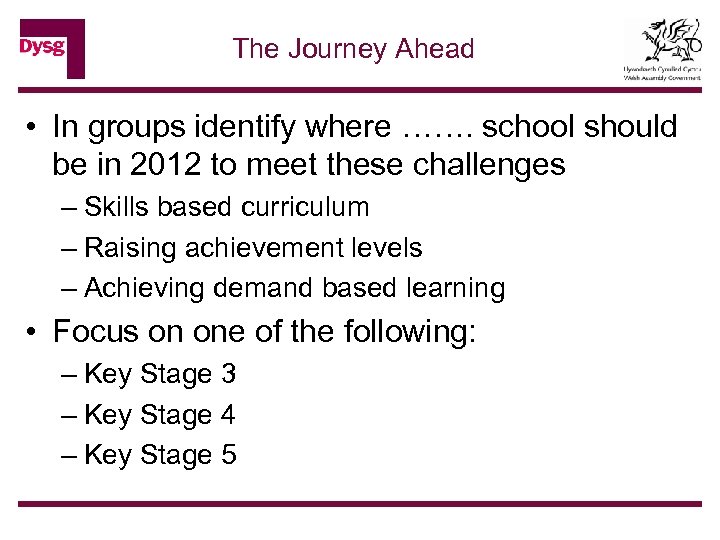 The Journey Ahead • In groups identify where ……. school should be in 2012 to meet these challenges – Skills based curriculum – Raising achievement levels – Achieving demand based learning • Focus on one of the following: – Key Stage 3 – Key Stage 4 – Key Stage 5
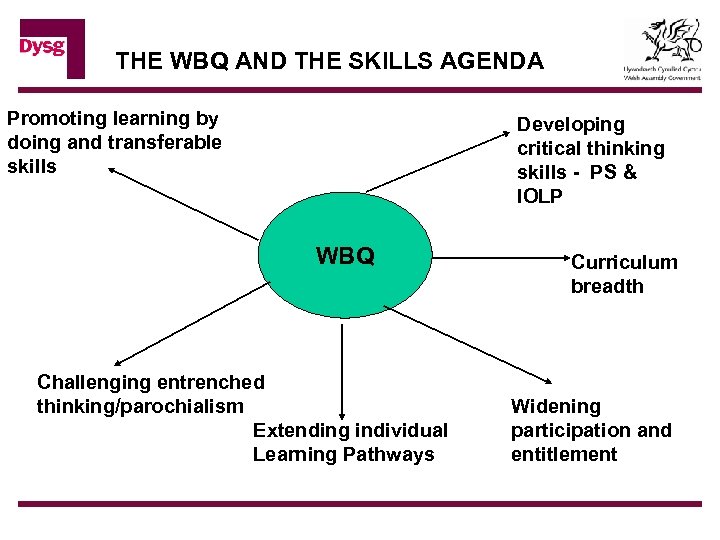 THE WBQ AND THE SKILLS AGENDA Promoting learning by doing and transferable skills Developing critical thinking skills - PS & IOLP WBQ Challenging entrenched thinking/parochialism Extending individual Learning Pathways Curriculum breadth Widening participation and entitlement
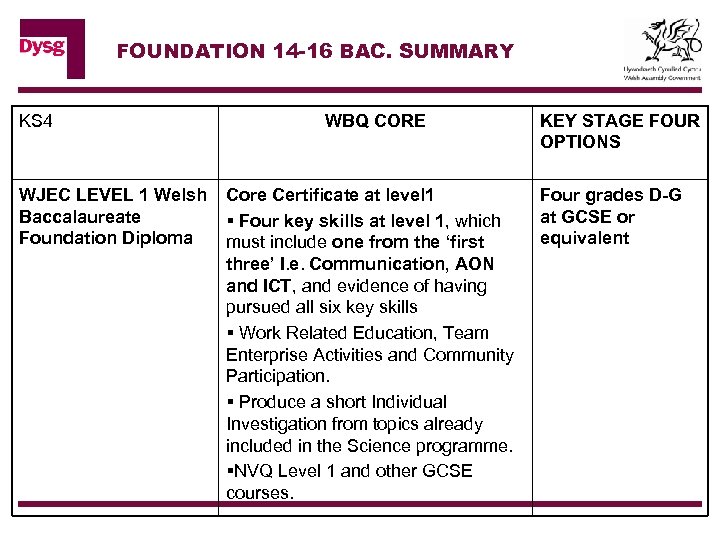 FOUNDATION 14 -16 BAC. SUMMARY KS 4 WJEC LEVEL 1 Welsh Baccalaureate Foundation Diploma WBQ CORE Core Certificate at level 1 § Four key skills at level 1, which must include one from the ‘first three’ I. e. Communication, AON and ICT, and evidence of having pursued all six key skills § Work Related Education, Team Enterprise Activities and Community Participation. § Produce a short Individual Investigation from topics already included in the Science programme. §NVQ Level 1 and other GCSE courses. KEY STAGE FOUR OPTIONS Four grades D-G at GCSE or equivalent
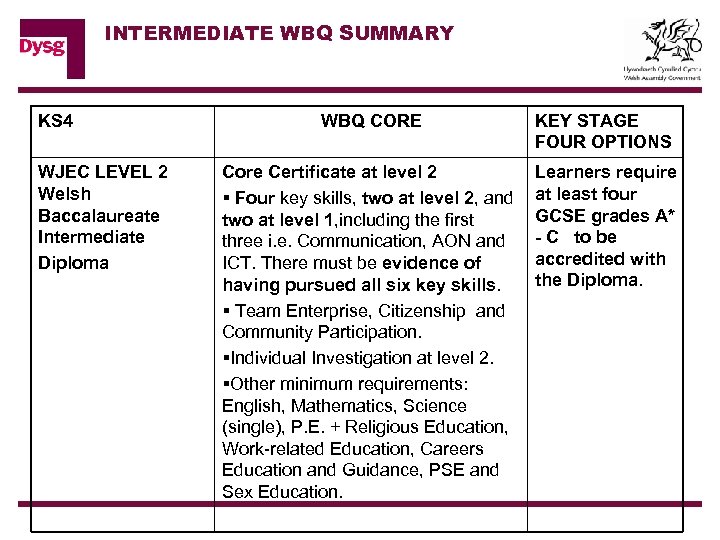 INTERMEDIATE WBQ SUMMARY KS 4 WJEC LEVEL 2 Welsh Baccalaureate Intermediate Diploma WBQ CORE KEY STAGE FOUR OPTIONS Core Certificate at level 2 § Four key skills, two at level 2, and two at level 1, including the first three i. e. Communication, AON and ICT. There must be evidence of having pursued all six key skills. § Team Enterprise, Citizenship and Community Participation. §Individual Investigation at level 2. §Other minimum requirements: English, Mathematics, Science (single), P. E. + Religious Education, Work-related Education, Careers Education and Guidance, PSE and Sex Education. Learners require at least four GCSE grades A* - C to be accredited with the Diploma.
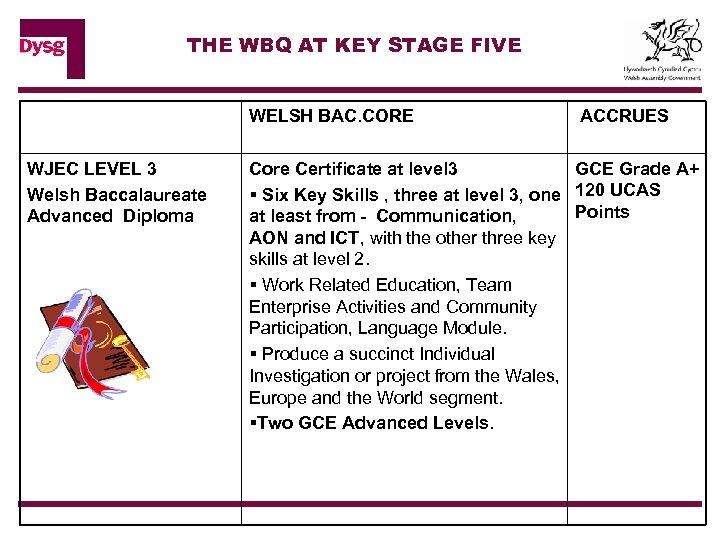 THE WBQ AT KEY STAGE FIVE WELSH BAC. CORE WJEC LEVEL 3 Welsh Baccalaureate Advanced Diploma ACCRUES Core Certificate at level 3 GCE Grade A+ § Six Key Skills , three at level 3, one 120 UCAS Points at least from - Communication, AON and ICT, with the other three key skills at level 2. § Work Related Education, Team Enterprise Activities and Community Participation, Language Module. § Produce a succinct Individual Investigation or project from the Wales, Europe and the World segment. §Two GCE Advanced Levels.
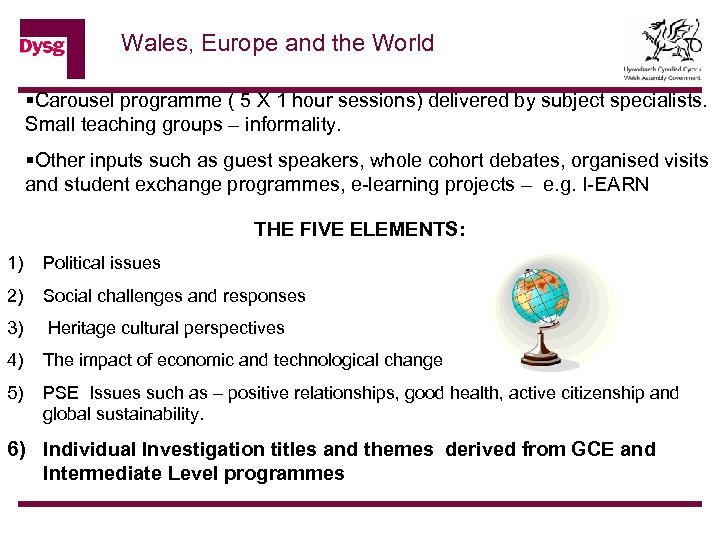 Wales, Europe and the World §Carousel programme ( 5 X 1 hour sessions) delivered by subject specialists. Small teaching groups – informality. §Other inputs such as guest speakers, whole cohort debates, organised visits and student exchange programmes, e-learning projects – e. g. I-EARN THE FIVE ELEMENTS: 1) Political issues 2) Social challenges and responses 3) Heritage cultural perspectives 4) The impact of economic and technological change 5) PSE Issues such as – positive relationships, good health, active citizenship and global sustainability. 6) Individual Investigation titles and themes derived from GCE and Intermediate Level programmes
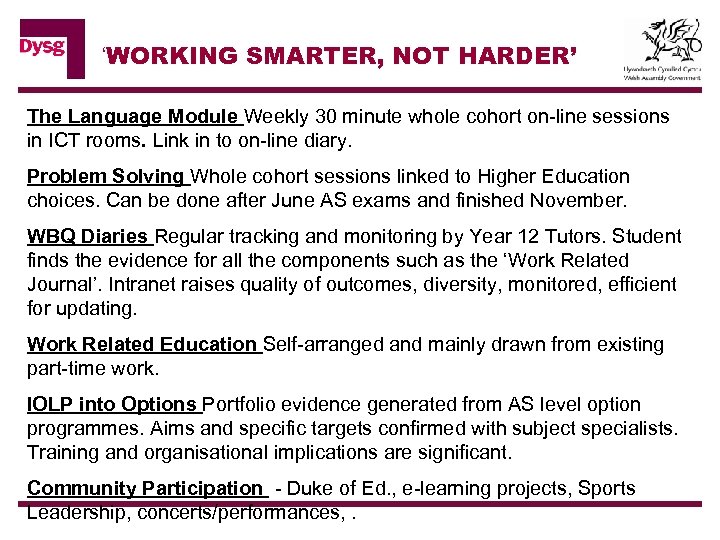 ‘WORKING SMARTER, NOT HARDER’ The Language Module Weekly 30 minute whole cohort on-line sessions in ICT rooms. Link in to on-line diary. Problem Solving Whole cohort sessions linked to Higher Education choices. Can be done after June AS exams and finished November. WBQ Diaries Regular tracking and monitoring by Year 12 Tutors. Student finds the evidence for all the components such as the ‘Work Related Journal’. Intranet raises quality of outcomes, diversity, monitored, efficient for updating. Work Related Education Self-arranged and mainly drawn from existing part-time work. IOLP into Options Portfolio evidence generated from AS level option programmes. Aims and specific targets confirmed with subject specialists. Training and organisational implications are significant. Community Participation - Duke of Ed. , e-learning projects, Sports Leadership, concerts/performances, .
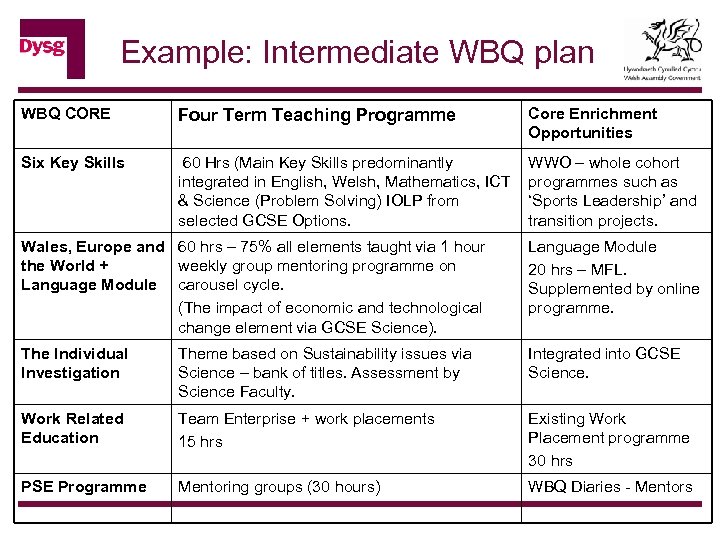 Example: Intermediate WBQ plan WBQ CORE Four Term Teaching Programme Core Enrichment Opportunities Six Key Skills 60 Hrs (Main Key Skills predominantly integrated in English, Welsh, Mathematics, ICT & Science (Problem Solving) IOLP from selected GCSE Options. WWO – whole cohort programmes such as ‘Sports Leadership’ and transition projects. Wales, Europe and 60 hrs – 75% all elements taught via 1 hour the World + weekly group mentoring programme on Language Module carousel cycle. (The impact of economic and technological change element via GCSE Science). Language Module 20 hrs – MFL. Supplemented by online programme. The Individual Investigation Theme based on Sustainability issues via Science – bank of titles. Assessment by Science Faculty. Integrated into GCSE Science. Work Related Education Team Enterprise + work placements 15 hrs Existing Work Placement programme 30 hrs PSE Programme Mentoring groups (30 hours) WBQ Diaries - Mentors
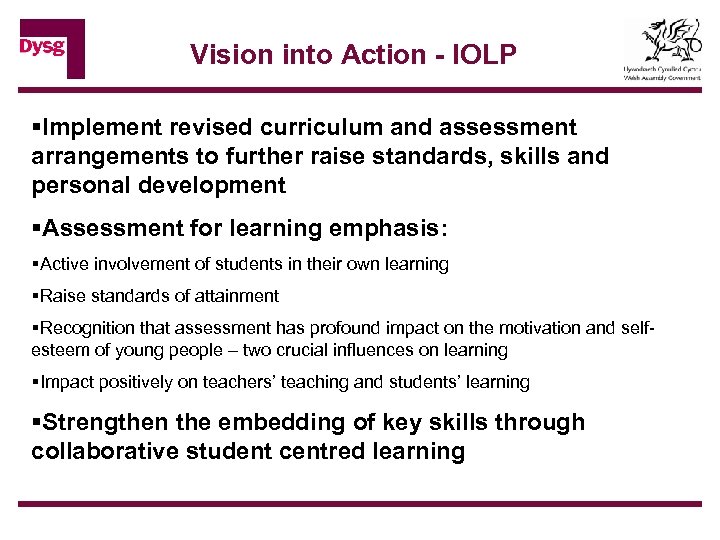 Vision into Action - IOLP §Implement revised curriculum and assessment arrangements to further raise standards, skills and personal development §Assessment for learning emphasis: §Active involvement of students in their own learning §Raise standards of attainment §Recognition that assessment has profound impact on the motivation and selfesteem of young people – two crucial influences on learning §Impact positively on teachers’ teaching and students’ learning §Strengthen the embedding of key skills through collaborative student centred learning
 Mapping • Whole school approach required • Identify appropriate and manageable opportunities for evidence across full range of courses • Some programmes of study can contribute more to specific key skills than others. For instance, History linking well with aspects of Communication or Science with Problem Solving • Critical that teachers and their students understand fully Part A before selecting opportunities to evidence Part B
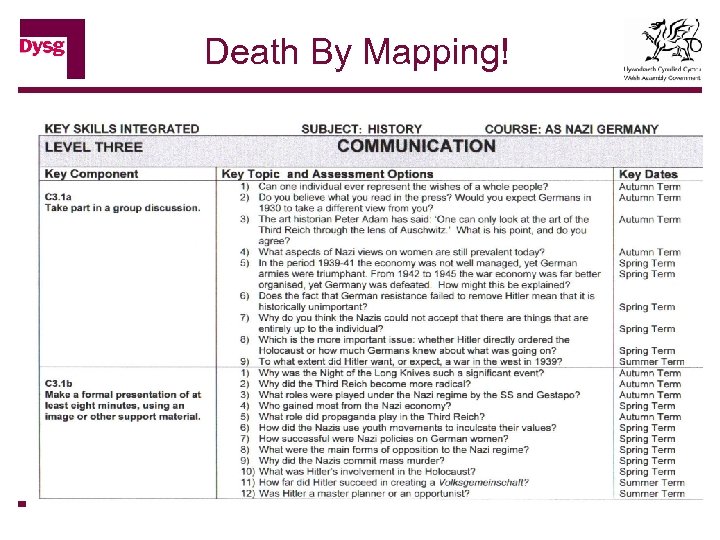 Death By Mapping!
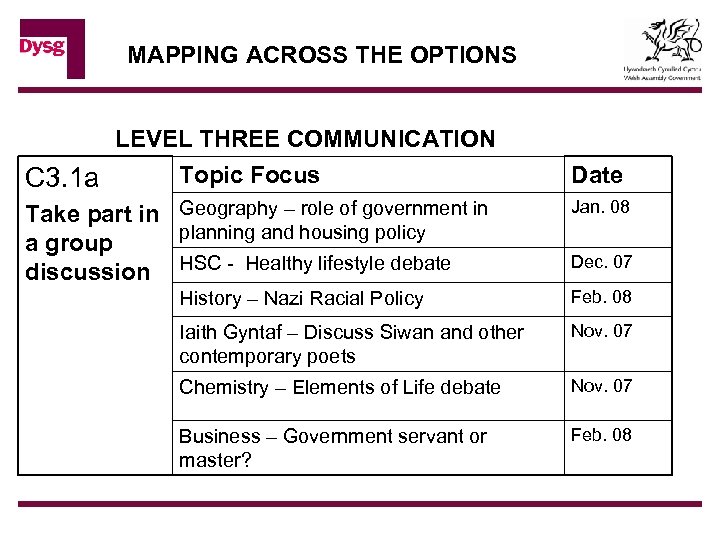 MAPPING ACROSS THE OPTIONS LEVEL THREE COMMUNICATION Topic Focus C 3. 1 a Take part in Geography – role of government in planning and housing policy a group discussion HSC - Healthy lifestyle debate Date Jan. 08 Dec. 07 History – Nazi Racial Policy Feb. 08 Iaith Gyntaf – Discuss Siwan and other contemporary poets Nov. 07 Chemistry – Elements of Life debate Nov. 07 Business – Government servant or master? Feb. 08
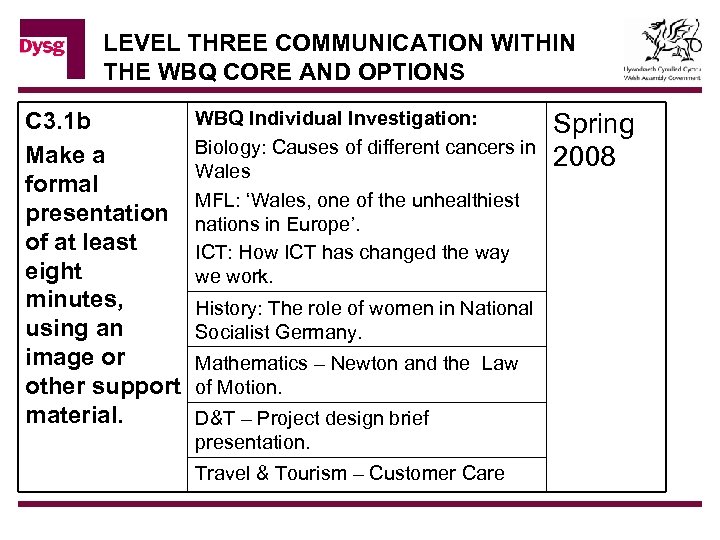 LEVEL THREE COMMUNICATION WITHIN THE WBQ CORE AND OPTIONS C 3. 1 b Make a formal presentation of at least eight minutes, using an image or other support material. WBQ Individual Investigation: Biology: Causes of different cancers in Wales MFL: ‘Wales, one of the unhealthiest nations in Europe’. ICT: How ICT has changed the way we work. History: The role of women in National Socialist Germany. Mathematics – Newton and the Law of Motion. D&T – Project design brief presentation. Travel & Tourism – Customer Care Spring 2008
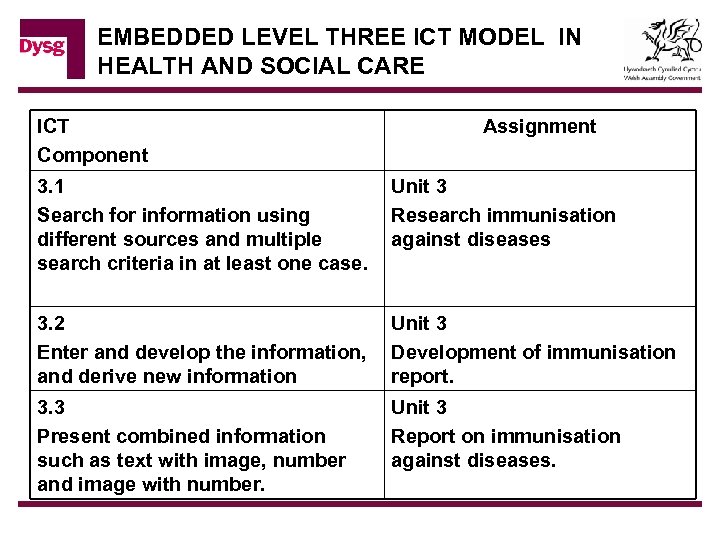 EMBEDDED LEVEL THREE ICT MODEL IN HEALTH AND SOCIAL CARE ICT Component Assignment 3. 1 Search for information using different sources and multiple search criteria in at least one case. Unit 3 Research immunisation against diseases 3. 2 Enter and develop the information, and derive new information Unit 3 Development of immunisation report. 3. 3 Present combined information such as text with image, number and image with number. Unit 3 Report on immunisation against diseases.
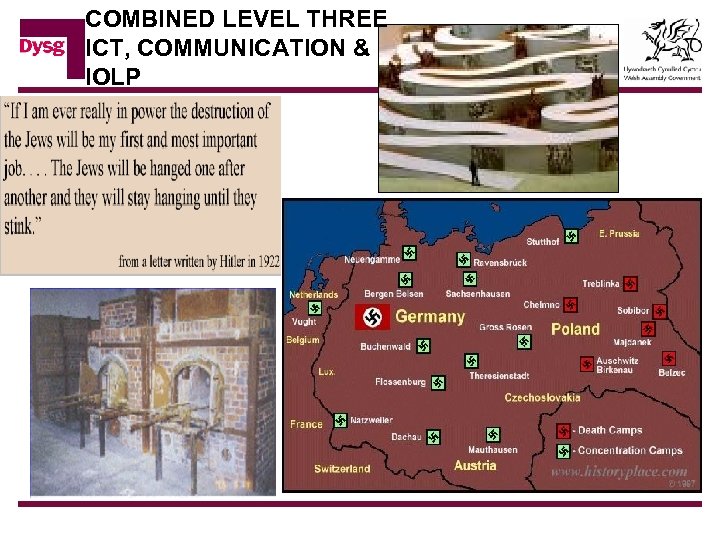 COMBINED LEVEL THREE ICT, COMMUNICATION & IOLP
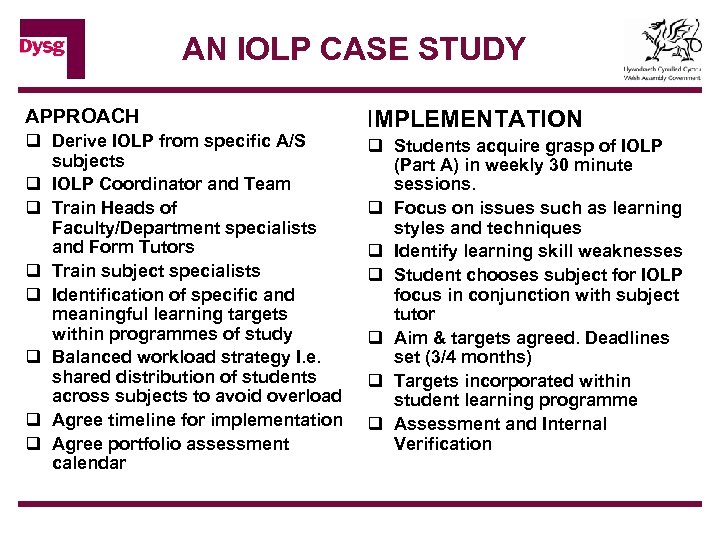 AN IOLP CASE STUDY APPROACH q Derive IOLP from specific A/S subjects q IOLP Coordinator and Team q Train Heads of Faculty/Department specialists and Form Tutors q Train subject specialists q Identification of specific and meaningful learning targets within programmes of study q Balanced workload strategy I. e. shared distribution of students across subjects to avoid overload q Agree timeline for implementation q Agree portfolio assessment calendar IMPLEMENTATION q Students acquire grasp of IOLP (Part A) in weekly 30 minute sessions. q Focus on issues such as learning styles and techniques q Identify learning skill weaknesses q Student chooses subject for IOLP focus in conjunction with subject tutor q Aim & targets agreed. Deadlines set (3/4 months) q Targets incorporated within student learning programme q Assessment and Internal Verification
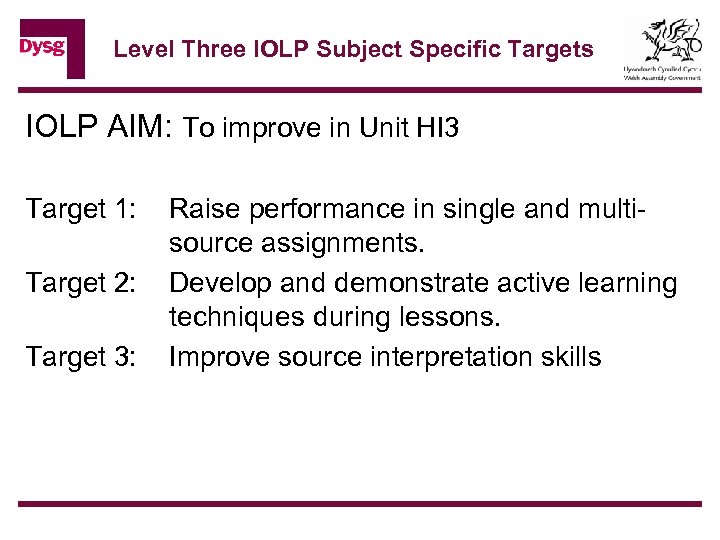 Level Three IOLP Subject Specific Targets IOLP AIM: To improve in Unit HI 3 Target 1: Target 2: Target 3: Raise performance in single and multisource assignments. Develop and demonstrate active learning techniques during lessons. Improve source interpretation skills
 Critical Success Elements 1. Quality of management 2. High quality tutorial support and teaching 3. Effective provision of Key Skills 4. Sound curriculum planning/organisation
 MANAGEMENT q. Proactive Leadership q Regular WBQ management meetings q Effective communications links q Commitment to WBQ principles and programme/s q Efficient systems
 EFFECTIVE TUTORIAL SYSTEM q. Small tutorial groups work best q. Sufficient contact time built into programme from outset – do not compromise. A worthwhile investment! q. Meaningful tutorial sessions q. Key Skills that are taught well q. Articulate Welsh Bac. students q. High quality staff inputs to Core q. Ongoing staff CPD q. Tailored curriculum planning
 KEY SKILLS q Raising provision and quality of delivery q. Comparisons with national results q. Purposeful/meaningful key skills assignments q. Considering what was taught at earlier Key Stages and avoiding repetitive practices q. Ensuring that students are proficient at Part A of the key skills standards before embarking on portfolio building q. Curriculum collaboration to reduce assessment burden q. Effective mapping q. Regular meetings
 CURRICULUM PLANNING q. Ensuring continuity and progression opportunities for all learners q Including WAG priorities within the WBQ programme e. g. healthy lifestyles, extending international links – i. EARN DYSG Learning Circles for WBQ centres 2007/08. q Ensuring that learners are not faced with the same activities at Key Stages Three, Four and Five q Awareness of completion levels
 For Information Jeff Moses Key Skills and WBQ Project Officer Dysg, Department for Education Lifelong Learning and Skills, WAG 11 Ty Nant Court, Morganstown, Cardiff CF 15 8 LW Tel: 02920 820 350 Jeff. moses@wales. gsi. gov. uk Key skills support programme: www. dysg. org. uk