


 Скачать презентацию Meeting the Needs of English Language Learners Using
032b14ff942f90512e4ac61cd7654854.ppt
- Количество слайдов: 20
 Meeting the Needs of English Language Learners: Using Assessment Results and Data to Inform Decisions Michael Sabados, Ph. D, CSDE consultant Bureau of Data, Research and Evaluation Megan Alubicki, CSDE Consultant, ELL/Bilingual Bureau of Accountability and Improvement
 Topics • The CT Context • LAS Links Considerations • Implications for Schools • Next Generation Assessment and ELLs
 The CT Context
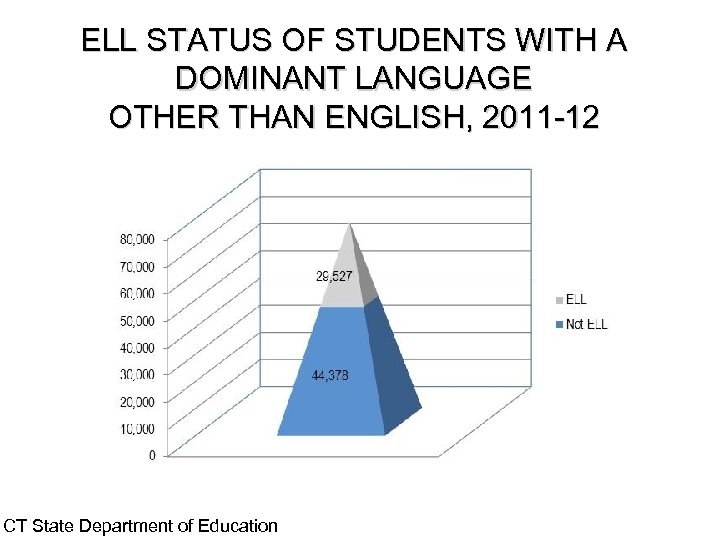 ELL STATUS OF STUDENTS WITH A DOMINANT LANGUAGE OTHER THAN ENGLISH, 2011 -12 CT State Department of Education
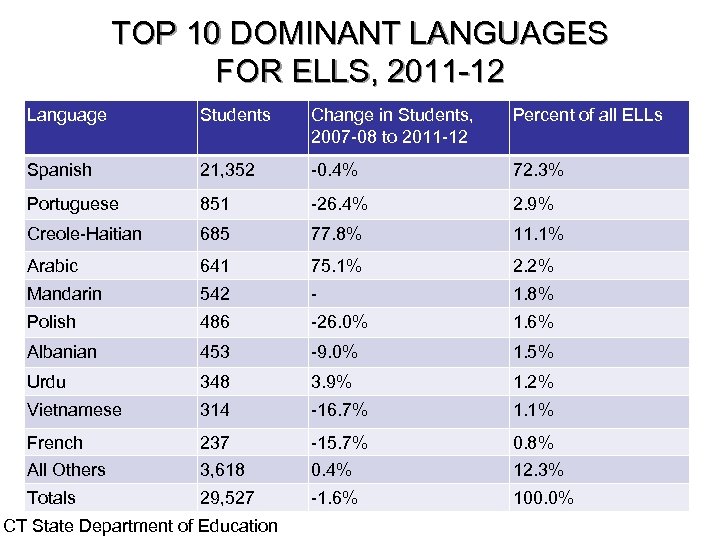 TOP 10 DOMINANT LANGUAGES FOR ELLS, 2011 -12 Language Students Change in Students, 2007 -08 to 2011 -12 Percent of all ELLs Spanish 21, 352 -0. 4% 72. 3% Portuguese 851 -26. 4% 2. 9% Creole-Haitian 685 77. 8% 11. 1% Arabic 641 75. 1% 2. 2% Mandarin 542 - 1. 8% Polish 486 -26. 0% 1. 6% Albanian 453 -9. 0% 1. 5% Urdu 348 3. 9% 1. 2% Vietnamese 314 -16. 7% 1. 1% French 237 -15. 7% 0. 8% All Others 3, 618 0. 4% 12. 3% Totals 29, 527 -1. 6% 100. 0% CT State Department of Education
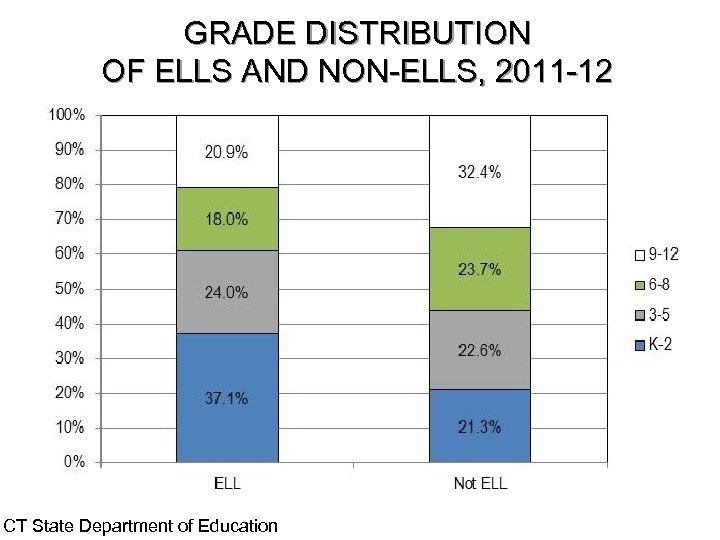 GRADE DISTRIBUTION OF ELLS AND NON-ELLS, 2011 -12 CT State Department of Education
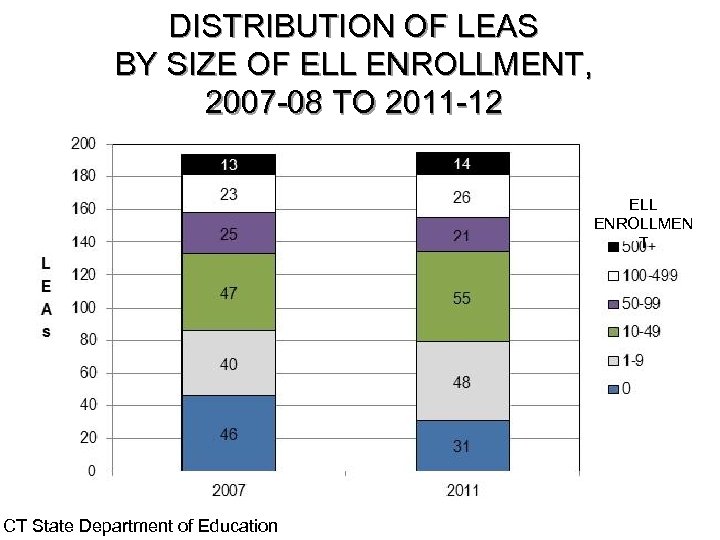 DISTRIBUTION OF LEAS BY SIZE OF ELL ENROLLMENT, 2007 -08 TO 2011 -12 ELL ENROLLMEN T CT State Department of Education
 LAS Links Considerations
 Using LAS Links subtest results to plan • LAS Links results are reported for the Speaking, Listening, Reading and Writing subtests, Comprehension and Oral composites and Overall. • Scores fall into five performance levels. • The Overall score is used to determine whether a student has met exit criteria and for compliance purposes. • However, the subtests provide valuable information for a range of purposes at the classroom and school levels.
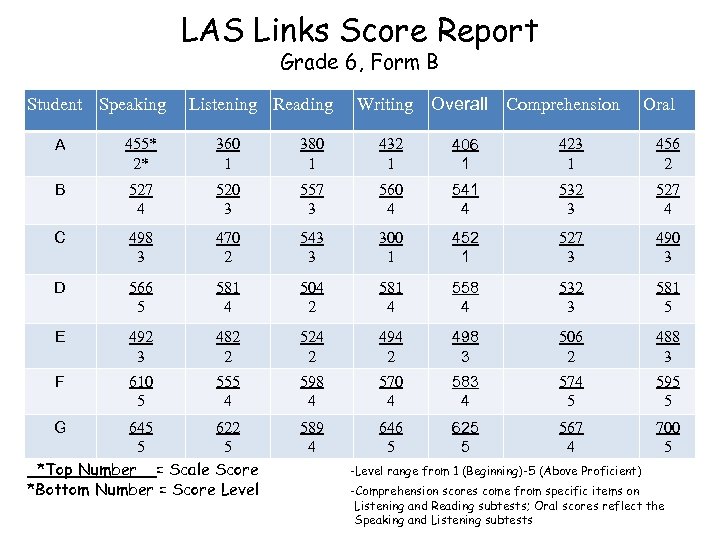 LAS Links Score Report Grade 6, Form B Student Speaking Listening Reading Writing Overall Comprehension Oral A 455* 2* 360 1 380 1 432 1 406 1 423 1 456 2 B 527 4 520 3 557 3 560 4 541 4 532 3 527 4 C 498 3 470 2 543 3 300 1 452 1 527 3 490 3 D 566 5 581 4 504 2 581 4 558 4 532 3 581 5 E 492 3 482 2 524 2 498 3 506 2 488 3 F 610 5 555 4 598 4 570 4 583 4 574 5 595 5 589 4 646 5 625 5 567 4 700 5 G 645 622 5 5 *Top Number = Scale Score *Bottom Number = Score Level -Level range from 1 (Beginning)-5 (Above Proficient) -Comprehension scores come from specific items on Listening and Reading subtests; Oral scores reflect the Speaking and Listening subtests
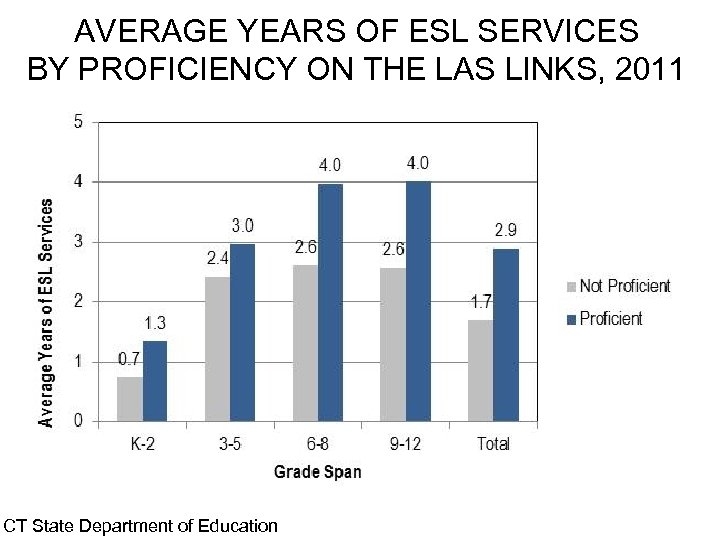 AVERAGE YEARS OF ESL SERVICES BY PROFICIENCY ON THE LAS LINKS, 2011 CT State Department of Education
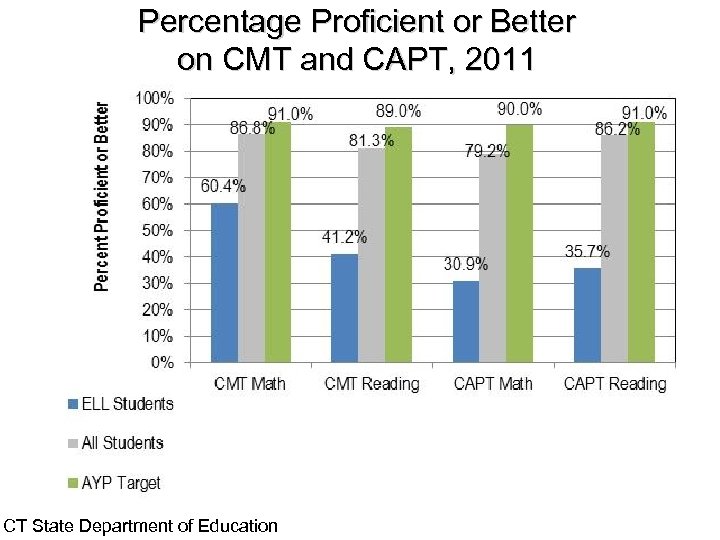 Percentage Proficient or Better on CMT and CAPT, 2011 CT State Department of Education
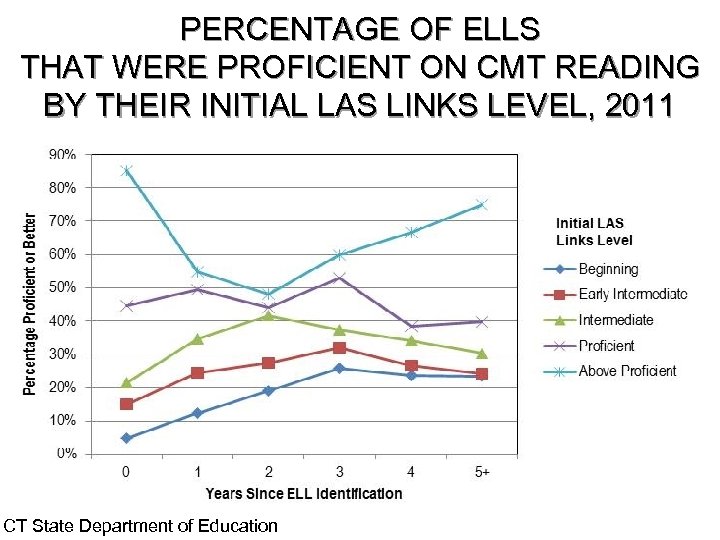 PERCENTAGE OF ELLS THAT WERE PROFICIENT ON CMT READING BY THEIR INITIAL LAS LINKS LEVEL, 2011 CT State Department of Education
 Implications for Schools
 • How to communicate scores – Who? – How? – When? • How to plan instruction that meets each students’ needs – all content areas – context of district
 Next Generation Assessment and ELLs
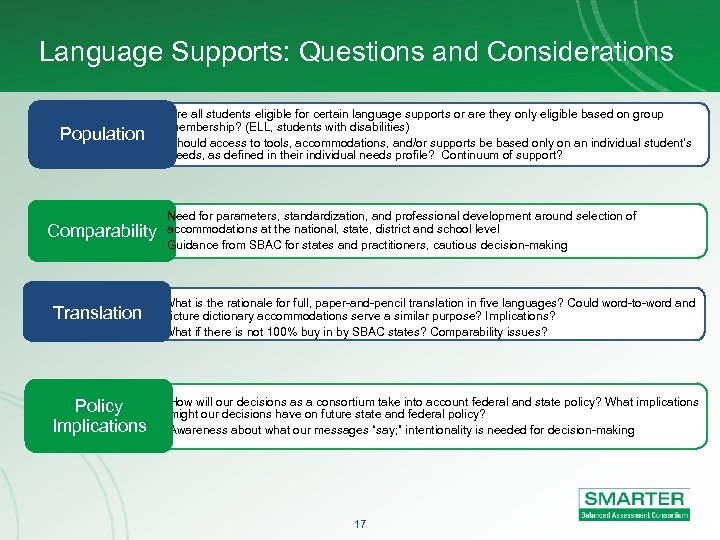 Language Supports: Questions and Considerations Population • Are all students eligible for certain language supports or are they only eligible based on group membership? (ELL, students with disabilities) • Should access to tools, accommodations, and/or supports be based only on an individual student’s needs, as defined in their individual needs profile? Continuum of support? • Need for parameters, standardization, and professional development around selection of Comparability accommodations at the national, state, district and school level • Guidance from SBAC for states and practitioners, cautious decision-making Translation Policy Implications • What is the rationale for full, paper-and-pencil translation in five languages? Could word-to-word and picture dictionary accommodations serve a similar purpose? Implications? • What if there is not 100% buy in by SBAC states? Comparability issues? • How will our decisions as a consortium take into account federal and state policy? What implications might our decisions have on future state and federal policy? • Awareness about what our messages “say; ” intentionality is needed for decision-making 17
 Item and Task Review • Review of all English language arts and mathematics for content, bias/sensitivity and accessibility o. Content Review Role: Evaluate whether the items and performance tasks align with grade-level expectations, measure identified assessment targets, align with the specified levels of cognitive complexity, are clearly worded, have appropriate scoring information, and are of appropriate grade-level difficulty. Bias/Sensitivity Review Role: Examine items and performance tasks for potential sources of bias, sensitivity issues, and stereotypes. o o Accessibility Review Role: Examine items and performance tasks for potential access barriers for students with disabilities and English language learners.
 Links • CSDE Bilingual/ESL Page: http: //www. sde. ct. gov/sde/cwp/view. asp? a=2618&q=320848 • Assessment Requirements for ELLs: http: //www. csde. state. ct. us/public/cedar/assessment/ell/index. htm • Assessment Guidelines for ELLs Manual: http: //www. csde. state. ct. us/public/cedar/assessment/agl/resources/CT_ELL_ Assessment_Guidelines_2011 -2012. pdf • Smarter Balanced Assessment Consortium website: http: //www. smarterbalanced. org/ • SBAC Overview and CT’s Role: http: //www. csde. state. ct. us/public/cedar/assessment/SBAC%20 SMAR TER_Summary%208 -17 -11. pdf • SBAC Factsheet: http: //www. csde. state. ct. us/public/cedar/assessment/SBACSummary 2 010. pdf
 Questions • Please feel free to contact us if you have additional questions! • • • Megan Alubicki, ELL Consultant CT State Department of Education Bureau of Accountability and Improvement Megan. alubicki@ct. gov (860) 713 -6786 • • • Michael Sabados, Consultant CT State Department of Education Bureau of Data Collection, Evaluation, and Research Michael. sabados@ct. gov (860) 713 -6856