


 Скачать презентацию Meet the Clauses Grammar Topic Mr Mc Gowan
593e947af49b5208c500be0dfe055eb1.ppt
- Количество слайдов: 40
 “Meet the Clauses” Grammar Topic Mr. Mc. Gowan – English 3
 Phrases vs. Clauses § across the river (prepositional phrase) § studying math (verbal phrase) § the vice-president of the bank (appositive phrase) § to play in the NFL (infinitive phrase) § Rudy proofread his essay § when I answered the phone § that we collected § as soon as we reached the house
 DEFINITIONS § CLAUSE – A group of words – Contains a verb and its subject – Used as part of a sentence How does this differ from a PHRASE? PHRASE: group of related words that functions as one part of speech
 Mini-quiz: Phrase or Clause? 1. riding in the car 2. when we got to the party 3. while she was talking to me 4. to say something like that 5. rodents are small mammals
 Answers 1. riding in the car – PHRASE (Verbal) 2. when we got to the party – CLAUSE 3. while she was talking to me – CLAUSE 4. to say something like that – PHRASE (infinitive) 5. rodents are small mammals – CLAUSE
 Independent vs. Subordinate Clauses § INDEPENDENT CLAUSE (or main clause) – Contains a subject and its verb – Expresses a complete thought – CAN stand by itself as a full sentence Ex: Ms. Reilly doesn’t know how to teach math. Ashley is a fun person; she loves to go out and have fun.
 § SUBORDINATE CLAUSE (or dependent) – Has a subject and verb – Does NOT express a complete thought – CANNOT stand on its own as a full sentence Ex: what Jill named her new dog when Jose read his essay which is used to measure temperature
 How do we make a subordinate clause into a full sentence? § Ex: what Jill named her new dog Do you know what Jill named her new dog? Answer: Add an independent clause to it somehow.
 PRACTICE EXERCISE: Using these subordinate clauses, write a full and complete sentence. 1. when Jose read his essay 2. which is used to measure temperature
 Sample Answers § when Jose read his essay – When Jose read his essay, he found lots of errors. – When Jose read his essay, he realized he needed to fix it. – Do you know when Jose read his essay? § that is used to measure temperature – A thermometer is an instrument that is used to measure temperature. – What is the name of that thing that is used to measure temperature?
 Independent or Subordinate? 1. Mr. Smith took the aluminum cans that we collected to the recycling center. 2. After a hen lays an egg, it gently rolls along the slanted floor of the cage. 3. The eggs pass through an inspection area, where bad eggs can be removed. 4. What is truly amazing is that no human hands ever touch the eggs.
 Answers 1. Mr. Smith took the aluminum cans that we collected to the recycling center. – SUBORDINATE 2. After a hen lays an egg, it gently rolls along the slanted floor of the cage. – INDEPENDENT
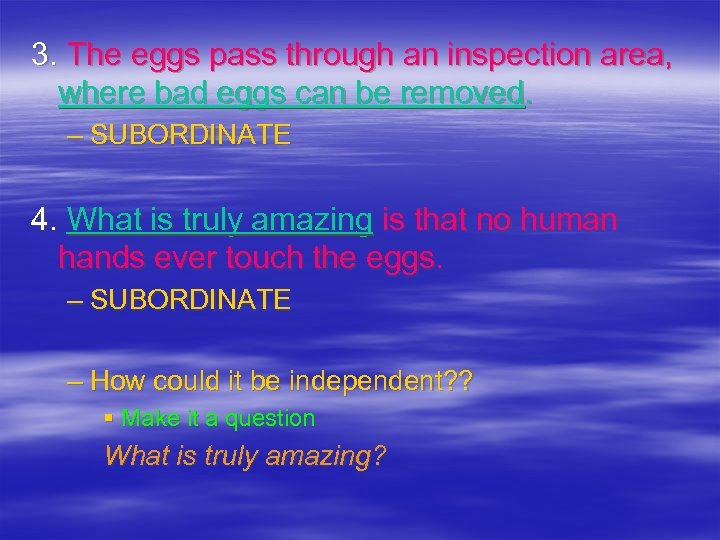 3. The eggs pass through an inspection area, where bad eggs can be removed. – SUBORDINATE 4. What is truly amazing is that no human hands ever touch the eggs. – SUBORDINATE – How could it be independent? ? § Make it a question What is truly amazing?
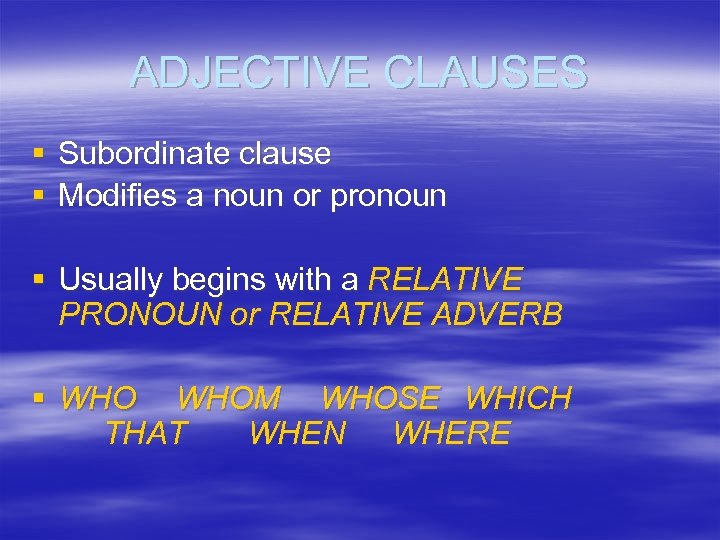 ADJECTIVE CLAUSES § Subordinate clause § Modifies a noun or pronoun § Usually begins with a RELATIVE PRONOUN or RELATIVE ADVERB § WHOM WHOSE WHICH THAT WHEN WHERE
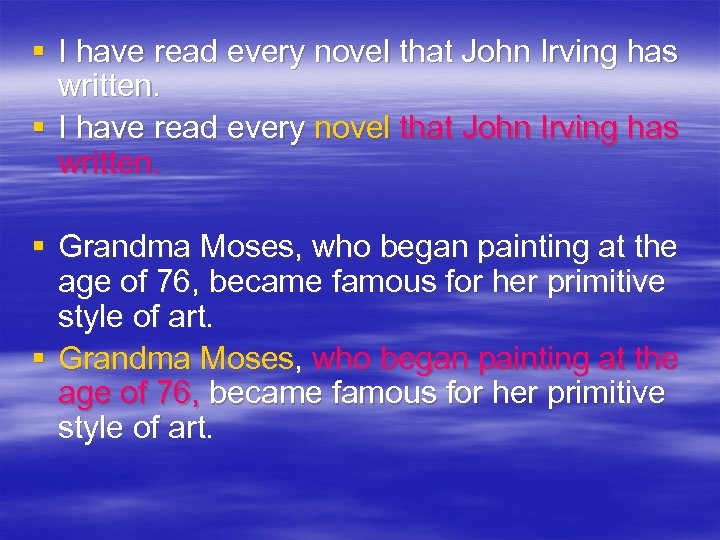 § I have read every novel that John Irving has written. § Grandma Moses, who began painting at the age of 76, became famous for her primitive style of art.
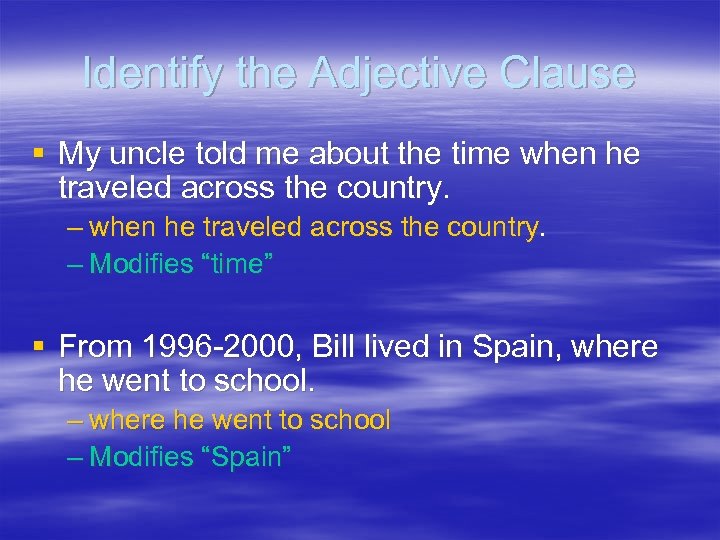 Identify the Adjective Clause § My uncle told me about the time when he traveled across the country. – Modifies “time” § From 1996 -2000, Bill lived in Spain, where he went to school. – where he went to school – Modifies “Spain”
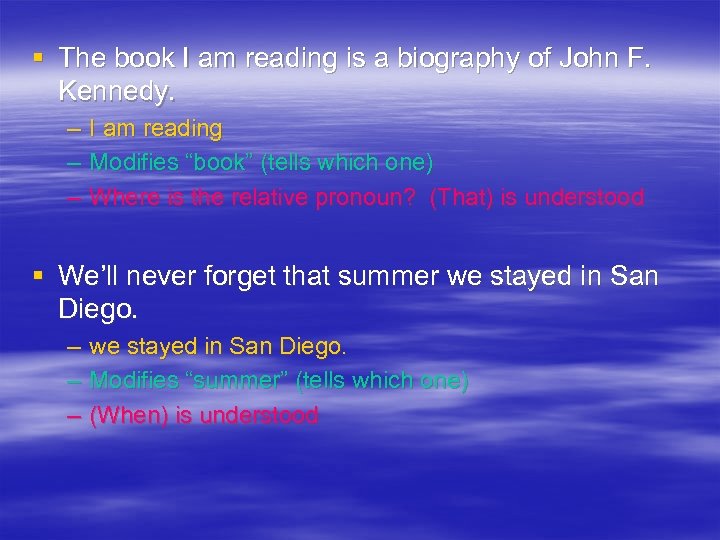 § The book I am reading is a biography of John F. Kennedy. – – – I am reading Modifies “book” (tells which one) Where is the relative pronoun? (That) is understood § We’ll never forget that summer we stayed in San Diego. – Modifies “summer” (tells which one) – (When) is understood
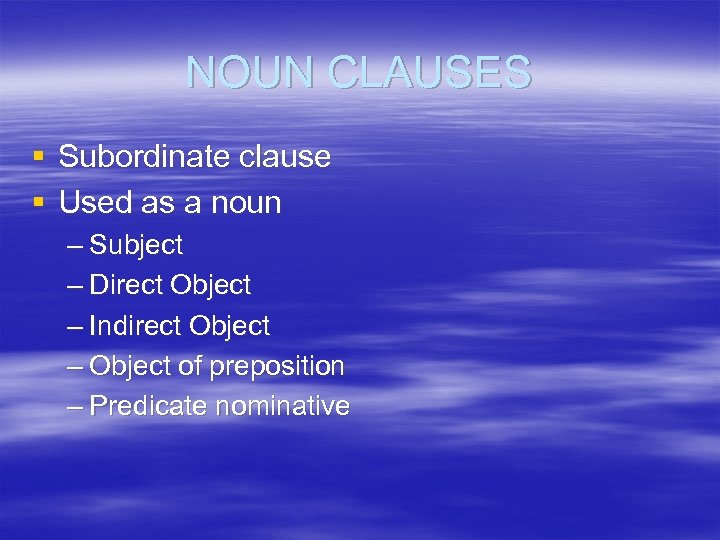 NOUN CLAUSES § Subordinate clause § Used as a noun – Subject – Direct Object – Indirect Object – Object of preposition – Predicate nominative
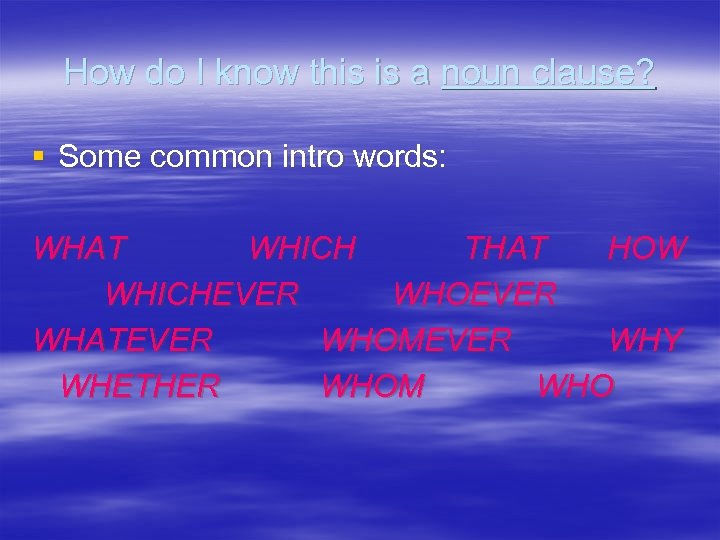 How do I know this is a noun clause? § Some common intro words: WHAT WHICH THAT HOW WHICHEVER WHOEVER WHATEVER WHOMEVER WHY WHETHER WHOM WHO
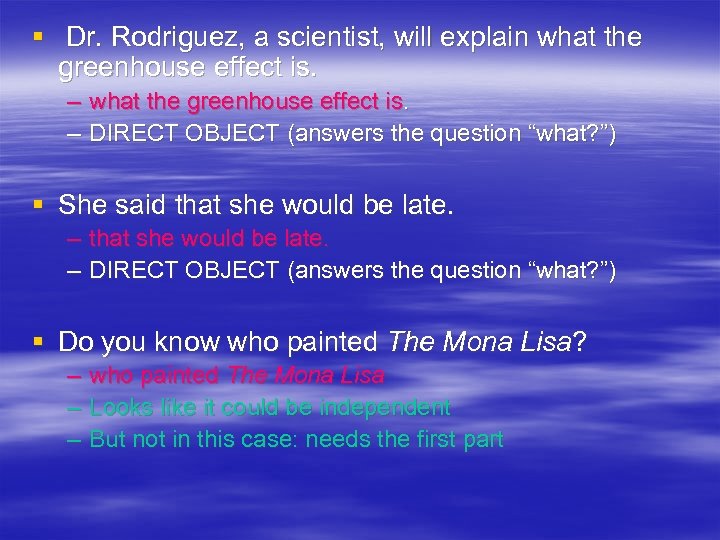 § Dr. Rodriguez, a scientist, will explain what the greenhouse effect is. – DIRECT OBJECT (answers the question “what? ”) § She said that she would be late. – DIRECT OBJECT (answers the question “what? ”) § Do you know who painted The Mona Lisa? – – – who painted The Mona Lisa Looks like it could be independent But not in this case: needs the first part
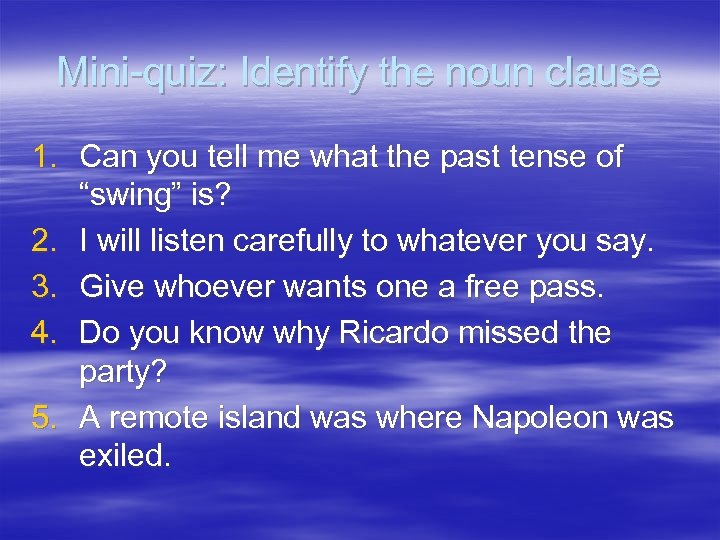 Mini-quiz: Identify the noun clause 1. Can you tell me what the past tense of “swing” is? 2. I will listen carefully to whatever you say. 3. Give whoever wants one a free pass. 4. Do you know why Ricardo missed the party? 5. A remote island was where Napoleon was exiled.
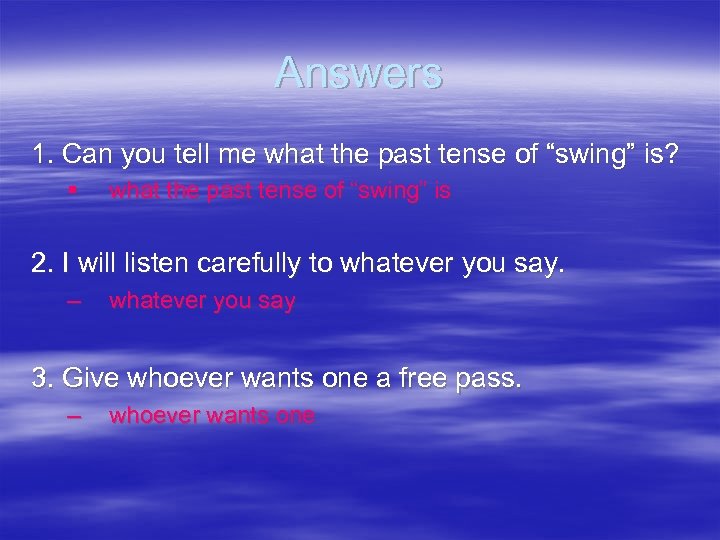 Answers 1. Can you tell me what the past tense of “swing” is? § what the past tense of “swing” is 2. I will listen carefully to whatever you say. – whatever you say 3. Give whoever wants one a free pass. – whoever wants one
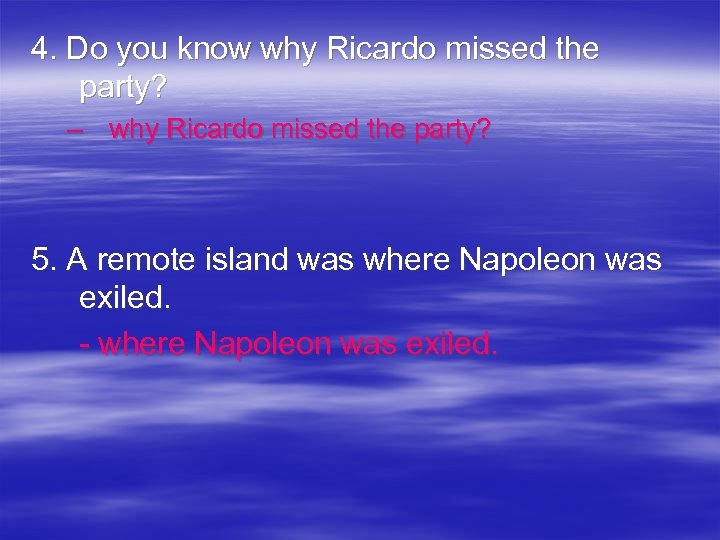 4. Do you know why Ricardo missed the party? – why Ricardo missed the party? 5. A remote island was where Napoleon was exiled. - where Napoleon was exiled.
 ADVERB CLAUSES § Subordinate clause § Modifies verb, adjective, or another adverb – Answers the questions: How? When? Where? Why? To what extent? Under what condition?
 § The pitcher felt as though all eyes were on him. (modifies verb “felt”) – HOW did he feel? § Alex Rodriguez made his major debut when he was only 18. (modifies verb “made”) – WHEN did he make his debut?
 § Introduced by SUBORDINATING CONJUNCTIONS – Partial list: AS LONG AS AS WELL AS IN ORDER THAT BECAUSE AS SOON AS UNLESS SINCE WHILE UNTIL IF AS IF He played as if he were a kid again. (HOW did he “play? ”)
 Mini-quiz: Identify the adverb clause 1. When our school has a fire drill, everyone must go outside. 2. She walked until she was too tired to take another step. 3. As soon as you’re ready, we’ll leave. 4. I visited the museum because I wanted to see the exhibit. 5. You should return your gift if you are not satisfied.
 Answers 1. When our school has a fire drill, everyone must go outside. § When our school has a fire drill § Modifies “must go” (WHEN? ) 2. She walked until she was too tired to take another step. § Modifies “walked” (TO WHAT EXTENT? )
 3. As soon as you’re ready, we’ll leave. § As soon as you’re ready § Modifies “will leave” (WHEN? ) § 4. I visited the museum because I wanted to see the exhibit. § Modifies “visited” (WHY? ) 5. You should return your gift if you are not satisfied. § Modifies “should return” (UNDER WHAT CONDITION? )
 Sentences Classified According to Structure § SIMPLE (S) § COMPOUND (CD) § COMPLEX (CX) § COMPOUND-COMPLEX (CC)
 § SIMPLE Sentences – 1 Independent clause – 0 Subordinate clauses § § § My uncle taught me how to play the guitar. The polar bear is an endangered species. Covered with dust, the old bike looked dirty but worked well.
 § COMPOUND Sentences – 2 or more independent clauses – 0 subordinate clauses § Clauses are connected by: – Comma + (and, but, for, nor, so, yet) – Semicolon + Transition expression
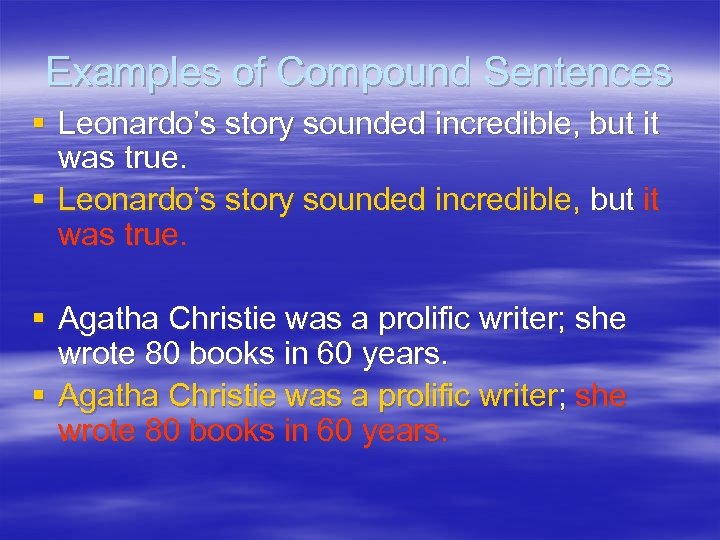 Examples of Compound Sentences § Leonardo’s story sounded incredible, but it was true. § Agatha Christie was a prolific writer; she wrote 80 books in 60 years.
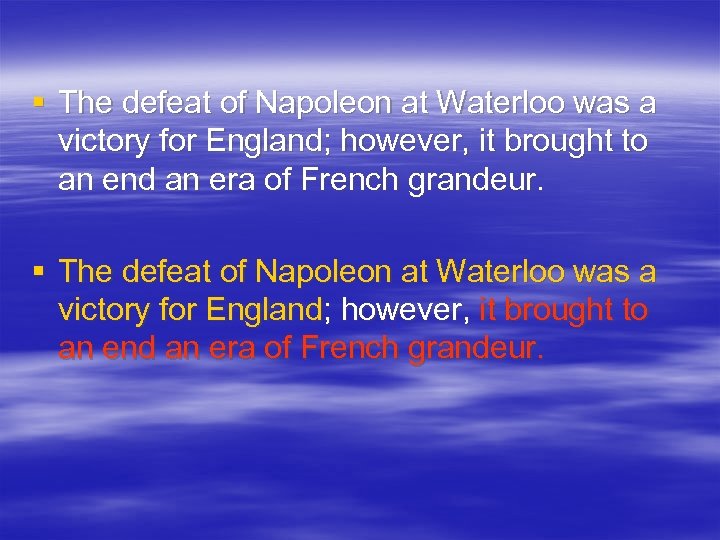 § The defeat of Napoleon at Waterloo was a victory for England; however, it brought to an end an era of French grandeur.
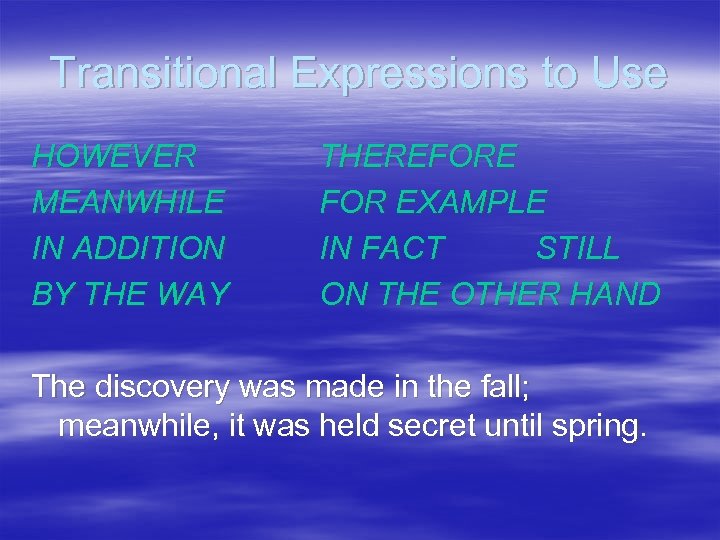 Transitional Expressions to Use HOWEVER MEANWHILE IN ADDITION BY THE WAY THEREFORE FOR EXAMPLE IN FACT STILL ON THE OTHER HAND The discovery was made in the fall; meanwhile, it was held secret until spring.
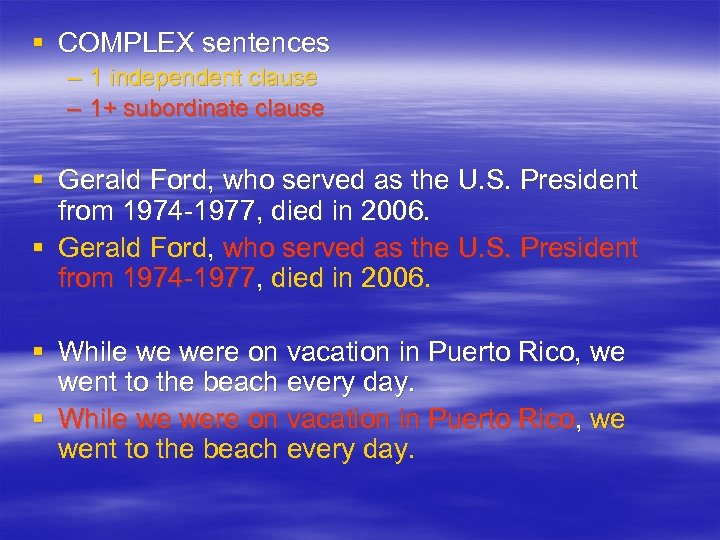 § COMPLEX sentences – 1 independent clause – 1+ subordinate clause § Gerald Ford, who served as the U. S. President from 1974 -1977, died in 2006. § While we were on vacation in Puerto Rico, we went to the beach every day.
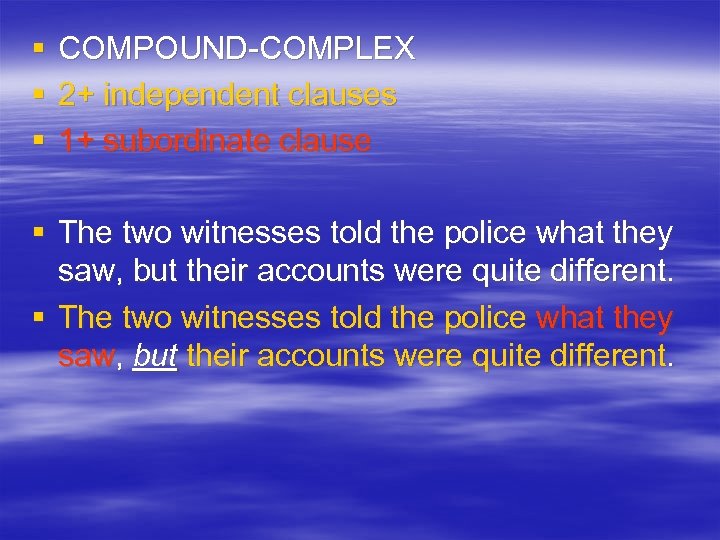 § § § COMPOUND-COMPLEX 2+ independent clauses 1+ subordinate clause § The two witnesses told the police what they saw, but their accounts were quite different.
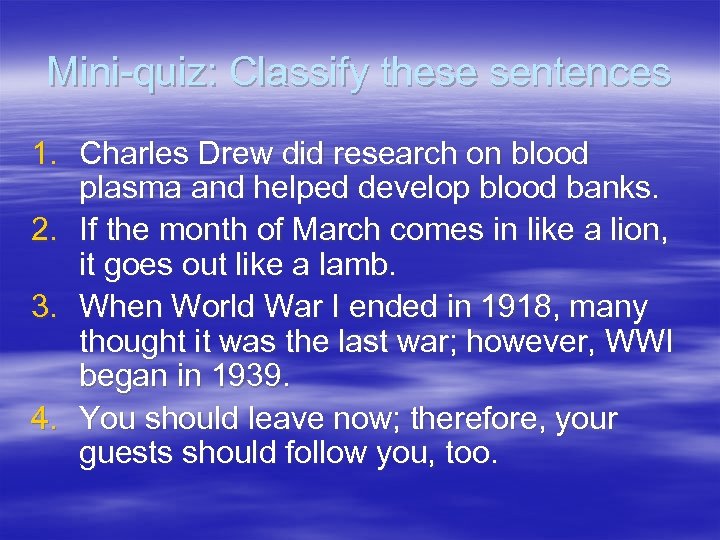 Mini-quiz: Classify these sentences 1. Charles Drew did research on blood plasma and helped develop blood banks. 2. If the month of March comes in like a lion, it goes out like a lamb. 3. When World War I ended in 1918, many thought it was the last war; however, WWI began in 1939. 4. You should leave now; therefore, your guests should follow you, too.
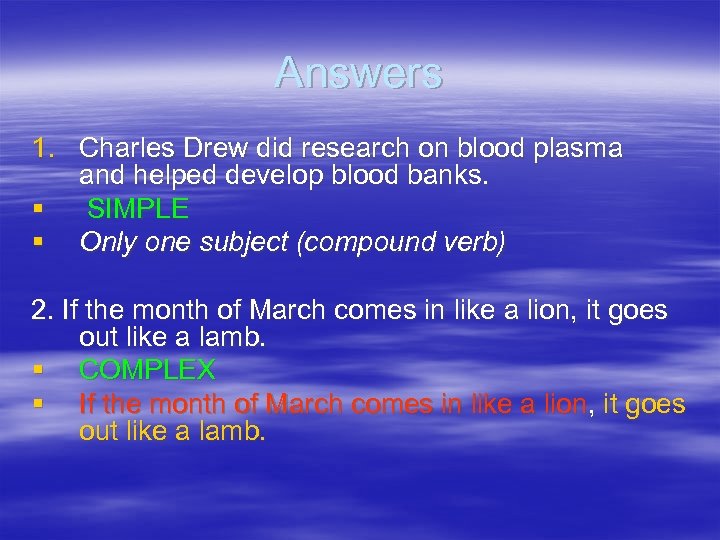 Answers 1. Charles Drew did research on blood plasma and helped develop blood banks. § SIMPLE § Only one subject (compound verb) 2. If the month of March comes in like a lion, it goes out like a lamb. § COMPLEX § If the month of March comes in like a lion, it goes out like a lamb.
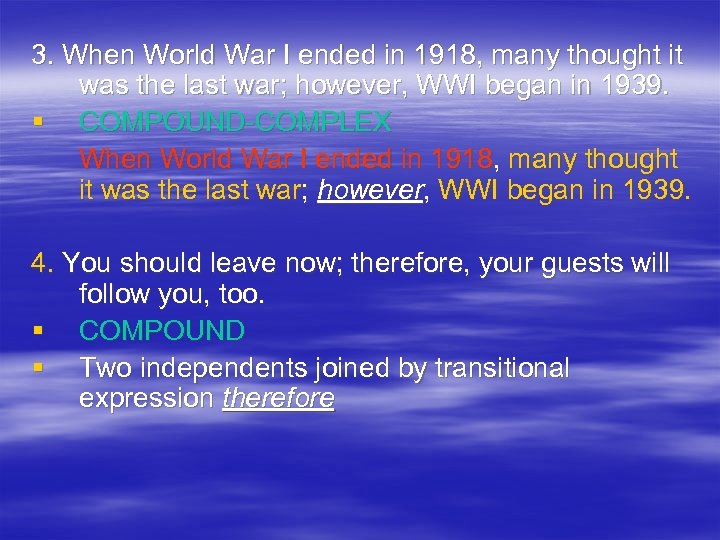 3. When World War I ended in 1918, many thought it was the last war; however, WWI began in 1939. § COMPOUND-COMPLEX When World War I ended in 1918, many thought it was the last war; however, WWI began in 1939. 4. You should leave now; therefore, your guests will follow you, too. § COMPOUND § Two independents joined by transitional expression therefore