


 Скачать презентацию Medium Range Weather Monthly and Seasonal forecasts Climate
f07b7201f746416134478927499e686a.ppt
- Количество слайдов: 21
 Medium Range Weather/ Monthly and Seasonal forecasts Climate & Seasonal Forecasts Magdalena A. Balmaseda My Ocean WP 18 , Athens 29 -30 September 2009 ECMWF (UK) 1
 WP 18: Task on Climate Seasonal Forecast • Participants: Ø Ø Ø Met Office Meteo France CMCC ECMWF Met. No (? ) • First suggestion: generalize a and split the task to 1. Seamless weather to seasonal forecasting 2. Climate Impacts My Ocean WP 18 , Athens 29 -30 September 2009 2
 Overview • Forecasts at different time scales: SEAMLESS prediction • Seasonal Forecasts needs Ø Ø Why do we want forecast at seasonal time scales? End To End Seasonal Forecasting Systems Initialization Calibration • Monthly Forecasts needs • Weather Forecasts needs • Climate Reanalysis (atmosphere/ocean/ice) needs My Ocean WP 18 , Athens 29 -30 September 2009 3
 • There is a clear demand for reliable seasonal forecasts: Ø Forecasts of anomalous rainfall and temperature at 3 -6 months ahead • For a range of societal, governmental, economic applications: Ø Ø Ø Agriculture Heath (malaria, dengue, …) Energy management Markets, insurance Water resource management, • Huge progress in the last decade: Ø Operational seasonal forecasts in several centres Ø Pilot/Research progress for demonstrating applicability (DEMETER, IRI, EUROBRISA, …) Ø Build-up of community infrastructure (at WMO level) My Ocean WP 18 , Athens 29 -30 September 2009 4
 The basis for extended range forecasts • Forcing by boundary conditions changes the atmospheric circulation, modifying the large scale patterns of temperature and rainfall, so that the probability of occurrence of certain events deviates significantly from climatology. Ø Important to bear in mind the probabilistic nature of climate forecasts Ø How long in advance? : from seasons to decades Ø The possibility of seasonal forecasting has clearly been demonstrated Ø Decadal forecasting activities are now starting. • The boundary conditions have longer memory, thus contributing to the predictability. Important boundary forcing: Ø Ø SST: ENSO, Indian Ocean Dipole, Atlantic SST Land: snow depth, soil moisture Atmospheric composition: green house gases, aerosols, … Ice? My Ocean WP 18 , Athens 29 -30 September 2009 5
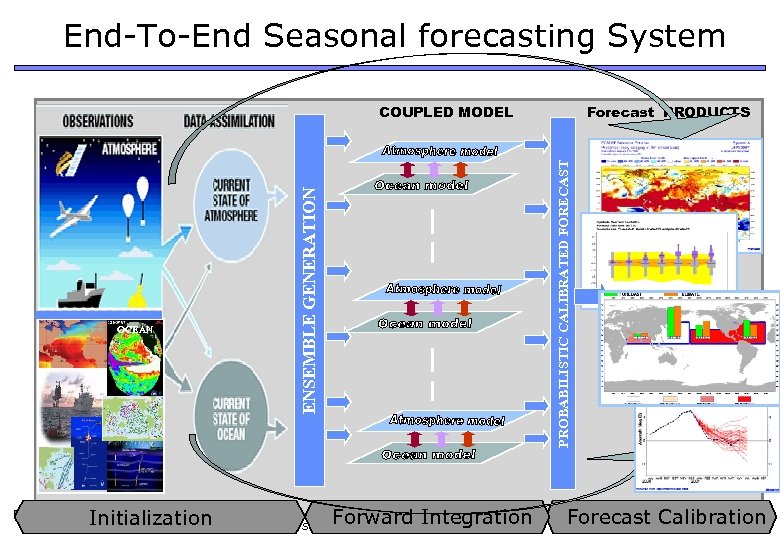 End-To-End Seasonal forecasting System Forward Integration Initialization , Athens 29 -30 September 2009 My Ocean WP 18 Forecast PRODUCTS PROBABILISTIC CALIBRATED FORECAST OCEAN ENSEMBLE GENERATION COUPLED MODEL Forecast Calibration 6
 Importance of Initialization • Atmospheric point of view: Boundary condition problem Ø Forcing by lower boundary conditions changes the atmospheric circulation. “Loaded dice” • Oceanic point of view: Initial value problem Ø Prediction of tropical SST: need to initialize the ocean subsurface. o Emphasis on thermal structure of the upper ocean o Predictability is due to higher heat capacity and predictable dynamics Ø A simple way: ocean model + surface fluxes. o But uncertainty in the fluxes is too large to constrain the solution. Ø Alternative : ocean model + surface fluxes + ocean observations o Using a data assimilation system. o The challenge is to initialize thermal structure – without disrupting the dynamical balances (wave propagation is important) – While preserving the water-mass characteristics My Ocean WP 18 , Athens 29 -30 September 2009 7
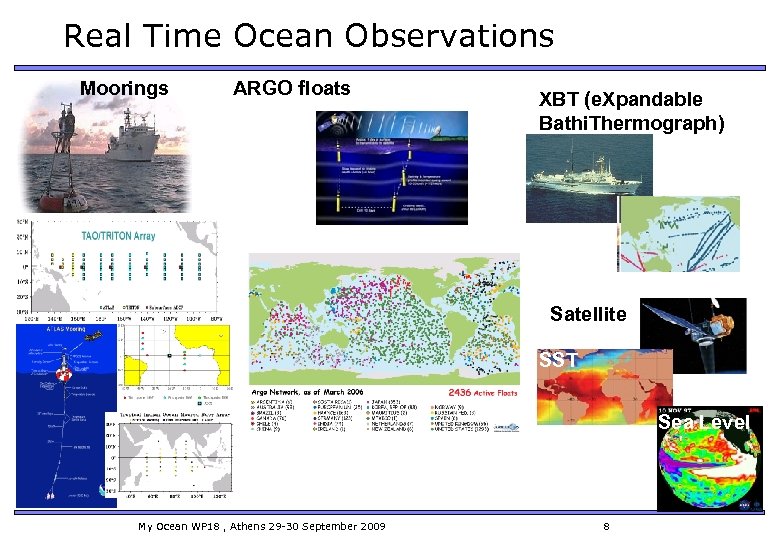 Real Time Ocean Observations Moorings ARGO floats XBT (e. Xpandable Bathi. Thermograph) Satellite SST Sea Level My Ocean WP 18 , Athens 29 -30 September 2009 8
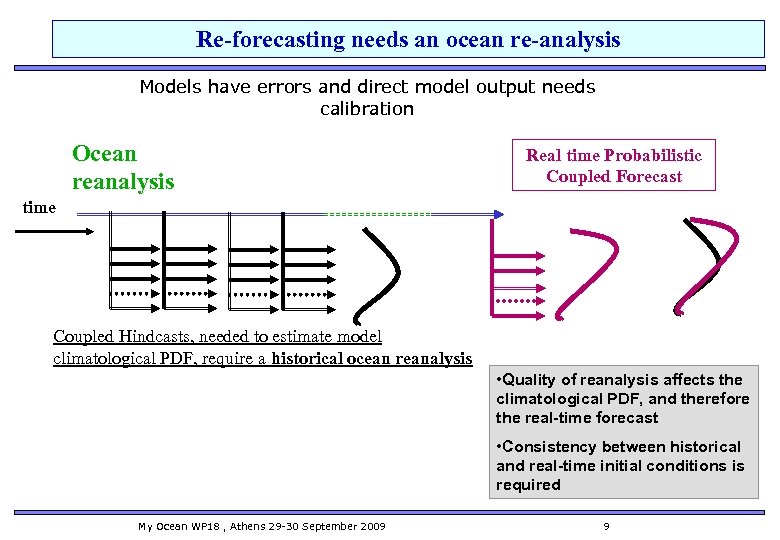 Re-forecasting needs an ocean re-analysis Models have errors and direct model output needs calibration Ocean reanalysis Real time Probabilistic Coupled Forecast time Coupled Hindcasts, needed to estimate model climatological PDF, require a historical ocean reanalysis • Quality of reanalysis affects the climatological PDF, and therefore the real-time forecast • Consistency between historical and real-time initial conditions is required My Ocean WP 18 , Athens 29 -30 September 2009 9
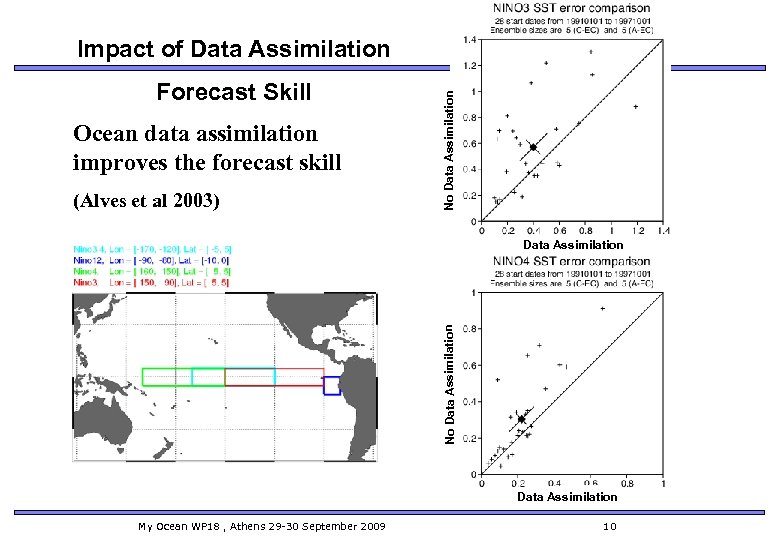 Forecast Skill Ocean data assimilation improves the forecast skill (Alves et al 2003) No Data Assimilation Impact of Data Assimilation No Data Assimilation My Ocean WP 18 , Athens 29 -30 September 2009 10
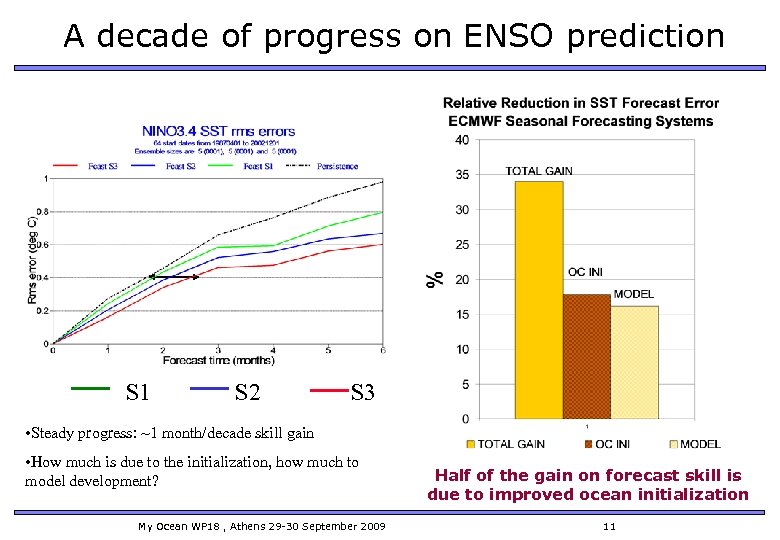 A decade of progress on ENSO prediction S 1 S 2 S 3 • Steady progress: ~1 month/decade skill gain • How much is due to the initialization, how much to model development? My Ocean WP 18 , Athens 29 -30 September 2009 Half of the gain on forecast skill is due to improved ocean initialization 11
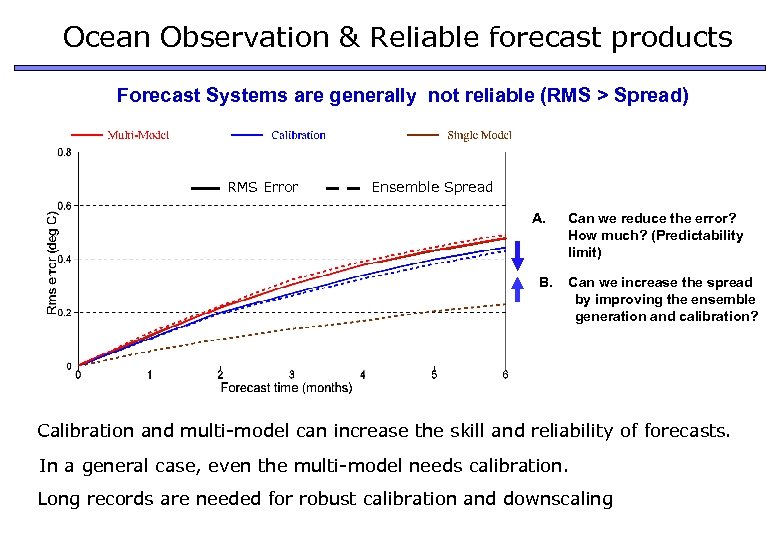 Ocean Observation & Reliable forecast products Forecast Systems are generally not reliable (RMS > Spread) RMS Error Ensemble Spread A. B. Can we reduce the error? How much? (Predictability limit) Can we increase the spread by improving the ensemble generation and calibration? Calibration and multi-model can increase the skill and reliability of forecasts. In a general case, even the multi-model needs calibration. Long records are needed for robust calibration and downscaling My Ocean WP 18 , Athens 29 -30 September 2009 12
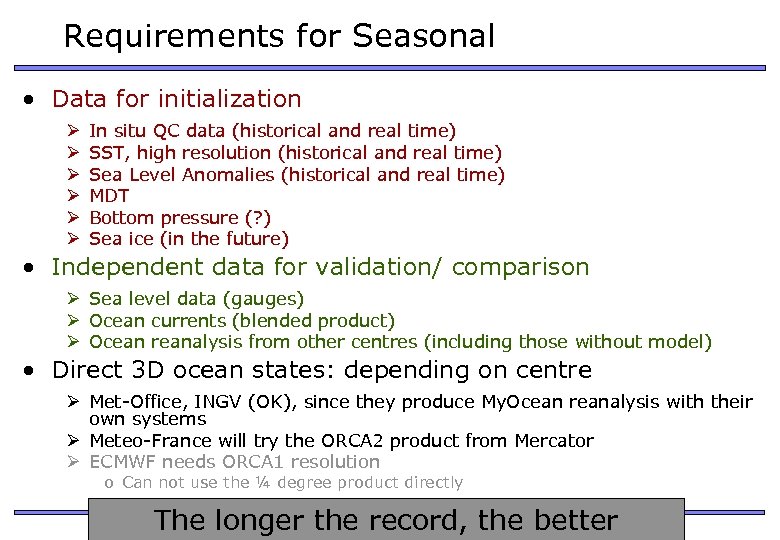 Requirements for Seasonal • Data for initialization Ø Ø Ø In situ QC data (historical and real time) SST, high resolution (historical and real time) Sea Level Anomalies (historical and real time) MDT Bottom pressure (? ) Sea ice (in the future) • Independent data for validation/ comparison Ø Sea level data (gauges) Ø Ocean currents (blended product) Ø Ocean reanalysis from other centres (including those without model) • Direct 3 D ocean states: depending on centre Ø Met-Office, INGV (OK), since they produce My. Ocean reanalysis with their own systems Ø Meteo-France will try the ORCA 2 product from Mercator Ø ECMWF needs ORCA 1 resolution o Can not use the ¼ degree product directly The longer the record, the better My Ocean WP 18 , Athens 29 -30 September 2009 13
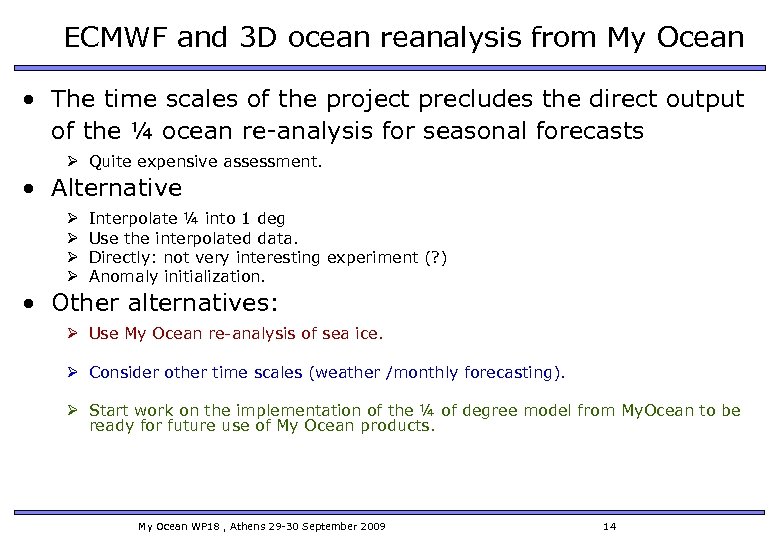 ECMWF and 3 D ocean reanalysis from My Ocean • The time scales of the project precludes the direct output of the ¼ ocean re-analysis for seasonal forecasts Ø Quite expensive assessment. • Alternative Ø Ø Interpolate ¼ into 1 deg Use the interpolated data. Directly: not very interesting experiment (? ) Anomaly initialization. • Other alternatives: Ø Use My Ocean re-analysis of sea ice. Ø Consider other time scales (weather /monthly forecasting). Ø Start work on the implementation of the ¼ of degree model from My. Ocean to be ready for future use of My Ocean products. My Ocean WP 18 , Athens 29 -30 September 2009 14
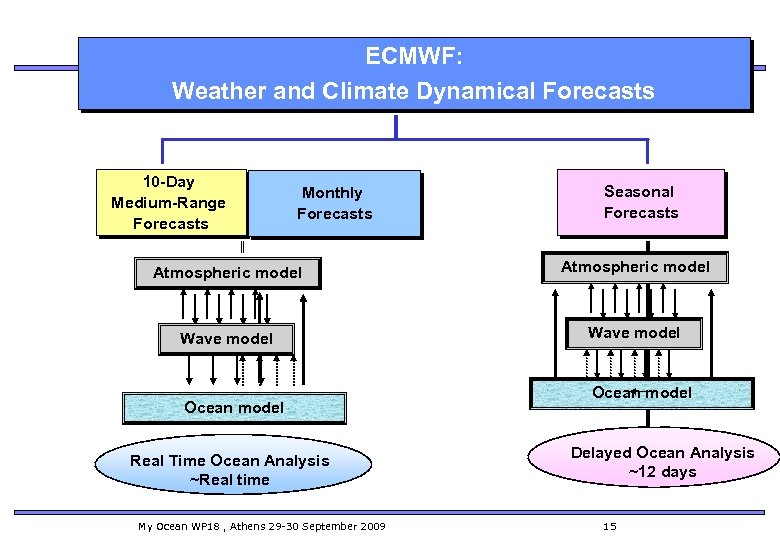 ECMWF: Weather and Climate Dynamical Forecasts 10 -Day Medium-Range Forecasts Monthly Forecasts Seasonal Forecasts Atmospheric model Wave model Ocean model Real Time Ocean Analysis ~Real time My Ocean WP 18 , Athens 29 -30 September 2009 Ocean model Delayed Ocean Analysis ~12 days 15
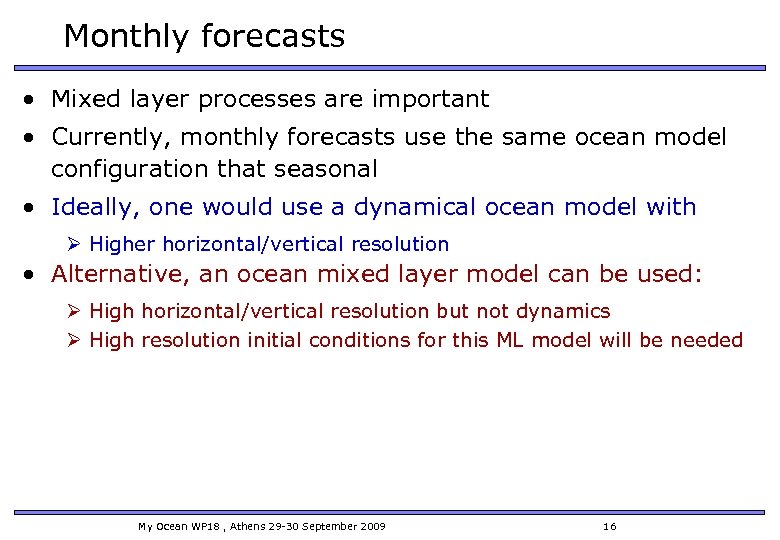 Monthly forecasts • Mixed layer processes are important • Currently, monthly forecasts use the same ocean model configuration that seasonal • Ideally, one would use a dynamical ocean model with Ø Higher horizontal/vertical resolution • Alternative, an ocean mixed layer model can be used: Ø High horizontal/vertical resolution but not dynamics Ø High resolution initial conditions for this ML model will be needed My Ocean WP 18 , Athens 29 -30 September 2009 16
 Requirements for Monthly Forecast • High resolution 3 D ocean re-analysis to initialize ML model Ø Temperature and Salinity. Velocities Ø Long Reanalysis and timely real-timi (within 12 -24 h) • Possibility 1: Ø Get data for a long term reanalysis. Exact period to be discussed. (1993 -2005) is a possibility) Ø Use it to initialize the ML model and conduct a series of monthly hindcasts. Ø Assess skill respect initial conditions from a low resolution ocean model. Ø Problem: human resources are scarce • Possibility 2: Ø Start work on the implementation of the ¼ of degree model from My. Ocean to be ready for future use of My Ocean products. My Ocean WP 18 , Athens 29 -30 September 2009 17
 Medium Range Weather forecasts • They will benefit from better representation of air-sea interaction: Ø Currents coupled to the wave model Ø High resolution SST with diurnal cycle. Sea-ice • Currently, persisted SST anomalies are used • Interest in testing coupling to currents. Or at least, initialization of currents Ø And use persisted currents during the forecast • Ideally, one would use a dynamical ocean/sea-ice model with Ø Higher horizontal resolution Ø Higher vertical resolution Ø But software does not exist yet • Alternative, ML model as in monthly. My Ocean WP 18 , Athens 29 -30 September 2009 18
 Requirements for Medium Range • Possibility 1: Ø Use ocean currents. It involves other groups at ECMWF. Ø Need for skill assessment of the product. • Possibility 2: Ø Start work on the implementation of the ¼ of degree model from My. Ocean to be ready for future use of My Ocean products. My Ocean WP 18 , Athens 29 -30 September 2009 19
 Summary • Extend the name of the task to seamless prediction, to include medium range and seasonal. Separate task on climate impacts. • Direct products from TACS will be used by the different partners. Ready to provide assessment for different time scales • URD Ø From ECMWF can include Atmospheric Re-analysis, Medium Range weather forecast, monthly and seasonal • Use of 3 D reanalysis Ø Not prescriptive. Depending of group. Ø Assessment of seasonal from CMCC, Met. Office and Meteo-France Ø ECMWF may not provide assessment of 3 D products for seasonal. It could (needs further discussion/iterations. Resource dependent) o o Use Sea-ice in seasonal Initialization of ML model for monthly (resources) Use of velocity data for the wave model in medium range. Start implementing My. Ocean software (1/4 degree ocean model/sea ice) My Ocean WP 18 , Athens 29 -30 September 2009 20
 THE END My Ocean WP 18 , Athens 29 -30 September 2009 21