


 Скачать презентацию MEDIEVAL PHILOSOPHY Lecture 4 Content of
PHIL-PP-L- 4. Medieval.ppt
- Количество слайдов: 21
 MEDIEVAL PHILOSOPHY Lecture # 4
 Content of lecture: 1. 2. 3. 4. 5. 6. Introduction Characteristics of the medieval period Patristics (St. Augustine) Scholastica (Thomas Aquinas) Nominalism and Realism Recommended readings
 Introduction • The origin of medieval philosophy lies in the period of early Christianity • The hallmark of medieval philosophy was its close relationship with Christianity • Christianity became the dominant worldview in Western Europe at that period of history • Through the relation "God - man" addressed the structure of the world, man's place, and the system of moral values
 Introduction • Therefore, medieval philosophy had theocentric character (the Greek word - theos - God) • The main function of medieval philosophy was justification of religious precepts (уағыздар/постулаты) • According to many historians, the philosophy of the period turned into a “servant of theology” • There were two main periods in the development of medieval philosophy in Europe: the patristic and scholastic
 Patristics and scholastica • Patristics (Latin word “pater” – “father”) - a set of theological and philosophical doctrines of Christian thinkers of II-VIII centuries • Scholastica (Latin word “scholastica” – “school”, “scholar”) defines a central role in the justification of theological philosophy of dogmas (IX-XII centuries) • Opposing positions to patristicism and scholasticism appeared in realism and nominalism • At the heart of these conflicts was the confrontation of faith (наным/сенім/вера) and knowledge • Dogma (догма) - учение, объявленное истиной и не подлежащее критике
 Characteristics of the Medieval period • Christian worldview has arisen in the first century in Palestine • Christianity spread within the geographical boundaries of the Roman Empire • Christianity emerged as the new religion did not divide people into lords and slaves, barbarians and Greeks, etc. • It opposed the ideas of Roman society and proclaimed values of austerity and worries about the fate of the world
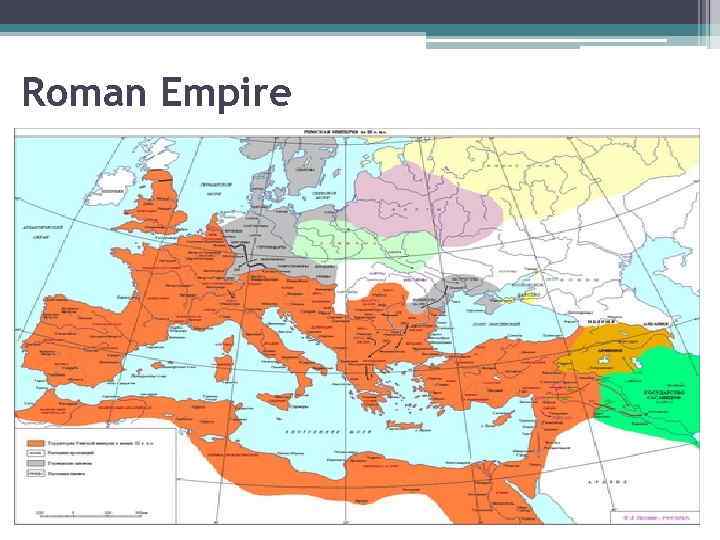 Roman Empire
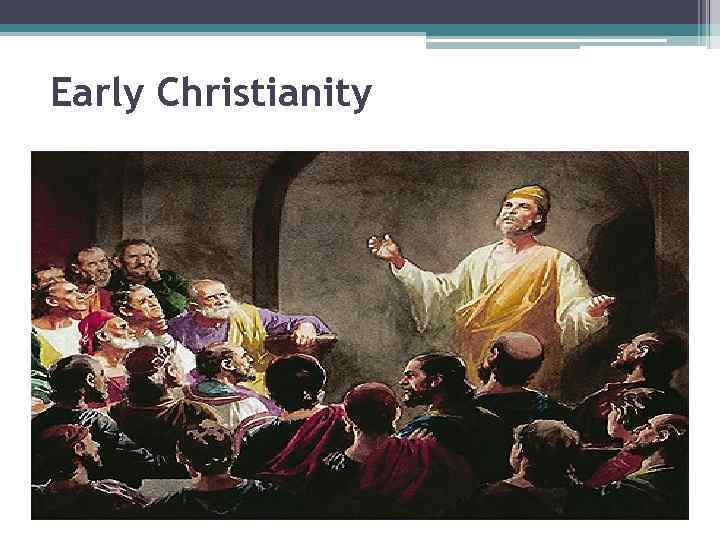 Early Christianity
 Early Christianity • Early Christians were cruel persecuted in Roman Empire, as the opposition to the official ideology • Image of Jesus Christ crucified on the cross, has become the most valuable symbol of Christian ethics • The Christian world view was based on two postulates: the creation (жарату/творение) and revelation (ашық айту/откровение) • Creation means the formation of the world and man by God
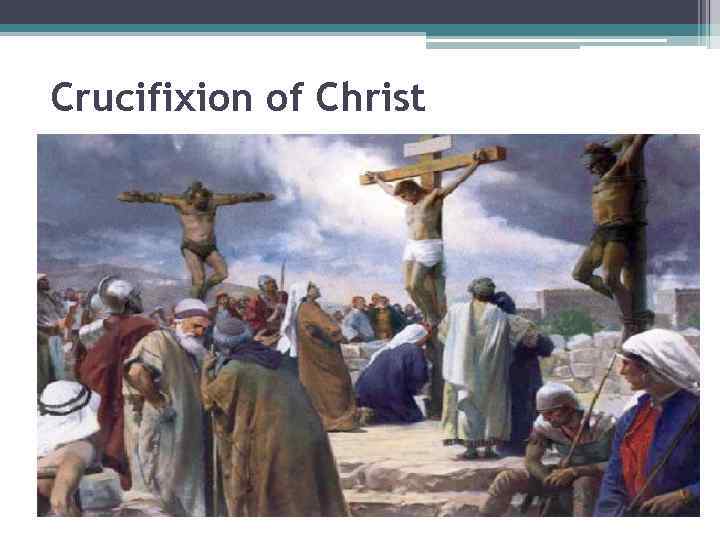 Crucifixion of Christ
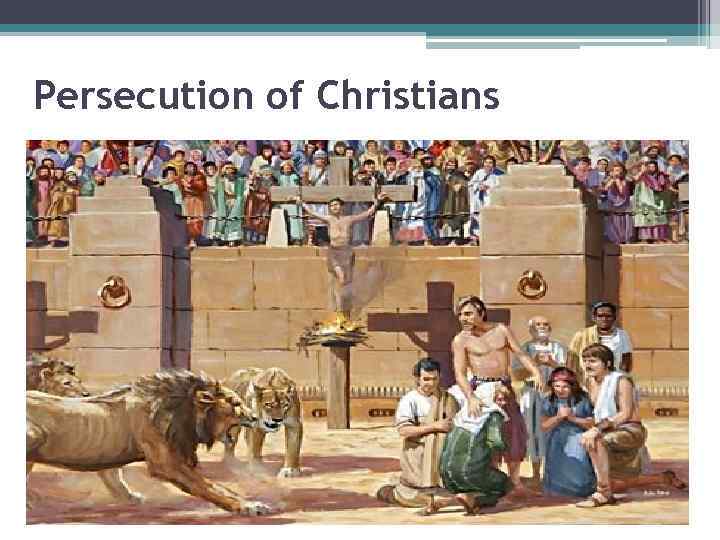 Persecution of Christians
 Medieval philosophy was characterized by: • Providence. The method of examination of historical events from the point of view of providence (болжағыштық/провидение) and salvation (құтқару/спасение) of man • Creationism (from lat. creatio - race, creationis creation). The concept of creation of the world by God from "nothing" within a limited period of time • Traditionalism. This is the concept of the superiority of tradition over mind. This concept is closed to conservatism
 Religious worldview of Middle Ages were characterized by: • Symbolism. Every significant phenomenon in nature and history was seen as a manifestation of the divine (құдай берген/божественный) will; • Contrast. All reality is seen as a struggle between good and evil, God and the Antichrist; • Absolutism of word. Word belongs to the God. "In the beginning was the word"
 St. Augustine (354 -430) • The prominent thinker of MA. His ideas have determined the further development of European philosophy • He was born in North Africa, in the Roman province • His father was a pagan (пұтқа табынушы/язычник), his mother - a Christian • He received an excellent education. He creatively developed the ideas of Plato and Neo-Platonists • Literary heritage of St. Augustine is more than 40 books
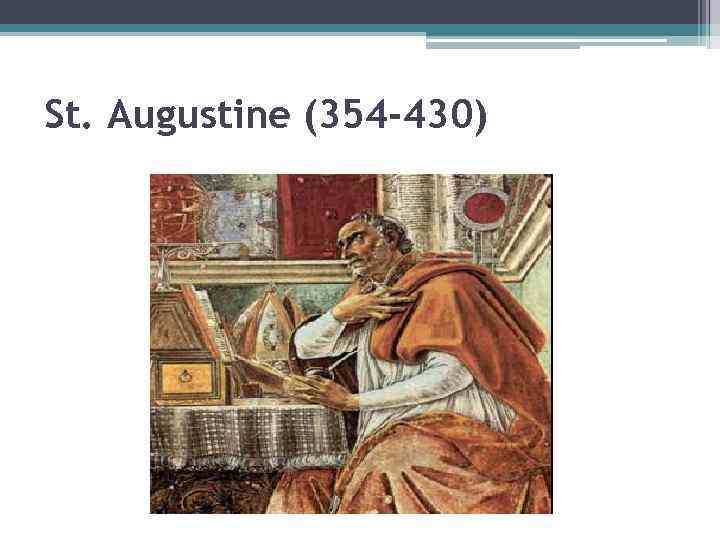 St. Augustine (354 -430)
 St. Augustine (354 -430) • The philosopher focused on issues of God and the world, life and times, faith and reason, truth, and knowledge of good and evil • The main direction of the teachings of Augustine was the relation of God and the world • This attitude is characterized as creationism, it recognized of the creation of the world by God from "nothing" in a limited period of time • Augustine denies the presence of any "material", "building bricks" to create the world
 Thomas Aquinas (1225 -1274) • Prominent and influential philosopher of medieval Western Europe is Thomas Aquinas (Фома Аквинский) • After his death he was canonized to the saints • Thomas Aquinas was born in the count's (ақсүйек/графская) family in the Kingdom of Naples • He graduated from the University of Paris • He taught at the University of Naples and Paris • Thomas Aquinas was the author of a number of works. His basic work was "Summa Theological" (1273) • Aquinas formed ethical doctrine of Catholicism. Its main purpose, as Augustine, was the contemplation (сырттай шому/созерцание, размышление) of God and preparing for the afterlife
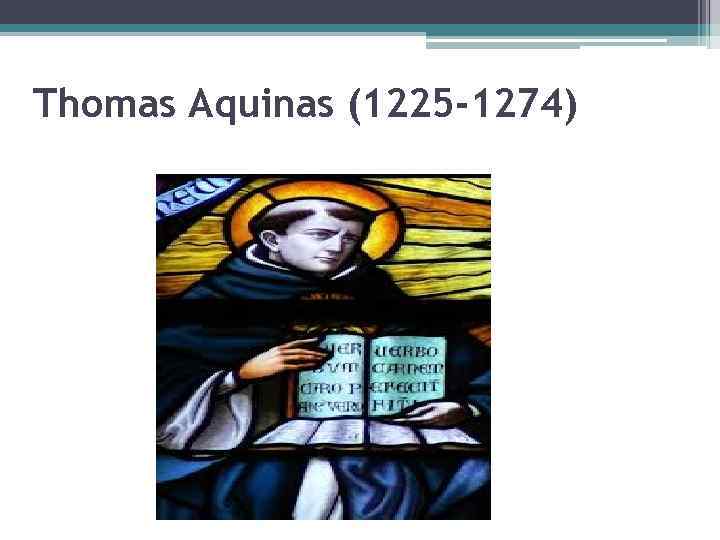 Thomas Aquinas (1225 -1274)
 Thomas Aquinas (1225 -1274) • Moral and practical human actions are determined by the mind through the choice between good and evil. Thus emphasizes human responsibility for their actions and activities • State, according to Thomas Aquinas, was to prepare its members to comprehend (түсіну/понимать) the sacred truths of heavenly (құдай берген/божественный) life • Civil society must be subordinated (бағыну/подчиняться) to the church and state • God's representative on earth is the Pope • The teaching of Thomas Aquinas became the official philosophy of the Roman Catholic Church
 Nominalism and realism • Several centuries the fierce debate between realists and nominalists exerted (әсер ету/оказывать влияние) considerable influence on the spiritual life of medieval society • Realists developed theory of Plato's "world of ideas" • This concept has been redesigned in the spirit of St. Augustine Christian doctrine • "Ideas" are interpreted as the Creator's creations and designs • Nominalists (Latin “nominalis - noun, ” referring to the names) were the founders of the materialistic direction in Medieval philosophy
 Nominalism and realism • They pointed out that the things - first, a concept - is secondary • The concept of "person" includes all the features of the individual • As a result, man is endowed (ие болу/быть наделенным) with reason more than any other • Realists views were closer to Christian dogma (doctrine) • For this reason, nominalists were persecuted by the authorities of Catholic Church and government