


 Скачать презентацию Medicine Surgery Pal Ondrejka MD Ph D Professor
53efacd27eb826b318ad3af3a73b1869.ppt
- Количество слайдов: 25
 Medicine, Surgery Pal Ondrejka, MD. Ph. D. Professor of surgery Semmelweis University Second Department of Surgery
 • What does it mean to be a surgeon?
 • If you are a good student, you will graduate at the university at the age of 24 • If you are a diligent young dr, you can finish your surgical training at the age of 30 • Now you are a young surgeon without much experience • You need another 10 years to be an independent surgeon • Between 40 and 50 you can apply for a leading position • Over 60 you can look after your grandchildren (if you are healthy and alive)
 • To be a surgeon, it means: A lot of work Very little free time, while you are young A lot of things to learn Little time for your family Little time for amusements
 Why should I be a surgeon • Because the experience of success • You can give a new life to patients • It is the strongest confidential relationship between patients and doctors • You can give back hope to the patients
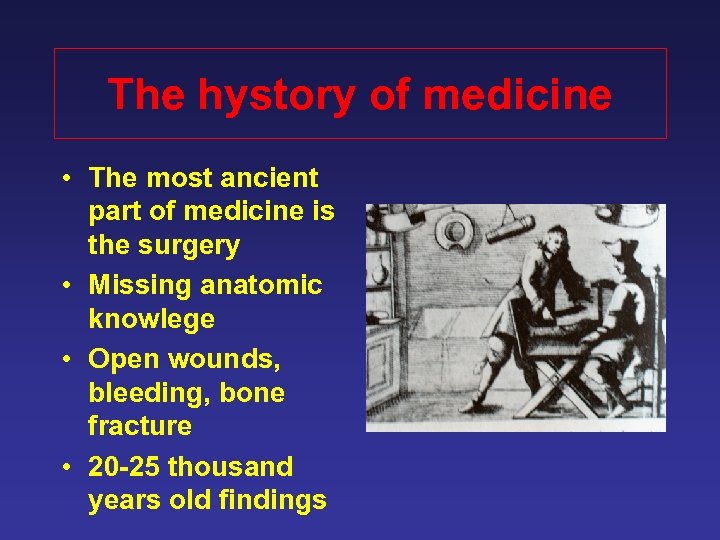 The hystory of medicine • The most ancient part of medicine is the surgery • Missing anatomic knowlege • Open wounds, bleeding, bone fracture • 20 -25 thousand years old findings
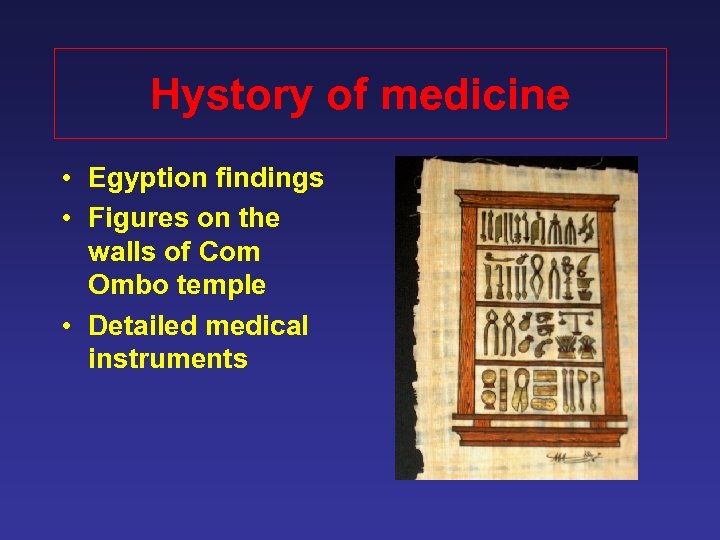 Hystory of medicine • Egyption findings • Figures on the walls of Com Ombo temple • Detailed medical instruments
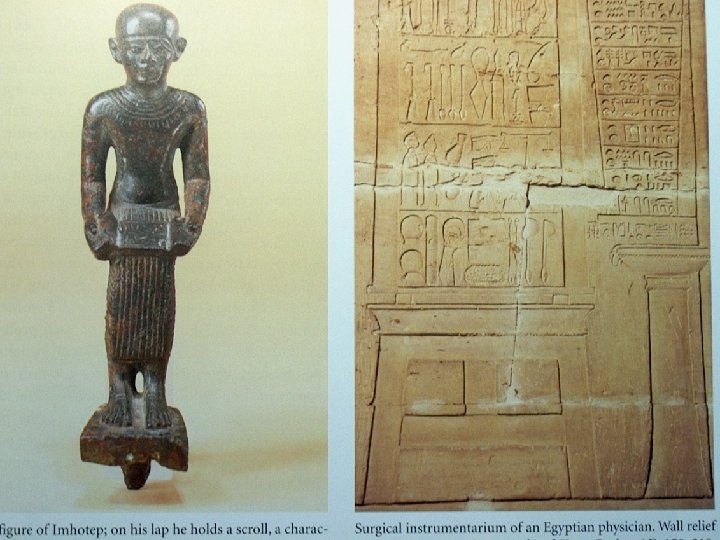
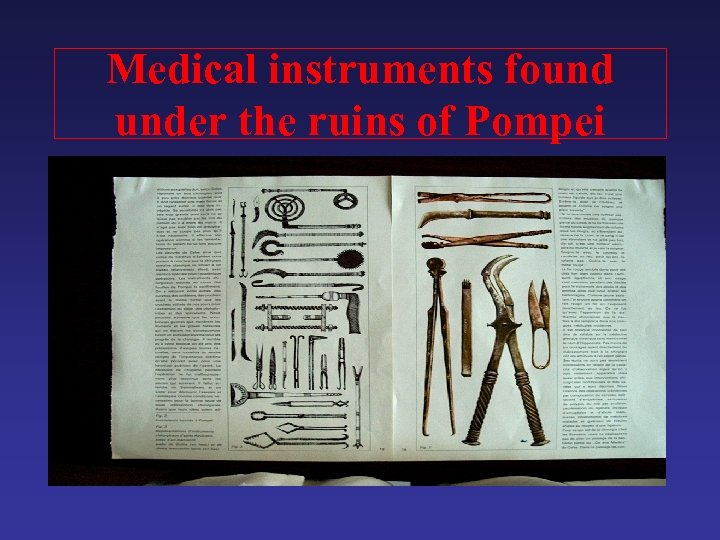 Medical instruments found under the ruins of Pompei
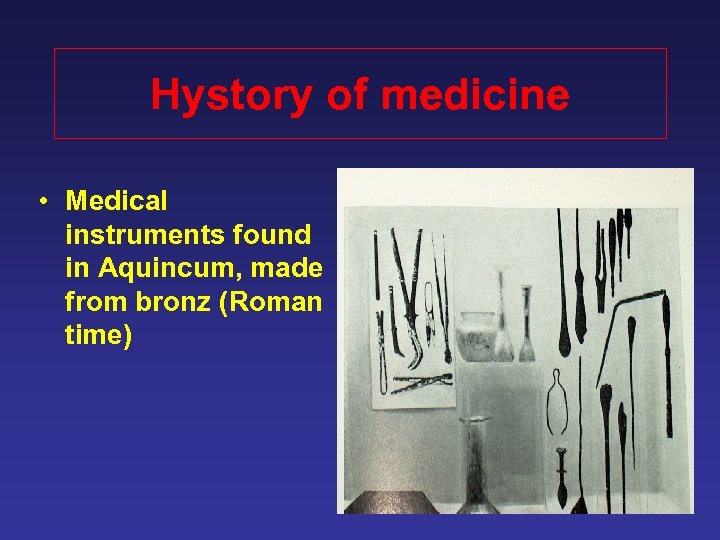 Hystory of medicine • Medical instruments found in Aquincum, made from bronz (Roman time)
 Hystory of medicine • Mezopotamia ( 18. Century B. C. ): • Code of Hammurabi : Knife made of bronze, bone fracture, principles • Egypt: Edwin Smith papirus: Description of 121 surgical instrument • India: Ayur-Veda: traction-antitraction in case of bone fracture, enterostomy in case of ileus
 Hystory of medicine • Greeks: Hippokrates 460 -377 B. C. : Medical school on Kos island: cleaning, suture of wounds, reposition of luxation of humerus, fistula ani, medical oath • Alexandria: (300 - 400 B. C. ) post mortem, ligature of vessels
 Hystory of medicine • Roman empire: – Celsus (14 - 38 B. C. ): 8 volumes of encyclopaedia – Galenus (129 -199): From empiria to dogmas (evolution of medicine became slower) • Persian medicine: Ibn Szina (980 -1038) Avicenna: again empiria, but no post mortem • European universities from the XI. century: Paris, Bologna, Oxford, Montpellier, Padua, Naples, Prague, Wiena, Heidelberg, Pecs (Hungary)
 Hystory of medicine • Renaissance: – Leonardo da Vinci (1452 -1519) anatomical studies – Vesalius (1514 -1564) De Humani Corporis Fabrica, anatomic studies – William Harvey (1578 -1657) realised the circulation of blood
 Hystory of medicine • XVIII. Century: Morgagni: Knowledge in pathology – John Hunter: Collateral circulation, inflammation, regeneration – Lorenz Heister: Surgical Textbook – Academie Royale de Chirurgie – Royal College of Surgeons • Difficulty in development: lack of asepsis, antisepsis, lack of anaesthesia
 Hystory of medicine • First narcosis with ether: Crawford W. Long 30. 03. 1842. • Narcosis with nitrogen oxidul: Horace Wells 1944 • 16. 10. 1846. : John Colin Warren in the Messechussetts General Hospital, Boston removes a tumour from the neck in narcosis with ether, this is the beginning of modern surgery
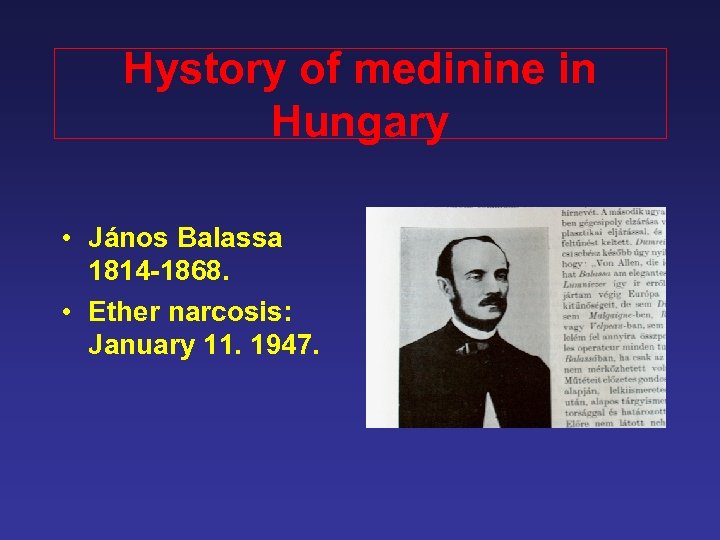 Hystory of medinine in Hungary • János Balassa 1814 -1868. • Ether narcosis: January 11. 1947.
 Hystory of medinine • The most serious complication in surgery was the infection – Ignác Semmelweis (1818 -1865) He realised the importance of desinfection – Joseph Lister (1827 -1912): Asepsis – antisepsis – Luis Pasteur 1863: Realised the microorganisms – Robert Koch 1878: Supported this observation
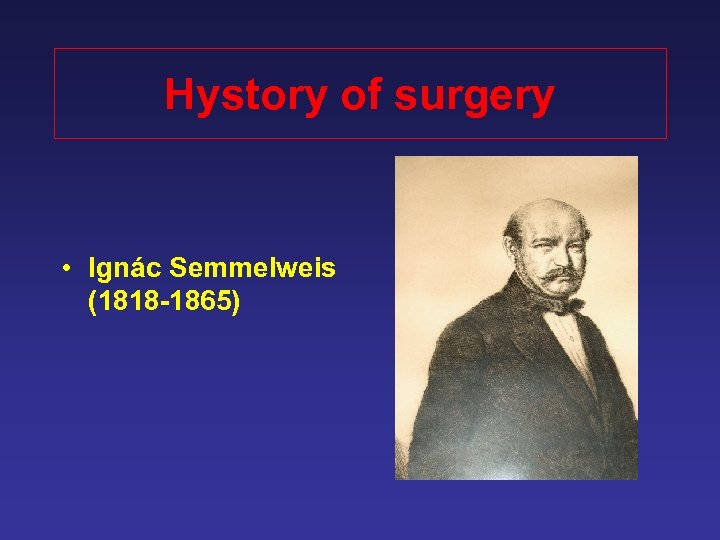 Hystory of surgery • Ignác Semmelweis (1818 -1865)
 Hystory of surgery • Sterilisation: – Trendelenburg: 1882: sterilisation with steem – Braun, Neuber, Schimmelbusch: autoclav (heat and pressure) – Halstedt 1891: steril rubber gloves
 Hystory of medicine • Wilhelm Konrad Röntgen 1895: invented the Xray • Landsteiner 1900: blood groups • Koller 1884: local anaeshesia with kokain • Einhorn 1905: Novocain • Magill és Rowbothan: anaesthesiology • Alexander Fleming 1929: Penicillin
 Hystory of medicine • Theodor Billroth (1829 -1894): 1881: first partial gastrectomy • Morton és Mc. Burney 1886: appendectomy • Carl Langenbech 1882: cholecystectomy • Ernest Miles 1908: abdominoperineal rectum resection • Teodor Kocher: surgery of thyroid gland • W. St. Halsted 1890: mastectomy
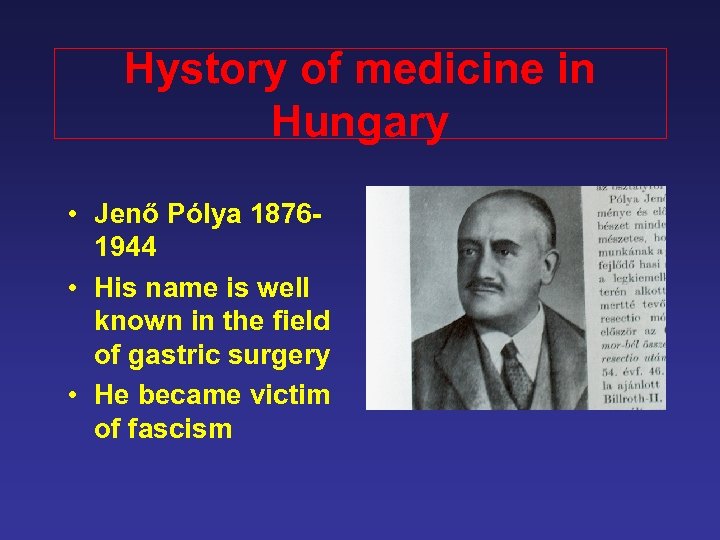 Hystory of medicine in Hungary • Jenő Pólya 18761944 • His name is well known in the field of gastric surgery • He became victim of fascism
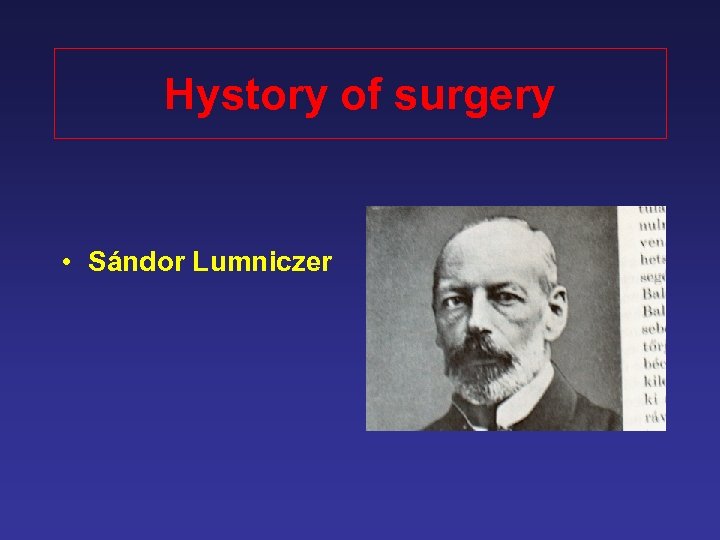 Hystory of surgery • Sándor Lumniczer
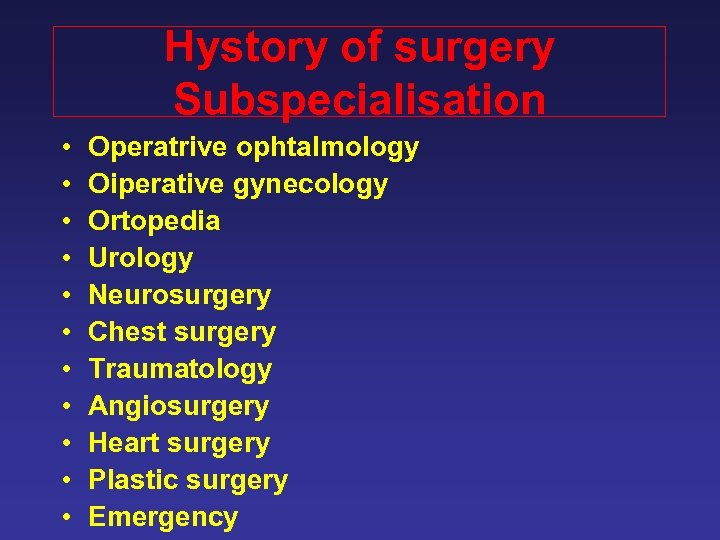 Hystory of surgery Subspecialisation • • • Operatrive ophtalmology Oiperative gynecology Ortopedia Urology Neurosurgery Chest surgery Traumatology Angiosurgery Heart surgery Plastic surgery Emergency