


 Скачать презентацию Medication Safety Results from the Hospital Pharmacy in
4878a03f3f49fa21ec8440faabb5c248.ppt
- Количество слайдов: 40
 Medication Safety Results from the Hospital Pharmacy in Canada report Patricia Lefebvre Millcroft Pharmacy Leadership Conference June 1 -3, 2007
 Objective q q Provide participants with a view of the state of patient safety from a pharmacy perspective in Canada Highlights of the 2005/2006 Annual Report – Hospital Pharmacy in Canada
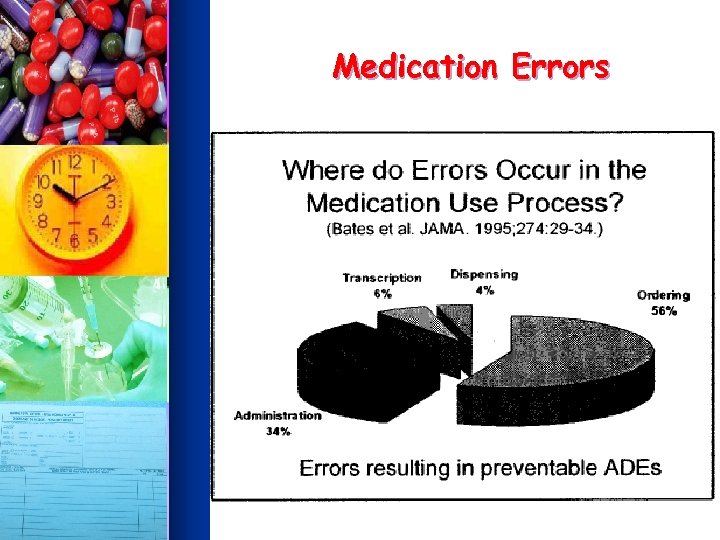 Medication Errors
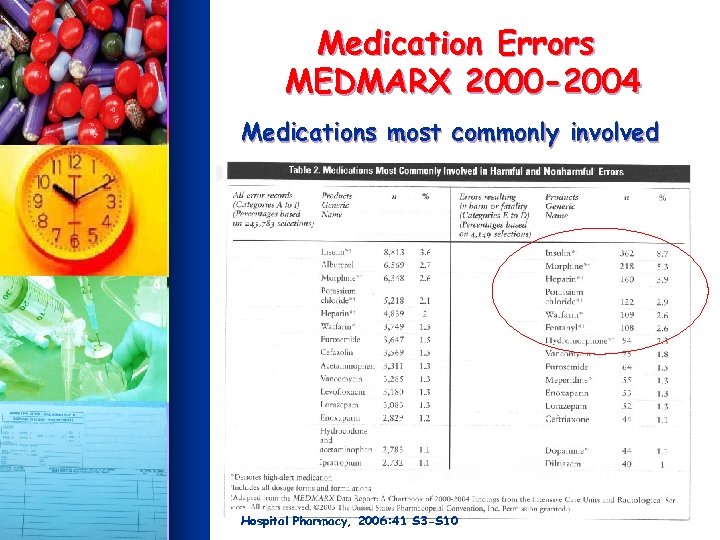 Medication Errors MEDMARX 2000 -2004 Medications most commonly involved Hospital Pharmacy, 2006: 41 S 3 -S 10
 2005/06 Hospital Pharmacy in Canada: survey methodology q q List of hospital pharmacies and membership list of the Association of Canadian Academic Healthcare Organizations (ACAHO) and telephone survey to obtain name and e-mail address of the Director of Pharmacy and the hospital’s Chief Executive Officer E-mails sent to Directors of Pharmacy and CEOs in June 2006; second E-mail to Directors of Pharmacy in July. Period to fill survey: June 23 to September 1, 06 Eligibility: total of 100 beds and at least 50 acute care beds q Response rate: 74% (142/193) q Hospital Demographic Info, Qc: 30% (42/142) q Québec response rate: 71% (42/59)
 Disclosure Policy q Hospital has a policy on the disclosure of incidents to patients and/or their (ROP – Culture) families 2005/06 80 % 2003/04 63 %
 Disclosure Policy q Disclosure is documented in the health record 2005/06 91% 2003/04 81%
 Medication Incident Reporting q A medication incident reporting system is in use 2005/06 2003/04 96% 100%
 Medication Incident Reporting q Medication incident reports can be used during an individual healthcare provider’s performance assessment 2005/06 12% q q 2003/04 21% Respondents: Academic Health Centres: 0% Non Academic Health Centres: 16%
 Committee responsible for the review of medication incidents q Committee responsible for the review of medication incidents 2005/06 80% 2003/04 80% If yes, committee is dedicated to Medication Safety 44% 17%
 Medication safety selfassessment q Medication safety selfassessment has been completed (ROP) 2005/06 71% q q 2003/04 51% ISMP: 91% Autres: 6% (Qc: 31 %)
 Medication History Taking q q When a patient visits the ED, a comprehensive medication history is conducted 45% The patient’s medication history is reconciled with medication orders written at the time of admission or ER visit 45%
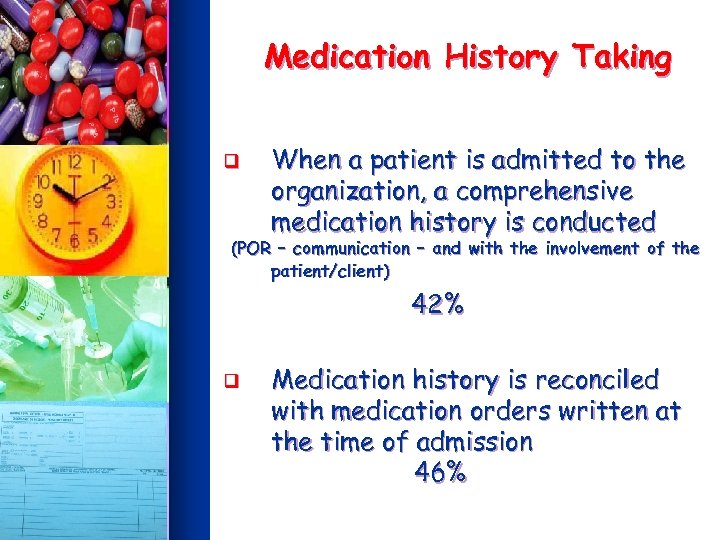 Medication History Taking q When a patient is admitted to the organization, a comprehensive medication history is conducted (POR – communication – and with the involvement of the patient/client) 42% q Medication history is reconciled with medication orders written at the time of admission 46%
 Medication History Taking q q When patient is transferred between levels of care within the facility, reconcile the patient’s medications and communicate that information to the next provider of care (POR – communication, with the patient/client) 38% (All: 20% / Sel: 78%)
 Medication History Taking q q When patient is transferred outside the facility, reconcile the patient’s medications and communicate that information to the next provider of care (POR – communication, with the patient/client) 35% (All: 8% /Sel: 90%)
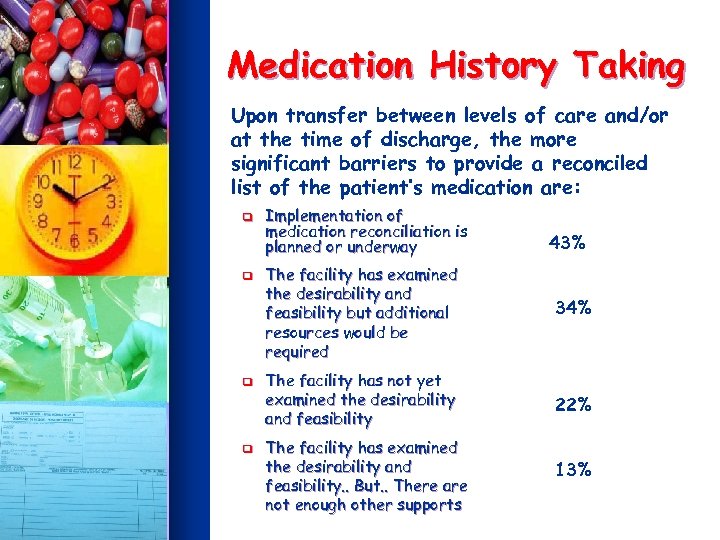 Medication History Taking Upon transfer between levels of care and/or at the time of discharge, the more significant barriers to provide a reconciled list of the patient’s medication are: q q Implementation of medication reconciliation is planned or underway 43% The facility has examined the desirability and feasibility but additional resources would be required 34% The facility has not yet examined the desirability and feasibility 22% The facility has examined the desirability and feasibility. . But. . There are not enough other supports 13%
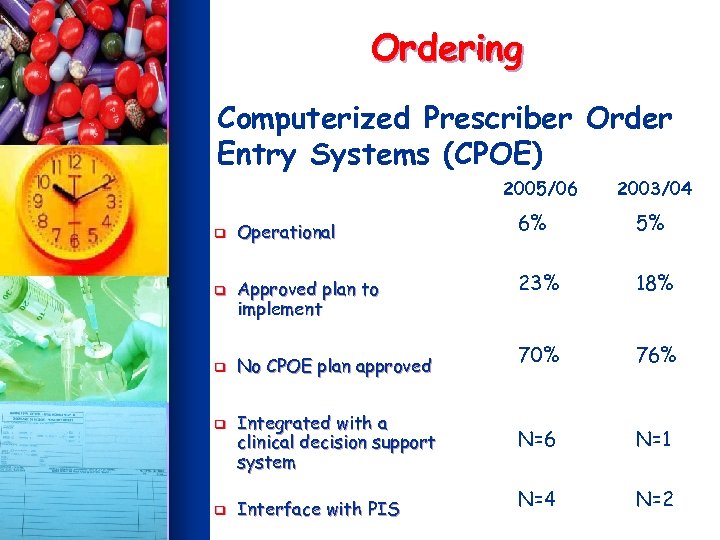 Ordering Computerized Prescriber Order Entry Systems (CPOE) 2005/06 q q q Operational Approved plan to implement No CPOE plan approved Integrated with a clinical decision support system Interface with PIS 2003/04 6% 5% 23% 18% 70% 76% N=6 N=1 N=4 N=2
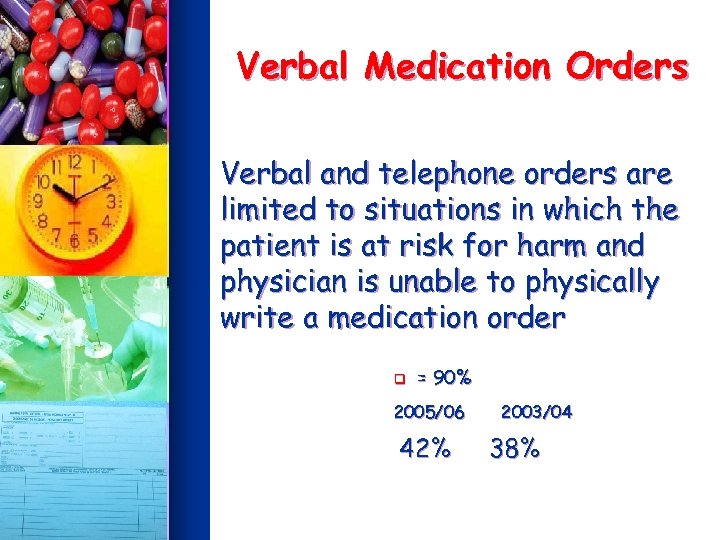 Verbal Medication Orders Verbal and telephone orders are limited to situations in which the patient is at risk for harm and physician is unable to physically write a medication order q = 90% 2005/06 42% 2003/04 38%
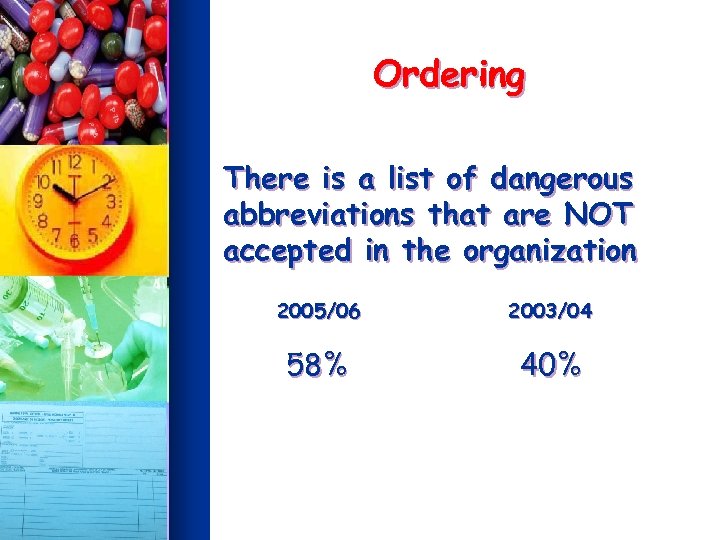 Ordering There is a list of dangerous abbreviations that are NOT accepted in the organization 2005/06 2003/04 58% 40%
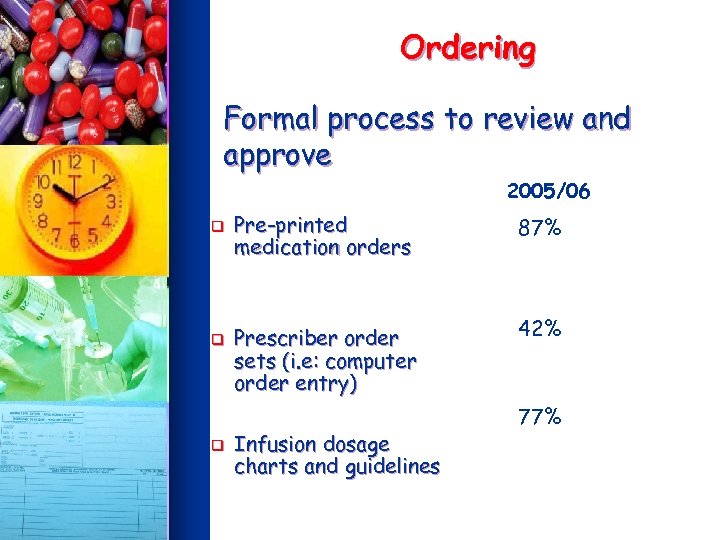 Ordering Formal process to review and approve 2005/06 q q q Pre-printed medication orders 87% Prescriber order sets (i. e: computer order entry) 42% Infusion dosage charts and guidelines 77%
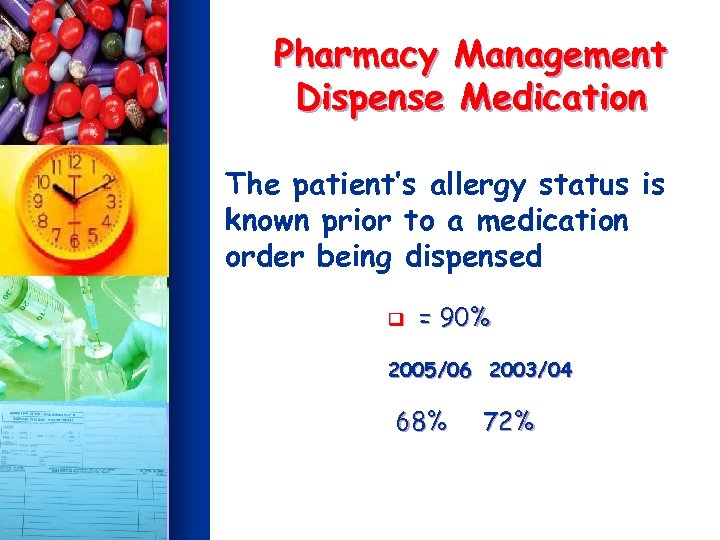 Pharmacy Management Dispense Medication The patient’s allergy status is known prior to a medication order being dispensed q = 90% 2005/06 2003/04 68% 72%
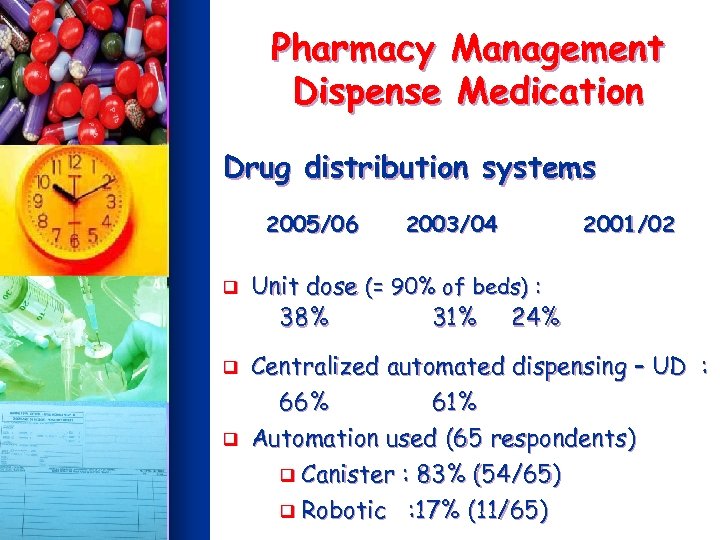 Pharmacy Management Dispense Medication Drug distribution systems 2005/06 q q q 2003/04 2001/02 Unit dose (= 90% of beds) : 38% 31% 24% Centralized automated dispensing – UD : 66% 61% Automation used (65 respondents) q Canister : 83% (54/65) q Robotic : 17% (11/65)
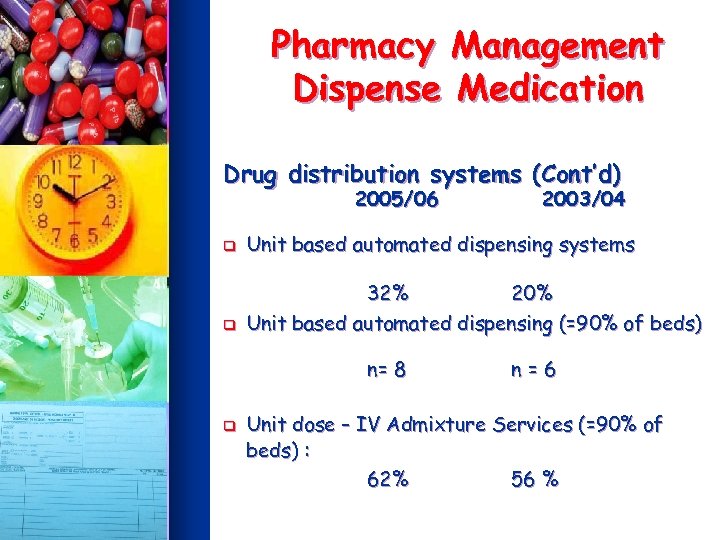 Pharmacy Management Dispense Medication Drug distribution systems (Cont’d) 2005/06 2003/04 q Unit based automated dispensing systems q 32% 20% Unit based automated dispensing (=90% of beds) n= 8 q n=6 Unit dose – IV Admixture Services (=90% of beds) : 62% 56 %
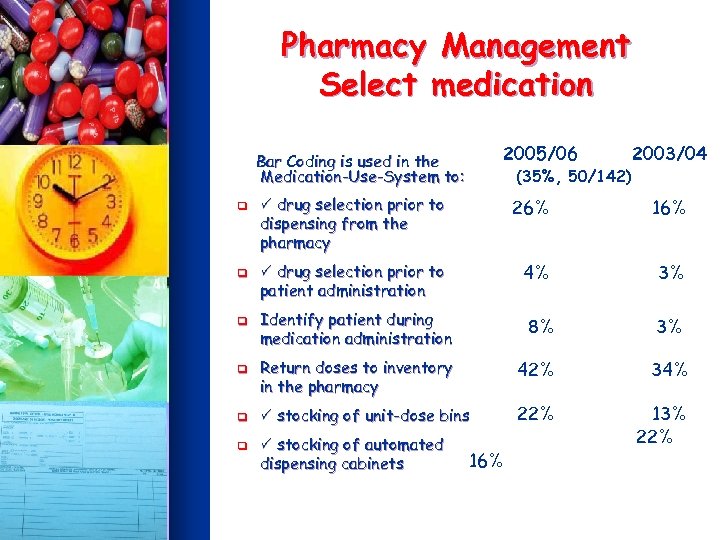 Pharmacy Management Select medication 2005/06 Bar Coding is used in the Medication-Use-System to: q q q (35%, 50/142) 2003/04 drug selection prior to dispensing from the pharmacy 26% 16% drug selection prior to patient administration 4% 3% Identify patient during medication administration 8% 3% Return doses to inventory in the pharmacy 42% 34% stocking of unit-dose bins 22% 13% 22% stocking of automated dispensing cabinets 16%
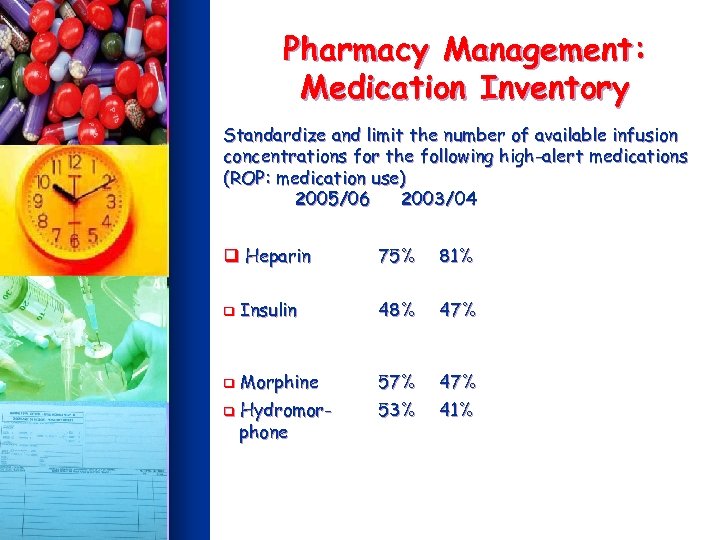 Pharmacy Management: Medication Inventory Standardize and limit the number of available infusion concentrations for the following high-alert medications (ROP: medication use) 2005/06 2003/04 q Heparin 75% 81% q Insulin 48% 47% q Morphine 57% 47% Hydromorphone 53% 41% q
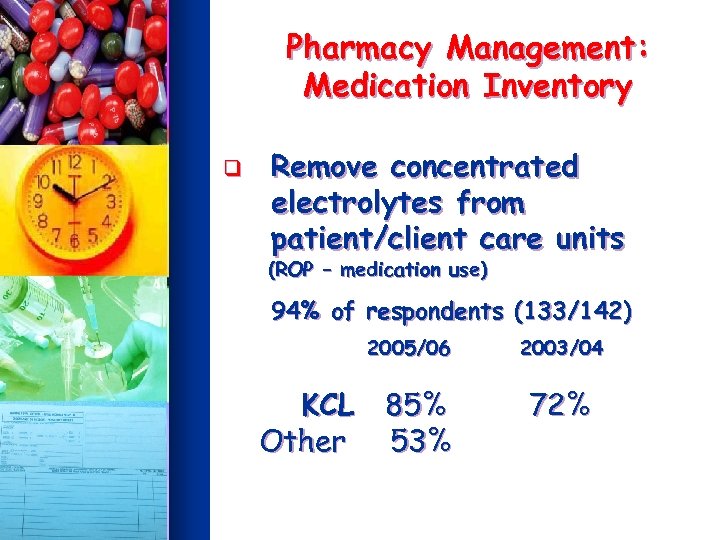 Pharmacy Management: Medication Inventory q Remove concentrated electrolytes from patient/client care units (ROP – medication use) 94% of respondents (133/142) 2005/06 KCL 85% Other 53% 2003/04 72%
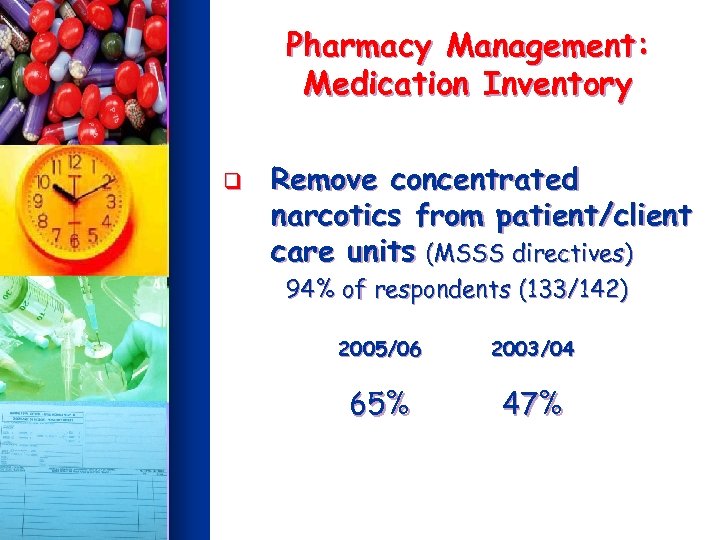 Pharmacy Management: Medication Inventory q Remove concentrated narcotics from patient/client care units (MSSS directives) 94% of respondents (133/142) 2005/06 2003/04 65% 47%
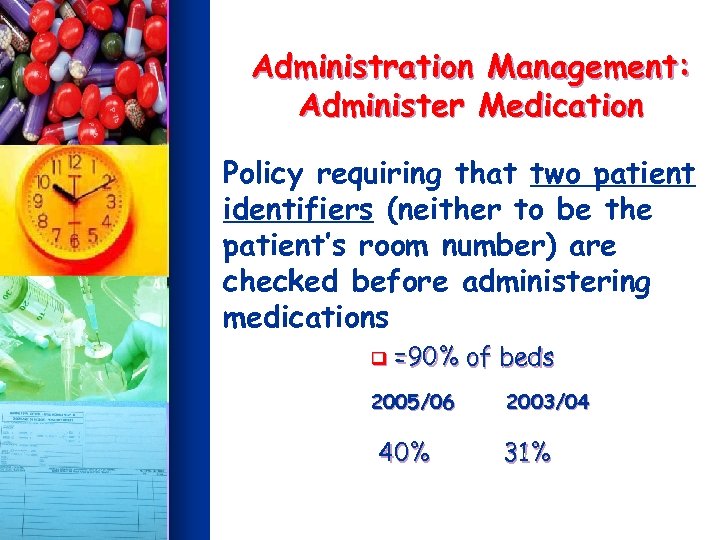 Administration Management: Administer Medication Policy requiring that two patient identifiers (neither to be the patient’s room number) are checked before administering medications q =90% of beds 2005/06 40% 2003/04 31%
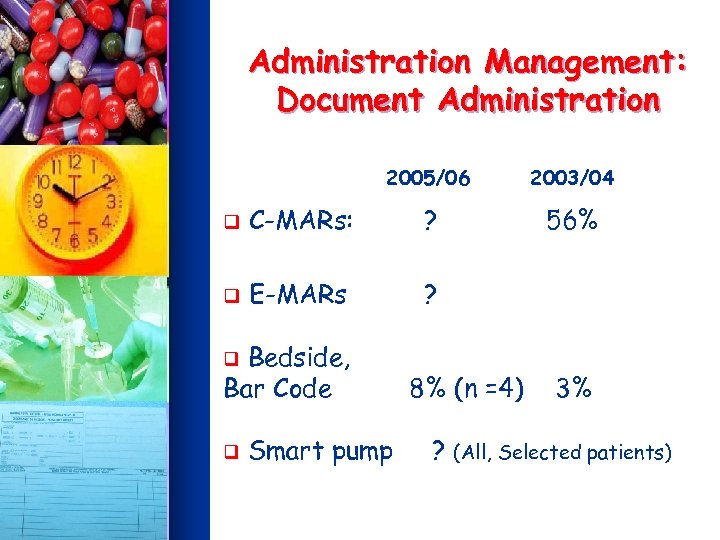 Administration Management: Document Administration 2005/06 2003/04 56% q C-MARs: ? q E-MARs ? Bedside, Bar Code q q Smart pump 8% (n =4) ? 3% (All, Selected patients)
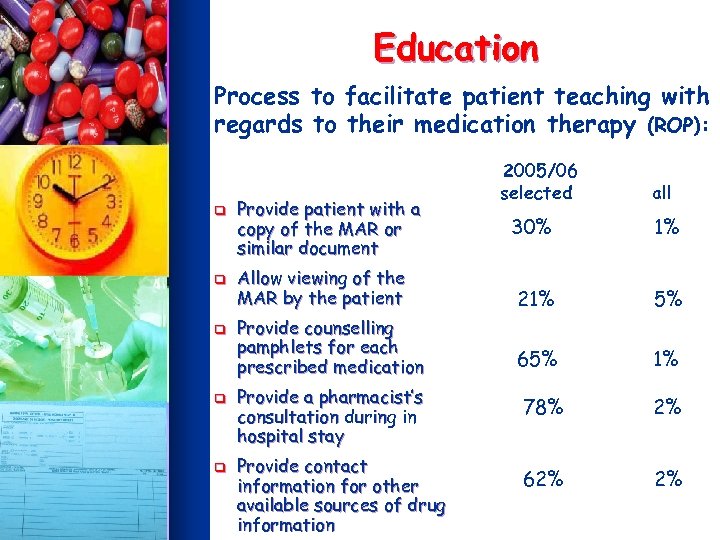 Education Process to facilitate patient teaching with regards to their medication therapy (ROP): q q q Provide patient with a copy of the MAR or similar document 2005/06 selected all 30% 1% Allow viewing of the MAR by the patient 21% 5% Provide counselling pamphlets for each prescribed medication 65% 1% 78% 2% 62% 2% Provide a pharmacist’s consultation during in hospital stay Provide contact information for other available sources of drug information
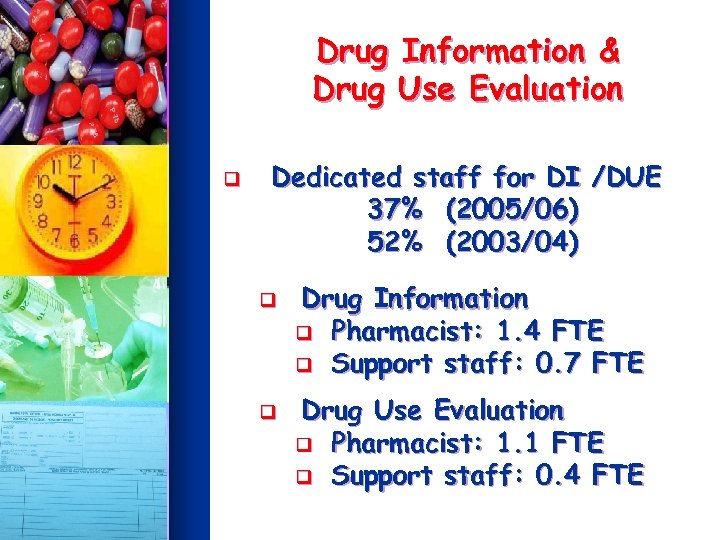 Drug Information & Drug Use Evaluation q Dedicated staff for DI /DUE 37% (2005/06) 52% (2003/04) q q Drug Information q Pharmacist: 1. 4 FTE q Support staff: 0. 7 FTE Drug Use Evaluation q Pharmacist: 1. 1 FTE q Support staff: 0. 4 FTE
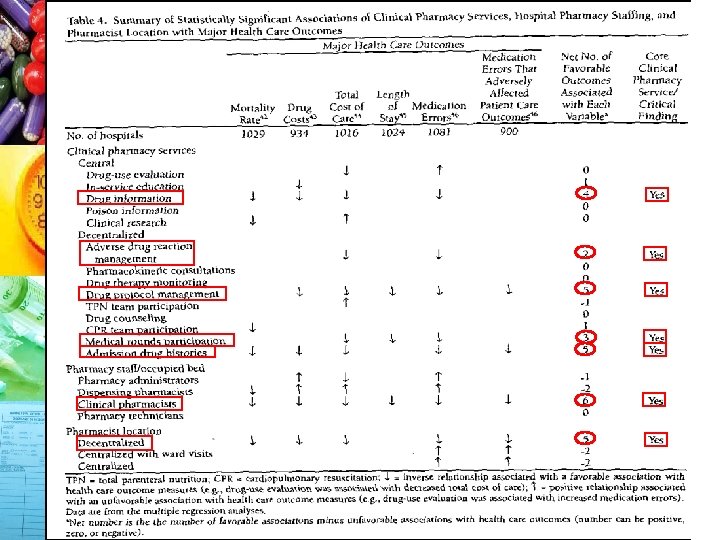
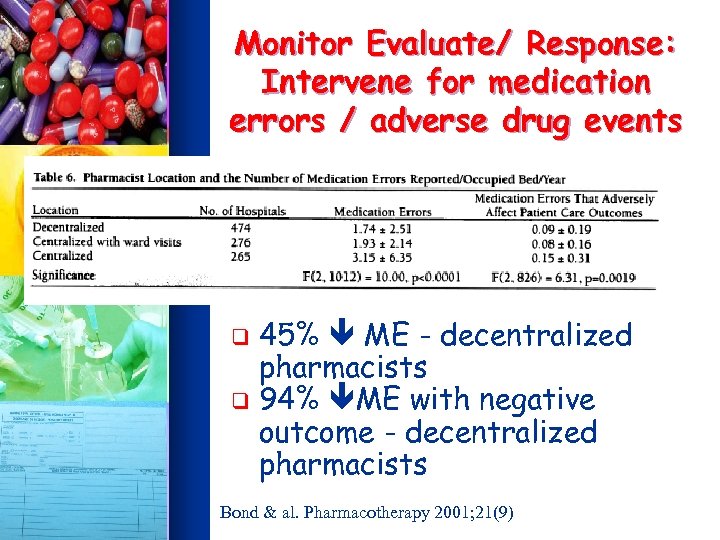 Monitor Evaluate/ Response: Intervene for medication errors / adverse drug events 45% ME - decentralized pharmacists q 94% ME with negative outcome - decentralized pharmacists q Bond & al. Pharmacotherapy 2001; 21(9)
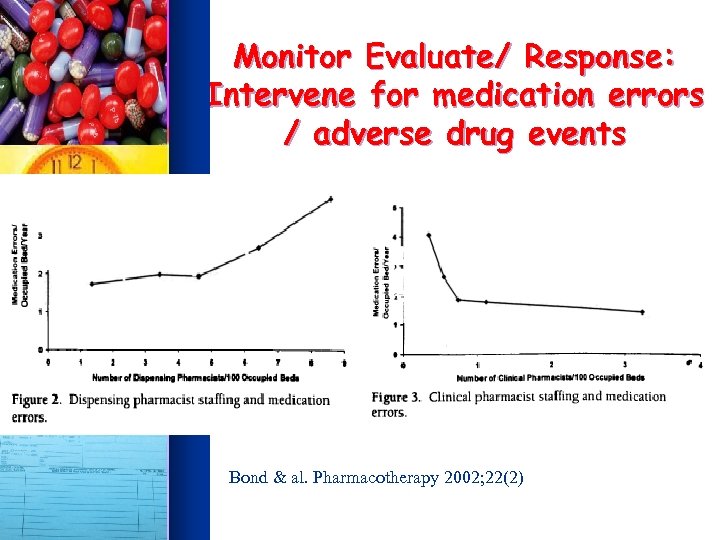 Monitor Evaluate/ Response: Intervene for medication errors / adverse drug events Bond & al. Pharmacotherapy 2002; 22(2)
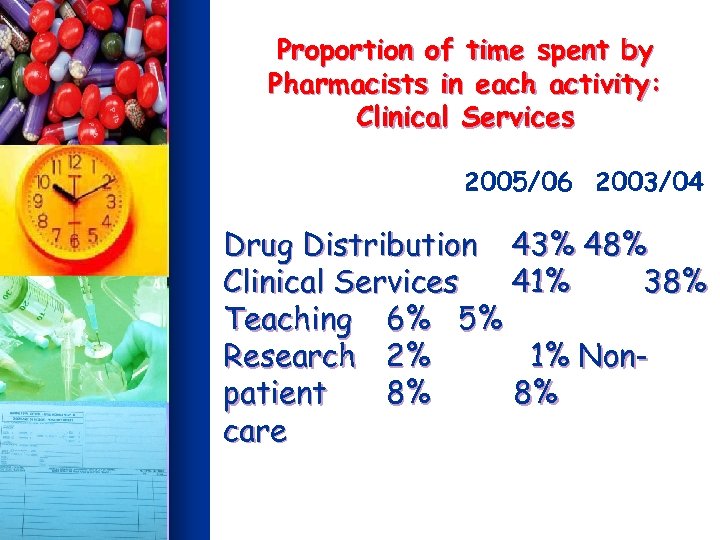 Proportion of time spent by Pharmacists in each activity: Clinical Services 2005/06 2003/04 Drug Distribution 43% 48% Clinical Services 41% 38% Teaching 6% 5% Research 2% 1% Nonpatient 8% 8% care
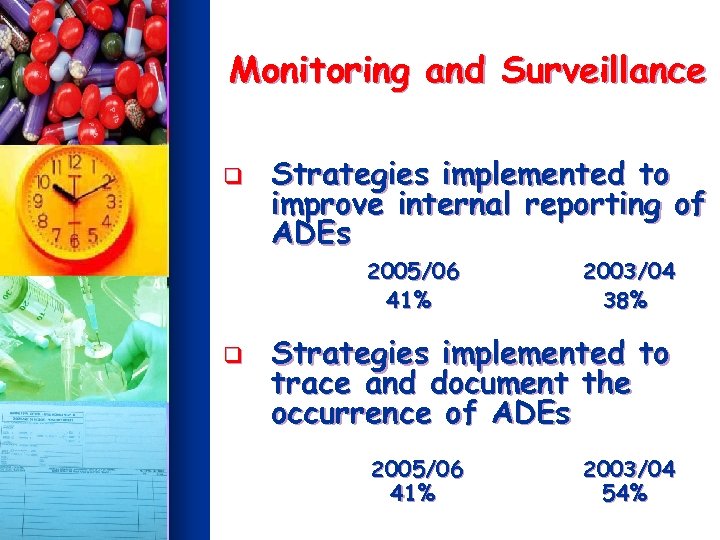 Monitoring and Surveillance q Strategies implemented to improve internal reporting of ADEs 2005/06 41% q 2003/04 38% Strategies implemented to trace and document the occurrence of ADEs 2005/06 41% 2003/04 54%
 Preventing Medication Errors: Quality Chasm Series q q At least 25% of all medicationrelated injuries are preventable HCP should seek to create highreliability organizations that constantly improve the safety and quality of medication use; q q should implement active internal monitoring programs so that progress toward improved medication safety can be accurately demonstrated Establish and maintain a strong provider-patient partnership
 Preventing Medication Errors: Quality Chasm Series (cont’d) Effective Error Prevention Strategies are available, in the hospital setting: q Good evidence for: q the effectiveness of computerized order entry with clinical decisionsupport systems and for clinical decision-support systems themselves; q Pharmacists participation on hospital rounds q Show promise, but their efficay has not yet been clearly demonstrated: q Bar coding q Smart intravenous (IV) pumps
 Internet sites q q q q Preventing Medication Errors: Quality Chasm Series. http: //www. nap. edu/catalog/11623. html Conseil canadien d’agrément des services de santé. Buts du CCASS en matière de sécurité des patients et pratiques organisationnelles requises (POR). www. cchasa-ccass. ca Rapport annuel 200506 sur les pharmacies hospitalières au Canada www. lillyhospitalsurvey. ca. Joint Commission on Accreditation of Healthcare Organizations. 2006 National Patient Safety Goals. www. jcaho. org. The Institute for Safe Medication Practices (ISMP US et ISMP Canada). www. ismp. org et www. ismp-canada. org. Institut canadien pour la sécurité des patients. http: //www. patientsafetyinstitute. ca/accueil. html Kit de départ: bilan comparatif des médicaments http: //soinsplussecuritairesmaintenant. ca
 Internet sites q q Société canadienne des pharmaciens d’hôpitaux. Lignes directrices sur la déclaration des erreurs de médication et la prévention des erreurs/incidents de médication. www. cshp. ca American Society of Health-Systems Pharmacists. ASHP Guidelines on Reporting Medication Errors/ Preventing Medication Errors. www. ashp. org. National Coordinating Council on Medication Error Reporting and Prevention (NCC MERP). www. nccmerp. org. United States Pharmacopeia. Summary of the information submitted to MEDMARX a national database for hospital medication error reporting. www. usp. org