 Скачать презентацию Medication Administration By Diana Blum MSN NURS 1510
bc51f33250b9747443b3521c3f09d12e.ppt
- Количество слайдов: 36



Medication Administration By: Diana Blum MSN NURS 1510
History • Definition: Substance administered for diagnosis, cure, treatment, or relief of a symptom or for prevention of disease. • Opium, castor oil, vinegar used in ancient times
Names • Generic – Given before drug officially approved • Official – Name under which it is listed in publications • Brand/TRADE – Given my manufacturer – Several names if several manufacturers • Chemical – Name by which the chemists know it
Legal Aspects • U. S. drug legislation • Sets official drug standards • Defines prescription drugs • Regulates controlled substances • Improves safety • Requires proof of efficacy • Nurse Practice Acts • Identify nursing responsibilities for administration and client monitoring
Standards • • Vary in strengths and activities Controlled by law NURSES can be punished if error made Controlled substances locked up in hospital
Effects of Drugs • Therapeutic/Desired: what is intended or reason it was prescribed • SE: secondary effect: effect that is not intended – May be harmful or harmless • Adverse Effects: more serious side effects or a reaction to the drug • Drug toxicity: related to overdose, ingestion when meant to be external in use, or build up in blood. • Allergic Reaction: immune response to drug • Anaphylactic Reaction: severe allergy to drug that could become fatal
Tolerance • Person requires increase dose to maintain effectiveness (opiates, tobacco, etc) • Cumulative effect: increased response to repeated doses. Toxic symptoms may occur. • Idiosyncratic effect: unexpected result. Under response or over response • Interaction: response to 2 drugs at once
Drug Misuse • Improper use of common meds • Abuse: inappropriate intake of drug • Dependence: reliance of a drug may be physiologic or psychologic • Habituation: feels better after taking drug • Illicit: street drug
Actions of Drugs on the Body • Half life: the time it takes for half of the drug to be excreted from the body • If you don’t receive steady amount of the drug it concentration decreases. • Onset of action: time it takes for the body to respond to drug • Peak plasma level: the highest level achieved by a single dose • Plateau: maintained level during a series of scheduled doses • Agonist acts to respond to a substance • Antagonist acts to inhibit a response to a substance
Pharmacokinetics • Process by which drug is excreted absorbed distributed or biotransformed. • Absorption: process of passing in the blood stream • Distribution: transportation from site of absorption to site of action. • Biotransformation: process that converts the drug to a less active form by way of a detox or metabolism • Excretion: leaves the body

Factors that affect med action • • Developmental factors Gender Genetics/culture Diet Environment Psychologic Illness/disease Time of administration
Medication Systems Stock Supply: Unit Dose: • Bulk quantity • Central location • Not client-specific • Individually packaged • Client-specific drawers • 24 -hour supply
Medication Systems Automated Dispenser: • Password-accessible locked cart • Computerized tracking • Can combine stock and unit doses Self-Administration: • Individual containers • Kept at client’s bedside
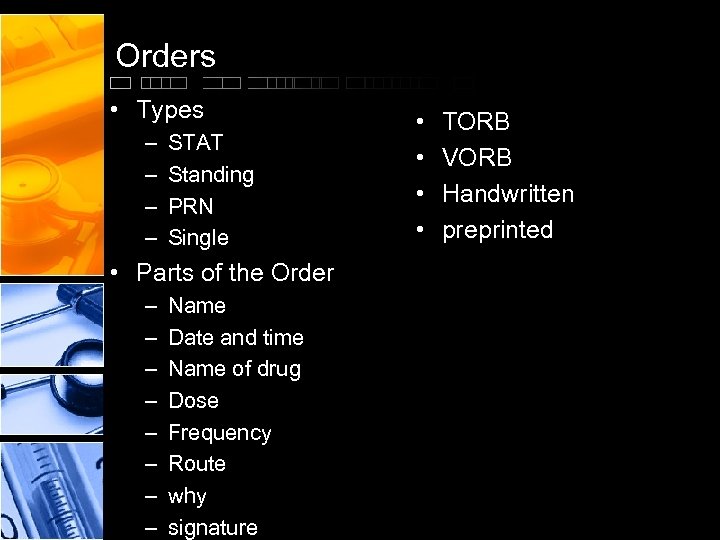
Orders • Types – – STAT Standing PRN Single • Parts of the Order – – – – Name Date and time Name of drug Dose Frequency Route why signature • • TORB VORB Handwritten preprinted
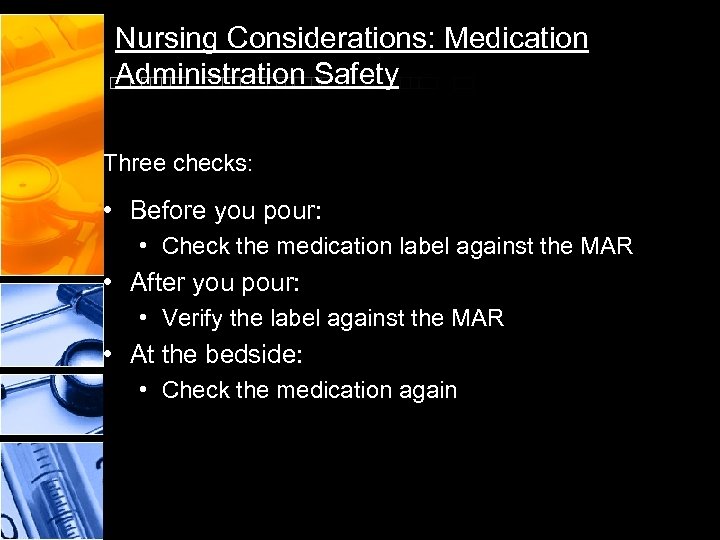
Nursing Considerations: Medication Administration Safety Three checks: • Before you pour: • Check the medication label against the MAR • After you pour: • Verify the label against the MAR • At the bedside: • Check the medication again
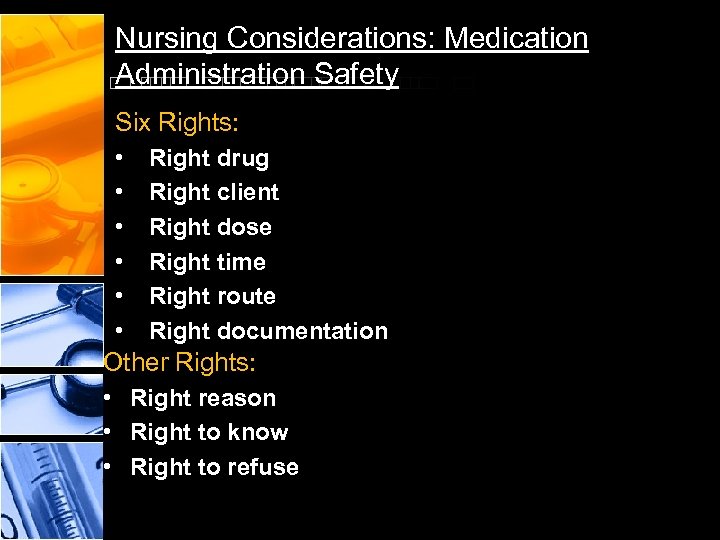
Nursing Considerations: Medication Administration Safety Six Rights: • • • Right drug Right client Right dose Right time Right route Right documentation Other Rights: • Right reason • Right to know • Right to refuse
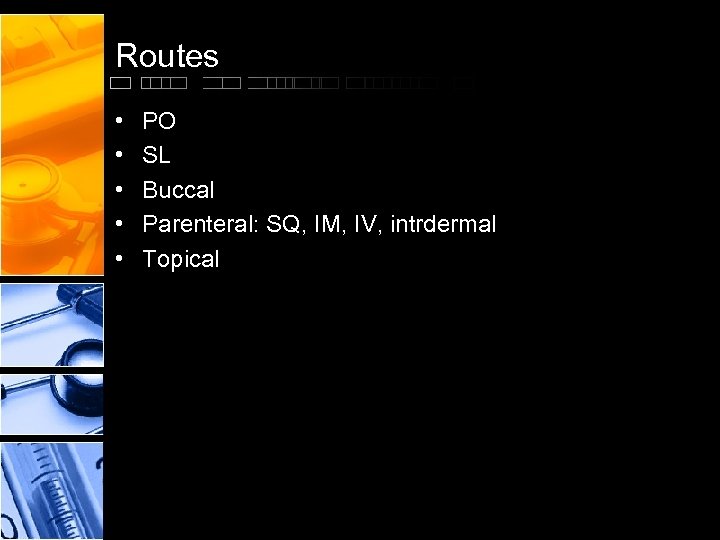
Routes • • • PO SL Buccal Parenteral: SQ, IM, IV, intrdermal Topical
Parenteral Medication Administration Equipment Preparation: • Syringe/needle (size, gauge) Medication Preparation: • Vials and ampules • Reconstituting from powder • Two medications in one syringe • Never recap dirty needle • Use the correct site • Wrong site could mean wrong route • Be familiar with the technique required for the medication (e. g. , heparin, insulin)
Avoiding Medication Errors • Use the six rights • Calculate doses carefully; double-check with a second RN • Watch for drugs with similar names • Watch for clients with same last names • Clarify illegible orders • Know and use your resources • Keep up with changes in medication orders
• Conversions
Systems of measurement Metric Ordered by units of 10 Decimal system Liter and gram are basic units kilogram milligram microgram milliliter
Apothecaries • • • Older than metric Grain Minum Pound Pints quarts
Household • • • Drops Teaspoons Tablespoons Cups Glasses
Equivalents of Measurements Metric: decimal system, most logically organized. Each unit is organized into units of 10. In X the decimal moves to the “R”; in division it moves “L” Basic measurement=meter(L), liter(volume), gram(weight)
• Basic units: – Deci 1/10 or 0. 1 – Centi 1/100 or 0. 01 – Milli 1/1000 or 0. 001 • 500 mg or 0. 5 g, not 1/2 g • 10 ml or 0. 01 L, not 1/100 L – With fractions the zero is always place in front of the decimal to prevent error
Conversion in One System • In metric system, division or multiplication are used, ie, to change mg to g. divide by 1000 or move the decimal 3 points to the left • To convert liters to ml, multiply by 1000 or move the decimal 3 points to the right
• To convert units of measurement within the apothecary or household system, must know the equivalent. • Example: To convert ounces to quarts must know 32 oz is = to 1 quart • To convert 8 oz to a quart measurement, divide 8 by 32 to get the equivalent, ¼ or 0. 25 quart
Setting Up the Calculations • When looking at a medication order, ask yourself 3 questions: What did the MD order? (desired quantity) What do I have on hand? (dose available) What conversion factor (conversion do I need? factor)
• The desired quantity is the MD order, (10 mg, v gr) • The dose available is found on the drug label, (tablet, number of capsules, ml) • *Remember, the quantity of tablets, capsules, or ml is always the numerator of the dose available; the amount (or dosage) is in the denominator
• To decide which equivalent measure should be in the numerator and which should be in the denominator, look at the units of measure in the desired quantity. • The units of measure in the desired quantity should be in the denominator of the conversion factor (i. e. , if the desired quantity is 100 mg and the equivalent conversion factor is 1000 mg = 1 g, then the conversion factor in fraction form should be 1 g / 1000 mg
Formula Desired quantity x Dose available X Conversion (if factor needed) = Amount to Administer This is a simple formula that uses ratio and proportions which will help you both correctly set up and solve dosage calculation problems
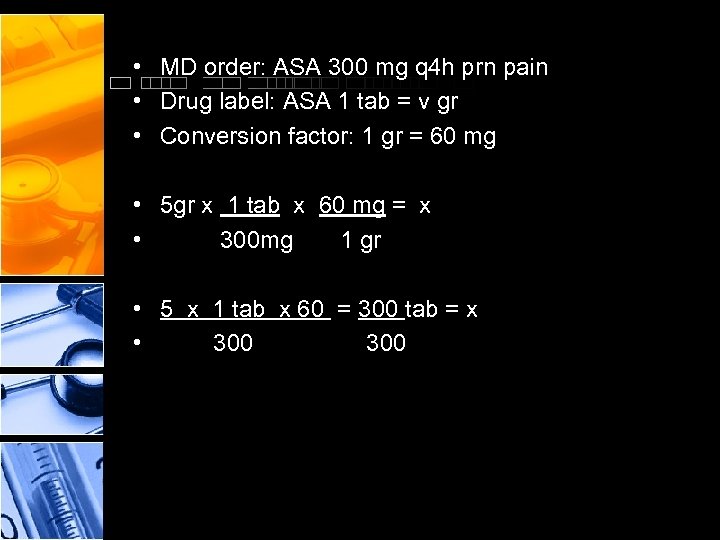
• MD order: ASA 300 mg q 4 h prn pain • Drug label: ASA 1 tab = v gr • Conversion factor: 1 gr = 60 mg • 5 gr x 1 tab x 60 mg = x • 300 mg 1 gr • 5 x 1 tab x 60 = 300 tab = x • 300
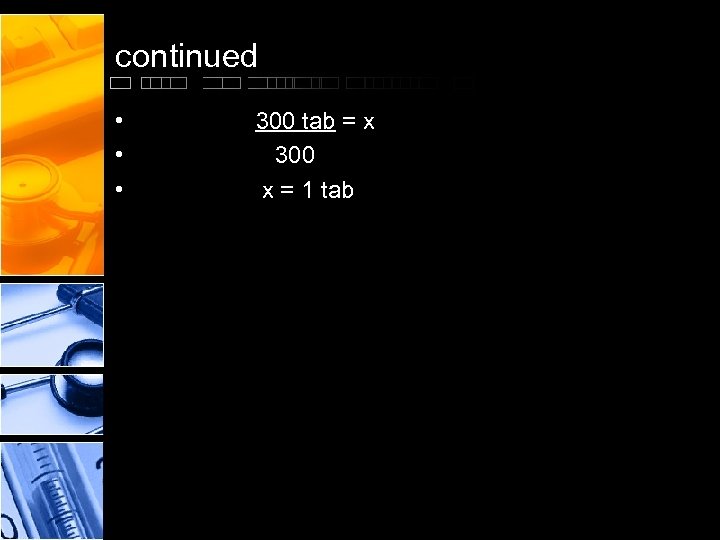
continued • • • 300 tab = x 300 x = 1 tab
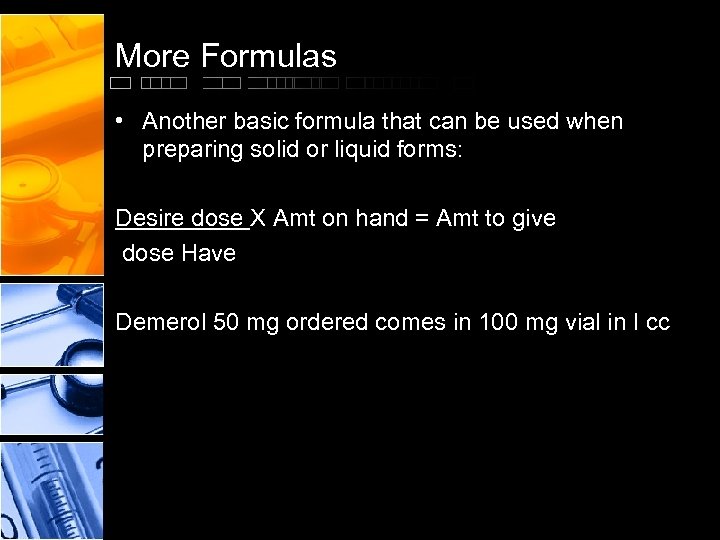
More Formulas • Another basic formula that can be used when preparing solid or liquid forms: Desire dose X Amt on hand = Amt to give dose Have Demerol 50 mg ordered comes in 100 mg vial in I cc
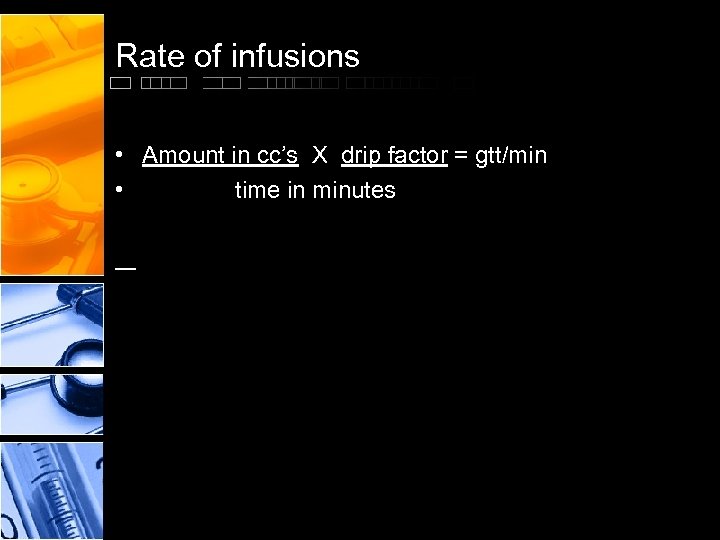
Rate of infusions • Amount in cc’s X drip factor = gtt/min • time in minutes
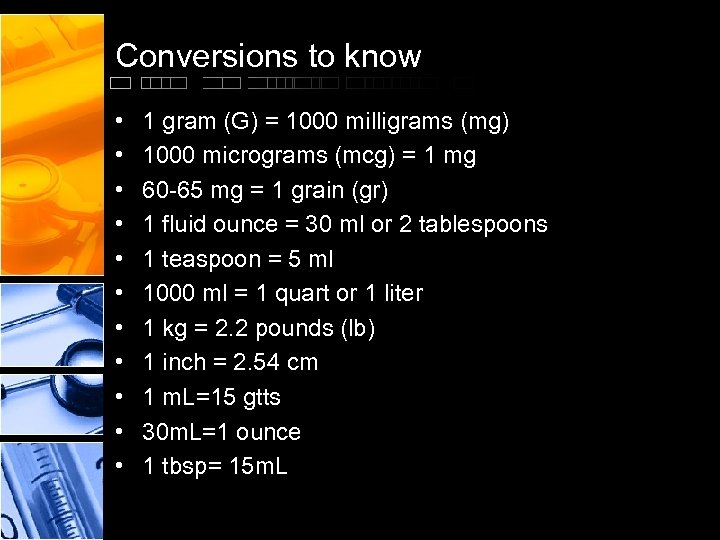
Conversions to know • • • 1 gram (G) = 1000 milligrams (mg) 1000 micrograms (mcg) = 1 mg 60 -65 mg = 1 grain (gr) 1 fluid ounce = 30 ml or 2 tablespoons 1 teaspoon = 5 ml 1000 ml = 1 quart or 1 liter 1 kg = 2. 2 pounds (lb) 1 inch = 2. 54 cm 1 m. L=15 gtts 30 m. L=1 ounce 1 tbsp= 15 m. L
Скачать презентацию Medication Administration By Diana Blum MSN NURS 1510
bc51f33250b9747443b3521c3f09d12e.ppt