 Скачать презентацию MEDICAL TERMINATION OF PREGNANCY INDUCTION OF ABORTION
e1bfdb121ea8a8c256af1b7c2d3b4bcf.ppt
- Количество слайдов: 45



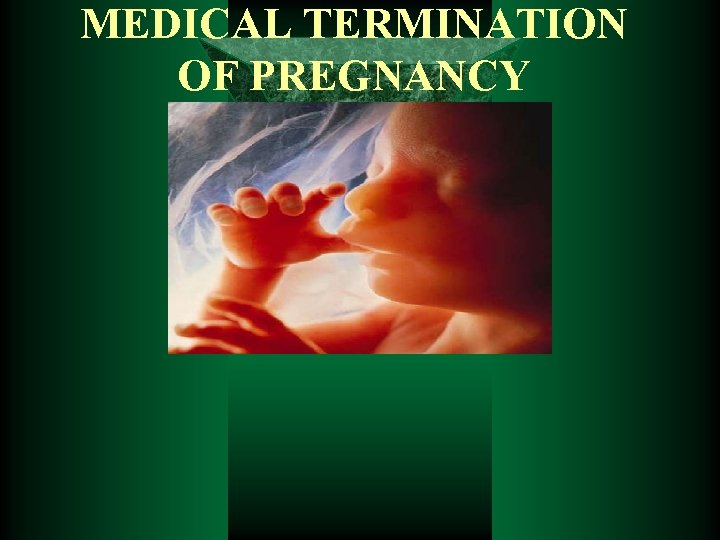
MEDICAL TERMINATION OF PREGNANCY
INDUCTION OF ABORTION Deliberate termination of pregnancy before the viability of the fetus is called induction of abortion.
PROVISIONS OF THE MTP ACT 1. The continuation of pregnancy would involve serious risk of life or grave injury to the physical and mental health of the pregnant women. 2. There is a substantial risk of the child being born with serious physical and mental abnormalities so as to be handicapped in life.
3. When pregnancy is caused by rape, both in case of major and minor girl and in mentally imbalanced women. 4. Pregnancy caused as a result of failure of contraceptive.
INDICATIONS FOR TERMINATION UNDER THE MPT ACT 1. To save the life of the mother. 2. Social Indications. 3. Eugenic.
RECOMMENDATION 1. Registered medical practitioner is qualified to perform an MTP provided: – One has assisted in at least 25 MTP cases in an authorized centre and having a certificate. – One has got six months house surgeon training in obstetrics and gynecology. – One has got diploma or degree in obstetrics and gynecology.
2. Termination can only be performed in hospitals, established or maintained by the government or places approved by the government. 3. Pregnancy can only be terminated on the written consent of the woman. Husband’s consent is not required. 4. Pregnancy in a minor girl (below the age of 18 years) or lunatic cannot be terminated without written consent of the parent or legal guardians.
5. Termination is permitted up to 20 weeks of pregnancy. When the pregnancy exceeds 12 weeks, opinion of two medical practitioner is required. 6. The abortion has to be performed confidentially and to be reported to the director of health services of the state in prescribed form.
METHODS OF TERMINATION FIRST TRIMESTER (UPTO 12 WEEKS) 1. Menstruation regulation (M. R) 2. Suction evacuation and / or curettage 3. Dilatation and evacuation: i. ii. 4. 5. 6. Rapid method Slow method Prostaglandins Mifepristone Methotrexate
FIRST TRIMESTER TERMINATION 1. MENSTRUAL REGULATION Definition: Menstrual regulation is the aspiration of the endometrial cavity within 14 days of the missed period in a previously normal cycle when the presence of an early pregnancy cannot be diagnosed accurately.
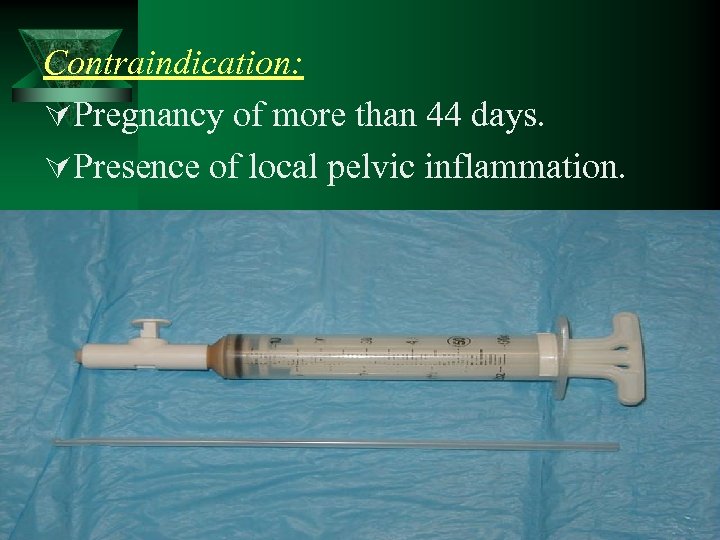
Contraindication: ÚPregnancy of more than 44 days. ÚPresence of local pelvic inflammation.
![2. SUCTION EVACUATION [SYN: VACCUM ASPIRATION OR CURETAGE] Definition: It is a procedure in](https://present5.com/presentation/e1bfdb121ea8a8c256af1b7c2d3b4bcf/image-12.jpg "2. SUCTION EVACUATION [SYN: VACCUM ASPIRATION OR CURETAGE] Definition: It is a procedure in")
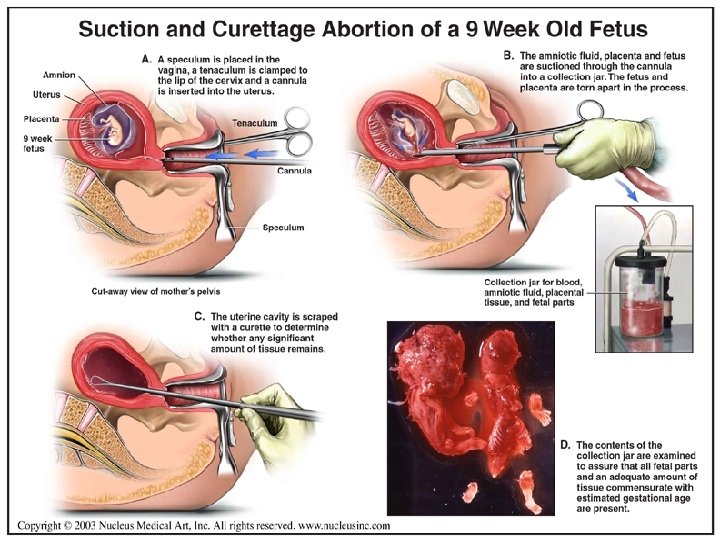
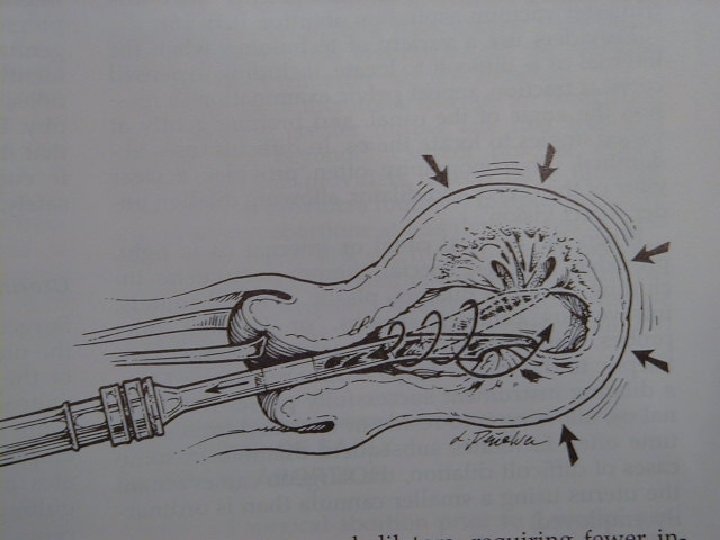
2. SUCTION EVACUATION [SYN: VACCUM ASPIRATION OR CURETAGE] Definition: It is a procedure in which the products of conception are sucked out from the uterus with the help of cannula fitted to a suction apparatus.
Indications: 1. Medical termination of pregnancy during first trimester (commonest). 2. Inevitable abortion. 3. Recent incomplete abortion. 4. Hydatidiform mole.
Complications: Immediate → 1. Excessive hemorrhage 2. Injury 3. Shock 4. Increased morbidity Late → • Pelvic inflammation • Infertility • Cervical incompetence • Uterine synechiae
Advantages: 1. It is done as an outdoor procedure. 2. Hazards of general anesthesia are absent. 3. Ideal for termination for therapeutic indications. 4. Blood loss is minimal. 5. Chance of uterine perforation is much less specially with the plastic cannula.
Drawbacks: 1. Not suitable if uterus size is more than 10 weeks. 2. Requires electricity to operate and the machine is coastly.
3. DILATATION AND EVACUATION Definition: D & E operation consists of dilatation of the cervix and evacuation of the products of conception from the uterine cavity. The operation may be performed as : ÚOne stage operation ÚTwo stage operation
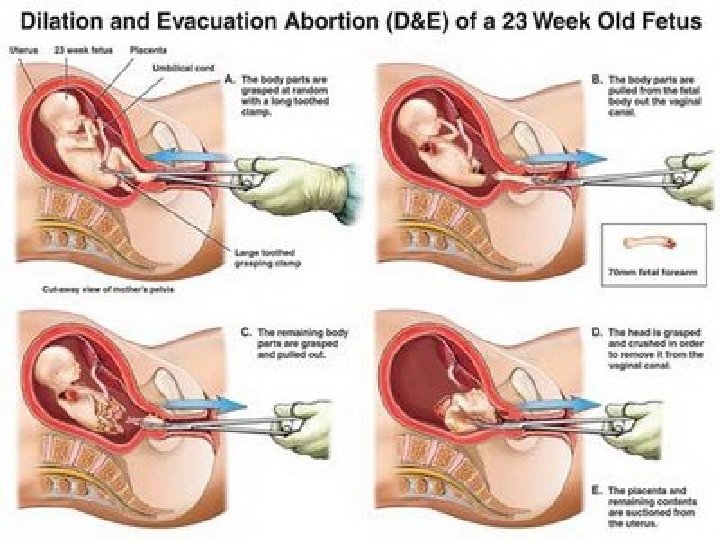
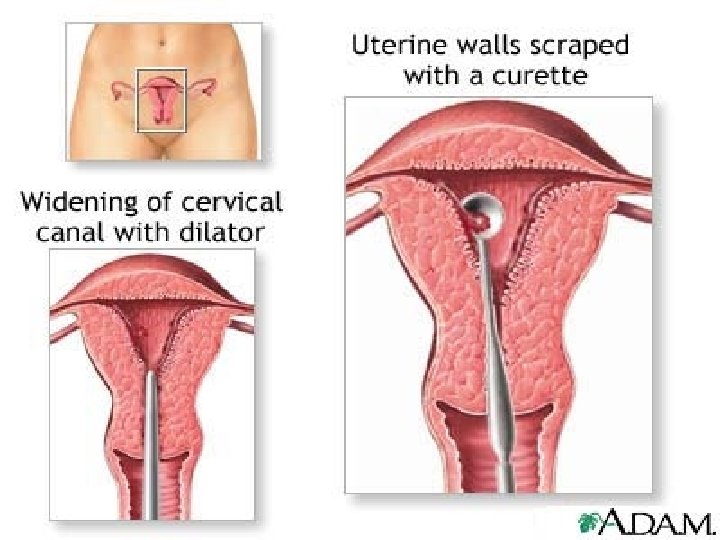
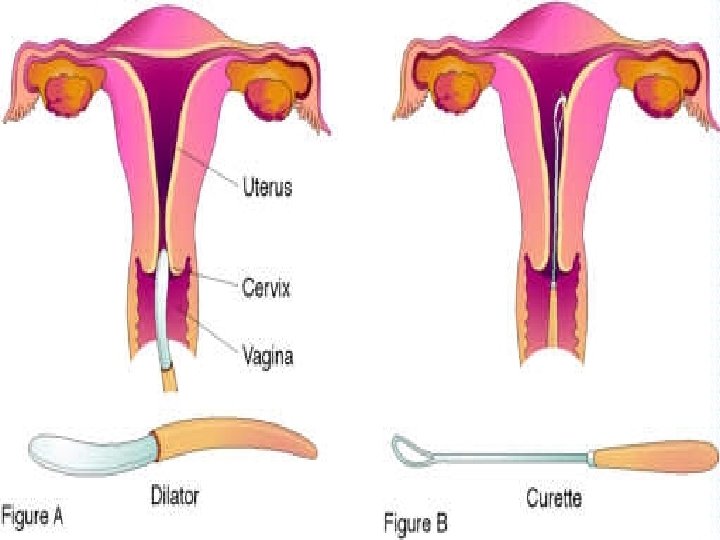
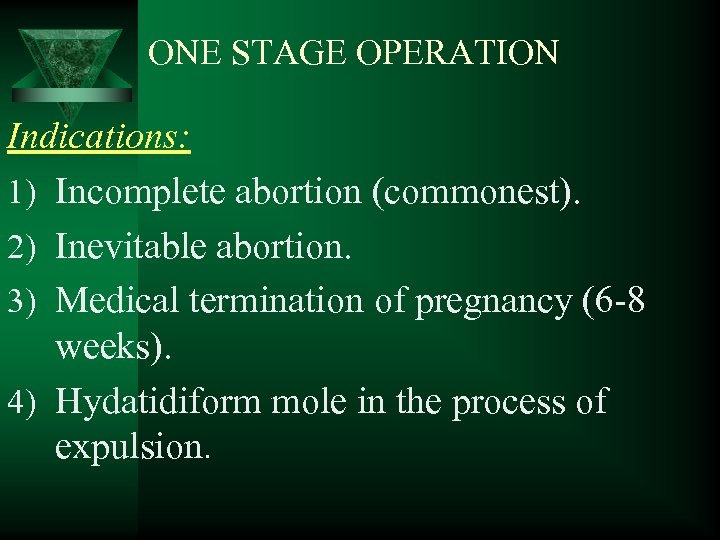
ONE STAGE OPERATION Indications: 1) Incomplete abortion (commonest). 2) Inevitable abortion. 3) Medical termination of pregnancy (6 -8 weeks). 4) Hydatidiform mole in the process of expulsion.
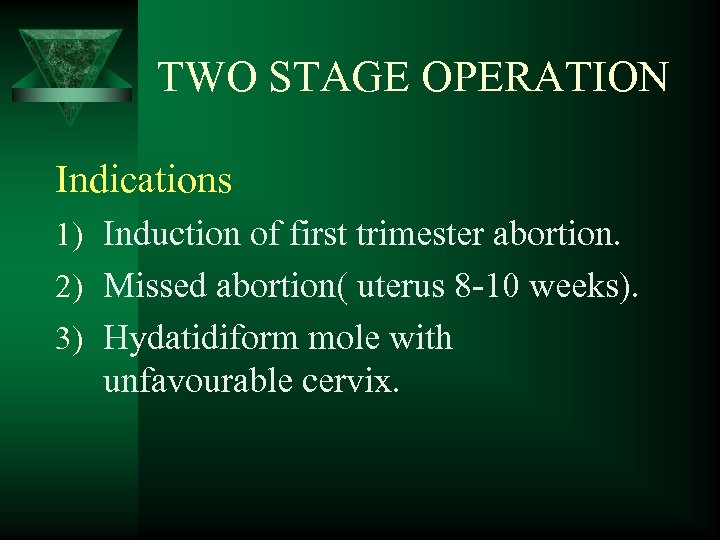
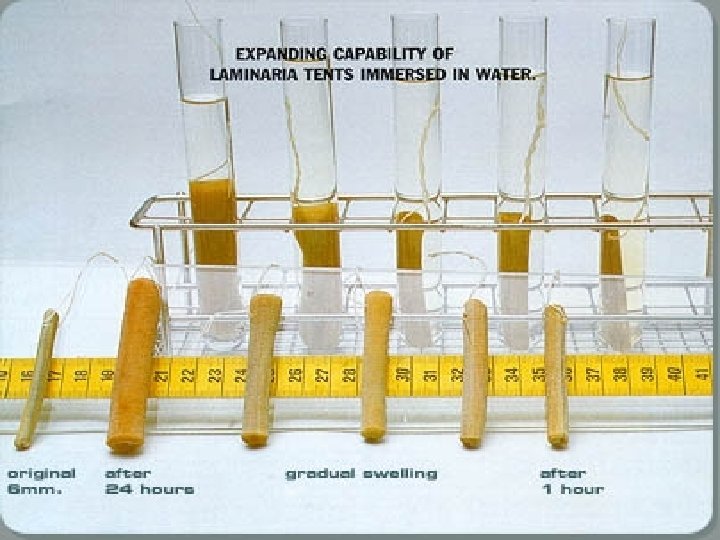
TWO STAGE OPERATION Indications 1) Induction of first trimester abortion. 2) Missed abortion( uterus 8 -10 weeks). 3) Hydatidiform mole with unfavourable cervix.
DANGERS OF D+E OPERATIONS Immediate: 1. Excessive hemorrhage 2. Injury 3. Shock 4. Increased morbidity Late: 1. Pelvic inflammation 2. Infertility 3. Cervical incompetence 4. Uterine synechiae
ADVANTAGES Rapid method → 1. It can be done as out door procedure. 2. Chance of sepsis is minimal. Slow method → 1. Chance of cervical injury is minimal. 2. Suitable in cases of therapeutic indications.
DRAW BACK Rapid method→ 1. Chance of cervical injury is more. 2. Uterus should not be more than 6 -8 weeks of pregnancy. 3. All draw backs of D+E. Slow method→ 1. Hospitalization required. 2. Chance of introducing sepsis is more. 3. All the complications of D+E.

SECOND TRIMESTER (13 -20 WEEKS) 1. Intra uterine instillation of hypertonic solutions. a) Intra – amniotic – 20% saline, 40% urea, mannitol. b) Extra – amniotic – Ethacrydine lactate. 2. Prostaglandins 3. Oxytocin infusion 4. Hysterotomy
MID TIMESTER TERMINATION ÚBetween 13 -15 weeks It is difficult to terminate ÚBetween 16 -20 weeks Intra – uterine instillation of hypertonic solution. – Intra – amniotic. – Extra – amniotic.
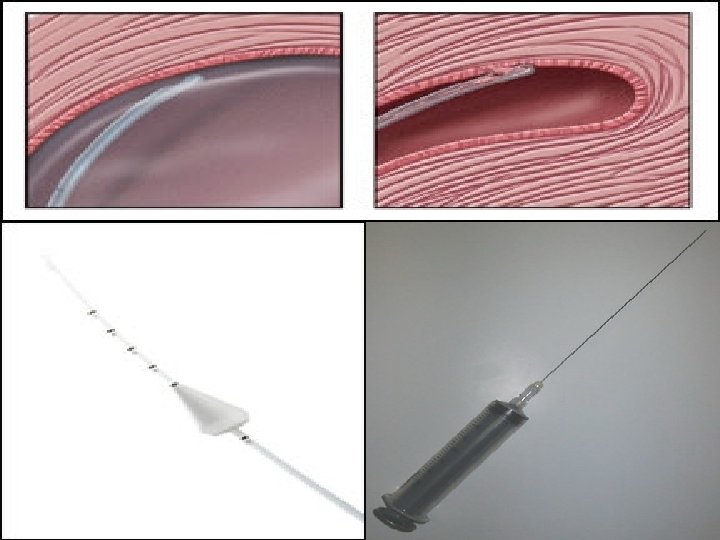
INTRA-AMNIOTIC Contraindication: ÚCardiovascular lesion ÚRenal lesion ÚSevere anemia
Complications: 1. Retained products of conception. 2. Infection. 3. Hypernatremia. 4. Cervical tear and laceration. 5. Minor complications like headache, fever, nausea & vomiting. 6. DIC. 7. Occasionally deaths
EXTRA – AMNIOTIC INSTILLATION OF 0. 1% ETHACRYDINE LACTATE Used where saline is contraindicate OXYTOCIN It is administered by intra venous drip method It is used to augment abortion HYSTEROTOMY Performed through abdominal route
Indications: v Termination of pregnancy on therapeutic grounds v Failure of medical induction in second trimester Hazards: Immediate 1. haemorrhage and shock 2. anaesthetic complications 3. peritonitis 4. intestinal obstruction
Remote 1. Menstrual abnormalities. 2. Scar endometriosis. 3. Incisional hernia. 4. Scar rupture.
4. PROSTAGLANDINS use in obstetrics: ÚInduction of abortion (MTP and missed abortion). ÚTermination of molar pregnancy. ÚInduction of labour. ÚCervical ripening prior to induction of abortion or labour. ÚAcceleration of labour. ÚManagement of atonic post partum hemorrhage. ÚMedical management of tabal ecotopic pregnancy.
Contraindications: Absolute → ÚHypersensitivity of the compound ÚAsthma ÚAcute PID Relative → ÚHypertension ÚCardiovascular disease ÚRenal disease ÚPeptic ulcer ÚJaundice ÚUterine scar
Draw backs: ÚIt is costly and is not available widely. ÚUnpleasant side effects. ÚCervical laceration. ÚThe hyperactivity of the uterus, if occurs continue for a variable period even after discontinuation of its administration.
Advantages: ÚIt has got a powerful oxytocic effect. ÚIn later months, where the pre induction score is low or in intra uterine death, it is more effective than oxytocin. ÚIt has got no antidiuretic effect.
COMPLICATIONS OF MTP Immediate→ 1. Trauma to the cervix and uterus. 2. Hemorrhage and shock. 3. Thrombosis or embolism. Remote → • Menstrual disturbances • Chronic PID • Infertility due to cornual block • Scar endometriosis • Uterine synechae
Obstetrical complications include 1. Recurrent mid trimester abortion due to 2. 3. 4. 5. 6. cervical incompetence Ectopic pregnancy Dysmaturity Increased perinatal loss Rupture of uterus Rh iso-immunisation
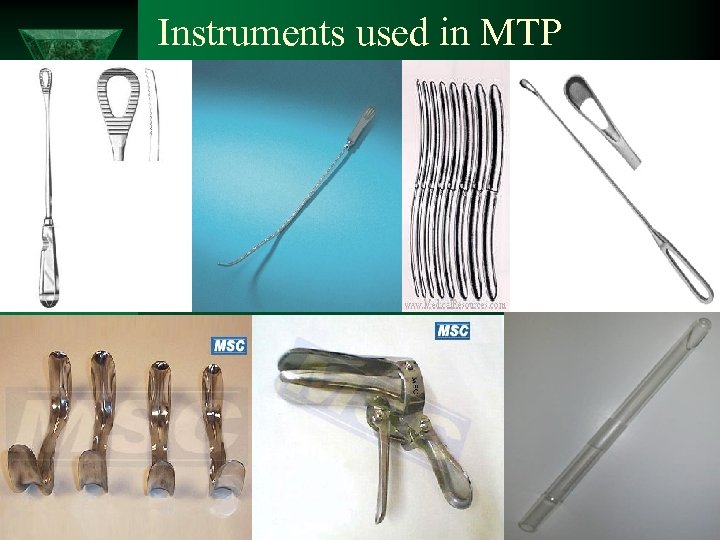
Instruments used in MTP
 Скачать презентацию MEDICAL TERMINATION OF PREGNANCY INDUCTION OF ABORTION
e1bfdb121ea8a8c256af1b7c2d3b4bcf.ppt