


 Скачать презентацию Medical Peace Work Online Course 1 Health professionals
99d66b25b1b3c3ed276496359d0428c9.ppt
- Количество слайдов: 38
 Medical Peace Work Online Course 1 Health professionals, conflicts and peace
 An introduction to Medical Peace Work Chapter 1: Peace and conflict theory Chapter 2: Medical Peace Work - a response to violent conflict Chapter 3: Peace skills for health workers
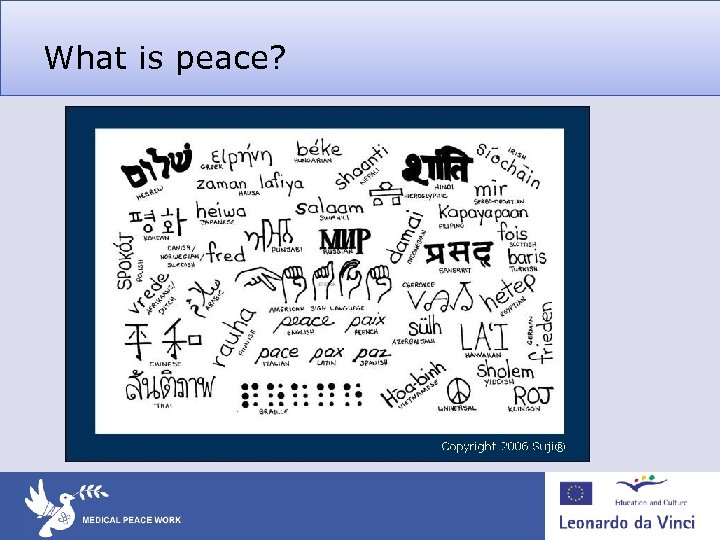 What is peace?
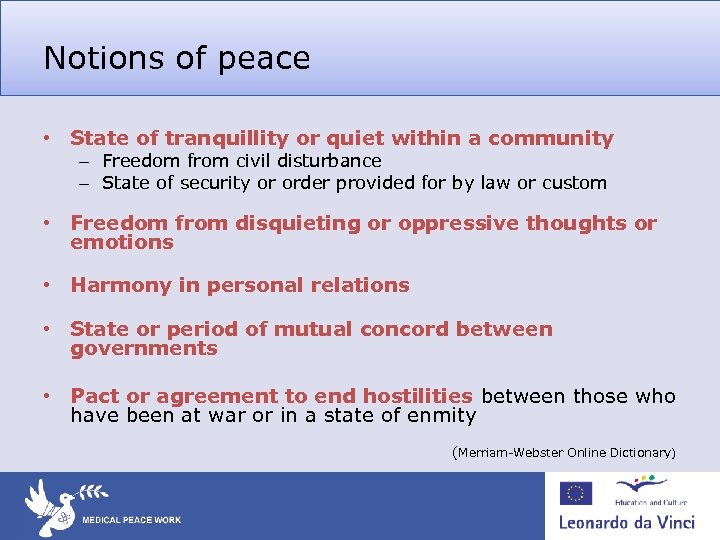 Notions of peace • State of tranquillity or quiet within a community – Freedom from civil disturbance – State of security or order provided for by law or custom • Freedom from disquieting or oppressive thoughts or emotions • Harmony in personal relations • State or period of mutual concord between governments • Pact or agreement to end hostilities between those who have been at war or in a state of enmity (Merriam-Webster Online Dictionary)
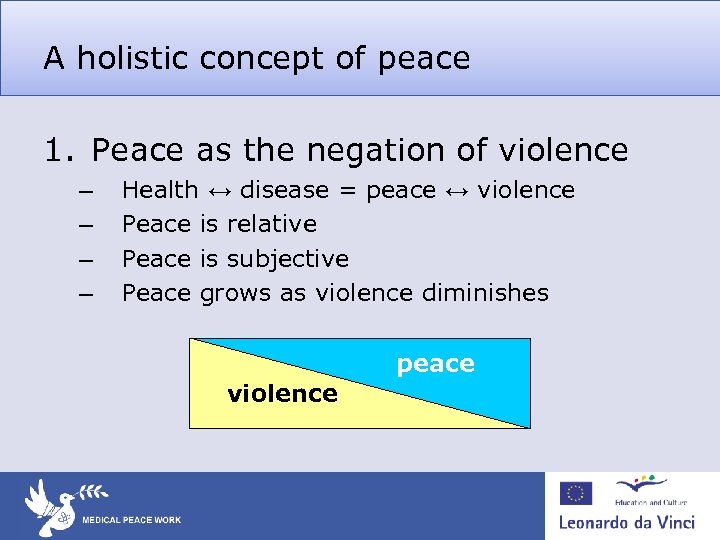 A holistic concept of peace 1. Peace as the negation of violence – – Health ↔ disease = peace ↔ violence Peace is relative Peace is subjective Peace grows as violence diminishes peace fred violence
 What is violence? Definition by World Health Organization: Violence is the intentional use of physical force or power, threatened or actual, against oneself, another person, or against a group or community, that either results in or has a high likelihood of resulting in injury, death, psychological harm, mal-development or deprivation. (WHO, 2002: 5)
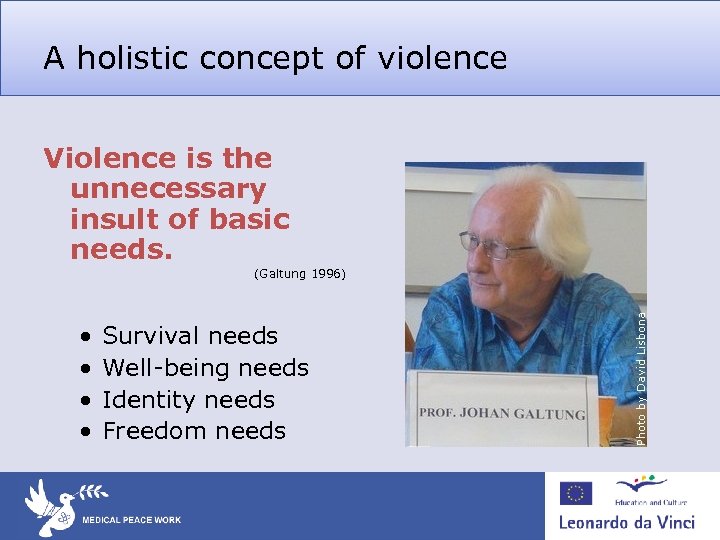 A holistic concept of violence Violence is the unnecessary insult of basic needs. (Galtung 1996) • • Survival needs Well-being needs Identity needs Freedom needs
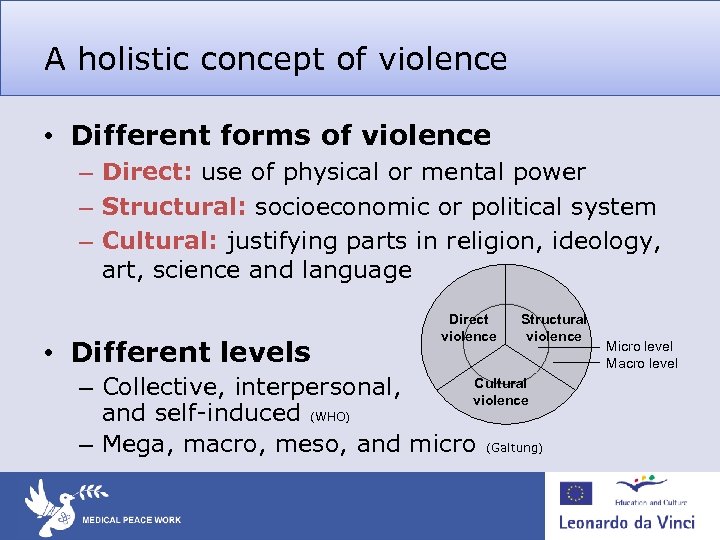 A holistic concept of violence • Different forms of violence – Direct: use of physical or mental power – Structural: socioeconomic or political system – Cultural: justifying parts in religion, ideology, art, science and language • Different levels Direct violence Structural violence Cultural – Collective, interpersonal, violence and self-induced (WHO) – Mega, macro, meso, and micro (Galtung) Micro level Macro level
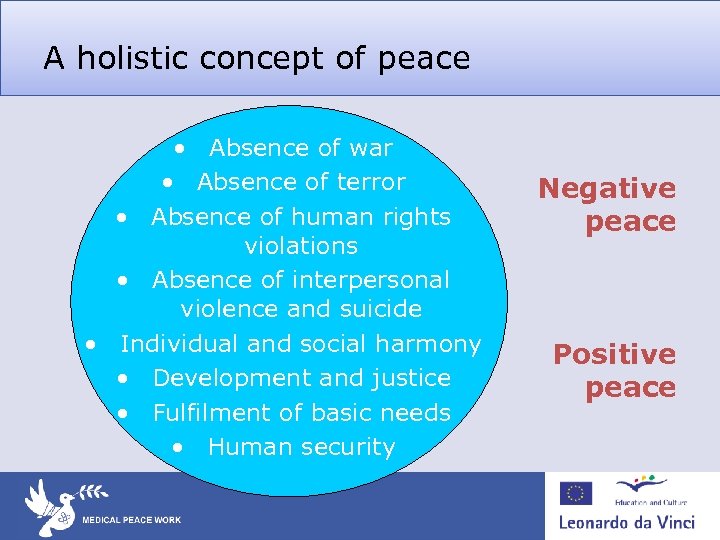 A holistic concept of peace • Absence of war • Absence of terror • Absence of human rights violations • Absence of interpersonal violence and suicide • Individual and social harmony • Development and justice • Fulfilment of basic needs • Human security Negative peace Positive peace
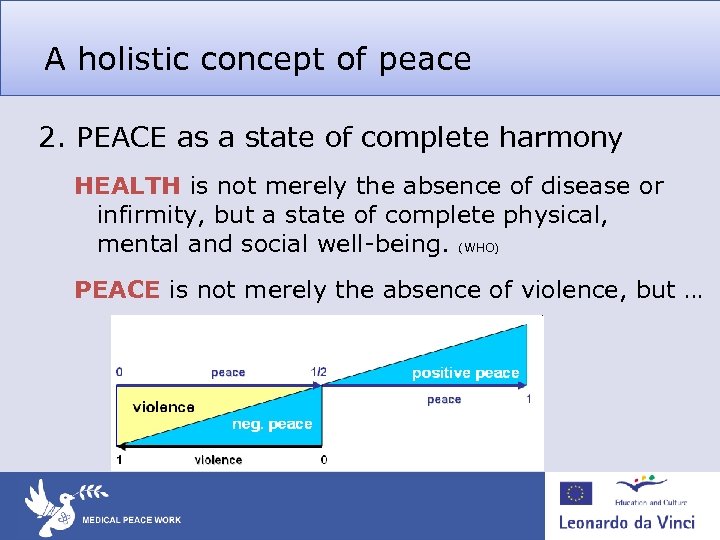 A holistic concept of peace 2. PEACE as a state of complete harmony HEALTH is not merely the absence of disease or infirmity, but a state of complete physical, mental and social well-being. (WHO) PEACE is not merely the absence of violence, but …
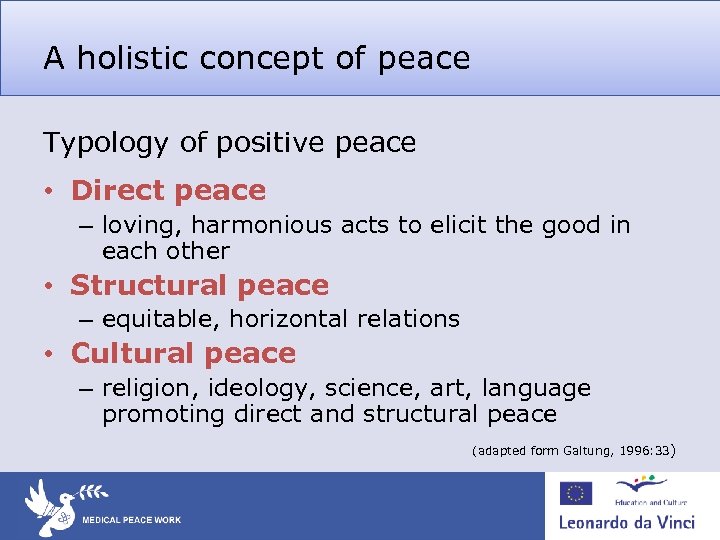 A holistic concept of peace Typology of positive peace • Direct peace – loving, harmonious acts to elicit the good in each other • Structural peace – equitable, horizontal relations • Cultural peace – religion, ideology, science, art, language promoting direct and structural peace (adapted form Galtung, 1996: 33 )
 A holistic concept of peace 3. Peace as the capacity to handle conflict Good health: strong immune system and quick recovery Peace: capacity to handle conflicts with empathy, creativity and by non-violent means (Galtung 2002: 8)
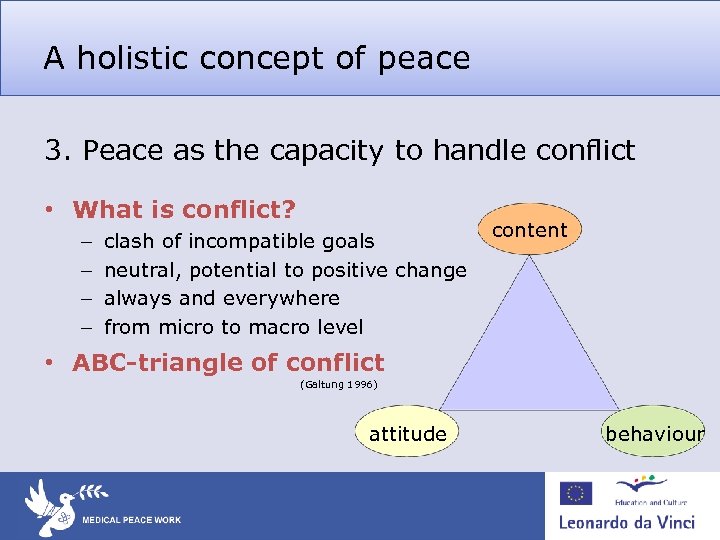 A holistic concept of peace 3. Peace as the capacity to handle conflict • What is conflict? – – clash of incompatible goals neutral, potential to positive change always and everywhere from micro to macro level content • ABC-triangle of conflict (Galtung 1996) attitude behaviour
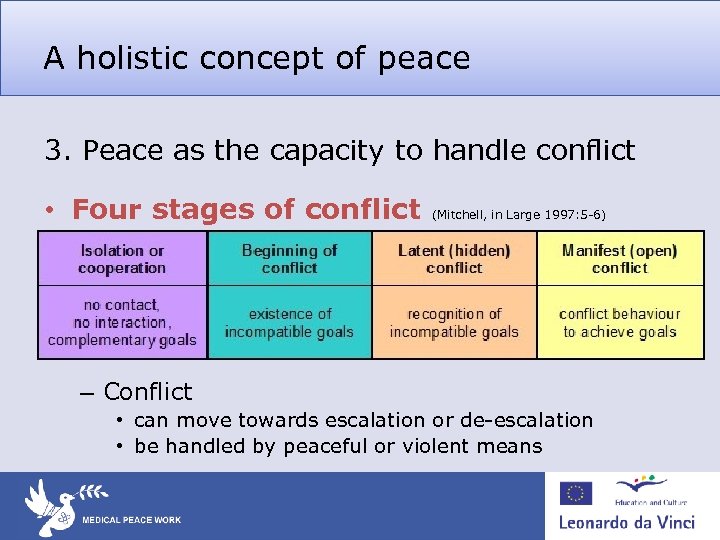 A holistic concept of peace 3. Peace as the capacity to handle conflict • Four stages of conflict (Mitchell, in Large 1997: 5 -6) – Conflict • can move towards escalation or de-escalation • be handled by peaceful or violent means
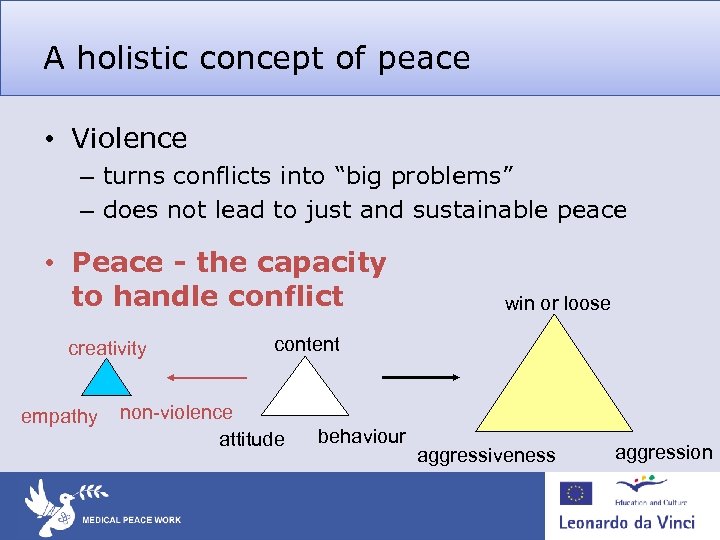 A holistic concept of peace • Violence – turns conflicts into “big problems” – does not lead to just and sustainable peace • Peace - the capacity to handle conflict creativity empathy win or loose content non-violence attitude behaviour aggressiveness aggression
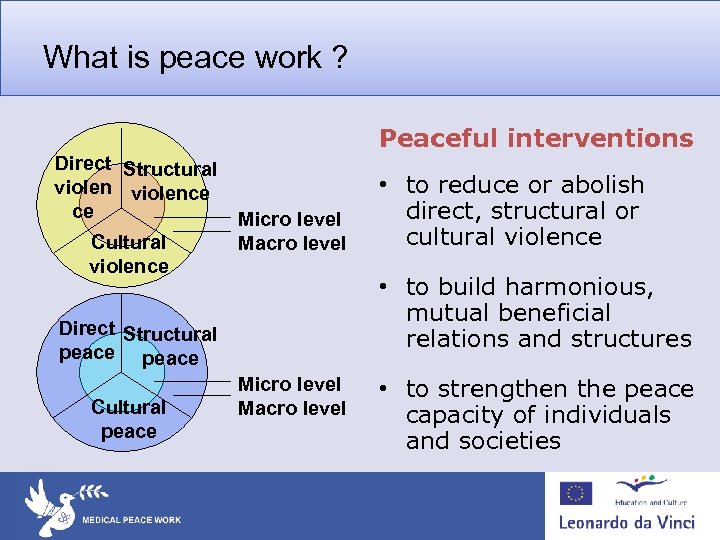 What is peace work ? Direct Structural violence ce Cultural violence Peaceful interventions Micro level Macro level • to build harmonious, mutual beneficial relations and structures Direct Structural peace Cultural peace • to reduce or abolish direct, structural or cultural violence Micro level Macro level • to strengthen the peace capacity of individuals and societies
 Peaceful means for social change • Non-violent protest and persuasion – a picket line or a peaceful demonstration • Social non-cooperation – students on strike • Economic non-cooperation – disinvestment, sanctions and boycotts – workers taking strike action • Political non-cooperation – Gandhi’s call on civil servants in the British administration of India to stop working • Non-violent intervention – the Freedom Flotilla that took medical equipment, food, building material, and other necessities to Gaza
 An introduction to Medical Peace Work Chapter 1: Peace and conflict theory Chapter 2: Medical Peace Work - a response to violent conflict Chapter 3: Peace skills for health workers
 Framework and definitions • What is Medical Peace Work?
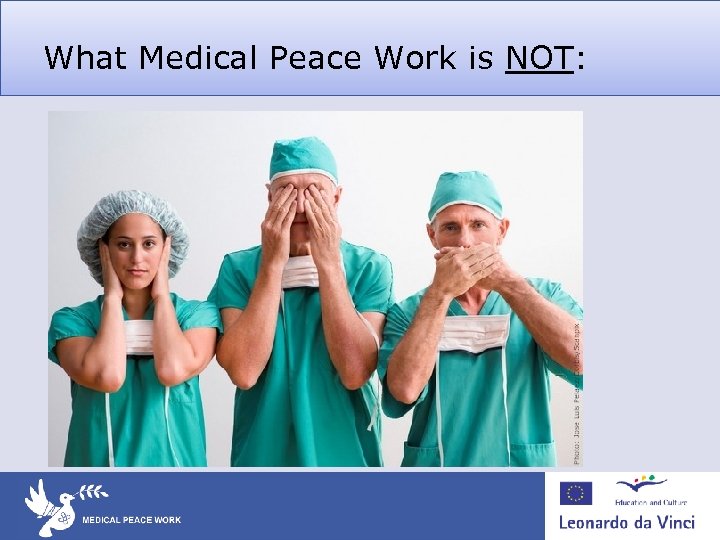 What Medical Peace Work is NOT:
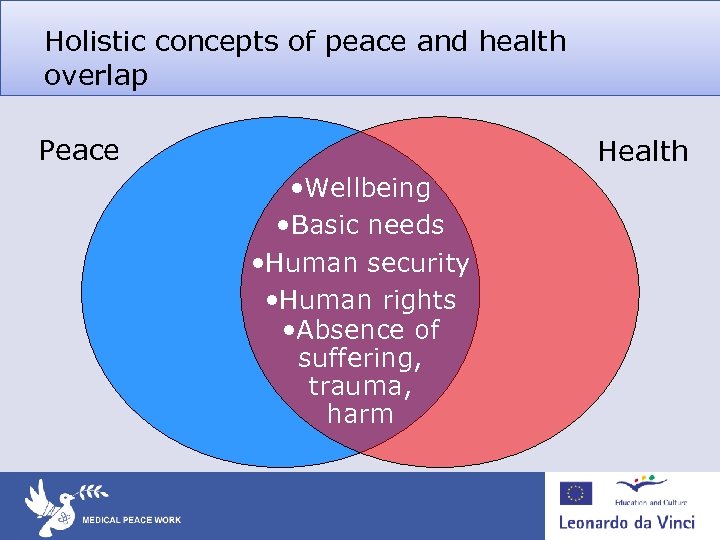 Holistic concepts of peace and health overlap Peace Health • Wellbeing • Basic needs • Human security • Human rights • Absence of suffering, trauma, harm
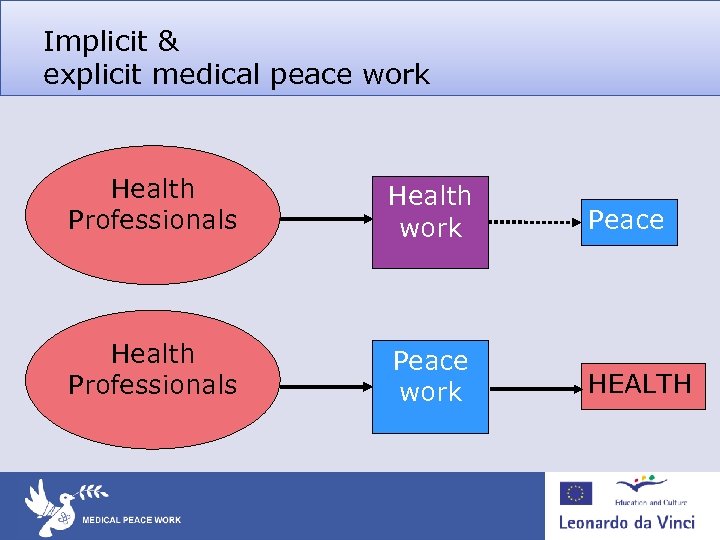 Implicit & explicit medical peace work Health Professionals Health work Peace Health Professionals Peace work HEALTH
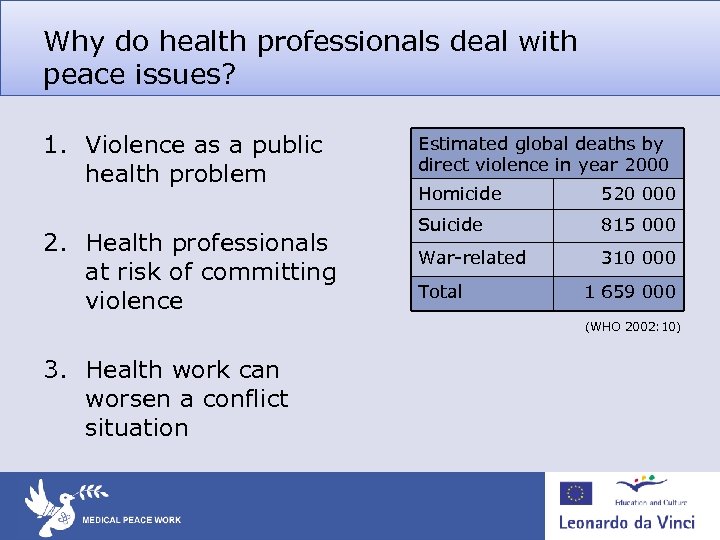 Why do health professionals deal with peace issues? 1. Violence as a public health problem 2. Health professionals at risk of committing violence Estimated global deaths by direct violence in year 2000 Homicide 520 000 Suicide 815 000 War-related 310 000 Total 1 659 000 (WHO 2002: 10) 3. Health work can worsen a conflict situation
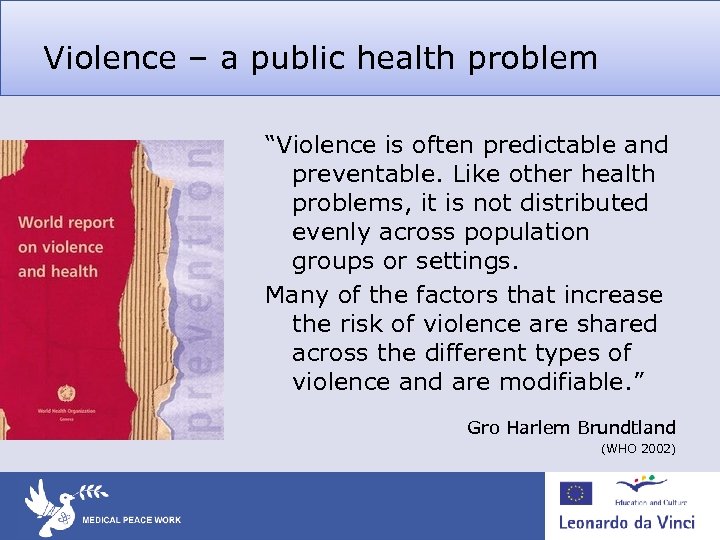 Violence – a public health problem “Violence is often predictable and preventable. Like other health problems, it is not distributed evenly across population groups or settings. Many of the factors that increase the risk of violence are shared across the different types of violence and are modifiable. ” Gro Harlem Brundtland (WHO 2002)
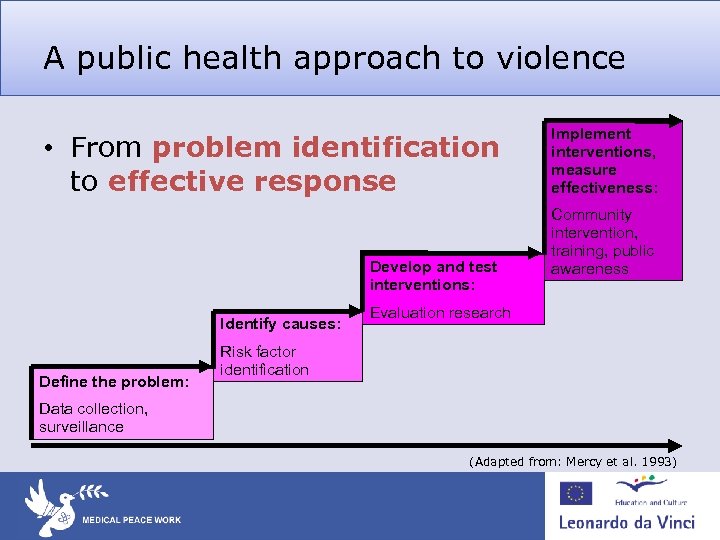 A public health approach to violence • From problem identification to effective response Develop and test interventions: Identify causes: Define the problem: Implement interventions, measure effectiveness: Community intervention, training, public awareness Evaluation research Risk factor identification Data collection, surveillance (Adapted from: Mercy et al. 1993)
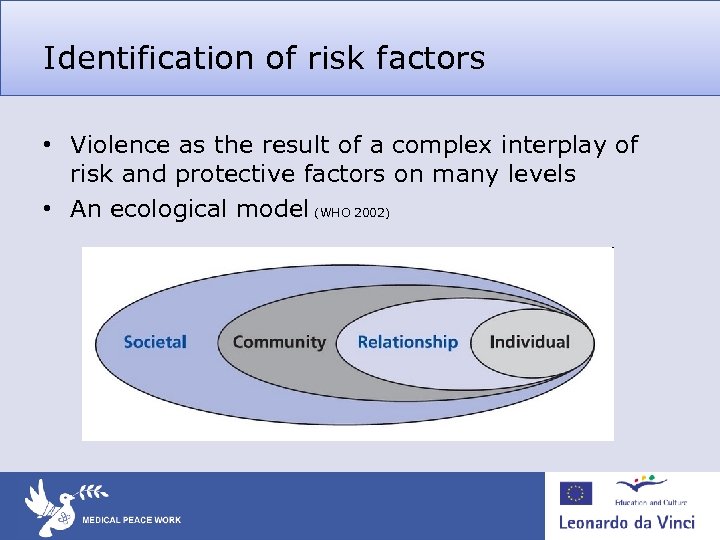 Identification of risk factors • Violence as the result of a complex interplay of risk and protective factors on many levels • An ecological model (WHO 2002)
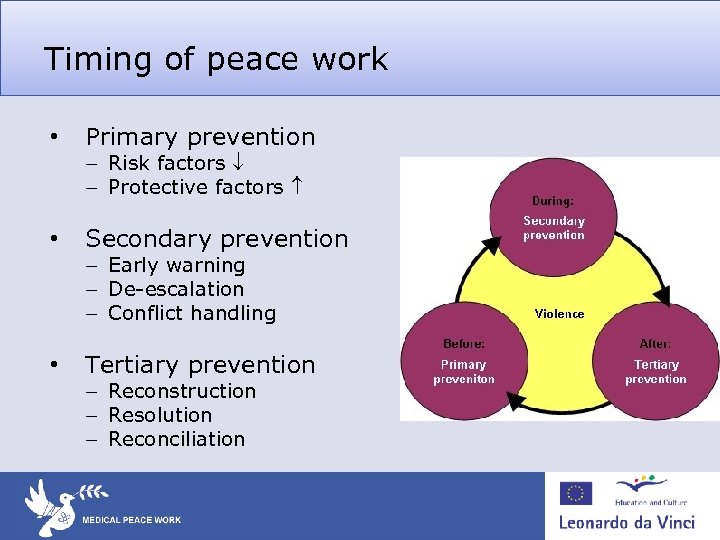 Timing of peace work • Primary prevention • Secondary prevention • Tertiary prevention – Risk factors – Protective factors – Early warning – De-escalation – Conflict handling – Reconstruction – Resolution – Reconciliation
 Mechanisms of medical peace work 1. Redefinition of the situation 2. Superordinate goals 3. Mediation and conflict transformation 4. Dissent and non-cooperation 5. Discovery and dissemination of knowledge 6. Rebuilding the fabric of society 7. Solidarity and support 8. Social healing 9. Evocation and extension of altruism 10. Limiting the destructiveness of war (Santa Barbara and Mac. Queen 2004)
 Risks and limitations of medical peace work • (Mis)perceptions when engaging in peace work – Risk of being labelled as ideological, extreme, divisive or confrontational – Potential divider between health worker and patient, employer or funder – Work for peace, human rights, justice, conflict mediation, etc. : sensitive and dangerous • Deficits in skills, knowledge and attitudes • No quick and easy solutions in peace work
 MPW training material • Web-based teaching resource centre • Seven MPW online courses - textbook lessons - test questions - problem-based e-learning cases www. medicalpeacework. org
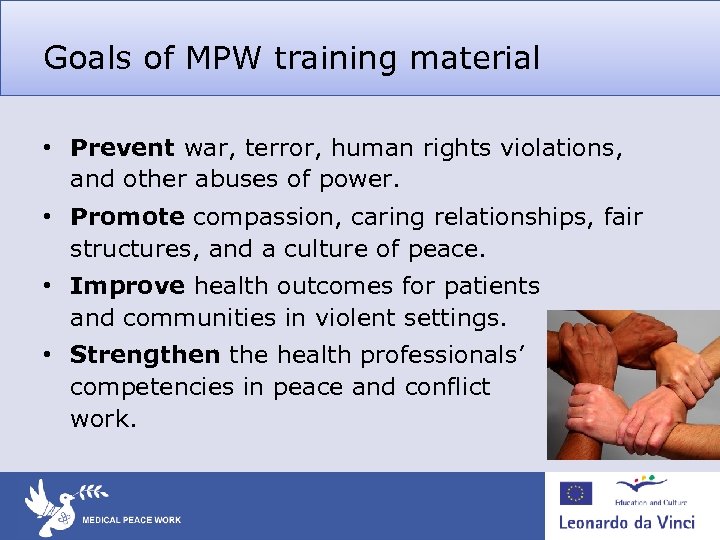 Goals of MPW training material • Prevent war, terror, human rights violations, and other abuses of power. • Promote compassion, caring relationships, fair structures, and a culture of peace. • Improve health outcomes for patients and communities in violent settings. • Strengthen the health professionals’ competencies in peace and conflict work.
 Characteristics of MPW-framework • Holistic peace concept ─ Peace work NOT only at the top level ─ Peace work NOT only in war zones ─ Peace work NOT only for peace activists • Public health approach to violence and peace • Explicit peace work – for the sake of HEALTH
 An introduction to Medical Peace Work Chapter 1: Peace and conflict theory Chapter 2: Medical Peace Work - a response to violent conflict Chapter 3: Peace skills for health workers
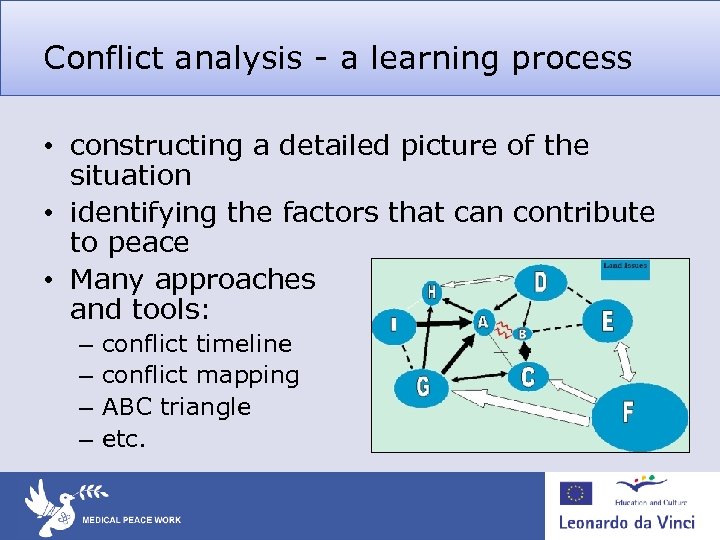 Conflict analysis - a learning process • constructing a detailed picture of the situation • identifying the factors that can contribute to peace • Many approaches and tools: – – conflict timeline conflict mapping ABC triangle etc.
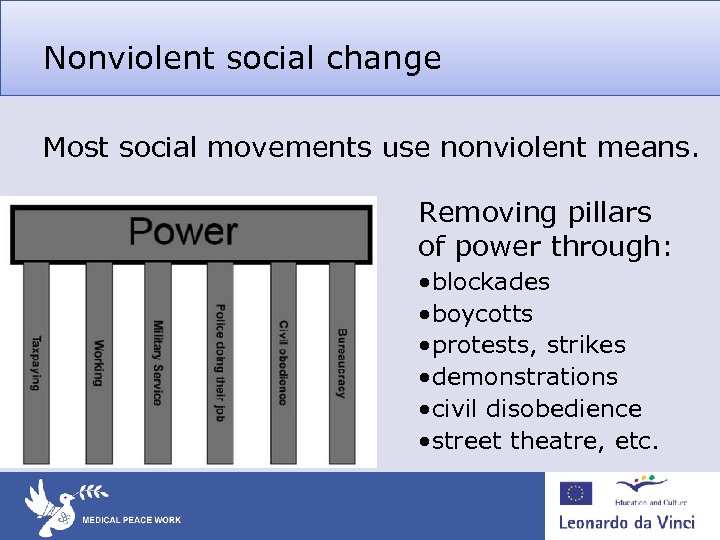 Nonviolent social change Most social movements use nonviolent means. Removing pillars of power through: • blockades • boycotts • protests, strikes • demonstrations • civil disobedience • street theatre, etc.
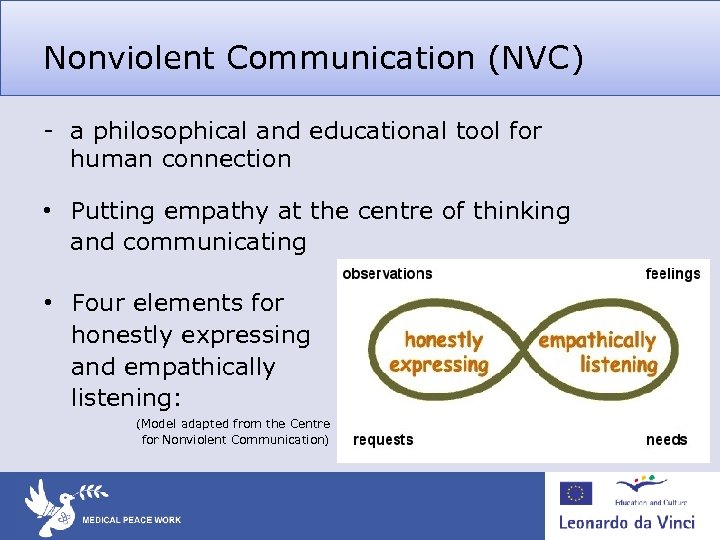 Nonviolent Communication (NVC) - a philosophical and educational tool for human connection • Putting empathy at the centre of thinking and communicating • Four elements for honestly expressing and empathically listening: (Model adapted from the Centre for Nonviolent Communication)
 References • • • Centre for Nonviolent Communication www. cnvc. org Galtung J (1996). Peace by peaceful means: peace and conflict, development and civilisation. London, Prio/Sage. Galtung J (2002). What is peace studies? In Johansen J, Vambheim V (eds). Three papers by Johan Galtung. Tromsø, Centre for Peace Studies, University of Tromsø, Norway Large J (1997). Considering conflict. First consultative meeting on Health as a Bridge for Peace. Les Pensières, Annecy, WHO. Mercy J et al. (1993). Public health policy for preventing violence. Health Affairs. Winter: 7 -29. Merriam-Webster Online Dictionary www. m-w. com Rosenberg M (2003). Nonviolent communication: a language of life. Encinitas, CA, Puddle Dancer Press. Santa Barbara J, Mac. Queen G (2004). Peace through health: key concepts. The Lancet 364: 384 -5. WHO (2002). World report on violence and health. Geneva, WHO. © medicalpeacework. org 2012 Author Klaus Melf, editor Mike Rowson, graphic design Philipp Bornschlegl