 Скачать презентацию MEDICAL NECESSITY AND REIMBURSEMENT ISSUES FOR PHYSICIANS
976c83914f5eb5677cc30f96e44b1645.ppt
- Количество слайдов: 20



MEDICAL NECESSITY AND REIMBURSEMENT ISSUES FOR PHYSICIANS • Clinical necessity and reimbursement issues • Medicare policies • Pre-operative testing • Financial impact • Emergency dept. • ABNs
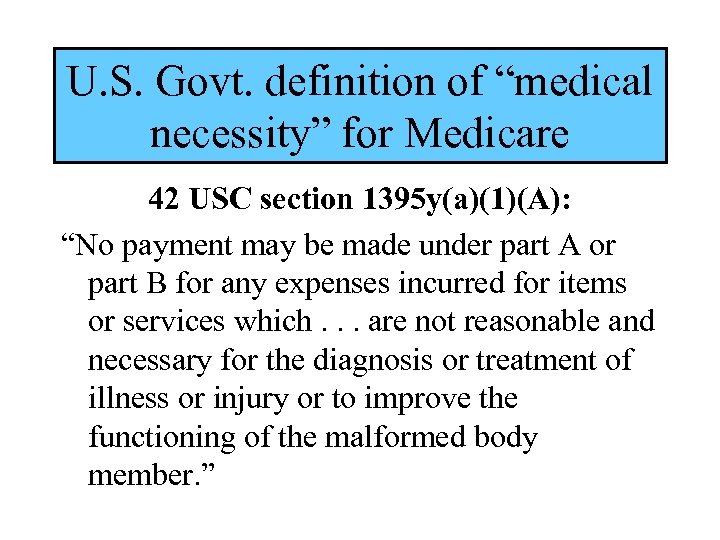
U. S. Govt. definition of “medical necessity” for Medicare 42 USC section 1395 y(a)(1)(A): “No payment may be made under part A or part B for any expenses incurred for items or services which. . . are not reasonable and necessary for the diagnosis or treatment of illness or injury or to improve the functioning of the malformed body member. ”
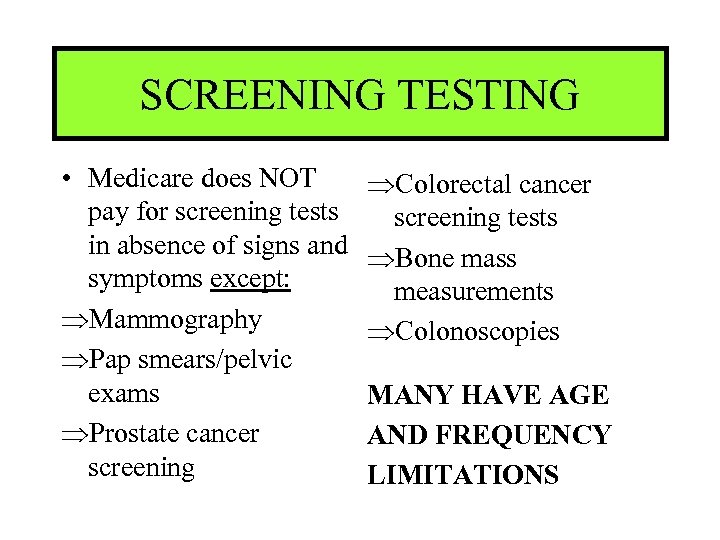
SCREENING TESTING • Medicare does NOT pay for screening tests in absence of signs and symptoms except: ÞMammography ÞPap smears/pelvic exams ÞProstate cancer screening ÞColorectal cancer screening tests ÞBone mass measurements ÞColonoscopies MANY HAVE AGE AND FREQUENCY LIMITATIONS
LOCAL MEDICAL REVIEW POLICIES • Each Medicare claims processor establishes policies for coverage • May differ among geographic areas • Many practicing physicians disagree with restrictions • Current policies on Web at www. lmrp. net
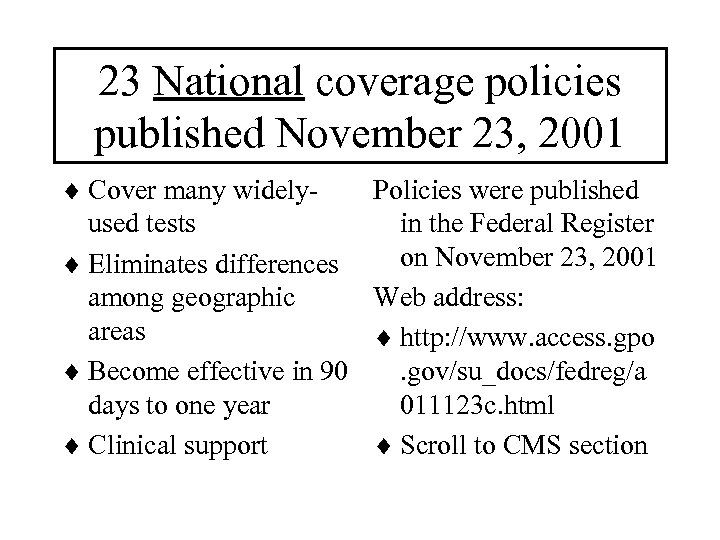
23 National coverage policies published November 23, 2001 ¨ Cover many widelyused tests ¨ Eliminates differences among geographic areas ¨ Become effective in 90 days to one year ¨ Clinical support Policies were published in the Federal Register on November 23, 2001 Web address: ¨ http: //www. access. gpo. gov/su_docs/fedreg/a 011123 c. html ¨ Scroll to CMS section
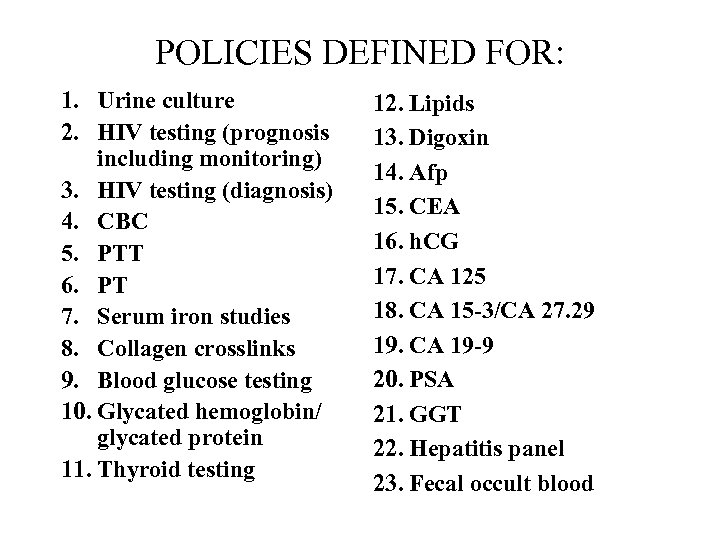
POLICIES DEFINED FOR: 1. Urine culture 2. HIV testing (prognosis including monitoring) 3. HIV testing (diagnosis) 4. CBC 5. PTT 6. PT 7. Serum iron studies 8. Collagen crosslinks 9. Blood glucose testing 10. Glycated hemoglobin/ glycated protein 11. Thyroid testing 12. Lipids 13. Digoxin 14. Afp 15. CEA 16. h. CG 17. CA 125 18. CA 15 -3/CA 27. 29 19. CA 19 -9 20. PSA 21. GGT 22. Hepatitis panel 23. Fecal occult blood
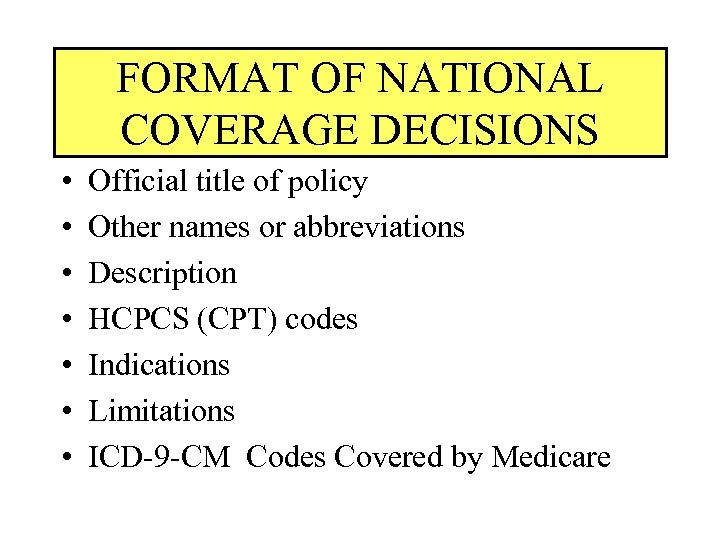
FORMAT OF NATIONAL COVERAGE DECISIONS • • Official title of policy Other names or abbreviations Description HCPCS (CPT) codes Indications Limitations ICD-9 -CM Codes Covered by Medicare
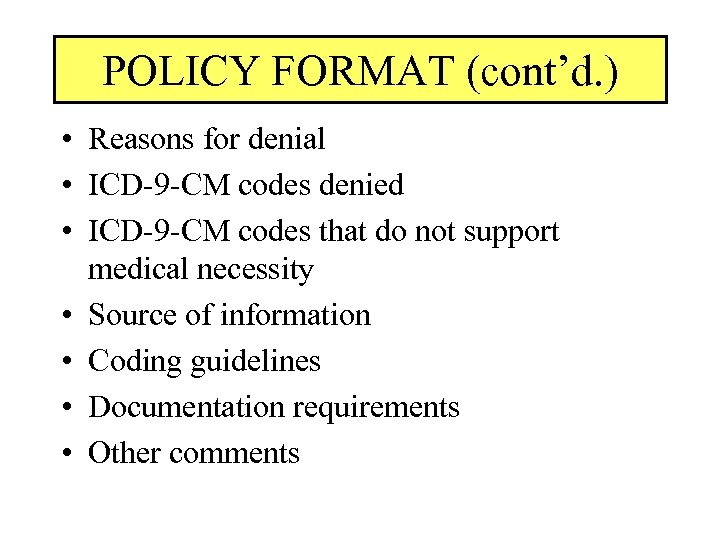
POLICY FORMAT (cont’d. ) • Reasons for denial • ICD-9 -CM codes denied • ICD-9 -CM codes that do not support medical necessity • Source of information • Coding guidelines • Documentation requirements • Other comments
How were policies developed? • Negotiated rulemaking process • Representatives included physicians, hospitals, labs, other interested groups, and CMS • Review of clinical literature • Drafts posted on Web in spring, 2000
Physician responsibilities • Physician or qualified extender must maintain documentation of medical necessity in patient’s medical record • Order must be specific and signed by person ordering • Diagnosis may be narrative or in ICD-9 -CM format; required by BBA of 1997
PRE-OPERATIVE TESTING • Prior to use of ICD-9 -CM coding in 1989, Medicare didn’t realize they were paying for pre-op testing • Customary pre-op EKG, CBC, chest x-ray were seen as necessary and usually were paid • Medicare realized big numbers and big $$ were involved
PRE-OP TESTING CHANGES • May 2001 --CMS clarified testing outside of global surgical period • Actually made denying tests easier for CMS • First test is “routine screening”, then medical necessity in light of condition requiring surgery, then underlying conditions and diseases
FINANCIAL IMPACT • Patient pays for noncovered services out-ofpocket • Hospital/lab cannot bill patient if they did not obtain a signed Advance Beneficiary Notice (ABN) • Potential fraud and abuse exposure • Many private insurers are following Medicare’s lead
RELATIONSHIP IMPACT • Patients are confused and upset – “My doctor said I needed this test, so why won’t Medicare pay for it? ” • Physicians and hospitals or labs concerned about patients deferring testing due to financial issues • Time-consuming and expensive process!
Advance Beneficiary Notices (ABNs) • CMS has redesigned forms and requires use of standard format upon final approval • Time demands on hospitals and labs are enormous • In absence of signed ABN, patient may NOT be billed • Routinely billing Medicare for “medically unnecessary” services can create fraud and abuse exposure • Diagnoses and tests must be evaluated at registration, not after testing done.
ABNs in the Emergency Dept. • CMS considers use of ABNs in emergency situations to violate EMTALA regulations • Seen as creating a financial barrier to patient obtaining care • Unfunded mandate • Inadequate testing of emergency patient can create malpractice risks
WCHA FUTURE PLANS • Presently evaluate medical necessity for lab patients before testing where possible • Began checking for MRI studies recently • Plan to expand to all services but ED within 6 months • Will not defer critical testing ordered by physicians due to patient refusal to sign ABN
PHYSICIAN INTERACTION • “Non-treating” physicians (i. e. pathologists and radiologists) may not order subsequent testing • Exception for suspicious screening mammograms • “Consult and treat” referrals don’t solve the problem • May use “if. . . then” orders
SUMMARY • Clinical medical necessity and reimbursement medical necessity are often different • Become familiar with local and national medical review policies, and provide input • Patients may be reluctant to bear increased costs • Complete information on orders can minimize time and cost for all involved • Maintain patient care without creating investigation risks

QUESTIONS AND DISCUSSION
Скачать презентацию MEDICAL NECESSITY AND REIMBURSEMENT ISSUES FOR PHYSICIANS
976c83914f5eb5677cc30f96e44b1645.ppt