


 Скачать презентацию MEDICAL GEOLOGY GEOCHEMISTRY PILLALAMARRI ILA Earth Atmospheric Planetary
2945f582aa50098b4cce73677aa4e521.ppt
- Количество слайдов: 66
 MEDICAL GEOLOGY/GEOCHEMISTRY PILLALAMARRI ILA Earth Atmospheric & Planetary Sciences Neutron Activation Analysis Laboratory Massachusetts Institute of Technology Cambridge, MA 02139 IAP 2006: 12. 091 Credit Course: January 9 - 25, 2006 Session 2 B January 11, 2006
 Session 2 B January 11, 2006 Objective Radon: Frequently Asked Questions (FAQs) Radon potential map of USA Radon potential map of Massachusetts Radon testing Radon in drinking water Radon in indoor and outdoor air Radon resistant new construction
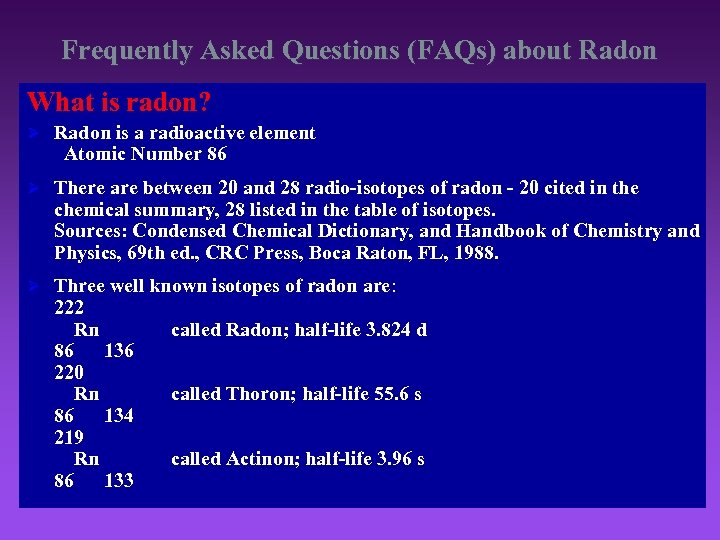 Frequently Asked Questions (FAQs) about Radon What is radon? Ø Radon is a radioactive element Atomic Number 86 Ø There are between 20 and 28 radio-isotopes of radon - 20 cited in the chemical summary, 28 listed in the table of isotopes. Sources: Condensed Chemical Dictionary, and Handbook of Chemistry and Physics, 69 th ed. , CRC Press, Boca Raton, FL, 1988. Ø Three well known isotopes of radon are: 222 Rn called Radon; half-life 3. 824 d 86 136 220 Rn called Thoron; half-life 55. 6 s 86 134 219 Rn called Actinon; half-life 3. 96 s 86 133
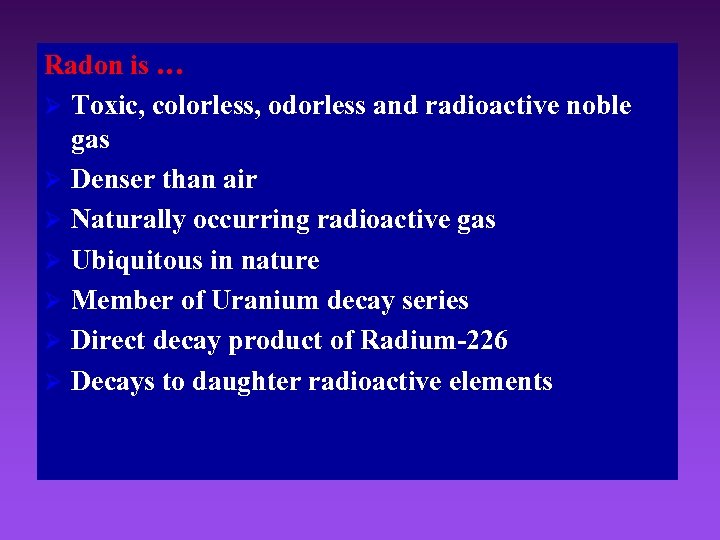 Radon is … Ø Toxic, colorless, odorless and radioactive noble gas Ø Denser than air Ø Naturally occurring radioactive gas Ø Ubiquitous in nature Ø Member of Uranium decay series Ø Direct decay product of Radium-226 Ø Decays to daughter radioactive elements
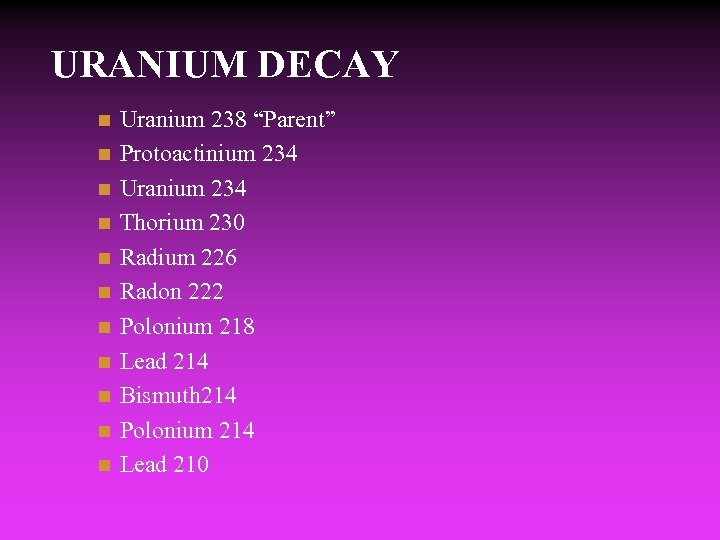 URANIUM DECAY n n n Uranium 238 “Parent” Protoactinium 234 Uranium 234 Thorium 230 Radium 226 Radon 222 Polonium 218 Lead 214 Bismuth 214 Polonium 214 Lead 210
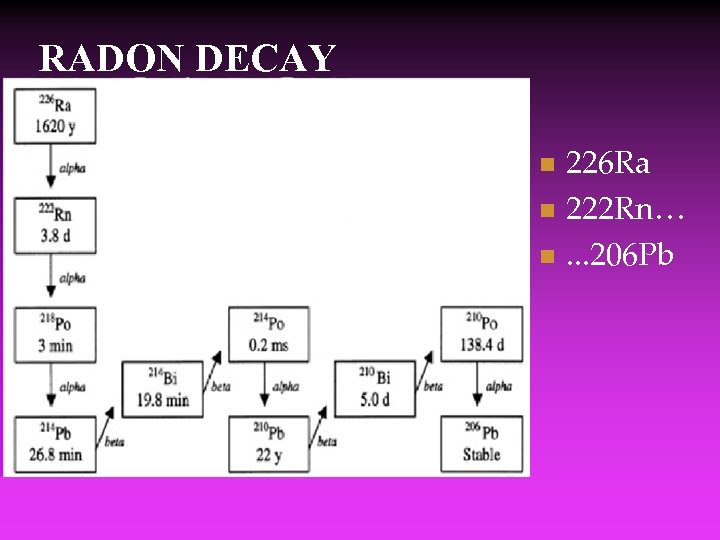 RADON DECAY n n n 226 Ra 222 Rn…. . . 206 Pb
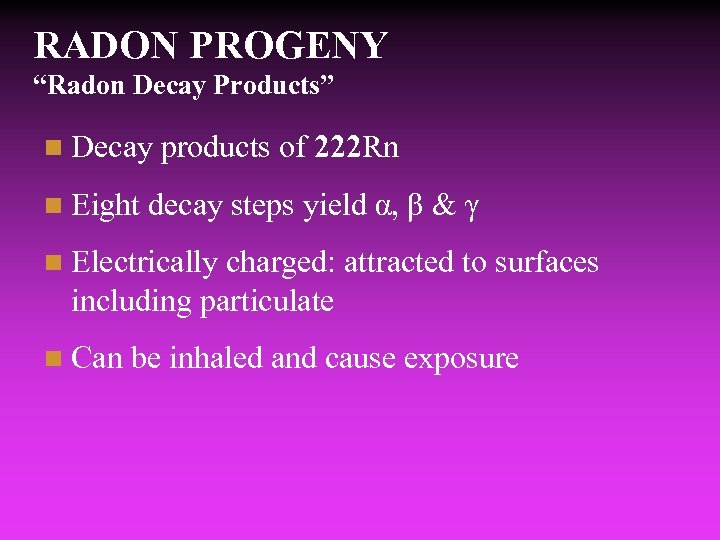 RADON PROGENY “Radon Decay Products” n Decay n Eight products of 222 Rn decay steps yield α, β & γ n Electrically charged: attracted to surfaces including particulate n Can be inhaled and cause exposure
 Why is Radon important? Ø Radon is present everywhere, all around us. Ø Radon cannot be seen with naked eye, cannot be smelled, cannot be aware easily of its presence. Ø Radon becomes harmful to health at unacceptable concentration levels.
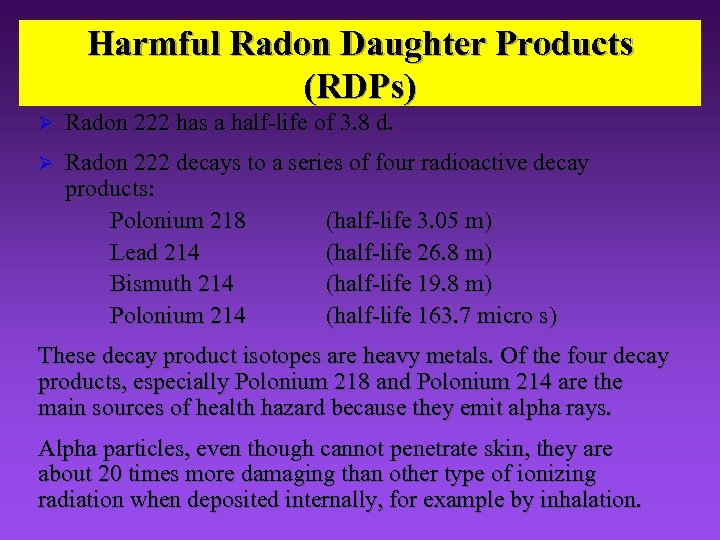 Harmful Radon Daughter Products (RDPs) Ø Radon 222 has a half-life of 3. 8 d. Ø Radon 222 decays to a series of four radioactive decay products: Polonium 218 (half-life 3. 05 m) Lead 214 (half-life 26. 8 m) Bismuth 214 (half-life 19. 8 m) Polonium 214 (half-life 163. 7 micro s) These decay product isotopes are heavy metals. Of the four decay products, especially Polonium 218 and Polonium 214 are the main sources of health hazard because they emit alpha rays. Alpha particles, even though cannot penetrate skin, they are about 20 times more damaging than other type of ionizing radiation when deposited internally, for example by inhalation.
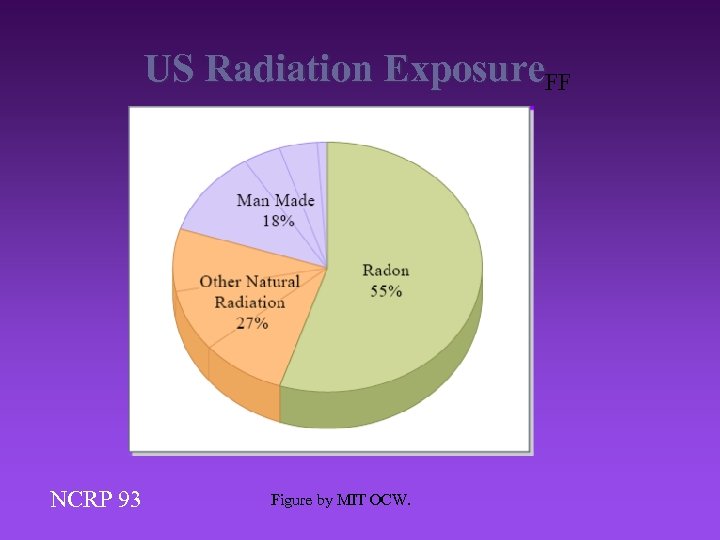 US Radiation Exposure. FF NCRP 93 Figure by MIT OCW.
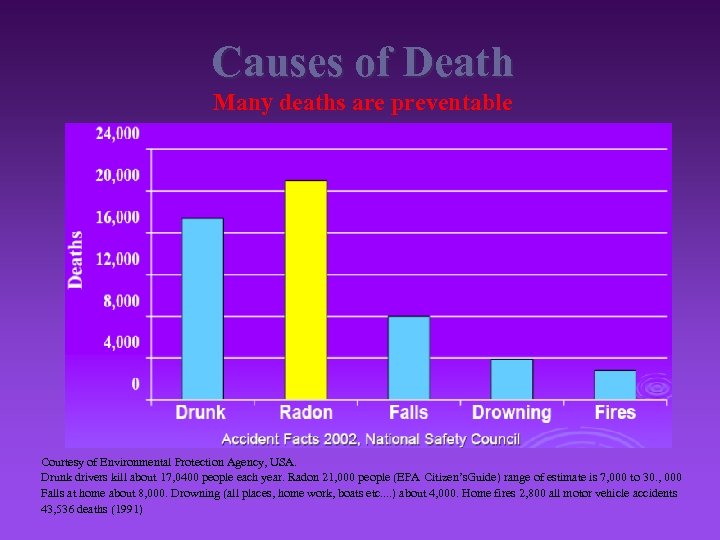 Causes of Death Many deaths are preventable Courtesy of Environmental Protection Agency, USA. Drunk drivers kill about 17, 0400 people each year. Radon 21, 000 people (EPA Citizen’s. Guide) range of estimate is 7, 000 to 30. , 000 Falls at home about 8, 000. Drowning (all places, home work, boats etc. . ) about 4, 000. Home fires 2, 800 all motor vehicle accidents 43, 536 deaths (1991)
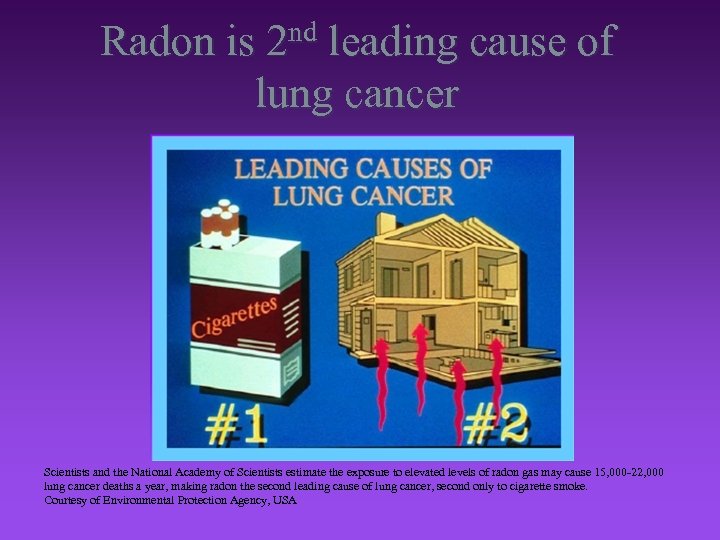 Radon is 2 nd leading cause of lung cancer Scientists and the National Academy of Scientists estimate the exposure to elevated levels of radon gas may cause 15, 000 -22, 000 lung cancer deaths a year, making radon the second leading cause of lung cancer, second only to cigarette smoke. Courtesy of Environmental Protection Agency, USA
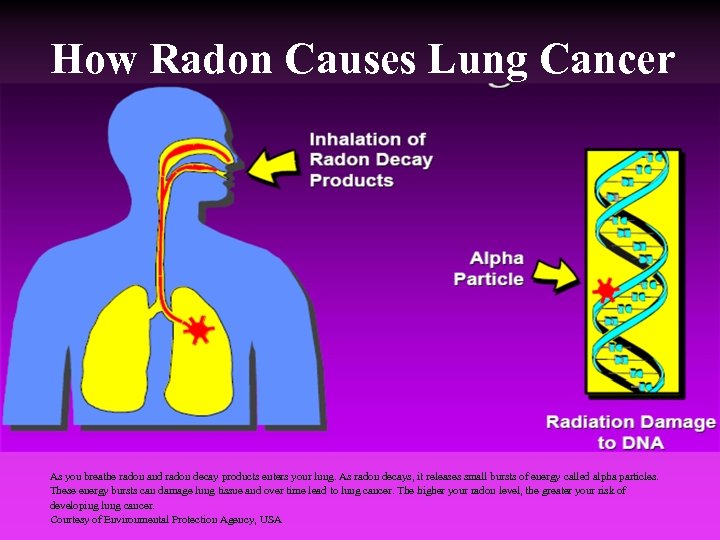 How Radon Causes Lung Cancer As you breathe radon and radon decay products enters your lung. As radon decays, it releases small bursts of energy called alpha particles. These energy bursts can damage lung tissue and over time lead to lung cancer. The higher your radon level, the greater your risk of developing lung cancer. Courtesy of Environmental Protection Agency, USA
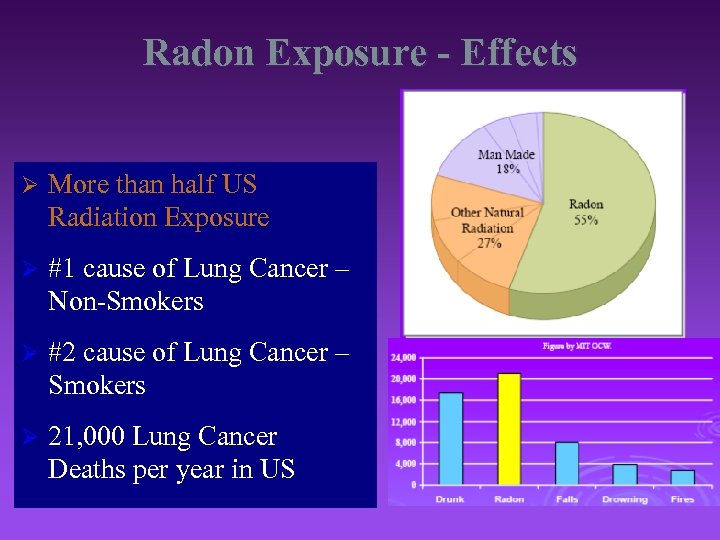 Radon Exposure - Effects Ø More than half US Radiation Exposure Ø #1 cause of Lung Cancer – Non-Smokers Ø #2 cause of Lung Cancer – Smokers Ø 21, 000 Lung Cancer Deaths per year in US
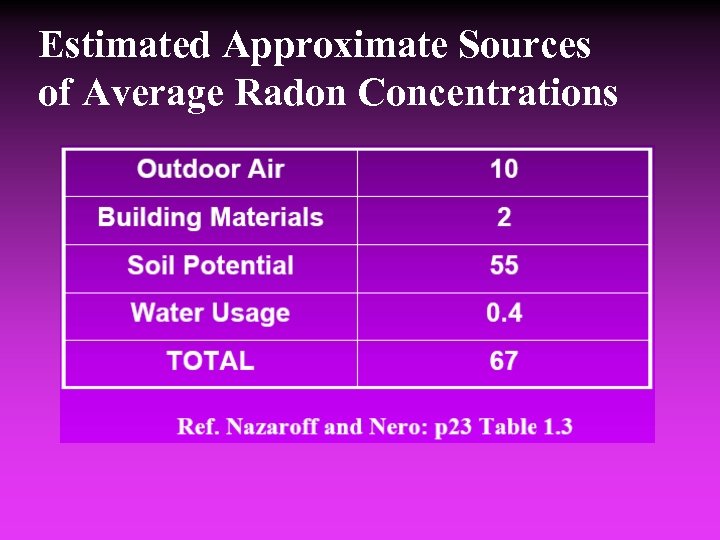
 Where does radon come from? Ø Occurs naturally by the decay of uranium in rock and soil. Ø Uranium is widely found in trace amounts in soil and rocks. Ø Radon in soil and rocks under and adjacent to buildings, migrates through foundations, cracks and small openings and concentrates inside buildings.
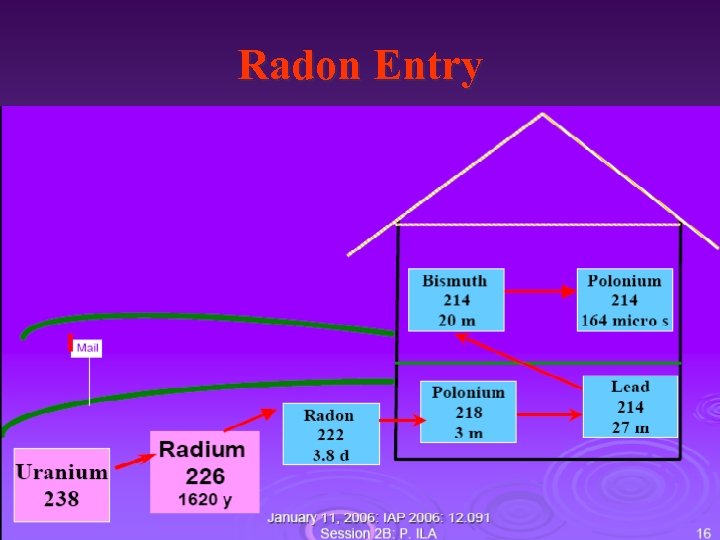 Radon Entry
 What is a p. Ci/L? Radioactivity is measured in units of disintegrations per second (dps). Units of Activity 1 Becquerel (Bq) = 1 disintegration per second 1 Curie (Ci) = 3. 7 x 10¹⁰ disintegrations per second 1 pico. Curie (p. Ci) = 0. 037 disintegration per second Radon concentration is measured in p. Ci per liter of air (or water) or Becquerel per meter cubed.
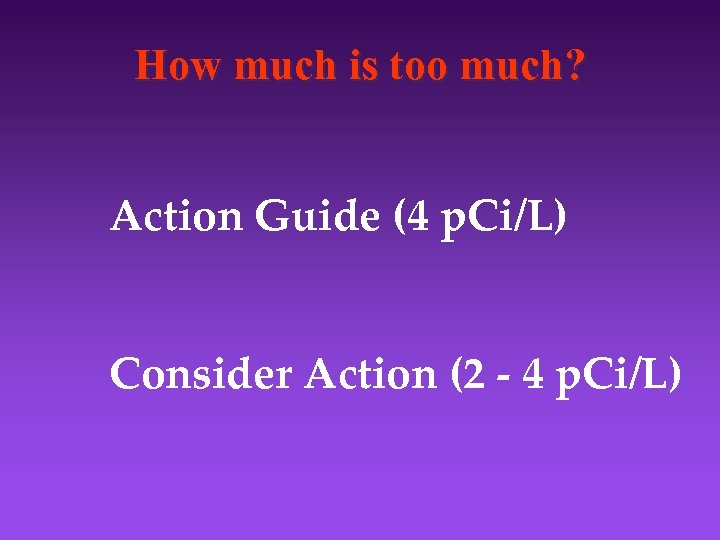 How much is too much? Action Guide (4 p. Ci/L) Consider Action (2 - 4 p. Ci/L)
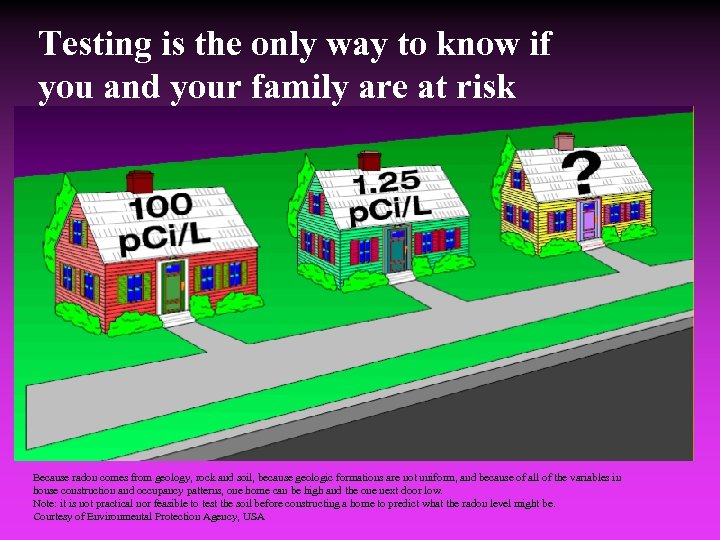 Testing is the only way to know if you and your family are at risk Because radon comes from geology, rock and soil, because geologic formations are not uniform, and because of all of the variables in house construction and occupancy patterns, one home can be high and the one next door low. Note: it is not practical nor feasible to test the soil before constructing a home to predict what the radon level might be. Courtesy of Environmental Protection Agency, USA
 Know about radon TESTING Guarantees Proof
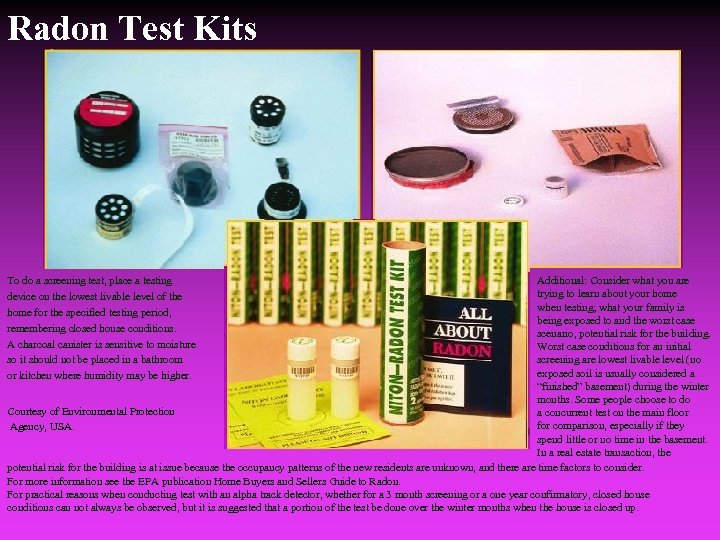 Radon Test Kits To do a screening test, place a testing device on the lowest livable level of the home for the specified testing period, remembering closed house conditions. A charcoal canister is sensitive to moisture so it should not be placed in a bathroom or kitchen where humidity may be higher. Additional: Consider what you are trying to learn about your home when testing; what your family is being exposed to and the worst case scenario, potential risk for the building. Worst case conditions for an initial screening are lowest livable level (no exposed soil is usually considered a “finished” basement) during the winter months. Some people choose to do Courtesy of Environmental Protection a concurrent test on the main floor for comparison, especially if they Agency, USA. spend little or no time in the basement. In a real estate transaction, the potential risk for the building is at issue because the occupancy patterns of the new residents are unknown, and there are time factors to consider. For more information see the EPA publication Home Buyers and Sellers Guide to Radon. For practical reasons when conducting test with an alpha track detector, whether for a 3 month screening or a one year confirmatory, closed house conditions can not always be observed, but it is suggested that a portion of the test be done over the winter months when the house is closed up.
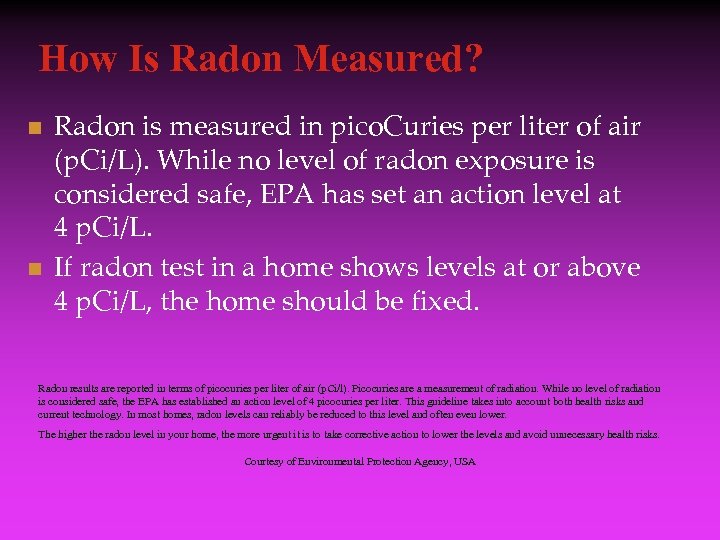 How Is Radon Measured? n n Radon is measured in pico. Curies per liter of air (p. Ci/L). While no level of radon exposure is considered safe, EPA has set an action level at 4 p. Ci/L. If radon test in a home shows levels at or above 4 p. Ci/L, the home should be fixed. Radon results are reported in terms of picocuries per liter of air (p. Ci/l). Picocuries are a measurement of radiation. While no level of radiation is considered safe, the EPA has established an action level of 4 picocuries per liter. This guideline takes into account both health risks and current technology. In most homes, radon levels can reliably be reduced to this level and often even lower. The higher the radon level in your home, the more urgent it is to take corrective action to lower the levels and avoid unnecessary health risks. Courtesy of Environmental Protection Agency, USA
 Radon and Radon Daughter Products (RDP) Measurement Radon and RDP Sampling Methods Radon and RDP Monitors
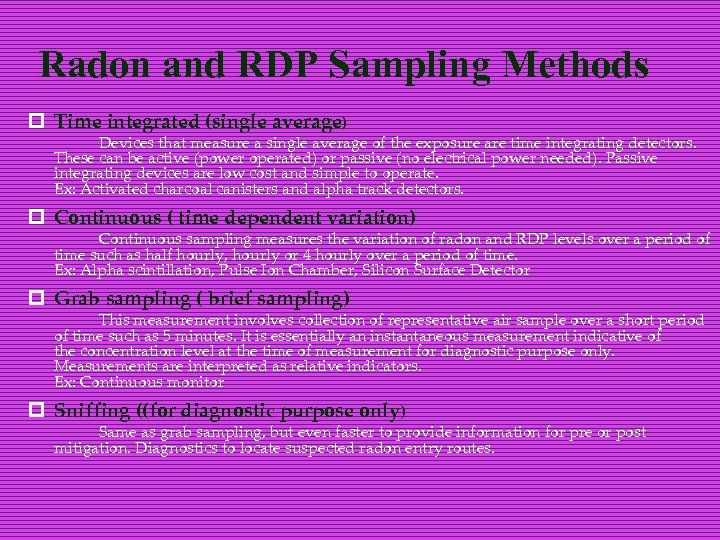 Radon and RDP Sampling Methods p Time integrated (single average) Devices that measure a single average of the exposure are time integrating detectors. These can be active (power operated) or passive (no electrical power needed). Passive integrating devices are low cost and simple to operate. Ex: Activated charcoal canisters and alpha track detectors. p Continuous ( time dependent variation) Continuous sampling measures the variation of radon and RDP levels over a period of time such as half hourly, hourly or 4 hourly over a period of time. Ex: Alpha scintillation, Pulse Ion Chamber, Silicon Surface Detector p Grab sampling ( brief sampling) This measurement involves collection of representative air sample over a short period of time such as 5 minutes. It is essentially an instantaneous measurement indicative of the concentration level at the time of measurement for diagnostic purpose only. Measurements are interpreted as relative indicators. Ex: Continuous monitor p Sniffing ((for diagnostic purpose only) Same as grab sampling, but even faster to provide information for pre or post mitigation. Diagnostics to locate suspected radon entry routes.
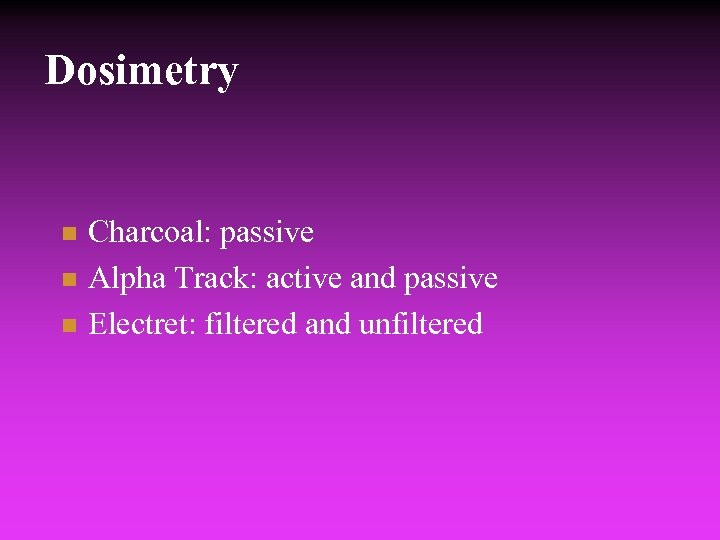
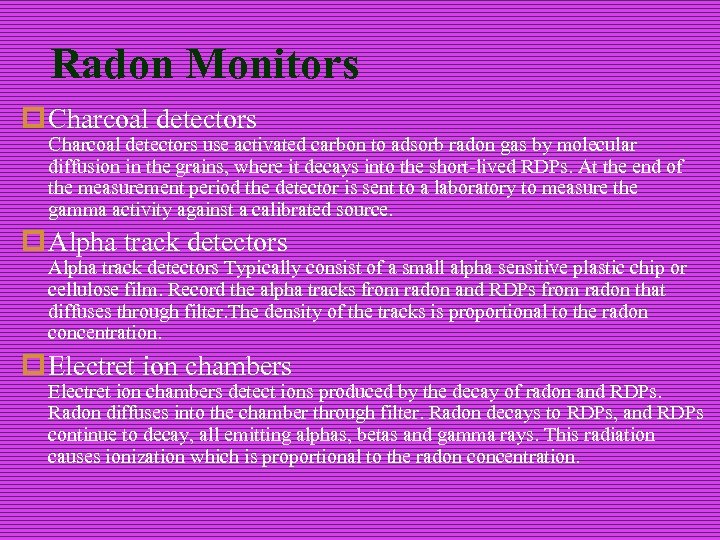 Radon Monitors p Charcoal detectors use activated carbon to adsorb radon gas by molecular diffusion in the grains, where it decays into the short-lived RDPs. At the end of the measurement period the detector is sent to a laboratory to measure the gamma activity against a calibrated source. p Alpha track detectors Typically consist of a small alpha sensitive plastic chip or cellulose film. Record the alpha tracks from radon and RDPs from radon that diffuses through filter. The density of the tracks is proportional to the radon concentration. p Electret ion chambers detect ions produced by the decay of radon and RDPs. Radon diffuses into the chamber through filter. Radon decays to RDPs, and RDPs continue to decay, all emitting alphas, betas and gamma rays. This radiation causes ionization which is proportional to the radon concentration.
 Continuous Radon Monitors p A continuous radon monitor (CRM) is an electronic device that measures the variation in radon levels over time. Continuous radon monitor collects the radon by either pump (active) or diffusion (passive). RDPs are filtered out. Alpha particles from radon and its RDPs are counted. p CRMs are typically three types – Alpha scintillation, Pulse ion chamber, Silicon surface barrier. p Web-Based &Networked Continuous Radon Monitoring in Real Time with High Sensitivity Ref: CRPA Bulletin Vol. 23 (2002) 9 -11
 Continuous Radon Monitoring in Real Time with High Sensitivity Developed at the University of Guelph for the Sudbury Neutrino Observatory. P. Jagam and J. J. Simpson
 Estimated Approximate Sources of Average Radon Concentrations
 Dosimetry n n n Charcoal: passive Alpha Track: active and passive Electret: filtered and unfiltered
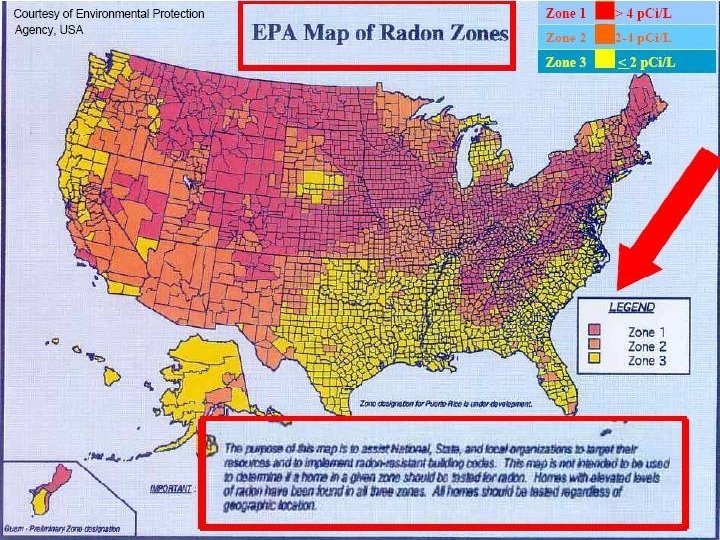
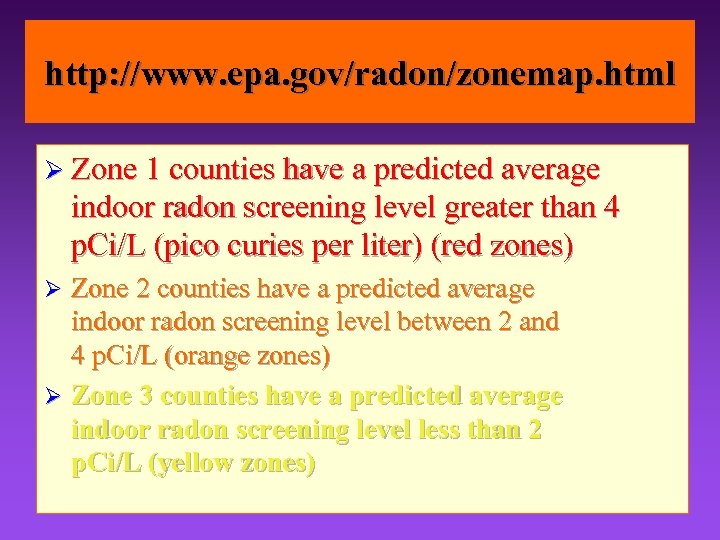 http: //www. epa. gov/radon/zonemap. html Ø Zone 1 counties have a predicted average indoor radon screening level greater than 4 p. Ci/L (pico curies per liter) (red zones) Zone 2 counties have a predicted average indoor radon screening level between 2 and 4 p. Ci/L (orange zones) Ø Zone 3 counties have a predicted average indoor radon screening level less than 2 p. Ci/L (yellow zones) Ø
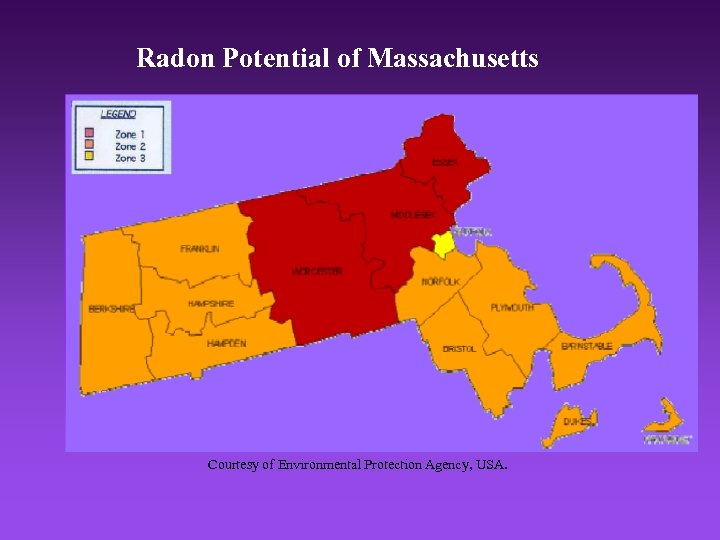 Radon Potential of Massachusetts Courtesy of Environmental Protection Agency, USA.
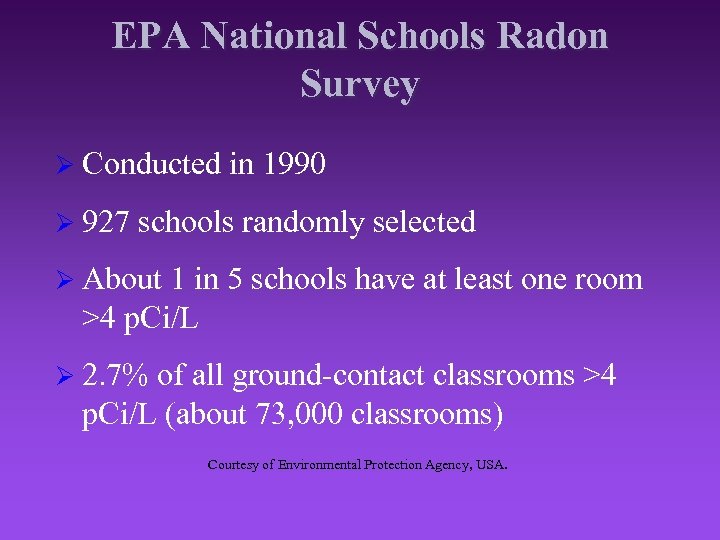 EPA National Schools Radon Survey Ø Conducted Ø 927 in 1990 schools randomly selected Ø About 1 in 5 schools have at least one room >4 p. Ci/L Ø 2. 7% of all ground-contact classrooms >4 p. Ci/L (about 73, 000 classrooms) Courtesy of Environmental Protection Agency, USA.
 Schedule Ø Normal Ø Lab Occupancy coordination Ø Testing Team Availability Ø Flexibility We want to conduct tests during periods of normal occupancy. Accordingly, we want to avoid vacations, holidays, early release days, snow days, etc We try to deploy tests on Mondays and Tuesdays and harvest them on Wednesdays and Thursdays. For large jobs, we warn the lab so they can plan accordingly. We want to avoid delivering a large number of detectors to the lab at 4 PM on Friday. We also need to make sure that critical team members, like the guy with the keys, are going to be able to be with us throughout the deployment and retrieval process. When we have all that worked out, we need to have a back-up plan in case of bad weather or unexpected problems. Courtesy of Environmental Protection Agency, USA
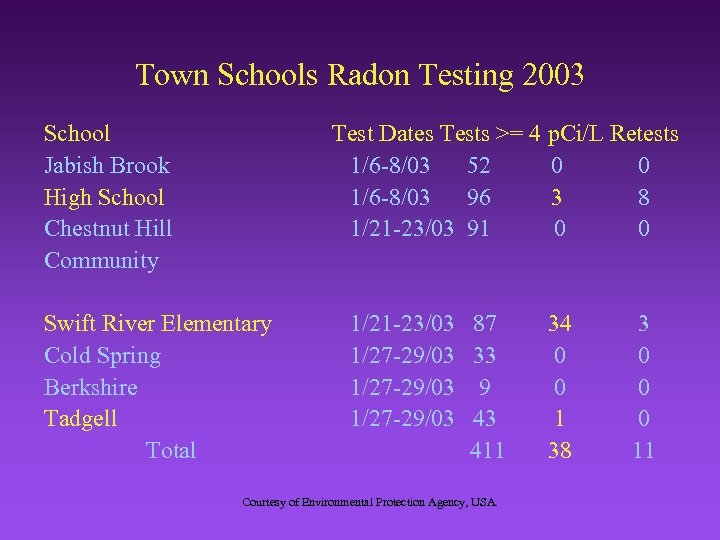 Town Schools Radon Testing 2003 School Jabish Brook High School Chestnut Hill Community Test Dates Tests >= 4 p. Ci/L Retests 1/6 -8/03 52 0 0 1/6 -8/03 96 3 8 1/21 -23/03 91 0 0 Swift River Elementary Cold Spring Berkshire Tadgell Total 1/21 -23/03 87 1/27 -29/03 33 1/27 -29/03 9 1/27 -29/03 43 411 Courtesy of Environmental Protection Agency, USA. 34 0 0 1 38 3 0 0 0 11
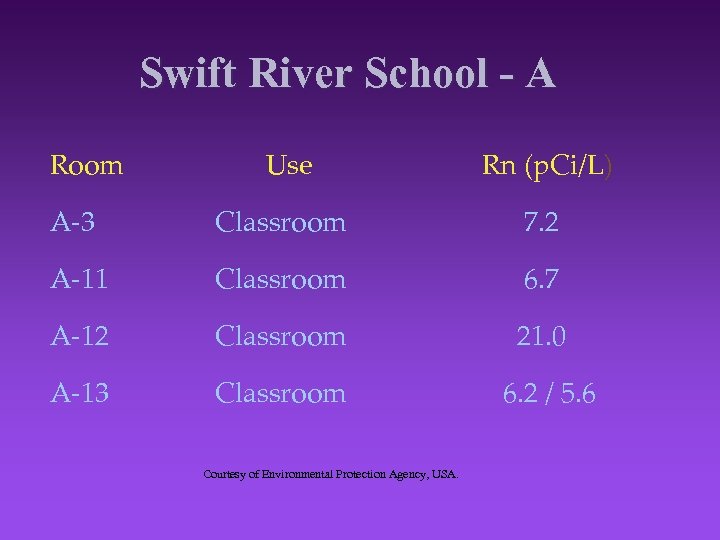 Swift River School - A Room Use Rn (p. Ci/L) A-3 Classroom 7. 2 A-11 Classroom 6. 7 A-12 Classroom 21. 0 A-13 Classroom 6. 2 / 5. 6 Courtesy of Environmental Protection Agency, USA.
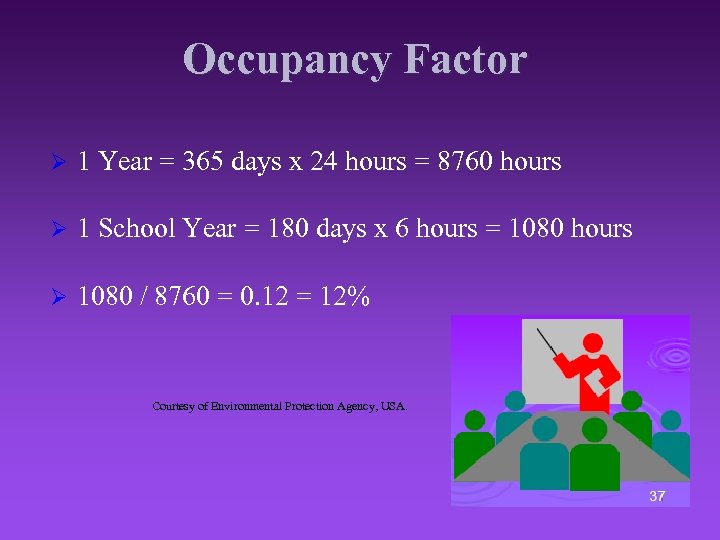 Occupancy Factor Ø 1 Year = 365 days x 24 hours = 8760 hours Ø 1 School Year = 180 days x 6 hours = 1080 hours Ø 1080 / 8760 = 0. 12 = 12% Courtesy of Environmental Protection Agency, USA.
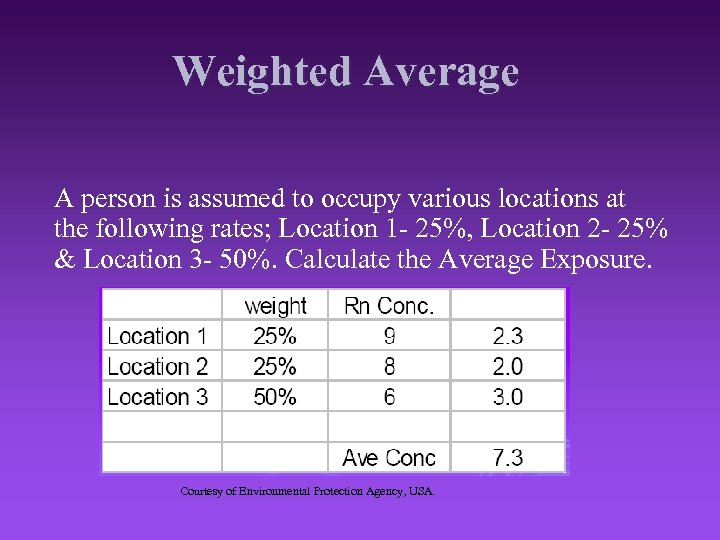 Weighted Average A person is assumed to occupy various locations at the following rates; Location 1 - 25%, Location 2 - 25% & Location 3 - 50%. Calculate the Average Exposure. Courtesy of Environmental Protection Agency, USA.
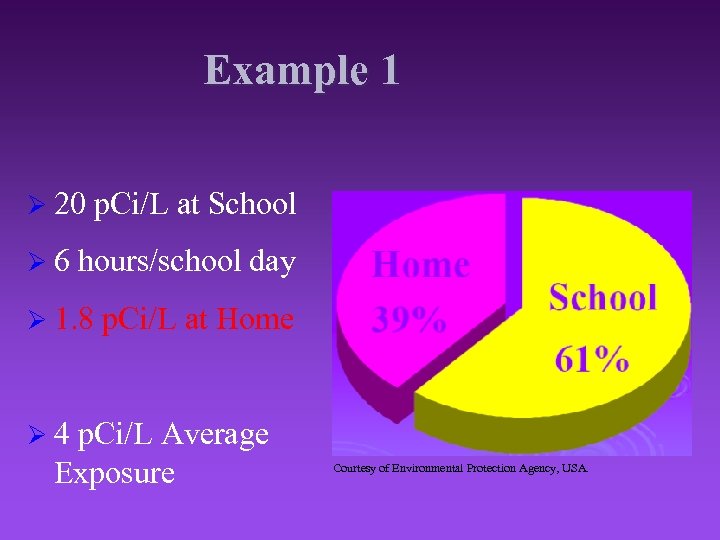 Example 1 Ø 20 Ø 6 p. Ci/L at School hours/school day Ø 1. 8 p. Ci/L at Home Ø 4 p. Ci/L Average Exposure Courtesy of Environmental Protection Agency, USA.
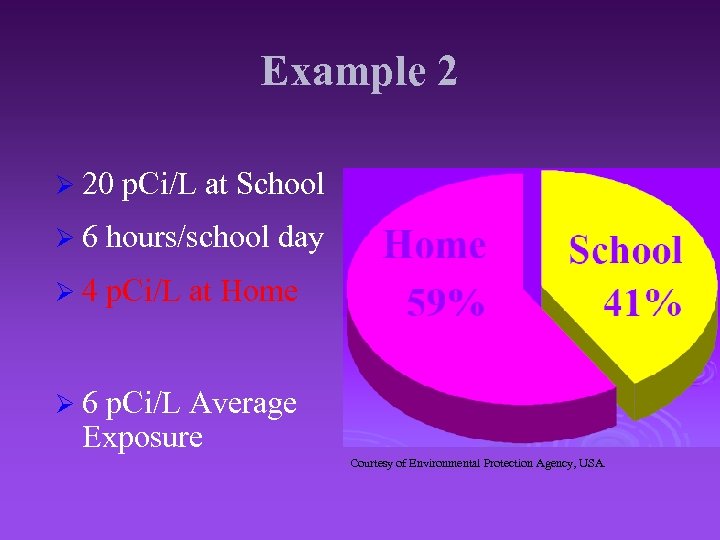 Example 2 Ø 20 p. Ci/L at School Ø 6 hours/school day Ø 4 p. Ci/L at Home Ø 6 p. Ci/L Average Exposure Courtesy of Environmental Protection Agency, USA.
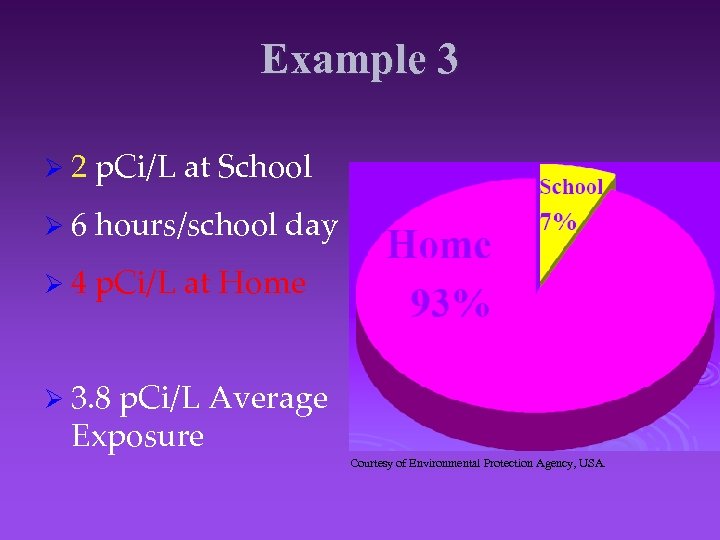 Example 3 Ø 2 p. Ci/L at School Ø 6 hours/school day Ø 4 p. Ci/L at Home Ø 3. 8 p. Ci/L Average Exposure Courtesy of Environmental Protection Agency, USA.
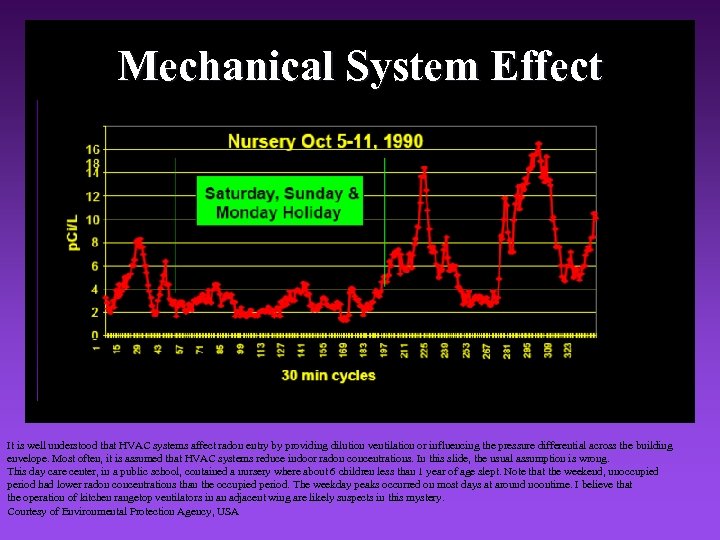 Mechanical System Effect It is well understood that HVAC systems affect radon entry by providing dilution ventilation or influencing the pressure differential across the building envelope. Most often, it is assumed that HVAC systems reduce indoor radon concentrations. In this slide, the usual assumption is wrong. This day care center, in a public school, contained a nursery where about 6 children less than 1 year of age slept. Note that the weekend, unoccupied period had lower radon concentrations than the occupied period. The weekday peaks occurred on most days at around noontime. I believe that the operation of kitchen rangetop ventilators in an adjacent wing are likely suspects in this mystery. Courtesy of Environmental Protection Agency, USA
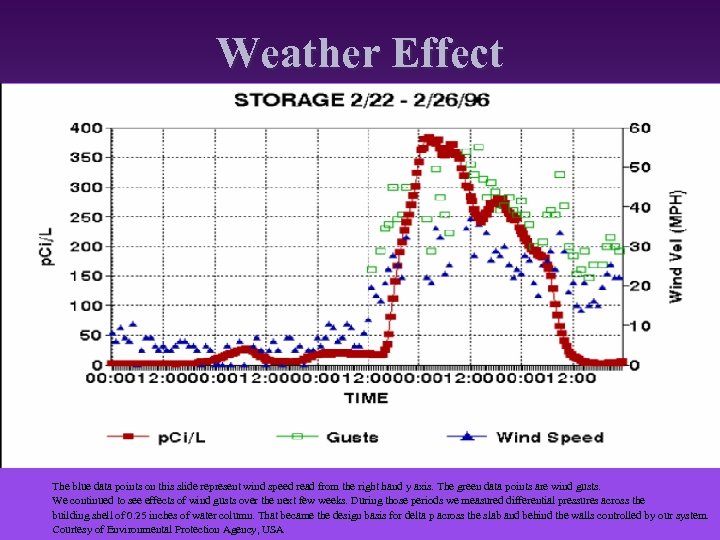 Weather Effect The blue data points on this slide represent wind speed read from the right hand y axis. The green data points are wind gusts. We continued to see effects of wind gusts over the next few weeks. During those periods we measured differential pressures across the building shell of 0. 25 inches of water column. That became the design basis for delta p across the slab and behind the walls controlled by our system. Courtesy of Environmental Protection Agency, USA
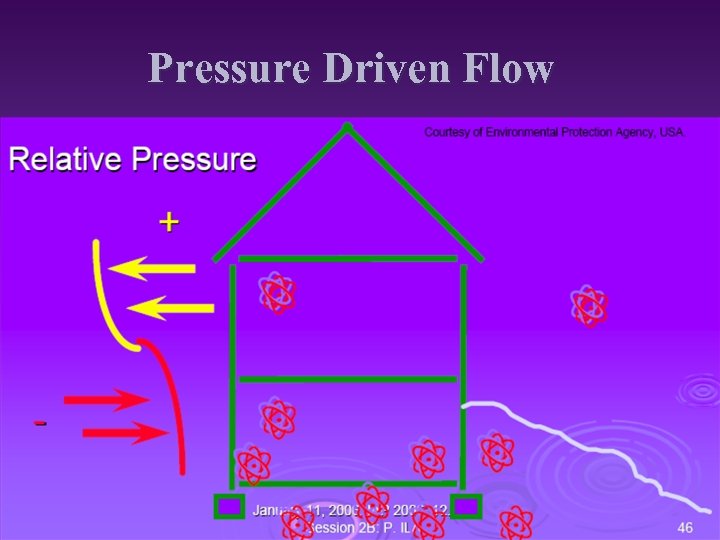
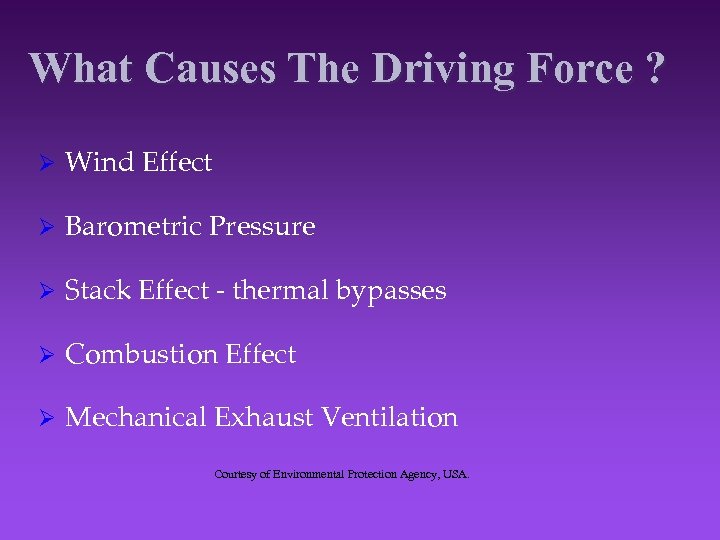 What Causes The Driving Force ? Ø Wind Effect Ø Barometric Pressure Ø Stack Effect - thermal bypasses Ø Combustion Effect Ø Mechanical Exhaust Ventilation Courtesy of Environmental Protection Agency, USA.
 Mitigation Philosophy - General Ø Radon mitigation is a professional level activity Ø EPA documents provides appropriate general Guidance Ø Strict adherence to EPA guidance should not replace common sense Government officials at all levels often treat the subject of Radon mitigation quite superficially, conveying the impression that mitigation is merely a mundane, handyman type of exercise requiring little in the way of professional level skill. Nowhere is this pervasive attitude more misplaced than in the area of school, large building and special problem mitigation. Our view has always been that competent radon mitigators require skills in basic engineering, practical mathematics, building science, health physics, industrial hygiene and problem solving. EPA guidance documents, provide appropriate general guidance which should be considered as a basis for and sometimes a departure point for the exercise of professional Judgment. Courtesy of Environmental Protection Agency, USA
 Pressure Driven Flow
 Occurrence Conclusions Ø Radon is a serious health threat ! Ø Elevated Radon Levels have been found in every State ! Ø Cannot predict which buildings are high Ø Test All Homes ! Ø Test All Schools !
 Radon in drinking water Courtesy of Environmental Protection Agency, USA.
 Radon in drinking water http: //www. epa. gov/safewater/radon/fact. html What are the Public Health Concerns? n Radon from tap water is a smaller source of radon in indoor air. n Only about 1 -2 percent of radon in indoor air comes from drinking water. n However breathing radon released to air from household water uses increases the risk of lung cancer over the course of your lifetime.
 Radon in drinking water http: //www. epa. gov/safewater/radon/fact. html Public Health Standards for Radon in Drinking Water n EPA is proposing new public health standards for radon in drinking water. The proposal would provide two options to States and community water systems for reducing radon health risks in both drinking water and indoor air quality, a unique multimedia framework authorized in the 1996 Amendments to the Safe Water Drinking Water Act (SDWA). Information about the proposed rule and information relating to the status of the rule can be found at: www. epa. gov/safewater/radon. html.
 Radon in drinking water … n n n A report released September 15, 1998, by the National Academy of Sciences is the most comprehensive accumulation of scientific data on the public health risks of radon in drinking water. The report was required by the Safe Drinking Water Act (SDWA). The NAS report (BEIR VI) issued earlier this year confirmed that radon is a serious public health threat. This report goes on to refine the risks of radon in drinking water and confirms that there are drinking water related cancer deaths, primarily due to lung cancer. The report, in general, confirms earlier EPA scientific conclusions and analyses for drinking water, and presents no major changes to EPA's 1994 risk assessment. Office of Ground Water Drinking Water has posted the press The release of "Risk Assessment of Radon in Drinking Water". There is also a link to NAS's Executive Summary on the report (with initial EPA perspectives) at: www. epa. gov/OGWDW/radon/nas. html. BEIRVI Report: http: //www. epa. gov/radon/beirvi. html
 Radon in drinking water … n SWDA Safe Drinking Water Act n CWS Community Water Systems n SCWS Small community water systems using ground water or ground + surface water serving homes apartments trailer parks n LCWS Large community water systems
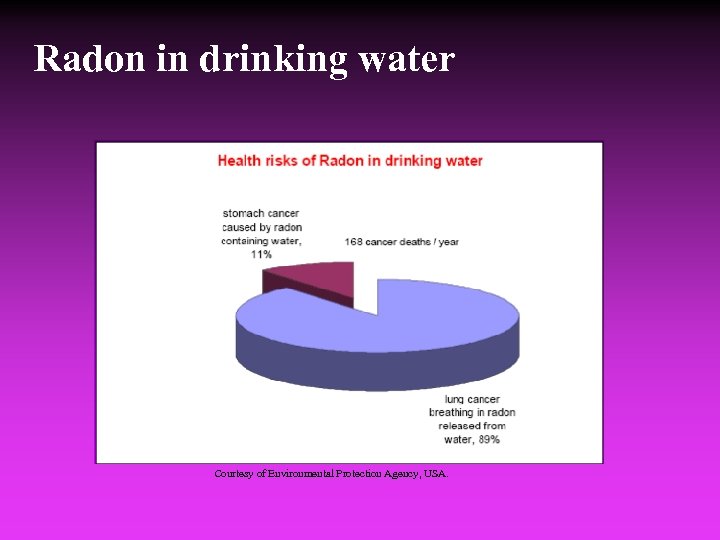
 Radon in drinking water Public Health Concerns … n n n Ingestion of drinking water containing radon also presents a risk of internal organ cancers, primarily stomach cancer. This risk is smaller than the risk of developing lung cancer from radon released to air from tap water. Based on a second 1999 NAS report on radon in drinking water, EPA estimates Courtesy of Environmental Protection Agency, USA.
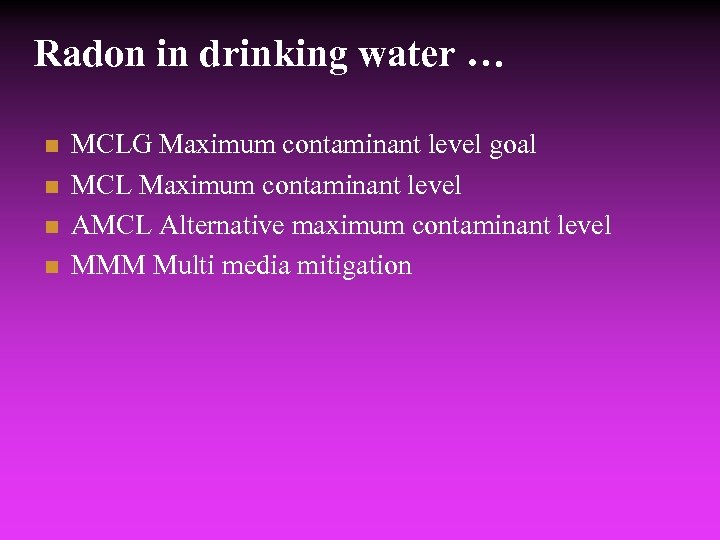 Radon in drinking water … n n MCLG Maximum contaminant level goal MCL Maximum contaminant level AMCL Alternative maximum contaminant level MMM Multi media mitigation
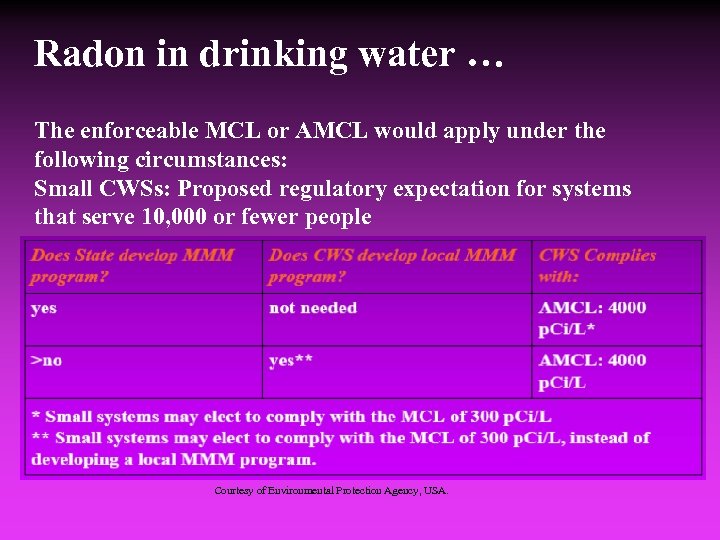 Radon in drinking water … The enforceable MCL or AMCL would apply under the following circumstances: Small CWSs: Proposed regulatory expectation for systems that serve 10, 000 or fewer people Courtesy of Environmental Protection Agency, USA.
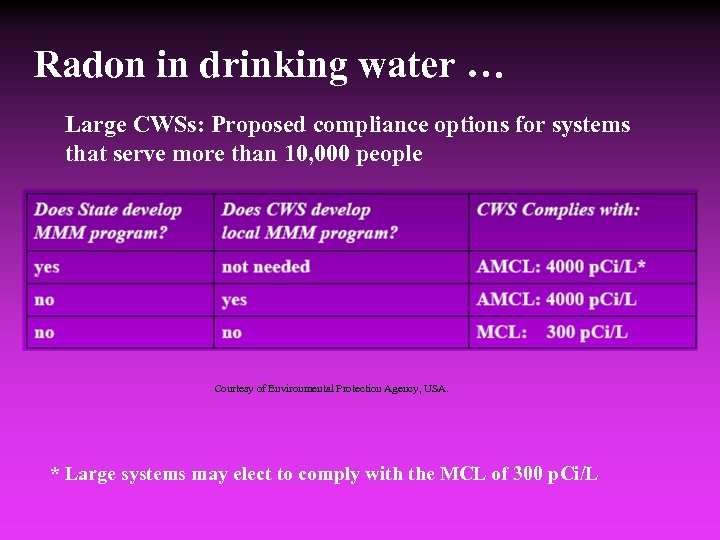 Radon in drinking water … Large CWSs: Proposed compliance options for systems that serve more than 10, 000 people Courtesy of Environmental Protection Agency, USA. * Large systems may elect to comply with the MCL of 300 p. Ci/L
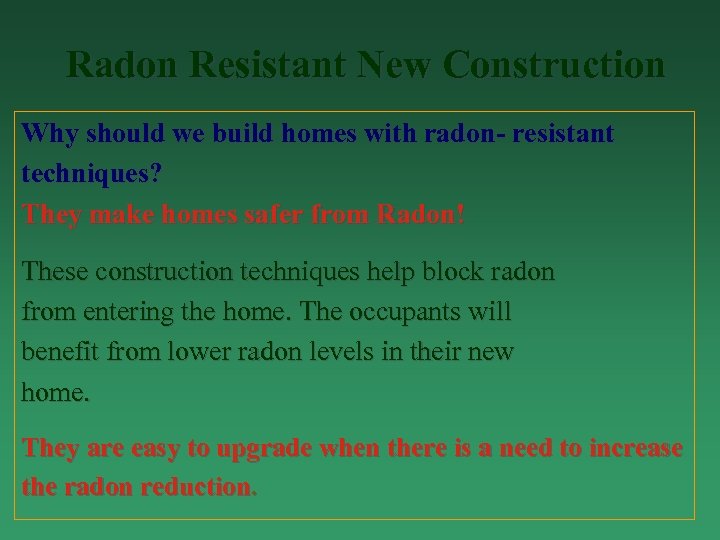 Radon Resistant New Construction Why should we build homes with radon- resistant techniques? They make homes safer from Radon! These construction techniques help block radon from entering the home. The occupants will benefit from lower radon levels in their new home. They are easy to upgrade when there is a need to increase the radon reduction.
 Radon Resistant New Construction n n They are Cost-Effective for Home Buyers It is more cost-effective to include radon-resistant techniques while building a home, rather than installing a radon reduction system in an existing home. For Example: Materials and labor costs for Radon-Resistant Techniques vs. Retrofitting an Existing Home is n $350 - $500 vs. $800 - $2, 500 (a 128% to 400% saving!) They May Improve The Home's Energy-Efficiency
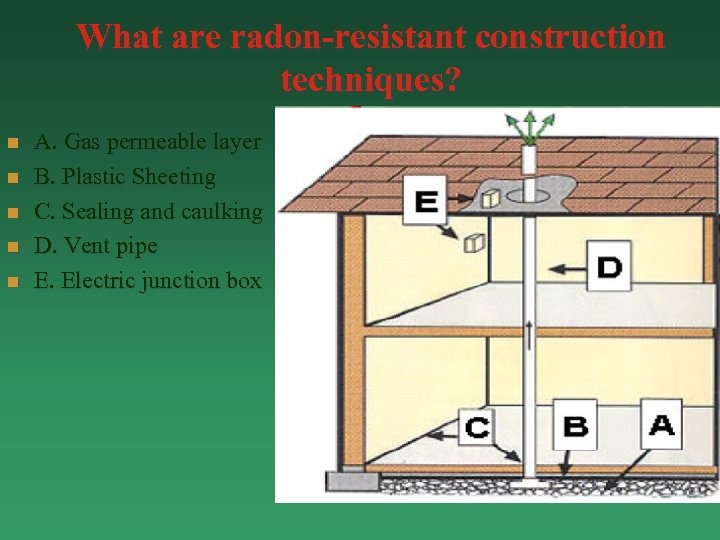 What are radon-resistant construction techniques? n n n A. Gas permeable layer B. Plastic Sheeting C. Sealing and caulking D. Vent pipe E. Electric junction box
 How many homes are built with radon-reducing features? n Based on the most recent analysis of annual home builder survey conducted by the National Association of Home Builders (NAHB) Research Center Single family detached homes built incorporating the radon-reducing features: n In 2001 65, 000 single family detached homes ( 5. 8% of 1, 124, 000 homes built) 30, 000 single family detached homes (11. 7% of 255, 000 homes built in zone 1) n Cumulative total since 1990 1, 000 single family detached homes 600, 000 single family detached homes built in zone 1 * These results exclude homes built on pier-style foundations
 Radon Testing Ø Short or Long Term Ø Every frequently occupied area with ground contact Ø During occupied period Courtesy of Environmental Protection Agency, USA.
 Summary I talked about Radon and radon daughter products (RDPs), Radon potential map of USA Radon potential map of Massachusetts Radon testing Radon monitors Radon in drinking water Radon in indoor and outdoor air Radon resistant new construction
 Internet key words p radon, radon progeny, decay chain series, radon potential, radon daughter products, radon detector, BEIR IV, BEIR VI
 References p Health effects of exposure to radon BEIR VI (Series) http: //www. epa. gov/radon/beirvi. html Committee on Health Risks of Exposure to Radon Board on Radiation Effects Research, Commission on Life Sciences, National Research Council. Washington, D. C. : National Academy Press, 1999. ISBN: 0309056454 p Risk assessment of radon in drinking water Committee on the Risk Assessment of Exposure to Radon in Drinking Water, Board on Radiation Effects Research, Commission on Life Sciences, National Research Council. Washington, DC : National Academy Press, 1999. ISBN: 0309062926 p Radon and its decay products in indoor air, Ed. : W. W. Nazaroff, and A. V. Nero, New York: J. Wiley, 1988. ISBN: 0471628107 p Assay of Radon and Radium in Water: Techniques Developed at SNO J. Farine, Topical Workshop of Low Radioactivity Techniques, LRT 2004, 12 -14 December 2004, New York: AIP Conference Proceedings, vol. 785, 2005
 References p Radon exhalation of hardening concrete: Monitoring cement hydration and prediction of radon concentration in construction site K. Kovler Journal of Environmental Radioactivity, v 86, n 3, 2006, p 354 -366 p Radon exhalation from phosphogypsum building boards: Symmetry constraints, impermeable boundary conditions and numerical simulation of a test case J. A. Rabi, N. C. Da Silva Journal of Environmental Radioactivity, v 86, n 2, 2006, p 164 -175 p Soil gases and building foundations J. W. Kristof, A. Hanna, J. Hadjinicolaou International Journal for Housing Science and Its Applications, v 30, n 1 SPEC. ISS. , 2005, p 69 -80
 References p Radioisotope deposition on interior building surfaces: Air flow and surface roughness influences, B. Leonard, Nuclear Technology, v 152, n 3, December, 2005, p 339 -353 p Up-to-date radon-thoron discriminative detector for a large scale survey S. Tokonami, , H. Takahashi, Y. Kobayashi, W. Zhuo, E. Hulber Review of Scientific Instruments, v 76, n 11, 2005, p 113505 p Site-specific characterization of soil Radon potentials [electronic resource] : project summary, K. K. Nielson, R. B. Holt, and V. C. Rogers Cincinnati, OH: United States Environmental Protection Agency, Research and Development, National Risk Management Research Laboratory, 1996. http: //purl. access. gpo. gov/GPO/LPS 35300