 Скачать презентацию Medical English Student Scientific Society 16 th November
16.11.2015.pptx
- Количество слайдов: 16



Medical English Student Scientific Society 16 th November, 2015 season 2015/2016 Examining a Patient. Focus on communication. Academic Supervisor: Ph. D. I. M. Markovina Moderator: A. S. Tivtikyan Moscow 2015
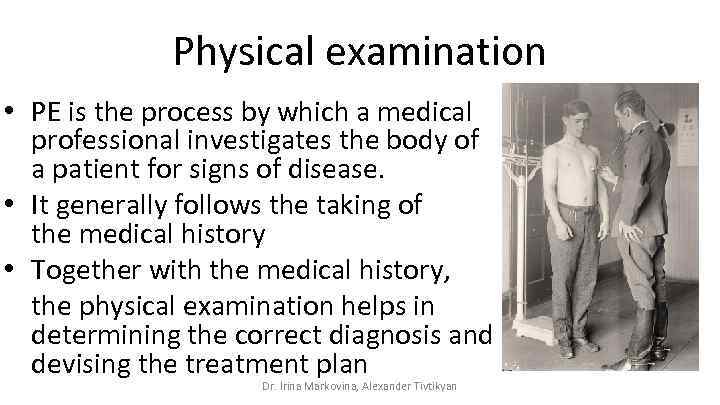
Physical examination • PE is the process by which a medical professional investigates the body of a patient for signs of disease. • It generally follows the taking of the medical history • Together with the medical history, the physical examination helps in determining the correct diagnosis and devising the treatment plan Dr. Irina Markovina, Alexander Tivtikyan
Focus on communication • Physical examination is often the least pleasant procedure for patient • The patient may be embarrassed about such things as being overweight/underweight, physical appearance • Doctors may find unexplained bruising or marks which may indicate physical or sexual abuse Dr. Irina Markovina, Alexander Tivtikyan
Doctors should bear in mind… • Not repeating painful maneuvers Cleanliness • Requesting permission before Lighting removing clothes or touching Comfort and privacy • Keeping the patient informed of Washing hands what they are doing Respecting patient’s sense of • Offering help to the patient as dignity he/she gets on and off the • Warming hands examination table • Explaining different examinations to patient Dr. Irina Markovina, Alexander Tivtikyan • • •
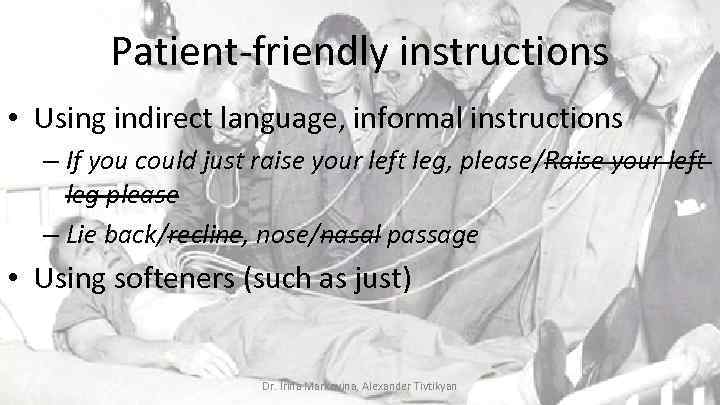
Patient-friendly instructions • Using indirect language, informal instructions – If you could just raise your left leg, please/Raise your left leg please – Lie back/recline, nose/nasal passage • Using softeners (such as just) Dr. Irina Markovina, Alexander Tivtikyan
Aims • Prepare and reassure patient during an examination • Explain examination procedures to their patient • Give effective instructions in a patient-friendly manner Dr. Irina Markovina, Alexander Tivtikyan
Encouraging a patient • Since this is your first visit to practice, I’d like to have a more detailed picture of things. Could you tell me about any illness you might have had in the past? • Can I ask you how bad the pain is when it comes on? • Have you noticed that anything makes it worse? • Does anything relieve it? Dr. Irina Markovina, Alexander Tivtikyan
Encouraging a patient • Does the pain move anywhere, or does it just stay in that, that one spot? • Have you noticed anything else that comes along with the pain? • Can I just ask you a bit along that? Do you drink any alcohol at all? Dr. Irina Markovina, Alexander Tivtikyan
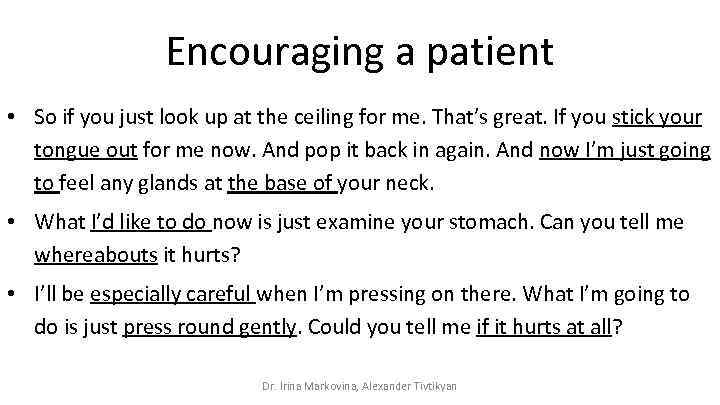
Encouraging a patient • So if you just look up at the ceiling for me. That’s great. If you stick your tongue out for me now. And pop it back in again. And now I’m just going to feel any glands at the base of your neck. • What I’d like to do now is just examine your stomach. Can you tell me whereabouts it hurts? • I’ll be especially careful when I’m pressing on there. What I’m going to do is just press round gently. Could you tell me if it hurts at all? Dr. Irina Markovina, Alexander Tivtikyan
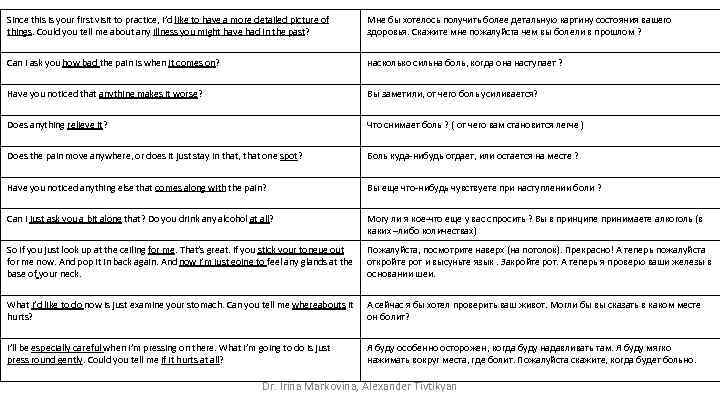
Since this is your first visit to practice, I’d like to have a more detailed picture of things. Could you tell me about any illness you might have had in the past? Мне бы хотелось получить более детальную картину состояния вашего здоровья. Скажите мне пожалуйста чем вы болели в прошлом ? Can I ask you how bad the pain is when it comes on? насколько сильна боль, когда она наступает ? Have you noticed that anything makes it worse? Вы заметили, от чего боль усиливается? Does anything relieve it? Что снимает боль ? ( от чего вам становится легче ) Does the pain move anywhere, or does it just stay in that, that one spot? Боль куда-нибудь отдает, или остается на месте ? Have you noticed anything else that comes along with the pain? Вы еще что-нибудь чувствуете при наступлении боли ? Can I just ask you a bit along that? Do you drink any alcohol at all? Могу ли я кое-что еще у вас спросить ? Вы в принципе принимаете алкоголь (в каких –либо количествах) So if you just look up at the ceiling for me. That’s great. If you stick your tongue out for me now. And pop it in back again. And now I’m just going to feel any glands at the base of your neck. Пожалуйста, посмотрите наверх (на потолок). Прекрасно! А теперь пожалуйста откройте рот и высуньте язык. Закройте рот. А теперь я проверю ваши железы в основании шеи. What I’d like to do now is just examine your stomach. Can you tell me whereabouts it hurts? А сейчас я бы хотел проверить ваш живот. Могли бы вы сказать в каком месте он болит? I’ll be especially careful when I’m pressing on there. What I’m going to do is just press round gently. Could you tell me if it hurts at all? Я буду особенно осторожен, когда буду надавливать там. Я буду мягко нажимать вокруг места, где болит. Пожалуйста скажите, когда будет больно. Dr. Irina Markovina, Alexander Tivtikyan
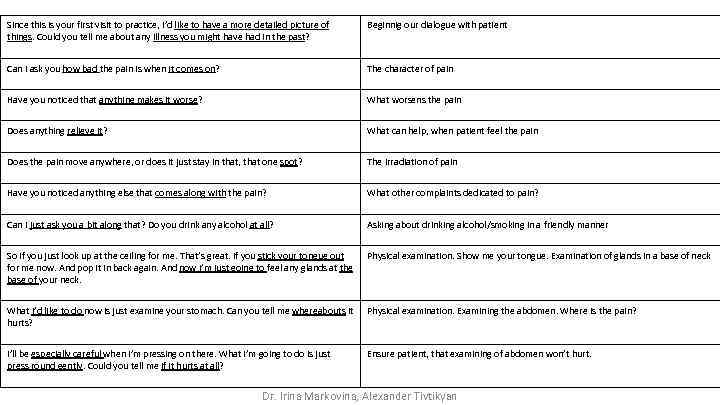
Since this is your first visit to practice, I’d like to have a more detailed picture of things. Could you tell me about any illness you might have had in the past? Beginnig our dialogue with patient Can I ask you how bad the pain is when it comes on? The character of pain Have you noticed that anything makes it worse? What worsens the pain Does anything relieve it? What can help, when patient feel the pain Does the pain move anywhere, or does it just stay in that, that one spot? The irradiation of pain Have you noticed anything else that comes along with the pain? What other complaints dedicated to pain? Can I just ask you a bit along that? Do you drink any alcohol at all? Asking about drinking alcohol/smoking in a friendly manner So if you just look up at the ceiling for me. That’s great. If you stick your tongue out for me now. And pop it in back again. And now I’m just going to feel any glands at the base of your neck. Physical examination. Show me your tongue. Examination of glands in a base of neck What I’d like to do now is just examine your stomach. Can you tell me whereabouts it hurts? Physical examination. Examining the abdomen. Where is the pain? I’ll be especially careful when I’m pressing on there. What I’m going to do is just press round gently. Could you tell me if it hurts at all? Ensure patient, that examining of abdomen won’t hurt. Dr. Irina Markovina, Alexander Tivtikyan
How does the doctor demonstrate his active listening skills at each stage of the dialogue • There are plenty of examples where the doctor demonstrates active listening skills, for example relieving pressure on areas of pain and apologizing, and responding to questions related to investigations the patient doesn’t inderstand Dr. Irina Markovina, Alexander Tivtikyan
The meaning of at all • At all is a softener placed at the end of a sentence to add politeness. The intonation rises on this expression. Dr. Irina Markovina, Alexander Tivtikyan
Literally or figuratively? • The meanings of that’s great or fine or good should not be taken literally. The doctor uses these to indicate a transition from one stage of the physical examination to the next Dr. Irina Markovina, Alexander Tivtikyan
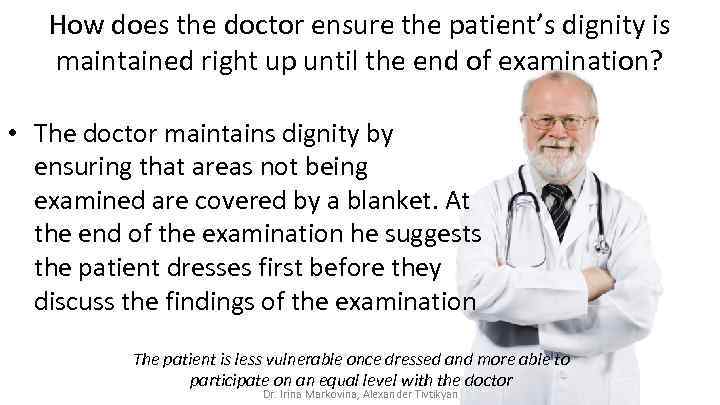
How does the doctor ensure the patient’s dignity is maintained right up until the end of examination? • The doctor maintains dignity by ensuring that areas not being examined are covered by a blanket. At the end of the examination he suggests the patient dresses first before they discuss the findings of the examination The patient is less vulnerable once dressed and more able to participate on an equal level with the doctor Dr. Irina Markovina, Alexander Tivtikyan
Summary ü Prepare and reassure patient during an examination ü Explain examination procedures to their patient ü Give effective instructions in a patient-friendly manner Dr. Irina Markovina, Alexander Tivtikyan
Скачать презентацию Medical English Student Scientific Society 16 th November
16.11.2015.pptx