


 Скачать презентацию Medical Device Software Development Peter Kazanzides Ph D
b88c20336364b1d53cad25f0cf5a3171.ppt
- Количество слайдов: 27
 Medical Device Software Development Peter Kazanzides, Ph. D.
 My Background • Co-Founder of Integrated Surgical Systems – Developed ROBODOC System – Commercial sales in Europe – Performed clinical trials in U. S. and Japan – Received FDA approval for ORTHODOC planning system – ISS obtained ISO 9001 certification • Now at JHU ERC-CISST
 Outline • Medical device regulations – FDA, ISO 9000, CE Mark • Design controls • Software development procedure – Typical development phases – Associated documentation
 Medical Device Regulations • Medical devices are highly regulated: – FDA approval (United States) • UL listing might be required by customer – CE mark (Europe) – MHW approval (Japan) – Other national requirements
 FDA Approval • Pre-Market Approval (PMA) – Path to market for new devices – Generally requires clinical trials – Company submits extensive documentation and data • 510(K) – Establish “substantial equivalence” to a predicate (existing) device – May include clinical trials – Less extensive documentation and data
 FDA Approval • Investigational Device Exemption (IDE) – Can do clinical trials • Also need hospital Institutional Review Board (IRB) approval – Not allowed to market the device
 CE Mark • Indicates that product satisfies European safety requirements • Managed by “notified bodies”, such as: – TUV (Germany) – BSI, SGS (United Kingdom)
 CE Mark and ISO 9000 • ISO 9000 Quality Standards encompass: – ISO 9001: Design and Manufacturing – ISO 9002: Manufacturing Only – ISO 9003: Inspection and Testing Only • Company with ISO 9001 can self-certify (CE Mark) its products • Notified Body periodically audits Quality System
 Design Controls • Quality System component that applies to product design – ISO 9001 – FDA QSR (Quality System Regulations) • Goal: prevent failures due to bad design
 Design Controls “Say what you will do and then do what you say” – Company defines its development process – Regulatory body reviews the process – Company follows the process, producing supporting documentation (Quality Records) – Regulatory body periodically reviews records
 Software Development Procedure • Typical phases are: – Requirements – Design – Implementation – Integration and Test – Design Transfer (to production) – Maintenance
 Requirements Phase Inputs • Customer Requirements document – also called: User Requirements, System Requirements Definition, Concept of Operations – Usually generated by marketing department
 Requirements Phase Outputs • Software (or Project) Development Plan • Software Quality Assurance Plan: – Defines standards to be used (e. g. , coding standards, documentation standards) – Defines review and audit plan – Specifies configuration management plan – Usually generated by Quality Assurance, with input from Engineering
 Requirements Phase Outputs • Software Requirements Specification (SRS) – Should specify requirements, not design – Should be unambiguous and testable – Must be traceable to Customer Requirements
 Sample SRS Outline • • Introduction References System Description External Interface Requirements Functional Requirements Performance Requirements Safety Requirements Design Constraints
 Requirements Phase Outputs • Preliminary Risk (or Hazard) Analysis – Identifies safety requirements – Various techniques can be used • Failure Modes and Effects Analysis (FMEA) • Failure Modes, Effects and Criticality Analysis (FMECA) • Fault Tree Analysis (FTA)
 Risk Analysis – FMEA/FMECA • Most common risk analysis method • Analyzes the effect of component failure – Bottom-up analysis • Typically presented in tabular format: – Failure Mode – Effect on System – Cause of Failure – Method of Control
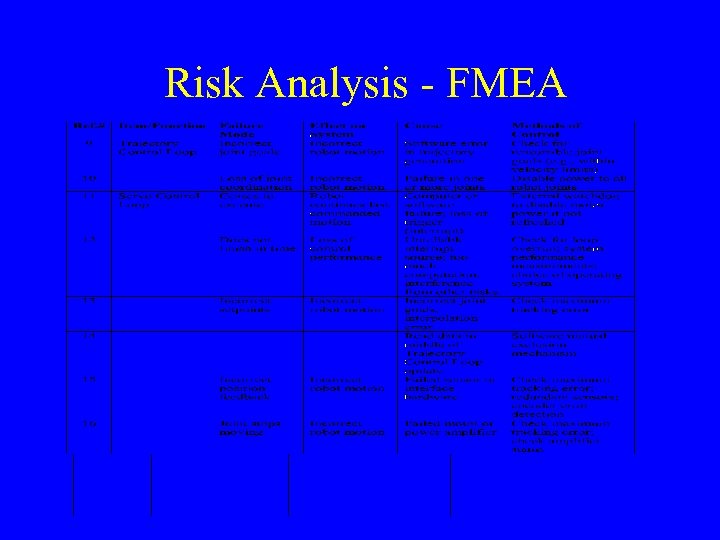 Risk Analysis - FMEA
 Risk Analysis – FMEA/FMECA • Risk assessment (criticality) – Severity (S) – seriousness of effect of failure – Occurrence (O) – likelihood of failure – Detection (D) – ability to detect failure – Risk Priority Number (RPN) = (S) x (O) x (D) • Assign numerical values (e. g. , 1 -10) for (S), (O) and (D) • Prioritize risks by RPN
 Requirements Phase Outputs • Preliminary Software Validation Plan – System Testing (e. g. , test that requirements have been met) • Design Review of all Requirements Phase Outputs – Meeting minutes
 Design Phase • Software Architectural Design – Architecture diagrams, data flow diagrams, etc. • Software Detailed Design – Software Design Specification (SDS) – Traceability analysis from SDS to SRS
 Design Phase • Update Software Validation Plan – Integration testing • Update Risk Analysis • Design Review II
 Implementation Phase • Write software according to Software Quality Assurance Plan (SQAP): – Programming Guidelines – Documentation Standards • Update Software Validation Plan – Unit or module testing • Traceability analysis (SVP to SDS/SRS) • Run module tests and write Test Reports
 Integration and Test Phase • Run Integration Tests and write Test Reports • Run System Tests and write Test Reports Verification vs. Validation
 Design Transfer • Write relevant manufacturing procedures – Software installation procedure – Software duplication procedure • Ensure user documentation is complete – Labeling review • Release software – Change control procedure
 Maintenance Phase • Review and update any necessary documents (e. g. , SRS, Risk Analysis, SDS) • Implement changes • Assess testing requirement – Test changes – Possible regression testing • Release via Change Control Procedure
 Conclusions Development process seems overwhelming! But: – It can be customized for each company – It can be improved over time – It is not that bad when you get used to it – It generally produces better software – It is required for medical products!