


 Скачать презентацию Mediated Music Intervention and Language Skills of Kindergarten
6c4e44805abed29334dd647f6f37dea6.ppt
- Количество слайдов: 26
 Mediated Music Intervention and Language Skills of Kindergarten Children of Migrant Workers Adena Portowitz - Givat Washington College Pnina Klein, Deborah Givon – Bar Ilan University Liat Kishon-Rabin, Shira Rotstein – Tel Aviv University ERASMUS TRAING EVENT PROGRAM ARTE PARA LA MOTIVACION APRIL 8 -12, 2016 LISBOA/FOZDO ARELHO/OEIRAS
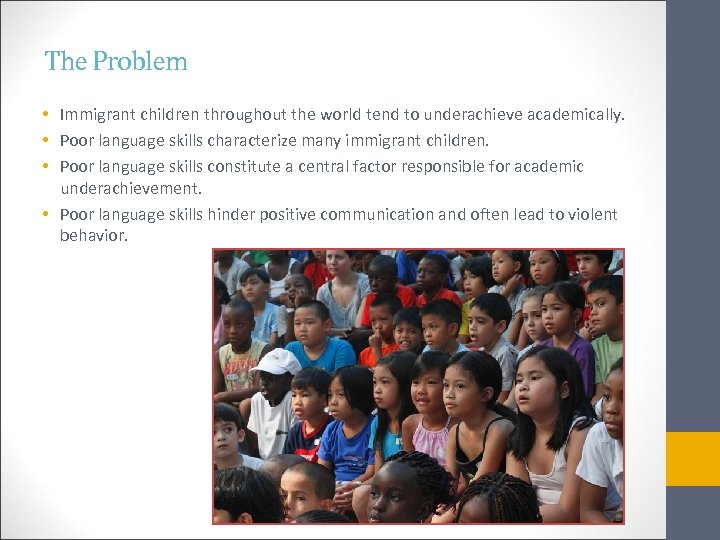 The Problem • Immigrant children throughout the world tend to underachieve academically. • Poor language skills characterize many immigrant children. • Poor language skills constitute a central factor responsible for academic underachievement. • Poor language skills hinder positive communication and often lead to violent behavior.
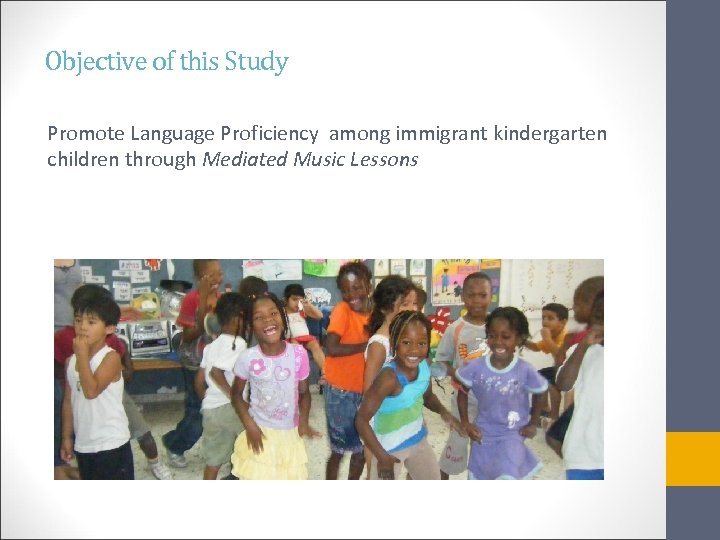 Objective of this Study Promote Language Proficiency among immigrant kindergarten children through Mediated Music Lessons
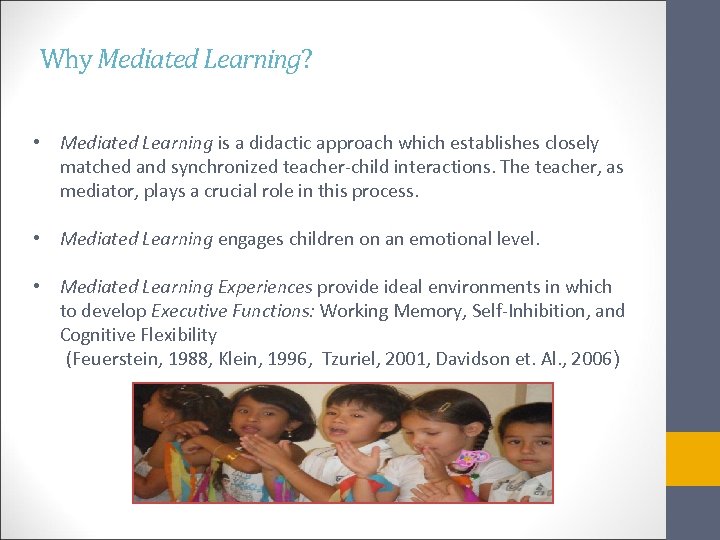 Why Mediated Learning? • Mediated Learning is a didactic approach which establishes closely matched and synchronized teacher-child interactions. The teacher, as mediator, plays a crucial role in this process. • Mediated Learning engages children on an emotional level. • Mediated Learning Experiences provide ideal environments in which to develop Executive Functions: Working Memory, Self-Inhibition, and Cognitive Flexibility (Feuerstein, 1988, Klein, 1996, Tzuriel, 2001, Davidson et. Al. , 2006)
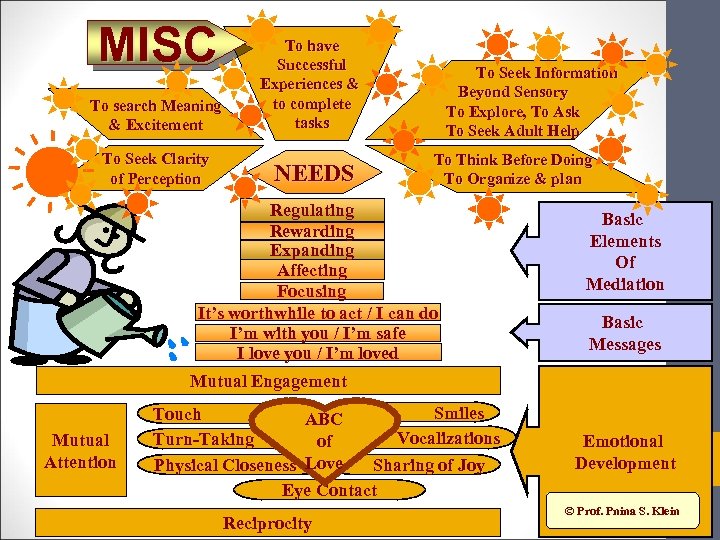 MISC To search Meaning & Excitement To Seek Clarity of Perception To have Successful Experiences & to complete tasks NEEDS To Seek Information Beyond Sensory To Explore, To Ask To Seek Adult Help To Think Before Doing To Organize & plan Regulating Rewarding Expanding Affecting Focusing It’s worthwhile to act / I can do I’m with you / I’m safe I love you / I’m loved Basic Elements Of Mediation Basic Messages Mutual Engagement Mutual Attention Smiles Touch ABC Vocalizations Turn-Taking of Physical Closeness Love Sharing of Joy Eye Contact Reciprocity Emotional Development © Prof. Pnina S. Klein
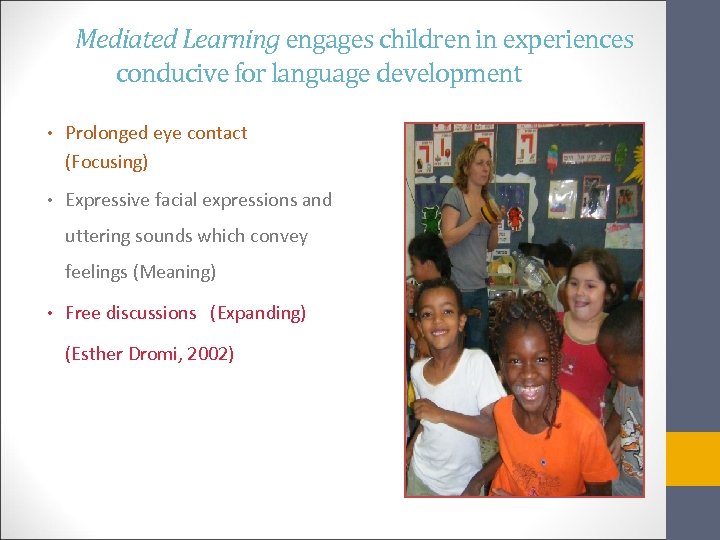 Mediated Learning engages children in experiences conducive for language development Prolonged eye contact (Focusing) • • Expressive facial expressions and uttering sounds which convey feelings (Meaning) • Free discussions (Expanding) (Esther Dromi, 2002)
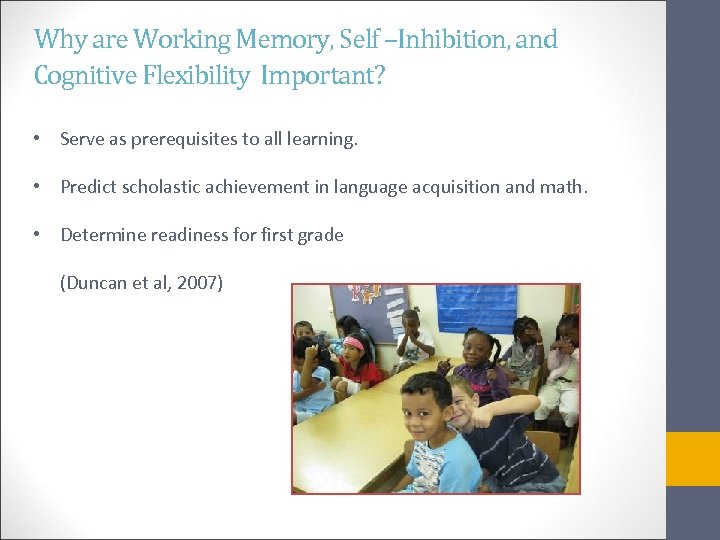 Why are Working Memory, Self –Inhibition, and Cognitive Flexibility Important? • Serve as prerequisites to all learning. • Predict scholastic achievement in language acquisition and math. • Determine readiness for first grade (Duncan et al, 2007)
 Why Music? • Mounting evidence worldwide confirms positive interactions between music education and language development (Hallam, 2010; Catterall, 2009). • Children who fail in school often display a natural talent for music. • The abstract nature of music enables teachers to connect with children on an emotional level. • Music education is particularly conducive for developing • Expression of thought in Multiple Representations • Sorting and differentiating between multiple sources of information • Holistic and sequential perception (Portowitz et al, 2009) • Music serves as a starting point from which teachers may address other learning issues, e. g. motivation, creativity, team work.
 Method The Participants: 63 Kindergarten children of immigrant families living in South Tel-Aviv • Guest workers from South America (Argentina, Bolivia) , the Philippines, Thailand, and African countries such as Ghana, Sudan, Eretria, Nigeria, Congo • New immigrants, mainly from the Former Soviet Union, Turkey, China, and Ethiopia • Refugees from Darfur
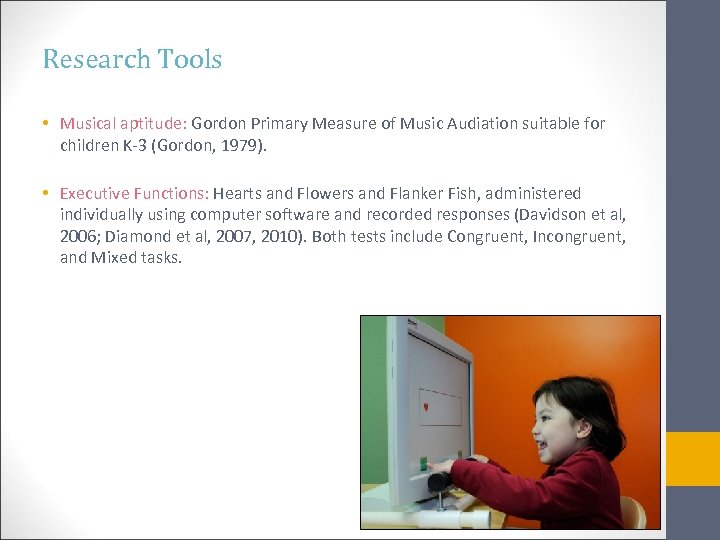 Research Tools • Musical aptitude: Gordon Primary Measure of Music Audiation suitable for children K-3 (Gordon, 1979). • Executive Functions: Hearts and Flowers and Flanker Fish, administered individually using computer software and recorded responses (Davidson et al, 2006; Diamond et al, 2007, 2010). Both tests include Congruent, Incongruent, and Mixed tasks.
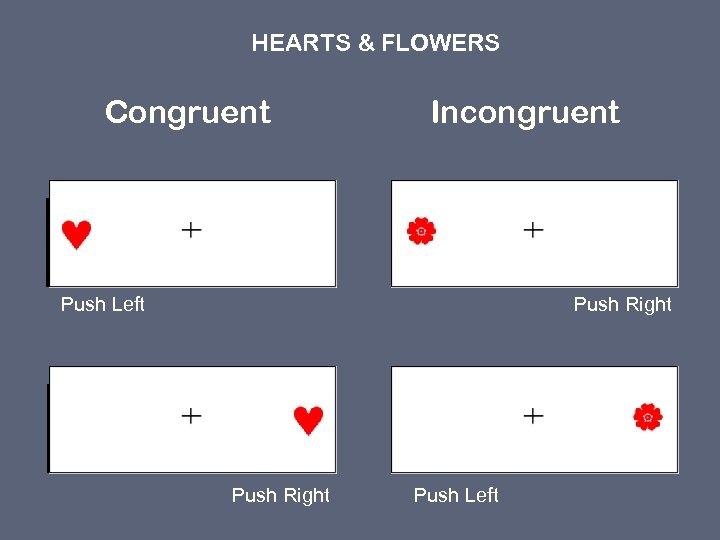 HEARTS & FLOWERS Congruent Incongruent Push Left Push Right Push Left
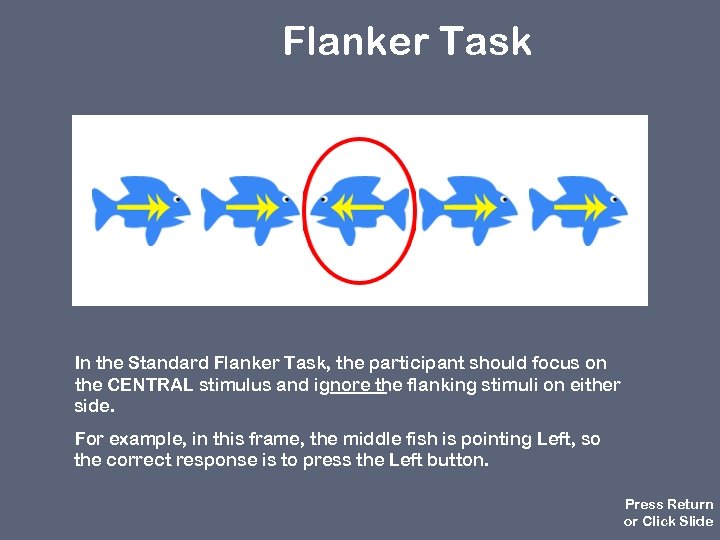 Flanker Task In the Standard Flanker Task, the participant should focus on the CENTRAL stimulus and ignore the flanking stimuli on either side. For example, in this frame, the middle fish is pointing Left, so the correct response is to press the Left button. Press Return or Click Slide
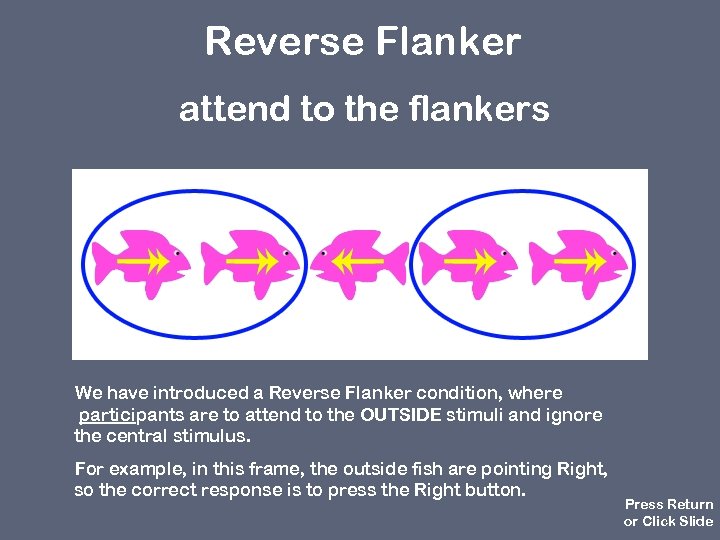 Reverse Flanker attend to the flankers We have introduced a Reverse Flanker condition, where participants are to attend to the OUTSIDE stimuli and ignore the central stimulus. For example, in this frame, the outside fish are pointing Right, so the correct response is to press the Right button. Press Return or Click Slide
 Research Tools (cont. ) • Language Assessment: Goralnik language test, suitable for children aged two to six years (Goralnik, 2005). Six subsections: • • • vocabulary pronunciation comprehension imitation expression storytelling • Working Memory: The Memory Digit Span Assessment for Words and Numbers (Wechsler, 1974)
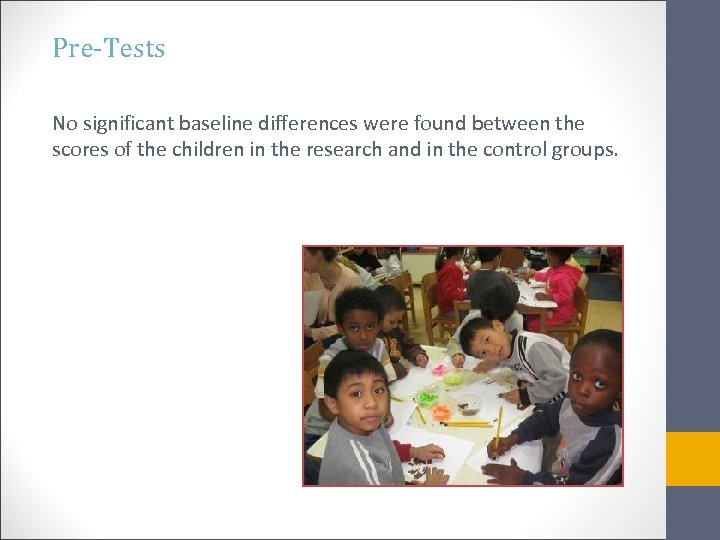 Pre-Tests No significant baseline differences were found between the scores of the children in the research and in the control groups.
 Intervention Time Span: 16 weeks • Experimental group (n = 31) studies music 2 hours a week with a certified music teacher + trained mediator • Control group (n = 32) studies music 2 hours a week with a certified music teacher
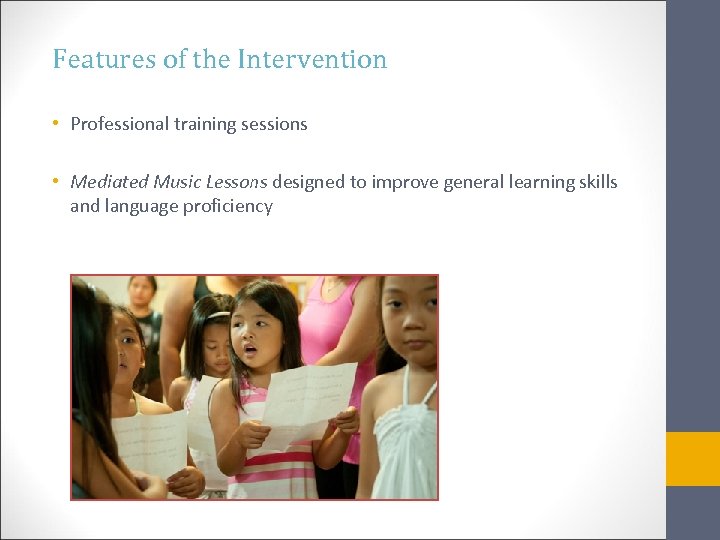 Features of the Intervention • Professional training sessions • Mediated Music Lessons designed to improve general learning skills and language proficiency
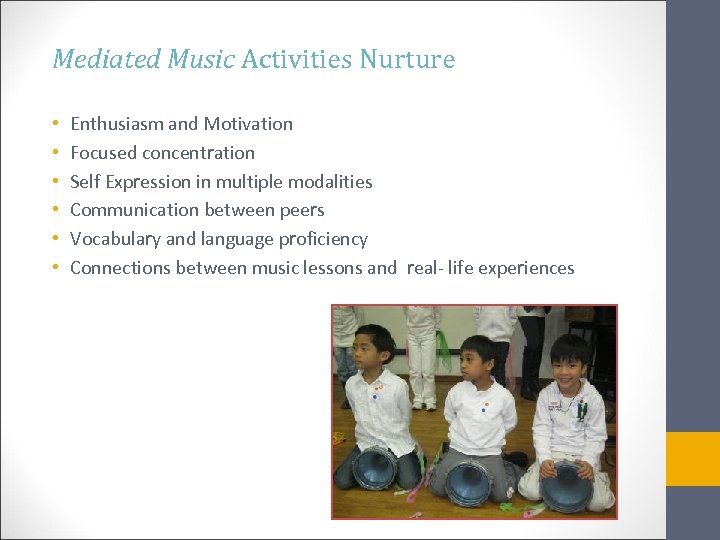 Mediated Music Activities Nurture • • • Enthusiasm and Motivation Focused concentration Self Expression in multiple modalities Communication between peers Vocabulary and language proficiency Connections between music lessons and real- life experiences
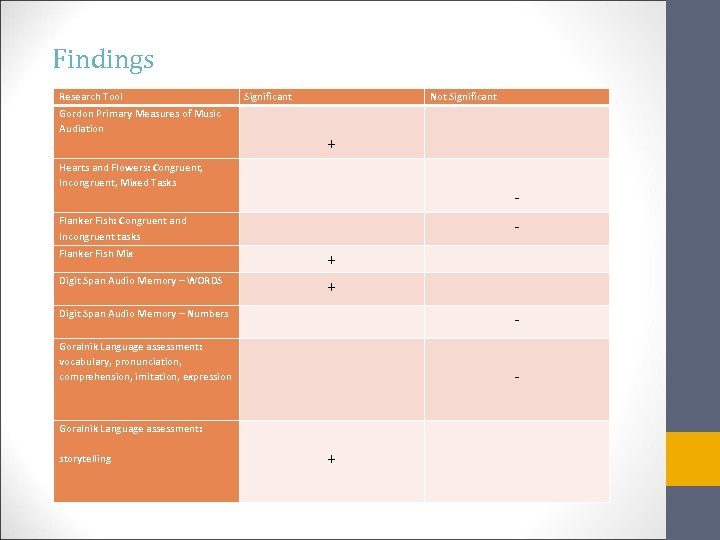 Findings Research Tool Gordon Primary Measures of Music Audiation Significant Hearts and Flowers: Congruent, Incongruent, Mixed Tasks - Flanker Fish: Congruent and Incongruent tasks - + Flanker Fish Mix + + Digit Span Audio Memory – WORDS Not Significant Digit Span Audio Memory – Numbers - Goralnik Language assessment: vocabulary, pronunciation, comprehension, imitation, expression - Goralnik Language assessment: storytelling +
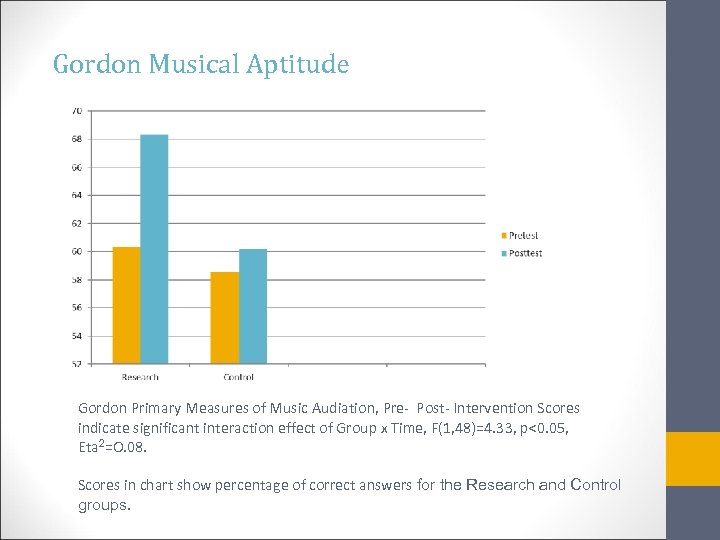 Gordon Musical Aptitude Gordon Primary Measures of Music Audiation, Pre- Post- Intervention Scores indicate significant interaction effect of Group x Time, F(1, 48)=4. 33, p<0. 05, Eta 2=O. 08. Scores in chart show percentage of correct answers for the Research and Control groups.
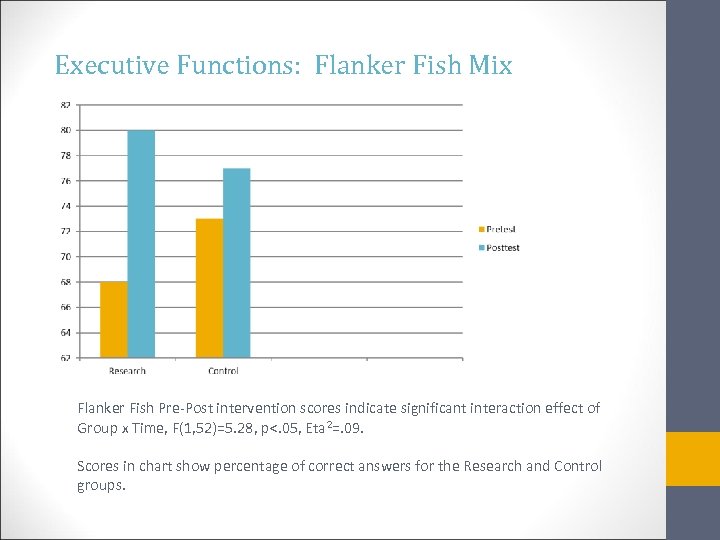 Executive Functions: Flanker Fish Mix Flanker Fish Pre-Post intervention scores indicate significant interaction effect of Group x Time, F(1, 52)=5. 28, p<. 05, Eta 2=. 09. Scores in chart show percentage of correct answers for the Research and Control groups.
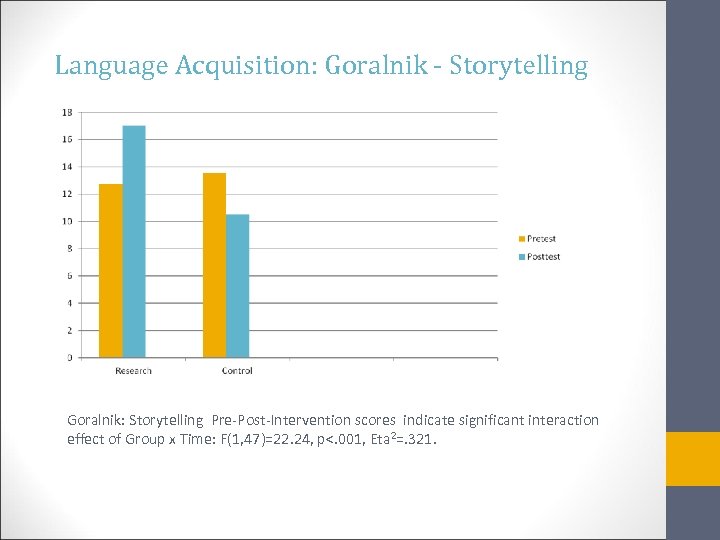 Language Acquisition: Goralnik - Storytelling Goralnik: Storytelling Pre-Post-Intervention scores indicate significant interaction effect of Group x Time: F(1, 47)=22. 24, p<. 001, Eta 2=. 321.
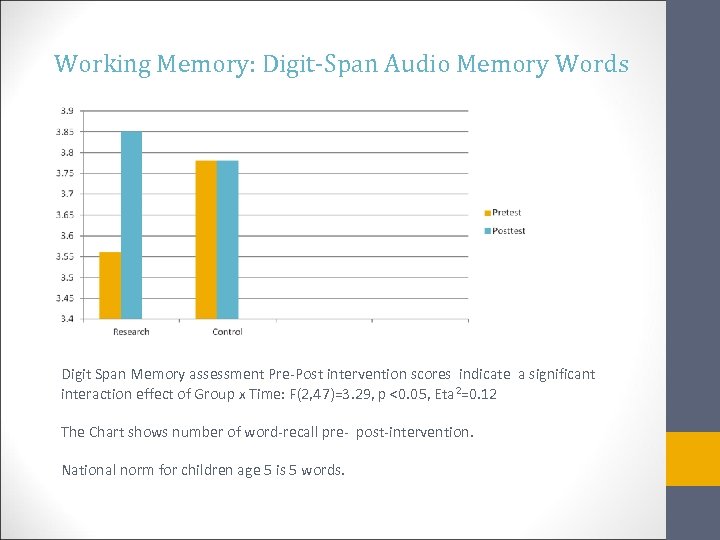 Working Memory: Digit-Span Audio Memory Words Digit Span Memory assessment Pre-Post intervention scores indicate a significant interaction effect of Group x Time: F(2, 47)=3. 29, p <0. 05, Eta 2=0. 12 The Chart shows number of word-recall pre- post-intervention. National norm for children age 5 is 5 words.
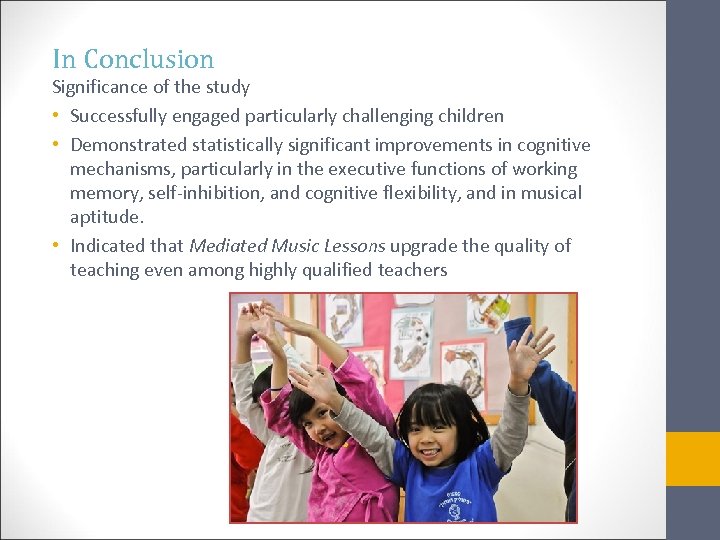 In Conclusion Significance of the study • Successfully engaged particularly challenging children • Demonstrated statistically significant improvements in cognitive mechanisms, particularly in the executive functions of working memory, self-inhibition, and cognitive flexibility, and in musical aptitude. • Indicated that Mediated Music Lessons upgrade the quality of teaching even among highly qualified teachers
 Research is needed to further explore • Issues of Sustainability • Issues of Transferability
 Our deepest thanks to The Jaffa Institute, Israel and the Caritas Foundation, Germany for their generous support of this study. Ronit Buron, Jaffa Institute, Jaffa, Israel , Music Teacher for the Research Group. Prof. Adele Diamond and her staff at the University of British Columbia, Vancouver, Canada, for their assistance in the administration and evaluation of the Hearts and Flowers and Flanker Fish tests. Michael Alvey for his assistance in administering and evaluating the Gordon audiation assessments. Dov Har. Even, Bar-Ilan University, and Omer Zarchi, Schneider Children's Hospital, for their assistance in evaluating the quantitative data. We welcome further communications! Please contact us at: Adena. Portowitz@BIU. ac. il