


 Скачать презентацию Media Relations News Releases Workshop content
706128c194e17c24b35d27089dbf274e.ppt
- Количество слайдов: 75
 Media Relations & News Releases
 Workshop content How to make a good news story n How to build news releases n How to build a publication profile and a media list n
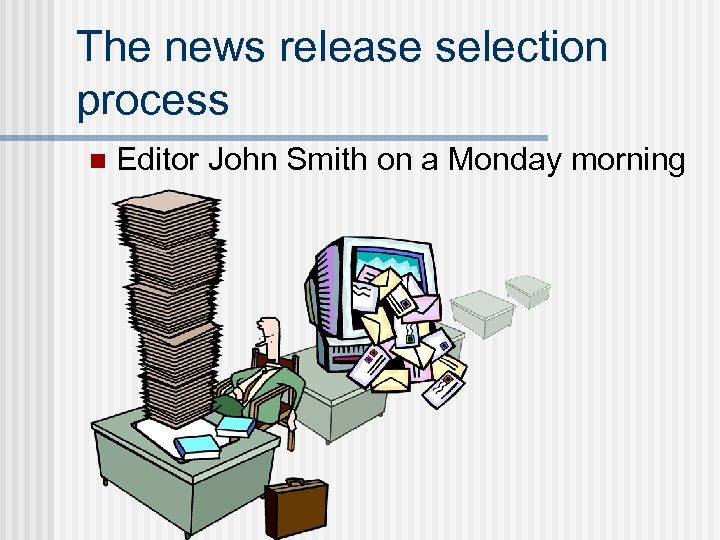 The news release selection process n Editor John Smith on a Monday morning
 How to build a news release - in the news or in the bin? n Editors receive up to 100 (150 not unheard off) news releases a day (might be sieved through by PA first)
 What makes a good news release? News releases need to have substance! n Now I want to add & emphasise that it has to be news and not just background info. n Many news releases send to editors start like this… n
 No news release n “Wilbur & Co is a well established engineering company that has been making hydraulic breaks in Glasgow for 58 years. They are based in Kirkwood street where…. . ” All background and no news story in sight at all
 Keep the story simple & clear The story that you want to cover needs to be obvious in the first sentence n Editor/journalist needs to be able to immediately see what the story is all about in the first paragraph n Don’t try to cram in too much n Decide what the story is and make it clear n
 Problem scenario n “Wilbur & Co, which has just opened a new factory in Cumbernauld, has appointed Ms Julie Smith as the first female Managing Director to launch a new range of hydraulic breaks. ”
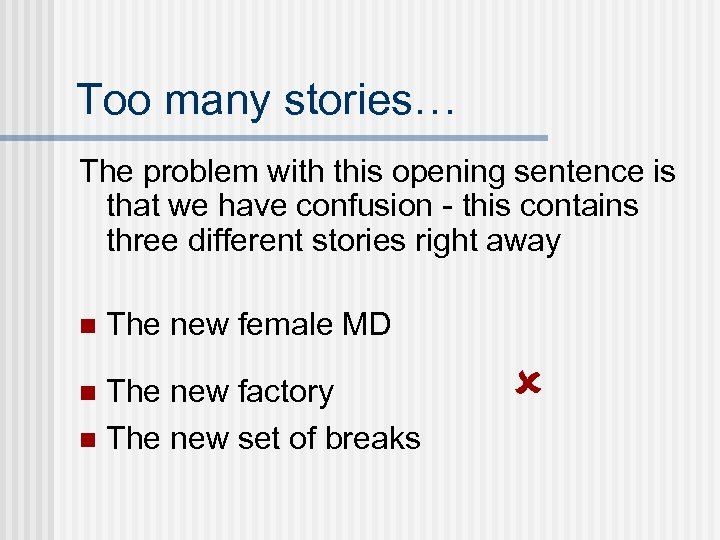 Too many stories… The problem with this opening sentence is that we have confusion - this contains three different stories right away n The new female MD The new factory n The new set of breaks n
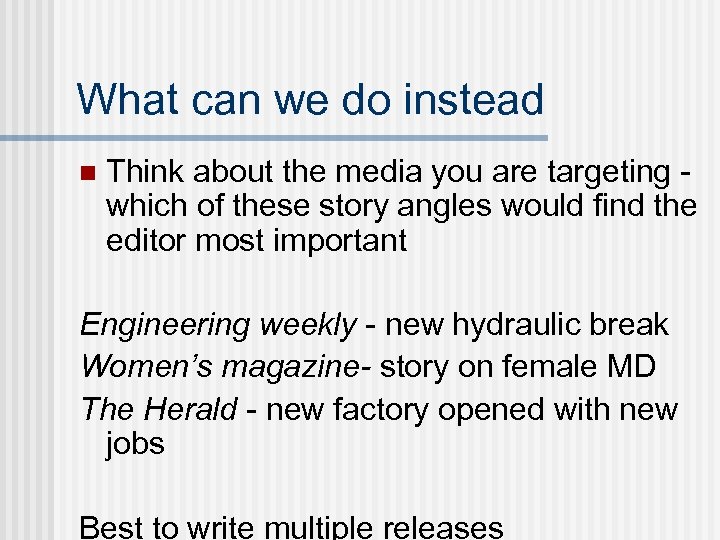 What can we do instead n Think about the media you are targeting which of these story angles would find the editor most important Engineering weekly - new hydraulic break Women’s magazine- story on female MD The Herald - new factory opened with new jobs Best to write multiple releases
 The story has to be complete A good story needs to answer all the questions rather then raise more. n You need to provide all the info an editor needs n They need to know immediately what’s happening and to whom! n
 This includes Title, first name & surname of all people mentioned - no initials n e. g. Ms Julie Smith, not J. M. Smith Always provide the position each person mentioned holds - who they are e. g. managing director
 n Provide full names of organisations etc before abbreviating them to initials. Exceptions are organisations that are known by their initials such as the BBC n E. g. The Scottish Canoe Association (SCA) is holding their annual …. .
 Always explain the context Although it may be clear to you why this news release is a superb news story, it may not be immediately clear to others/ editors n Fine balance to be struck - provide enough info without overloading the news release with too much background info. n
 Example: Wilbur & Co n Wilbur & Co has announced profits of £ 150, 000 for the last financial year This in itself is not such a big story, a modest profit for a little know company. So, we need some context here!
 n Wilbur & Co have announced profits of £ 150, 000 for the last financial year only 18 months after the factory was completely destroyed by a devastating explosion. Now, this is completely different! Suddenly, there is a bigger story. How can this company be making profits such a short time after disaster struck, etc
 n Wilbur & Co have announced profits of £ 150, 000 for the last financial year only 18 months after the factory went into receivership. There is another great story here. How could this happen? Was previous management terrible, some dodgy dealings going on etc.
 A story needs to stand up! n Journalists often receive news releases that would make good stories if only there were more facts to go on. n Example: Wilcott Safety Ltd, Glasgow, has won a £ 1 m order from a major Canadian insurance company. Ø Ø This could be a good story, major investment, foreign investor, etc But who are they? Need to provide the name, if the client doesn’t want to give the name, it’s no story.
 How to build a news release “Given how many millions of news releases are produced and pumped out by press offices every year, it is amazing how many are totally rubbish: badly written, wrongly targeted, and destined for the waste bin. ” Paul Richards (1998) How to be your own spin doctor n
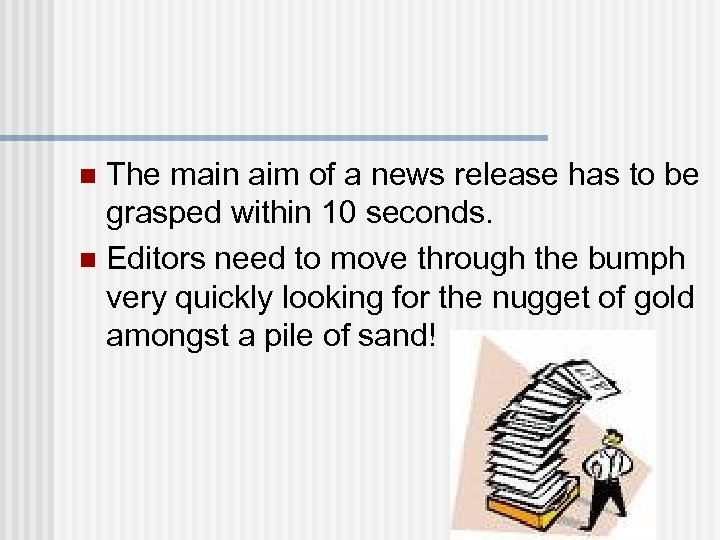 The main aim of a news release has to be grasped within 10 seconds. n Editors need to move through the bumph very quickly looking for the nugget of gold amongst a pile of sand! n
 Essential elements of a news release A news release is essentially a news story written to the interest of a specific news organisation / publication n It consists of three main parts: n The headline n The introduction (called “intro” by journalists) n The body of the story n
 Further elements It can also contain: Note to the editors at the bottom of the page. This can contain background information about the company, issue or product that is not vital to the story, but might help the journalist to understand the wider issue. Appended documents such as product information sheets / company information sheets. n
 First step: Write the body of the news release To do this you have to select the right facts to answer the famed W- questions What is happening Who is doing it Where is it taking place When it happened or will happen Why is it happening n
 Intro paragraph n n All these questions have to be answered in the intro of the story. The first paragraph encapsulates the whole story and entices the journalist to read on by concentrating on the most newsworthy elements. From the five W’s the strongest angle might be where & what. Where is important because it will quickly tell the journalists whether it’s on his / her patch
 Intro paragraph The first paragraph should be short & snappy. n One or two sentences, maximum 30 words. n A good way of getting a feel for it is to take a newspaper and read a few opening paragraphs. n Try to style your opening paragraph on that n
 Intro : examples n Airport capacity in Scotland (what & where) is at a breaking point due to the failure of past governments to address the problem (why), according to an article Consumer Policy Review (who) published today (when).
 Example 2: Gobble & Belch n n Gobble & Belch a food processing company have decided to launch a new range of baby foods for discerning infants in a test market in London & South East. It will be called Gourmet baby. The company’s research revealed that the modern baby likes a range of subtle flavours. Gobble and Belch plans to have its first three products in the range out for Christmas. They are launching their food range today, 24 October 2008 at Harrods in London. Flavours included Salmon & Asparagus; Caviar & Lime; Honeyroasted Pork & Parsnip
 Intro: Gobble & Belch n Gobble & Belch, a food manufacturer, (who) is launching its new range of baby food (what), Gourmet Infant, today (when) at Harrods in London (where). This comes as research shows that modern babies have sophisticated palates. (why)
 Don’ts - common mistakes!!!! n Do not put background info in the first paragraph that should come later or never Example: Gobble & Belch, the London food manufacturer that was founded 83 years ago by the great grandfather of today’s managing director is launching a new range of baby food n
 Don’ts - common mistakes Describe thinking that has led up to the launch of the new product before delving into the news n Example: Gobble& Belch has been researching the market into baby food. After an extensive study the company felt that there should be a greater range of flavours available to mothers to buy for their babies. Research has shown that……As a result the company is launching their new range today. n
 Different intro versions for different papers ry at sto n Mothers chose the recipes for Gourmet baby, a - a wh e gazinof tinned baby foods launched this new ma range en’s Womweek by Gobble & Belch thisoweek launched a test y o st r market zine - a wh baby, its new range of tinned aof Gourmet g de ma foods, in 800 supermarkets in London and Trababy the south-east story e n Kent was chosen rby market researchers to test whe a per a Gourmet baby, a new range of tinned baby ewsp n ocal L foods, launched by Gobble & Belch n
 Writing the body of the news release Once you have written the first paragraph you will find it much easier to do the rest of the story. n Subsequent paragraphs should then expand on aspects of the 5 W’s with less important information and quotes coming further down the text n
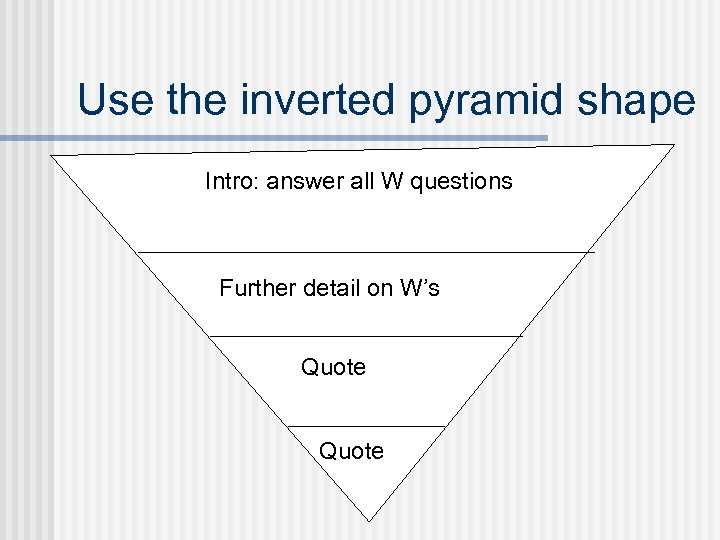 Use the inverted pyramid shape Intro: answer all W questions Further detail on W’s Quote
 Further considerations for the main body of the release Quotations should be short and punchy. n Nothing crucial should be buried in latter stages of the body text n Journalists often complain that there was something useful buried in the fifth paragraph after 200 words - that’s too late! n
 n n News releases should never be longer than two pages, in most cases only one. If you can’t tell the story in two pages, you have to rethink the bare bones of the story. (Is it maybe more then one story, do you need all the information, are you using a scattergun approach? ) The point of a release is to attract attention in a competitive market, not to give a comrephensive report. If journalists want more info, they’ll call!
 Writing the headline n n After you have written the main body, you can move on to the headline. The intro will give you good direction and focus your mind on what this is all about The headline should sum up the essence of the story Might be the only part the editor reads - make it count!
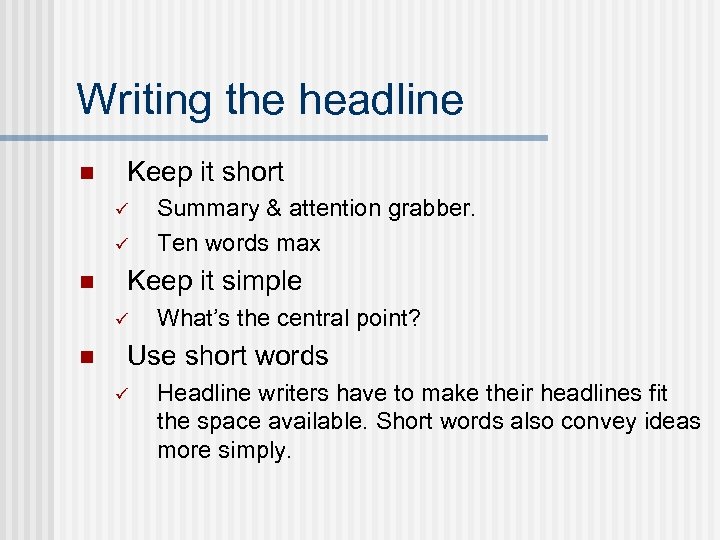 Writing the headline n Keep it short ü ü n Keep it simple ü n Summary & attention grabber. Ten words max What’s the central point? Use short words ü Headline writers have to make their headlines fit the space available. Short words also convey ideas more simply.
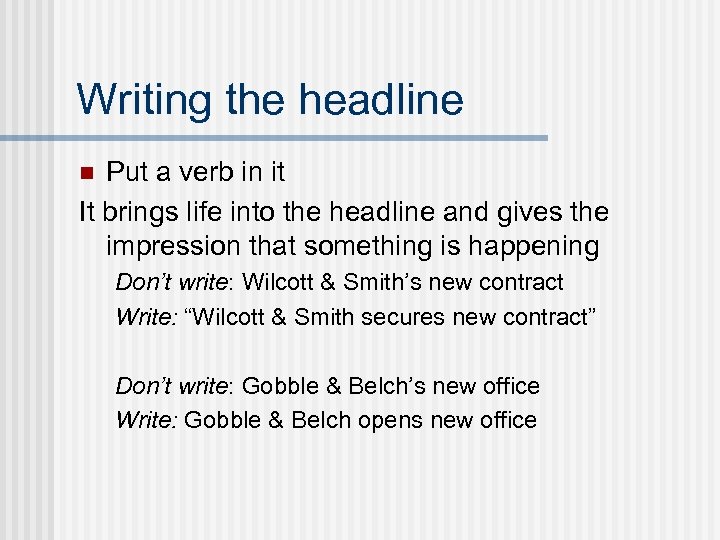 Writing the headline Put a verb in it It brings life into the headline and gives the impression that something is happening n Don’t write: Wilcott & Smith’s new contract Write: “Wilcott & Smith secures new contract” Don’t write: Gobble & Belch’s new office Write: Gobble & Belch opens new office
 Writing the headline n Don’t try to be funny or clever There is nothing worse than a poor pun, particularly if it’s a weak story n Most journalists/editors will write their own n If they want a funny headline they’ll make one up themselves n
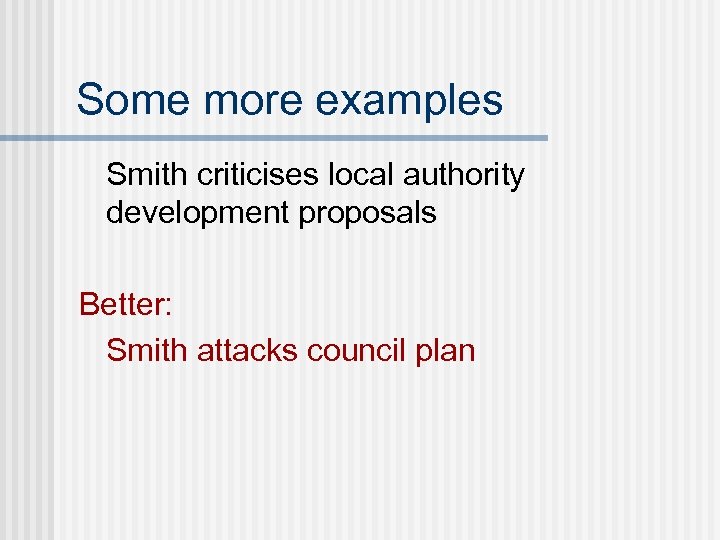 Some more examples Smith criticises local authority development proposals Better: Smith attacks council plan
 Some more examples Babies to gobble new food (Ouch!!!) n Better: New food launched for babies
 Things to avoid when writing a news release Puffery Example: Smith & Co, who have been making world-famous hydraulic breaks for half a century, have yet again established themselves as the leading player in the market by creating a superb new product. n n Basically, puffery are words that lengthen a story, but don’t get your news release anywhere apart from the bin!
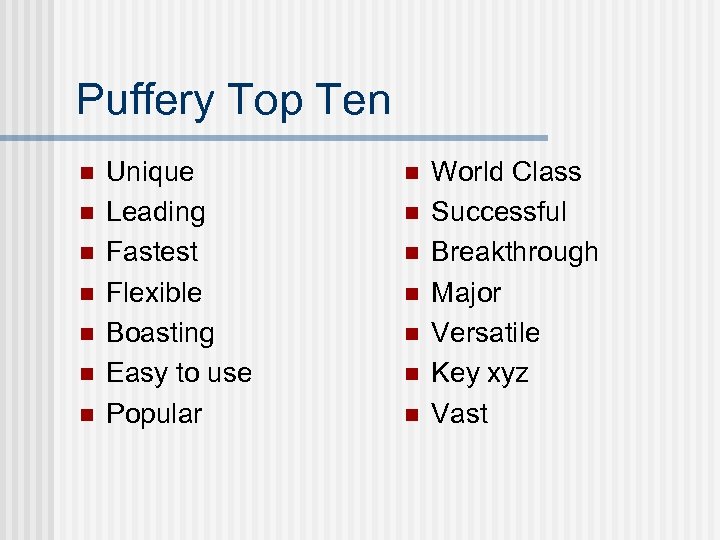 Puffery Top Ten n n n Unique Leading Fastest Flexible Boasting Easy to use Popular n n n n World Class Successful Breakthrough Major Versatile Key xyz Vast
 n Self-praise Lunch-to-go, the best café in Glasgow, has extended its tasty sandwiches by adding a new luxury range. They offer the finest ingredients in town.
 Exaggeration n Thousands of office workers thank God for Lunch-to-go who helped them to relieve their lunch boredom by providing …. (as if…!!!) n There is also more subtle exaggeration which needs to be avoided, always stick to the facts!
 The news release format The format must be consistent and meet the journalists’ expectations of the info they need n Must follow accepted rules of journalism n Has to be clear and clean n Has to be in line with the house style of your own organisation to be easily recognisable. n
 News release format A 4 paper n Produced on news release printed paper / on-line version of this n Single sided n The design should be simple, not cluttered up with too many logos and awards n 12 point for text n Easy to read font n
 News release format 1. 5 or 2 line spacing, two line spacing is preferable n Wide margins, perhaps 2. 5 cm to the left and right and margins at top and bottom, too. n At the top of the news release, it should clearly state those two words. n
 Contact details should appear at the top as well as the bottom n Contact details should included the name of the person journalists should phone and that should include 24 hour contact if possible n Below the contact details there should be details to whom it is directed n
 n So: For the attention of housing correspondents n Or: For newsdesks Best: include the name of journalists which you have researched beforehand E. g. For attention of Julie Smith, Food & Lifestyle editor n
 Date or Embargo? n n At the top left comes the date the news release is issued or the date and time of the embargo that you whish to place on the information in the release. Embargoes are used to warn journalists that info in advance of an event cannot be transmitted to the public beforehand Journalists tend to observe this, but they have no obligation and will ignore it if they see fit. Use embargoes only when necessary.
 n NOTICE OF PHOTO OPPORTUNITY should be given above the heading in Capitals n Heading: should be bold, centred, upper case and not more then two lines long (the shorter the better)
 Body text: Main chunk of the release: should be 12 point, perhaps Times, but could be other easily readable font, aligned left, arranged in short paragraphs Sub headings are only necessary if it’s a long release, which shouldn’t happen to often. n
 More follows or ends n n At the bottom of the first page you must inform the journalist whethere is more on a following page Write “more follows” or “more” bottom right on the page At the top of the next page comes the so called “slug” n The slug is upper case and preceded by a forward slash and should reflect the story, e. g. /Baby Food 2 n
 Notes to Editors Notes to editors is a convention where background information is supplied n They are always numbered n The first note is usually about what the organisation is and does n Second could be further info on what additional publications etc are available n
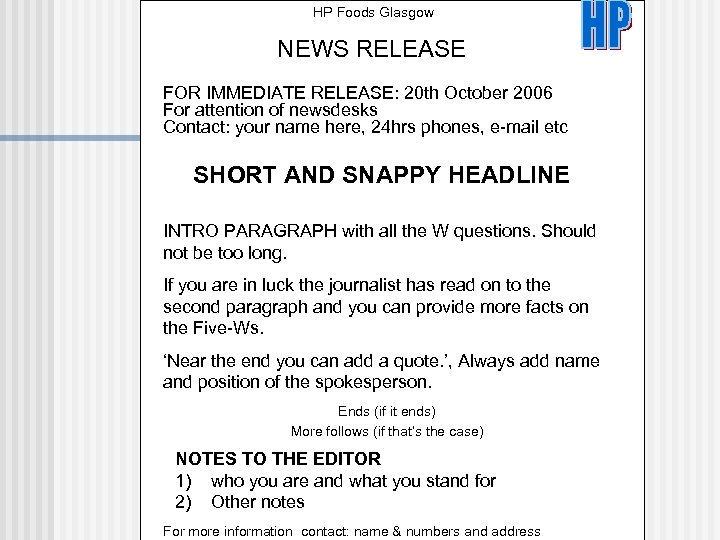 HP Foods Glasgow NEWS RELEASE FOR IMMEDIATE RELEASE: 20 th October 2006 For attention of newsdesks Contact: your name here, 24 hrs phones, e-mail etc SHORT AND SNAPPY HEADLINE INTRO PARAGRAPH with all the W questions. Should not be too long. If you are in luck the journalist has read on to the second paragraph and you can provide more facts on the Five-Ws. ‘Near the end you can add a quote. ’, Always add name and position of the spokesperson. Ends (if it ends) More follows (if that’s the case) NOTES TO THE EDITOR 1) who you are and what you stand for 2) Other notes For more information contact: name & numbers and address
 “The news release wot I wrote”…or questions of English Write in clear English, n Do not use code or jargon (particularly difficult when writing about technical subjects such as engineering, computing, etc), n Do not use essay or literary writing styles, n Avoid attempts at being humourous. n
 Common errors n Mixing single & plural Example: The company’s finance committee has decided to hold a emergency meeting and they will meet on Thursday Remedy: always choose either plural or singular and be consistent
 n Wrong possessive All corporate bodies are impersonal - so they should be not be referred to by personal pronouns Example: All the company’s departments, who are located at Stirling, will be involved in the expansionong r programme. W Replace “who” with “which”
 Muddled timings There often can be a confusion over tenses. n For example: Lunch-to-go has launched a new range of sandwiches which will be available in all their outlets. n Problem: has launched & will be available Remedy: always check tenses to reflect the current status of what is happening. Here it should be “the range is available in all their outlets.
 Other faux pas n n Don’t use clichés. Don’t repeat yourself (make every word count instead) Extra capitals: use capitals only for proper nouns, so for example don’t write Managing Director, but managing director Under no circumstances highlight the company name in capitals in a news release - this is editors’ pet hate as the have to mark it down to lower case and it also makes it look like an advert.
 n Leave out words that do not work Too many press releases are very wordy and packed with words that don’t do anything apart from fill the page Ø Examples: Actually, really, simply Ø Be very tough when editing - think, do I need really need these words? Ø
 n Use short words when they do the job best (journalistic convention) For example use “say” instead of “communicate” “let” for “allow” “make” for “manufacture” “about for “approximately” “show” for “demonstrate”
 A few words on quotes A news release can be strengthened by a quotation or quote in journalists speak. n It brings the human element to the story. n However, there are many pitfalls: n Don’t make empty sentences full of puffery or praise. Ø Don’t make them sound as if they are invented. Ø
 So, how to quote properly? ? ? n Add the human touch by making it sound as if the quote was spoken by a normal human being. n Use “I” and “we” and “don’t” and “can’t”
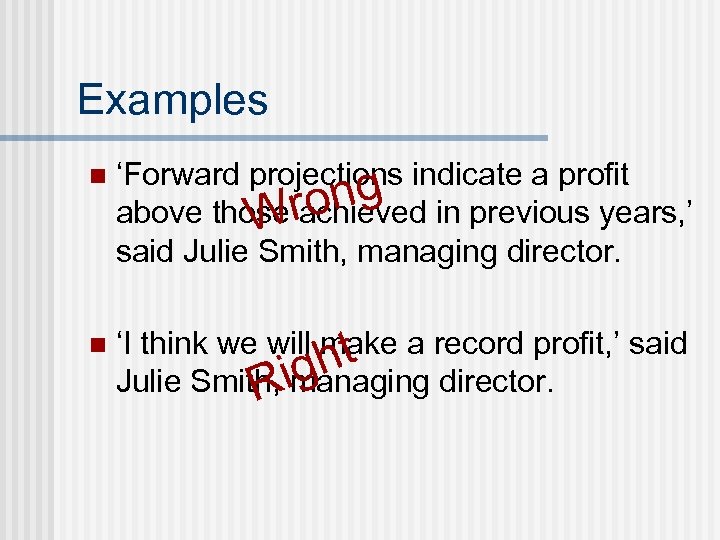 Examples n ‘Forward projections indicate a profit ng in previous years, ’ above those ro W achieved said Julie Smith, managing director. n ‘I think we will make a record profit, ’ said ht Julie Smith, ig R managing director.
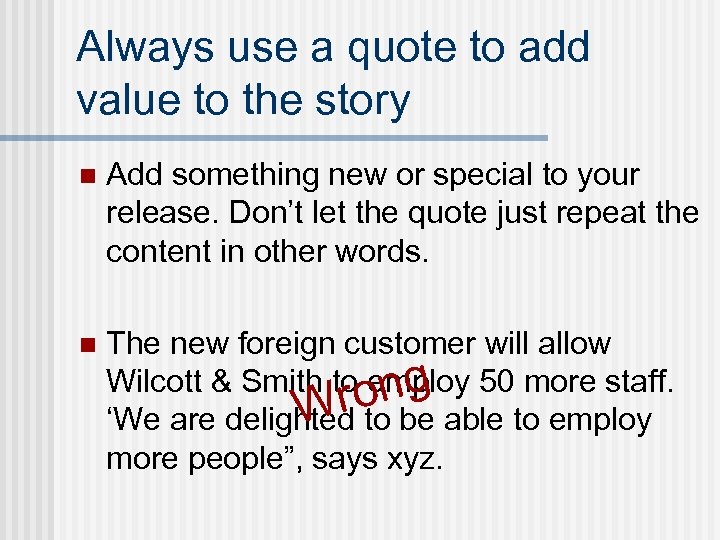 Always use a quote to add value to the story n Add something new or special to your release. Don’t let the quote just repeat the content in other words. n The new foreign customer will allow Wilcott & Smith to employ 50 more staff. ng ro be able to employ W ‘We are delighted to more people”, says xyz.
 One problem you might come across is that clients/ bosses etc might want to add their own quotes which might sound awful and stilted. n Another problem might be that they’ll ask you to invent quotes for them. Always, always check that they are happy with them before sending material out!!! n
 Putting the final touches to your release Once you have drafted your release and worked on the layout, you need to be you own editor!!! Check for n Story-line: does it work well, have you included all the facts? n Repetition: Have you repeated yourself in material or quotes
 n n n Ambiguity: Is everything perfectly clear? Could anything be misconstrued Has it been cleared by all interested parties? Have I written like a journalist? Grammar? Have any grammatical errors crept in? Accuracy: Are all the names right, prices, product names, etc? Proof reading: Are there no spelling, typing or punctuation errors?
 What can be added to a release n Photos Need to be professional n Need to add something n Don’t expect they’ll be used n They are more like a taster n Add a caption n
 Further material n n n n n Graphs Charts Technical drawings Cartoons Fact sheets Logos Maps Artists’ impressions (e. g. of new buildings etc. ) Product samples (careful: bribery!)
 How to deliver your news release? n n n n Mail Fax E-mail / Online news release delivery services Website (pull-medium) Special Delivery Multi-method approach Don’t forget to research preferences of journalists.
 Summary: A news release is a means NOT an end! It is a method of alerting a journalist and selling a story. n You are in competition with other people wanting to sell stories. n That’s why it has to have the right combination of a clear and recognisable format & a strong, well-written story n
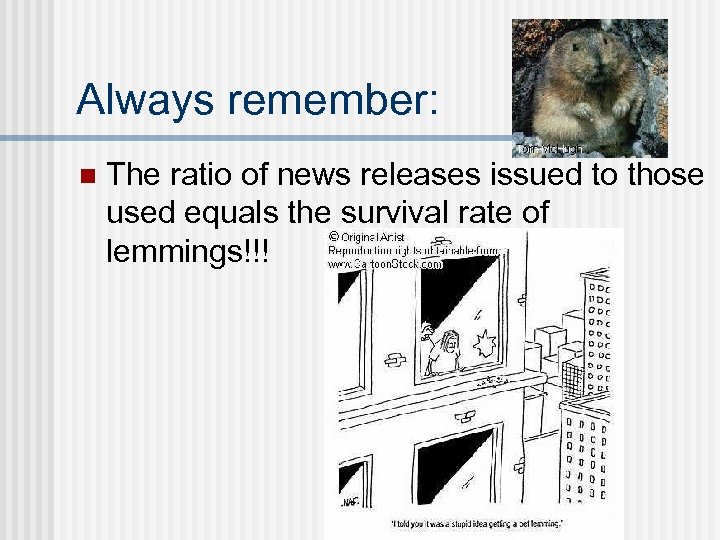 Always remember: n The ratio of news releases issued to those used equals the survival rate of lemmings!!!