


 Скачать презентацию Media Economics What Is Media Economics
6efba60d2b2c8aeba669f6a821be81f0.ppt
- Количество слайдов: 19
 Media Economics
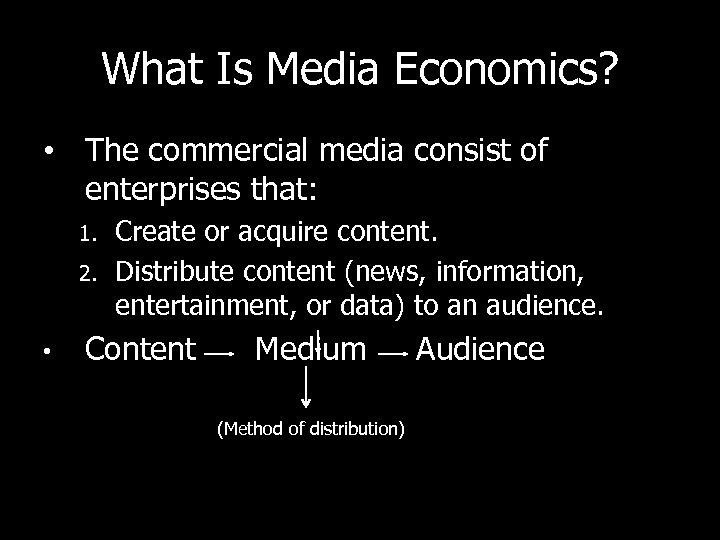 What Is Media Economics? • The commercial media consist of enterprises that: 1. 2. • Create or acquire content. Distribute content (news, information, entertainment, or data) to an audience. Content Medium (Method of distribution) Audience
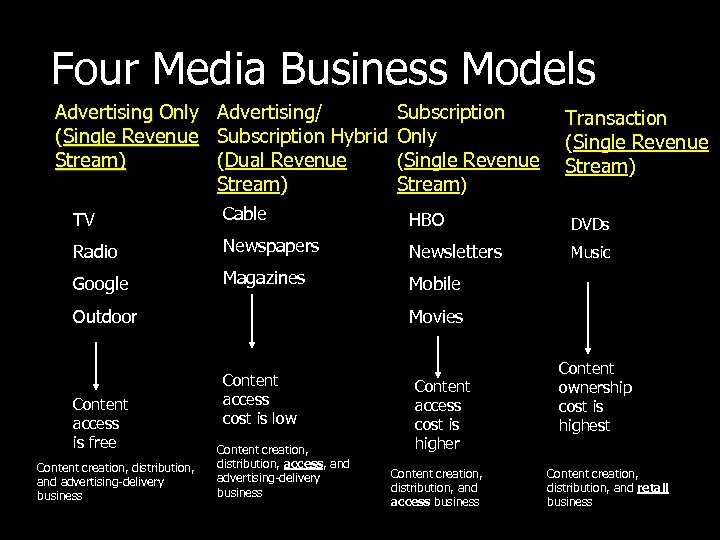 Four Media Business Models Advertising Only Advertising/ Subscription (Single Revenue Subscription Hybrid Only Stream) (Dual Revenue (Single Revenue Stream) Transaction (Single Revenue Stream) TV Cable HBO DVDs Radio Newspapers Newsletters Music Google Magazines Mobile Outdoor Content access is free Content creation, distribution, and advertising-delivery business Movies Content access cost is low Content creation, distribution, access, and advertising-delivery business Content access cost is higher Content creation, distribution, and access business Content ownership cost is highest Content creation, distribution, and retail business
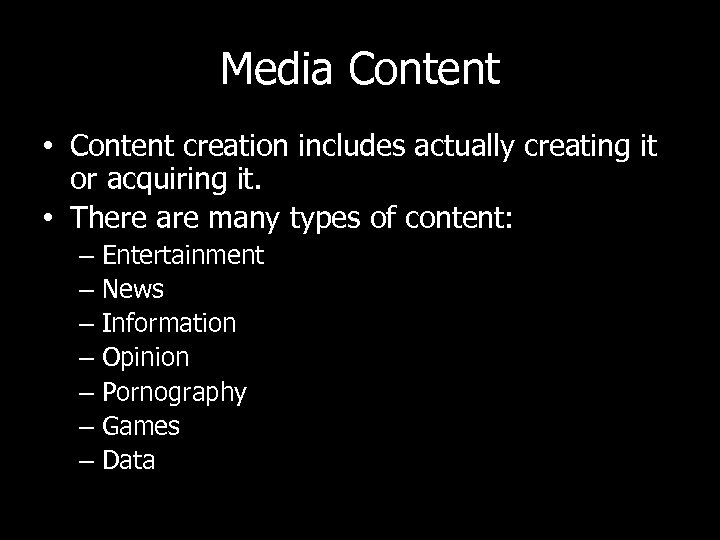 Media Content • Content creation includes actually creating it or acquiring it. • There are many types of content: – Entertainment – News – Information – Opinion – Pornography – Games – Data
 Consumers/Customers • A consumer uses a product: Radio, TV, websites – Audience or readers • A customer buys a product: Newsletters, music, HBO, DVDs – Advertisers are customers for radio, TV, magazines, newspapers, websites—they buy access to audience/readers/users. – Subscription revenue is relatively minor. – Who is P&G’s customer? • Wal. Mart • In some businesses the consumer and the customer are the same person – Detergent, razors
 Media Economics • Media economics is the study of how media enterprises: 1. 2. 3. 4. 5. Create or acquire content. Package it. Distribute it to targeted audiences. Generate revenue. Make a profit.
 Media Enterprises • Typically incorporated – Limited liability • Types of corporations – Private (LLC, LP, S Corp) – Flow-through entities – Public (C Corp) – Tax-paying entity – Benefit (B Corp) – Consider society and the environment in addition to profit – in many states (no media companies, but Warby Parker e. g. )
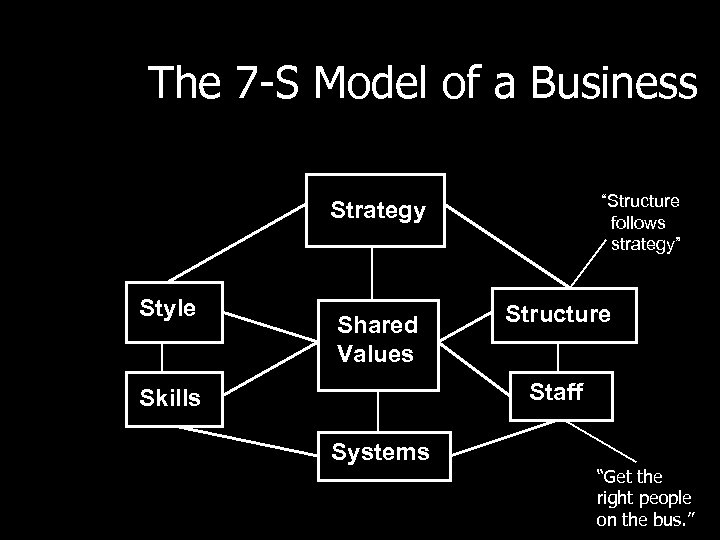 The 7 -S Model of a Business “Structure follows strategy” Strategy Style Shared Values Structure Staff Skills Systems “Get the right people on the bus. ”
 Structure of a Corporation • Board of Directors • President/CEO • Divisions/Functions – Staff and Operating • CFO (Chief Financial Officer) • CMO (Chief Marketing Officer) – Sales, Advertising, Customer Service, Promotion, Distribution • CTO (Chief Technical Officer)/Head of Production – Operations, Production • CIO (Chief Information Officer)
 Purpose of a Corporation • To create and keep customers – Can’t make a profit unless you have customers • To serve stakeholders – – – Consumers/audience Customers/advertisers Society Employees Stockholders (owners, investors, lenders) • To survive – Need profits – Need to innovate and adapt (innovator’s dilemma—disruptive technologies)
 Create a Customer • Must satisfy unmet consumer/audience needs and wants —benefits sought (might be unrecognized). – Find an underserved niche (don’t go after Mc. Donalds or Google). • SWOT analysis (strengths, weaknesses, opportunities, and threats). • Create a business concept and strategy (see following Five-Forces slide). • Create a differential, sustainable, promotable competitive advantage that will get customers/audience and keep them. – Best way – high barrier to entry. • Create a business model that monitizes content/audience/traffic.
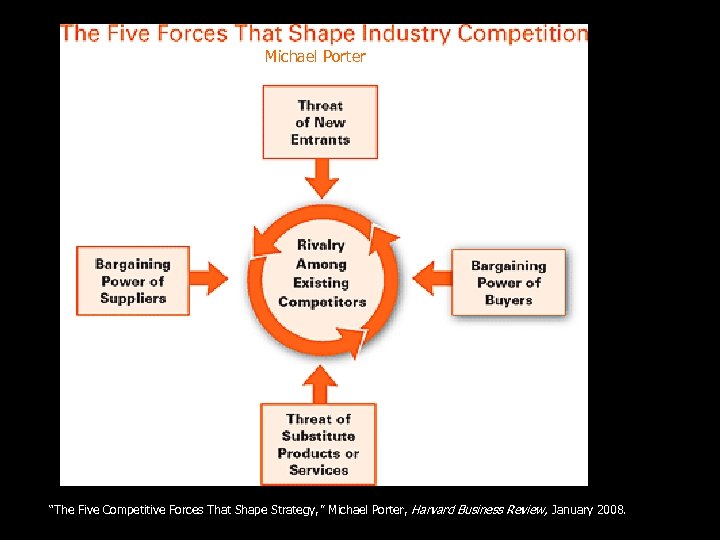 Michael Porter “The Five Competitive Forces That Shape Strategy, ” Michael Porter, Harvard Business Review, January 2008.
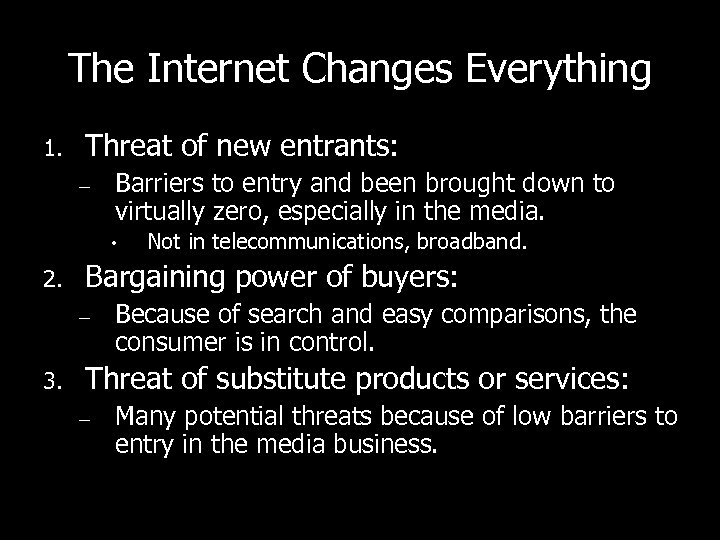 The Internet Changes Everything 1. Threat of new entrants: – Barriers to entry and been brought down to virtually zero, especially in the media. • 2. Bargaining power of buyers: – 3. Not in telecommunications, broadband. Because of search and easy comparisons, the consumer is in control. Threat of substitute products or services: – Many potential threats because of low barriers to entry in the media business.
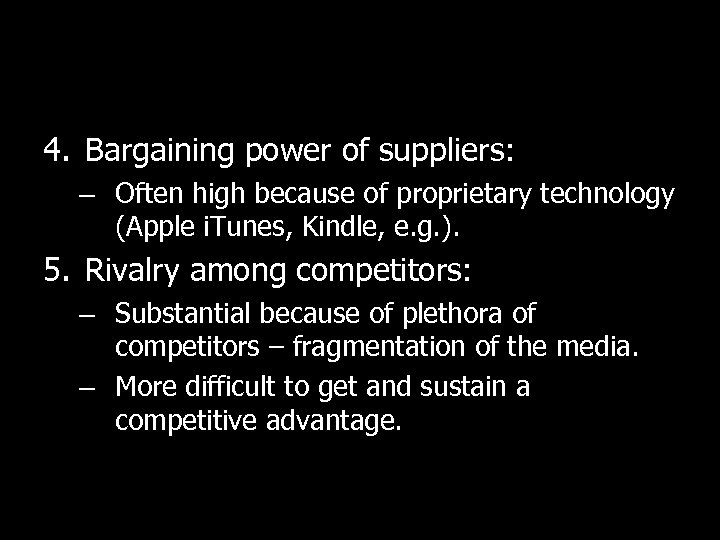 4. Bargaining power of suppliers: – Often high because of proprietary technology (Apple i. Tunes, Kindle, e. g. ). 5. Rivalry among competitors: – Substantial because of plethora of competitors – fragmentation of the media. – More difficult to get and sustain a competitive advantage.
 Competitive Advantage • The main source of competitive advantage is barrier to entry. • Hard to achieve except by mergers and consolidation, which create huge companies that are near monopolies. – Bad for consumers.
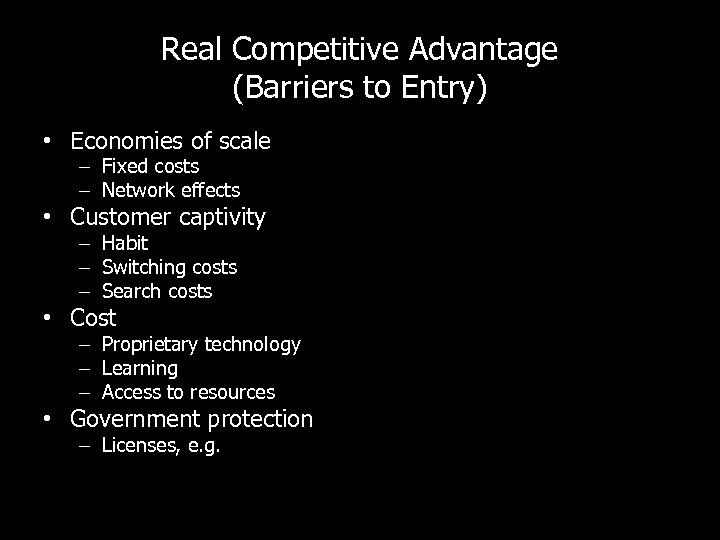 Real Competitive Advantage (Barriers to Entry) • Economies of scale – Fixed costs – Network effects • Customer captivity – Habit – Switching costs – Search costs • Cost – Proprietary technology – Learning – Access to resources • Government protection – Licenses, e. g.
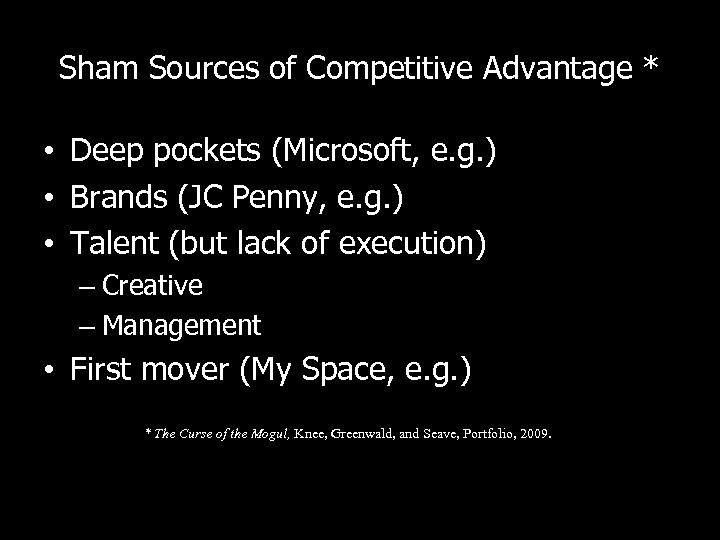 Sham Sources of Competitive Advantage * • Deep pockets (Microsoft, e. g. ) • Brands (JC Penny, e. g. ) • Talent (but lack of execution) – Creative – Management • First mover (My Space, e. g. ) * The Curse of the Mogul, Knee, Greenwald, and Seave, Portfolio, 2009.
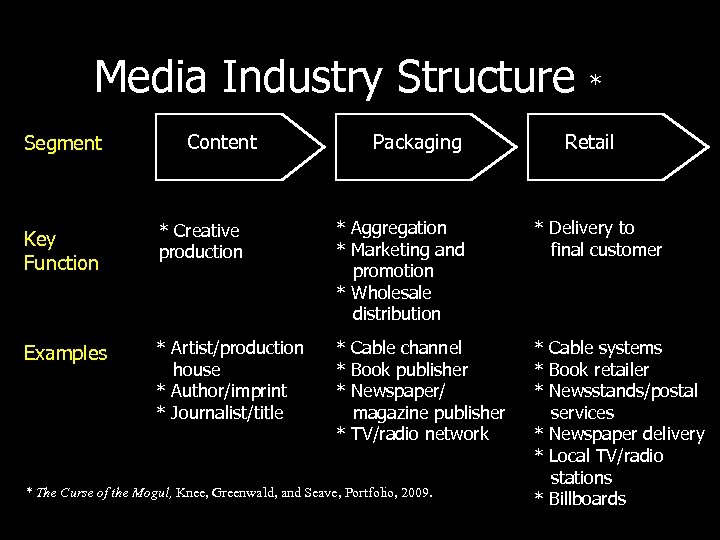 Media Industry Structure Segment Content Packaging * Retail Key Function * Creative production * Aggregation * Marketing and promotion * Wholesale distribution * Delivery to final customer Examples * Artist/production house * Author/imprint * Journalist/title * Cable channel * Book publisher * Newspaper/ magazine publisher * TV/radio network * Cable systems * Book retailer * Newsstands/postal services * Newspaper delivery * Local TV/radio stations * Billboards * The Curse of the Mogul, Knee, Greenwald, and Seave, Portfolio, 2009.
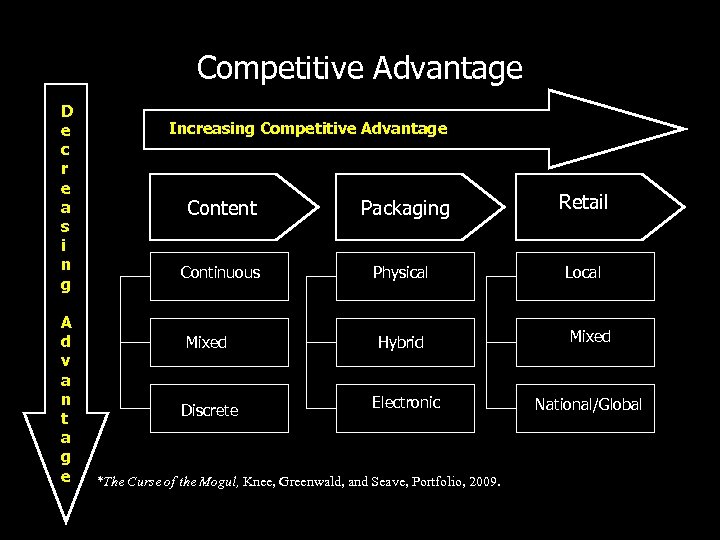 Competitive Advantage D e c r e a s i n g A d v a n t a g e Increasing Competitive Advantage Content Packaging Retail Continuous Physical Local Mixed Hybrid Mixed Discrete Electronic *The Curse of the Mogul, Knee, Greenwald, and Seave, Portfolio, 2009. National/Global