


 Скачать презентацию Media Convergence l l Additional notes to Ch
5d8a61e69830412f002c4fb55bbfe63f.ppt
- Количество слайдов: 13
 Media Convergence l l Additional notes to Ch. 14 Media Transformation Judith Molka-Danielsen Modified 2007 Lo 205 e-business
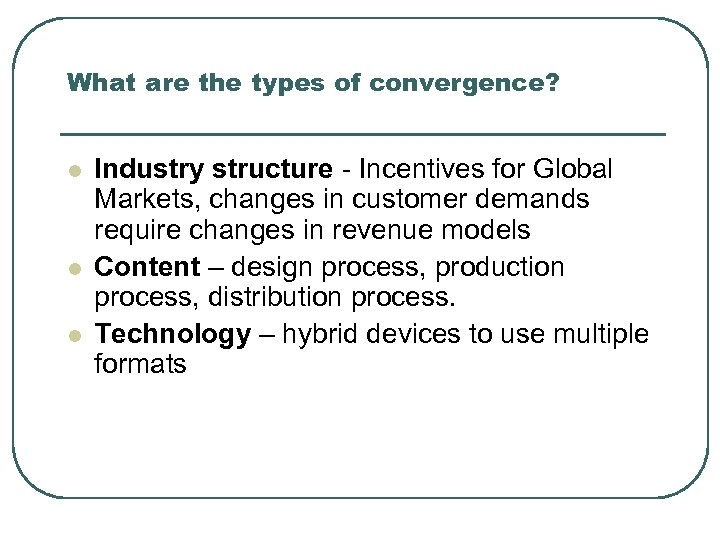 What are the types of convergence? l l l Industry structure - Incentives for Global Markets, changes in customer demands require changes in revenue models Content – design process, production process, distribution process. Technology – hybrid devices to use multiple formats
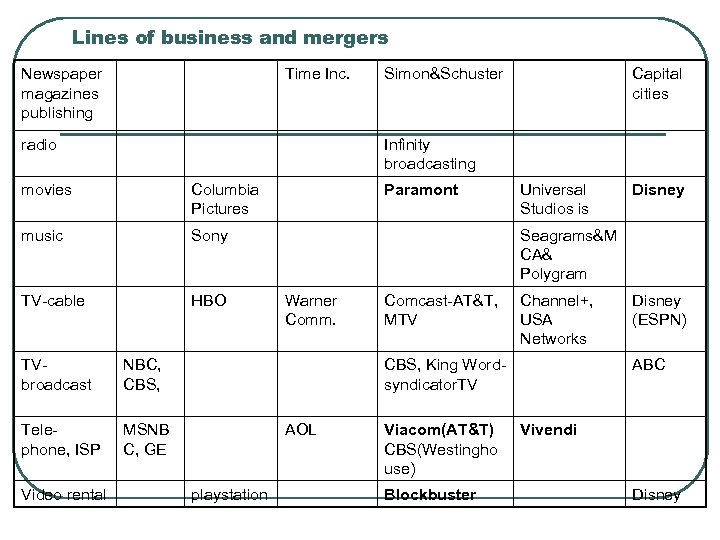 Lines of business and mergers Newspaper magazines publishing Time Inc. radio Simon&Schuster Infinity broadcasting movies Columbia Pictures music Sony TV-cable HBO TVbroadcast Tele- phone, ISP MSNB C, GE Paramont Universal Studios is Warner Comm. Comcast-AT&T, MTV Channel+, USA Networks CBS, King Wordsyndicator. TV AOL playstation Disney Seagrams&M CA& Polygram NBC, CBS, Video rental Capital cities Viacom(AT&T) CBS(Westingho use) Blockbuster Disney (ESPN) ABC Vivendi Disney
 Who Owns What http: //www. cjr. org/owners/index. asp Media companies continue to grow, and a shrinking number of them shape what we view and read. What does that mean for journalists -- and for the nation? The following article is an example of media convergence accross industries. http: //www. cjr. org/tools/owners/advance-timeline. asp The resource guide is maintained by Aaron Moore, Ph. D. , a Publishing/Media writer
 The print publishing industry l l Print publishing industry is changing. • Decline of independent book sellers, rise of big chains (global markets) also news-networks require global reach and resources. • Digital technologies – every book an e-book or in multiple media forms. Books as cultural artifacts. (technology) • Customers read or hear news from Internet (demand) • Copyright Laws (WTO) & big business (publishers) – same issues in the music and video industry. The publishing industry is in ”Terminal decrepitude” says Jason Epstein, former editorial director of Random House, previously with Doubleday since 1950.
 A Changing Industry l l Historically: Publishing houses took modest profits and relied on the firms backlist- books that sold steady year after year. New releases feed the backlist, not immediate sales. Decline: Americans move to suburbs, bookstores open in malls (high rent space), require fast turnover of stock, emphasis on bestsellers, impulse buys, promos on ”Oprah”. Then the Digital revolution…
 The Digital Revolution… l l Electronic bookstores (Amazon. com) create ”pricecutting” competition. Marginal profits do not offset warehouse and customer service costs. The next logical step is to remove these costs…Only send e-books? But there are several directions: • • l Hand held devices for reading e-books will grow: palmtops, mobile phones, e-book readers, … E-ink – improved readability in the technology Print-on-demand technology: will lower the printing costs for publishers, allow small scale publishing, selfpublishing. But, the demand for paper copies will never disappear. Standards for shared multimedia already exist. (XML, PDF, MP 3).
 The e-book readers l E-book readers: There are many free e-book reader software downloads that can be installed on PCs, laptops, and handheld devices. • • l Adobe Acrobat Reader: Download here i. Silo is a versatile document reader available for Palm OS®, Pocket PC, and Windows® CE Handheld PC handhelds, as well as for Windows® computers. Microsoft Reader: Download here The Microsoft Reader with Clear. Type™ technology can be used on your PC, Laptop, or Pocket PC. Palm Reader: Download here Palm Reader is an award winning application used to read Palm Digital Media e. Books on your Palm OS handheld. The Palm Reader is free, but there is a upgrade called Palm Reader Pro that is not free. Competition also comes from Franklin Electronic Publishers, . .
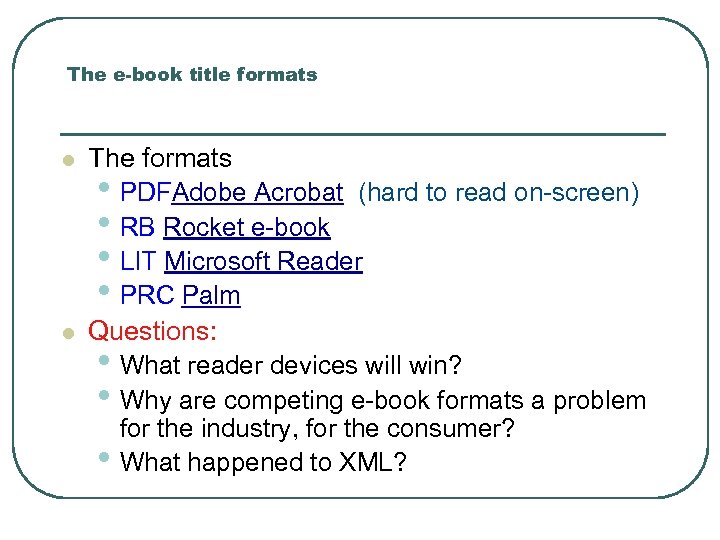 The e-book title formats l l The formats • PDFAdobe Acrobat (hard to read on-screen) • RB Rocket e-book • LIT Microsoft Reader • PRC Palm Questions: • What reader devices will win? • Why are competing e-book formats a problem for the industry, for the consumer? • What happened to XML?
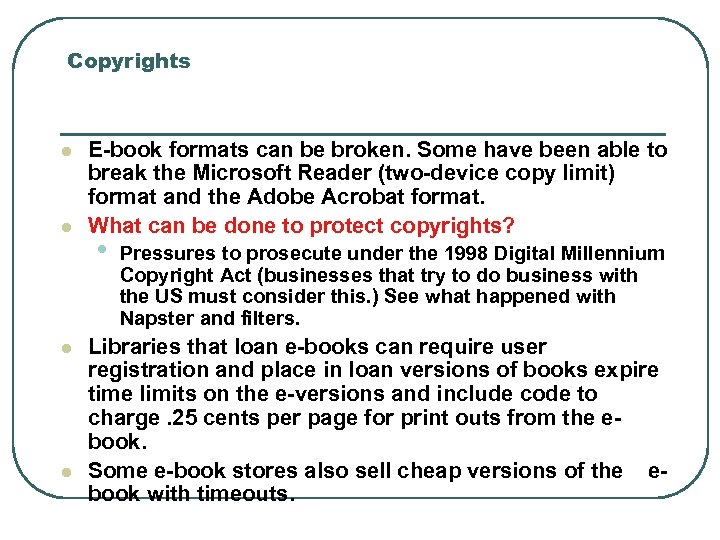 Copyrights l l E-book formats can be broken. Some have been able to break the Microsoft Reader (two-device copy limit) format and the Adobe Acrobat format. What can be done to protect copyrights? • Pressures to prosecute under the 1998 Digital Millennium Copyright Act (businesses that try to do business with the US must consider this. ) See what happened with Napster and filters. Libraries that loan e-books can require user registration and place in loan versions of books expire time limits on the e-versions and include code to charge. 25 cents per page for print outs from the ebook. Some e-book stores also sell cheap versions of the ebook with timeouts.
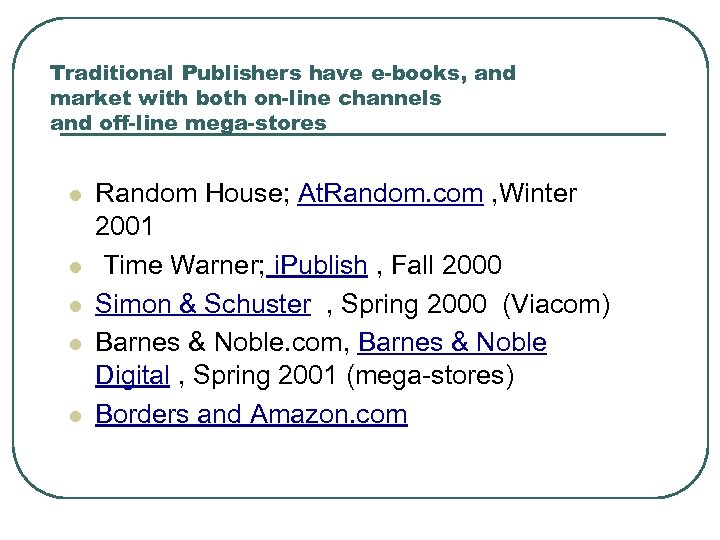 Traditional Publishers have e-books, and market with both on-line channels and off-line mega-stores l l l Random House; At. Random. com , Winter 2001 Time Warner; i. Publish , Fall 2000 Simon & Schuster , Spring 2000 (Viacom) Barnes & Noble. com, Barnes & Noble Digital , Spring 2001 (mega-stores) Borders and Amazon. com
 Other forms of online Publishing l l l Zines (e. Magazines or e. Newsletters) - http: //www. e-zinez. com/handbook/ Blogs Online Education
 Revenue Models for Online Publishing Example, potential sources of ezine revenue: l advertising l commissions from affiliate or other revenuesharing programs l sales of your own products or services l revenue generated directly from your content (through syndication, etc. ) l subscription fees l voluntary donations from your subscribers l http: //emailuniverse. com/ezine-tips/? id=843&cat=revenue