


 Скачать презентацию Media and Violence Designing Coverage to Foster Peace
1f43142e6a8d5c1182df397328c90106.ppt
- Количество слайдов: 99
 Media and Violence: Designing Coverage to Foster Peace A collaborative Workshop of Konrad Adenauer Center for Journalism at the Ateneo de Manila University & James M. Cox Jr. Center for International Mass Communication Training and Research at the University of Georgia With the support of the Crimes of War Project and the Dart Center for Journalism & Trauma
 Fostering Peace Covering Crime: Fostering a Free, Competent and Competitive Press in Southeast Asia
 Mass Communication Training and Research is a unit of the Henry W. Grady College of Journalism and Mass Communication at the University of Georgia. Fostering Peace Covering Crime: The James M. Cox Jr. Center for International
 Mission To encourage the development of free and independent journalistic media throughout the world. Fostering Peace Covering Crime: of the Cox Center
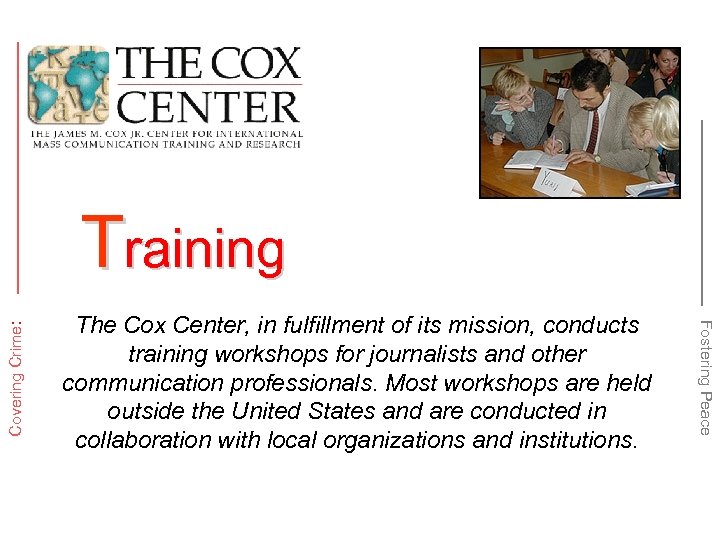 The Cox Center, in fulfillment of its mission, conducts training workshops for journalists and other communication professionals. Most workshops are held outside the United States and are conducted in collaboration with local organizations and institutions. Fostering Peace Covering Crime: Training
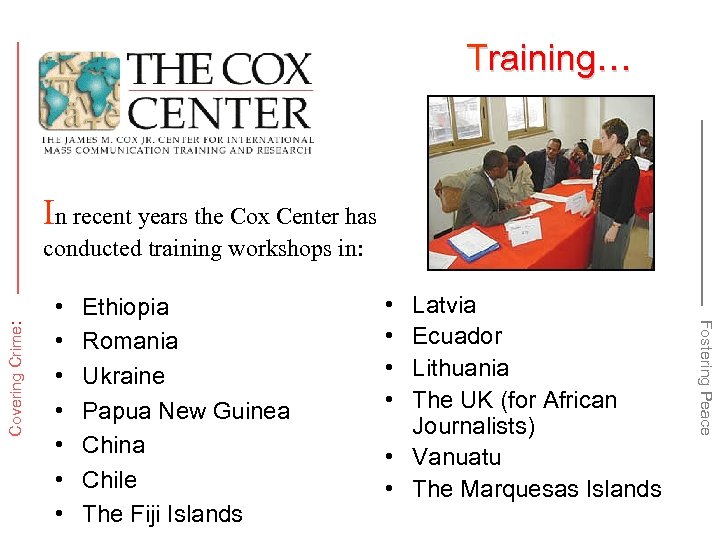 Training… In recent years the Cox Center has • • Ethiopia Romania Ukraine Papua New Guinea China Chile The Fiji Islands • • Latvia Ecuador Lithuania The UK (for African Journalists) • Vanuatu • The Marquesas Islands Fostering Peace Covering Crime: conducted training workshops in:
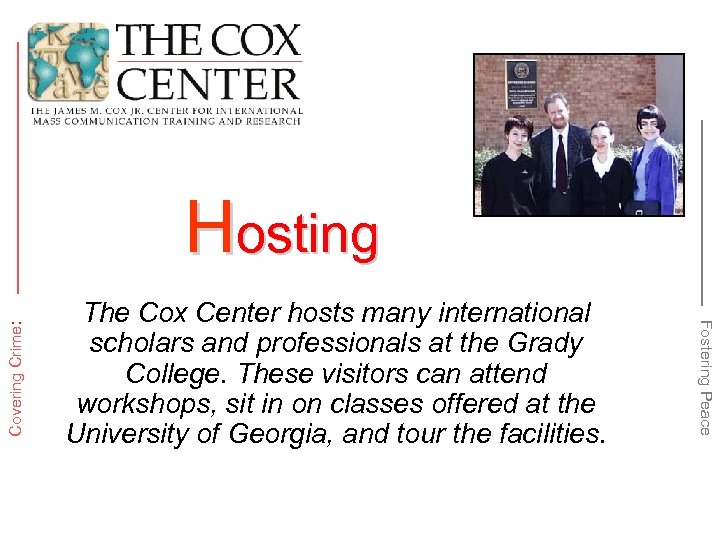 The Cox Center hosts many international scholars and professionals at the Grady College. These visitors can attend workshops, sit in on classes offered at the University of Georgia, and tour the facilities. Fostering Peace Covering Crime: Hosting
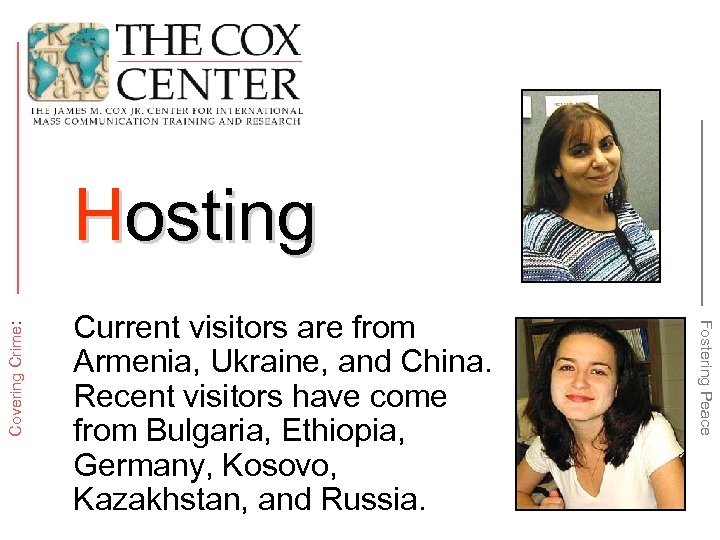 Current visitors are from Armenia, Ukraine, and China. Recent visitors have come from Bulgaria, Ethiopia, Germany, Kosovo, Kazakhstan, and Russia. Fostering Peace Covering Crime: Hosting
 • Evaluation of the Knight International Press Fellowship Program. • Evaluation of Midcareer Training in the Field of Journalism. • Study of Journalism Education and Its Impact. • Examination of the Role of Media in Democratization. Fostering Peace Covering Crime: Research
 Fostering Peace Covering Crime: • www. grady. uga. edu/coxcenter
 • Begun in 1998. • Collaboration of world-renowned journalists, photographers, legal experts and academics. • The mission is to promote understanding and support of international humanitarian law. • The belief is that a wider knowledge of the legal framework governing armed conflict will foster peace. Fostering Peace Covering Crime: Crimes of War Project
 • Raise the level and quality of journalistic reporting on war and the laws of war. • Provide journalists, students, academics, governmental agencies, and nongovernmental organizations access to information on critical issues in modern armed conflict • Encourage consultation among journalists, legal experts and humanitarian actors in highlighting the need for compliance with international humanitarian law. Fostering Peace Covering Crime: Crimes of War
 • Published and disseminated Crimes of War: What the Public Should Know, the first attempt to make this law accessible. • Editions published in Chinese, English, French, German, Italian and Russians. Soon to have editions in Spanish and Arabic. • Participate in seminars around the world on this topic. • Produced a video, Crimes of War. Fostering Peace Covering Crime: Crimes of War
 Crimes of War Fostering Peace Covering Crime: • Produce a web site with a bimonthly web magazine with discussions among experts on current topics related to coverage of war. • www. crimesofwar. org
 • The Dart Center is a global network of journalists, journalism educators and health professionals dedicated to improving media coverage of trauma, conflict and tragedy. • The Center also addresses the consequences of such coverage for those working in journalism. Fostering Peace Covering Crime: Dart Center
 Dart Center • • Fostering Peace Covering Crime: • Advocates ethical and thorough reporting of trauma; sensitive, professional treatment of victims and survivors by journalists; and greater awareness by media organizations of the impact of trauma coverage on both news professionals and news consumers. Educates working journalists about the science and psychology of trauma and the implications for news coverage. Develops and disseminates research, training modules and educational curricula. Creates and sustains partnerships among media professionals, therapists and others concerned with trauma, and nurtures peersupport among working journalists. Serves as a forum for print, broadcast and internet journalists to analyze issues, exchange ideas and advance strategies related to reporting on violence and catastrophic stress.
 Dart Center • Located at the School of Communications at the University of Washington. • Companion site at Michigan State University called Victims and the Media – www. victims. jrn. msu. edu Fostering Peace Covering Crime: – www. dartcenter. org
 • Maria Lourdes “Honey” Carandang • Elisa Munoz • Barry A. Hollander • Lee B. Becker Fostering Peace Covering Crime: Discussion Leaders
 Program Format • Interactive – Please offer comments and share your thoughts. – We all have some involvement with the topic of the workshop. • We are all experts. – We can each learn from one another. Fostering Peace Covering Crime: • Share experiences as a journalist and as a citizen.
 Program Overview Fostering Peace Covering Crime: • What we’ll be doing for the next three days.
 • Tell us why you applied for the program. • Tell us what your special interests and experience with the topic are. • Tell us what you would like to learn from the workshop. Fostering Peace Covering Crime: Please Introduce Yourself
 Group Assignment Fostering Peace Covering Crime: • Develop guidelines for covering crime and violence that will foster peace.
 • How are crime and violence covered in the media? • Why are crime and violence covered by the media? • What interests do the audience have in crime and violence? Fostering Peace Covering Crime: Session I: Introduction of the Topic
 • How do media organizations in the U. S. cover crime? • What kinds of stories are covered? • Are there media differences in how crime is covered? • Do journalists interview the victims of crime? Fostering Peace Covering Crime: Questions to Address
 • Why do the media cover crime? • Why do the media differ in how they cover crime? • Why do the media interview the victims of crime and violence? Fostering Peace Covering Crime: Additional Questions
 • Do audience members want to read about or hear about crime? • Why? • What do audience members want to learn from crime coverage? • Do audience member want reporters to interview victims of crime and violence? • Why do we care about audience interests? Fostering Peace Covering Crime: Additional Questions
 • How are crime and violence covered in the media in your country? • Why are crime and violence covered by the media? • What interests do the audience have in crime and violence? • Do journalists interview the victims of crime? Fostering Peace Covering Crime: What about your country?
 Session II: Trauma Defined Fostering Peace Covering Crime: • What is trauma as suffered by the victims of crime? • Do journalists also suffer trauma?
 Dictionary Definition of Trauma Fostering Peace Covering Crime: • A bodily injury or shock; • An emotional shock, often having lasting psychic effect.
 Post-Traumatic Stress Disorder (PTSD) Fostering Peace Covering Crime: • Intrusive recollections • Avoidance • Heightened anxiety
 Acute Stress Disorder (ASD) Fostering Peace Covering Crime: • The three PTSD reactions plus • Abnormal sign of disassociation
 Session III: Reporting at the Scenes of Crime and Violence Fostering Peace Covering Crime: • What are the journalistic routines? • Can journalists get in the way? • What are the special problems of covering war and civil violence?
 • • • Beat structure. Reliance on familiar and credible sources. News is framed in terms of conflict. Competitive pressures. Thinking in terms of quotes rather than stories. • Assume everybody wants to talk to you. • Deadline pressures. Fostering Peace Covering Crime: Journalistic Routines
 Getting in the Way Fostering Peace Covering Crime: • Police barricades. • Balance between not interfering with police and the need to observe. • Challenges to police procedures.
 Special Problems of War Coverage • Safety Need for safety training Need for proper equipment Pressures of competition Reporters being targets • Access – Some wars blocked off to reporters – Problems of verification – Reporter pools controlled by military • Problems of propaganda. Fostering Peace Covering Crime: – –
 • When you mention something from your country, please begin the example with some background, since not all of us have the background to understand the example. • Please also remember to speak slowly and loudly so we can all understand the example. Fostering Peace Covering Crime: Tip for Discussion
 • The routines of news coverage encourage coverage that focuses on institutions and institutional sources. • Because of these routines, the victims of crime are not always given the attention they deserve. • Crime coverage also is episodic, rather than focused on the large issues of crime’s patterns, causes and consequences. Fostering Peace Covering Crime: Summary of Afternoon Day 1
 • The laws of war actually dictate how journalists are “supposed” to be treated in war. • War coverage poses special problems of safety for journalists. • War coverage also poses problems of access. • Journalists must be careful not to be propagandists for one side or the other. Fostering Peace Covering Crime: Summary of Day 1 Afternoon
 • Are journalists in the countries represented at this workshop being adequately trained for war coverage? • Is there sufficient concern for the safety of the journalists? • Are media organizations providing post trauma counseling and assistance to journalists? • What are the consequences of inadequate training, protection and post trauma counseling for coverage of crime and war? • What are the special problems associated with coverage of victims of war? Fostering Peace Covering Crime: Unresolved Issues from Day 1
 Some Strategies for Dealing with Your Trauma Fostering Peace Covering Crime: • Review pages 52 -55 of workshop notes.
 Session IV: Interviewing Fostering Peace Covering Crime: • Does interviewing increase or decrease trauma? • What techniques can be used to minimize trauma?
 General Interviewing Skills – Informed consent. • Let the interviewee talk first. • Develop a way to elicit information. • Focus on small number of people. Fostering Peace Covering Crime: • Identify yourself completely and correctly. • Give interviewee a sense of control. • Help them understand the consequences of talking to the journalist.
 • • • Find an appropriate setting. Establish eye contact. Nod and show signs of listening. Learn to listen. Approach questions from different directions. Fostering Peace Covering Crime: Additional Tips
 What to Say to Victims Fostering Peace Covering Crime: • “I’m sorry this happened to you. ” • “I’m glad were not killed. ” • “It is not your fault. ”
 What Not to Say to Victims Fostering Peace Covering Crime: • “I know how you feel. ”
 Example The frail boy was lying flat on the kitchen floor by the sink. There was no sign that he was breathing or that his heart was beating. He was disturbingly thin. The first rescue workers to arrive at the modest ranch house thought they were looking at an AIDS victim, or perhaps a child undergoing chemotherapy. Only a few tufts of hair sprouted from his nearly bald head. The mother had called 911 at 12: 22 p. m. , and help arrived 10 minutes later. Soon the house was swarming with medical technicians and state troopers. The boy, dressed in a shirt and sweat pants with a diaper underneath, was taken by ambulance at 1: 10 p. m. to the Hunderdon County Medical Center, 10 miles away. As the ambulance was preparing to leave, the mother swore at the police officers still there and ordered them off her property. She chose not to ride in the ambulance, but went to the hospital about 15 minutes later with her husband, who had been at Sunday church services with their six other children. In the emergency room, doctors and nurses were able to restore the child’s heartbeat, but his condition was critical. The decision was made to transfer him by helicopter that afternoon. Fostering Peace Covering Crime: The mother of the stricken 7 -year-old was trying to administer CPR, but she was pushing on his abdomen, not his chest. A telephone receiver was on the kitchen floor, the line open to the county emergency center.
 continued Doctors there noted that the boy, Viktor Alexander Matthey, was covered with 40 cuts, scrapes and bruises. The skin on his right hand was bright red, from his wrist to his fingertips. Three bones in that hand were broken, and there was evidence of an earlier, untreated fracture. Two days later, On Oct. 31, the boy died. A week after that, Bob and Brenda Matthew, a deeply religious couple who 10 months earlier had adopted Viktor Sergeyevich Tulimov in Russia and given him their name, were charged with his death. Hunterdon county authorities said that before he died, the Matthews’ adopted son had been imprisoned in an unheated, unlit and damp pump room, off the basement, when the temperature outside got down to 37. Put simply, the child from Siberia had died in the cold of America. Fostering Peace Covering Crime: He was also in an advanced state of hypothermia; his body temperature, recorded as 83. 2 degrees at the emergency room, had dropped by 80. He was put on life support in an intensive care unit while his family prayed for his recovery.
 Session V: Writing about Crime Fostering Peace Covering Crime: • Can it be done sensitively?
 Session VI: Use of Pictures and Sound Fostering Peace Covering Crime: • What are the special issues of visualizing crime? • What are the special problems of the broadcast media?
 VII: Reporting on Rape and Domestic Violence Fostering Peace Covering Crime: • Should these topics be covered? • How should they be covered? • Should the identify of the victim be revealed?
 Point-Counterpoint • Woman should lead a discussion on domestic violence • Man should lead a discussion on domestic violence – It is a man’s problem. Fostering Peace Covering Crime: – It is a women’s problem.
 My Answer • It is a male problem. • The victims are women and children. • It certainly is a problem for women and children. • The solution rests largely with men. Fostering Peace Covering Crime: – In most cases—though not all—the perpetrators are men.
 Restate the General Principle Fostering Peace Covering Crime: • At least, do no harm to the victim. • Don’t victimize a victim a second time.
 • The women’s movement has brought the problem to the public’s attention. • Women are more prominent in newsrooms, and they have increased the sensitivity to the issue. Fostering Peace Covering Crime: Domestic Violence Has Become an Important Story in the U. S.
 • Tell what women and children can do for help. • Tell what can be done to prevent the crime. • The dominant image is of a strong survivor. • The survivors are shown as powerful. Fostering Peace Covering Crime: Stories about Battered Women and Battered Children
 • Stories rarely involve interviews immediately after the crime. • Story is told via profiles of women who left their husbands. • Focuses on the trauma they suffered. • Focuses on what they have done to rebuild their lives. • Trauma, remember, can be a physical wound, an emotional wound, or both. • Stories in which children are interviewed are infrequent. Fostering Peace Covering Crime: Interviews With Victims
 Rape Defined • Forcible violation of another person’s body. • Men raping women is most common pattern, but not the only example. • Experts say rape is NOT about sex. – The anger, violence, intimidation, use of force, abuse of power and trauma of the victim distinguish rape from conventional sexual acts. Fostering Peace Covering Crime: – Also includes male on male, female on female, and female on male.
 • The trauma of rape results from the choice of one human being to destroy another’s autonomy over her or his body. • The initial assault often surprises the victim, induces physical injury, includes use of physical force or a weapon, and imposes the threat of death. • The victim—a captive—endures the violation of her or his body. Fostering Peace Covering Crime: Trauma and Rape
 Rape Survivor • Faces immediate contact with strangers • Trauma effects continue for years • Fear, anxiety, heightened need for privacy. • The journalist who invades the privacy of the rape survivor interferes with that persons right to recover. Fostering Peace Covering Crime: – Police and medical personnel
 • “No crime is more horribly invasive, more brutally intimate. • “In no crime does the victim risk more being blamed, and in so insidious a way: • “‘She asked for it, she wanted it. ’ • “Perhaps worst of all, there’s the judgment: • “‘She’s damaged goods, less desirable, less marriageable. ’” – Virginia Overholser, then editor of the Des Moines Register, who invited a rape survivor to tell her story AND used her name. Fostering Peace Covering Crime: Rape Presents Special Challenges
 What Can Media Do? • Present an accurate portrayal of frequency of crime – In US, studies show, media coverage distorts when, who, where, and how often. – Dress, bar, drinking. • Mention details that communicate the seriousness of the crime. • Name agencies that help survivors. Fostering Peace Covering Crime: • Avoid describing details that reinforce stereotypes
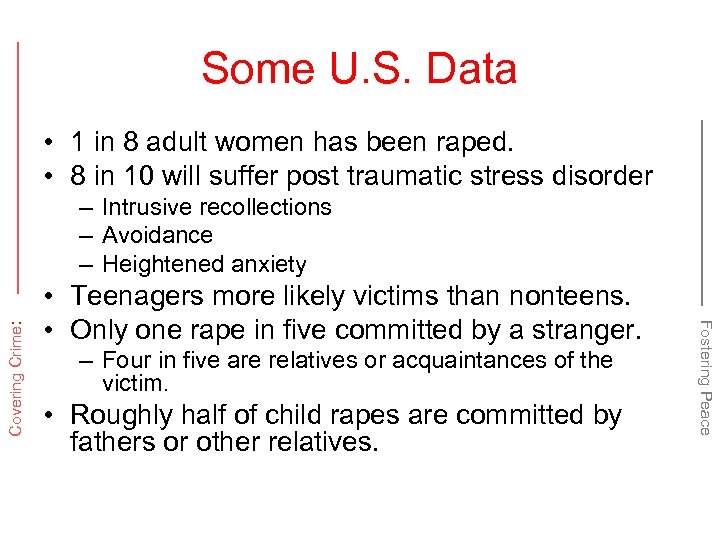 Some U. S. Data • 1 in 8 adult women has been raped. • 8 in 10 will suffer post traumatic stress disorder • Teenagers more likely victims than nonteens. • Only one rape in five committed by a stranger. – Four in five are relatives or acquaintances of the victim. • Roughly half of child rapes are committed by fathers or other relatives. Fostering Peace Covering Crime: – Intrusive recollections – Avoidance – Heightened anxiety
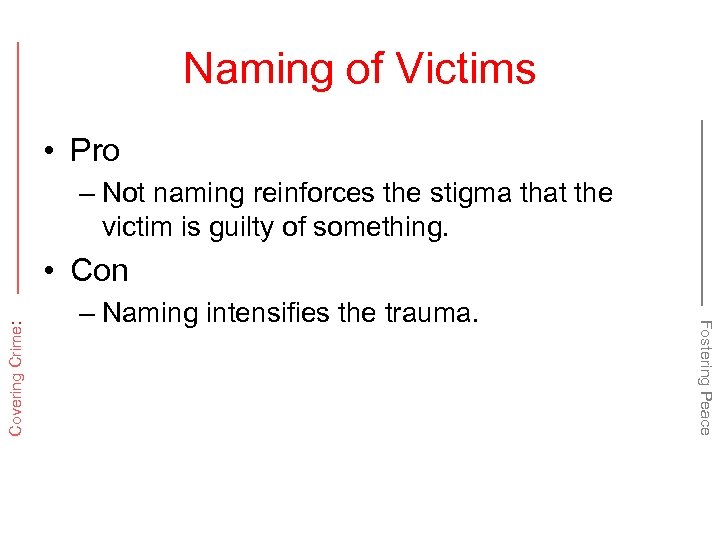 Naming of Victims • Pro – Not naming reinforces the stigma that the victim is guilty of something. – Naming intensifies the trauma. Fostering Peace Covering Crime: • Con
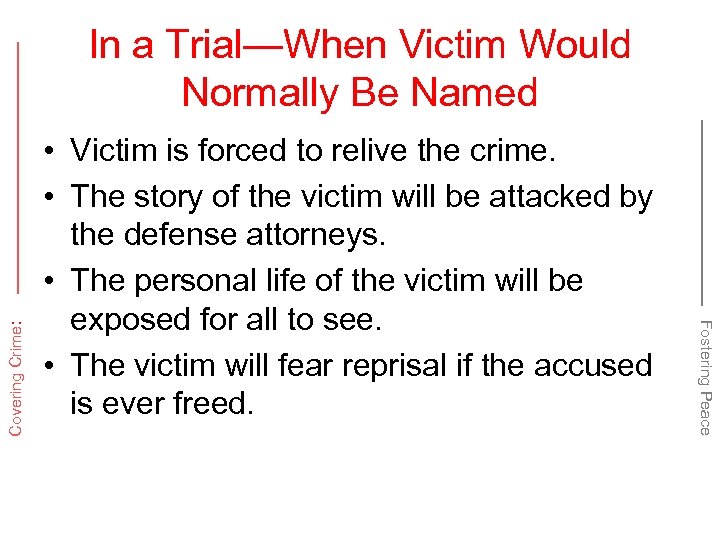 • Victim is forced to relive the crime. • The story of the victim will be attacked by the defense attorneys. • The personal life of the victim will be exposed for all to see. • The victim will fear reprisal if the accused is ever freed. Fostering Peace Covering Crime: In a Trial—When Victim Would Normally Be Named
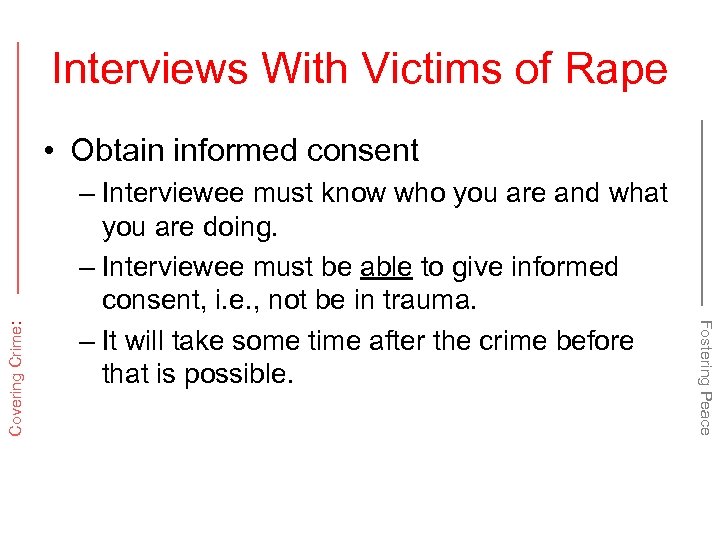 Interviews With Victims of Rape – Interviewee must know who you are and what you are doing. – Interviewee must be able to give informed consent, i. e. , not be in trauma. – It will take some time after the crime before that is possible. Fostering Peace Covering Crime: • Obtain informed consent
 Interviewing Children Who Are Victims • Informed consent very difficult • Yet children make good news, and children who are victims often become the subject of news. Fostering Peace Covering Crime: – In general, they are not likely to understand rules of interviewing by the media. – If they also are suffering trauma, it is doubly unlikely that they will understand.
 • Children who survive earthquakes, tornadoes, hurricanes suffer great trauma. • Children who witness violence—such as in school settings—are greatly affected by what they have seen. • Children close to those who have been killed are likely to suffer extreme trauma. Fostering Peace Covering Crime: Children and Trauma
 At the Scene of the Crime • Interviewing children is very difficult. • Media often engage in overly aggressive behavior in such settings. – One description of a school shooting: The children were chased by a mob—microphone poles extended like weapons, cameras trained on them, people shouting at them to stop, shouting questions at them. Fostering Peace Covering Crime: – The child is not in a very good position to understand the interview’s consequences – The child consequently is not able to make a good decision about participation—and divulging information.
 • Do not photograph children under 10 in connection with violence. • If you interview children at all, get the permission of their parents. • Even in that case, ask the child for informed consent: Do you want to be interviewed and photographed. What you say and your pictures most likely will appear in the newspaper/on the news. • Interview the child with an adult present. • Take the child away from the crime scene. • Sit at the level of the child. Fostering Peace Covering Crime: Some Recommendations from Cote and Simpson
 Special Problems • Anticipate that the child’s version may differ from that of others. – Might remember peripheral rather than central details. – Perspective—but figuratively and literally—is different. – Always a good idea. – Even a better idea when the victim is a child. – Even a better idea again when the victim has been traumatized—as is usually the case. Fostering Peace Covering Crime: • Independently verify what the child tells you.
 • Cover victims in a way that is sensitive to their trauma. • Do not reduce them to statistics. • Salute them. • Empower them. • Explain their trauma and their triumph. Fostering Peace Covering Crime: Summary
 Example: Childhood Incest Story • Debra Mc. Kinney of the Anchorage Times wrote about survivors of incest. Fostering Peace Covering Crime: – P. 177 Covering Violence
 Children as Soldiers • How do you cover this story? Fostering Peace Covering Crime: – P. 76 Crimes of War
 • Goal: Develop Guidelines for coverage of crime and violence, including during war, that foster peace. • Divide into three groups. • Each group will make a presentation of its Guidelines. • We’ll join each of the groups and participate. Fostering Peace Covering Crime: Group Project
 Review of Day 2 – Identify yourself completely and correctly. – Give interviewee a sense of control. – Help them understand the consequences of talking to the journalist. – Get informed consent. • Discussion of Special Issues of Rape, Domestic Violence, and Coverage of Children – Salute them. – Empower them. – Explain their trauma and their triumph. Fostering Peace Covering Crime: • Discussion of unresolved issues, with particular focus on the needs of journalists here in the region for training for war coverage and for counseling for trauma. • Discussion of Interviewing and Writing about Crime.
 Review of Day 2 (continued) • Discussed the power and importance of visual images. • Introduced the broad framework of the Crimes of War Project. • Began our group projects – Create Guidelines for Coverage of Victims of Crime and Violence Fostering Peace Covering Crime: – Can we select visual images that give us as journalists what we need without adding to the trauma of those we picture?
 Session X: Crimes of War Defined Fostering Peace Covering Crime: • What should journalists know? • What should the public know?
 • Four Geneva Conventions of 1949 – Convention for the Amelioration of the Condition of the Wounded and Sick in Armed Forces in the field – Convention for the Amelioration of the Condition of the Wounded, Sick, and Shipwrecked Members of the Armed Forces at Sea – Convention Relative to the Treatment of Prisoners of War – Convention Relative to the Protection of Civilians in Time of War Fostering Peace Covering Crime: The Geneva Conventions
 • Protocol I: Protection of Victims of International Armed Conflict (154 States Party) • Protocol II: Protection of Non-International Armed Conflict (147 States Party) Fostering Peace Covering Crime: Additional Protocols
 Genocide Convention – killing members of the group – causing serious bodily or mental harm to members of the group – deliberately inflicting on the group conditions of life calculated to bring about its physical destruction, in whole or in part – imposing measures intended to prevent birts within the group – forcibly transferring children of the group to another group Fostering Peace Covering Crime: • Any of the following acts committed with the intent to destroy, in whole or in part, a national, ethnic, racial or religious group, as such:
 • • • Protection of Persons (Pg. 295) Protection of Soldiers (Pg. 342 & 282) Proportionality (Pg. 294) Military Necessity (Pg. 251) Civilian Immunity (Pg. 84) Protected Objects and Property (Pg. 288) Fostering Peace Covering Crime: Six Main Principles of International Humanitarian Law
 Session XII: Case Studies Fostering Peace Covering Crime: • Israeli Strike Against Hamas • Law and the Campaign Against Terrorism
 Israeli Attack on Hamas – Included were 15 civilians – Included were 9 children – Included were the wife and child of Shehadeh Fostering Peace Covering Crime: • July 22, 2002, Israeli F-16 dropped a oneton bomb in a densely population area of Gaza City, killing Hamas military wing leader Salah Shehadeh and 16 others.
 • Within Israeli, members of the peace movement called the pilots war criminals • Critics said the pilots should be sentenced to prison by the International Criminal Court at Den Haag. Fostering Peace Covering Crime: Criticism of Israel
 • Shehadeh was the leader of Hamas’ military wing, Iz Adin al-Kassam. • He was one of the most extreme members of Hamas, according to Isreali intelligence. • Shehadeh was, according to Israel, directly responsible for dozens of attacks against both Israeli military personnel and civilians. Fostering Peace Covering Crime: Reason for Targeting Shehadeh
 • According to Israel, the current violence and Israeli engagement in the West Bank and Gaza Strip are akin to an armed conflict. • Due to the heightened level and frequency of the violence, Israel can no longer engage in mere policing actions, but had to modify its rules of engagement for the situation in which it found itself. • It thus treats Palestinian militants as combatants and claims the right to target them accordingly, so as to neutralize whatever threat they may present to the Israeli military or to Israeli civilians. Fostering Peace Covering Crime: Israel’s View of West Bank and Gaza Strip
 • It is wrong to classify the current situation as a general armed conflict entitling Israel to employ force offensively. • Neither the partial, conditional and unilaterally revocable transfer of authority to the Palestinian Authority nor the actual state of affairs on the ground can be construed as ending Israel’s exercise of effective control. • Israel therefore continues to be bound by the corresponding duties of an occupying power, including the duty to repress criminal activity and maintain security and public order through lawful policing and criminal justice measures. Fostering Peace Covering Crime: Palestinians Take a Different View
 • Even if one chooses not to define the situation in the terms of policing a civilian population and instead describes it, as the Israelis do, as a situation of general armed conflict, Israel's strike may not have been legal within the framework of international humanitarian law. • Thus, while some consider Shehadeh to have been a legitimate military target, the manner in which Israel pursued him may not have been legitimate, and in fact, may have been a violation of international humanitarian law. Fostering Peace Covering Crime: Crimes of War Interpretation
 • In judging the legality of a military offensive, combatants must weigh the military advantage gained from the offensive against the harm inflicted by the operation on civilians. • Actions cannot be undertaken that would cause disproportionate harm to civilians relative to the military advantage gained. Fostering Peace Covering Crime: Interpretation Continued
 • The chances of an Israel official being brought before the International Criminal Court in The Hague to answer for the attack on Shehadeh are negligible. • Israel has said that it does not intend to ratify the ICC’s statute; therefore the only way the court could obtain jurisdiction over the case would be through a referral by the Security Council, over which the United States would have power of veto. Fostering Peace Covering Crime: A Case for the ICC?
 • Did the media coverage of this event include this detailed information on international law? • Would coverage that included this information had been valuable to readers? • Would coverage that included this information have decreased the likelihood of such attacks in the future? Fostering Peace Covering Crime: For Discussion
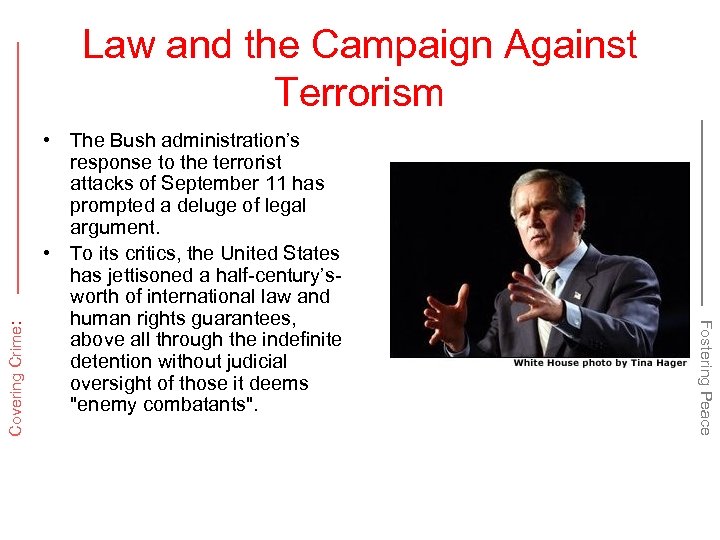 • The Bush administration’s response to the terrorist attacks of September 11 has prompted a deluge of legal argument. • To its critics, the United States has jettisoned a half-century’sworth of international law and human rights guarantees, above all through the indefinite detention without judicial oversight of those it deems "enemy combatants". Fostering Peace Covering Crime: Law and the Campaign Against Terrorism
 • In many people’s eyes, the challenge posed to the United States by al-Qaeda represents something of a hybrid between war and crime. • The scale and scope of the assault of September 11 were clearly on the level of an act of war, but in traditional legal thinking, armed conflict has generally been seen as taking place only between states or (in the case of civil wars) between groups in control of part of a country’s territory. • Terrorists, by contrast, have tended to be seen as criminals, to be pursued through law-enforcement means and subjected to trial if captured. Fostering Peace Covering Crime: Hybrid of Terrorism
 • The Bush administration asserts that the United States is engaged in a global war with al-Qaeda, and that the laws of war can be applied to this conflict. • Representatives argue that the state of war was defined by a pattern of repeated attacks and continuing threat posed by terrorists against the United States – and therefore that the armed conflict might in fact have started before September 11. Fostering Peace Covering Crime: U. S. Actions and the Laws of War
 • One obvious way in which this conflict differs from traditional wars is the imprecise nature of the enemy. • The enemy includes al-Qaeda and other international terrorists around the world, and those who support such terrorists. Fostering Peace Covering Crime: Who is the Enemy in this Conflict?
 • The authority to detain enemy combatants applies not just to armed soldiers engaged in battlefield combat, but extends to all belligerents, including any individuals who act in concert with enemy forces and aim to further their cause. • An individual cannot immunize himself from treatment as an enemy combatant by attempting to extend the battle beyond the traditional battlefield. Fostering Peace Covering Crime: The Case for Guantanamo
 • The White House announced that al-Qaeda detainees did not qualify for the protection of the Geneva Conventions, since they did not belong to a state party. • Taliban detainees were said to come under the Geneva Conventions, but not to meet the tests to qualify as prisoners of war. • One regulation that is particularly relevant is Article 75 of Additional Protocol I, which sets out a list of fundamental guarantees for detainees who do not qualify for more favourable treatment (e. g. prisoner of war status). • Among these guarantees are the right to be treated humanely, not to be subjected to murder, torture, beating, or humiliating and degrading treatment, and the right to be released “as soon as the circumstances justifying the arrest, detention or internment have ceased to exist. ” Fostering Peace Covering Crime: What International Law Applies to the Conflict?
 • The charge sometimes made against the United States in its campaign against al-Qaeda is that it has dropped any pretence of legal justification and is operating outside the law altogether. • It would be more accurate to phrase the most troubling questions raised by the Pentagon’s account of its military approach to terrorism somewhat differently. • Essentially, they revolve around whether the rigid structure of the laws of armed conflict – with their clear-cut distinctions between combatants and civilians, war and peace, legitimate and illegitimate targets – can have a meaningful application to the murky world of counter-terrorism. Fostering Peace Covering Crime: The Outstanding Questions: Crimes of War Conclusion
 • Did the media coverage of the captives at Guantanamo Bay include this detailed information on international law? • Would coverage that included this information had been valuable to readers? • Would coverage change the behavior of the Bush administration in any way? Fostering Peace Covering Crime: For Discussion