 Скачать презентацию Mechanisms to reward standby generation capacity are they
8b85a71fec9f3f4370420ff3b4e26dd9.ppt
- Количество слайдов: 22



Mechanisms to reward standby generation capacity: are they necessary and will we see an EU architecture? Håkan Feuk Chair of the EURELECTRIC TF Market Design for RES Integration Webinar with the Russian Market Council 16. April 2013
Agenda 1 What is needed to back-up intermittent generation? 2 What needs to be done to energy markets? 3 Will we see a European capacity mechanism design?
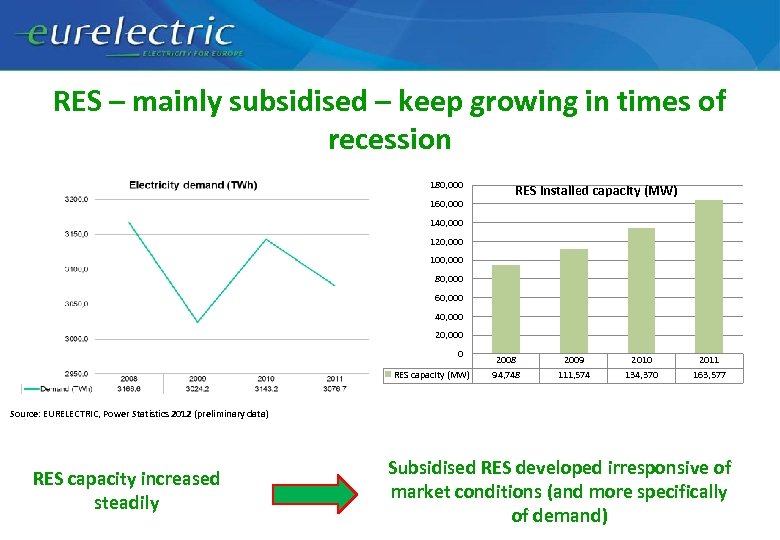
RES – mainly subsidised – keep growing in times of recession 180, 000 160, 000 RES installed capacity (MW) 140, 000 120, 000 100, 000 80, 000 60, 000 40, 000 20, 000 0 RES capacity (MW) 2008 94, 748 2009 111, 574 2010 134, 370 2011 163, 577 Source: EURELECTRIC, Power Statistics 2012 (preliminary data) RES capacity increased steadily Subsidised RES developed irresponsive of market conditions (and more specifically of demand)
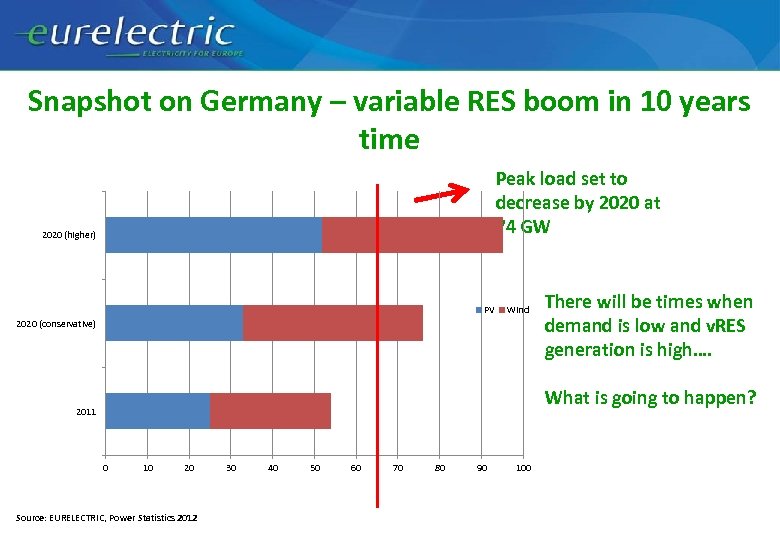
Snapshot on Germany – variable RES boom in 10 years time Peak load set to decrease by 2020 at 74 GW 2020 (higher) PV Wind 2020 (conservative) There will be times when demand is low and v. RES generation is high…. What is going to happen? 2011 0 10 20 Source: EURELECTRIC, Power Statistics 2012 30 40 50 60 70 80 90 100
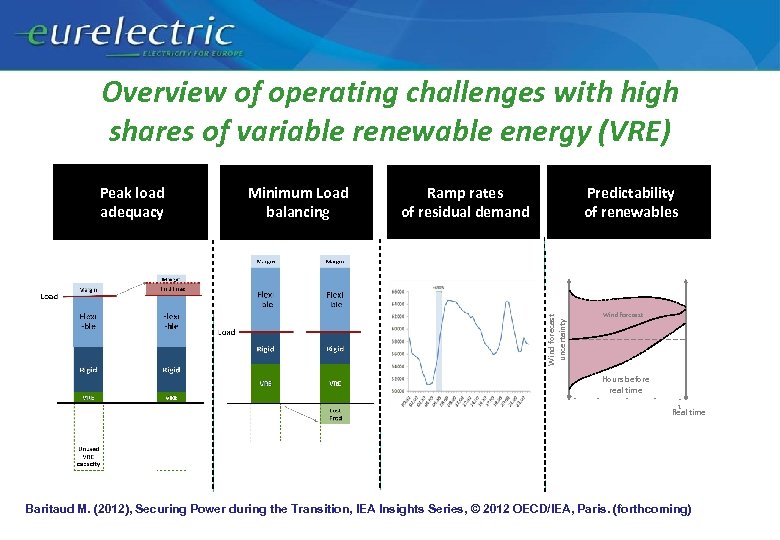
Overview of operating challenges with high shares of variable renewable energy (VRE) Minimum Load balancing Ramp rates of residual demand Predictability of renewables Wind forecast uncertainty Peak load adequacy - - Hours before real time - - 1 Real time Baritaud M. (2012), Securing Power during the Transition, IEA Insights Series, © 2012 OECD/IEA, Paris. (forthcoming)
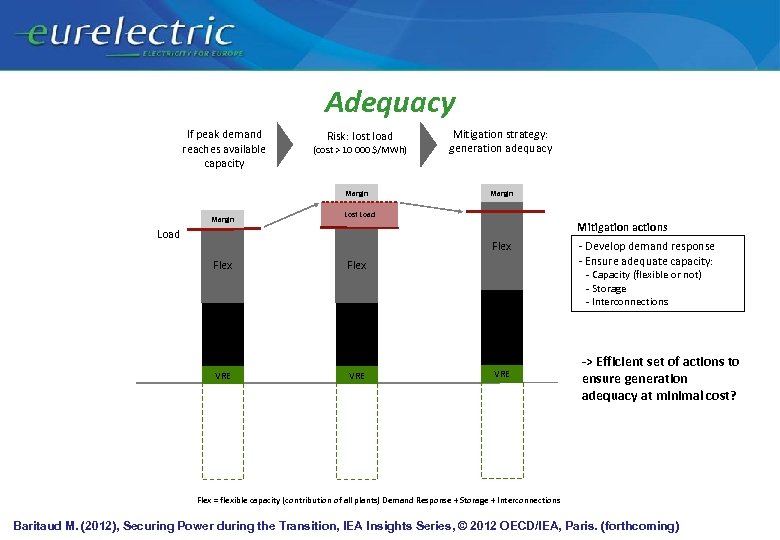
Adequacy If peak demand reaches available capacity Risk: lost load (cost > 10 000 $/MWh) Margin Mitigation strategy: generation adequacy Margin Lost Load Mitigation actions Load Flex Nonflex VRE - Develop demand response - Ensure adequate capacity: - Capacity (flexible or not) - Storage - Interconnections Nonflex VRE -> Efficient set of actions to ensure generation adequacy at minimal cost? Flex = flexible capacity (contribution of all plants) Demand Response + Storage + Interconnections Baritaud M. (2012), Securing Power during the Transition, IEA Insights Series, © 2012 OECD/IEA, Paris. (forthcoming)
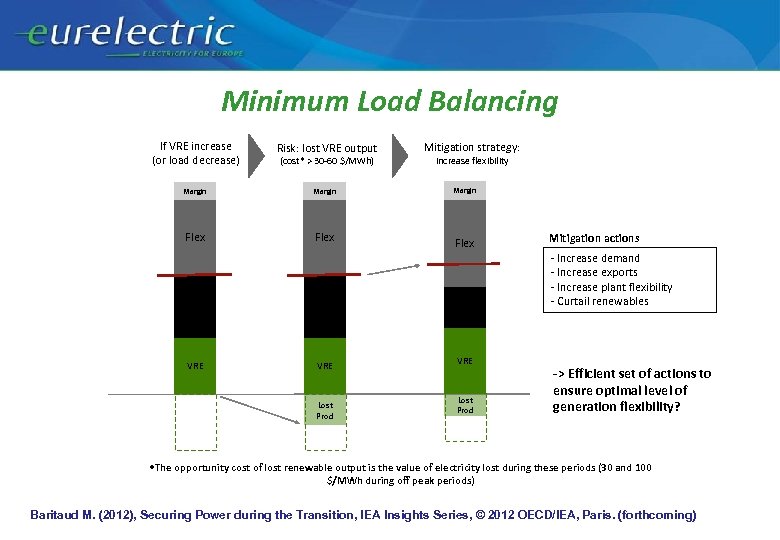
Minimum Load Balancing If VRE increase (or load decrease) Risk: lost VRE output Margin Flex (cost* > 30 -60 $/MWh) Nonflex VRE Lost Prod Mitigation strategy: Increase flexibility Margin Flex Nonflex VRE Lost Prod Mitigation actions - Increase demand - Increase exports - Increase plant flexibility - Curtail renewables -> Efficient set of actions to ensure optimal level of generation flexibility? • The opportunity cost of lost renewable output is the value of electricity lost during these periods (30 and 100 $/MWh during off peak periods) Baritaud M. (2012), Securing Power during the Transition, IEA Insights Series, © 2012 OECD/IEA, Paris. (forthcoming)
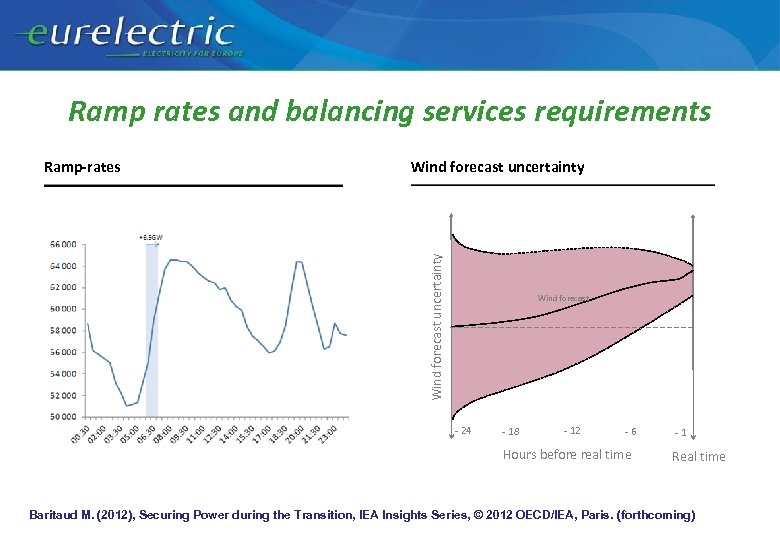
Ramp rates and balancing services requirements Wind forecast uncertainty Ramp-rates Wind forecast - 24 - 18 - 12 -6 Hours before real time -1 Real time Baritaud M. (2012), Securing Power during the Transition, IEA Insights Series, © 2012 OECD/IEA, Paris. (forthcoming)
What is needed to back-up intermittent generation? • Several solutions are needed • Demand response • Storage • Flexible Generation • Grids • Different perspectives • Wholesale market perspective • Network perspective
Agenda 1 What is needed to back-up intermittent generation? 2 What needs to be done to energy markets? 3 Will we see a European capacity mechanism design?
Building favourable investment climate is key to ensure generation adequacy in the energy sector • EURELECTRIC fully supports the 2020 policy objectives and the decarbonisation by 2050 • A smooth transition towards a low-carbon economy must be underpinned by strict coherence of national and EC policies; Member States should avoid taking discretionary measures and introducing retroactive changes • Strengthen investors’ confidence requires a holistic approach to post 2020 policies (CO 2, RES and energy efficiency) • EU ETS should be the key driver to bring the EU power sector towards carbon-neutrality, whilst support schemes to mature RES technologies should be progressively phased out by 2020 • The EU should adopt ambitious CO 2 targets for 2030/ up to 2050
Generation adequacy assessment in the EU: possible improvements • Security of Supply Directive 2005/89/EC - security of supply is in the remit of Member States - remains adequate • EURELECTRIC favours the stepwise development of European generation adequacy standards: harmonisation of general principles, MS regional cooperation, moving towards EU standards • Generation adequacy should take into account contribution of cross border connections - > a firm commitment between involved MS to share interconnection capacities in case of scarcity and respect trade contracts is needed • The ENTSO-E generation adequacy methodology will have to be improved, in particular with regard taking into account economic parameters of the existing and future generation
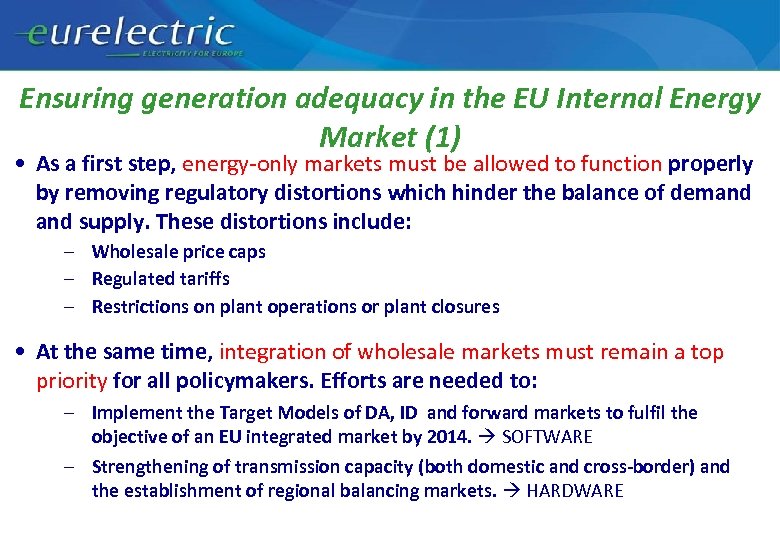
Ensuring generation adequacy in the EU Internal Energy Market (1) • As a first step, energy-only markets must be allowed to function properly by removing regulatory distortions which hinder the balance of demand supply. These distortions include: – Wholesale price caps – Regulated tariffs – Restrictions on plant operations or plant closures • At the same time, integration of wholesale markets must remain a top priority for all policymakers. Efforts are needed to: – Implement the Target Models of DA, ID and forward markets to fulfil the objective of an EU integrated market by 2014. SOFTWARE – Strengthening of transmission capacity (both domestic and cross-border) and the establishment of regional balancing markets. HARDWARE
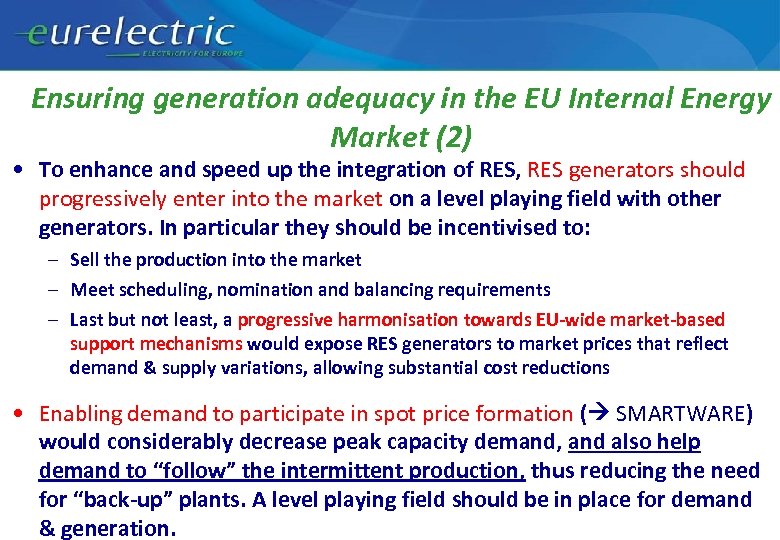
Ensuring generation adequacy in the EU Internal Energy Market (2) • To enhance and speed up the integration of RES, RES generators should progressively enter into the market on a level playing field with other generators. In particular they should be incentivised to: – Sell the production into the market – Meet scheduling, nomination and balancing requirements – Last but not least, a progressive harmonisation towards EU-wide market-based support mechanisms would expose RES generators to market prices that reflect demand & supply variations, allowing substantial cost reductions • Enabling demand to participate in spot price formation ( SMARTWARE) would considerably decrease peak capacity demand, and also help demand to “follow” the intermittent production, thus reducing the need for “back-up” plants. A level playing field should be in place for demand & generation.
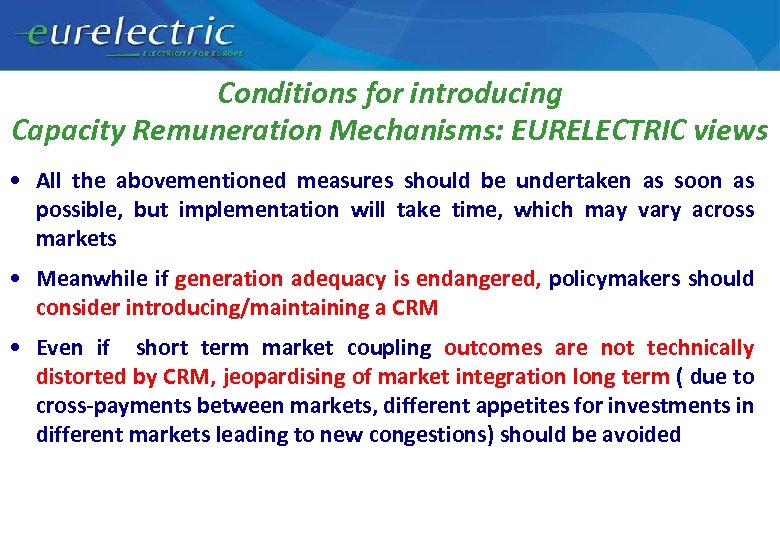
Conditions for introducing Capacity Remuneration Mechanisms: EURELECTRIC views • All the abovementioned measures should be undertaken as soon as possible, but implementation will take time, which may vary across markets • Meanwhile if generation adequacy is endangered, policymakers should consider introducing/maintaining a CRM • Even if short term market coupling outcomes are not technically distorted by CRM, jeopardising of market integration long term ( due to cross-payments between markets, different appetites for investments in different markets leading to new congestions) should be avoided
Agenda 1 What is needed to back-up intermittent generation? 2 What needs to be done to energy markets? 3 Will we see a European capacity mechanism design?
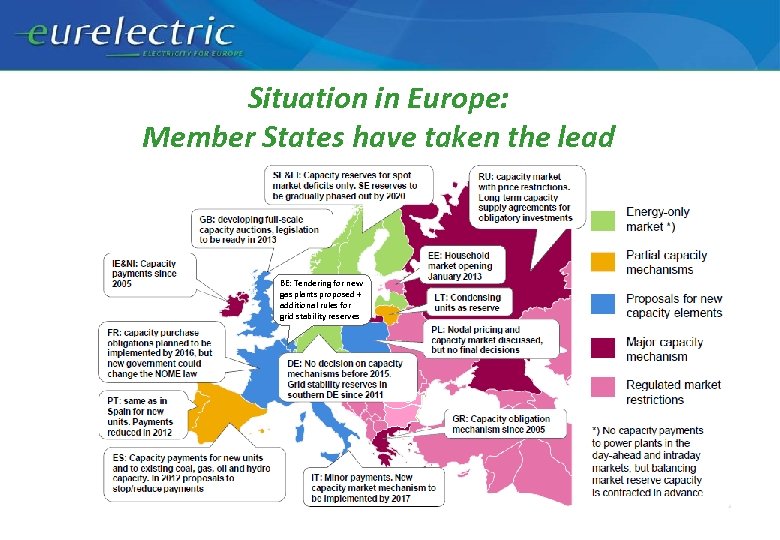
Situation in Europe: Member States have taken the lead BE: Tendering for new gas plants proposed + additional rules for grid stability reserves
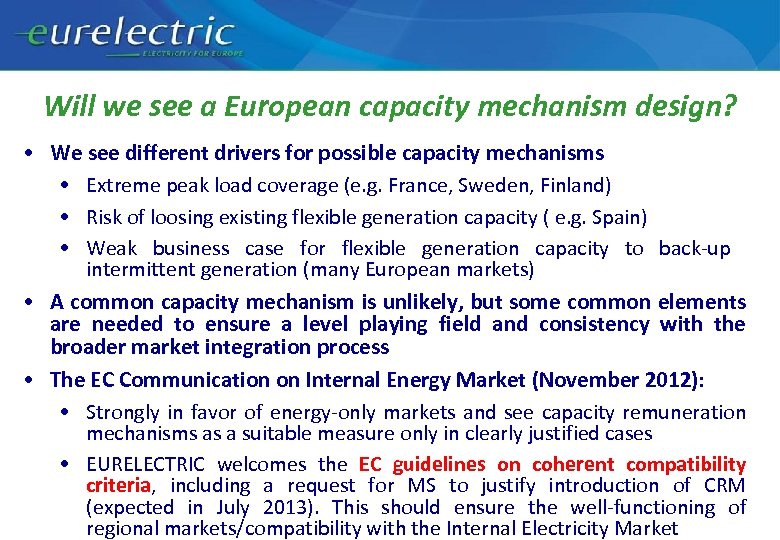
Will we see a European capacity mechanism design? • We see different drivers for possible capacity mechanisms • Extreme peak load coverage (e. g. France, Sweden, Finland) • Risk of loosing existing flexible generation capacity ( e. g. Spain) • Weak business case for flexible generation capacity to back-up intermittent generation (many European markets) • A common capacity mechanism is unlikely, but some common elements are needed to ensure a level playing field and consistency with the broader market integration process • The EC Communication on Internal Energy Market (November 2012): • Strongly in favor of energy-only markets and see capacity remuneration mechanisms as a suitable measure only in clearly justified cases • EURELECTRIC welcomes the EC guidelines on coherent compatibility criteria, including a request for MS to justify introduction of CRM (expected in July 2013). This should ensure the well-functioning of regional markets/compatibility with the Internal Electricity Market
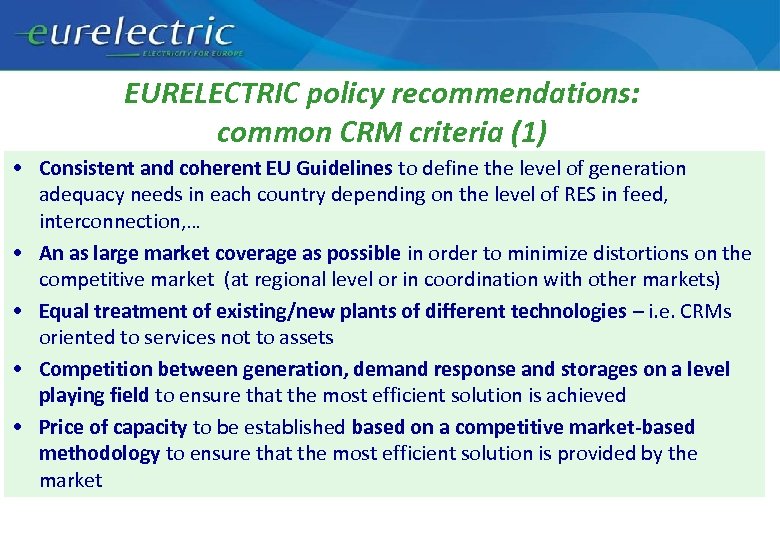
EURELECTRIC policy recommendations: common CRM criteria (1) • Consistent and coherent EU Guidelines to define the level of generation adequacy needs in each country depending on the level of RES in feed, interconnection, … • An as large market coverage as possible in order to minimize distortions on the competitive market (at regional level or in coordination with other markets) • Equal treatment of existing/new plants of different technologies – i. e. CRMs oriented to services not to assets • Competition between generation, demand response and storages on a level playing field to ensure that the most efficient solution is achieved • Price of capacity to be established based on a competitive market-based methodology to ensure that the most efficient solution is provided by the market
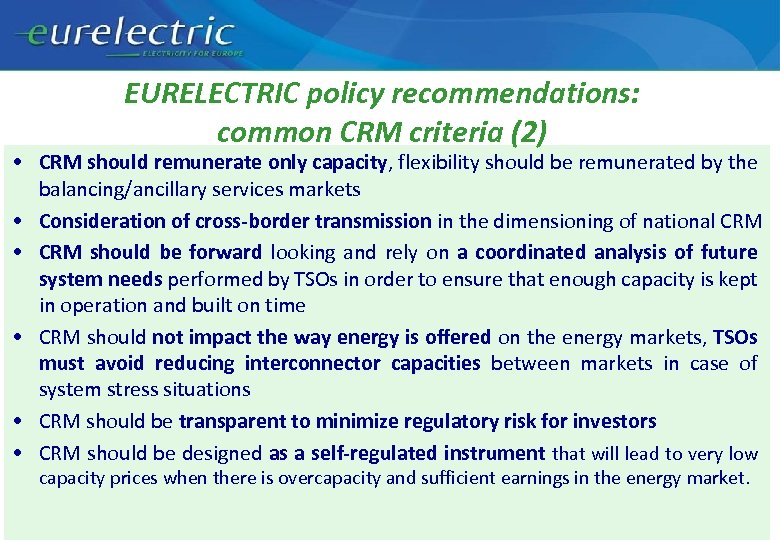
EURELECTRIC policy recommendations: common CRM criteria (2) • CRM should remunerate only capacity, flexibility should be remunerated by the balancing/ancillary services markets • Consideration of cross-border transmission in the dimensioning of national CRM • CRM should be forward looking and rely on a coordinated analysis of future system needs performed by TSOs in order to ensure that enough capacity is kept in operation and built on time • CRM should not impact the way energy is offered on the energy markets, TSOs must avoid reducing interconnector capacities between markets in case of system stress situations • CRM should be transparent to minimize regulatory risk for investors • CRM should be designed as a self-regulated instrument that will lead to very low capacity prices when there is overcapacity and sufficient earnings in the energy market.
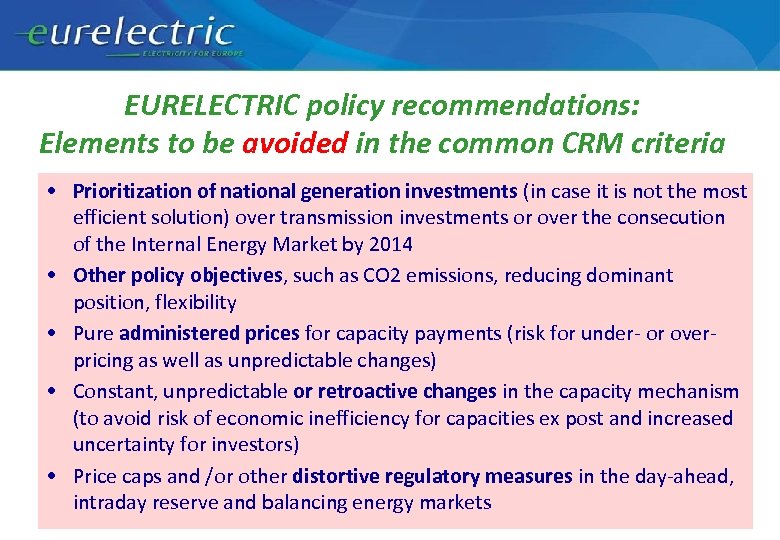
EURELECTRIC policy recommendations: Elements to be avoided in the common CRM criteria • Prioritization of national generation investments (in case it is not the most efficient solution) over transmission investments or over the consecution of the Internal Energy Market by 2014 • Other policy objectives, such as CO 2 emissions, reducing dominant position, flexibility • Pure administered prices for capacity payments (risk for under- or overpricing as well as unpredictable changes) • Constant, unpredictable or retroactive changes in the capacity mechanism (to avoid risk of economic inefficiency for capacities ex post and increased uncertainty for investors) • Price caps and /or other distortive regulatory measures in the day-ahead, intraday reserve and balancing energy markets

Thank you very much for your attention!
Скачать презентацию Mechanisms to reward standby generation capacity are they
8b85a71fec9f3f4370420ff3b4e26dd9.ppt