


 Скачать презентацию Mechanics of Mind Control Mind Control Dual
de96855b0bd0e171f603339eb9b33bb7.ppt
- Количество слайдов: 41
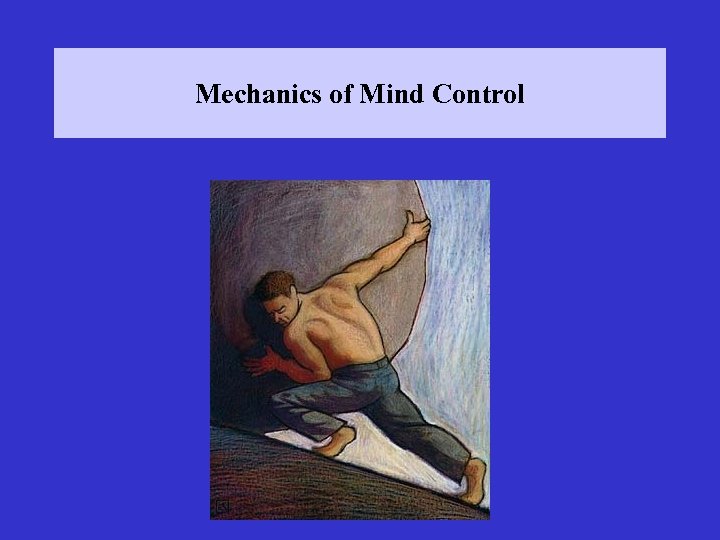 Mechanics of Mind Control
 Mind Control: Dual Processes • Wegner (1994) mental control and its ironies flow from the operation of a simple mechanism: the interplay of an intentional operating process and an ironic monitoring process. • Cybernetics Wiener (1948) noted that it takes 2 processes to control anything at all.
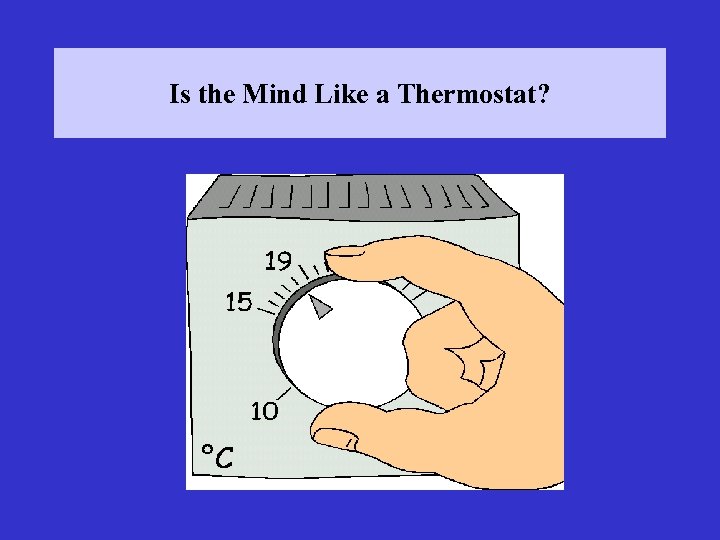 Is the Mind Like a Thermostat?
 Dynamics of Control • control involves changing something to a certain criterion, thus processes are needed to provide both the change and the assessment of success in reaching the criterion. • Miller, Galanter, & Pribram (1960) - TOTE goal-directed behavior is the result of 2 processes: the operate and test mechanisms in a test-operate-testexit (TOTE) unit - mind as a thermostat!
 Wegner’s Theory of Mental Control • the two processes underlying mental control are cognitive search processes that increase the accessibility of stimuli. Each process is an attentional process that orients the system toward a particular set of inputs. • the 2 processes differ with respect to their: (a) target search, (b) degree of consciousness (c) attentional demands, (d) conditions of activation
 Operating Process • search target the desire for a mental state creates an operating process that seeks items consistent with that state (e. g. , concentration). The desire to avoid a mental state (e. g. , suppression) creates an operating process that seeks items inconsistent with that state. Thus, the operator looks for distractors in an attempt to provide mental control.
 • consciousness the operating process is present in consciousness. It is the ‘subjective’ feeling of doing in mental life.
 • effortfulness the operating process is an effortful (i. e. , controlled) mental process (i. e, it demands attentional resources - Bargh, 1989; Hasher & Zacks, 1979; Posner & Snyder, 1975; Shiffrin & Schneider, 1977). As an effortful mental activity, it is vulnerable to competing task demands.
 • activation The operating process is activated by the monitoring process. Whenever the monitor is satisfied that a failure of the intentional operation has been found, the operating process is implemented. Thus, the operator is a non-continuous process, it occurs cyclically in response to failure.
 Monitoring Process • search target the monitoring process searches for indications of the failure of mental control (i. e. , it searches for the unwanted thought, impulse, or memory). Thus, the monitor reviews potentially conscious material. A search attuned for failure is uncomplicated as it needs only to hold a single template against which input can be compared. • disabling the monitor (Luria, 1966) • frontal lobe dysfunction (Stuss & Benson, 1987)
 • consciousness during mental control attempts, the monitoring process is usually not reflected in conscious thought. • effortfulness the monitoring process is less effortful than the operating process, thus it is less likely to be disturbed by concurrent tasks.
 • activation the monitoring process is activated by the initiation of mental control. Once the intention to control the mind is implemented, the monitoring process runs continuously until the intention is relaxed.
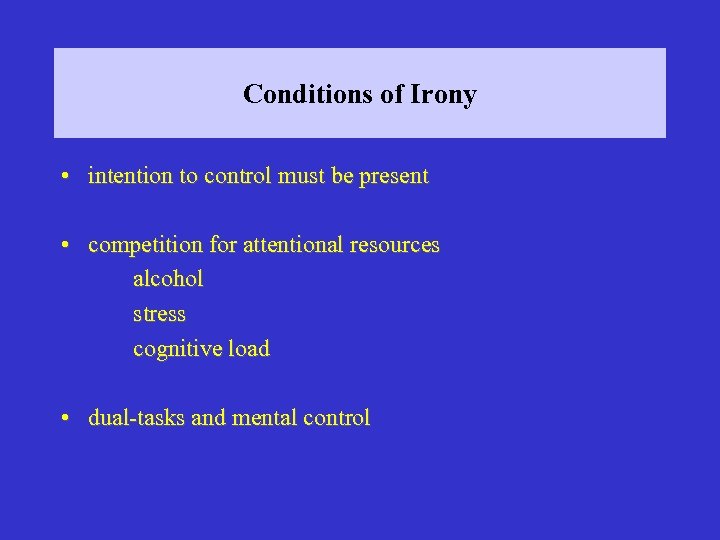 Conditions of Irony • intention to control must be present • competition for attentional resources alcohol stress cognitive load • dual-tasks and mental control
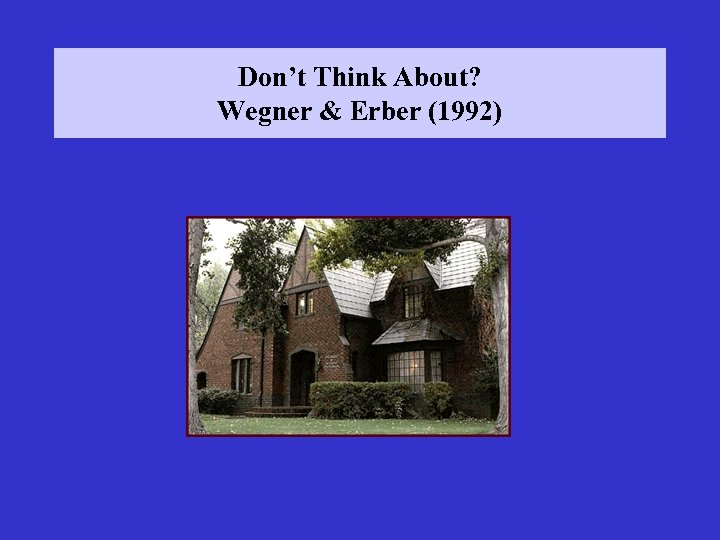 Don’t Think About? Wegner & Erber (1992)
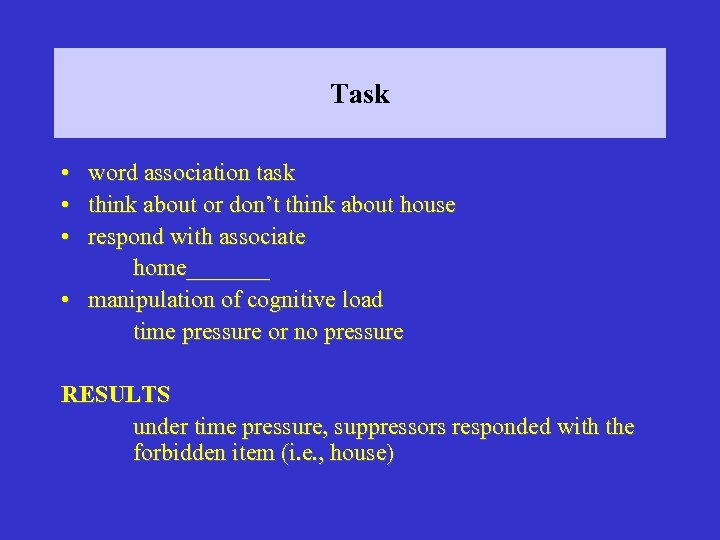 Task • • • word association task think about or don’t think about house respond with associate home_______ • manipulation of cognitive load time pressure or no pressure RESULTS under time pressure, suppressors responded with the forbidden item (i. e. , house)
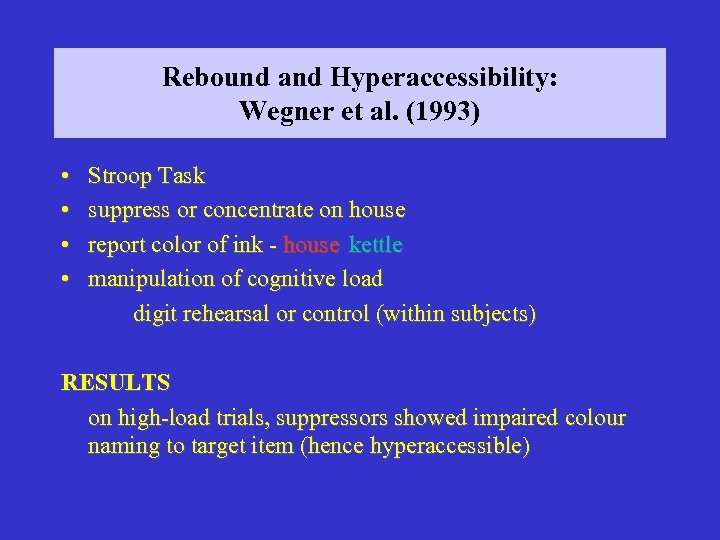 Rebound and Hyperaccessibility: Wegner et al. (1993) • • Stroop Task suppress or concentrate on house report color of ink - house kettle manipulation of cognitive load digit rehearsal or control (within subjects) RESULTS on high-load trials, suppressors showed impaired colour naming to target item (hence hyperaccessible)
 Mood Control: Wegner et al. (1993) • recall either happy or sad life event sad event (try not to be sad, no instruction, be sad) happy event (try not to be happy, no instruction, be happy) • manipulation of load digit rehearsal or control (between subjects) RESULTS mood control produced ironic effects under load (trying not to be sad, made people sad)
 While You Were Sleeping
 Try to Sleep: Wegner et al. (1993) • play cassette when you get into bed • narrator sleep as quickly as you can sleep whenever you want • rest of the tape - cognitive load New Age music or brass band • time taken to get to sleep
 Sleeping Beauty
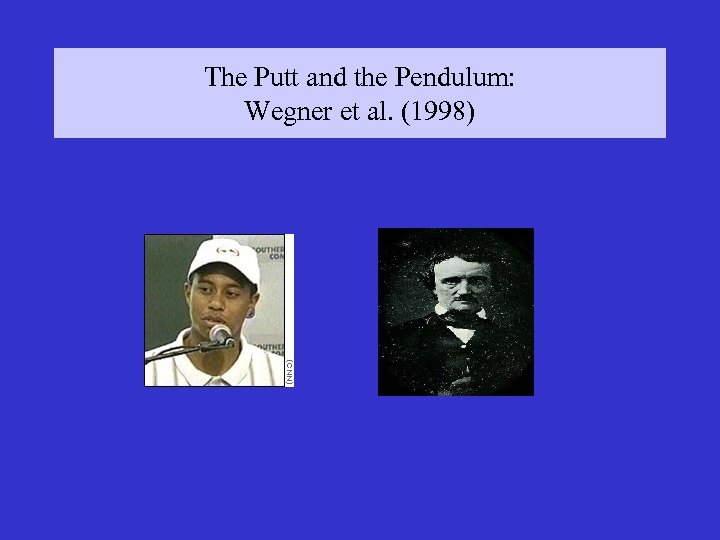 The Putt and the Pendulum: Wegner et al. (1998)
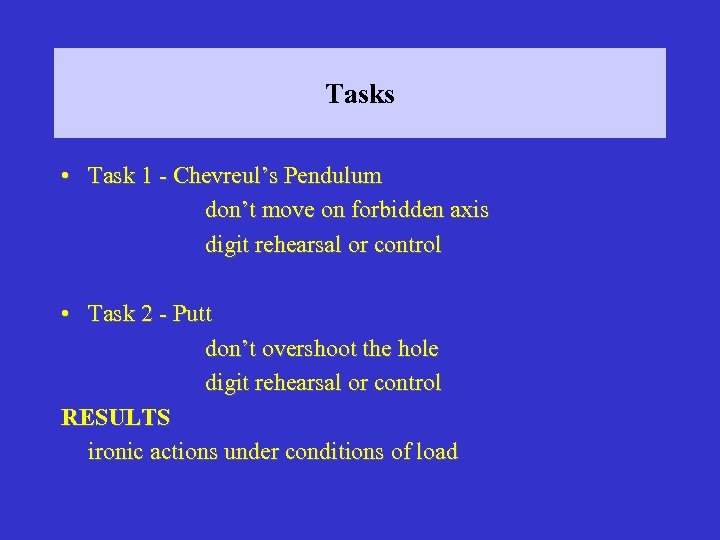 Tasks • Task 1 - Chevreul’s Pendulum don’t move on forbidden axis digit rehearsal or control • Task 2 - Putt don’t overshoot the hole digit rehearsal or control RESULTS ironic actions under conditions of load
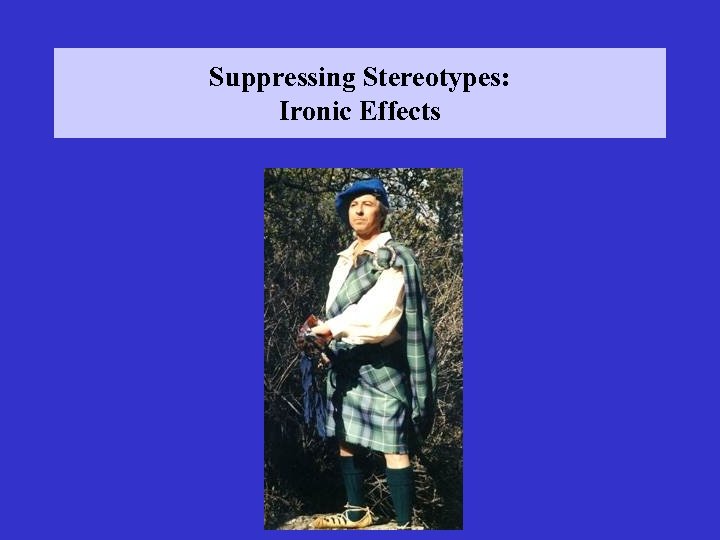 Suppressing Stereotypes: Ironic Effects
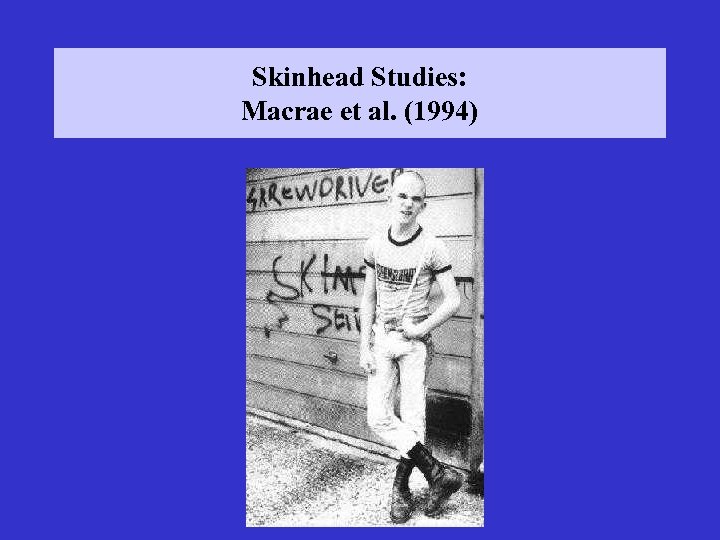 Skinhead Studies: Macrae et al. (1994)
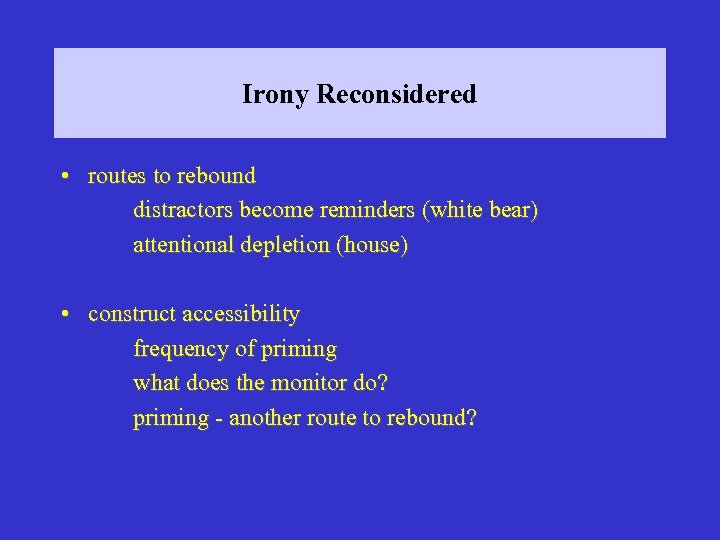 Irony Reconsidered • routes to rebound distractors become reminders (white bear) attentional depletion (house) • construct accessibility frequency of priming what does the monitor do? priming - another route to rebound?
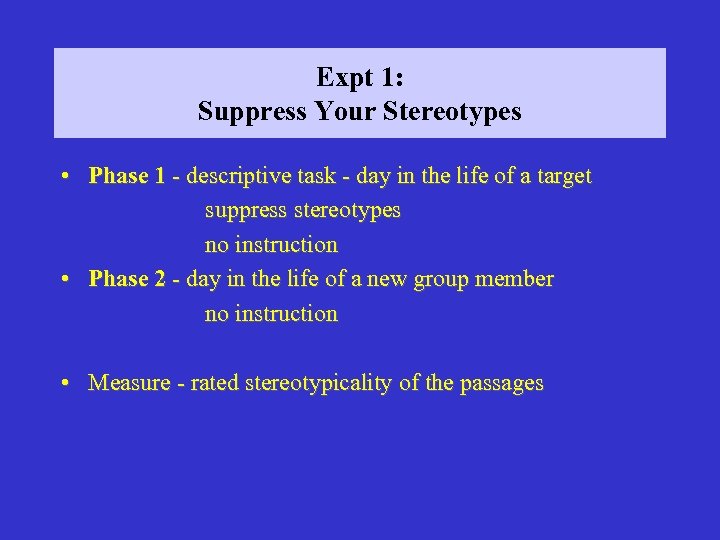 Expt 1: Suppress Your Stereotypes • Phase 1 - descriptive task - day in the life of a target suppress stereotypes no instruction • Phase 2 - day in the life of a new group member no instruction • Measure - rated stereotypicality of the passages
 Stereotype Rebound
 But What About Social Behavior?
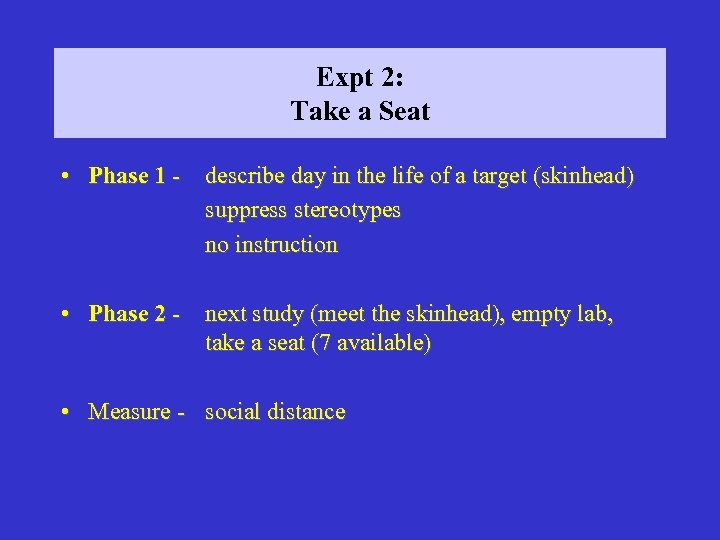 Expt 2: Take a Seat • Phase 1 - describe day in the life of a target (skinhead) suppress stereotypes no instruction • Phase 2 - next study (meet the skinhead), empty lab, take a seat (7 available) • Measure - social distance
 The Significant Buttock!
 Stereotype Hyperaccessibility • rebound with and without resource depletion • construct priming accessibility following the relaxation of suppression intention monitor in action
 Expt 3: Press a Button • Phase 1 - describe day in the life of a skinhead suppress stereotypes no instruction • Phase 2 - lexical decision task accessibility of stereotype
 Stereotype Accessibility
 Other Ironic Effects: Suppression is Effortful • forming impression of others categorical plus individuating material individuation is effortful (Fiske & Neuberg, 1990) suppression is effortful (Wegner, 1994) • suppressing stereotypes which information is remembered
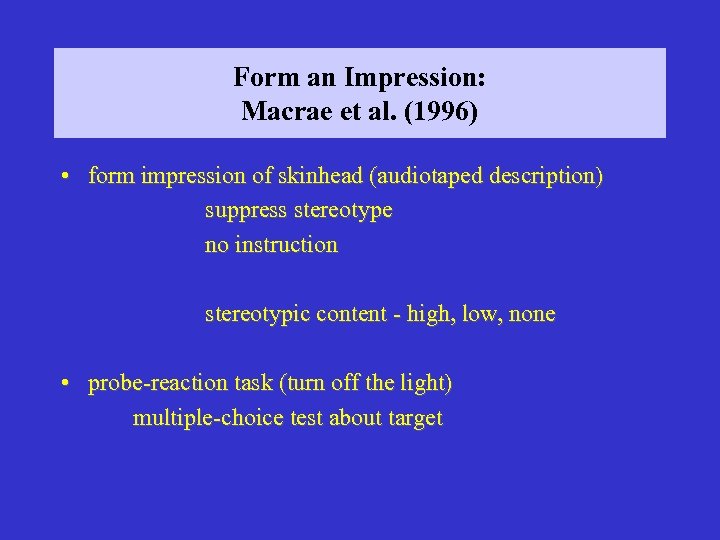 Form an Impression: Macrae et al. (1996) • form impression of skinhead (audiotaped description) suppress stereotype no instruction stereotypic content - high, low, none • probe-reaction task (turn off the light) multiple-choice test about target
 Probe Performance
 Target Knowledge
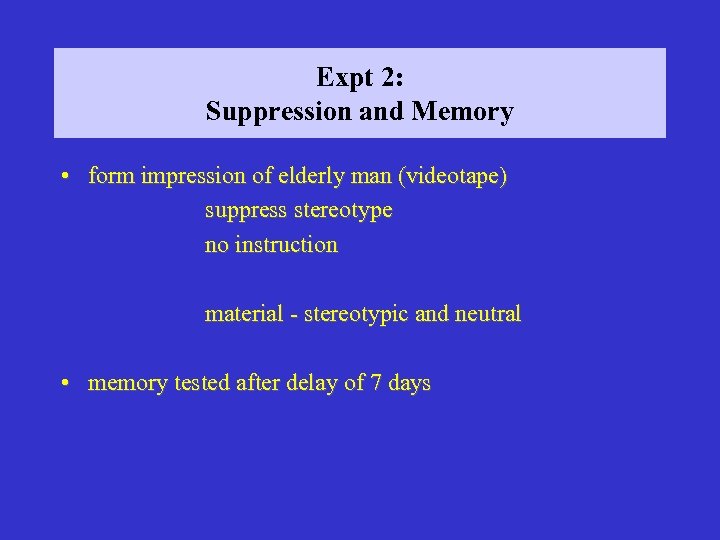 Expt 2: Suppression and Memory • form impression of elderly man (videotape) suppress stereotype no instruction material - stereotypic and neutral • memory tested after delay of 7 days
 Target Recollections
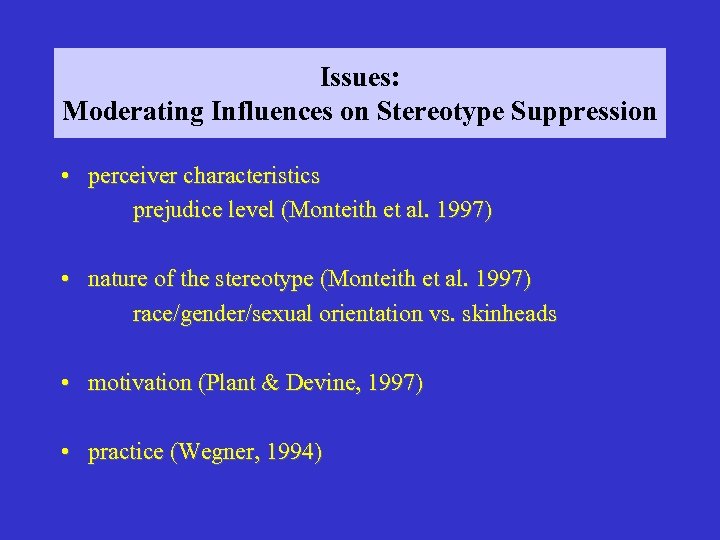 Issues: Moderating Influences on Stereotype Suppression • perceiver characteristics prejudice level (Monteith et al. 1997) • nature of the stereotype (Monteith et al. 1997) race/gender/sexual orientation vs. skinheads • motivation (Plant & Devine, 1997) • practice (Wegner, 1994)
 Things Worth Knowing 1. Wegner’s (1994) model of mental control. 2. The nature of post-suppression rebound effects.