


 Скачать презентацию Meat Science What is Meat Science n
0ba865140c6a1a147453699fd5d5e549.ppt
- Количество слайдов: 100
 Meat Science
 What is Meat Science? n. The study of the entire meat industry from the production of the animal to the preparation of the final product to the marketing of the product
 Types of Meat n. Beef n. Veal n. Lamb n. Venison n. Rabbit n. Sea Food n. Poultry n. Wild Game n. Pork n. Ostrich n. Emu
 Why is Meat Important? n. High quality protein n. Iron n. Vitamin B n. Vitamin A
 Meat is Composed of n. Muscle Tissue n. Cartilage n. Nerve Tissue n. Tendons n. Fat Tissue n. Bone n. Blood Vessels n. Organ Tissue
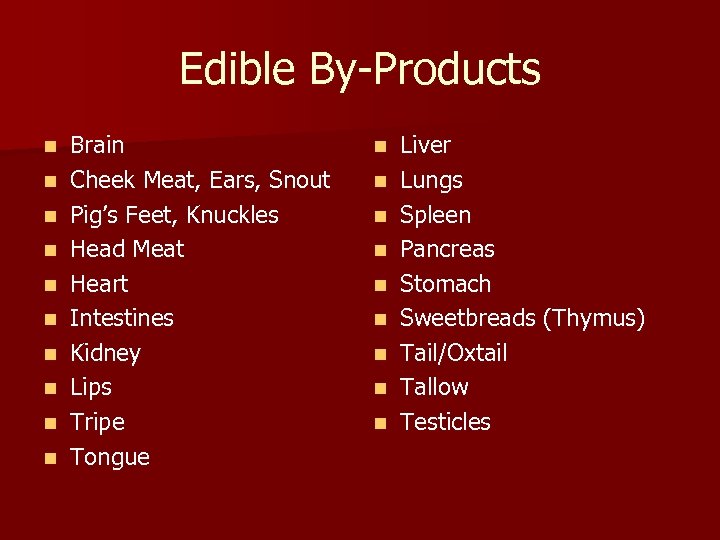 Edible By-Products n n n n n Brain Cheek Meat, Ears, Snout Pig’s Feet, Knuckles Head Meat Heart Intestines Kidney Lips Tripe Tongue n n n n n Liver Lungs Spleen Pancreas Stomach Sweetbreads (Thymus) Tail/Oxtail Tallow Testicles
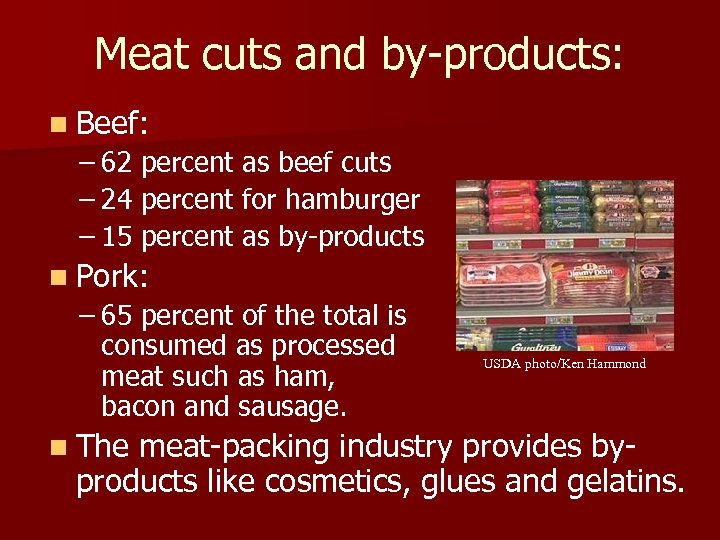 Meat cuts and by-products: n Beef: – 62 percent as beef cuts – 24 percent for hamburger – 15 percent as by-products n Pork: – 65 percent of the total is consumed as processed meat such as ham, bacon and sausage. USDA photo/Ken Hammond n The meat-packing industry provides by- products like cosmetics, glues and gelatins.
 History of The Meat Industry n Early butchers began killing and cutting animals for other people outside of their own family n Meat preservation began with the packing of meat in a salt solution in wooden barrels
 History of The Meat Industry n Animals were driven “on the hoof” until refrigeration was invented n Huge meat packing plants developed in the Midwest and began processing meat and shipping it
 History of The Meat Industry n As cities grew, small meat shops began to open to the public n Animals were driven to the railroad “on the hoof” and taken to larger cities to be butchered
 History of The Meat Industry n. Meat plants were rebuilt and/or automated n. It became more economical to ship frozen meat products than the live animal
 Overview of the Beef Industry n. Approximately 1. 3 billion total cattle in the world n 35 million of these are beef cows in the U. S.
 Segments of the Beef Cattle Industry n Seedstock/Purebred Breeders n Cow/Calf Operation n Yearling/Stocker Operation n Feedlots n Meat Packaging/Processing n Wholesalers n Retailers n Consumers
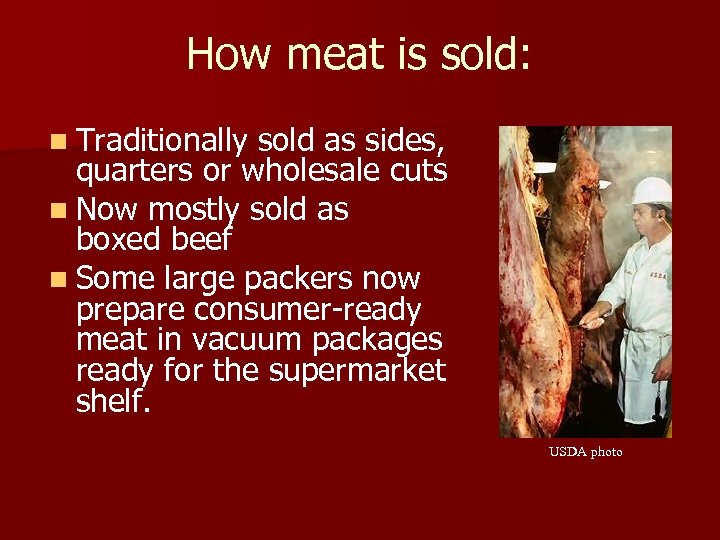 How meat is sold: n Traditionally sold as sides, quarters or wholesale cuts n Now mostly sold as boxed beef n Some large packers now prepare consumer-ready meat in vacuum packages ready for the supermarket shelf. USDA photo
 Beef Cattle Breeds n n n n Angus (black and red) Charolais Hereford Limousin Simmental Brahman Salers Texas Longhorn Shorthorn n Belted Galloway n Holstein and other dairy breeds? ? ? n n > 250 beef cattle breeds
 Meat Inspection n. The mandatory evaluation of the health status of meat animals and the wholesomeness of the meat obtained from them
 Government surveillance: n Purposes of inspection: – Prevents harmful additives and ingredients – Excludes sick and diseased animals – Eliminates misleading labeling and packaging – Prohibits contaminated and unwholesome meats Federal meat inspection is administered by the Food Safety and Inspection Service (FSIS) as part of USDA. n States may inspect meat only for use within that state. n
 Federal Inspection n. Exceptions to federal inspection of meat to be sold are farmers and custom/local butchers, however, they fall under state inspection guidelines
 Cutability n. The amount of saleable retail cuts that can be obtained from a carcass
 Dressing Percentage n. Ratio of the dressed carcass weight to the weight of the live animal n(Hot carcass weight/live weight)X 100 naverage=62. 5%
 Wholesome Meat Act of 1967 n. All meat must be inspected before sale
 Humane Slaughter Act n. All animals must be immobilized prior to shackling and bleeding
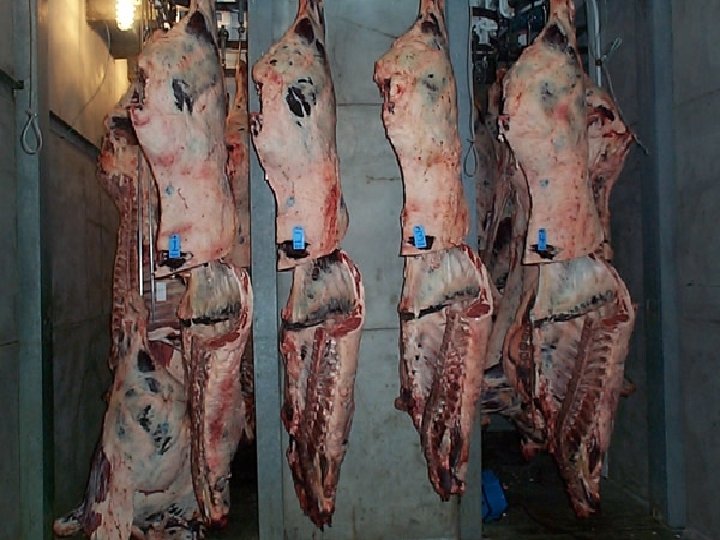
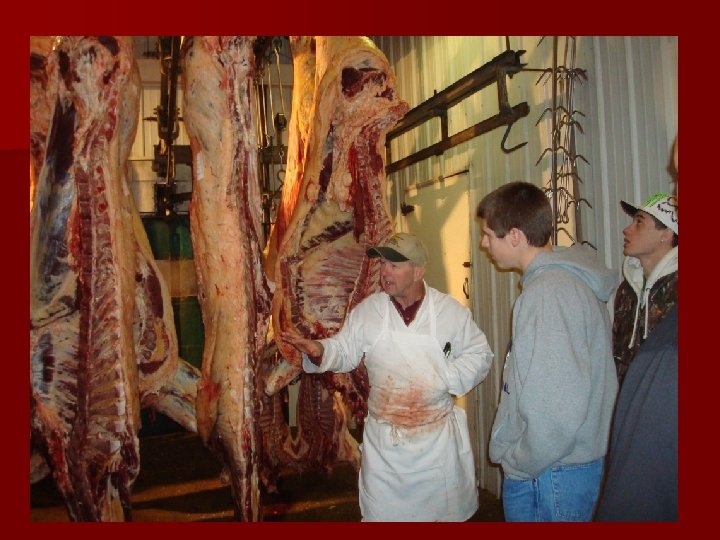
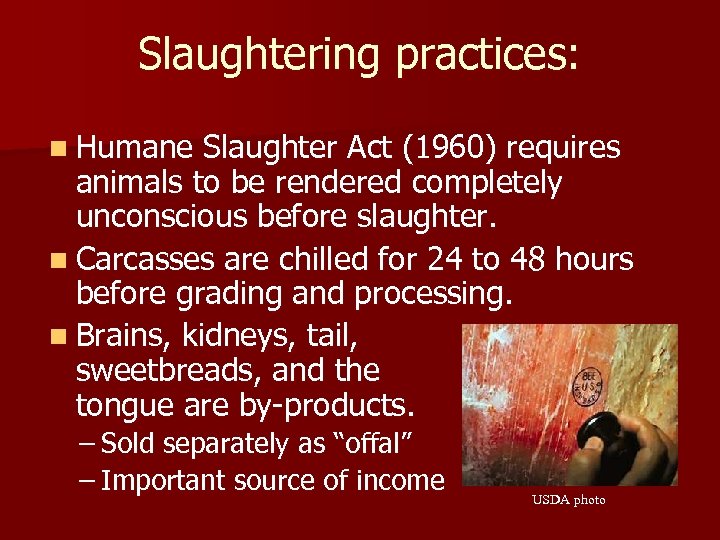 Slaughtering practices: n Humane Slaughter Act (1960) requires animals to be rendered completely unconscious before slaughter. n Carcasses are chilled for 24 to 48 hours before grading and processing. n Brains, kidneys, tail, sweetbreads, and the tongue are by-products. – Sold separately as “offal” – Important source of income USDA photo
 Immobilization n. Rendering an animal unconscious (brain dead), but the heart is still beating--technically the animal is still alive
 Methods of Immobilization n. Mechanical (gun, steel rod gun, captive bolt gun) n. Electrical shock n. Chemical (carbon dioxide)
 Killing n. The bleeding of an animal until the heart stops beating (Exsanguination)
 Kosher Slaughtering n. Butchering according to religious beliefs (Jewish Religion) n. Kosher is exempt from the Humane Slaughter Act (Immobilization)
 9 Components of Meat Inspection/Facilities Inspection n. Sanitation n. Ante-Mortem inspection n. Post-Mortem inspection n. Product inspection n. Lab analysis
 9 Components of Meat Inspection/Facilities Inspection n. Control and Restriction of condemned material n. Marking and Labeling n. Pest Control n. Sewage and Waste Disposal
 Rigor Mortis n. The “stiffness of death” – the stiffening of muscles in a dead animal due to the lack of energy in the muscle n. Occurs about 6 -12 hours after death
 Rigor Mortis n Energy is needed in muscle in order for the muscle fibers to relax n When an animal is killed there is no way for energy to be produced because there is no more oxygen entering the body
 Rigor Mortis n Rigor mortis can be thought of as an irreversible muscle contraction n Pre-slaughter death, rigor mortis, rate of carcass cooling affect muscle change after death
 Carcass Grading n. Types of Fat include: §Subcutaneous – fat found directly under the skin §Intermuscular – fat found between muscles §Intramuscular – fat found in the muscles (marbling)
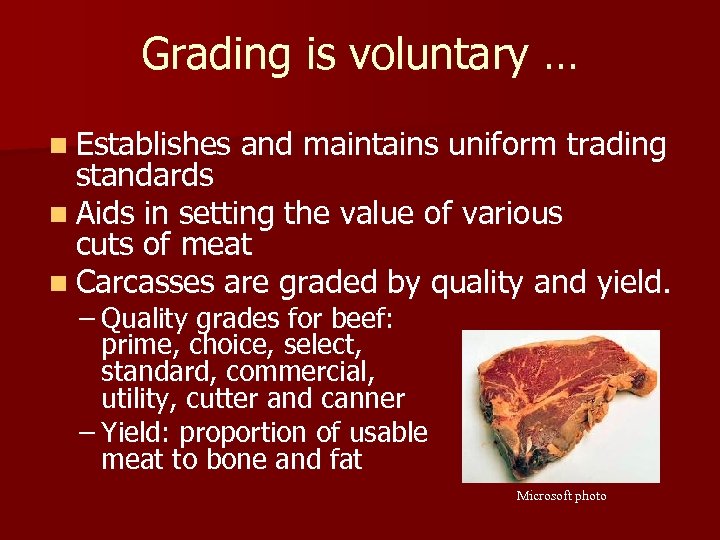 Grading is voluntary … n Establishes and maintains uniform trading standards n Aids in setting the value of various cuts of meat n Carcasses are graded by quality and yield. – Quality grades for beef: prime, choice, select, standard, commercial, utility, cutter and canner – Yield: proportion of usable meat to bone and fat Microsoft photo
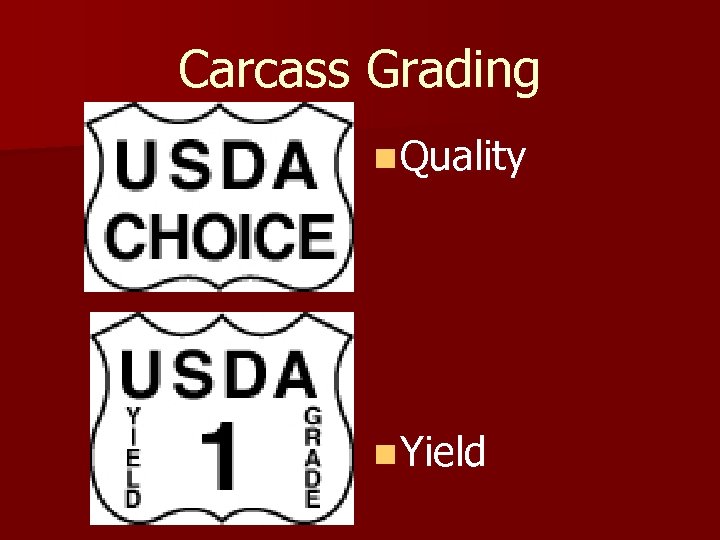 Carcass Grading n Quality n Yield
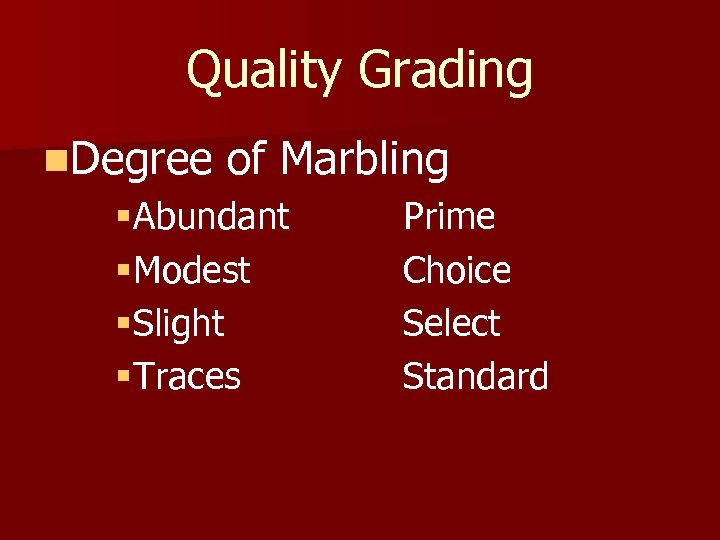 Quality Grading n. Degree of Marbling §Abundant Prime §Modest Choice §Slight Select §Traces Standard
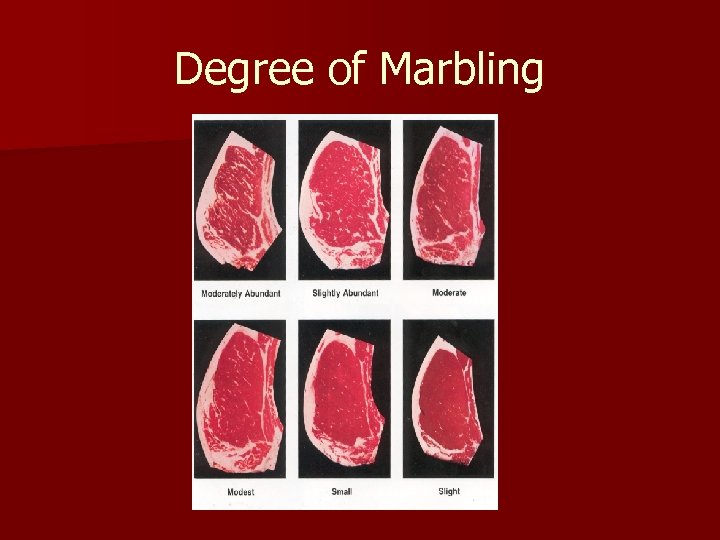 Degree of Marbling
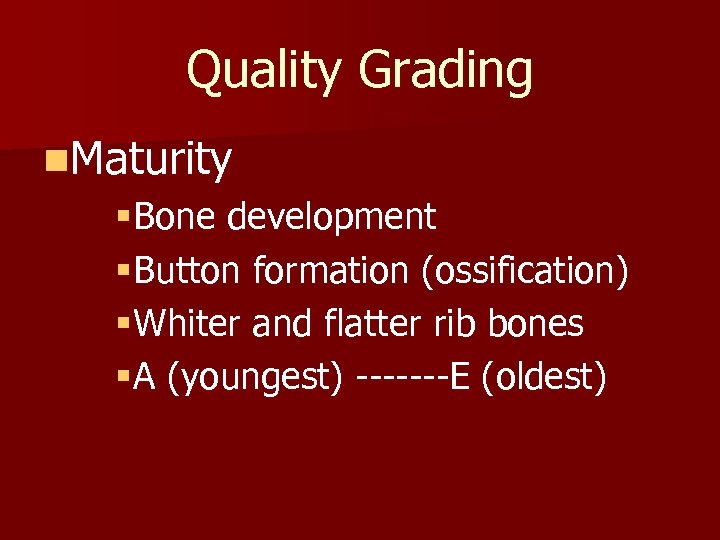 Quality Grading n. Maturity §Bone development §Button formation (ossification) §Whiter and flatter rib bones §A (youngest) -------E (oldest)
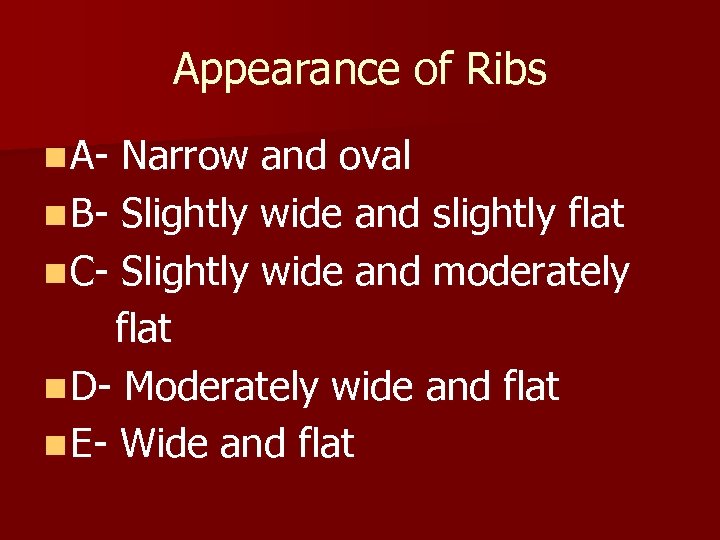 Appearance of Ribs n A- Narrow and oval n B- Slightly wide and slightly flat n C- Slightly wide and moderately flat n D- Moderately wide and flat n E- Wide and flat
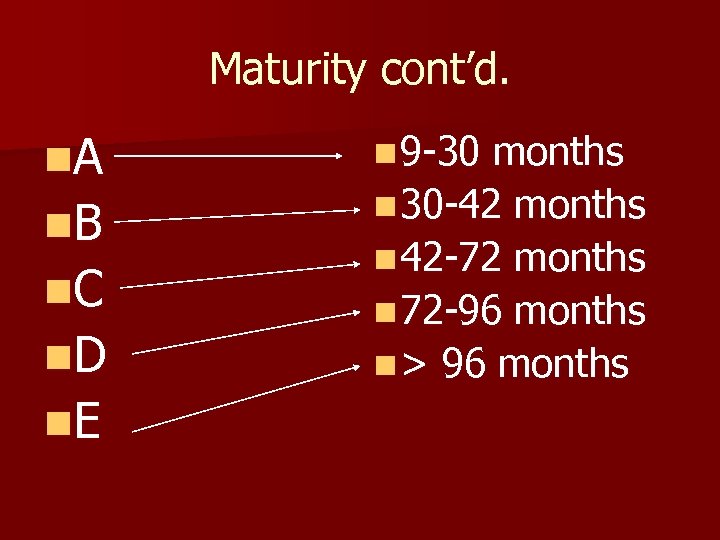 Maturity cont’d. n. A n. B n. C n. D n. E n 9 -30 months n 30 -42 months n 42 -72 months n 72 -96 months n > 96 months
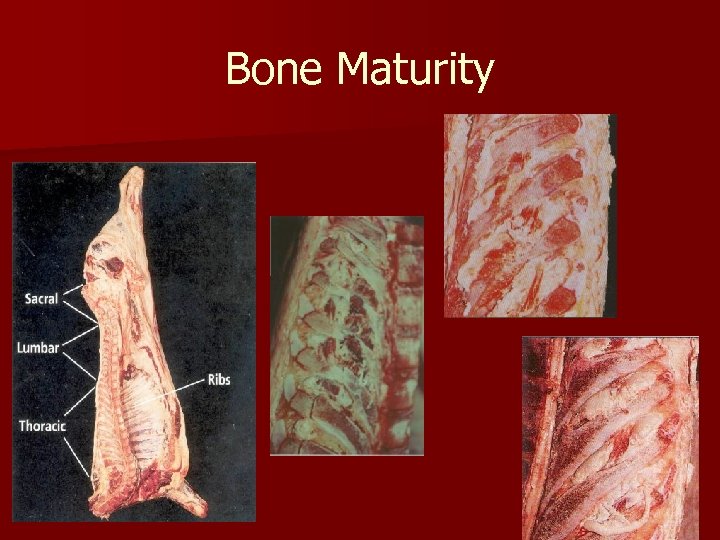 Bone Maturity
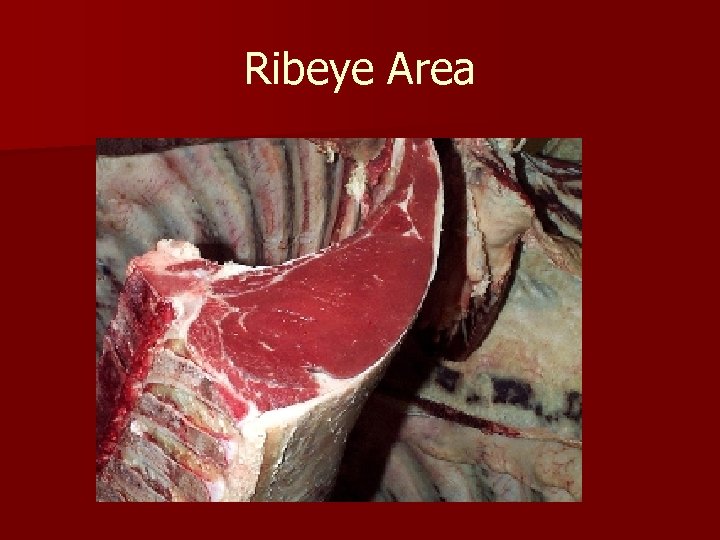
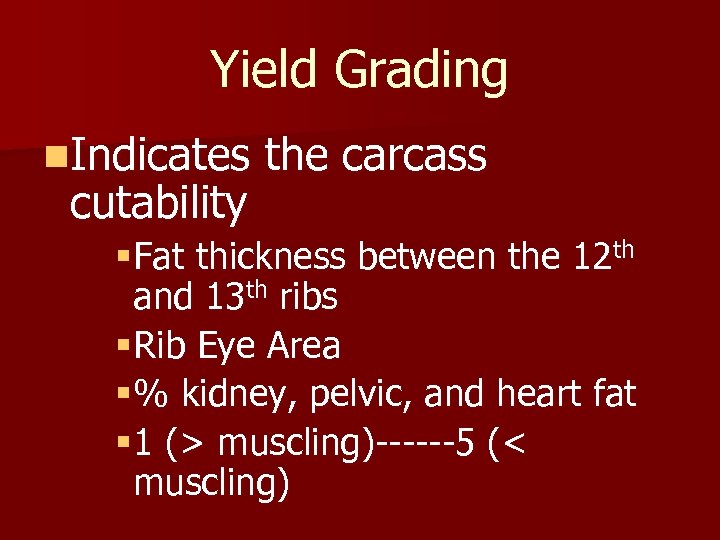 Yield Grading n. Indicates the carcass cutability §Fat thickness between the 12 th and 13 th ribs §Rib Eye Area §% kidney, pelvic, and heart fat § 1 (> muscling)------5 (< muscling)
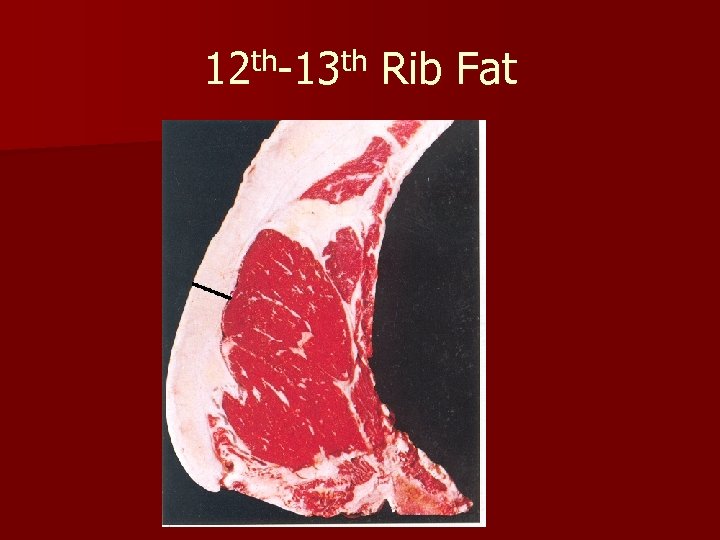 12 th-13 th Rib Fat
 Ribeye Area
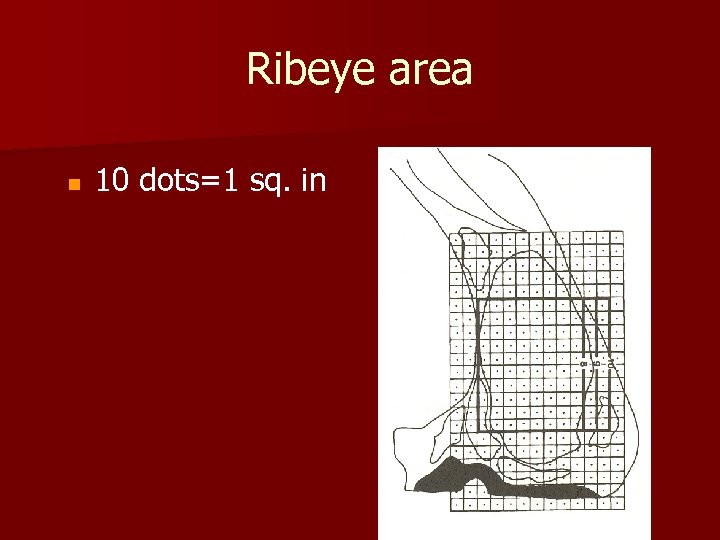 Ribeye area n 10 dots=1 sq. in
 Lamb Carcass Processing n https: //www. dropbox. com/s/143 gvs 77 c 2 cr ug 8/American%20 Lamb%20%20 Fabricating%20 for%20 Value%20 vide o. mov
 Video on Jungle n https: //www. youtube. com/watch? v=h 2 pp a. Jw. Q 9 UM n Meatpacking jungle – christy
 Why a recall? Pathogens - E. coli O 157: H 7 in ground beef - Lm or Salmonella in RTE foods • Undeclared allergens • Extraneous materials/chemical contaminants/residues • Operating w/o inspection presence
 http: //ohioline. osu. edu/aex-fact/0251. html Examples? . . .
 -Wholesale Level – Product has been distributed to a warehouse or distribution center, where it is NOT under the direct control of the producing company (level between the manufacturer and the retailer) -Retail Level – Product has been received by retailers for sale to household consumers - Consumer Level – The product has been sold directly to household consumers (mail order)
 Calling all Consumers! n Recall Release! – Recall Release uses a standard format to provide the public with pertinent, descriptive product information – Release is sent to media outlets, public health officials, subscribers, posted on the FSIS website and Twitter.
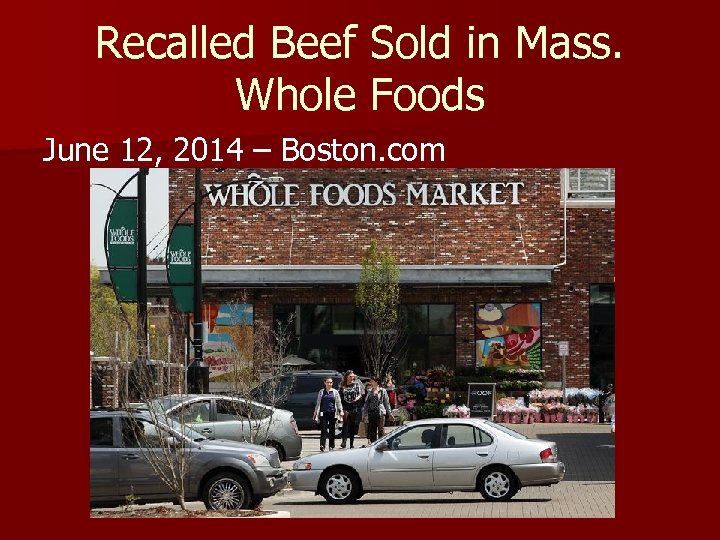 Recalled Beef Sold in Mass. Whole Foods June 12, 2014 – Boston. com
 The US Department of Agriculture says that Fruitland American Meat, a Jackson, Mo. beef company, is recalling more than 4, 000 pounds of beef due to a potential risk for Bovine Spongiform Encephalopathy (BSE), also referred to as mad cow disease. n Not all beef is at risk. The bone-in “Rain Crow Ranch Ribeye” and quartered beef carcasses bearing establishment number EST. 2316 inside the USDA mark of inspection are currently being recalled. n
 Thursday morning the USDA announced that a Whole Foods distribution center in Connecticut that serves stores in New England received the potentially tainted beef. n Not all beef is at risk. The bone-in “Rain Crow Ranch Ribeye” and quartered beef carcasses bearing establishment number EST. 2316 inside the USDA mark of inspection are currently being recalled. n
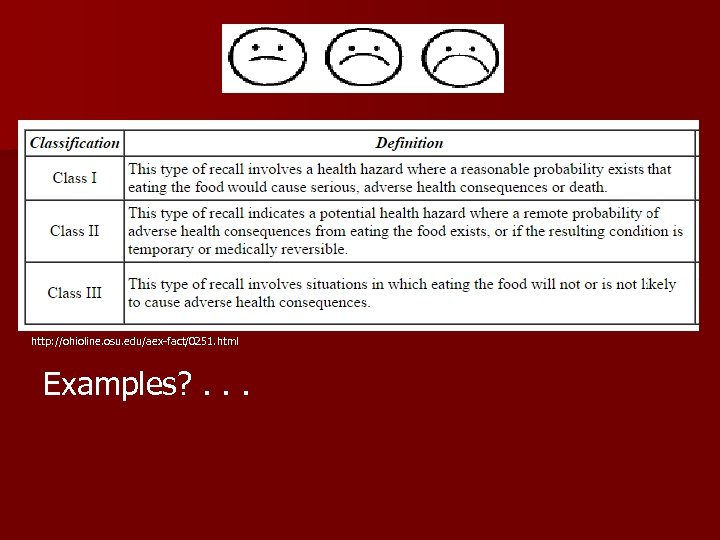
 These are branches of the cow’s central nervous system along the spine. If the cow was infected with BSE, this is the area where the infected tissues would be located. Regulations require that they be removed from cattle more than 30 months old. It appears that procedure was not followed for the beef in question. n The USDA has classified this recall as a low health risk, but a Class II recall: “This is a health hazard situation where there is a remote probability of adverse health consequences from the use of the product, ” -USDA n The bone-in ribeyes roasts, according to the USDA, were distributed to two restaurants: n
 Answer these questions… n Group of Consumer, USDA, Whole Foods n Who is at fault? n Time frame? n Consequences? n Safety in Future for product
 Do Now: n Log on to the computer and find one meat product that includes packaging and answer these questions: – What were they trying to sell? – How did they reach the demographics? – What kind is their niche market?
 Do-Now n Write down your favorite meat commercial and why?
 n https: //www. youtube. com/watch? v=Bafk. F ntxg. Pw go meat n https: //www. youtube. com/watch? v=2 WNd YL 8 N 4 zk Jack Link n https: //www. youtube. com/watch? v=Kwa. U 0 YNG 3 Vo Whole Foods
 Who, What, Where, When, How? n What is each commercial marketing? n What were they trying to sell? n Who was the audience each was trying to reach? n How did they reach the demographics? n What was the Whole Foods commercial trying to emphasize?
 AMS n Agricultural Marketing Services n Administers programs that facilitate the efficient, fair marketing. n ensure the quality and availability of wholesome food for consumers across the country.
 Organic
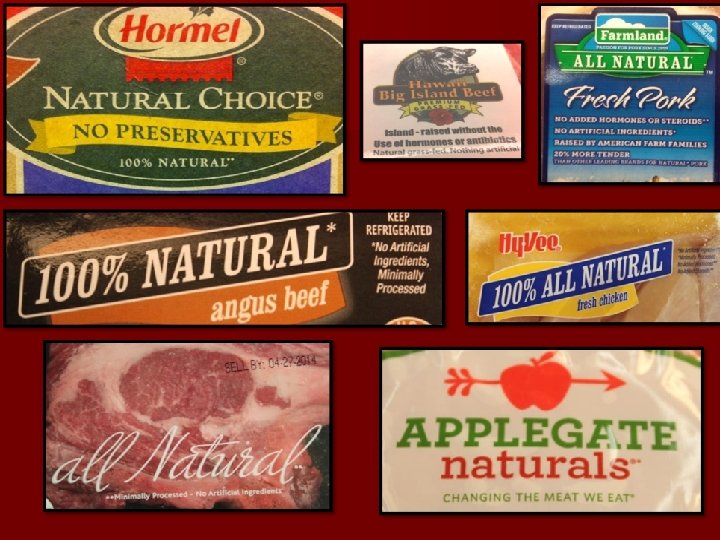
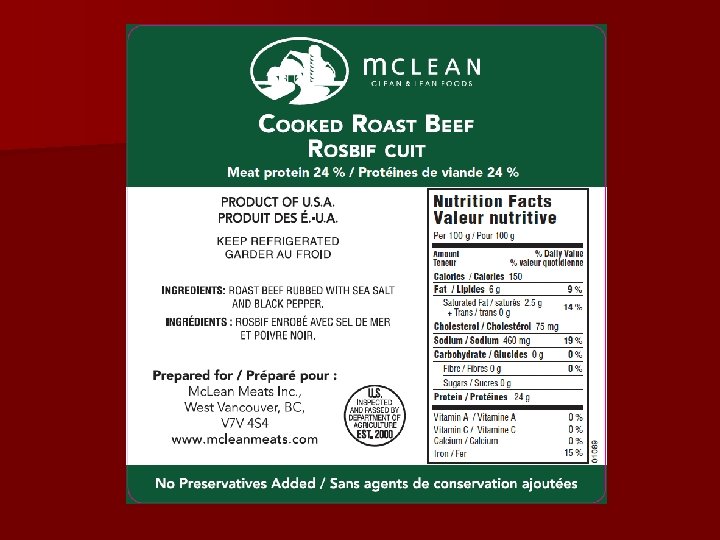
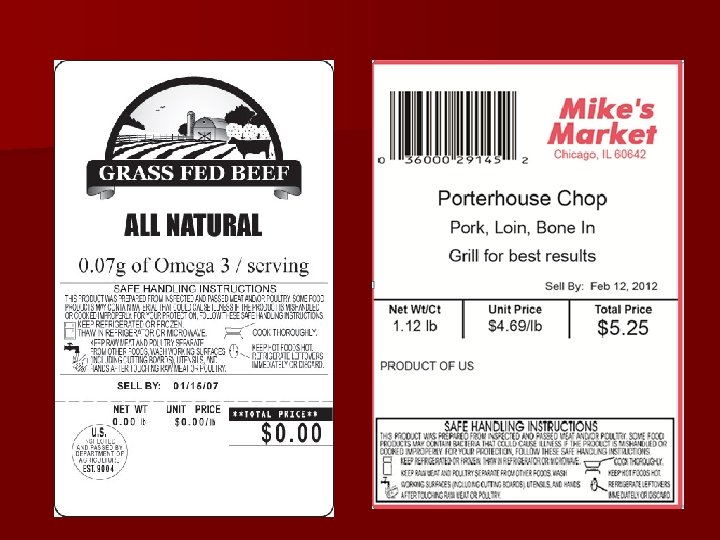
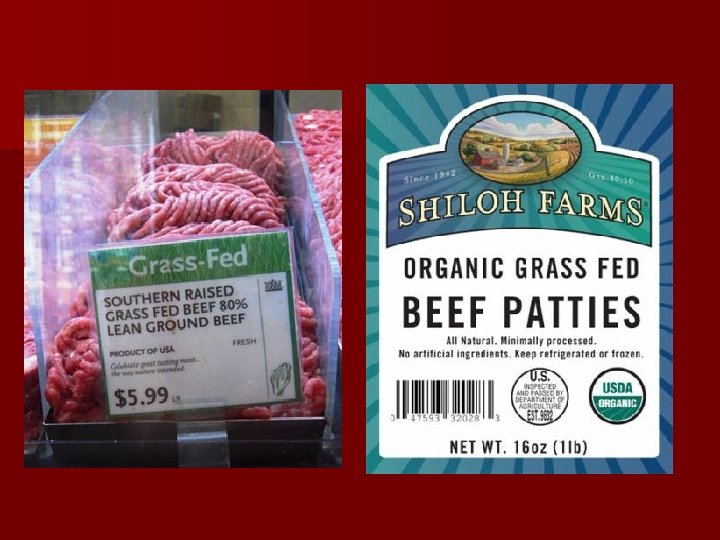
 Labels n Must include: § Name § Ingredients § Handling § Sell by date § Manufacturer § Nutritional information § weight
 Grass Feed n “Grass-fed animals receive a majority of their nutrients from grass throughout their life, while organic animals’ pasture diet may be supplemented with grain. Also USDA regulated, the grass-fed label does not limit the use of antibiotics, hormones, or pesticides. Meat products may be labeled as grass-fed organic. ”-AMS
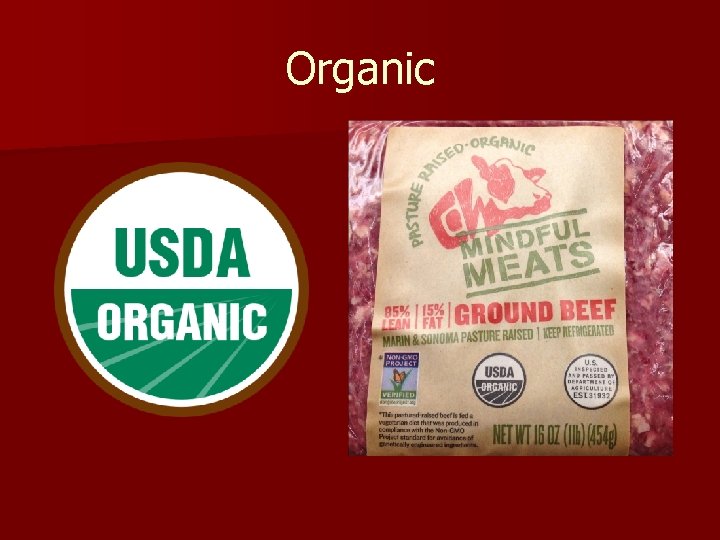
 Organic n “Organic is a labeling term that indicates that the food or other agricultural product has been produced through approved methods. These methods integrate cultural, biological, and mechanical practices that foster cycling of resources, promote ecological balance, and conserve biodiversity. Synthetic fertilizers, sewage sludge, irradiation, and genetic engineering may not be used. ”
 Natural n As required by USDA, meat, poultry, and egg products labeled as “natural” must be minimally processed and contain no artificial ingredients. However, the natural label does not include any standards regarding farm practices and only applies to processing of meat and egg products. There are no standards or regulations for the labeling of natural food products if they do not contain meat or eggs.
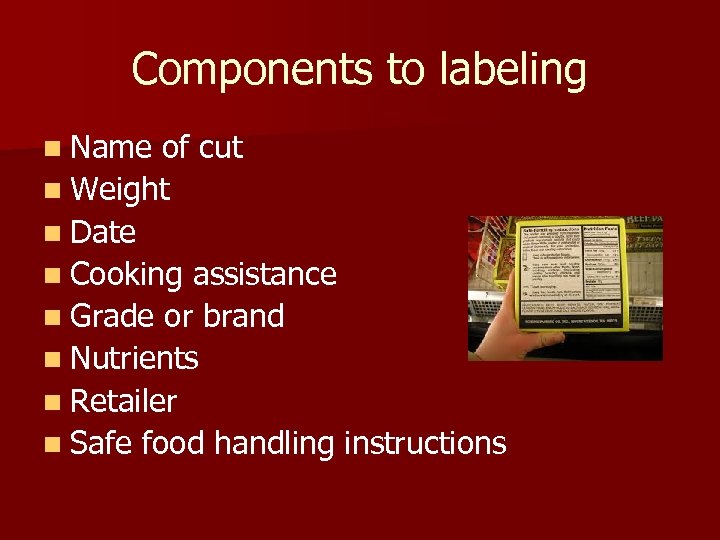 Components to labeling n Name of cut n Weight n Date n Cooking assistance n Grade or brand n Nutrients n Retailer n Safe food handling instructions
 Appearance of Meat Depends On n. Water §Mixes with and binds to the protein in meat §Free water found on the surface of meat (allows bacteria to grow)
 Appearance of Meat Depends On n. Color §Type of meat and amount of light in contact with the meat §Reflecting of light from the meat package
 Appearance of Meat Depends On n Pigments § Hemoglobin = red pigment found in blood § Myoglobin = pigment found in muscle § The iron in myoglobin combines with oxygen to change the color of meat
 Appearance of Meat Depends On n. Pigments cont’d. §The different kinds of meats have different iron levels, which is why they are different colors §Color change usually occurs from purple – to red – to brown
 Appearance of Meat Depends On n. Texture §How the meat feels (cooking affects this) n. Ratio of Meat: Fat §The amount of fat in meat changes how a piece of meat looks
 Meat Tenderness n. Tenderness is the biting or chewing of meat n. Tenderness is heavily influenced by many factors
 What Affects Meat Tenderness n. Age n. Cut n. Tenderizers n. Water content nprocessing n. Type of meat n. Rigor Mortis n. Cooking style n. Marbling n. Packaging
 Variations in tenderness: n Genetics is a big factor. n Species and age – younger animals are more tender n Feeding – indirect effect, grain-fed animals are younger at slaughter weight n Muscle variations – amount of connective tissue affects tenderness n Suspension of carcass
 Variations in tenderness (cont. ): n Electrical stimulation improves tenderness. n Chilling rate – rapid cooling toughens meat n Aging – beef is aged for 7 to 10 days n Quality grade – age plays a big factor here n Mechanical – grinding or cubing increases tenderness
 Variations in tenderness (cont. ): n Chemical – salt or enzymes increase tenderness n Marinades – may include salt, acid, enzymes, alcohol, oil to soften collagen, increase water uptake and break down connective tissues n Freezing and thawing n Cooking method n Carving against the grain improves tenderness
 Types of Cookery n. Heat from the cooking process denatures (breaks down) the protein in meat §Dry Heat Cooking – cooking meat with hot, dry air—includes broil, grill, stir fry, roast, fry
 Types of Cookery §Moist Heat Cooking – cooking meat in a closed container with added water—includes cooking in water and pot roasts §Microwave Cooking – rapid cooking of meat by using electromagnetic waves
 Microorganisms Found In Meat n. Bacteria n. Yeast n. Mold §These microorganisms can grow from 40 to 115 degrees F.
 Microorganisms Found In Meat n“Life begins at 40” n. Most bacteria are killed at around 120 degrees F. n. Pasteurization occurs at 155165 degrees F.
 Microorganisms Found In Meat n Microorganisms have many factors affecting their growth § p. H of meat § Water content § Temperature § Oxygen § Type and quality of packaging § Nitrates § Initial # of bacteria in the meat
 Common Sources of Meat Contamination n Knife n. Machines n Animal hide n. Facilities n Intestinal tract n. Seasonings n Employees n. Packaging (hands, clothing, n. Storage areas health)
 Characteristics of Spoiled Meat n Color n Odor – sweet or sickening n Flavor - rancid n Texture – sticky or tacky – liquid coating n Date of packaging n Freezer burn
 How to Prevent Spoilage n. Use proper sanitation n. Store at right temperatures n. Keep packages sealed n. Cook thoroughly n. Follow all directions
 Types of Meat Storage n. Refrigeration §Chill carcasses after killing §The lower the chilling temperature without freezing, the more shelf life is increased §Chilling tries to slow down bacteria growth
 Types of Meat Storage n. Freezing §Used for long term storage (recommended 6 mo. – 1 yr. ) §Freeze quickly after slaughtering §Commercial -10 to 20 degrees F. §Home -10 to 0 degrees F. §Watch out for freezer burn!!!
 Types of Meat Storage n Curing § Adding ingredients to extend the shelf life/preserve the food § Ingredients include salt, nitrite/nitrate, sugar, water, spices § Cured meat examples include ham, bacon, dried beef, bologna, beef jerky
 Types of Meat Storage n Dehydration § The nearly complete removal of water from foods under controlled conditions § The removal of water decreases spoilage and bulkiness and increases the convenience of the food
 Types of Meat Storage n Vacuum Packaging § Storing food by compressing all of the air out of the food source § Tends to make the meat look purple, which may turn consumers off
 Types of Meat Storage n Controlled Atmosphere Packaging § Similar to vacuum packaging, but tries to control the gasses inside the meat package so bright red color remains
 Types of Meat Storage n Irradiation § Uses different kinds of radiant energy to destroy living organisms that would normally spoil food § Takes the place of chemicals being applied to the food § No radiation is left in or on the food!
 Meat Packaging n The goal of meat packaging is to keep the meat fresh and decrease the chance of spoilage, change in color, or leaking of water/juices while still making it appealing to the consumer
 Types of Packaging Materials n Saran wrap n Foam trays n Freezer paper n Aluminum foil n Vacuum bags