


 Скачать презентацию Meat Poultry and Eggs Processing Ag Processing Technology
a965ac919b4b11b0b9f3e9dfcd3c18fd.ppt
- Количество слайдов: 64
 Meat, Poultry and Eggs Processing Ag Processing Technology Unit 3
 Objectives ¢ ¢ ¢ ¢ ¢ Describe the production of meat from cattle, pigs and poultry Identify meat products from cattle, pigs and poultry List five factors affecting meat tenderness Describe the cooking of meat Discuss the production of meat substitutes Identify quality grading of meat Describe egg production Identify factors affecting egg quality Discuss egg grading
 Introduction ¢ First meat packers in the United States were the colonial New England farmers l ¢ ¢ ¢ They packed meat in salt to preserve it Then the beef industry moved to be near the commercial feedlots in the central United States—Kansas, Oklahoma, Texas Pork Industry—The Midwest; Iowa, Illinois, Minnesota, Michigan, Nebraska Poultry industry is characterized by rapid growth and vertical integration
 Meat and Meat By. Products
 Poultry
 Poultry ¢ ¢ ¢ Production is dominated by large integrated companies These companies control hatching, egg production, hatching, growing, processing, marketing They often mill their own feed and render the offal and feathers to produce feed ingredients Any of these steps may be controlled by contract The company owns all functions except live production
 Production Contracts ¢ ¢ ¢ Farmer may provide the growing facility, equipment, litter, brooder, fuel, electricity and labor The company provides the chicks, feed, medication, bird loading and hauling, and some grow out supervision Contract payments are based on a set amount per pound of chicken marketed
 Growing Houses ¢ ¢ ¢ 40 -50’ wide, 400 -500’ long Modern facilities control air entering the sides of the building Exhaust fans blow air over the birds in hot weather Overhead fogger lines cool chickens in hot weather Space allowance range from 0. 7 -1. 0 square foot per bird depending on season, house type and age marketed
 Feeding Feed is moved on conveyors that drop the feed into attached pans ¢ Water is supplied by bird activated nipples attached to water pipes running the length of the building ¢ Three diets are used: starter, grower, undmediacated or withdrawal feed ¢
 Processing ¢ ¢ ¢ Meat chickens are marketed as broiler, roasters or game hens Commercial meat strains reach an average live weight of 4 lbs at 42 days or 4. 8 lbs at 49 days Turkey hens are marketed between 14 -16 weeks age and weigh from 14. 7 -17. 5 pounds Toms are marketed between 17 -20 weeks of age and weight 26. 4 -32. 3 lbs 16% of turkeys are processed for the whole body market
 Processing Steps Assembly line operation conducted under sanitary conditions ¢ Inspecting, classifying and grading are a part of the processing ¢
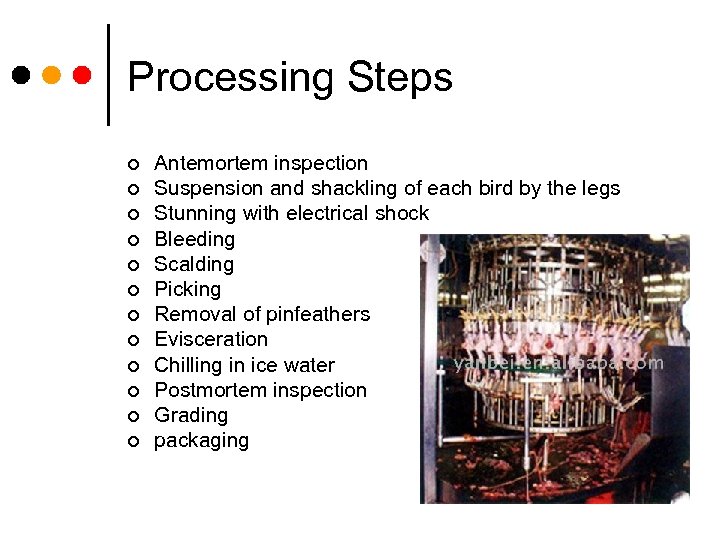 Processing Steps ¢ ¢ ¢ Antemortem inspection Suspension and shackling of each bird by the legs Stunning with electrical shock Bleeding Scalding Picking Removal of pinfeathers Evisceration Chilling in ice water Postmortem inspection Grading packaging
 Properties of Poultry ¢ ¢ High in protein Low in fat Excellent source of essential amino acids Also a good source of l ¢ Phosphorus, iron, copper, zinc, B vitamins (12 & 6) Dark meat and skin are higher in fat than white
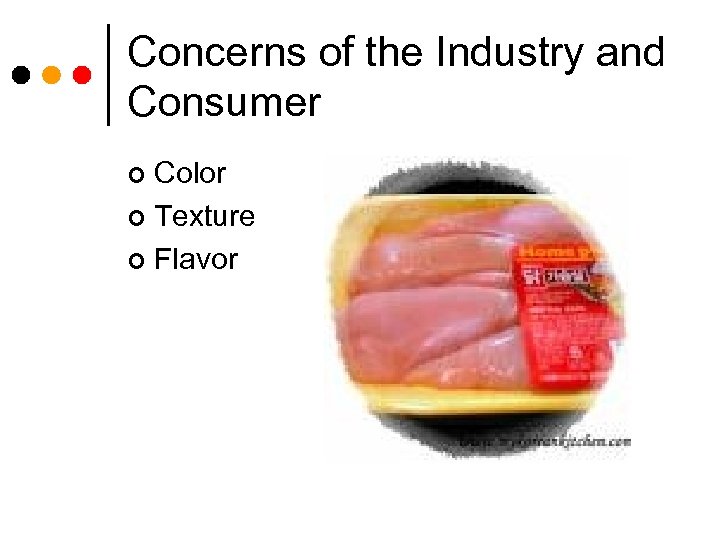 Concerns of the Industry and Consumer Color ¢ Texture ¢ Flavor ¢
 Appearance Color ¢ Important because consumers associate it with freshness ¢ Poultry is unique because it is sold both with and without skin ¢ Poultry also has extremes in meat color-white or breast meat and dark or thigh and leg meat ¢
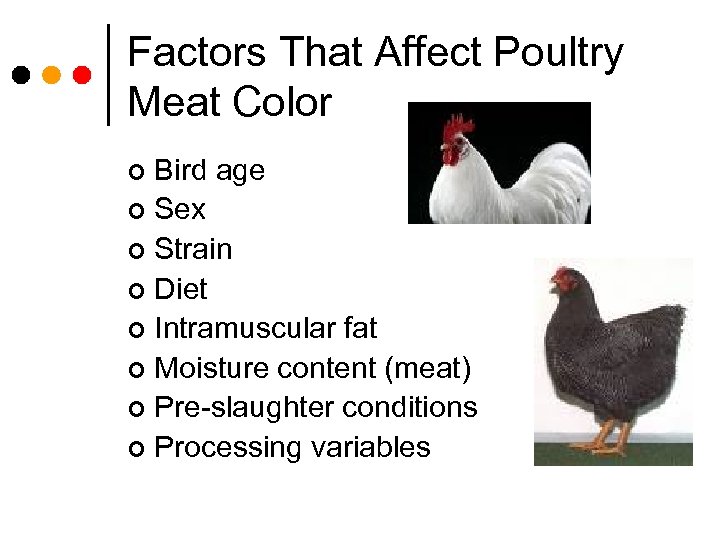 Factors That Affect Poultry Meat Color Bird age ¢ Sex ¢ Strain ¢ Diet ¢ Intramuscular fat ¢ Moisture content (meat) ¢ Pre-slaughter conditions ¢ Processing variables ¢
 Meat Color Depends on presences of muscular pigments myoglobin and hemogolobin ¢ Discoloration can be related to the amount of these pigments that are present, the chemical state of the pigments or the way that the light is reflected off the meat ¢ Discolorations can occur in the whole muscle or limited to a specific area ¢
 Muscle Discoloration When a whole muscle is discolored it is frequently the breast ¢ This is due to the breast muscle accounting for a large portion of the live weight of the bird, making it more sensitive to factors that contribute to discoloration ¢ The light color of the meat also makes color differences more noticeable ¢
 Other Factors that Contribute to Discoloration ¢ ¢ Extreme environmental temperatures can cause boiler and turkey breast meat to be discolored Bruising l l 29% of all carcasses processed in the US are downgraded a majority of the time due to bruising The industry generally tries to determine where, how and when these injuries occur but it is often difficult to determine
 Texture Also related to quality ¢ Tenderness depends upon rate and extent of chemical and physical changes occurring in the muscle as it becomes meat ¢
 Factors that Affect Poultry Tenderness ¢ ¢ ¢ ¢ Anything that disrupts rigor mortis and the following softening of the muscle Birds that struggle before or during slaughter cause rigor to set in to quickly Exposure to environmental stresses before slaughter will cause a similar situation High pre-slaughter stunning temperatures High scalding temperatures Longer scalding times Machine picking Can all contribute to poultry being tougher
 Factors that Affect Poultry Tenderness of boneless cuts are influenced by the time between death (postmortem) and deboning ¢ To avoid toughening meat can be aged for 6 -24 hours before deboning ¢ This is costly for the processor ¢
 Fighting Tough Meat Post slaughter electrical stimulation to hasten rigor development and reduce aging time before deboning ¢ Using this method meat can be deboned within 2 hours postmortem instead of 4 to 6 ¢
 Flavor ¢ ¢ ¢ Also used to determine acceptability by consumers Both taste and odor contribute to flavor Few factors during processing affect this Age of the bird at slaughter affect flavor Other minor effects on flavor are related to bird strain, diet, environmental conditions, scalding temperatures, chilling, product packaging and storage Overall these effects are too small for the consumer to notice
 Most Important Aspect of Poultry Quality ¢ ¢ Eating Quality l Combined effects of appearance, texture and flavor Live production affects poultry meat quality by determining the state of the animal at slaughter Processing affects meat quality by establishing the chemistry of the muscle constituents and the interactions within the muscle structure Producer, processor, retailer and consumer all have specific expectations for the quality attributes of poultry
 Grading Chickens, Turkeys, Ducks, Geese, Guineas, Pigeons are all eligible for grading and certification services provided by the USDA’s Agricultural Marketing Service (AMS) Poultry Programs Grading Branch ¢ These services are provided in accordance with federal poultry grading regulations ¢
 Grading ¢ ¢ Chickens and turkeys are often sold as value-added products Poultry parts and increasing number of skinless and/or boneless products are meeting consumer demand for convenient, lower-fat, portion controlled items This shift away from whole carcass birds creates special challenges for buyers and sellers whether they are poultry producers or processors, wholesalers, food manufacturers, food service operators, food retailers or consumers All depend on USDA’s poultry grading services to ensure that their requirements for quality, weight, condition and other factors are met
 Grading and USDA Quality Standards Grading provides a standardized means of describing the marketability of a particular food product ¢ To be eligible for an official USDA grade ¢ each carcass or part must be individually graded by a plant grader l a sample must be certified by a USDA grader l
 Poultry Grades After passing the examination and evaluation process the product is eligible for a grade shield ¢ USDA Grades are A, B or C ¢ Poultry standards are frequently reviewed, revised and updated as needed to keep pace with changes in processing and merchandising ¢
 Contract Acceptance Certification ¢ ¢ ¢ Ensures the integrity and quality of poultry and further processed poultry products bought by quantity food buyers such as food manufactures, food service operators and food retailers USDA specialists help institutional buyers develop and prepare explicit specifications tailored to their requirements USDA graders then provide certification that purchases comply with these specifications
 Contract Acceptance Certification ¢ ¢ ¢ Specific items that may be part of a product specification include l Kind and class (species and age) l Type (frozen, chilled) and style (cut-up parts, whole muscle) l Formula, processing, fabrication l Laboratory analysis l Net weight l Labeling and marketing, packing and packaging l Storage and transportation Products meeting specified requirements are eligible for the Contract Compliance identification mark The official grading certificate accompanies each shipment to the receiving agency
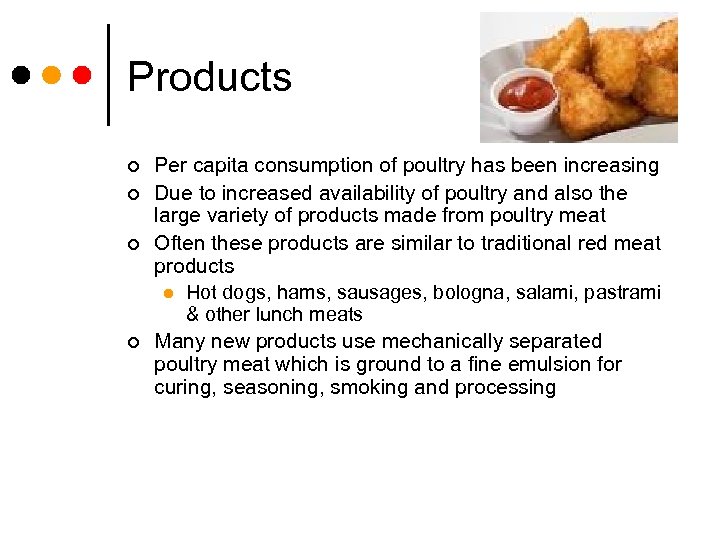 Products ¢ ¢ Per capita consumption of poultry has been increasing Due to increased availability of poultry and also the large variety of products made from poultry meat Often these products are similar to traditional red meat products l Hot dogs, hams, sausages, bologna, salami, pastrami & other lunch meats Many new products use mechanically separated poultry meat which is ground to a fine emulsion for curing, seasoning, smoking and processing
 Eggs THE INCREDIBLE EGG!!
 Production of Top Quality Eggs ¢ ¢ Starts with a closely controlled breeding program emphasizing favorable genetic factors Industry is dominated by White-Leghorn type In major egg producing states flocks of 100, 000 laying hen are not unusual and some flocks number more than 1 million Each of the 235 million laying birds in the US produce from 250 to 300 eggs a year
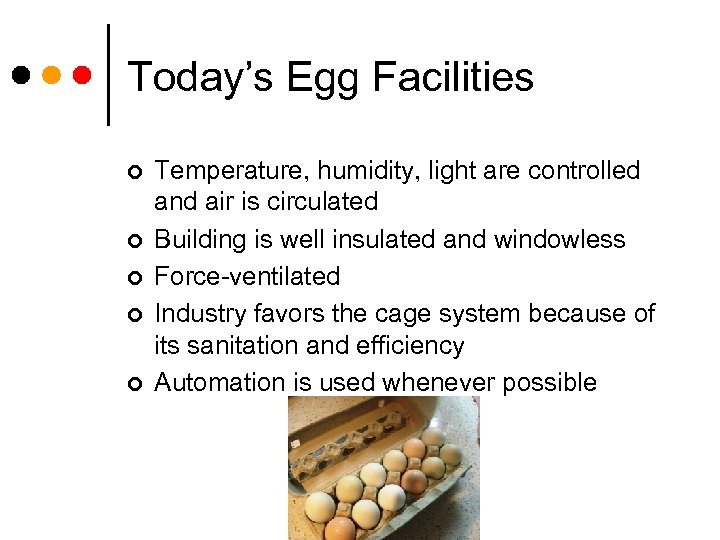 Today’s Egg Facilities ¢ ¢ ¢ Temperature, humidity, light are controlled and air is circulated Building is well insulated and windowless Force-ventilated Industry favors the cage system because of its sanitation and efficiency Automation is used whenever possible
 Processing ¢ ¢ The moment an egg is laid physical and chemical changes begin to reduce freshness In most production facilities automated gathering belts gather and refrigerate eggs frequently Gathered eggs are moved into refrigerated holding rooms where the temperature is maintained between 40 -45 degrees F Humidity is relatively high to minimize moisture loss
 Carton Dates ¢ Egg cartons from USDA inspected plants must display a Julian date l ¢ Julian Date is a number 1 -365 indicating the date the eggs were packed Although not required they may also carry an expiration date beyond which the eggs should not be sold
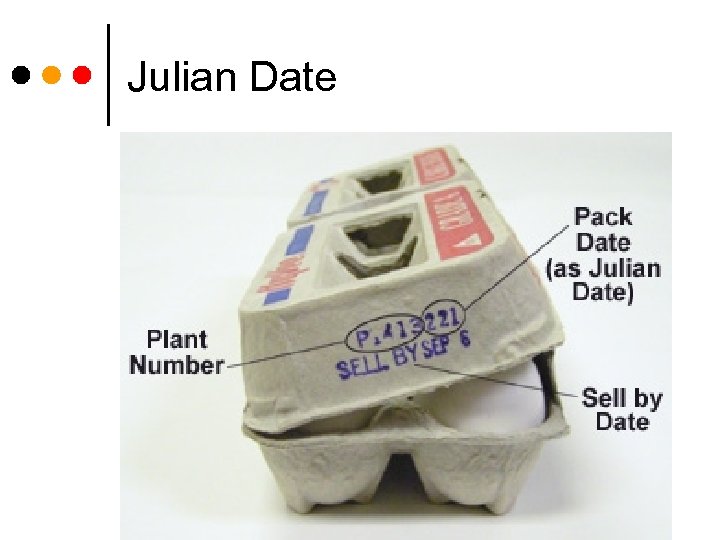 Julian Date
 Carton Dates In USDA inspected plants the sell by date can not exceed 30 days after the pack date ¢ Plants not under USDA inspection are governed by state law ¢ Fresh shell eggs can be stored in their cartons in the refrigerator for 4 -5 weeks beyond their Julian date with insignificant quality loss ¢
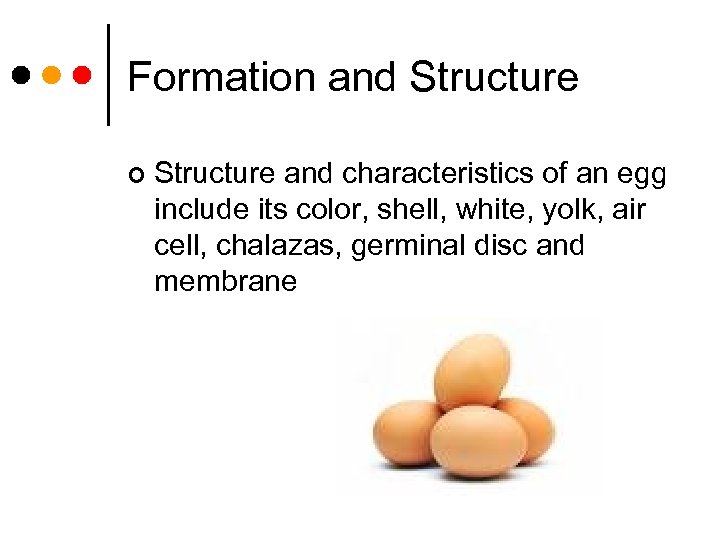 Formation and Structure ¢ Structure and characteristics of an egg include its color, shell, white, yolk, air cell, chalazas, germinal disc and membrane
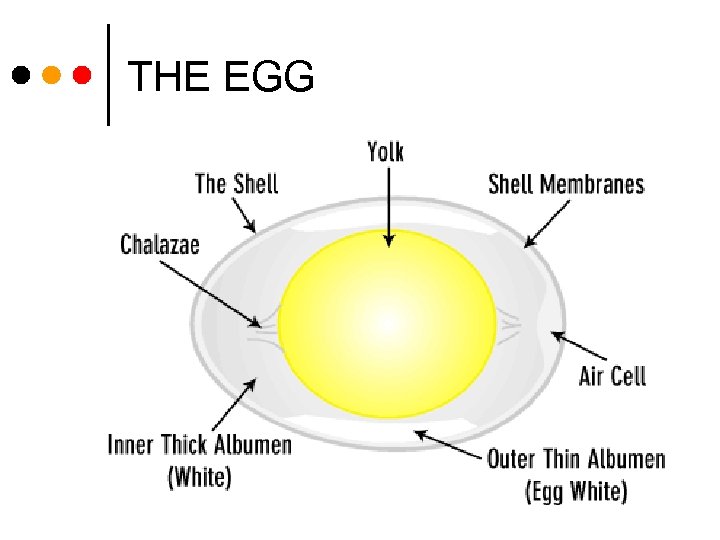 THE EGG
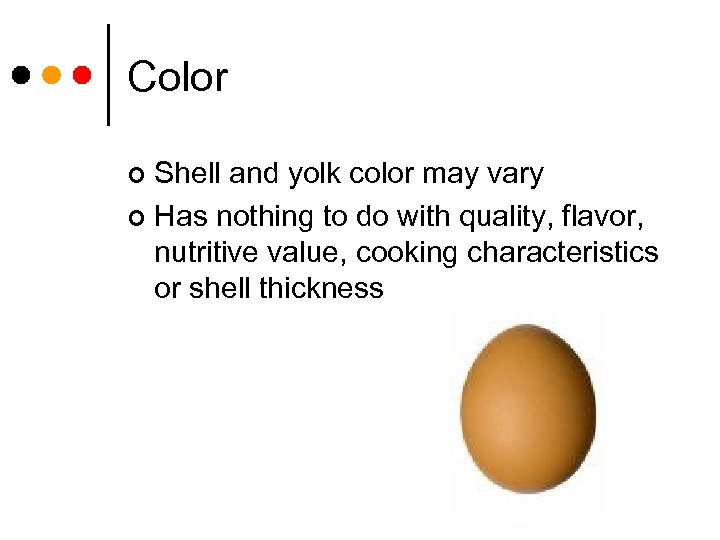 Color Shell and yolk color may vary ¢ Has nothing to do with quality, flavor, nutritive value, cooking characteristics or shell thickness ¢
 Shell ¢ ¢ ¢ Color comes from pigments in the outer layer of the shell May range in various breeds from white to deep brown Breed of hen determines the color of shell 9 -12% of the eggs total weight depending on egg size First line of defense against bacterial contamination Largely composed of calcium carbonate (94%), calcium phosphate, other organic matters including protein
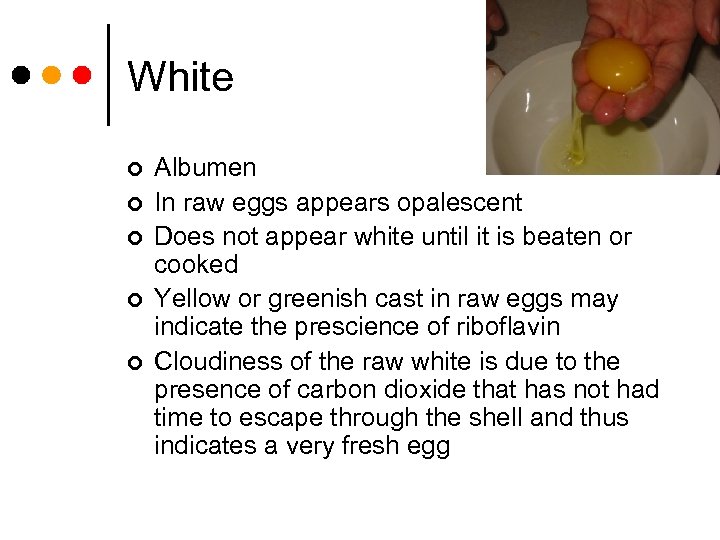 White ¢ ¢ ¢ Albumen In raw eggs appears opalescent Does not appear white until it is beaten or cooked Yellow or greenish cast in raw eggs may indicate the prescience of riboflavin Cloudiness of the raw white is due to the presence of carbon dioxide that has not had time to escape through the shell and thus indicates a very fresh egg
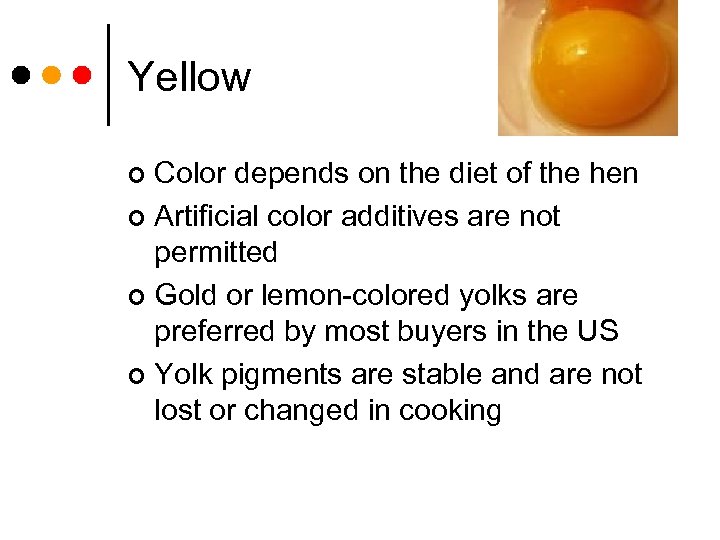 Yellow Color depends on the diet of the hen ¢ Artificial color additives are not permitted ¢ Gold or lemon-colored yolks are preferred by most buyers in the US ¢ Yolk pigments are stable and are not lost or changed in cooking ¢
 Air Cell Empty space between the white and the shell at the large end of the egg ¢ When an egg is first laid it is warm, as it cools the contents contract and the inner shell membrane separates from the outer shell membrane, forming the air cell ¢
 Chalazas Ropey strands of egg white that anchor the yolk in place in the center of the thick white ¢ They are neither imperfections nor beginning embryos ¢ The more prominent the chalazae the fresher the egg ¢
 Germinal Disc X Channel leading to the center of the yolk ¢ When the egg is fertilized sperm enter by the way of the germinal disc and travel to the center and a chick embryo starts to form ¢
 Membranes ¢ ¢ ¢ 2 Just inside the shell, inner and outer After the egg is laid and begins to cool, an air cell forms between these two layers at the large end of the egg The vitelline membrane is the covering of the yolk, its strength protects the yolk from breaking The vitelline membrane is weakest at the germinal disc and tends to become more fragile as the egg ages
 Composition (start) ¢ Yolk (yellow) l l l 33% of the liquid weight of an egg Contains all the fat Little less than half the protein With the exception of riboflavin and niacin the yolk contains a higher proportion of the egg’s vitamins than the white Also contains more phosphorus, manganese, iron, iodine, copper and calcium
 Composition ¢ White l More than half the protein, niacin, riboflavin, chlorine, magnesium, potassium, sodium, sulfur
 Grading Classification is determined by interior and exterior quality ¢ Designated by the letters AA, A, B ¢ In many packing plants USDA provides a grading service for shell eggs ¢ Not mandatory ¢
 Grading Process ¢ ¢ ¢ Eggs are examined for both interior and exterior quality Sorted according to weight (size) Grade quality and size are not related No difference in nutritive value exists between different grades However almost no grade B eggs find their way to the retail supermarket, they go to egg users such as bakeries or food service operations and to egg breakers for use in egg products
 Grade AA ¢ ¢ ¢ ¢ When cracked onto a surface a grade AA egg will stand up tall Yolk is firm Area covered by the while is small Large proportion of thick white to thin white exists The shell approximates the usual shape for an egg Generally clean and unbroken Ridges/rough spots that do not affect the shell strength are permitted
 Grade A ¢ ¢ ¢ When cracked covers a relatively small area Yolk is round and upstanding Thick white is large in proportion to the thin white and stands fairly well around the yolk Shell approximates the usual shape for an egg Generally clean and unbroken Rideges/rough spots that do not affect the shell strength are permitted
 Grade B ¢ ¢ ¢ ¢ When cracked, spreads out more Yolk is flattened About as much (or more) thin white as thick white Shell has an abnormal shape Some slightly stained eggs are permitted Unbroken Pronounced ridges/thin spots are permitted
 Size ¢ ¢ Several factors influence size Major factor is the age of the hen l ¢ ¢ ¢ As hens age their eggs increase in size Breed is the second factor Weight of the bird Environmental factors Egg sizes are: Jumbo, Extra Large, Medium, Small and Peewee Medium, Large and Extra Large are the sizes most commonly available
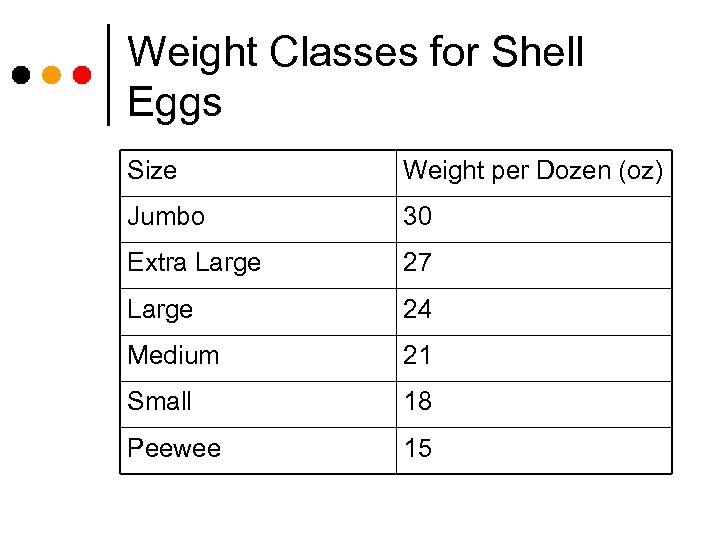 Weight Classes for Shell Eggs Size Weight per Dozen (oz) Jumbo 30 Extra Large 27 Large 24 Medium 21 Small 18 Peewee 15
 Blood Spots Occasionally found on yolk ¢ Do not indicate a fertilized egg ¢ Caused by the rupture of a blood vessel on the yolk surface during the formation of the egg or by a similar accident in the wall of the oviduct ¢ Less than 1% of all eggs produced have blood spots ¢
 Storing Eggs Can be stored at 30 degrees F for up to 6 months in the shell ¢ They can be frozen out of the shell for extended storage ¢
 Salmonella Inside of the egg was once considered sterile ¢ Recently Salmonella enteritidis has been found inside some eggs ¢ FDA now warns consumers that eggs are perishable and should be kept refrigerated and sanitary handling methods used ¢
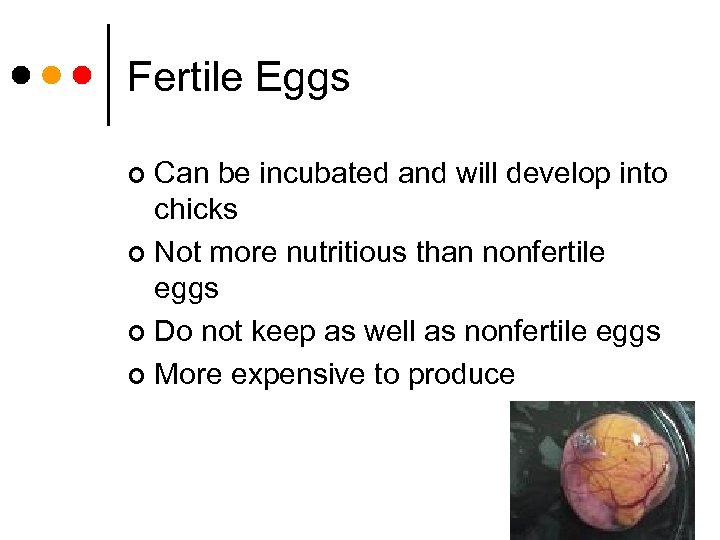 Fertile Eggs Can be incubated and will develop into chicks ¢ Not more nutritious than nonfertile eggs ¢ Do not keep as well as nonfertile eggs ¢ More expensive to produce ¢
 Organic Eggs ¢ ¢ Come from hens that are fed rations that were grown with pesticides, fungicides, herbicides or commercial fertilizers No commercial laying hen rations ever contain hormones Due to higher production costs and lower volume per farm organic eggs are more expensive Nutrient content is not affected by whether or not the ration is organic
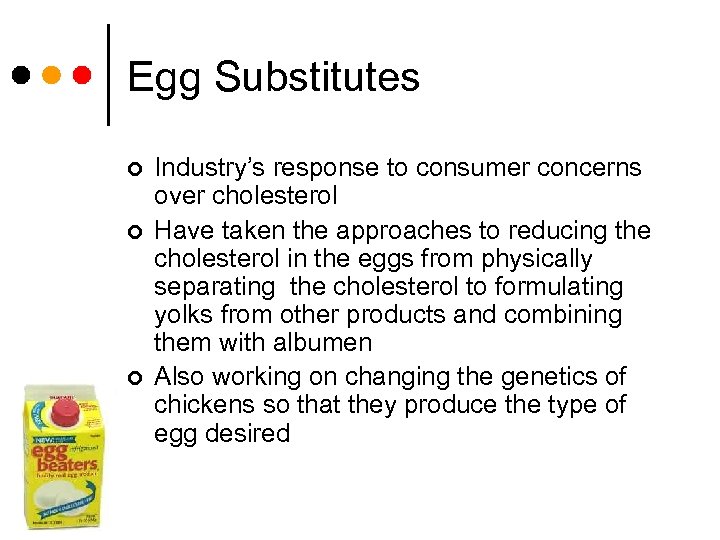 Egg Substitutes ¢ ¢ ¢ Industry’s response to consumer concerns over cholesterol Have taken the approaches to reducing the cholesterol in the eggs from physically separating the cholesterol to formulating yolks from other products and combining them with albumen Also working on changing the genetics of chickens so that they produce the type of egg desired