


 Скачать презентацию Meat Exports from Ethiopia Traditionally live animal
974f1244bac18e9a79f2848577b28243.ppt
- Количество слайдов: 8
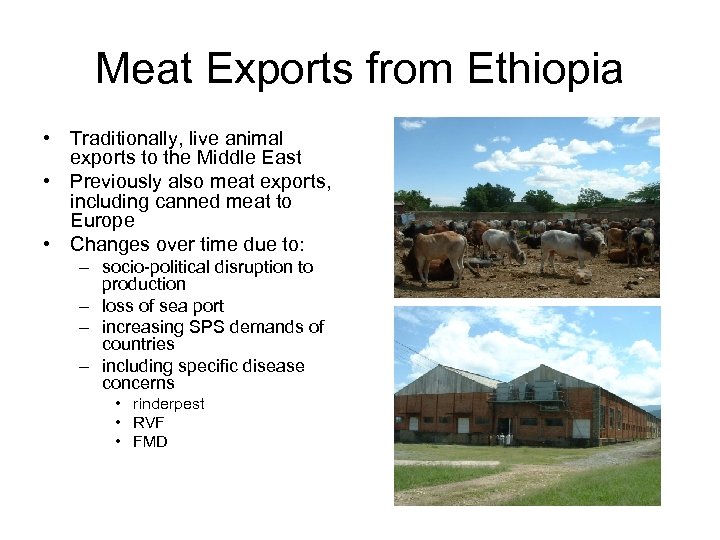 Meat Exports from Ethiopia • Traditionally, live animal exports to the Middle East • Previously also meat exports, including canned meat to Europe • Changes over time due to: – socio-political disruption to production – loss of sea port – increasing SPS demands of countries – including specific disease concerns • rinderpest • RVF • FMD
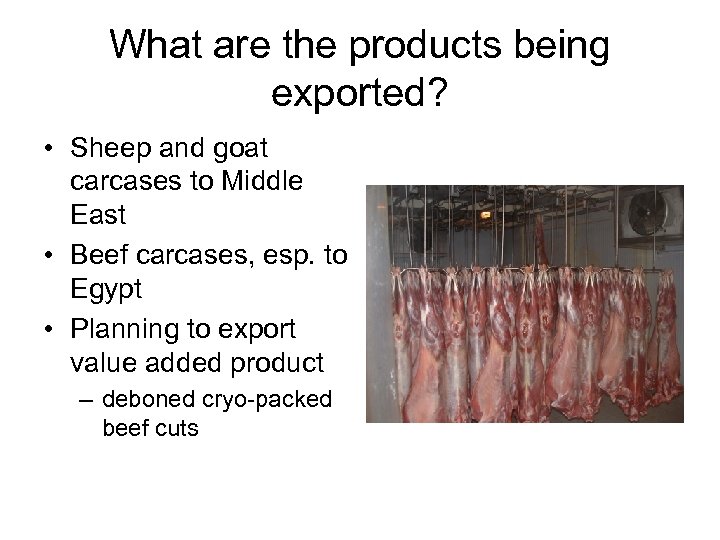 What are the products being exported? • Sheep and goat carcases to Middle East • Beef carcases, esp. to Egypt • Planning to export value added product – deboned cryo-packed beef cuts
 What and where are the markets? • • Resources – 35 m C, 42 m S&G Available for export – 325, 000 C, 3 m S&G Potential for export – 72, 000 tonnes meat Exports 2002/2003 – – meat US $2. 9 million (1, 535 tonnes) live animals US $0. 6 million informal live animal exports 325, 000 C; 1. 2 m S&G UAE, Yemen, Saudi Arabia, other ME countries, Egypt • Egyptian contracts for 2005 – 100 tonnes of beef per day – 300, 000 live cattle • Additional contracts for Egypt and elsewhere (Jordan)
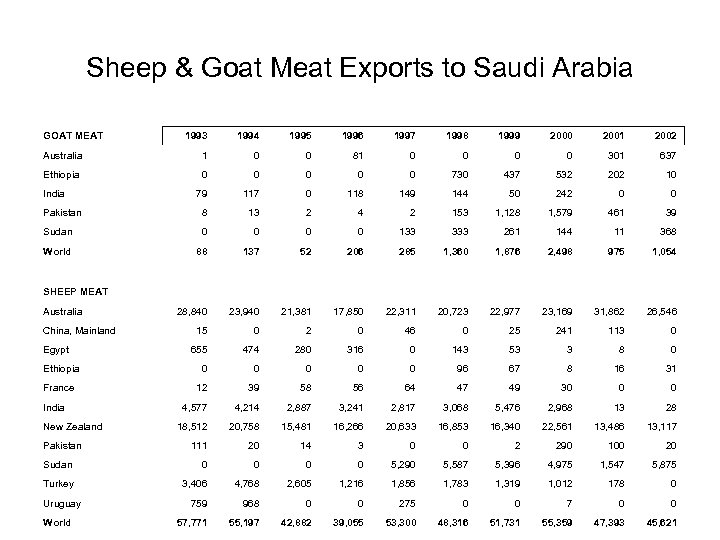 Sheep & Goat Meat Exports to Saudi Arabia GOAT MEAT 1993 1994 1995 1996 1997 1998 1999 2000 2001 2002 Australia 1 0 0 81 0 0 301 637 Ethiopia 0 0 0 730 437 532 202 10 79 117 0 118 149 144 50 242 0 0 Pakistan 8 13 2 4 2 153 1, 128 1, 579 461 39 Sudan 0 0 133 333 261 144 11 368 World 88 137 52 206 285 1, 360 1, 876 2, 498 975 1, 054 28, 840 23, 940 21, 381 17, 850 22, 311 20, 723 22, 977 23, 169 31, 862 26, 546 15 0 2 0 46 0 25 241 113 0 655 474 280 316 0 143 53 3 8 0 Ethiopia 0 0 0 96 67 8 16 31 France 12 39 58 56 64 47 49 30 0 0 4, 577 4, 214 2, 887 3, 241 2, 817 3, 068 5, 476 2, 968 13 28 18, 512 20, 758 15, 481 16, 266 20, 633 16, 853 16, 340 22, 561 13, 486 13, 117 111 20 14 3 0 0 2 290 100 20 Sudan 0 0 5, 290 5, 587 5, 396 4, 975 1, 547 5, 875 Turkey 3, 406 4, 768 2, 605 1, 216 1, 856 1, 783 1, 319 1, 012 178 0 759 968 0 0 275 0 0 7 0 0 57, 771 55, 197 42, 882 39, 055 53, 300 48, 316 51, 731 55, 359 47, 393 45, 621 India SHEEP MEAT Australia China, Mainland Egypt India New Zealand Pakistan Uruguay World
 Who are the producers in this chain? • Mostly pastoralists in arid/semi-arid areas • Highland animals mostly go into domestic markets • Middlemen are generally small traders but export markets are becoming more organised • Five export abattoirs – several more under construction or planned – Ethiopian and international (importing country) interests
 Impact on poverty reduction • Livestock sales are almost the sole means for pastoralists to earn income to buy or barter food items • Development of meat exports, with reduced threat of market disruptions, improves security of livelihoods • Government plans to improve efficiency of production – feedlots, ranching • Very significant contribution to national economy – hides & skins are second biggest export after coffee
 Barriers to trade • Rinderpest – ban on cattle, and beef, to Saudi Arabia • RVF – ban on live sheep and goats to Saudi Arabia • FMD – – • • • many countries wont even consider Ethiopia Russia wants a disease-free zone Egypt tests all animals for Ab to NSPs traditional markets have concerns Generally poor veterinary services Potential concerns about HACCP requirements Unsatisfactory trade agreements Poor internal marketing infrastructure Bureaucratic constraints Limited air freight capacity
 Dealing with the issues • Improving international marketing initiatives – but weak in technical negotiating capacity • Upgrading abattoirs and improving air services • Seeking means to improve veterinary services – – increased veterinary and paraveterinary training donor funded projects (FAO, USAID, UNIDO/Norway) plans for disease-free zone some improvement in internal marketing arrangements