


 Скачать презентацию Measuring Trade in Services Training Module WTO OMC
b0a216b6b15c157c4fe78d921e1db378.ppt
- Количество слайдов: 82
 Measuring Trade in Services Training Module © WTO/OMC 1
 Overview n Characteristics and economic importance of services • Importance of services • Trade in services n GATS and modes of supply n Manual on Statistics of International Trade in Services • BOP • FATS • Modes of supply and statistical domains © WTO/OMC 2
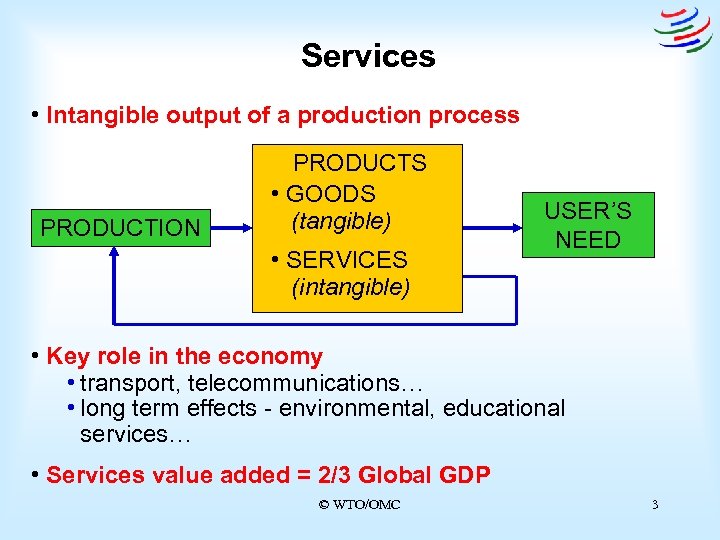 Services • Intangible output of a production process PRODUCTION PRODUCTS • GOODS (tangible) • SERVICES (intangible) USER’S NEED • Key role in the economy • transport, telecommunications… • long term effects - environmental, educational services… • Services value added = 2/3 Global GDP © WTO/OMC 3
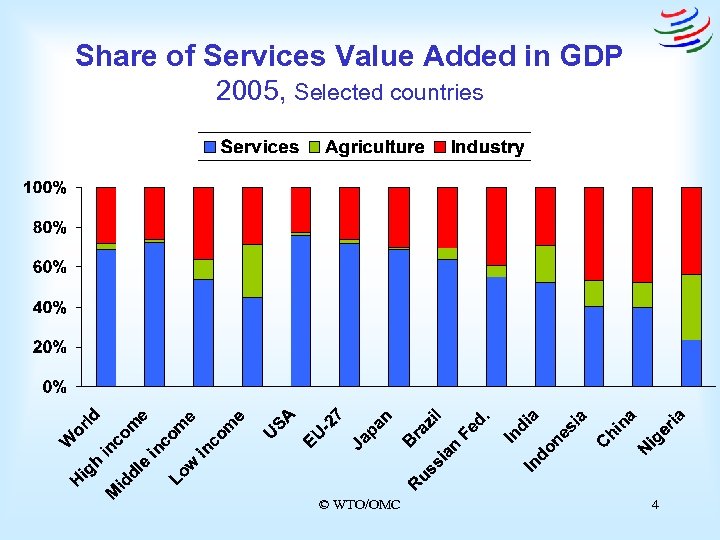 Share of Services Value Added in GDP 2005, Selected countries © WTO/OMC 4
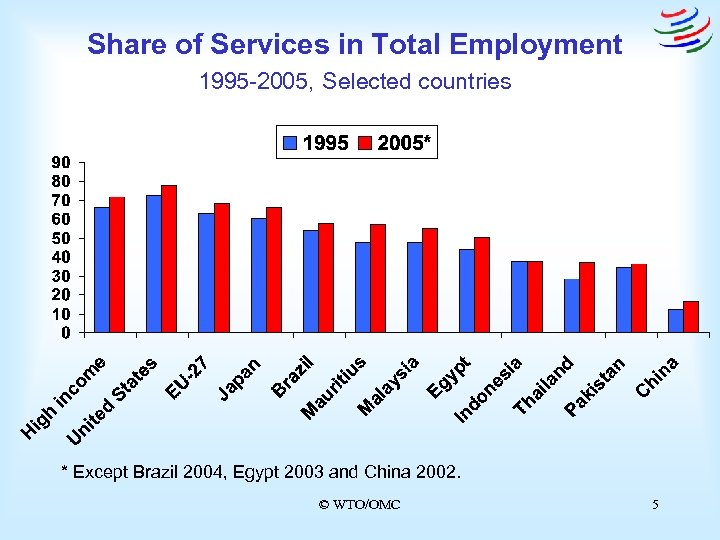 Share of Services in Total Employment 1995 -2005, Selected countries * Except Brazil 2004, Egypt 2003 and China 2002. © WTO/OMC 5
 Measuring Services Production (1/2) Statistics on domestic activity • Value added broken down by industry (of which services) within the National Accounts framework • Employment in the services sector within employment statistics (also part of the National Accounts) • Information on specific services sectors from business statistics © WTO/OMC 6
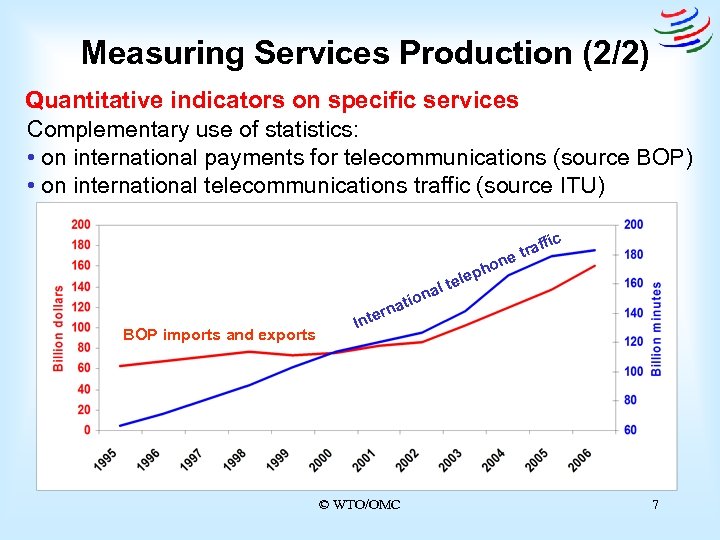 Measuring Services Production (2/2) Quantitative indicators on specific services Complementary use of statistics: • on international payments for telecommunications (source BOP) • on international telecommunications traffic (source ITU) c fi traf e n o eph l e t nal atio rn BOP imports and exports Inte © WTO/OMC 7
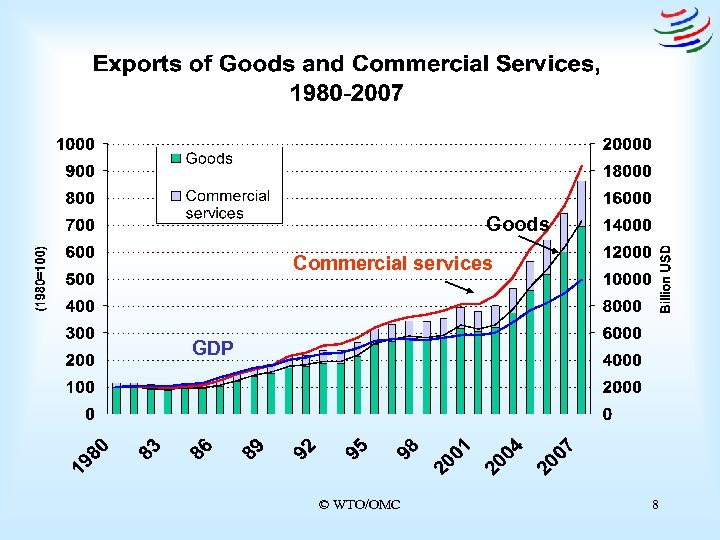 Goods Commercial services GDP © WTO/OMC 8
 Specific Features of Trade in Services represent 20% of total world trade and account for the 2/3 of GDP Intangible nature • Many services require physical proximity of provider and consumer: Þ services perceived as less easily tradable than goods Conventional trade statistics do not cover all international trade in services • Services delivered by foreign affiliates > conventional international trade in services © WTO/OMC 9
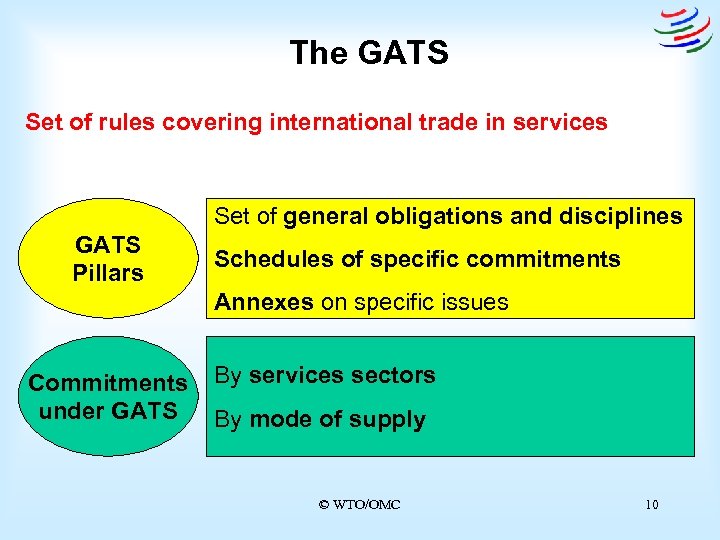 The GATS Set of rules covering international trade in services Set of general obligations and disciplines GATS Pillars Schedules of specific commitments Annexes on specific issues Commitments under GATS By services sectors By mode of supply © WTO/OMC 10
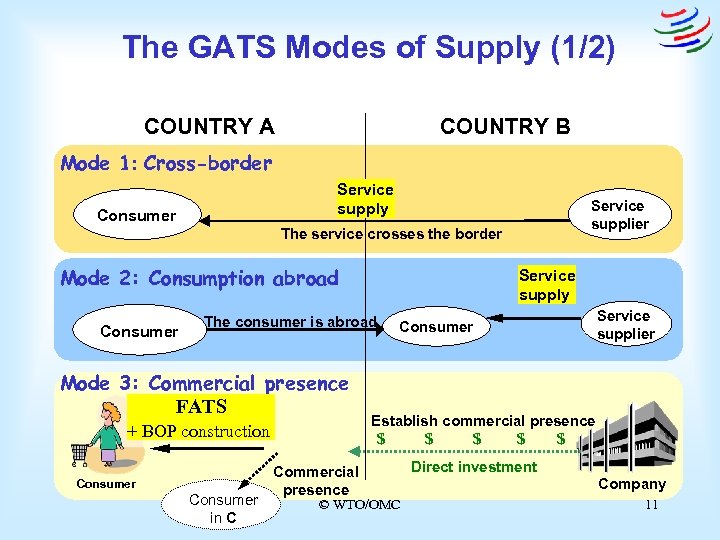 The GATS Modes of Supply (1/2) COUNTRY A COUNTRY B Mode 1: Cross-border Service supply Consumer Service supplier The service crosses the border Mode 2: Consumption abroad Consumer Service supply The consumer is abroad Mode 3: Commercial presence FATS Service supply + BOP construction Consumer in C Establish commercial presence $ Commercial presence Service supplier Consumer © WTO/OMC $ $ Direct investment Company 11
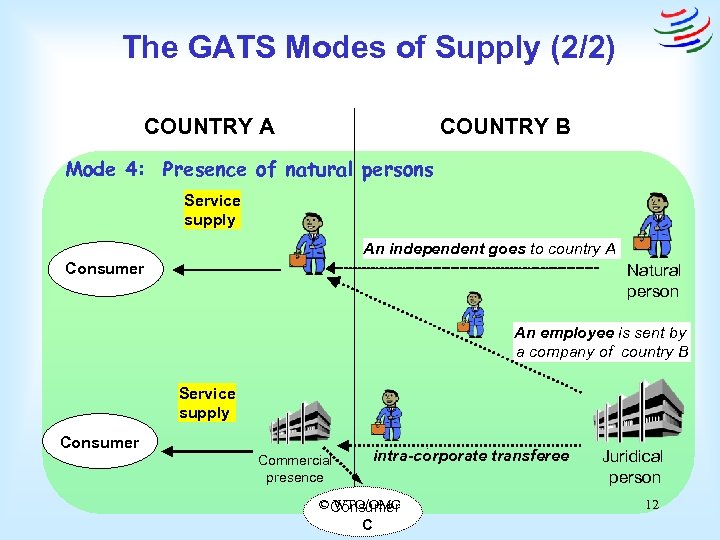 The GATS Modes of Supply (2/2) COUNTRY A COUNTRY B Mode 4: Presence of natural persons Service supply An independent goes to country A Consumer Natural person An employee is sent by a company of country B Service supply Consumer intra-corporate transferee Commercial presence © Consumer WTO/OMC C Juridical person 12
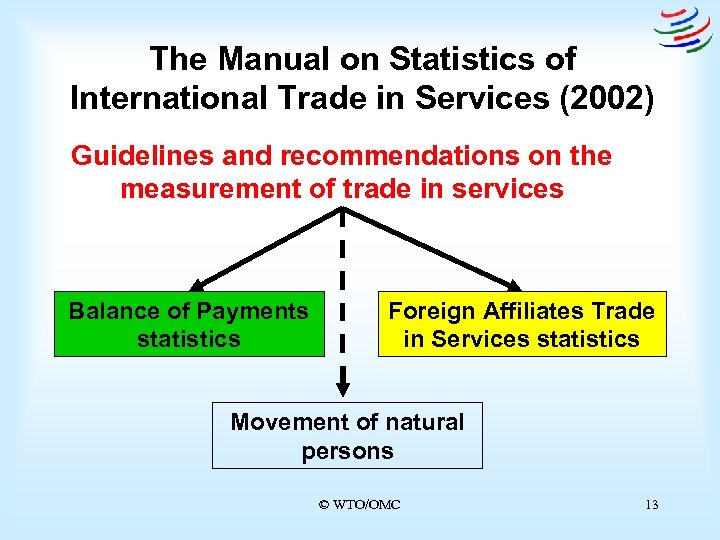 The Manual on Statistics of International Trade in Services (2002) Guidelines and recommendations on the measurement of trade in services Balance of Payments statistics Foreign Affiliates Trade in Services statistics Movement of natural persons © WTO/OMC 13
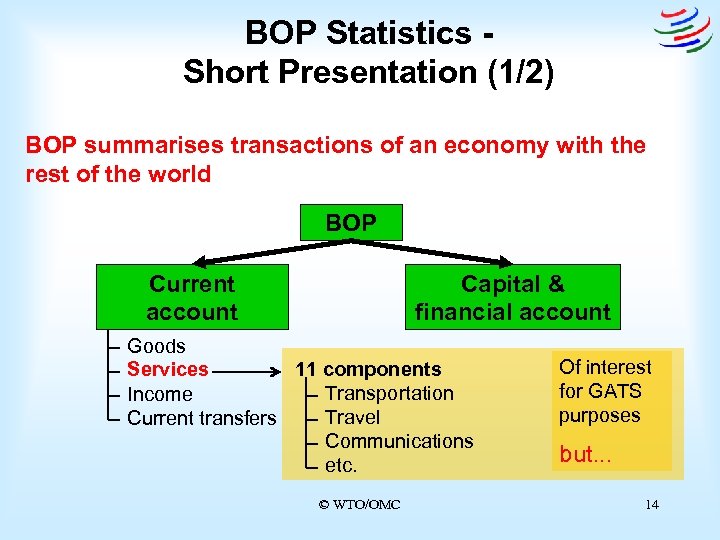 BOP Statistics - Short Presentation (1/2) BOP summarises transactions of an economy with the rest of the world BOP Current account Capital & financial account Goods Services 11 components Transportation Income Travel Current transfers Communications etc. © WTO/OMC Of interest for GATS purposes but. . . 14
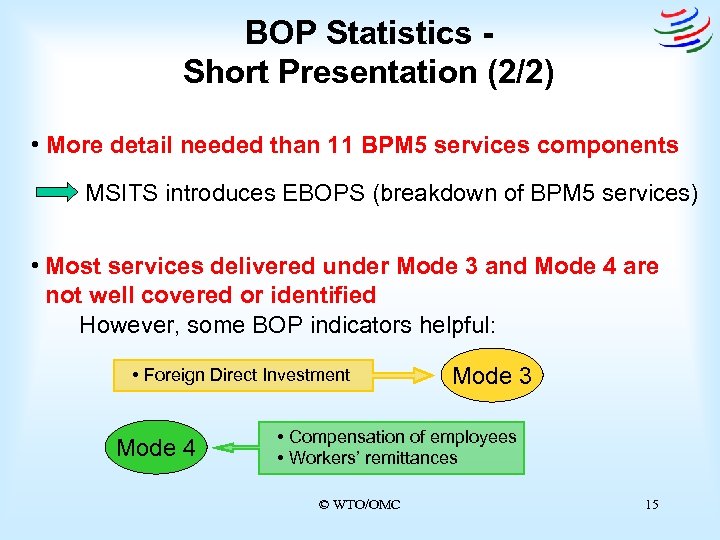 BOP Statistics - Short Presentation (2/2) • More detail needed than 11 BPM 5 services components MSITS introduces EBOPS (breakdown of BPM 5 services) • Most services delivered under Mode 3 and Mode 4 are not well covered or identified However, some BOP indicators helpful: • Foreign Direct Investment Mode 4 Mode 3 • Compensation of employees • Workers’ remittances © WTO/OMC 15
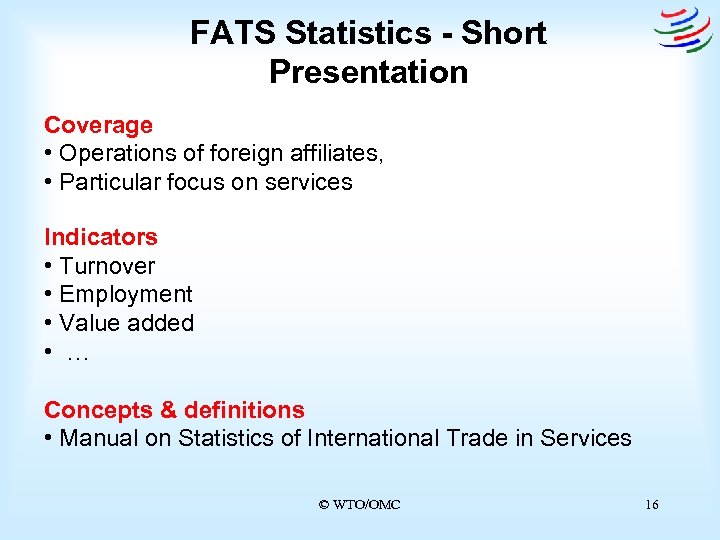 FATS Statistics - Short Presentation Coverage • Operations of foreign affiliates, • Particular focus on services Indicators • Turnover • Employment • Value added • … Concepts & definitions • Manual on Statistics of International Trade in Services © WTO/OMC 16
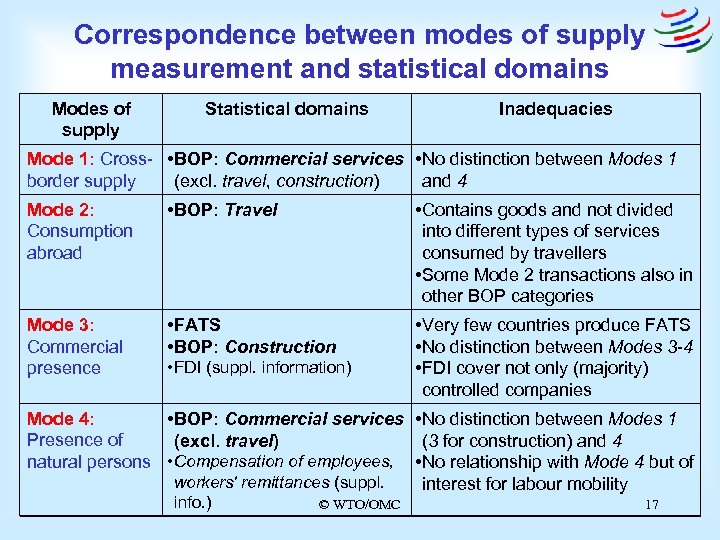 Correspondence between modes of supply measurement and statistical domains Modes of supply Statistical domains Inadequacies Mode 1: Cross- • BOP: Commercial services • No distinction between Modes 1 border supply (excl. travel, construction) and 4 Mode 2: Consumption abroad • BOP: Travel • Contains goods and not divided into different types of services consumed by travellers • Some Mode 2 transactions also in other BOP categories Mode 3: Commercial presence • FATS • BOP: Construction • Very few countries produce FATS • No distinction between Modes 3 -4 • FDI cover not only (majority) controlled companies • FDI (suppl. information) Mode 4: • BOP: Commercial services • No distinction between Modes 1 Presence of (excl. travel) (3 for construction) and 4 natural persons • Compensation of employees, • No relationship with Mode 4 but of workers' remittances (suppl. interest for labour mobility info. ) © WTO/OMC 17
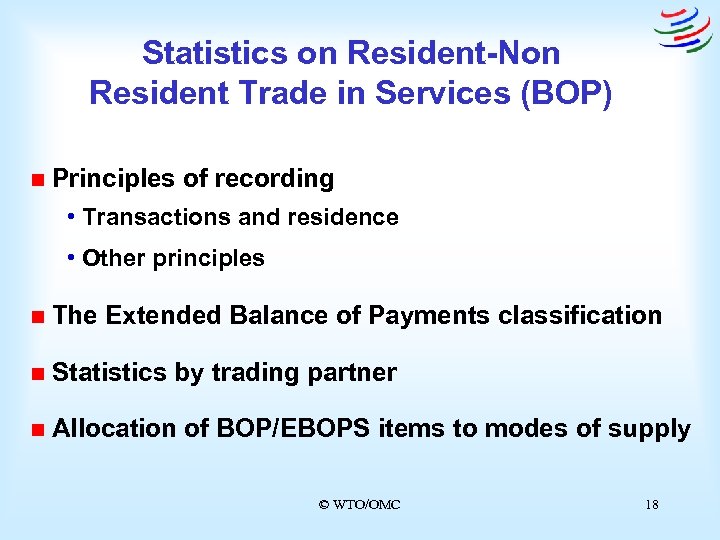 Statistics on Resident-Non Resident Trade in Services (BOP) n Principles of recording • Transactions and residence • Other principles n The Extended Balance of Payments classification n Statistics by trading partner n Allocation of BOP/EBOPS items to modes of supply © WTO/OMC 18
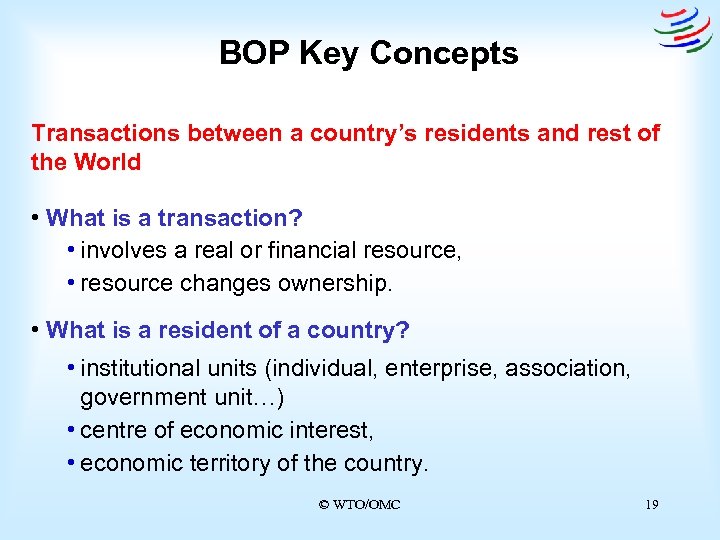 BOP Key Concepts Transactions between a country’s residents and rest of the World • What is a transaction? • involves a real or financial resource, • resource changes ownership. • What is a resident of a country? • institutional units (individual, enterprise, association, government unit…) • centre of economic interest, • economic territory of the country. © WTO/OMC 19
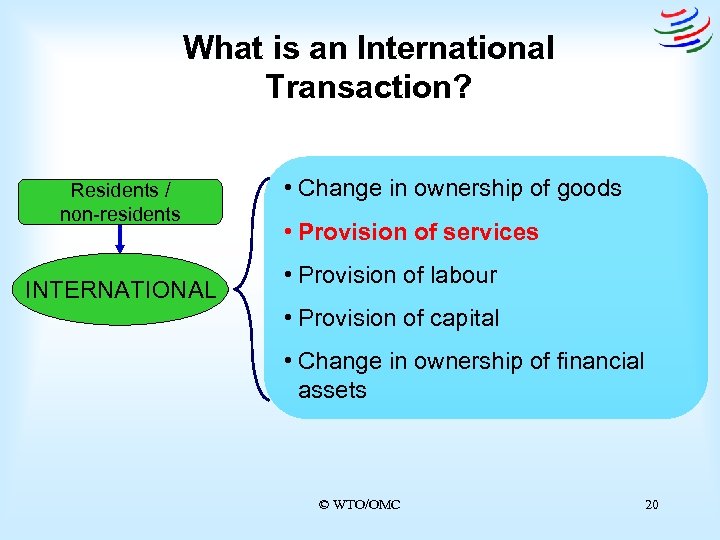 What is an International Transaction? Residents / non-residents INTERNATIONAL • Change in ownership of goods • Provision of services • Provision of labour • Provision of capital • Change in ownership of financial assets © WTO/OMC 20
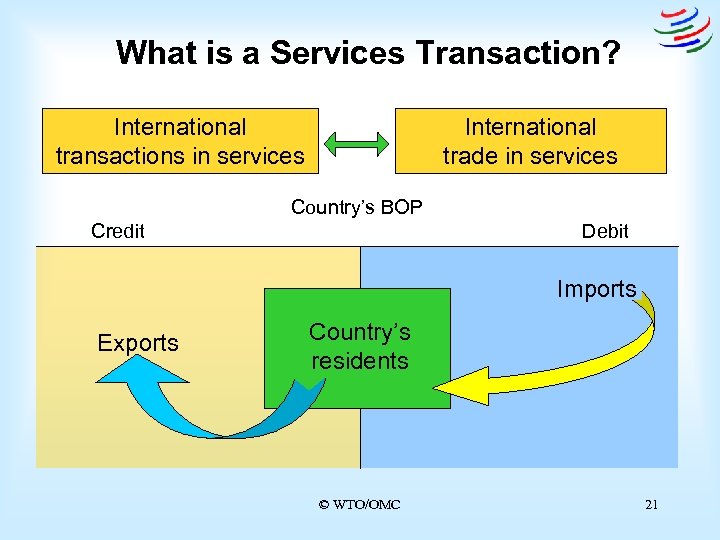 What is a Services Transaction? International transactions in services International trade in services Country’s BOP Credit Debit Imports Exports Country’s residents © WTO/OMC 21
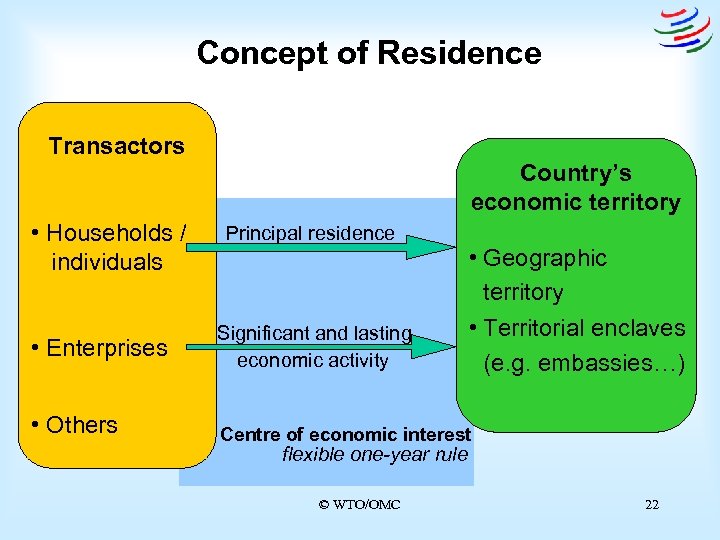 Concept of Residence Transactors Country’s economic territory • Households / individuals Principal residence • Geographic territory • Territorial enclaves (e. g. embassies…) • Enterprises Significant and lasting economic activity • Others Centre of economic interest flexible one-year rule © WTO/OMC 22
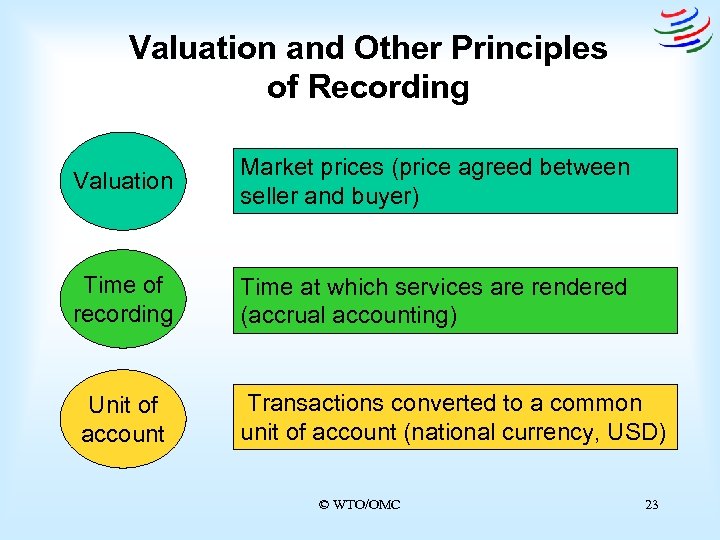 Valuation and Other Principles of Recording Valuation Market prices (price agreed between seller and buyer) Time of recording Time at which services are rendered (accrual accounting) Unit of account Transactions converted to a common unit of account (national currency, USD) © WTO/OMC 23
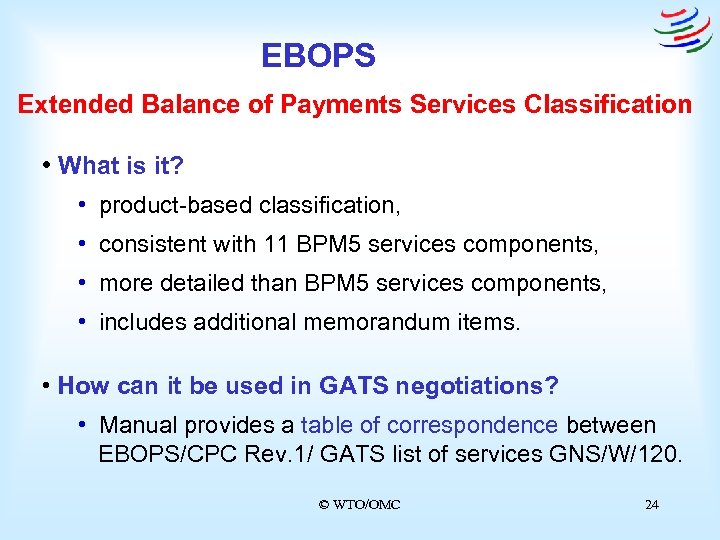 EBOPS Extended Balance of Payments Services Classification • What is it? • product-based classification, • consistent with 11 BPM 5 services components, • more detailed than BPM 5 services components, • includes additional memorandum items. • How can it be used in GATS negotiations? • Manual provides a table of correspondence between EBOPS/CPC Rev. 1/ GATS list of services GNS/W/120. © WTO/OMC 24
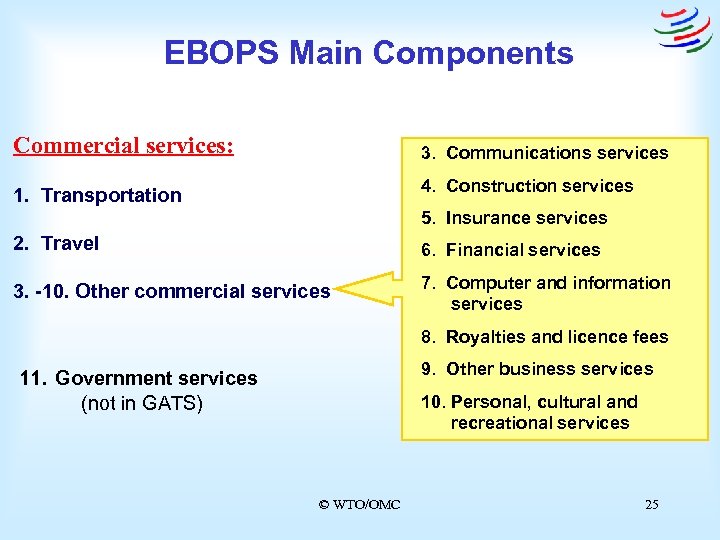 EBOPS Main Components Commercial services: 3. Communications services 4. Construction services 1. Transportation 5. Insurance services 2. Travel 6. Financial services 3. -10. Other commercial services 7. Computer and information services 8. Royalties and licence fees 9. Other business services 11. Government services (not in GATS) 10. Personal, cultural and recreational services © WTO/OMC 25
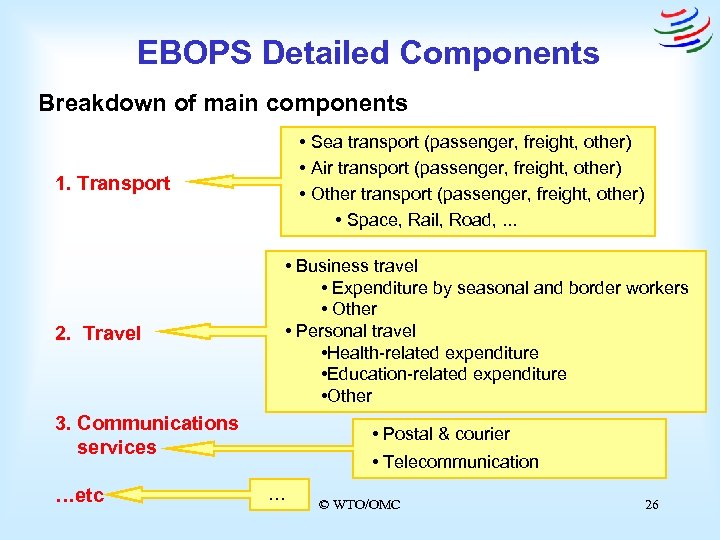 EBOPS Detailed Components Breakdown of main components • Sea transport (passenger, freight, other) • Air transport (passenger, freight, other) • Other transport (passenger, freight, other) • Space, Rail, Road, . . . 1. Transport 2. Travel • Business travel • Expenditure by seasonal and border workers • Other • Personal travel • Health-related expenditure • Education-related expenditure • Other 3. Communications services …etc • Postal & courier • Telecommunication … © WTO/OMC 26
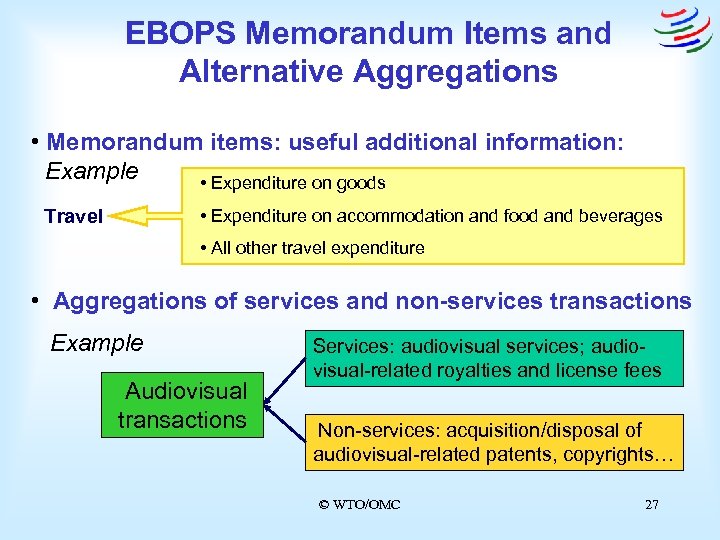 EBOPS Memorandum Items and Alternative Aggregations • Memorandum items: useful additional information: Example • Expenditure on goods • Expenditure on accommodation and food and beverages Travel • All other travel expenditure • Aggregations of services and non-services transactions Example Audiovisual transactions Services: audiovisual services; audiovisual-related royalties and license fees Non-services: acquisition/disposal of audiovisual-related patents, copyrights… © WTO/OMC 27
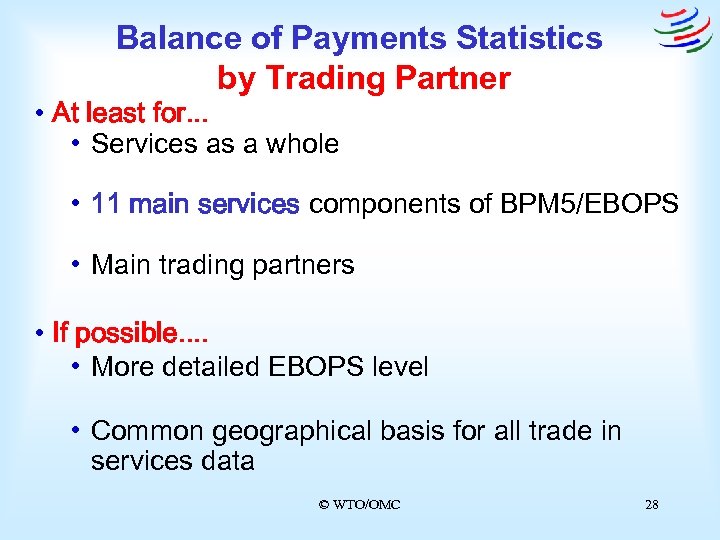 Balance of Payments Statistics by Trading Partner • At least for. . . • Services as a whole • 11 main services components of BPM 5/EBOPS • Main trading partners • If possible. . • More detailed EBOPS level • Common geographical basis for all trade in services data © WTO/OMC 28
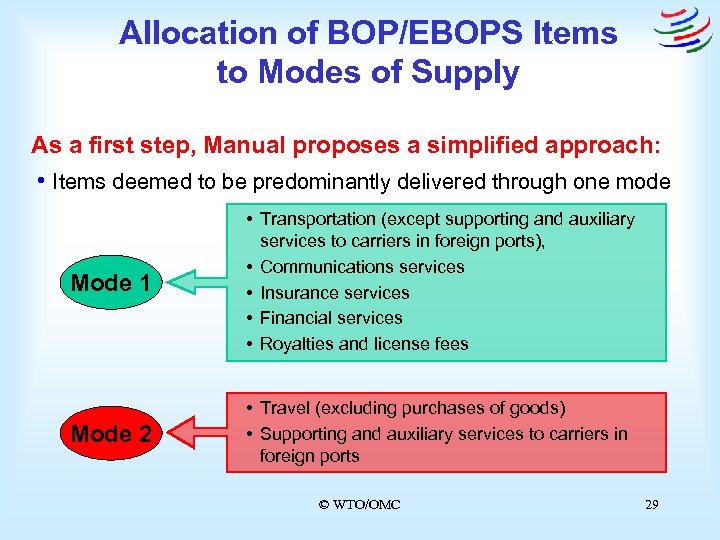 Allocation of BOP/EBOPS Items to Modes of Supply As a first step, Manual proposes a simplified approach: • Items deemed to be predominantly delivered through one mode Mode 1 • Transportation (except supporting and auxiliary services to carriers in foreign ports), • Communications services • Insurance services • Financial services • Royalties and license fees Mode 2 • Travel (excluding purchases of goods) • Supporting and auxiliary services to carriers in foreign ports © WTO/OMC 29
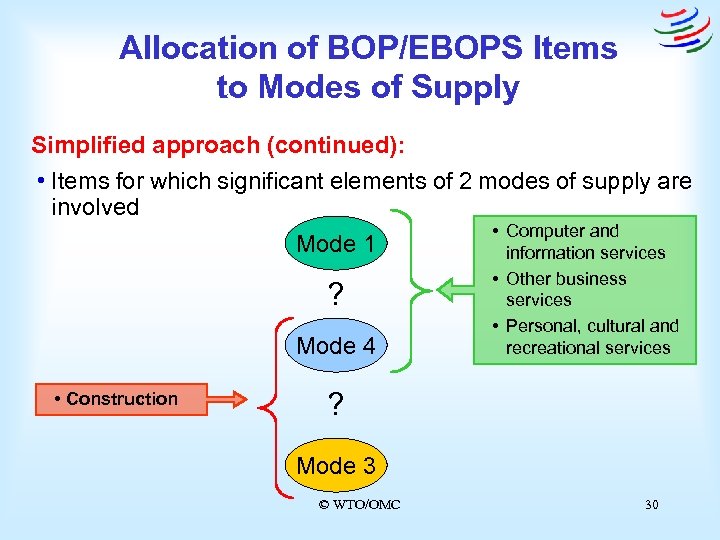 Allocation of BOP/EBOPS Items to Modes of Supply Simplified approach (continued): • Items for which significant elements of 2 modes of supply are involved • Computer and Mode 1 information services ? Mode 4 • Construction • Other business services • Personal, cultural and recreational services ? Mode 3 © WTO/OMC 30
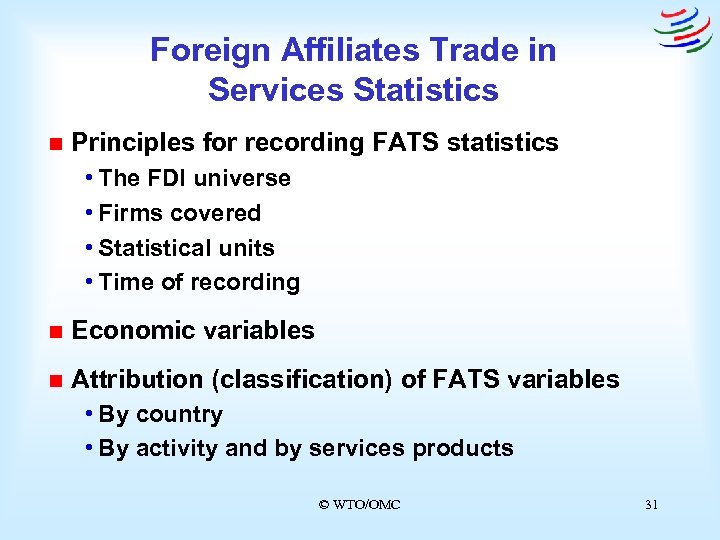 Foreign Affiliates Trade in Services Statistics n Principles for recording FATS statistics • The FDI universe • Firms covered • Statistical units • Time of recording n Economic variables n Attribution (classification) of FATS variables • By country • By activity and by services products © WTO/OMC 31
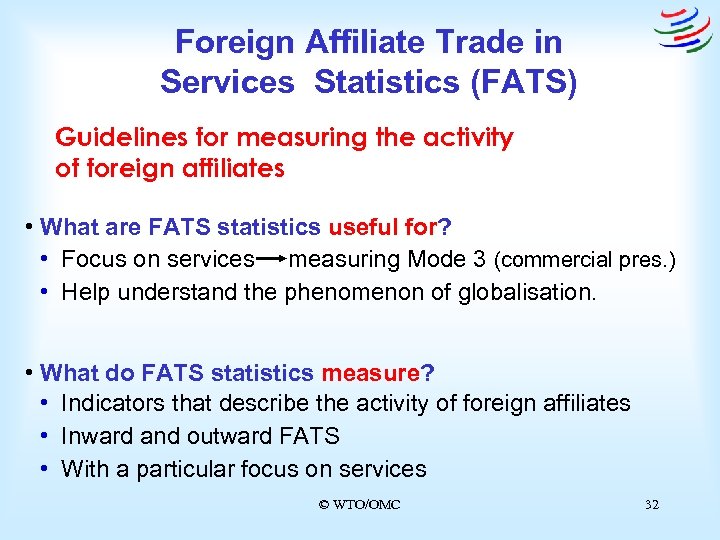 Foreign Affiliate Trade in Services Statistics (FATS) Guidelines for measuring the activity of foreign affiliates • What are FATS statistics useful for? • Focus on services measuring Mode 3 (commercial pres. ) • Help understand the phenomenon of globalisation. • What do FATS statistics measure? • Indicators that describe the activity of foreign affiliates • Inward and outward FATS • With a particular focus on services © WTO/OMC 32
 Principles Underpinning FATS Statistics In line with international standards • SNA 1993 (National Accounts) • BPM 5 (BOP) • OECD Benchmark Definition of FDI statistics may be used as an interim indicator where FATS are not compiled © WTO/OMC 33
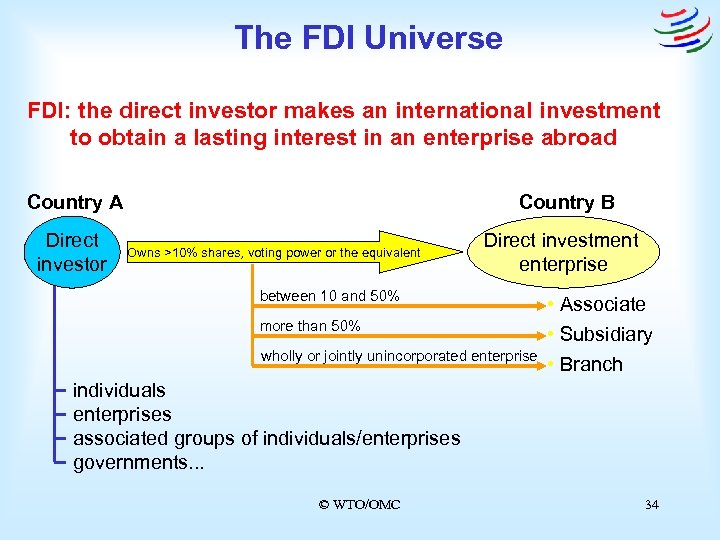 The FDI Universe FDI: the direct investor makes an international investment to obtain a lasting interest in an enterprise abroad Country A Direct investor Country B Owns >10% shares, voting power or the equivalent Direct investment enterprise between 10 and 50% • Associate more than 50% • Subsidiary wholly or jointly unincorporated enterprise • Branch individuals enterprises associated groups of individuals/enterprises governments. . . © WTO/OMC 34
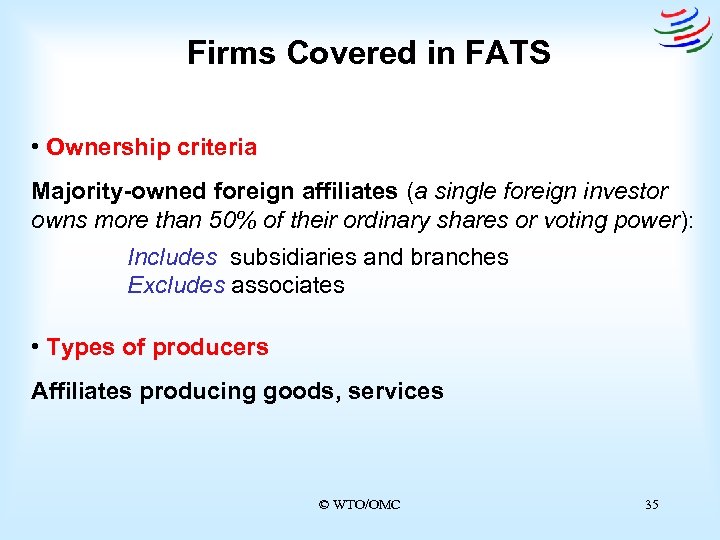 Firms Covered in FATS • Ownership criteria Majority-owned foreign affiliates (a single foreign investor owns more than 50% of their ordinary shares or voting power): Includes subsidiaries and branches Excludes associates • Types of producers Affiliates producing goods, services © WTO/OMC 35
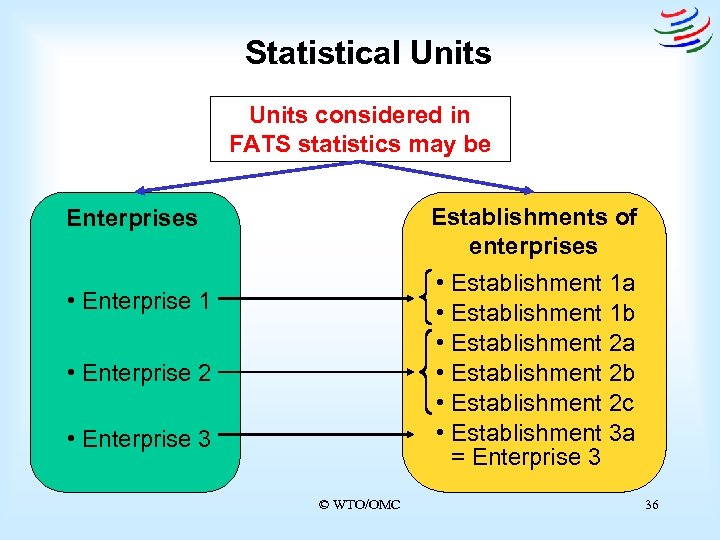 Statistical Units considered in FATS statistics may be Establishments of enterprises Enterprises • Establishment 1 a • Establishment 1 b • Establishment 2 a • Establishment 2 b • Establishment 2 c • Establishment 3 a = Enterprise 3 • Enterprise 1 • Enterprise 2 • Enterprise 3 © WTO/OMC 36
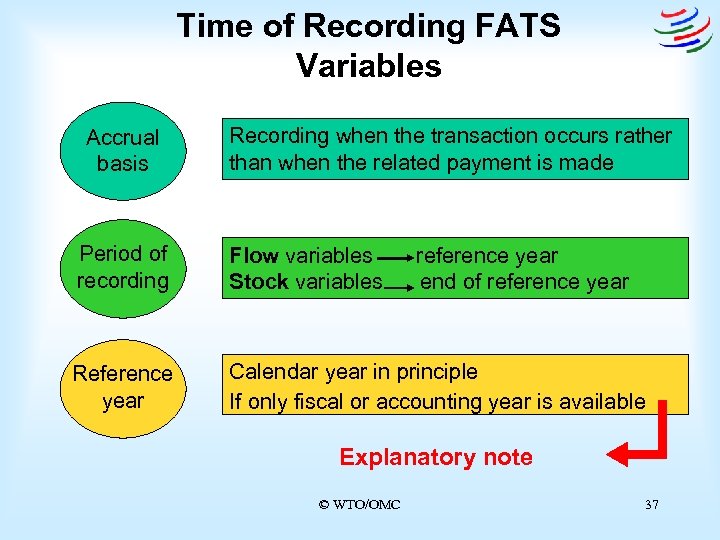 Time of Recording FATS Variables Accrual basis Recording when the transaction occurs rather than when the related payment is made Period of recording Flow variables reference year Stock variables end of reference year Reference year Calendar year in principle If only fiscal or accounting year is available Explanatory note © WTO/OMC 37
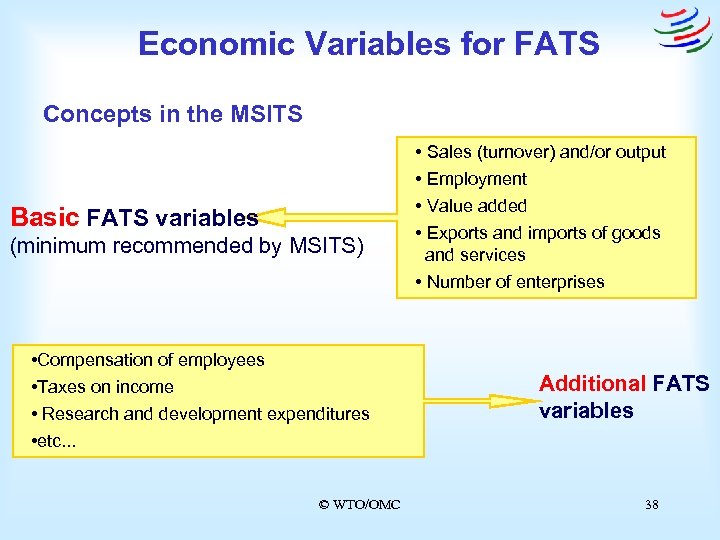 Economic Variables for FATS Concepts in the MSITS Basic FATS variables (minimum recommended by MSITS) • Compensation of employees • Taxes on income • Research and development expenditures • etc. . . © WTO/OMC • Sales (turnover) and/or output • Employment • Value added • Exports and imports of goods and services • Number of enterprises Additional FATS variables 38
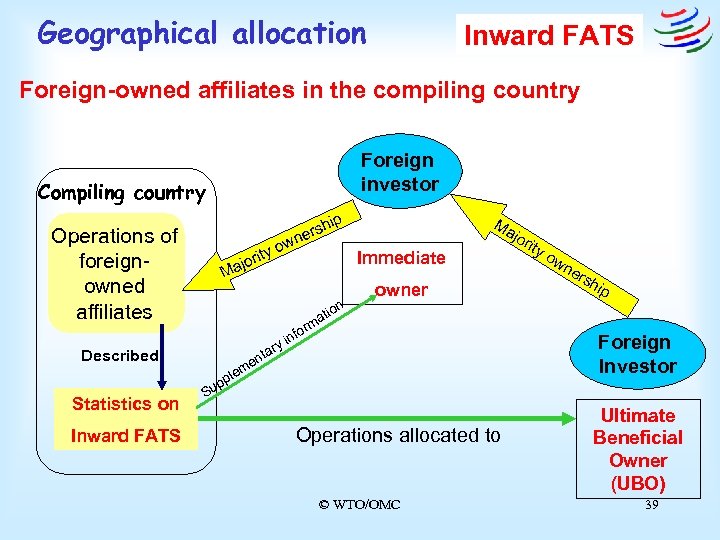 Geographical allocation Inward FATS Foreign-owned affiliates in the compiling country Foreign investor Compiling country Operations of foreignowned affiliates Described Statistics on Inward FATS ip Ma ty jori h ers n ow on ati m Ma Immediate owner for in ry ta en m ple p Su Operations allocated to © WTO/OMC jor ity ow ne rsh ip Foreign Investor Ultimate Beneficial Owner (UBO) 39
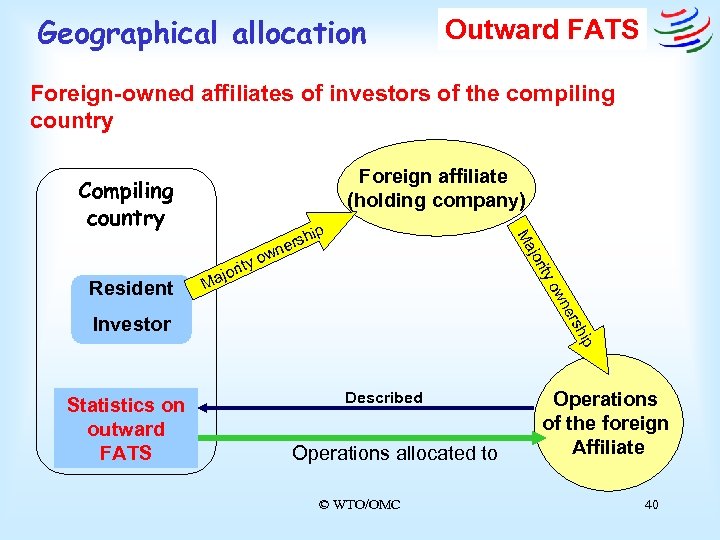 Geographical allocation Outward FATS Foreign-owned affiliates of investors of the compiling country Foreign affiliate (holding company) Compiling country ow ity jori Ma Ma rs ne ow Resident hip s ner Statistics on outward FATS hip Investor Described Operations allocated to © WTO/OMC Operations of the foreign Affiliate 40
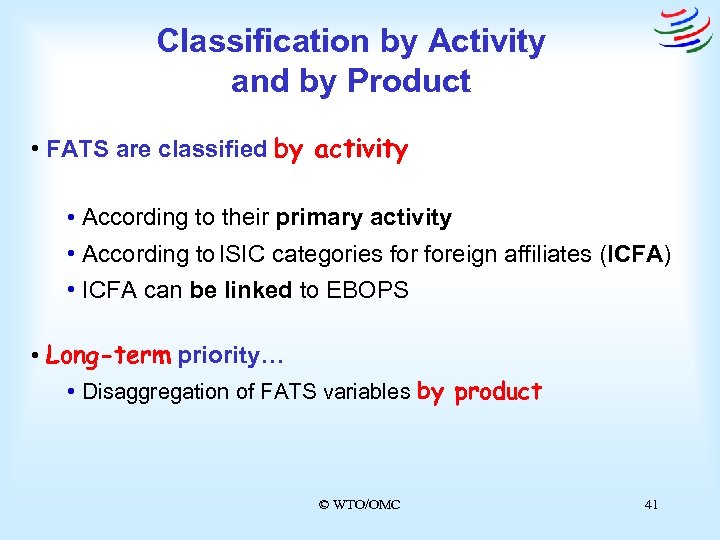 Classification by Activity and by Product • FATS are classified by activity • According to their primary activity • According to ISIC categories foreign affiliates (ICFA) • ICFA can be linked to EBOPS • Long-term priority… • Disaggregation of FATS variables by product © WTO/OMC 41
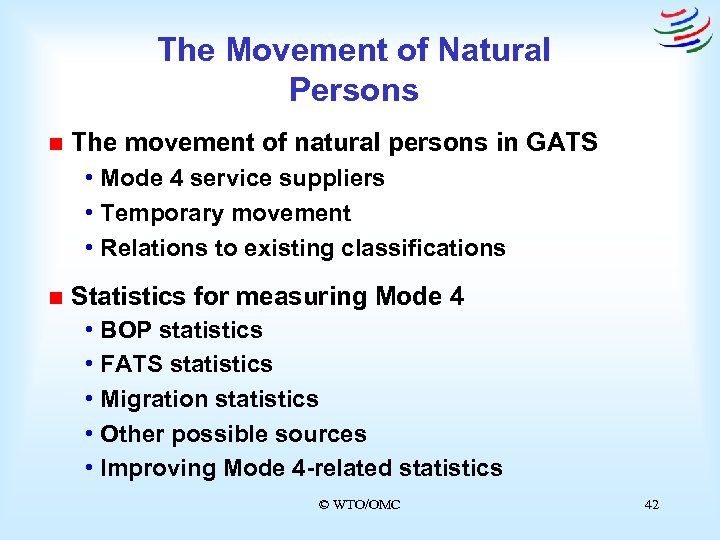 The Movement of Natural Persons n The movement of natural persons in GATS • Mode 4 service suppliers • Temporary movement • Relations to existing classifications n Statistics for measuring Mode 4 • BOP statistics • FATS statistics • Migration statistics • Other possible sources • Improving Mode 4 -related statistics © WTO/OMC 42
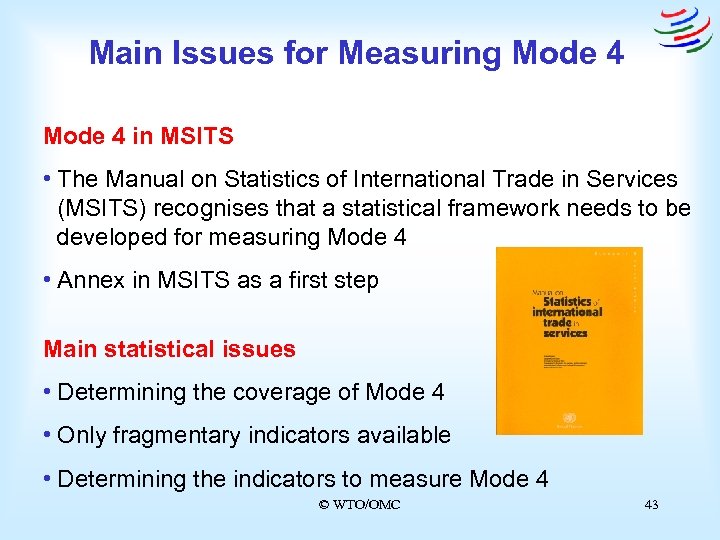 Main Issues for Measuring Mode 4 in MSITS • The Manual on Statistics of International Trade in Services (MSITS) recognises that a statistical framework needs to be developed for measuring Mode 4 • Annex in MSITS as a first step Main statistical issues • Determining the coverage of Mode 4 • Only fragmentary indicators available • Determining the indicators to measure Mode 4 © WTO/OMC 43
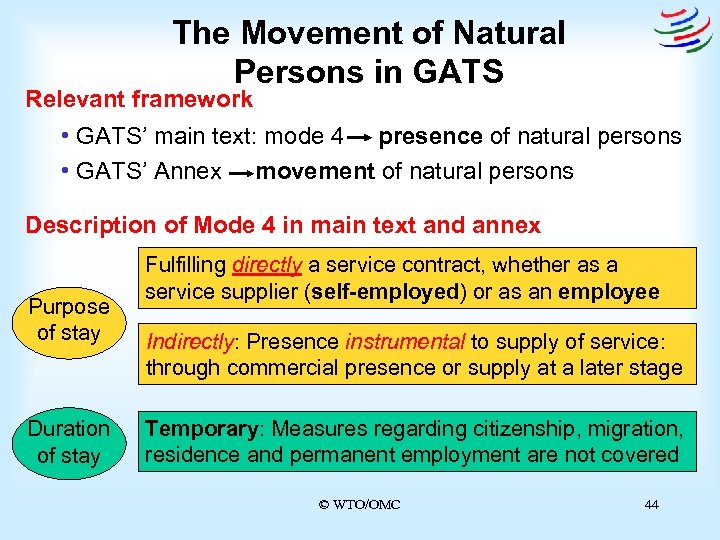 The Movement of Natural Persons in GATS Relevant framework • GATS’ main text: mode 4 presence of natural persons • GATS’ Annex movement of natural persons Description of Mode 4 in main text and annex Purpose of stay Duration of stay Fulfilling directly a service contract, whether as a service supplier (self-employed) or as an employee Indirectly: Presence instrumental to supply of service: through commercial presence or supply at a later stage Temporary: Measures regarding citizenship, migration, residence and permanent employment are not covered © WTO/OMC 44
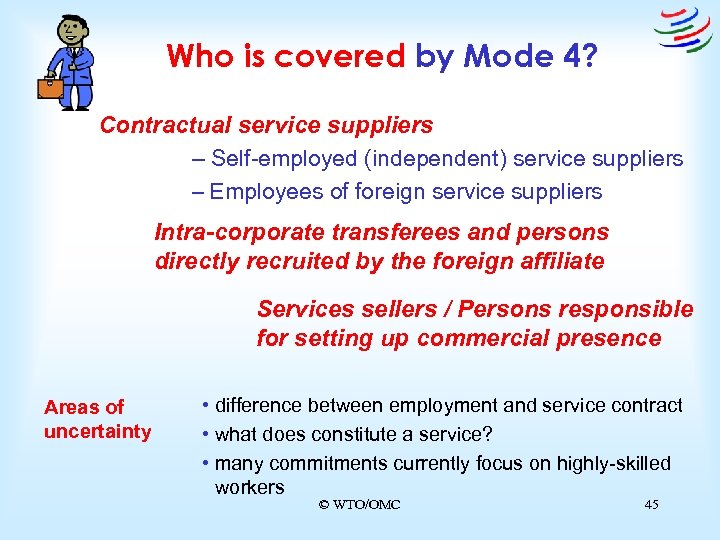 Who is covered by Mode 4? Contractual service suppliers – Self-employed (independent) service suppliers – Employees of foreign service suppliers Intra-corporate transferees and persons directly recruited by the foreign affiliate Services sellers / Persons responsible for setting up commercial presence Areas of uncertainty • difference between employment and service contract • what does constitute a service? • many commitments currently focus on highly-skilled workers © WTO/OMC 45
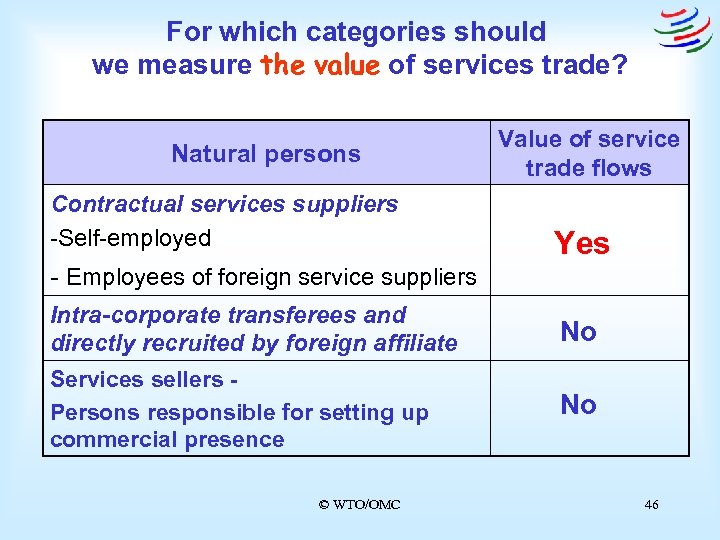 For which categories should we measure the value of services trade? Natural persons Contractual services suppliers -Self-employed - Employees of foreign service suppliers Intra-corporate transferees and directly recruited by foreign affiliate Services sellers Persons responsible for setting up commercial presence © WTO/OMC Value of service trade flows Yes No No 46
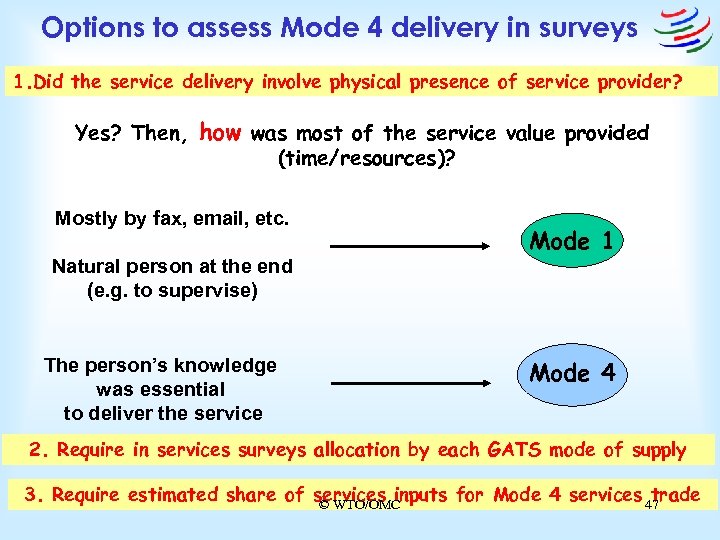 Options to assess Mode 4 delivery in surveys 1. Did the service delivery involve physical presence of service provider? Yes? Then, how was most of the service value provided (time/resources)? Mostly by fax, email, etc. Natural person at the end (e. g. to supervise) The person’s knowledge was essential to deliver the service Mode 1 Mode 4 2. Require in services surveys allocation by each GATS mode of supply 3. Require estimated share of services inputs for Mode 4 services 47 trade © WTO/OMC
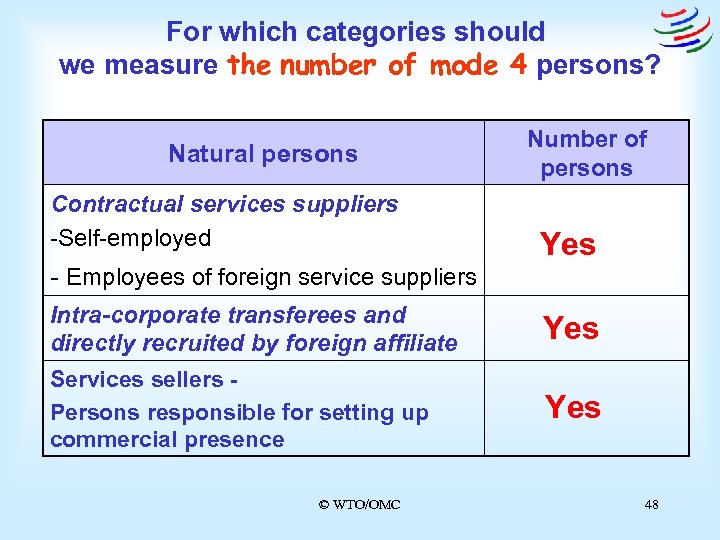 For which categories should we measure the number of mode 4 persons? Natural persons Contractual services suppliers -Self-employed - Employees of foreign service suppliers Intra-corporate transferees and directly recruited by foreign affiliate Services sellers Persons responsible for setting up commercial presence © WTO/OMC Number of persons Yes Yes 48
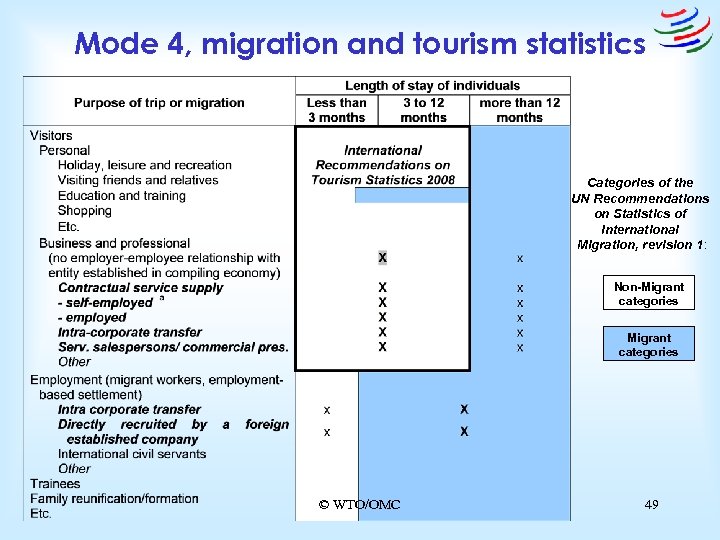 Mode 4, migration and tourism statistics Categories of the UN Recommendations on Statistics of International Migration, revision 1: Non-Migrant categories © WTO/OMC 49
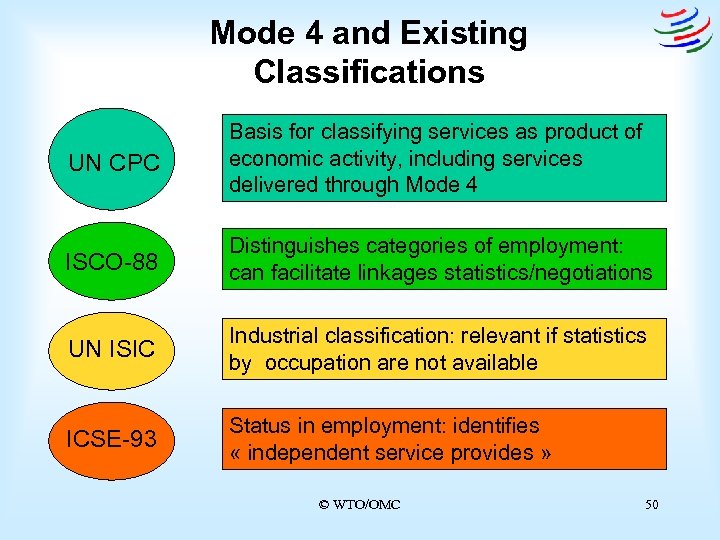 Mode 4 and Existing Classifications UN CPC Basis for classifying services as product of economic activity, including services delivered through Mode 4 ISCO-88 Distinguishes categories of employment: can facilitate linkages statistics/negotiations UN ISIC Industrial classification: relevant if statistics by occupation are not available ICSE-93 Status in employment: identifies « independent service provides » © WTO/OMC 50
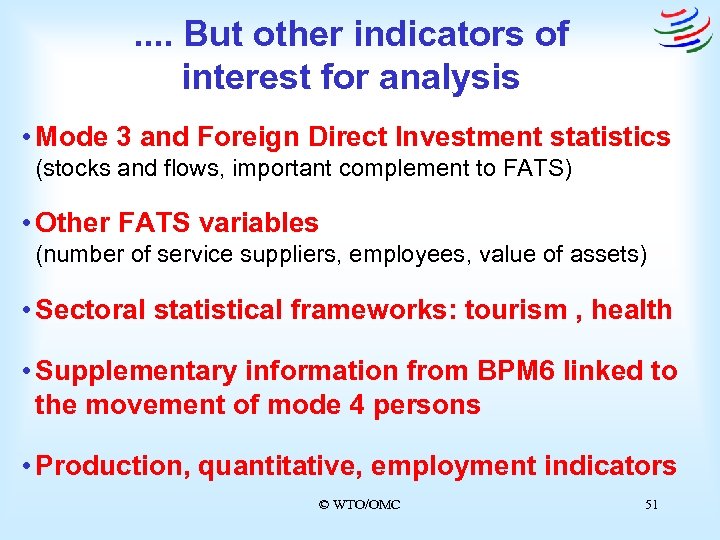 . . But other indicators of interest for analysis • Mode 3 and Foreign Direct Investment statistics (stocks and flows, important complement to FATS) • Other FATS variables (number of service suppliers, employees, value of assets) • Sectoral statistical frameworks: tourism , health • Supplementary information from BPM 6 linked to the movement of mode 4 persons • Production, quantitative, employment indicators © WTO/OMC 51
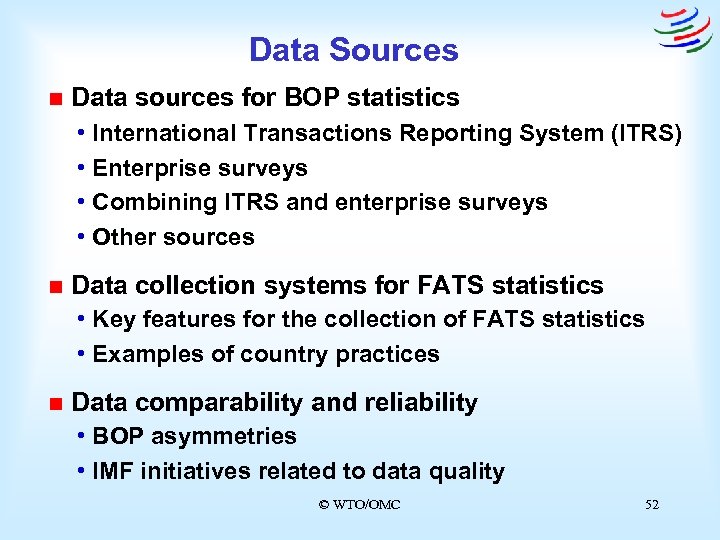 Data Sources n Data sources for BOP statistics • International Transactions Reporting System (ITRS) • Enterprise surveys • Combining ITRS and enterprise surveys • Other sources n Data collection systems for FATS statistics • Key features for the collection of FATS statistics • Examples of country practices n Data comparability and reliability • BOP asymmetries • IMF initiatives related to data quality © WTO/OMC 52
 Collection Systems for BOP Statistics Main alternatives for the collection of BOP statistics • International Transaction reporting System (ITRS) • Enterprise surveys • A combination of both systems Possible supplementary sources • Surveys of travellers and household expenditure surveys • Official sources and government transactions • Partner countries and International Organizations © WTO/OMC 53
 ITRS • Coverage • All services transactions • Responsibility • (generally) the national central bank • Respondents • domestic banks (indirect reporting) • residents holding accounts abroad or involved in clearing/netting schemes (direct reporting) • Advantages • timely, comprehensive, few respondents • Limitations • transactions proxied by payments, possible misclassifications © WTO/OMC 54
 Enterprise Surveys • Coverage • all service transactions • Responsibility • (generally) the national statistical office • Respondents • sampled enterprises who are international transactors • Requisites • high quality business register • appropriate techniques for sample design, preparation of questionnaires, and processing of survey results © WTO/OMC 55
 ITRS and Enterprise Surveys - Examples • System mainly based on enterprise surveys, with no use of ITRS e. g. United States, United Kingdom • Systems mainly based on ITRS, using a limited form of enterprise surveys e. g. France • Systems mainly based on enterprise surveys, using a limited form of ITRS e. g. Netherlands Great benefits to be drawn from co-operation between different institutions © WTO/OMC 56
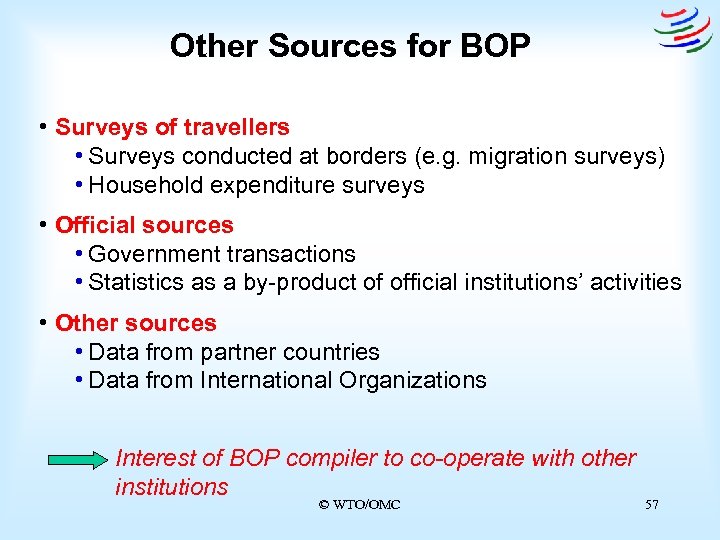 Other Sources for BOP • Surveys of travellers • Surveys conducted at borders (e. g. migration surveys) • Household expenditure surveys • Official sources • Government transactions • Statistics as a by-product of official institutions’ activities • Other sources • Data from partner countries • Data from International Organizations Interest of BOP compiler to co-operate with other institutions © WTO/OMC 57
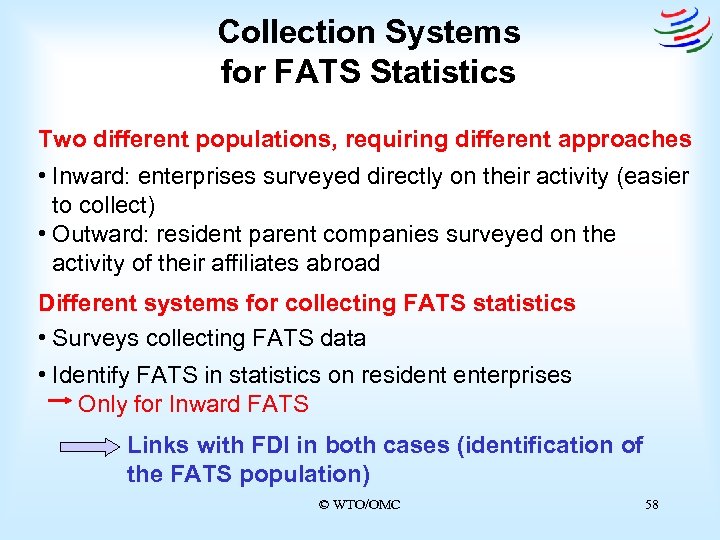 Collection Systems for FATS Statistics Two different populations, requiring different approaches • Inward: enterprises surveyed directly on their activity (easier to collect) • Outward: resident parent companies surveyed on the activity of their affiliates abroad Different systems for collecting FATS statistics • Surveys collecting FATS data • Identify FATS in statistics on resident enterprises Only for Inward FATS Links with FDI in both cases (identification of the FATS population) © WTO/OMC 58
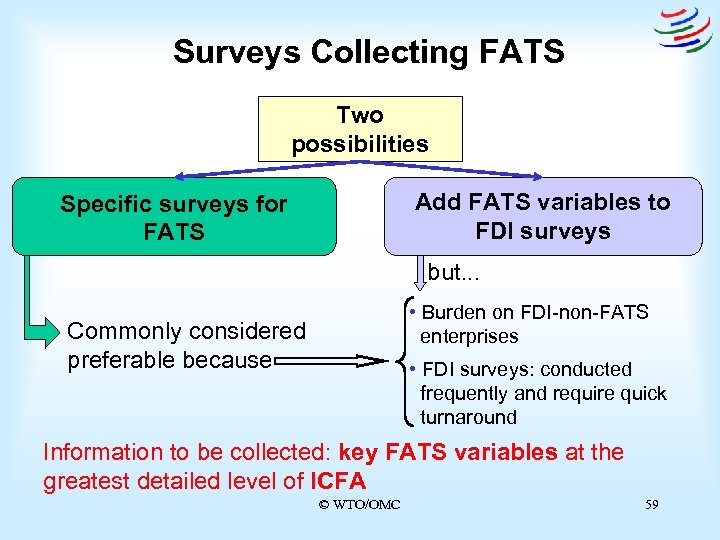 Surveys Collecting FATS Two possibilities Add FATS variables to FDI surveys Specific surveys for FATS but. . . • Burden on FDI-non-FATS enterprises Commonly considered preferable because • FDI surveys: conducted frequently and require quick turnaround Information to be collected: key FATS variables at the greatest detailed level of ICFA © WTO/OMC 59
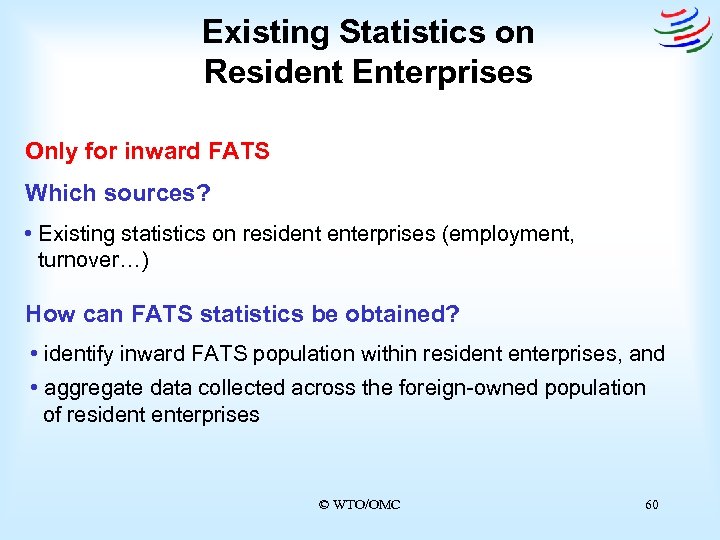 Existing Statistics on Resident Enterprises Only for inward FATS Which sources? • Existing statistics on resident enterprises (employment, turnover…) How can FATS statistics be obtained? • identify inward FATS population within resident enterprises, and • aggregate data collected across the foreign-owned population of resident enterprises © WTO/OMC 60
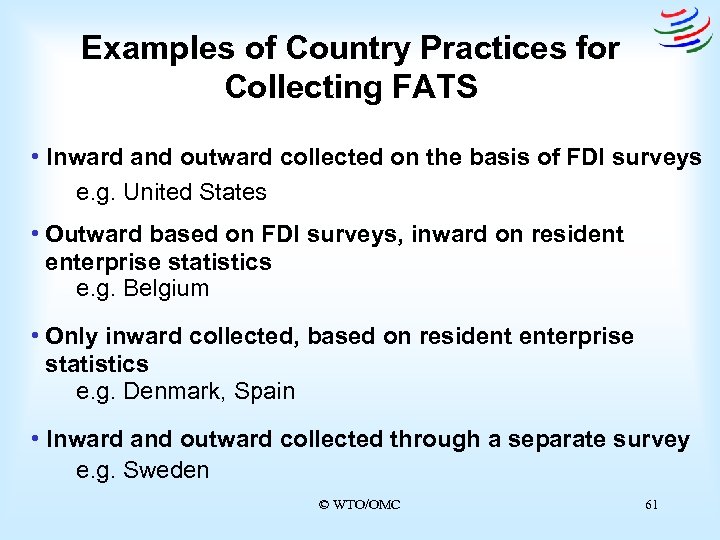 Examples of Country Practices for Collecting FATS • Inward and outward collected on the basis of FDI surveys e. g. United States • Outward based on FDI surveys, inward on resident enterprise statistics e. g. Belgium • Only inward collected, based on resident enterprise statistics e. g. Denmark, Spain • Inward and outward collected through a separate survey e. g. Sweden © WTO/OMC 61
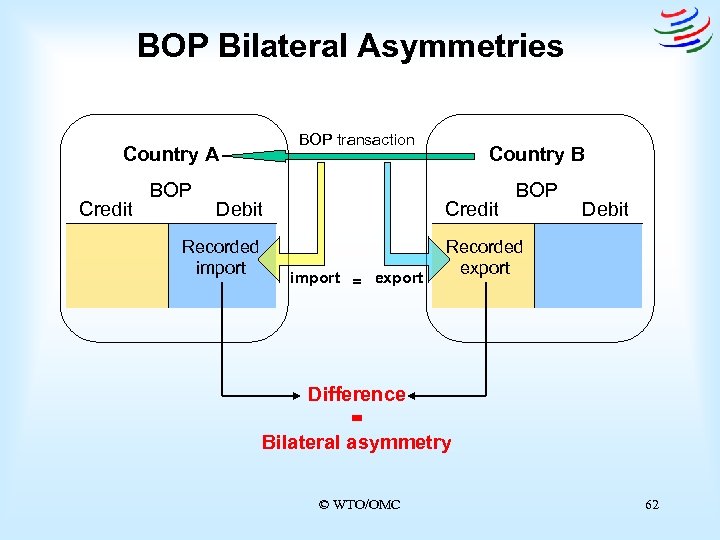 BOP Bilateral Asymmetries BOP transaction Country A Credit BOP Debit Recorded import Country B Credit import = export BOP Debit Recorded export Difference = Bilateral asymmetry © WTO/OMC 62
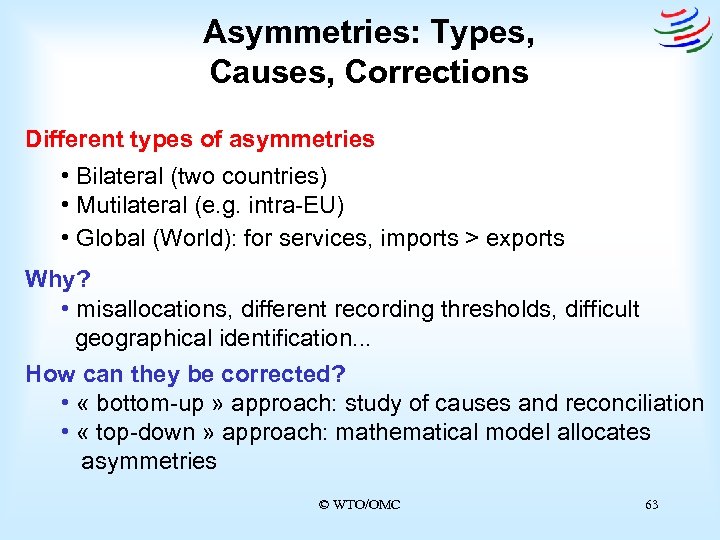 Asymmetries: Types, Causes, Corrections Different types of asymmetries • Bilateral (two countries) • Mutilateral (e. g. intra-EU) • Global (World): for services, imports > exports Why? • misallocations, different recording thresholds, difficult geographical identification. . . How can they be corrected? • « bottom-up » approach: study of causes and reconciliation • « top-down » approach: mathematical model allocates asymmetries © WTO/OMC 63
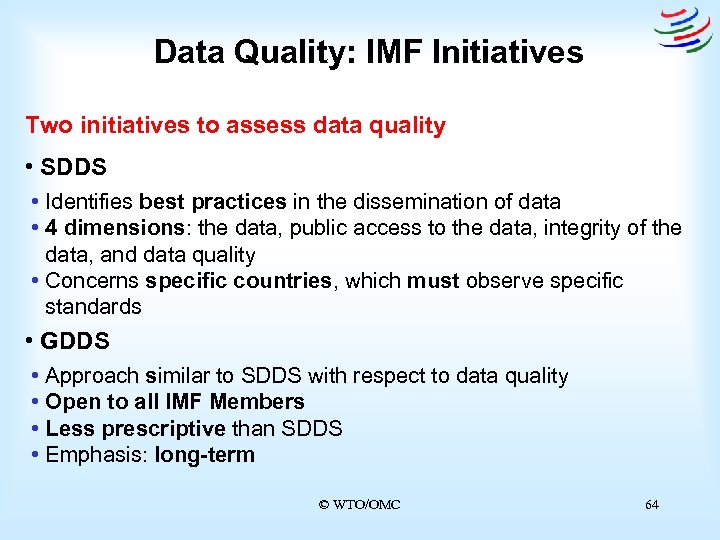 Data Quality: IMF Initiatives Two initiatives to assess data quality • SDDS • Identifies best practices in the dissemination of data • 4 dimensions: the data, public access to the data, integrity of the data, and data quality • Concerns specific countries, which must observe specific standards • GDDS • Approach similar to SDDS with respect to data quality • Open to all IMF Members • Less prescriptive than SDDS • Emphasis: long-term © WTO/OMC 64
 Data Availability and Dissemination by International Organizations n BOP trade in services data • BOP/EBOPS • International dissemination n Information available on commercial presence • Availability and dissemination of FATS statistics • Alternative: FDI data © WTO/OMC 65
 Availability of BOP/EBOPS Data on Trade in Services Compilation of trade in services is relatively well established and widespread • BPM 5 standard components widely compiled: the number of countries reporting these data has more than doubled since 1997 (breakdown of exports) • Significant progress was made in compiling more detailed items, and in compiling a breakdown by partner country © WTO/OMC 66
 International Dissemination of BOP/EBOPS Statistics (1/2) Where can I find statistics on trade in services. . . … broken-down by type of service? • Eurostat, OECD, IMF, UNSD • these organisations are collecting data on an EBOPS basis … broken-down geographically? • Eurostat • OECD • UNSD © WTO/OMC 67
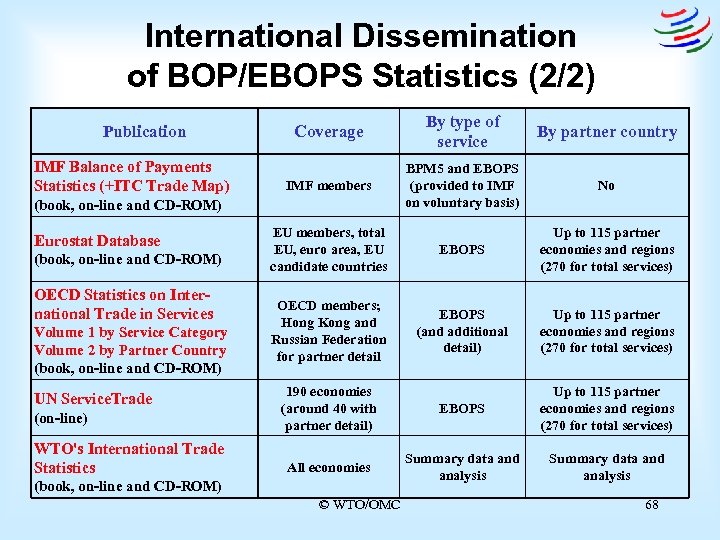 International Dissemination of BOP/EBOPS Statistics (2/2) Publication IMF Balance of Payments Statistics (+ITC Trade Map) Coverage By type of service By partner country IMF members BPM 5 and EBOPS (provided to IMF on voluntary basis) No EU members, total EU, euro area, EU candidate countries EBOPS Up to 115 partner economies and regions (270 for total services) OECD members; Hong Kong and Russian Federation for partner detail EBOPS (and additional detail) Up to 115 partner economies and regions (270 for total services) 190 economies (around 40 with partner detail) EBOPS Up to 115 partner economies and regions (270 for total services) All economies Summary data and analysis (book, on-line and CD-ROM) Eurostat Database (book, on-line and CD-ROM) OECD Statistics on International Trade in Services Volume 1 by Service Category Volume 2 by Partner Country (book, on-line and CD-ROM) UN Service. Trade (on-line) WTO's International Trade Statistics (book, on-line and CD-ROM) © WTO/OMC 68
 Collection of FATS Statistics Collected by Eurostat and OECD • Common questionnaire to member countries: • Inward and outward FATS: by activity (37 categories of ISIC) by country of origin/destination of investment • Dissemination: • OECD: Measuring globalisation: the role of Multinationals in OECD economies • Eurostat: publication in the Statistics in focus series, and in the New Cronos reference database • UNCTAD: World Investment Report © WTO/OMC 69
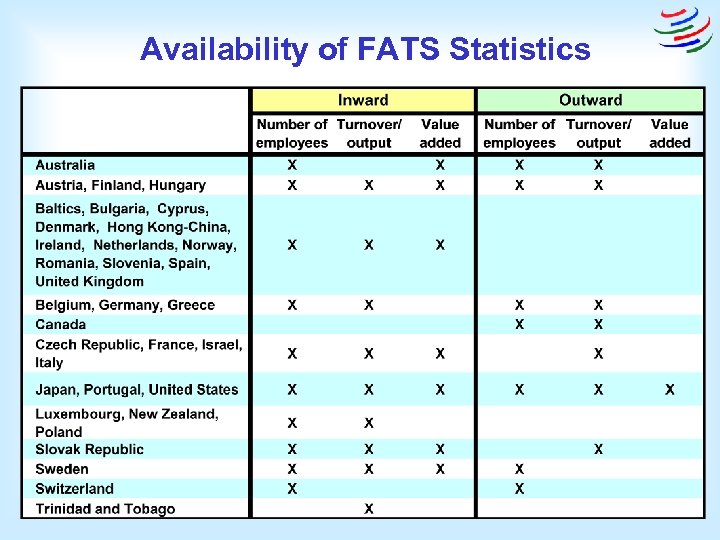 Availability of FATS Statistics
 FDI Statistics as an Alternative State of implementation • Many countries collect FDI flows, with geographical and activity breakdown (more data for inward than outward) • Fewer countries collect FDI income flows Collection and dissemination • Eurostat and OECD: FDI inward and outward stock, flows and income (by industry and country) • IMF: FDI positions, flows and income, no industry and partner breakdown • UNCTAD © WTO/OMC 71
 Current State and Prospects n Implementation: phased approach of MSITS • 5 core recommendations • 5 other recommended elements n Recent progress and short-term plans n Prospects for trade in services statistics • Areas for improvement • Future work © WTO/OMC 72
 MSITS’ Phased Approach to Implementation 5 core elements Implement BPM 5 recommendations for trade in services Compile BOP services according to EBOPS, starting with items of major economic importance to the country Compile FDI by ISIC categories of activity Compile basic FATS variables broken down by ICFA categories of activity Compile statistics by partner country © WTO/OMC 73
 MSITS’ Phased Approach to Implementation 5 other elements (long-term) Full implementation of EBOPS Compile FATS additional detail Compile statistics on the presence of natural persons Split BOP trade in services among trade between related parties / trade with unrelated parties Allocate BOP trade in services by mode of supply © WTO/OMC 74
 Recent Progress (1/3) • Dramatic improvement of quality and quantity of statistics on resident/non-resident trade in services • for BPM 5 main items, but also for more detailed items a multi-country set of statistics available for major services categories • FATS statistics are increasingly compiled © WTO/OMC 75
 Recent progress (2/3) • Eurostat: 2 regulations • on the compilation of FATS statistics • on BOP statistics, embodying EBOPS FATS and EBOPS have become binding in EU member states • IMF collect data according to EBOPS from 2003 on a voluntary basis © WTO/OMC 76
 Recent progress (3/3) • OECD: • expand the collection of BOP trade in services by partner country • request BOP trade in services broken down by EBOPS • UNSD: dissemination of EBOPS trade in services by partner country from for OECD and non-OECD countries • UNCTAD: expand data collection on FATS © WTO/OMC 77
 Areas Where Improvements are Needed • BOP trade in services • Many countries still do not report the full BPM 5 detail • Lack of reliability • Documentation on coverage and deviations from international standards rarely available • FATS • Lack of reliability and comparability • Almost no FATS collected outside OECD • Confidentiality severely limits data availability • No framework for statistics by mode of supply, in particular for Mode 4 © WTO/OMC 78
 Need for a revised Manual • Incorporate BPM 6 and SNA revisions + ISIC, CPC, Tourism statistics. . • New recommendations relating to activities of foreign affiliates: – OECD Handbook on Economic Globalisation Indicators – OECD Benchmark Definition of FDI – Eurostat recommendations Manual • Need for guidance for mode 4 and modes of supply generally. . . 1 st worlwide consultation in 2006 © WTO/OMC 79
 Next steps for the Revision of MSITS May 2006 – April 2009 Worldwide consultation on scope of update and issues TFSITS reviewed worldwide consultation responses Started drafting of Chapter on modes of supply and updating/drafting of other chapters Consultation with 2007 OECD-Eurostat Expert meeting and 2008 Working Party on International Trade in Goods and Services. Progress report to IMF BOPCOM and UN Statistical Commission Draft chapters agreed by TFSITS 2 nd Worldwide consultation on complete draft of revised MSITS TFSITS to review comments and re-draft MSITS chapters TFSITS meeting: review comments and revised draft; cross-cutting issues Summer 2009: Finalize draft and chapters and post for final review November 2009: Prepare submission to UNSC March 2010: Draft submitted to UN Statistical Commission Revised Manual in 2010! © WTO/OMC 80
 Future Work Interagency Task Force on Statistics of International Trade in Services • need for technical assistance in the area of services statistics • prepare Compilation Guide • concentrate on further methodological work © WTO/OMC 81
 Keys for Improvement of Statistics • Efforts by national agencies in charge of statistics • Governments’ willingness to allocate resources to statistics • Co-operation between national institutions • Co-operation between international and regional institutions, and support to national initiatives • Effective technical assistance • Compilation guidance © WTO/OMC 82